Lulla Family

Stories of the Bhagavatam

The chapters below currently open in the original Hindi; the full English translation is in progress.

Stories of the Bhagavatam · भागवतम् की कथाएँ
Shrimad Bhagavata Mahapurana · Vedavyasa
Shrimad Bhagavata Mahapurana, twelve skandhas, about 18,000 shlokas. Vedavyasa’s composition, flowing through Shukadeva’s voice, recited in the last seven days of Parikshit’s life. A king with seven days left, and one question: “In this final stretch, what should a man listen to?”
॥ निगमकल्पतरोर्गलितं फलम् ॥
This is the ripened fruit of the wish-granting tree of the Vedas. The Bhagavatam’s own word about itself.

Introduction

Parikshit was Arjuna’s grandson. King of Hastinapura. One day he went out hunting, tired. Thirsty. He came to a rishi’s ashram. The rishi was in meditation. He did not open his eyes. Anger took Parikshit; he picked up a dead snake, draped it around the rishi’s neck, and left. The rishi’s son learned of it. He gave a curse, “In seven days the serpent Takshaka will bite you.”

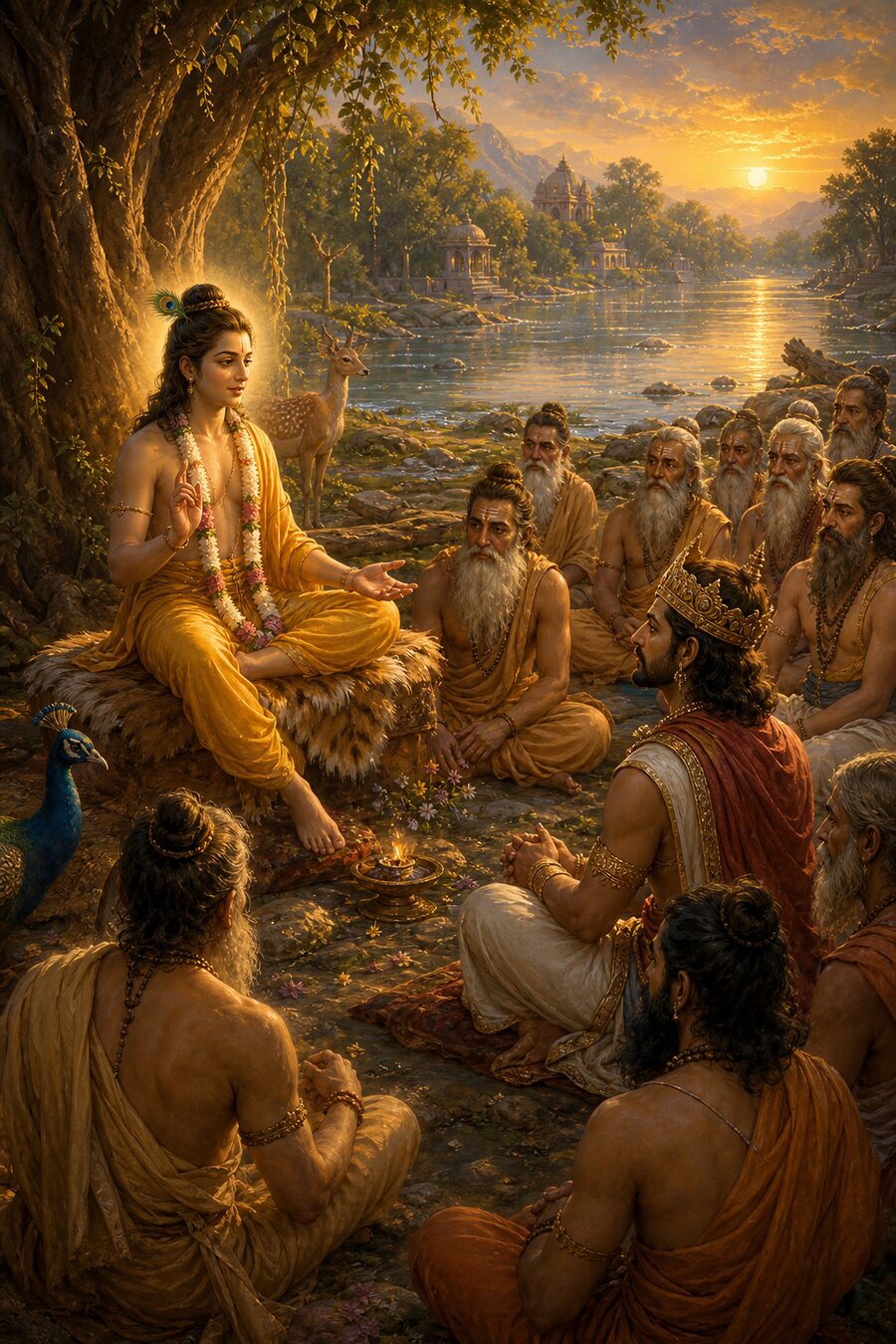
When the news reached Parikshit, he walked out of his kingdom. He sat down on the bank of the Ganga. Shukadeva came there, Vyasa’s son, awake from birth itself. Parikshit asked one question, “A man with seven days left, what should he listen to, what should he do?” Shukadeva recited the Bhagavatam for seven days. On the eighth day Takshaka came. But by then the king had already gone, to the place where a snakebite does not mean anything.

This is the framing of the Bhagavatam. An entire shastra, in seven days, for a dying man. Which is why there is urgency in its every line. No idle detours. Every story says something worth remembering before you die.

Yoga Vasishtha and the Bhagavatam differ in one particular way. The Vasishtha teaches through experiments in consciousness; “who are you?” sits at its center. The Bhagavatam teaches through relationships; “whose are you?” sits at its center. Both roads reach the same place, the same silence. But one by dissolving the ‘I’, the other by making the ‘I’ into ‘yours’.

Another gift of the Bhagavatam: it makes you feel the philosophy, not merely explains it. Yashoda’s love for her child, Sudama meeting Krishna and returning without a word, the elephant calling out to the Lord while going under, there is philosophy in each of these as deep as in Kapila Muni’s Sankhya-shastra. Perhaps deeper.

At its root the Bhagavatam is a bhakti-shastra, a scripture of devotion, but Advaita Vedanta sits inside it. Shukadeva, free from birth itself, was drawn to this shastra. The Bhagavatam itself says, “आत्मारामाश्च मुनयो निर्ग्रन्था अप्युरुक्रमे। कुर्वन्त्यहैतुकीं भक्तिम्।” Even those munis who rest content in themselves, with no knots left to untie, are drawn toward this ahaituki bhakti, love without any reason. This is the text where inquiry and love come in through the same door.

Here are sixty-five stories, in Hindi, in everyday language. Each one carries its own manthan section, a churning of the meaning. No reading order is required. Whichever title pulls you, begin right there.

Background

Most scholars place the composition of the Bhagavatam in the 9th to 10th century CE, though it holds material older than that. The original language is Sanskrit. Twelve skandhas in all, 335 chapters, about 18,000 shlokas.

The credit for the composition goes to Vedavyasa. The story is that even after finishing the Mahabharata and all the other Puranas, Vyasa ji felt an emptiness. Narada came to him and said, “You have written dharma, artha, kama, moksha, all of it. But you have not properly described the Lord’s lilas. That is your unfinished work.” Then Vyasa ji wrote the Bhagavatam. He taught it to his son Shukadeva, who was born free, yet stayed on in this world a while for this one shastra.

The narrative layers of the Bhagavatam sit one inside another. Suta Gosvami is reciting to the rishis of Naimisharanya. He is reciting exactly what Shukadeva recited to Parikshit. Inside that are still more dialogues, Krishna and Uddhava, Kapila and Devahuti, Narada and Vyasa, the story of Jaya and Vijaya, Dhruva and Narayana, and more. Each layer is a frame that holds the next frame.

The Padma Purana describes the twelve skandhas as the limbs of Krishna’s body. The first skandha his feet, the second the thighs, the third the navel, the fourth the chest, and so on upward. The tenth skandha, which holds Krishna’s whole lila, is counted as his face. The twelfth skandha the head.

The Bhagavatam’s influence has spread into every Indian language. Kathak, miniature painting, Harikatha, Yakshagana, Kuchipudi, all of it stands on this text. It is also the first Purana translated into a European language, into French in 1788.

Frequently asked questions

How do the Bhagavatam and the Bhagavad Gita differ?

The Gita is a part of the Mahabharata, only 700 shlokas, and its setting is a battlefield, where Krishna teaches Arjuna his duty. The Bhagavatam is an independent Purana, 18,000 shlokas, and its setting is a dying king’s last week. In the Gita, Krishna is the teacher. In the Bhagavatam, Krishna is the story itself. One is argument, the other love.

When was the Bhagavatam written?

Most scholars date its composition to the 9th-10th century CE, though parts of it are much older. Its earliest references appear in South India, and its final form was probably settled there. But note, “written down” and “composed” are not the same. It flowed through the oral tradition for generations, and then was set to the pen.

Is the Bhagavatam only for Vaishnavas?

No. Yes, it dwells at length on the lilas of Krishna and Vishnu, and the Vaishnava tradition has embraced it the most. But the Bhagavatam itself makes room for all three readings, Advaita, Dvaita, and Vishishtadvaita. Shukadeva, who recites it, was himself a jivanmukta Advaitin. Shankaracharya quoted its verses. This is a text above sect.

Who was Shukadeva, and why did he tell this story?

Shukadeva was Vyasa’s son. The story goes that he stayed in his mother’s womb for twelve years, refusing to come out, because outside lay the touch of maya. At last Krishna himself came and gave his word that maya would not touch him. Then he came out, and walked straight toward the forest. He was awake from birth itself. Hearing of Parikshit’s seven-days-left kingdom, he came walking on his own, because the chance to recite the Bhagavatam is, even for a liberated soul, an occasion for love without reason.

In what order should the twelve skandhas be read?

The traditional order runs first through twelfth. But in practice, most readers begin with the tenth skandha, which holds Krishna’s whole lila. Then the eleventh, which holds the Uddhava Gita. Then back toward the first, so the framing makes sense. Every story is complete in itself.

Why is the tenth skandha the most famous?

Because it carries the whole story from Krishna’s birth to his leaving for Mathura. Putana, Yashoda’s butter-thief child, the lifting of Govardhana, the rasa-lila, the slaying of Kamsa, all of it is here. This is the skandha without which India’s religious imagination is incomplete. Mirabai, Surdas, Chaitanya, Tulsi, they all draw their oxygen from it.

Is the Bhagavatam Advaita, or bhakti?

Both, without either diminishing the other. The subtlest thing about the Bhagavatam is that it speaks Advaita in the language of bhakti. The teachings of Shukadeva, Uddhava, Kapila, all sit comfortably with Advaita Vedanta. But the presentation is bhakti’s, where the seeker keeps himself apart from Krishna so that he can love. In the end the two meet in the same place.

How were these sixty-five stories chosen?

Each story had to have three things. One, a dramatic arc, that is, a beginning, middle, and end. Two, a character who changes. Three, a philosophical point that lingers after the story is over. Many tales were left out, especially the genealogies. This is a curated reading, not an exhaustive one.

Can these stories be told to children?

Mostly, yes. The Krishna-lila stories were practically made for children. Prahlada, Dhruva, Gajendra, these are children’s favorites. Some parts, like Saubhari Muni or Ila and Sudyumna, are a little grown-up; with light editing they too can be told to children. But in the old days these stories were told to every age, and everyone took away their own share of understanding.

Do you need any prior knowledge to read the Bhagavatam?

Not at all. The text was deliberately built so that anyone can take hold of it. Yes, if you know the main story of the Mahabharata, some references will resonate more. But it is not required. Every story brings its whole world along with it.

The sixty-five stories

Each card leads to a self-contained story. The order is only a loose thematic thread, from the approachable toward the deep. You can begin anywhere.


01

Gajendra Moksha
An elephant caught in a crocodile’s grip. After a thousand years, his strength gone, he called out. The Lord came running.


02

Sudama’s Journey
A poor brahmin went to meet his childhood friend Krishna. He could not bring himself to ask. He returned without a word.


03

Dhruva’s Tapas
A five-year-old child, stung by his stepmother’s taunt, went into the forest and sat down in tapas.


04

The Damodara Lila
Yashoda trying to tie up the butter-thief Krishna. The rope always two fingers short.


05

Kunti’s Prayer
A mother says to Krishna, “Give me more hardship, so that I keep seeing you.”


06

Govardhana
Indra’s terrible rains. Seven-year-old Krishna lifted the mountain on his little finger.


07

Prahlada’s Rebellion
The demon-gurus taught power. Prahlada began teaching his classmates bhakti.


08

The Narasimha Avatar
Out of a pillar, half lion, half man. Neither day nor night. The avatar that broke every condition.


09

Kamsa’s Fear, and the Birth of Krishna
Devaki and Vasudeva in prison. The eighth son. The locks opened by themselves, the guards fell asleep.


10

Putana
A demoness who came in a beautiful form and fed him poisoned milk. Krishna drew out her life, but gave her a mother’s destiny.


11

Bhishma’s Last Teaching
Lying on a bed of arrows, in Krishna’s presence, Bhishma speaks his final word on dharma.


12

The Rama Story of the Bhagavatam
The whole Ramayana in one chapter. Brief, sharp, and steeped in bhakti-rasa.


13

Vamana and Bali
The dwarf brahmin who asked for three paces of land, and measured out the universe in two.


14

Kaliya the Serpent
A poisonous serpent in the Yamuna. Krishna danced on its hoods.


15

The Rasa Lila
The night of the sharad full moon. The flute. The gopis left everything and came. A separate dance with each one.


16

The Gopi Geet
Krishna has vanished. The gopis ask the trees, the vines, the deer. The Bhagavatam’s deepest poetry of separation.


17

The Churning of the Ocean
Devas and asuras churning the ocean together. Mount Mandara the churning rod, Vasuki the rope. First poison, then amrita.


18

The Deliverance of Ajamila
A sinful brahmin. Dying, he called out his son’s name, “Narayana!” The messengers of Yama and of Vishnu fell into argument.


19

Kardama and Devahuti
A rishi weds a princess. “I will stay until there are children, then I will go.”


20

Kapila’s Sankhya
A son teaches his mother philosophy. Kapila Muni shows his mother Devahuti the way to liberation.


21

Narada’s Previous Birth
A servant-maid’s son who ate the leavings of sadhus and became a rishi. Where does bhakti begin?


22

Vyasa’s Discontent
Emptiness of heart even after writing all the Vedas and Puranas. Narada says, “You have not written the lila.”


23

Parikshit and Kali
The new king meets the age of Kali, which has already broken three legs of the bull of dharma.


24

Ashvatthama’s Brahmastra
Drona’s son loosed the brahmastra at a child still in the womb. Arjuna’s dilemma of dharma.


25

The Deliverance of the Yamalarjuna Trees
Kubera’s two sons, turned to trees by a curse. Krishna, tied with a rope, passed between them, and the trees were uprooted.


26

The Bewilderment of Brahma
Brahma stole all the cowherd boys and calves. Krishna himself became every one of them.


27

Akrura’s Vision
Bathing in the Yamuna on the road, Akrura saw Vishnu beneath the water.


28

The Slaying of Kamsa
Krishna reached Mathura. The elephant, the wrestlers, and at last Kamsa. The kingdom restored.


29

The Carrying Away of Rukmini
Rukmini sent a letter, “Take me with you.” Krishna carried her off from the middle of the svayamvara.


30

The Varaha Avatar
The earth sank into the ocean. Vishnu took the form of a boar and raised her on his tusk.


31

The Battle with Hiranyaksha
The fight of Varaha and Hiranyaksha. A thousand years.


32

The Matsya Avatar
The deluge is coming. A little fish kept growing, and growing.


33

The Mohini Avatar
The amrita is to be shared out. The asuras are quarreling. Vishnu became a woman. Everyone lost their wits.


34

Shiva and Mohini
Shiva asked to see the Mohini form. Vishnu showed him. Even Mahadeva was shaken.


35

Daksha and Sati
A father insulted a husband. Sati gave up her body in the yajna fire. Shiva’s tandava.


36

King Vena and Prithu
A wicked king. The rishis struck him down. From his thigh a sinner; from his arm, Prithu, who made the earth fertile.


37

The Curse of Jaya and Vijaya
The two gatekeepers of Vaikuntha. The curse of the Sanaka sages. Three births as the Lord’s enemies.


38

The Parable of Puranjana
A city of nine gates. A king. The whole story an allegory of body and soul.


39

The Prachetas
Ten brothers, ten thousand years of tapas in the sea. They came out to find trees had covered the earth.


40

The Renunciation of Rishabhadeva
A king naked, smeared in filth, still as a stone. The world thinks him mad.


41

Bharata and the Deer: Jadabharata
A renunciate king. Attachment to a fawn. The next birth, a deer. Then Jadabharata.


42

The Dialogue of Rahugana and Jadabharata
Jadabharata, bearer of the king’s palanquin. The king scolded him. The answer he got changed the king.


43

Vritrasura, the Devotee Demon
Indra’s greatest enemy, praying in the middle of battle, “I want only your feet, not even liberation.”


44

Prahlada’s Lessons in the Womb
Narada taught bhakti to Kayadhu, Hiranyakashipu’s wife. Prahlada, sitting in the womb, was listening.


45

Prahlada’s Prayer
Narasimha’s fury will not cool. Brahma, Shiva, Lakshmi, none can go near. A five-year-old child goes.


46

Ambarisha and Durvasa
A devotee king’s vow. Durvasa’s rage. The Sudarshana chakra gave chase. Even Brahma, Shiva, and Vishnu could not save him.


47

Parashurama
The brahmin who became the destroyer of kshatriyas. Vengeance for his father’s murder. Twenty-one times he emptied the earth of kshatriyas.


48

Yayati’s Old Age
Old age came as a curse. He asked his sons for their youth. Puru gave it. After a thousand years of pleasure Yayati said, “Desires only grow.”


49

Rantideva’s Compassion
A forty-eight-day fast. Food arrived; the hungry kept coming. He gave it all away. At the end, even the water.


50

Saubhari Muni
Twelve years of tapas underwater. He saw a pair of fish. Desire woke. Fifty princesses.


51

Ila and Sudyumna
Any man who enters Shiva and Parvati’s forest becomes a woman. King Sudyumna’s journey of identity.


52

The Syamantaka Jewel
The story of a gem. Theft, misunderstanding, and Krishna himself entering the cave to fight Jambavan.


53

Muchukunda
A king worn out helping the devas. He asked one boon, “Let me sleep.” Thousands of years later, Kalayavana woke him.


54

Narakasura
Sixteen thousand one hundred princesses held captive. Krishna slew him, and gave every one of them honor.


55

Banasura and Aniruddha
Krishna’s grandson taken captive. Krishna came, and Shiva stood facing him. A duel.


56

Bhrigu’s Test, and the Return of the Brahmin’s Sons
Bhrigu tested Brahma, Shiva, and Vishnu; then Krishna and Arjuna brought the brahmin’s dead sons back from the supreme abode.


57

The Avadhuta’s Twenty-Four Gurus
A naked fakir. The king asked, “Where does such happiness come from?” The python, the bee, the courtesan, the child, all of them gurus.


58

The Uddhava Gita
Krishna is leaving. The last teaching, to the last friend, Uddhava. The Bhagavatam’s own Gita.


59

The End of the Yadu Line
Krishna’s own clan, destroyed fighting itself in a drunken brawl. The curse of the iron pestle. It was his own will.


60

Markandeya’s Vision of the Deluge
A rishi adrift in the deluge. No one anywhere. Then, on a banyan leaf, an infant, a universe in every breath.


61

Chitraketu’s Anguish
A king was given a son, and lost him. The dead son himself spoke, and told him how old relationships are, and how fleeting.


62

Bhagiratha and the Descent of the Ganga
Sagara’s sixty thousand sons were turned to ash. Generations later Bhagiratha brought the Ganga down to earth. On that same Ganga’s bank sits Parikshit.


63

Balarama and Pralamba
That Vrindavana game where the loser carries the winner on his shoulders. A demon carried Balarama off, and Balarama needed one blow.


64

The Bhramar Geet
Uddhava went to Vraja carrying knowledge. The gopis’ longing changed him instead. Words spoken to a bumblebee, the Bhagavata’s highest note.


65

Parikshit’s Final Freedom
The seventh day. Takshaka comes. The king who had sat trembling with fear meets death in such a way that there is no need left to hide. The circle of the story closes.

Read alongside · Companion Texts

हिन्दी