Introduction
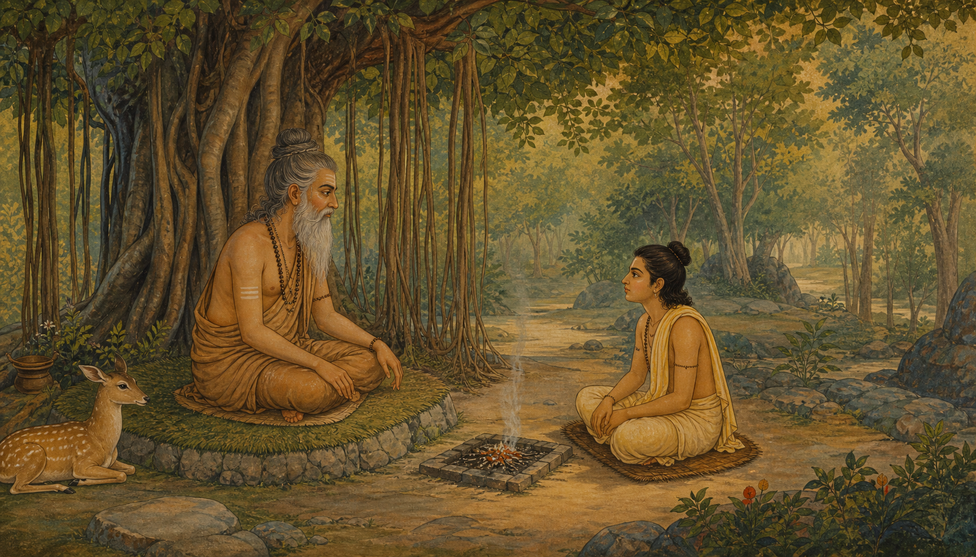
The Upanishads are the knowledge-section of the Vedas, their philosophical summit. Rising above the fire-rites and rituals of the karma-section, here the sages raise the question directly: what is Brahman, what is the atman, what remains beyond death. These very questions would in time become the whole edifice of Vedanta.
Tradition counts one hundred and eight Upanishads, though ten among them are held to be the principal ones, the ten on which Shankaracharya wrote his commentaries: Ishavasya, Kena, Katha, Prashna, Mundaka, Mandukya, Aitareya, Taittiriya, Chandogya, and Brihadaranyaka. Within these lie the four great sayings, the mahavakyas, that ground all of Advaita: the Chandogya’s “तत्त्वमसि”, the Brihadaranyaka’s “अहं ब्रह्मास्मि”, the Aitareya’s “प्रज्ञानं ब्रह्म”, and the Mandukya’s “अयमात्मा ब्रह्म”.
This collection links to twelve Upanishads and, alongside them, the Bhagavad Gita. The introductions and reading pages offer Sanskrit passages, meanings, and commentary; the scope and format vary by work. Ishavasya offers an inviting beginning. Its original text has eighteen mantras; this site presents selected thematic commentary. Kena is another possible starting point. The scope note on each reading explains what is included.
The Upanishads and the Bhagavad Gita
Twelve Upanishads, followed by the Bhagavad Gita. Choose a work to see its introduction and reading sequence.
Read alongside
- Bhagavad Gita The same Upanishadic truth, opening here in the unbroken dialogue of Krishna and Arjuna.
- The Stories of the Yoga Vasistha The same knowledge of the Upanishads, here in the form of stories.
- Ashtavakra Gita The pure Advaita of the Upanishads, distilled to its essence.