On this page
The Abduction of Rukmini
There was a kingdom named Vidarbha, its capital was Kundinapura, and over it ruled the great king Bhishmaka, a sovereign to whom lesser kings answered.
Bhishmaka had five sons and one daughter of astonishing beauty. The eldest son was Rukmi; after him came Rukmaratha, Rukmabahu, Rukmakesha, and Rukmamali. Their sister was the virtuous Rukmini, and those who knew how to read the auspicious marks of a body said a portion of Sri herself, the goddess of fortune who never leaves Vishnu’s side, had come into the world in her. There was a poise in the way she moved that seemed older than her years, and whoever spoke with her even once carried away the memory of a mind that shone.
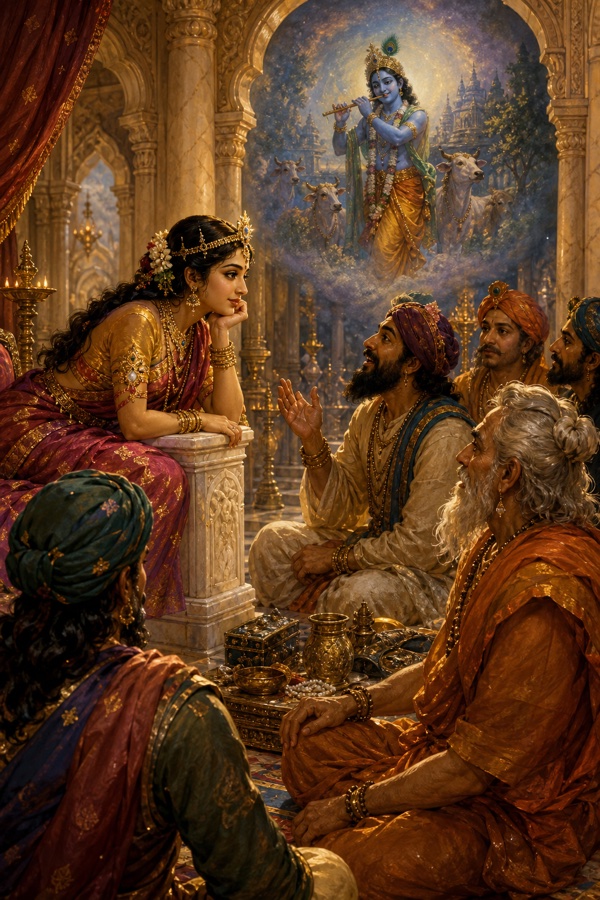
When merchants came up from Dwarka, the sea-guarded city of the Yadavas on the far western coast, one name kept returning in their talk as they traded in the bazaars of Kundinapura. The rishis and wandering ascetics who crossed the kingdom and were lodged as guests at the palace told of him too: Krishna, who had broken the tyrant Kamsa at Mathura, whose deeds were already turning into song. Rukmini listened to every visitor who entered her father’s house. His beauty, his valor, his character, his wealth: each account laid another line on a portrait forming inside her, the portrait of a man her eyes had never met.
And one day a certainty settled in her and never moved again. The one she would walk beside through this life was him.
Shri Hari had been listening too. From the same kind of travelers’ talk he knew that Rukmini carried the loveliest of auspicious marks, that her intelligence was rare, and that in generosity, beauty, conduct, and grace she had no equal anywhere. He decided within himself that here was the one wife who matched him.
Her kinsmen wanted the same match; father and brothers alike meant to give her to Shri Hari. But the eldest brother, Rukmi, nursed an old hatred for Krishna, and he planted himself across the plan and stopped it.
Rukmi had picked another groom. His sister would marry Shishupala, king of Chedi, a ruler whose friendships ran through Jarasandha’s court and whose enmity, like Rukmi’s own, pointed at Krishna. He talked his father and his brothers down from their intention until the whole house bent to him.
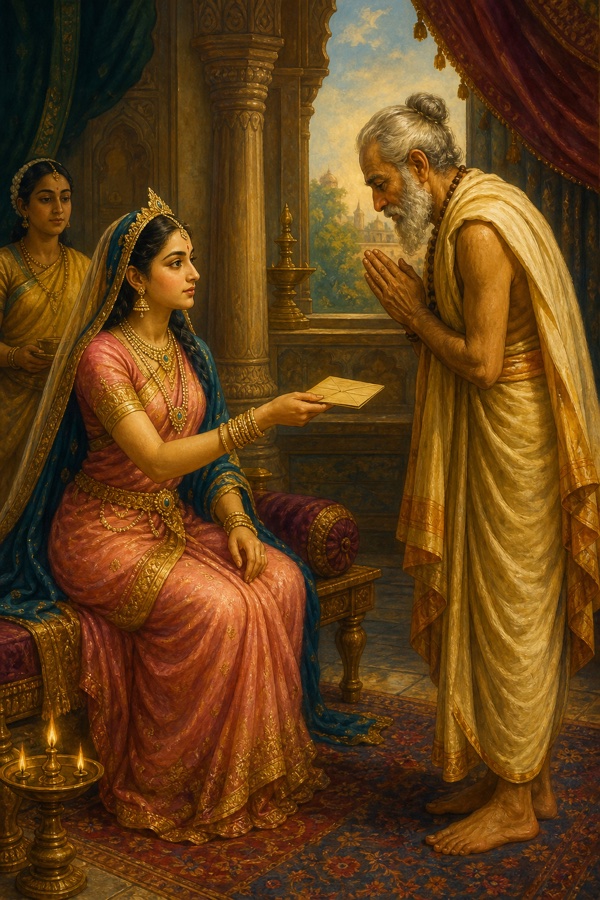
When word reached Rukmini that her brother meant to give her to Shishupala, everything she had quietly settled in her heart stood in sudden danger. She was shaken, and she thought for a long while. Then she did one thing. She sent for a Brahmin she trusted completely, and she resolved to place in his hands a message for Shri Hari.
Not a single tear fell. Something drew taut inside her instead, and within that tautness a decision finished forming.
For Dwarka, addressed to Shri Hari.
“O Krishna,” the message ran, “beauty of the three worlds. Your virtues, carried in the mouths of those who tell of you, enter through the ears of whoever hears them and put out the burning of the heart, and your form gives the eyes of whoever sees it everything eyes were made for. I have only heard. And on the strength of hearing alone, my mind has dropped every shame and entered into you, Achyuta, you who never fall and never fail.”
“In birth, in character, in beauty, in learning, in youth, in wealth, and in glory, you have no counterpart; you are the only measure of yourself. What woman of steady mind and good family, when her hour to choose arrived, would look past you? So I have chosen. I have taken you for my husband, and I have already given myself to you. Come, Lord, and claim me as your wife.”
“Let the lion’s portion never go to the jackal. Let Shishupala never touch what has been set apart for the hero. If across my births I have truly worshiped the Lord, with wells dug and temples raised for others, with fire-rites, with gifts and charity, with vows and fasts kept, with honor paid to the gods, to the Brahmins, and to my elders, then let Shri Hari come and take my hand, and let the son of Damaghosha, and every other man, be kept from me forever.”
“And this, Ajita, unconquered one, is how it can be done. On the day before the wedding, enter our city unseen. Then, with the captains of your army around you, crush the massed forces of Shishupala and Jarasandha, and take me by the rakshasa rite, the warrior’s marriage, in which the bride is carried off in open defiance after her defenders are beaten, and won as the prize of valor.”
“And if you should object that a girl kept inside the women’s quarters cannot be reached without cutting down her kin, hear the custom of our house. On the eve of a wedding the bride goes out of the city in a great procession to the shrine of Ambika, the goddess of our family, to stand before Girija, the mountain’s daughter. For that one hour I will be outside the walls. Take me from there.”
“But if your grace does not come to me, Krishna, whose feet’s very dust the great god Shankara gathers to himself to burn away his own darkness, then I will let this body go, thinned as it already is with fasting. And I will take up another body, and let that one go too, through a hundred births if a hundred births are needed, until the grace is mine.”
She wrote it out, set the letter in the trusted Brahmin’s hands, and said, “Go to Dwarka. Put this into Shri Hari’s own hand, and no other. And come back to me quickly with his answer.”
The Brahmin walked out of Vidarbha and kept walking, day after day, until the land ended at the sea and Dwarka stood beyond it, ringed by water on every side. The doorkeepers led him in, and he saw Shri Hari seated on a throne of gold. What happened next the Brahmin would carry with him for the rest of his life. The Lord of the city saw him from a distance, came down from the throne, and seated his guest upon it, honoring him exactly as the gods honor Krishna when he comes to their bright world. When the Brahmin had eaten and rested, Krishna sat close, took the traveler’s feet in his own hands, pressed them gently, and asked after him. Were his observances going on untroubled? Was his mind content? For contentment, Krishna said, is a Brahmin’s entire treasury; Indra himself, discontented, wanders restless from world to world, while a contented man who owns nothing sleeps soundly, every limb at ease. He bowed his head, he said, again and again to the Brahmin who stays satisfied with whatever comes unasked, who is a friend to every creature, and who carries no pride in himself. And your king, does he protect you? Dear to me is the king in whose realm the people live guarded and happy. Then, at last: what has brought you across a sea so hard to cross? Ask anything of us. So invited, the Brahmin laid the whole matter before him, and then the message itself, word for word, and added that whatever ought to be done in this should be done without delay.
Shri Hari heard it to the end. Then he laughed, warm and sudden, and closed his hand around the Brahmin’s.
“What the princess of Vidarbha feels, I feel,” he said. “My mind stays fixed on her, and at night sleep will not come. I know it was Rukmi who blocked the marriage, out of an old grudge against me. I will churn those disgraces of the kshatriya name in battle, and I will bring her out of their midst the way flame is drawn up out of the wood that hid it.”
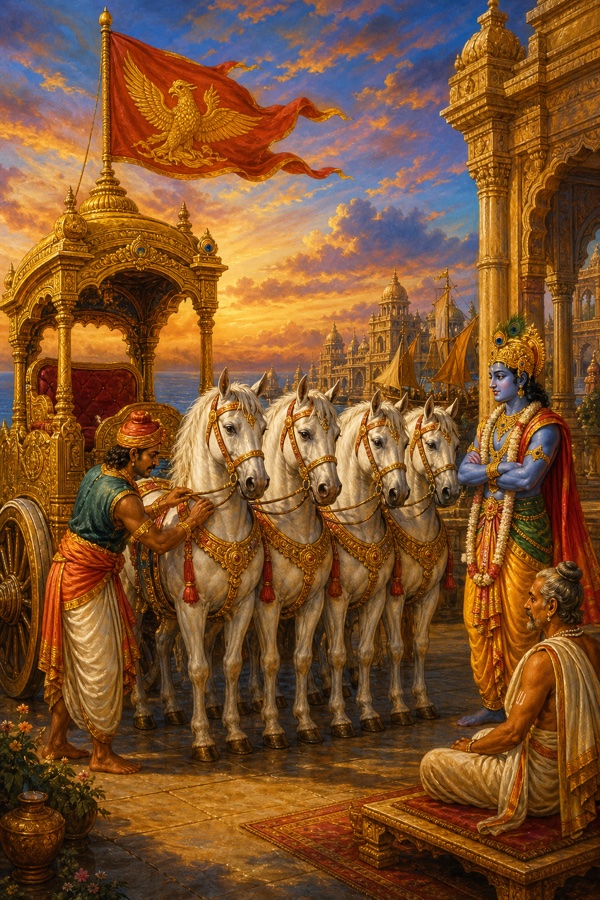
He did not wait for morning. That same hour he called for his charioteer, Daruka, and the chariot came with four named horses in the yoke, Shaibya, Sugriva, Meghapushpa, and Balahaka, and Daruka standing before it with joined palms. Shri Hari handed the Brahmin up first and then mounted himself, and the swift team took the distance whole: the road the messenger had worn down on foot over long days ran backward beneath the wheels in a single night, out of the Anarta country and into Vidarbha.
In Kundinapura the wedding was already in motion. Bhishmaka loved his eldest son too much to refuse him, and so, with his own heart pulling the other way, he had the rites begun for giving his daughter to Shishupala. The ancestors and the gods were worshiped as the scriptures direct, the Brahmins fed each in his place, verses of blessing recited over the bride. Rukmini was bathed and adorned, bound with the auspicious wedding thread with its small piece of gold knotted at the middle, and dressed in a brand-new pair of silks and the finest of ornaments. Priests set protecting chants from the Sama, the Rig, and the Yajur around her like a guard, and the family priest, a master of the Atharva lore, poured oblations into the fire to quiet whatever planets stood unfriendly. And Bhishmaka, who knew the ordinances as well as any king alive, gave the Brahmins gold and silver and cloth, sesamum mixed with jaggery, and cows. The city was dressed to match: royal roads, lanes, and crossings swept and sprinkled with water, the townspeople out in spotless white with garlands, sandal paste, and jewels, aloe smoke drifting from the doorways of the mansions, and flags of every color flying over festive arches.
Damaghosha, the king of Chedi, had every auspicious rite performed for his son Shishupala and then marched, with elephants streaming rut down their temples, chariots hung with gold, and long columns of horse and foot, up to the gates of Kundinapura. Bhishmaka went out with full ceremony to receive him and lodged him in a mansion raised for the occasion. And behind the bridegroom came the alliance: Shalva, Jarasandha, Dantavakra, Viduratha, Paundraka, kings in their thousands, every one an enemy of Krishna and Balarama, and every one arrived under a single understanding. If Krishna came for the bride, they would stand against him together and hold her for Shishupala.
The news traveled fast over the water to Dwarka: the rival kings massed at Kundinapura, and Krishna already gone, alone, to take the bride. Balarama, his elder brother, the wielder of the plow, who had stood between Krishna and danger since they were boys, read a battle in it at once. Love for his brother would not let him hold back. He set out for Kundinapura at the head of a great army, elephants, horsemen, chariots, and foot soldiers, driving them hard.
And Rukmini, inside the palace, was counting hours. The Brahmin had not returned, and dread crept over her. “My wedding is one night away,” she thought. “And Krishna has not come. I do not know why. Even the Brahmin who carried my word has not come back. Did Krishna find some flaw in me after all, and turn away? Is Brahma the ordainer against me? Is the great Shiva against me? Is Gauri herself, the mountain’s daughter, unwilling to be kind?” Her eyes had begun to fill, and she pressed the tears down, for tears on the eve of a wedding are an ill sign. She held them, and she waited.
Then her left thigh trembled, and her left arm, and her left eye: the body’s own glad signals, the old signs that tell a woman her beloved is near. And the Brahmin was there, coming through the door with his face alight. Shri Hari had come. He had given his solemn word to carry her away. Rukmini heard it and shone. She looked for something worthy to give the man who had brought her this, found nothing in the world that was, and simply bowed to him instead, and the bow of Rukmini was no small payment, for she was Lakshmi walking the earth. By then the city outside knew whose chariot had entered it. Bhishmaka himself went out to Krishna and Balarama with madhuparka, the honeyed offering reserved for the most honored of guests, and the people of Kundinapura, drinking in Krishna’s face, said to one another that he alone, faultless in every limb, deserved to have Rukmini, and prayed that whatever merit their own good deeds had earned might flow to this one end: let Krishna, and no one else, marry the princess of Vidarbha.
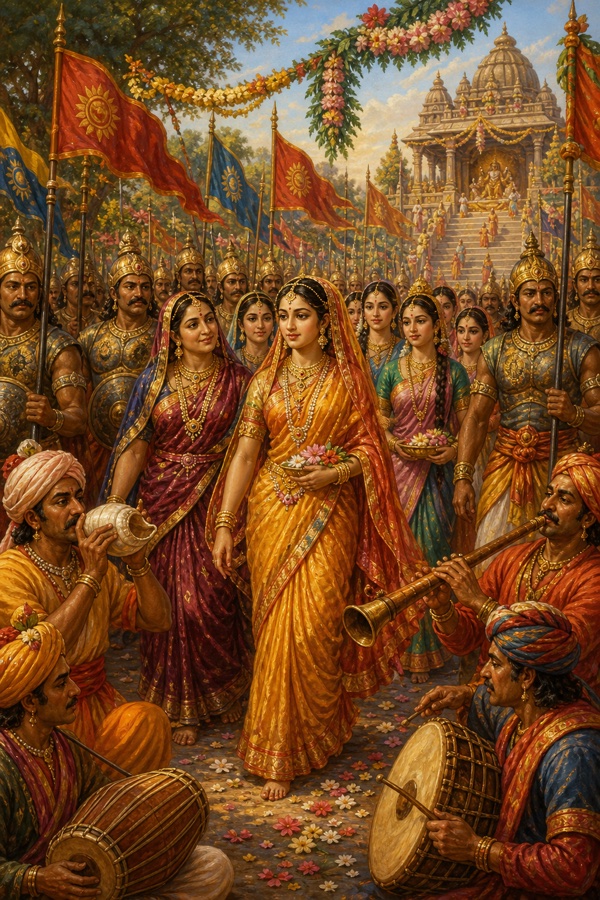
At dawn the bride came out of the inner palace under heavy guard and set out for the shrine of Ambika. She had bound her speech in a vow of silence, and her mind held a single image, the feet of Shri Hari. Soldiers of the king’s personal guard walked armored around her with weapons raised. Clay drums and conches sounded, great drums, horns, and kettledrums. Dancing girls went with her in their thousands, carrying trays of offerings; the wives of Brahmins walked garlanded and sandal-scented; singers sang her forward, players played, and the keepers of the old lineages, the bards, and the praise-singers called out her glory the whole way. At the outer gate of the temple she stepped down with her mother and the elder women of the house and went the last stretch on foot, toward the goddess.
At the shrine she washed her hands and feet, sipped the water of purification, and went in quiet and clean before Ambika. The elder Brahmin women, who knew the ritual, led her in honoring Bhavani and her lord Shankara together with their children, Ganesha and Kartikeya, and Rukmini made the one prayer she had brought: “Mother Ambika, I bow to you again and again. Let Shri Krishna be my husband. Let it be so.” She worshiped the goddess and all her divine household with water and sandal paste, with whole grains of rice, incense, cloth, garlands, necklaces, and ornaments, with offerings of food and rows of waved lamps; she honored the married Brahmin women too, with the seasoned cakes and betel, the auspicious neck-threads, the fruit and the sugarcane the rite asks for. The matrons gave her back a portion of what the goddess had touched, and their blessings over it, and she bowed her head to them and to the goddess.
Then the vow of silence ended, and she came out of Girija’s shrine holding tight to a maidservant’s hand, a jeweled ring bright on her own. And her eyes went to work in the crowd, searching.
She moved slowly, deliberately slowly, waiting for him: brushing her hair back from her eyes with the fingers of her left hand, glancing sidelong across the ranked kings who had come to watch a wedding. And then, at the edge of it all, she found a chariot, and on the chariot, wrapped in yellow silk, the one whose face she had built out of years of listening.
Shri Hari.
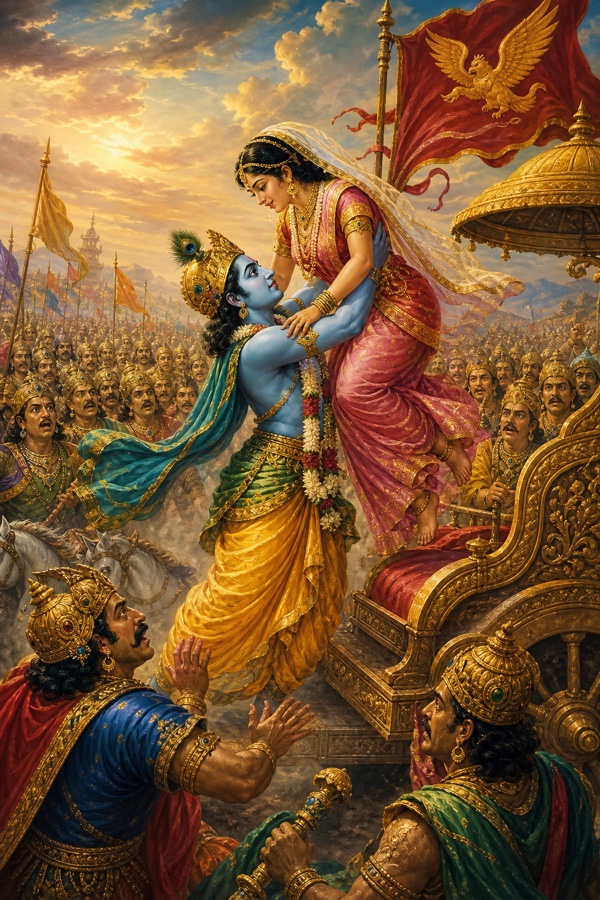
The kings had come armed to prevent exactly this, and the mere sight of her had already disarmed them; weapons slipped from slack hands, and more than one famous warrior slid half-senseless from his elephant, his horse, or his chariot. Into that stunned stillness Krishna moved. In full view of every enemy he had, he lifted Rukmini out of their midst just as she stepped toward her own chariot, and seated her beside him on his, the great chariot whose banner bore Garuda, the eagle who carries Vishnu himself. Taking her like that, openly, before them all, he might as well have set his foot on the head of every king present.
Then, unhurried, the way a lion walks out of a circle of jackals with its kill and dares a single one of them to move, Shri Hari carried Rukmini away, and Balarama and the Yadava host closed around the chariot and went with him.
The temple courtyard burst. “Someone has taken Rukmini!” ran from mouth to mouth. And the proud kings of Jarasandha’s alliance stood there tasting the ruin of their own names. “Shame on us,” they cried. “We stood here under arms, lions every one of us, and cowherds have carried off our glory the way deer might strip a lion’s kill while the lion looks on.”
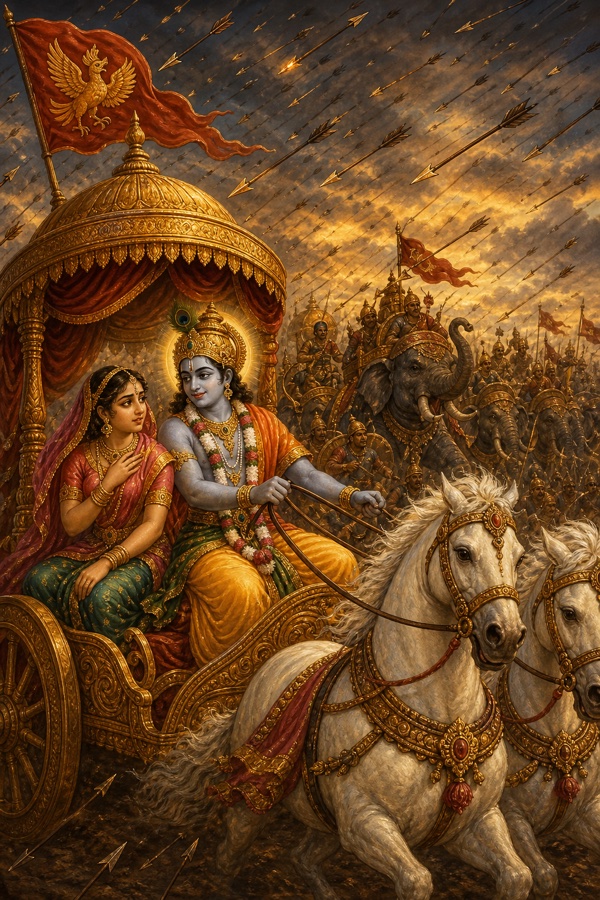
Rage put them back on their mounts. Armor buckled, bows strung, armies behind them, they came down the road after him, and the celebrated generals of the Yadava army wheeled and stood to meet them, bowstrings answering. Arrows fell on the Yadava lines the way monsoon clouds fall on a mountain, volley after volley, from horseback, from the shoulders of elephants, from the decks of chariots. Rukmini watched her husband’s army vanish under that arrow-fall and turned her face up to his, her eyes wide with a fear she was ashamed of. Shri Hari laughed. “Do not be afraid, my fair-eyed one. Your own army is about to finish theirs.”
Gada, Sankarshana, and the other Yadava heroes would not stand under that prowess a moment longer. With narachas, the long arrows made all of iron, they tore into the enemy’s elephants, horses, and chariots, and what came down from the mounts and the chariots was terrible to count: heads by the tens of millions, still wearing their earrings, their diadems, their turbans; hands still gripping swords and maces and bows; thighs and feet; horses and mules, elephants, camels, donkeys, men. Beaten by the Yadus, who fight keenest when victory is in reach, Jarasandha and every king with him turned their backs on the field and ran.
They found Shishupala like a man whose wedded wife had been carried off, drained and dim, his face gone dry. Jarasandha came and stood with him. “Shake off this gloom,” he said. “Joy and sorrow keep no permanent seat in anyone who wears a body. A creature dances the way the showman’s puppet dances, pulled by the will of Providence, and reaps its pleasure and its pain on the same strings. I have lost to Krishna seventeen times, seventeen, with twenty-three akshauhinis behind me each time, every akshauhini a complete army of chariots, elephants, horsemen, and foot soldiers, and I have won exactly once. Loss leaves me composed, and victory brings no gloating, because I know how time and destiny run this world. Today time favored the Yadus. Another day it will favor us.” So counseled by his friends, Shishupala gathered his surviving followers and went home to Chedi, and the kings who still lived scattered each to his own country.
But Rukmi could not fold his loss into philosophy. That his sister had been taken by force in front of him burned past anything he could bear. Before the assembled kings dispersed, he strapped on his armor, took up his bow, and swore an oath for all of them to hear: he would not set foot in Kundinapura again until he had killed Krishna in battle and brought Rukmini back. Then, with a single akshauhini behind him and his own chariot outrunning it, he went after the Lord himself.
“Stop! Stop the chariot!” he kept roaring down the road. “I am not letting this cowherd go today!”
He caught them. He drew his bow to the ear, put three arrows into Shri Hari, and threw his taunts after them: disgrace of the Yadu line; sister-thief; a crow filching the offering from the altar fire. “Let my sister go, before my arrows put you in the dust.” Shri Hari smiled. He cut Rukmi’s bow apart and answered with six arrows into Rukmi himself, eight into his four horses, two into his charioteer, three through his banner. Rukmi snatched up a second bow; Krishna split it. A third; split. Then the iron club, the sharp-edged spear, the pike, the sword and shield, the javelin, the bludgeon: every weapon he raised was sheared away even as he raised it. At last Rukmi leapt down from his chariot, sword bare in his hand, and ran at Krishna the way a moth runs into flame. Krishna broke that sword and that shield into slivers in the air, and took up his own keen-edged blade to finish him.
Rukmini saw the lifted blade, and terror took her whole body. She was off the chariot in a breath and at her husband’s feet, her limbs shaking, her mouth dry, her throat closing around the words, her gold necklace slipped askew in her distress. “Yogeshwara,” she managed, “master of all yoga, Lord past anyone’s measuring, god of the gods themselves. You of the mighty arms: my brother’s death must not come from you.”
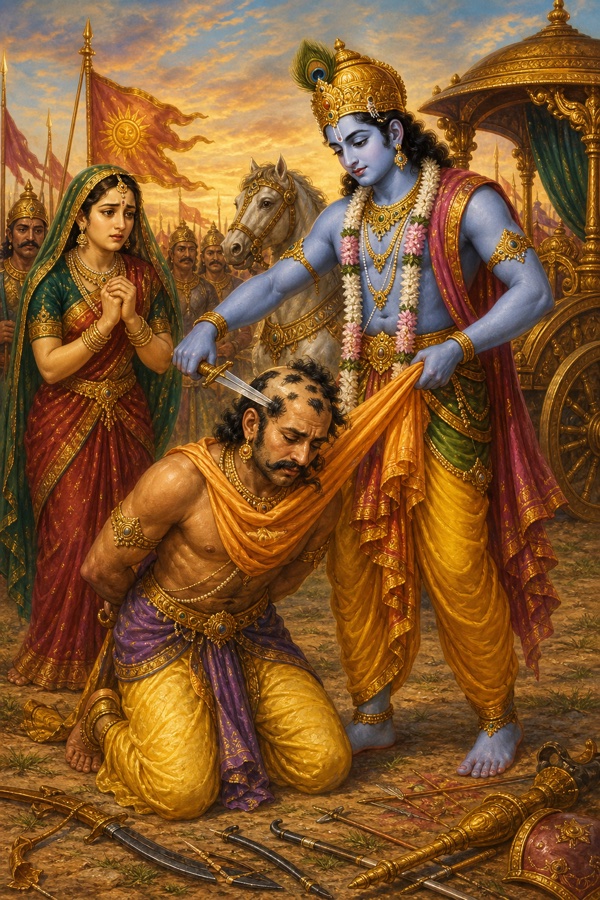
The merciful Lord stopped. But he would not let Rukmi’s malice walk away unmarked. He bound him with Rukmi’s own scarf, and with the edge of his sword he shaved away the proud warrior’s beard, mustache, and hair in ragged patches, leaving tufts, and left him standing there disfigured.
By then the flower of the Yadava army had crushed Rukmi’s host the way a herd of elephants crushes a bed of lotus stalks. Coming back to Krishna, they found Rukmi bound, shorn, and half dead of shame, and at the sight of him pity moved Balarama. He undid the bindings with his own hands.
Then Balarama turned to his brother. “Krishna, this was badly done, and it will sit badly on our house. To shave a kinsman’s face and mar him is a killing by another name; it kills the man and leaves the body standing.” He turned to Rukmini next, and his voice gentled. “Good lady, do not hold your brother’s disfigurement against us. No one hands a living being its joy or its sorrow; each of us harvests exactly what our own acts have planted. A kinsman is spared even when his offense deserves death, for a man already destroyed by his own deed stands destroyed; why kill him twice? The code Brahma laid down for kshatriyas is a hard one, so hard that under it a brother may kill his own brother, and it is the proud, blinded by the pride of fortune, who reach for it, humiliating their own kin over dominion, land, wealth, women, or honor. And hear the rest, good lady. This habit the mind has of sorting the world into friend, enemy, and stranger is ignorance at work; the maya of the Lord persuades every being that wears a body to see three where there is one. The one Self lives in all creatures, the way a single sun stands reflected in a thousand vessels of water and seems a thousand suns. Birth and death belong to the body, which is put together out of matter, the senses, and their objects, and comes apart again; they touch the Self no more than waxing and waning touch the moon itself, though on the night called the moon’s death the whole world says the moon has died. A sleeping man tastes pleasure and pain in things that do not exist at all and suffers them as real: that is exactly how the soul that mistakes the body for itself wanders from grief to grief, birth after birth. So let understanding do its work. The sorrow in you was born of ignorance, and it dies with it.”
Rukmini heard him through, and slowly her mind found its footing; she reasoned her way back to calm, and the fear drained out of her.
Rukmi lowered himself to the ground among his own shorn hair, and his head went down after it. He had sworn before kings that he would never enter Kundinapura without killing Krishna, and Krishna lived. His army was wreckage, his glory was gone, and his face had become a thing he could not carry into his sister’s wedding city. So he never went back at all. On that very ground he raised a great city and named it Bhojakata, and there, with his anger and his unkept oath for company, he stayed.
Rukmini and Shri Hari came home to Dwarka, and there he married her with every rite the scriptures ordain, in full ceremony, before the whole city.
And the whole city answered. There was festival in every house of Dwarka, for every heart in that city already belonged to Krishna, and now their Lord was a bridegroom. Men and women in earrings of polished gems came bearing gifts for the bride and the groom in their marriage finery. Flags rose in Indra’s honor over wreaths, tapestries, and jeweled arches; every doorway stood dressed with fried grain and barley sprouts and flowers, with brimming water-pots, aloe smoke, and burning lamps. The streets were dark and damp where the elephants of invited kings had passed, and plantain trunks and areca palms stood tied at the gateways. Through the crowds the great houses met one another in joy, Kurus and Srinjayas, Kaikeyas and Vidarbhas, Yadus and Kuntis, and in every lane singers were already singing the story of how Rukmini was carried away, so that princes and princesses from distant courts heard it and marveled. And when the people of Dwarka saw Krishna, the Lord of Sri, joined at last with Rukmini, who was Sri herself come to walk among them, their celebration rose past anything the city had known. Rukmini became his chief queen, first of his house.
And Rukmini lived out her years beside Shri Hari in Dwarka, inside the love that had begun long before her eyes had any part in it, the love that came in through the ear.
Literary context
The carrying away of Rukmini spans Chapters 52 to 54 of the tenth Skandha of the Shrimad Bhagavata. The heart of the episode is Rukmini’s message (10.52.37 to 43), where her intelligence and her resolve stand fully lit, from the reasoned plan of the temple procession down to the closing vow to fast this body away and take up another, through a hundred births if need be, until his grace is won.
In the reckoning of the shastras this marriage counts as the ‘rakshasa’ rite, since the groom takes the bride by force; here the abduction was planned by the bride herself, and that prior consent gives the rite its unusual character. Shridhara Swami’s Bhavartha-dipika reads the episode in exactly this spirit: a love that is bhakti born of shravana, devotion that entered through the ear.
Why this katha matters now
Rukmini recognized by ear a man she had never once seen, and when her family’s wish stood against her heart’s call, she walked out behind the call. That crossroads returns in every generation, whenever the truth inside a person and the will of the house come face to face.
The same katha elsewhere
- Harivamsha · The Abduction of Rukmini
The Harivamsha’s account of Rukmini’s abduction