Vivekachudamani
Adi Shankaracharya · all 580 verses
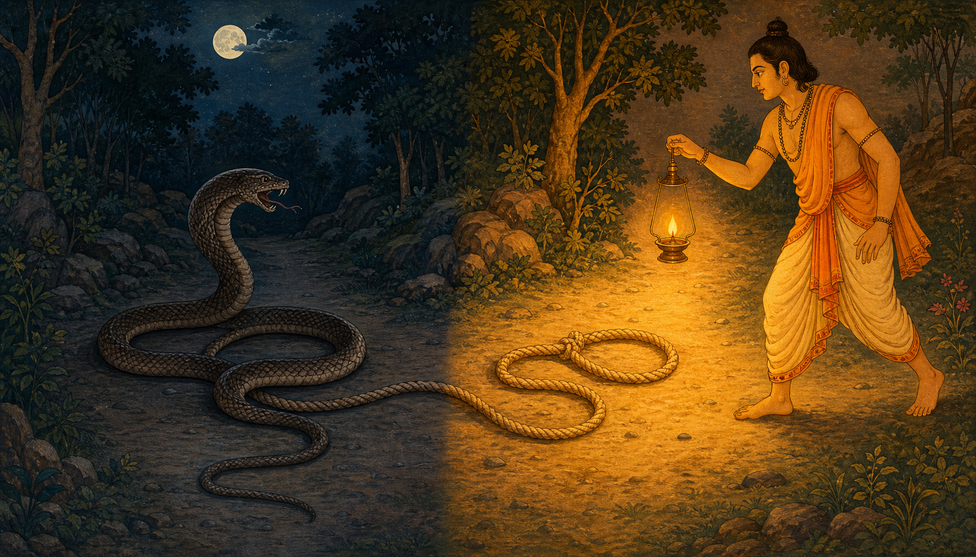
Vivekachudamani, the crest-jewel of viveka, the discernment that tells the lasting from the passing, is the whole of Advaita Vedanta set as one conversation between a guru and a disciple, in 580 verses that tradition ascribes to Adi Shankara. It runs from the disciple’s first question, what bondage is and how it came, to his release, and every image on the way, the rope and the snake, the five sheaths, the painted moon, the leaf that falls from the tree, works the old grip of the mind a little looser.
What this is
The work teaches Advaita as a story. A disciple comes to a guru, carried by the longing to know, and the guru begins with the four means that make a seeker fit to inquire. He leads him through every layer that is taken for the self, the body, the mind, maya, the five sheaths; names the witness; establishes Brahman; and unfolds the sentence tat tvam asi, you are That, until the disciple can hear it said of himself. The practical teaching follows: the wearing away of the vasanas, the ego and the one lapse of attention that undoes everything, samadhi, the marks of the one who is free while alive, the three kinds of karma. The disciple sinks into samadhi, rises, and pours out his own hymn; the guru speaks once more on how the knower lives. At the close, in verses 576 and 577, the disciple bows and, with the guru’s leave, goes his way freed from bondage, and the guru roams the earth, making it pure.
Each part carries its verses in English prose, verse by verse, so that the full sense of every verse reaches a reader with no Sanskrit in front of him. The images are the verses’ own, with one from daily life where it helps the sense land, and a Sanskrit word stands in roman letters only where the word is itself the teaching, with its meaning beside it. The meaning of every verse is checked against Swami Madhavananda’s translation and notes (Advaita Ashrama, 1921).
How to read this
There are two ways in. The first is in order, from Part 1 to Part 19, since each part stands on the one before it; one part a sitting, with each part giving its own reading time at the top, brings the whole work round in nineteen sittings. The second is by theme: the list below gives the subject and the verse range of every part, and a reader after one question, the sheaths, the three karmas, the marks of the jivanmukta, can begin there and read outward.
Every part opens with a short map of its verses and closes with a line toward the part that follows, so the thread can be picked up where it was left. The verses are built to be taken slowly. One verse read and left to settle for a day does more than a part read through in a hurry.
Vivekachudamani, complete in nineteen parts
Part 1 · The Rare Human Birth
Verses 1 to 13 · 13 verses
A bow to Govinda, God and guru in one name; a staircase of rarities from a human birth up to abiding as Brahman; three gifts of grace, a human birth, the longing for liberation, and the shelter of a great soul. The one who has the birth and will not strive is called, in verse 4, the slayer of his own self. Action purifies the mind, inquiry reaches the truth, and certainty comes from inquiry upon the counsel of the wise.
Part 2 · The Fourfold Preparation
Verses 14 to 31 · 18 verses
The result rests on the seeker, and four means decide whether steadiness in Brahman is reached. Verses 20 to 27 define them: viveka, the firm conviction that Brahman is real and the world mithya, appearing without a being of its own; vairagya, the wish to be done with every passing enjoyment, from the body up to the seat of Brahma; the six inner virtues that begin with shama; and mumukshuta, the longing to be free. Verse 31 defines bhakti as the constant seeking of one’s own true nature.
Part 3 · Refuge in the Guru
Verses 32 to 71 · 40 verses
What the guru should be and how he is approached. The disciple makes his plea, scorched by the heat of the world, and the guru’s first gift, in verse 41, is fearlessness. Verse 49 unfolds the disciple’s root question into seven: what bondage is, how it came, how it continues, how one is freed, what the not-Self is, who the supreme Self is, and how the two are told apart. Verses 51 and 52 answer that no one else can do this work in his place, as hunger is ended by no one except oneself.
Part 4 · The Not-Self, the Body, the Mind, and Maya
Verses 72 to 123 · 52 verses
The guru begins from the most solid end, the body. Gross body, senses, breath, mind and intellect are each examined and set aside; the three bodies and the three states, waking, dream and deep sleep, are laid out; then maya, the Lord’s own power made of the three gunas, and the gunas themselves. The part closes in verses 122 and 123 on the whole of the not-Self as a mirage, seen and walked toward, with no water in it.
Part 5 · The Nature of the Self, and the Knot of Bondage
Verses 124 to 145 · 22 verses
With the not-Self set aside, the Self is described: the witness, self-luminous, the knower who is never the known, unchanged through waking, dream and sleep and lighting all three. Verses 137 to 145 tie the knot: how the Self came to be taken for the body, the two powers of ignorance, avarana and vikshepa, veiling and projection, and the tree of samsara that grows from that root.
Part 6 · The Five Sheaths, First Half: Food, Breath, Mind
Verses 146 to 183 · 38 verses
Bondage is a thing knowledge alone can cut: verse 147 gives the sword of discrimination, verse 149 lays the sheaths over the Self as algae lies over the water of a tank, and verse 153 draws the Self out of them as a stalk is drawn from munja grass. The first three of the Taittiriya’s five sheaths follow: annamaya, the sheath of food; pranamaya, the sheath of breath; manomaya, the sheath of mind.
Part 7 · The Five Sheaths, Second Half: Intellect and Bliss
Verses 184 to 211 · 28 verses
The two subtlest sheaths. Vijnanamaya, the sheath of intellect, is the one most easily taken for the Self, since it borrows the Self’s light and does the work of the person. Midway the disciple asks how a bondage that has run from all time can ever end, and verse 200 answers that a thing with no beginning can still end, as prior non-existence does. Anandamaya, the sheath of bliss, the quiet of deep sleep, is the last covering.
Part 8 · The Witness and Brahman
Verses 212 to 240 · 29 verses
The disciple fears that when everything has been denied, what remains may be an emptiness. Verse 214 names the Self as the one by whom all things are experienced and who is experienced by none, and the Self stands firm as the witness of the three states. Brahman is established, existence, knowledge and bliss without a second; the inner Self is that Brahman itself; and verse 227 says that this whole universe, appearing manifold through ignorance, is Brahman alone.
Part 9 · Tat Tvam Asi, You Are That
Verses 241 to 266 · 26 verses
The Chandogya’s great sentence, tat tvam asi, you are That, opened word by word. “That” means Brahman and “you” means the inner Self, and the two literal senses stand as far apart as a firefly and the sun; the identity lies in the implied sense, reached by jahad-ajahad-lakshana, the implication that drops the clashing part of each word’s meaning and keeps the rest. From verse 251 to 263 the sentence closes verse after verse.
Part 10 · The Wearing Away of Vasanas
Verses 267 to 297 · 31 verses
The vasanas, the old drives laid down by past acts, stay strong even after the truth is known, and verse 267 calls their thinning liberation itself. Verse 271 names the three followings that hold a man back, the world and what people will say, the body and its comfort, and scripture turned into one more bondage, and verse 272 calls them iron fetters on the feet. The means of release are Shruti, reasoning and one’s own experience together, and a steady dwelling on the Self.
Part 11 · The Ego and Heedlessness
Verses 298 to 328 · 31 verses
One enemy remains, the small I that says I am the doer. Verse 300 shows the Self freed from its grip as the moon comes clear of Rahu, and the verses that follow say how the ego is to be watched and starved. The warning comes last: pramada, heedlessness, a single lapse of attention from Brahman. Verse 321 cites Sanatsujata’s saying in the Mahabharata that heedlessness is death itself; verse 322 runs the chain from one lapse, delusion, the notion of I, bondage, pain; and verse 328 says the fallen is never seen to rise.
Part 12 · Samadhi, the Heart’s Knot Comes Undone
Verses 329 to 366 · 38 verses
The method of nirvikalpa samadhi, absorption with no ripple of thought, from the first instruction to let go of samkalpa, the mind’s constant weaving. Verse 344 tells the seer from the seen as milk from water, and verse 353 unties the knot of the heart. Verse 364 weighs the three means, shravana, manana and nididhyasana, hearing, reflection and sustained meditation: reflection a hundred times hearing, meditation a hundred thousand times reflection, and nirvikalpa samadhi beyond measure.
Part 13 · Yoga, Dispassion, and “Where Is Difference?”
Verses 367 to 407 · 41 verses
Verse 367 names the first door of yoga: restraint of speech, taking nothing, freedom from expectation and from desire, and a constant habit of solitude. Verse 374 makes dispassion and realization the two wings on which alone the creeper of liberation is reached. Dwelling on the not-Self gives way to dwelling on the Self, and through verses 399 to 402 one question returns four times, bhida kutah, where is division, in the one thing that is changeless, formless and without distinction.
Part 14 · Recognizing the Jivanmukta
Verses 408 to 440 · 33 verses
Three verses, 408 to 410, hold up one picture three times: the knower holds the full Brahman in the heart, in samadhi. Verses 419 and 420 set the chain of fruits, dispassion to realization, realization to the turning from sense pleasure, that to the Self’s bliss, and from it peace, each link meaningless without the next. From verse 428 come the marks of the jivanmukta, the one free while still alive, set out one mark to a verse.
Part 15 · The Three Karmas and the One Without a Second
Verses 441 to 470 · 30 verses
The knower still eats, walks and speaks; why is he not bound? The three karmas are reckoned: sanchita, the stored; prarabdha, the ripened; and agami, the karma yet to come, the verses’ own word for it. The stored and the coming are burned by knowledge, and the ripened runs its course like an arrow already loosed, in verses 451 and 452. Verses 464 to 470 close with one line said seven times: Brahman is one, without a second, and here there is no manifold whatever.
Part 16 · The Guru’s Summing Up, the Disciple’s Awakening
Verses 471 to 485 · 15 verses
The guru sums up in verse 478: the verdict of every Vedanta discussion is that the jiva and the whole universe are Brahman alone, and liberation is abiding as that undivided Brahman. The disciple sinks into samadhi, rises, and his first words are verse 481: my intellect has dissolved and all its activity has melted away, I know neither this nor not-this, and what or how much this boundless bliss is, I cannot say.
Part 17 · The Disciple’s Hymn
Verses 486 to 519 · 34 verses
Homage to the guru first, then one declaration after another built on aham, I: unattached, bodiless, without mark; the one who does nothing and enjoys nothing; and in verse 494, Narayana, the slayer of Naraka, the destroyer of the cities, the Lord, all that same I. Verse 518 turns back to the guru, you woke me from the great dream and saved me, and verse 519 bows once more.
Part 18 · The Guru Speaks Again
Verses 520 to 545 · 26 verses
The guru speaks again. Verses 520 to 527 ask for an unbroken stream of the awareness of Brahman; when the moon that delights the whole world is shining, verse 522 asks, who would look at a painted moon. Verses 528 to 535 give the knower his freedom from rule, and verses 536 to 545 his gait in the world: now like a madman, now like a child, now like a ghoul, in verse 540; sometimes a fool, sometimes a sage, sometimes a king, in verse 542.
Part 19 · Videha-Kaivalya and the Conclusion
Verses 546 to 580 · 35 verses
Videha-kaivalya, the aloneness of the one who is bodiless. Let the body fall anywhere like a leaf from a tree, and the tree stands as it was; verse 558 puts release in the untying of the heart’s knot of ignorance. The pot breaks and its space is space, verse 565; milk poured into milk is milk, verse 566. Verse 574 gives the highest statement: none bound, none striving, none seeking release, none released. The disciple goes his way freed, the guru roams the earth, and verse 580 closes: Shankara’s word triumphs, the giver of nirvana.
A word for those who read this
Begin with Parts 1 and 2 even when the theme you want lies later. Part 2 defines the terms every later part uses without stopping to define them again, viveka, vairagya, shama, mumukshutva, and Part 1 gives the rope and the snake, the one image the whole work argues from.
The argument has a spine, and a reader short of time can follow it alone: Part 5 for what the Self is, Part 8 for the witness and Brahman, Part 9 for tat tvam asi, Part 16 for the guru’s summing up and the disciple’s first words, and Part 19 for verse 574, where even bondage and release are set aside.
For a fuller exposition, Swami Madhavananda’s translation with notes and Swami Chinmayananda’s commentary are the two to keep within reach. These parts stand alongside them and lead back to the verses.