On this page
Kardama and Devahuti
This is a very old story, from the first days of creation.
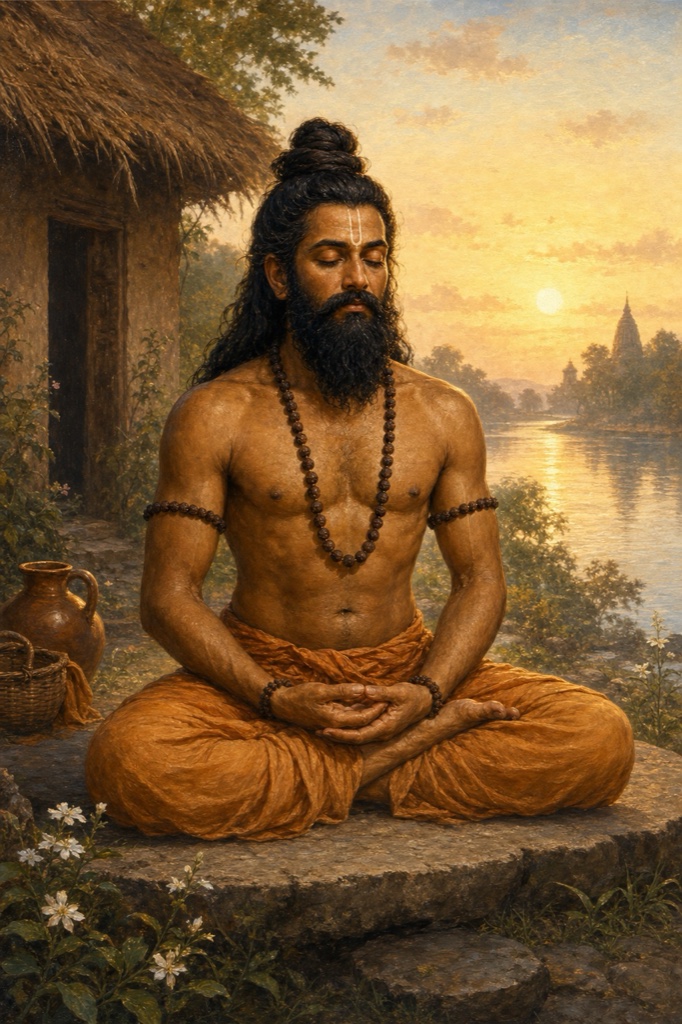
When Brahma set about filling the new worlds, he brought forth sons by his bare will, and one of them was Kardama, a lord of created beings. To this son the father of all gave a single charge: beget children, people this creation. Kardama carried the command to the bank of the Sarasvati and built his hut there, a thatched roof and one stone seat and nothing else. On that seat he performed tapas for ten thousand years. He steadied the fire, steadied the breath, steadied the mind, and through all of it he served Sri Hari, the shelter of everyone who runs to him, with worship folded into deep meditation. The river’s cold water at dawn, the hushed sunlight of noon, the night silence in which a man hears only his own breathing: this was his entire world. Ten thousand years is no small span. Mountains wear down in that much time, and rivers wander out of their beds. But Kardama’s seat on that stone never shifted, and inside him one call kept sounding, without words, without a tongue, from the heart alone.
One desire had stayed with him through it all, and he half hid it even from himself. Let a companion come, a woman who knew dharma and could walk at the pace of his tapas. Brahma’s own command asked this of him, and still, for an ascetic, the asking chafed, and so did leaving it unasked.
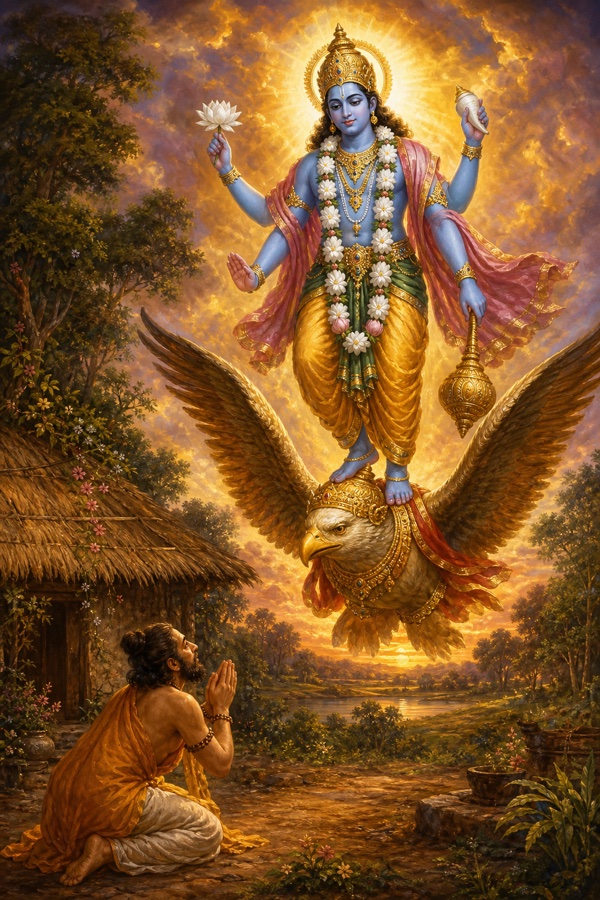
One day the call was answered. It was the opening of the Satya age, the first morning of the world’s first era, and Sri Hari came down to him in the form that only the Word of the Veda can name. The empty air of the hut seemed suddenly full. He stood above the ground, effulgent as the risen sun, his feet resting on the shoulders of Garuda, the great eagle who carries him. Spotless yellow silk wrapped his body. A crown sat on his head, bright earrings hung at his ears, and his face, deep blue and framed in sleek curling hair, carried a smile that could take a heart without effort. A garland of white lotuses and water lilies lay across his chest, where the golden line of Shri shone beside the Kaustubha gem at his throat. Three of his four hands held the conch, the discus Sudarshana, and the mace, and the fourth turned a white lily, held for nothing except play. Kardama gazed at this form, and a thirst ten thousand years old was quenched in a single swallow. He dropped with his forehead to the earth, and when he rose, his palms had already joined of their own accord.
Kardama joined his hands and spoke.
“Today my eyes have earned the full fruit of their seeing. Yogis ripen through birth after birth of deep meditation for one glimpse of this form, and you have brought it to a mud hut on a riverbank. Your lotus feet are the vessel that crosses the ocean of birth and death, and men whose sense your maya has stolen still worship those feet for trinkets, for small pleasures a body can find even in hell, and you are generous enough to grant even that. I am no better than they are. My heart still carries its wanting, and so I have come to a wish-yielding tree with a beggar’s request: a wife whose nature matches mine, a companion in dharma who will make my married life yield everything such a life is meant to yield. This whole world hangs bound like an ox to the cord of your word and follows where it pulls; I only follow along with it, bringing my obedience to you, who appear before us as Time itself. For I have watched your wheel turning. Its axle is imperishable Brahman. Its three hubs are the year’s three four-month turnings, its thirteen spokes the thirteen months, its three hundred and sixty joints the days, its six rims the seasons, and its leaves are moments past counting, and as it spins at terrible speed it shears the life from everything that breathes. Only your devotees stand beyond its cut. You alone spin this universe out of yourself the way a spider spins its web, you hold it, and one day you draw it back in. I know that what I ask is small. Grant it anyway, and let even this desire carry me toward my final good, for you have come to stand before me wearing a wreath of tulasi leaves, in a form my eyes can hold. I bow to you, again and again.”
There was no mockery in Sri Hari’s smile. “I knew what was in your heart long before you spoke it, Kardama, and what you worshiped me for is already arranged. Worship offered to me by a man whose whole mind rests on me never goes to waste. Emperor Svayambhuva Manu, the first sovereign of this world, famous for his righteousness, rules the earth to the rim of its seven oceans from his seat in Brahmavarta. The day after tomorrow that royal sage will come to this ashram with his queen, Shatarupa. He brings his daughter, dark-eyed, grown to the age of marriage, noble in character and searching for a husband to match her heart. Her name is Devahuti. She is the very kind of woman your mind has dwelt on all these years; she will be your wife, and she will serve you until your heart is full. Through her you will father nine daughters, and through those daughters the great sages will raise the lines of the world.”
“The day after tomorrow,” Kardama repeated slowly, as if after ten thousand years of waiting so small a phrase were a stranger in his mouth.
“And keep one thing in mind. With her you must live the householder’s life for a time, and live it fully. Carry out my command with a clean heart, resign the fruit of everything you do to me, and the household itself will purify you: showing kindness to living beings, you will come to see your own self, and giving every creature the assurance of safety, you will see the whole universe resting in me and me resting in you. Then I myself will descend into your house. I will take birth as your son through Devahuti, and I will teach her the knowledge that cuts the knot of birth and death. When the boy is grown, you are free. Return to your tapas.”
Kardama bowed his head to all of it. Then Sri Hari turned back toward his own realm by the road the great Siddhas praise, and as Garuda’s wings beat the air they gave out the hymns on which the Samaveda is sung, so that the Lord rose out of sight on a rhythm of Vedic song. At the place where he had stood, the air kept the scent of lotus for a long while.
Meanwhile Manu was searching for a husband for his daughter Devahuti.
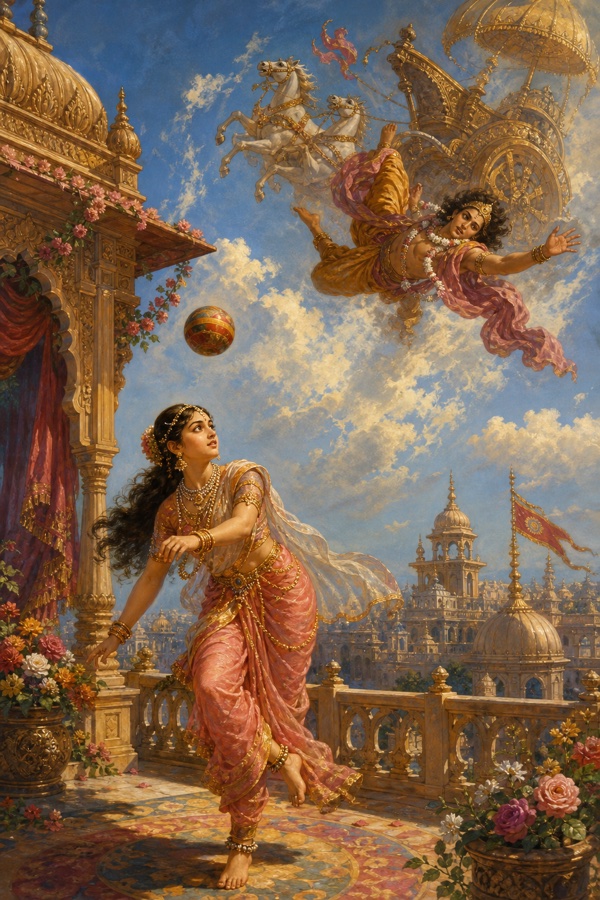
Devahuti was the daughter of Svayambhuva Manu and Queen Shatarupa, sister of Priyavrata and Uttanapada, born into the first royal house the world had known. Yet the palace never quite held her heart. Once she was playing with a ball on the open terrace of her palace, gold anklets ringing at every step, her eyes darting after every bounce, and Vishvavasu the gandharva, a celestial famous for his own beauty, looked down at her as he crossed the sky, lost his senses at the sight, and fell out of his flying chariot. Inside that beauty lived another thirst, and the palace could never touch it. Then the wandering sage Narada came through, as he comes through everywhere, and from him she heard of Kardama: his character, his learning, his youth, his face. From that day her mind was fixed, and she told her father plainly, “I want no prince. Find me that rishi.”
Manu heard where his daughter’s heart had settled, seated her on his gold-plated chariot beside the queen, and set out across the world for the hermitage on the Sarasvati, arriving on the exact day Sri Hari had foretold.
The hut was plain, mud walls and a faint smell of smoke, and the man inside it had just completed the observances of ten thousand years. He was tall, his eyes wide as lotus petals, his hair in matted locks, his clothing rags; he looked like a gem no one had polished. And the austerity had not hollowed him, because the Lord’s glance had rested on him and his ears had drunk the nectar of the Lord’s own words, and a body fed that way does not waste. The sage bowed to the monarch and received him with honor, and he spoke so warmly of the burden of kings, of the chariot and the bow that keep the world’s laws from breaking, that the emperor lowered his eyes. But Devahuti was looking only at his face, long and radiant with silence, and the doubt inside her went still.
“Yes, Father. He is the one worthy of me.”
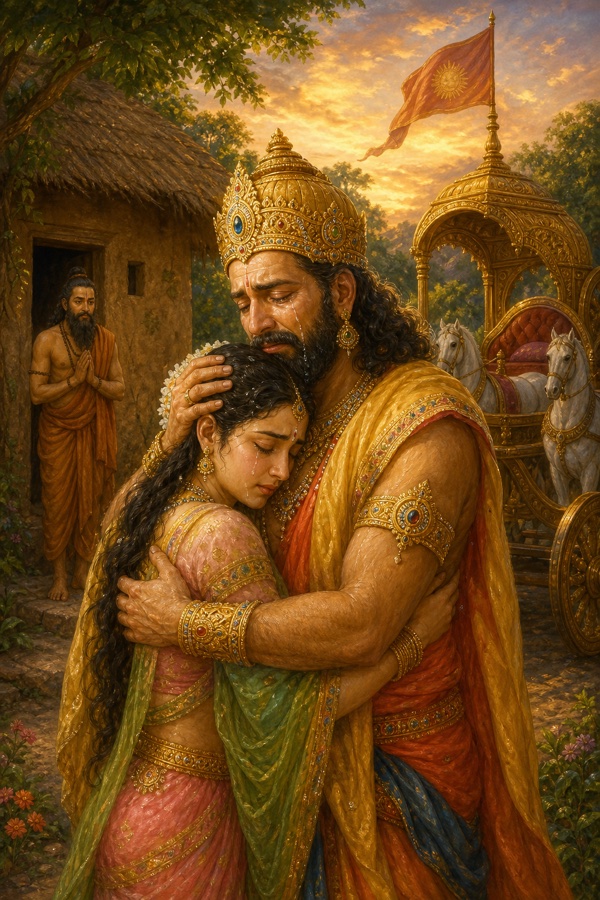
Kardama accepted her hand by the rite the wise call the Brahma rite, the plainest and highest of them all, and he set his one condition in the open, before the emperor himself: he would keep the householder’s life until she had borne through him a spark of the Supreme Spirit, and then he would take up the harmless, possessionless way of the renunciant, the way the Lord himself had marked out for him. Manu, who could read his daughter’s shining face, gave her away with gladness. Queen Shatarupa gave the couple what a mother gives, jewels and fine cloth and every vessel of a household. Then came the farewell. The first emperor of the world, whose word ran across the seven island-continents of the earth, could not carry the weight of this one parting. He clasped Devahuti to his chest, crying “my daughter, my darling,” and wept until all the hair of her head was soaked with his tears. Then the chariot turned.
The palace fell away behind her. Devahuti came to live in Kardama’s small hut. The silks were folded away, the ornaments set aside one by one, and what remained to her was her body and her service.
She took it all on without one complaint. She learned to read her husband’s wishes before he spoke them, and she tended him the way Parvati, the mountain king’s daughter, tends Shiva, holding him higher in her heart than fate itself. She put away lust, deceit, malice, greed, vanity, and everything forbidden, and she won him by fidelity, by cleanness of body and mind, by reverence, restraint, service, love, and plain sweet speech. So deep did she sink herself into that service, through fasts and observances kept year upon year, that her body grew thin and worn. The line of her brow never tightened.
Year after year passed. The two lived close beside each other, and lived like ascetics, bound by the rule of brahmacharya. Husband and wife, and seekers both, waiting on a promise.
It was Kardama who finally broke the long quiet between them. He looked at his wife one day and saw what his tapas had cost her, the thinned wrists, the worn frame, and pity and love rose in him together, and his voice shook when he spoke.
“Daughter of Manu, you have honored me past all deserving. This body, which every living creature holds dearest of all things, you have spent for my sake without once grudging it. So take what my years of penance have stored. I will give your eyes the power to see the unearthly riches my austerity and worship have won, blessings free of fear and free of grief, and yours now by right of everything you have done for me. What are the enjoyments kings chase beside these? One movement of the Lord’s brow can sweep away everything a palace calls pleasure. What devotion to your own dharma has earned you, no throne on earth could buy.”
Something in Devahuti loosened at those words. She had married a master of yoga, and now, for the first time, he had opened the door himself. Her face warmed, and with a smile held down by shyness she answered in a low voice. “I know what your powers can do, my lord. But one promise still stands open, the one you spoke before my father: that we would be husband and wife in full until a child came through you. In all these years I have asked you for nothing, and a child through a husband such as you is the rarest blessing a devoted wife can hold. I am asking now. The scriptures say what should be made ready for such a meeting; tell me, and let it be made ready. And my lord, think also of a house fit for it.”
Kardama looked at her. In her eyes stood a true and open longing, and behind it the fact he had never once forgotten, that this woman had traded a palace for his hut and spent her beauty on his tapas.
“Very well,” he said.
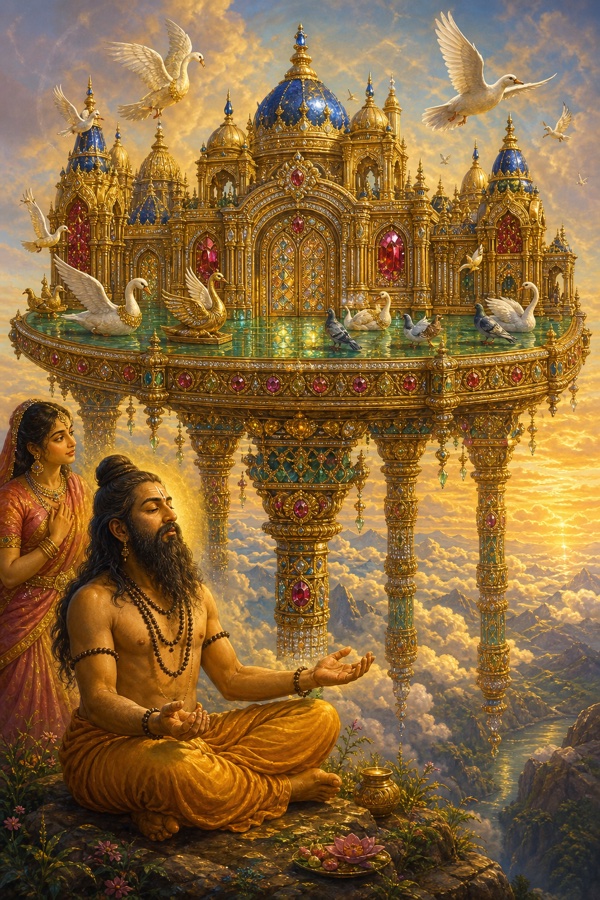
What he did next, he did in that same moment. Kardama settled into yoga, and out of his gathered power he raised a vimana, a mansion of the air that would go wherever a wish pointed it. It stood on pillars of precious stones, and it gave whatever was asked of it, its wealth increasing with use, never wearing thin. It rose floor above floor, hung with flags and buntings of every color and with wreaths of charming flowers that pulled the bees in to hum, and it held couches and beds and seats and fans arranged through its many levels, tapestries of linen and silk, walls worked with art in every corner. Its pavements were emerald set off with daises of coral, its thresholds were coral, and its doors were paneled with diamond. Domes of sapphire carried pinnacles of gold, and the choicest rubies set into its diamond walls glowed as if the palace had eyes. Golden festoons and wondrous canopies hung through its halls, and the artificial swans and pigeons perched about it were made so faithfully that living swans and pigeons flew up to them, took them for their own kind, settled beside them, and called. Pleasure grounds, resting chambers, bedrooms, inner and outer courts, everything stood ready for comfort in every season of the year. Kardama had drawn all of it out of himself, and even so, whenever he looked at it, he wondered at it as if it were another’s work.
And still he watched her, this sage who could weigh the feeling inside any heart, and he saw that even this had not lifted her spirits while she stood in her worn sari with her matted hair. So he said, gently and unasked, “Bathe first in the lake there, and then climb into the vimana. Sri Hari has consecrated that water himself. It grants whatever a human being desires of it.”
That lake was no ordinary water. It was Bindu-sarovar, the lake of the drop, and it lay beside the ashram because of what had happened on this very ground: when Sri Hari looked at the sage who had thrown himself on his protection, compassion so flooded him that tears rose in the Lord’s own eyes and fell, and where those drops touched the earth, a tirtha was born. The Sarasvati kept it brimming. Its water was wholesome and sweet as amrita. Kadamba and champaka, ashoka and bakula, mango and mandara crowded its shores, flocks of rapturous birds called across it, swans and cranes and chakravakas answered from the water, drunken bees hummed, and peacocks danced with their tails spread wide.
Devahuti stepped down into that water. Her sari by then was worn and soiled, her hair had tangled into matted locks, the grime of long austerity coated her body, and the radiance had gone from her breast. She took one dip.
And under the water she saw a palace.
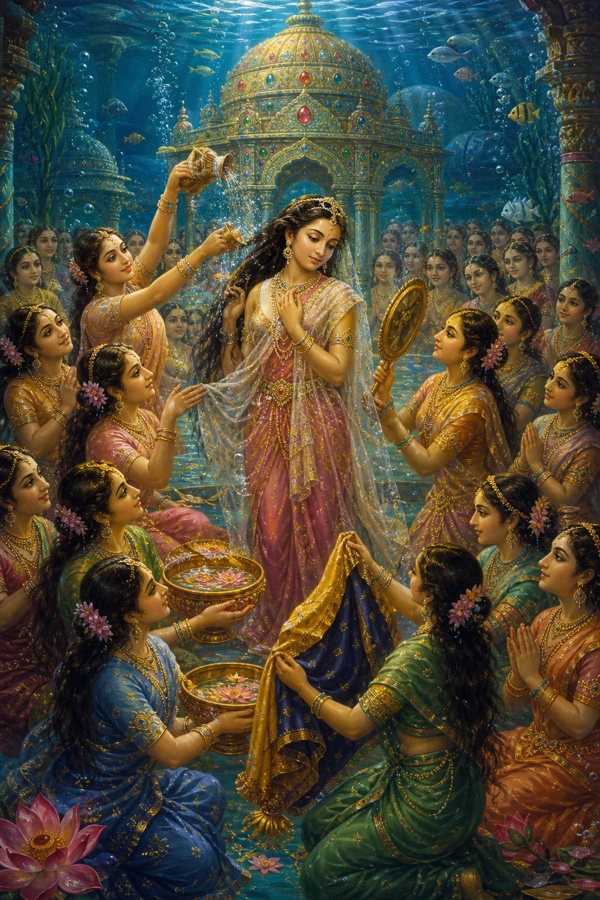
Inside it waited a thousand maidens, Vidyadhara girls in the first bloom of youth, the scent of lotus rising from their bodies. The instant they saw Devahuti they rose together, palms joined, and said, “We are your servants. Tell us what to do for you.” They bathed her with costly oils and perfumed powders, worked the tangles out of her hair, washed the grime away, and dressed her in two new spotless garments. They brought her brilliant jewels, food carrying every good quality, and drinks sweet enough to make the head swim. Then they held a mirror before her face.
Devahuti looked, and for a breath she did not know the woman looking back. The dirt was gone; a garland lay on her; auspicious marks brightened her skin. She had been bathed head to foot, the full bathing of festival days, and dressed in unsullied robes. Gold shone at her throat beside a rope of pearls, bangles rang on her wrists, a jeweled girdle of gold sat on her hips, and at her ankles chimed the same golden bells that had once rung across a palace terrace. Her teeth, her brows, her eyes contending with lotus buds, her dark loosened hair: it was the beauty of her wedding day and something past it, everything the years of tapas had quietly taken, returned in a single dip. Her lips trembled, and no words came. And the moment her mind touched her husband, she found herself standing beside him at the vimana, she and all thousand of her maids at once, and only then, staggered by what his yoga could do, did she understand whom she had married.
He looked at her a long moment, and fondness rose in him, and he handed her up into the vimana.
They rose over the valleys of Meru, the golden mountain at the center of the world, where the eight guardians of the directions keep their pleasure grounds, where the fall of the Ganga out of heaven sounds without pause, and where a cool fragrant wind moves that wakes Kamadeva, the god of desire, in whoever it brushes. Attended by his bride and sung to by hosts of Siddhas, Kardama shone in that mansion like the moon moving with Rohini among the lunar houses, opening the night lilies wherever his light fell, and he reveled there for long years the way Kubera, the lord of treasure, revels above the north. They stayed in the gardens of the gods, Vaishrambhaka, Surasana, Nandana, Pushpabhadra, and Chaitrarathya, and bathed in Manasa-sarovar. On that palace that went wherever will pointed it, Kardama moved through the spheres more freely than the gods themselves, who must each keep to their own. He showed his wife the whole wheel of the earth, its island-continents and their wonders, and brought her home to the hermitage. He lived every enjoyment of the householder, honestly and in full, and the greatness in him never dimmed, and by the power of yoga a hundred autumns went by like a single muhurta, one beat of a day. That slight distance from time, which keeps a seeker always a little apart from the world he moves through, never left him.
When the time for children came, Kardama regarded his wife as the other half of his own self, and by yoga he divided himself into nine forms, and Devahuti bore nine daughters on a single day, every one lovely in every limb, the scent of red lotus on their skin. In time those nine would become the wives of nine great rishis, Marichi, Atri, Angira, Pulastya, Pulaha, Kratu, Bhrigu, Vasishtha, and Atharva, and through them the families of creation would spread across the world.
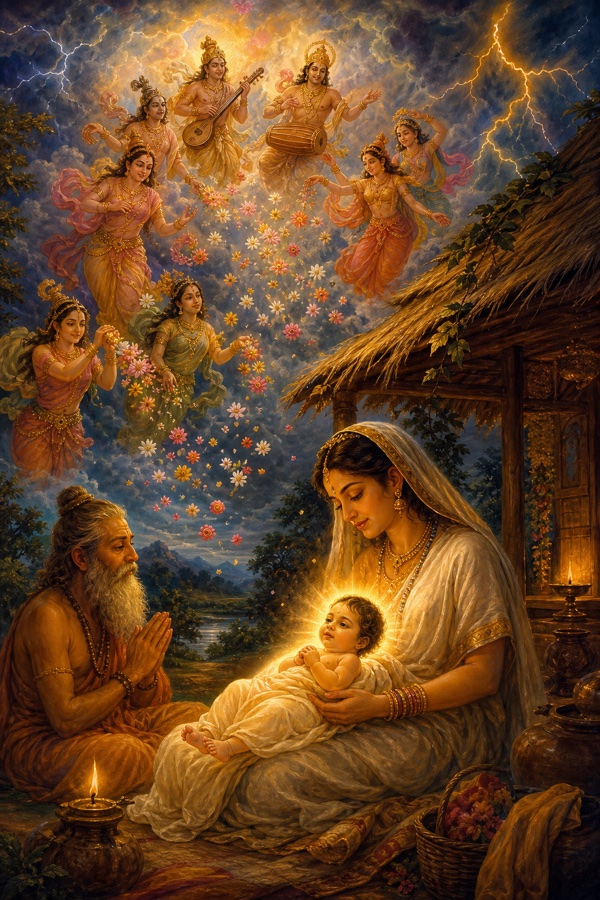
Then one day, the way fire hidden in wood declares itself, a son came forth from Devahuti’s womb. That day the clouds boomed across the sky like drums under the hands of the gods, gandharvas sang, apsaras danced overhead, and divine flowers came down in a slow rain. The quarters of the sky turned clear, the waters ran bright, and a quiet settled over the minds of living things. The child was named Kapila, and in him Sri Hari himself had come down, exactly as he had promised Kardama on this same bank of the Sarasvati.
And with that, the vow that had shaped the marriage came due.
Devahuti had always known this day would come. When it came, she found she was not ready for it. She stood with her head bowed, scratching at the ground with one toe, its gem-bright nail drawing small lines in the dust, as if some word that would not reach her lips might be written there instead. She held her tears where they were, and a smile stayed on her face while her heart shook under it. “My lord,” she said at last, slowly, in a voice sweet and unsteady, “every promise you made me, you have kept in full. And still I am in your refuge, and I ask one thing more: fearlessness. These daughters will need husbands worthy of them. And when you have gone to the forest, there must be someone left to lift from me the grief of birth and death. Enough of the years I have spent on the pleasures of the senses with my back turned to the Supreme. I loved you without knowing your true glory, my lord; let even that love, because it was given to a holy man, work the way love for a holy man always works, and cut my bonds. A person whose days produce no merit, detachment, or service of the Lord is dead while still breathing. And I have been sleeping inside the Lord’s maya: I gained you, the giver of liberation, and never once asked you for it.”
Kardama had carried the Lord’s words for years, and now he gave them to her. Her answer was sleeping in a cradle in her own house. He reminded her of the vows she had kept without a flaw, and he told her what had been promised on this same riverbank, that the son born of her own body would cut the knot of ignorance in her heart and lift her grief with the knowledge of the Self. And confirmation came from higher still, for Brahma himself, the maker of worlds, descended to the hermitage ringed by the Sarasvati, Marichi and the greatest of sages behind him, looked on the radiant child, and knew him at once: golden-haired, with the soles of his feet marked with the lotus, the most ancient Person come down by his own power to give the world the reckoning called Sankhya. “The masters of that knowledge will hold him in highest honor,” the creator said, “and the world will know him by the name Kapila.” Then he charged Kardama to give the nine daughters that very day to the nine great sages, each to the sage her own nature leaned toward, and rode his swan home to Satyaloka. Kardama performed the weddings with the full rites, honored the bridegrooms, and watched the sages carry his daughters away toward their own hermitages, full of joy.
Kardama knew by now exactly who his son was: the one he had beheld ages ago above this riverbank, standing on the shoulders of Garuda. He went to him when the child sat alone, bowed, and spoke to him as to the Lord. “Grace comes so slowly to those burning in the pit of birth and death, and yet you, whom seekers strain to glimpse in solitude after lifetimes of devotion, have entered a house of sense-bound people like us and thought nothing of the disgrace. You were born here to keep your word to me and to give the world the knowledge it has lost. I owed my father Brahma a debt of children; through you it is paid, and every desire I ever held is finished. Allow me now to go.” And Kapila answered him with the calm of the teacher he had been born to be: that whatever he spoke was authority itself, that he had taken this body precisely to open again the subtle path of Self-knowledge that long ages had buried, that his father should go wherever he wished, conquer death, which yields to no one easily, by laying every act at his feet, and find him at last inside his own heart, past all sorrow, in the fearless state. “And to my mother,” he said, “I will give the same knowledge, and she will cross beyond fear.” Kardama walked around his son in reverence and left for the forest. He bound himself in the silence of hermits, the vow in which no word is spoken and no living thing is harmed, gave up the sacred fire and every settled roof, and went out with Sri Hari as his only holding. His mind settled into Brahman until, free of I and mine, indifferent to heat and cold and joy and grief, seeing all things with one eye, he became like an ocean whose waves have stopped. He saw the Lord in every creature and every creature in the Lord, and somewhere on that open road, without desire and without malice, he passed into union with him. He never came back.
Devahuti remained with her son, and Kapila stayed on at the Bindu-sarovar for her sake alone.
Years passed. Kapila grew into his full stature. And one morning the hour arrived that the mother had been feeling for inside herself for days.
Devahuti came and stood before her son. The same son she had nursed at her breast, whose tiny toenails she had trimmed against the pad of her thumb, whose first laugh she still kept somewhere in her hearing. She looked at him and could no longer simply see him, because in that face now lived the one who had descended on this same bank ages before, four-armed, on the shoulders of Garuda, and Brahma’s words had stood in her memory ever since: he has been born of you to tear out the roots of karma.
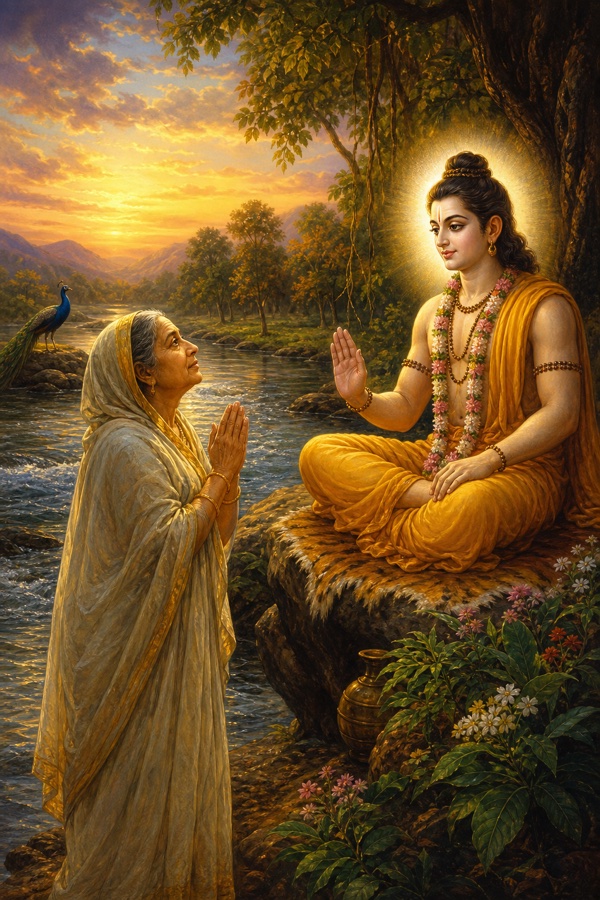
She drew one long breath. Her throat closed; her lips parted and shut again. Slowly she raised her two hands and joined them, the way a disciple joins them before a guru. The palms that had held this child, bathed him, steadied his first steps, now folded themselves before him. Something shook in her chest, a mother’s pride and a disciple’s smallness arriving together, and the joined hands held them both. Nearby the Sarasvati went on flowing, and far off a peacock cried once.
“Bhagavan.” Her voice had grown very small. “I am sick past telling of these senses and their craving. I have spent a lifetime feeding them, and the feeding has dropped me into a darkness so deep I cannot see its walls. And still, at the end of it, by your grace I have gained you, an eye given to me for seeing through that dark. You are the most ancient Person, the Lord of all beings, risen in my own house like a sun for a world blinded by its ignorance. Take apart this delusion of mine, this I and this mine that you yourself once breathed into me. I have come to you to know what Prakriti is and what the Spirit is, and I bow to you, the axe that fells the tree of birth and death.”
Kapila looked at his mother’s joined palms, at the lines her years of serving him had worn into them, and his face opened in a gentle smile, for this asking of hers would become a door for every soul that longs to be free. Then he began to speak to her, and what he spoke would be called Sankhya, the subtle reckoning of spirit and matter that had faded from the world through long ages, and to say it anew was the very reason Sri Hari had let himself be born from her body.
Literary context
The story of Kardama and Devahuti runs through the third Skandha of the Shrimad Bhagavata, chapters 21 through 24: the ten-thousand-year penance and the Lord’s boon, the marriage and the householder’s tapas, the aerial mansion and the tour of the worlds, Kardama’s departure for the forest, and the birth of Kapila, whose Sankhya teaching (the Kapila Gita) unfolds later in the same Skandha.
The text names all nine daughters and their husbands: Kala to Marichi, Anasuya to Atri, Shraddha to Angira, Havirbhu to Pulastya, Gati to Pulaha, Kriya to Kratu, Khyati to Bhrigu, Arundhati to Vasishtha, and Shanti to Atharva. Through their descendants the lineage of creation spread. The Bindu-sarovar on whose bank all of this took place is described as a tirtha kept full by the Sarasvati, born of the tears the Lord shed for the sage who took refuge in him.
A rishi sat on the bank of the Sarasvati for ten thousand years. Then a king’s daughter came to his hut, then a palace rose into the air and was set down again, and at the end everything the story owned had gathered into two palms a mother joined before her own son. Beside them ran the same water into which Sri Hari’s tears had once fallen.