On this page
Ambarisha and Durvasa
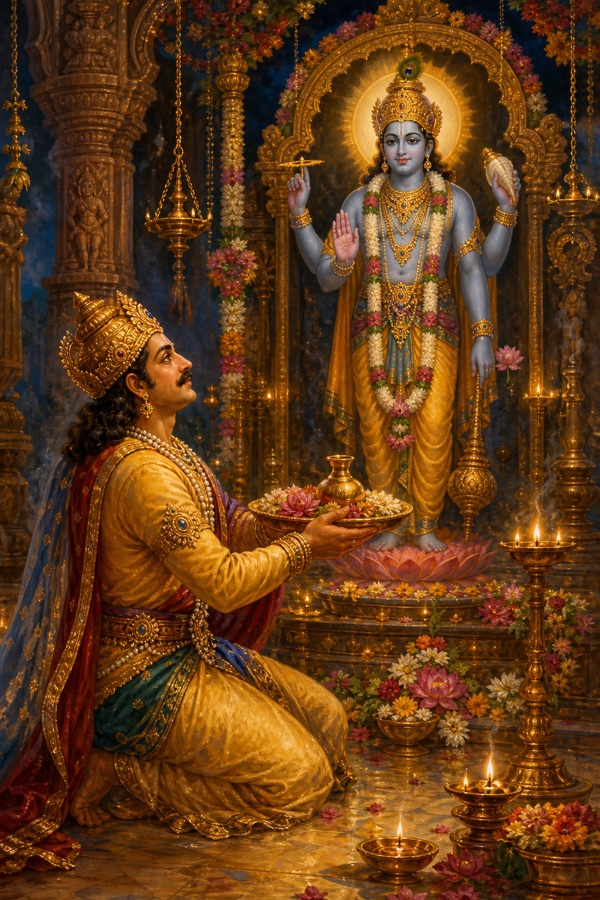
Ambarisha ruled the whole earth, all seven of its island continents, with wealth past counting and power no rival dared test. He had also seen exactly what such things were worth. To him the empire looked like something glimpsed in a dream, real enough to hold and gone the moment the eyes open, and he knew how wealth makes men drunk, so he kept his heart clear of it. His heart he had given to Sri Hari, and with it, one by one, his senses, each set to its own service. His mind rested on the Lord’s lotus feet. His words went to the telling of the Lord’s glory, his hands to sweeping the Lord’s temple, his ears to the katha of the Lord, his eyes to the Lord’s image, his touch to the embrace of the Lord’s people, his nose to the fragrance of tulasi leaves laid at those feet, his tongue to food that had first been offered there, his feet to the roads that led to holy ground, his head to bowing. Even the kingship he carried like a duty performed for its true owner: he ruled as the Brahmins devoted to the Lord instructed him, poured his treasury into great horse sacrifices on the desert bank of the Saraswati with Vasishtha and Asita and Gautama presiding, and governed a people so filled with the stories of Hari that they never asked heaven itself of the gods. And Sri Hari, pleased with a love that wanted nothing back, had given his servant a gift the king had never asked for: Sudarshana, the Lord’s own discus, terror of his enemies, set silently to watch over him.
He had taken up a vow, he and his queen together, who was of one mind with him. A full year of it. On every Ekadashi, the eleventh day of the moon’s bright half and again of its dark half, a fast without food and without water; and on the Dvadashi, the twelfth day, the parana, the formal breaking of the fast, done by rule while the twelfth day still held. Month after month the two of them carried that slow discipline of the body without a single lapse.
The year was nearing its close. The last Ekadashi fell in the month of Kartik, and Ambarisha kept the fast by rule through three full nights. On the Dvadashi morning he bathed in the Yamuna and worshiped Sri Hari in the forest of Madhuvana, on whose ground the city of Mathura would one day rise. He bathed the image of the Lord as one bathes a king, the water rich with sandal and flowers, and dressed it in raiment and ornaments, and laid every fine thing before it; then he honored the Brahmins, though they wanted for nothing, and gave into their keeping sixty crore cows, young, sweet-tempered, heavy with milk, each with its calf and its milking vessel, horns cased in gold and hooves in silver, draped in excellent cloth. He fed the Brahmins first, delicacies suited to every taste, and when they had blessed him and given their leave, he sat down at last to break his own fast. In that very moment a guest arrived at his door.
Durvasa the muni. Son of the sage Atri, carrying in himself a portion of Shiva’s own fire. At his name even the realm of Indra, king of the gods, would go quiet. His anger slept like banked fire in his matted locks and could wake at any moment.
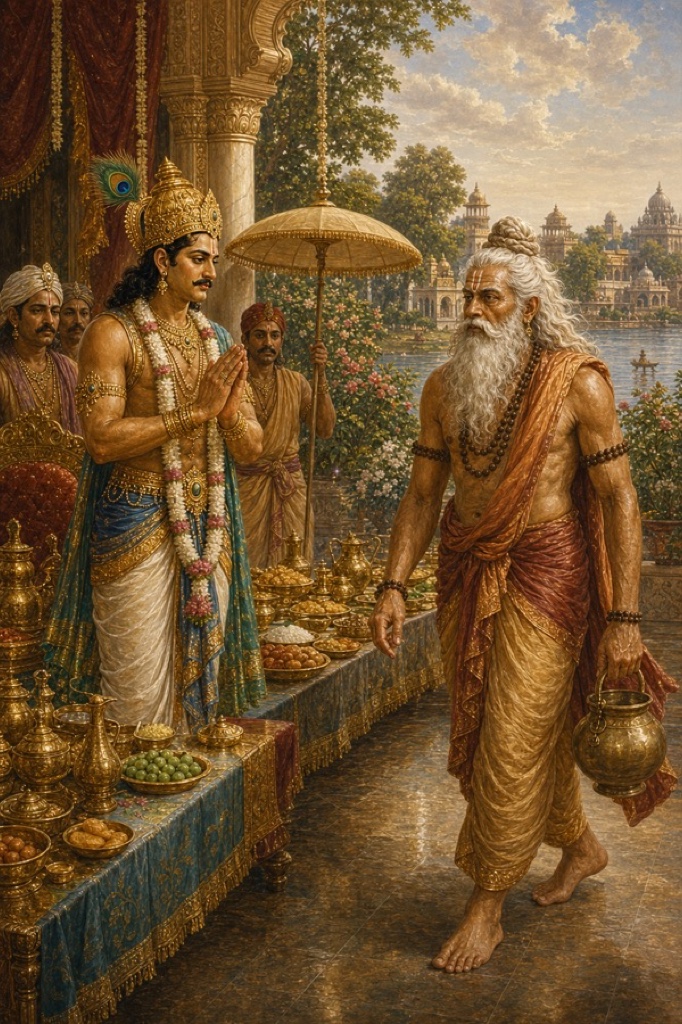
Ambarisha rose, stepped forward, and bowed low, folding his hands. “Come, Munivar. That your feet have touched this courtyard is my great fortune. The meal is ready. Today is the day of my parana; we shall sit together.”
Durvasa was pleased. “Very well, Rajan. Let me first finish my bath and my midday rites, then I will come. Wait until I return.”
He went off toward the Yamuna, waded into her current with his mind fixed on the Infinite, and settled into a meditation that kept no hours.
Ambarisha kept waiting. The hour slid on. Only half a muhurta was left of the Dvadashi now, a span of some twenty-four minutes, and the parana had to be finished while the Dvadashi still held; let that window close and a full year’s vow would come apart at its final knot. Of Durvasa there was no sign anywhere.
Ambarisha turned to his Brahmin preceptors. “What am I to do? To eat before an invited guest is a wound to a Brahmin’s honor, and sin comes of it. And if the hour of the parana passes, sin comes of that too, and a full year of tapas turns to dust. Dharma stands on both sides of me, and both sides are breaking in my hands. Show me the path on which good comes to me and no sin touches me.”
Those Brahmins, knowers of dharma, bent their heads together and weighed it.
“Maharaja, the shastra has a way through this. Take only a little water. The shruti says that drinking water both is and is not eating. By this the bound of the parana is kept, and the rule of honoring a guest with the meal stays unbroken too.”
Ambarisha remembered Sri Hari and touched a single palmful of water to his lips. Then, his mind resting on the imperishable Lord, he sat with folded hands and watched the road for the muni.
In that very instant Durvasa returned.
From far off he sensed it, the way sages of his attainment sense things, with no word spoken: the king had taken water. And the fire that had slept in his matted locks woke in a single jolt. His whole body began to shake. His brows drew down until his face was a knot, and beneath the rage a long day’s hunger burned, feeding it.
“Ambarisha! Look at this cruel man, drunk on his own fortune, who believes all power belongs to him. With me here, having invited me yourself, you began your meal without me. In the arrogance of your riches you forgot what a Brahmin is. Stand where you are, and I will show you what that insult costs.”
Ambarisha folded his hands and bowed his head, and said nothing. What he had done, he had done to keep the bound of dharma, and he had no wish to argue his own case before an enraged muni.
Durvasa tore a matted lock from his head and dashed it against the ground in fury. Out of it rose a Kritya, a demoness fashioned from an angry man’s own power, blazing like the fire that ends the universe, a burning sword in her hand.
“Burn this king to ashes!”
She came down on Ambarisha with the sword raised and flames streaming over her head, and the earth shook with the stamp of her feet.
Ambarisha did not stir. He raised no weapon and gave no ground. He stood remembering Sri Hari, hands folded, and in him there was not one line of fear, for a man who has handed himself wholly to the Lord has nothing left that a sword can take.
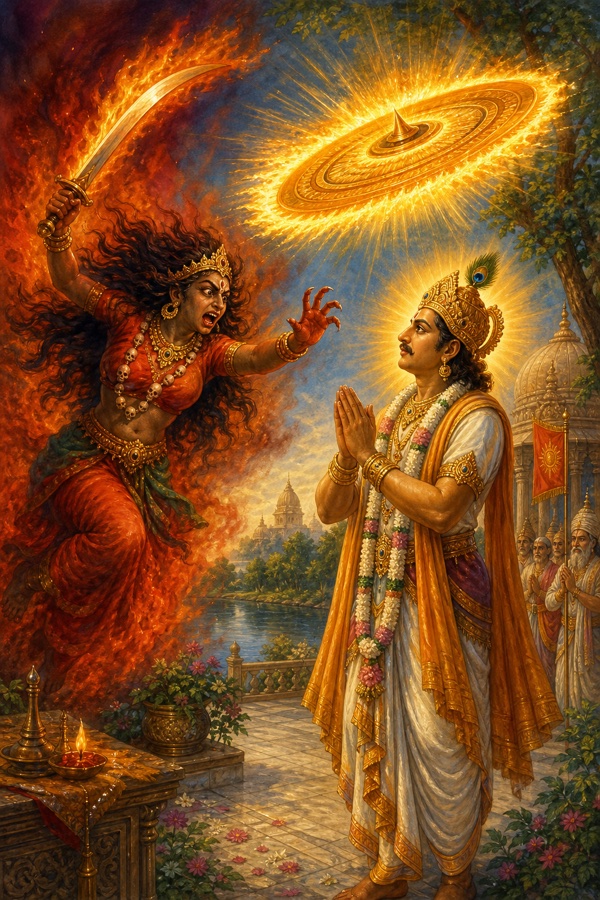
And then the gift answered. Sudarshana, the discus Sri Hari had set over his servant long before, stood blazing between the king and the blade. The Lord had posted that guard long ago, and no cry for help had been needed to wake it.
A whirling ring of fire, burning like a thousand suns risen together. Before its heat even the Kritya’s flaming body went pale.
As a forest fire takes a snake that rears up hissing at it, the chakra took her. One moment, and there was ash.
Then Sudarshana turned toward the one who had sent her.
Durvasa watched the death he himself had loosed come wheeling back for him. Out of his mouth broke the words, “What is this!”
Ambarisha said nothing. Hands folded, head bowed, he stayed exactly where he stood. He left the chakra to its course. Even in that hour there was not one line of enmity in his mind toward the muni.
Durvasa flung everything aside and ran for his life.
A muni who had spent a whole lifetime gathering tapas, at whose anger the worlds trembled, was running now like any hunted creature. The chakra held behind him, at the same distance, with the same heat, tireless as thought.
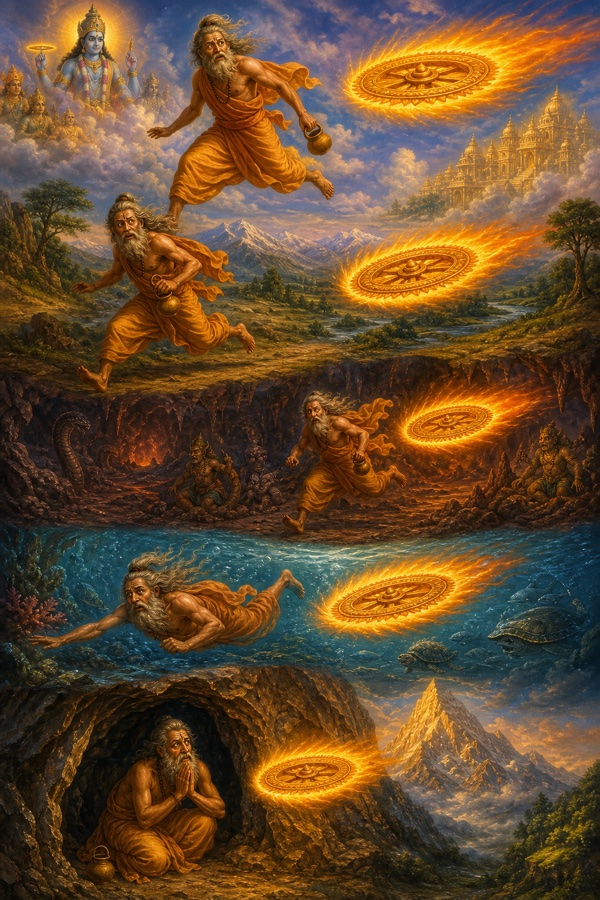
He fled through the quarters of the sky and across the face of the earth. He went down through the lower worlds, Atala and Vitala and the rest of the realms that hang beneath the earth, and through the oceans, and up through the guarded spheres of the world-guardians, and into heaven itself. He hid in a cave of Mount Meru, the golden axis on which the worlds turn. And wherever he went, there, filling the mouth of every refuge, hung Sudarshana, unbearable to look at, waiting.
Beaten, he came to Brahma, the creator seated above it all, the grandfather of every made thing. “Pitamaha! Give me shelter. Save me from the might of Vishnu!”
Brahma raised his hands. “Consider what you are asking of me. When the two long halves of my own life are spent and the Lord, as Time, knits his brows to draw creation back in, this whole universe goes out, and my realm goes out with it. I, Shankara ji, Daksha, Bhrigu and the other lords of created beings, the rulers of ghosts and spirits, the chief of the gods: every one of us carries his law on our heads like a burden and obeys. That discus is his, and it has gone out for the sake of his devotee. For the one who has wronged his devotee I can do nothing.”
Durvasa fled to Kailasa, the mountain where Shiva sits, and fell at his feet. “Mahadeva! Save me!”
Shiva looked at him with compassion. “Muni, this is the weapon of the Lord of all, and none of us can face it. Universes as vast as this one rise within him in their thousands and set again at their appointed time, and in them we are tossed about like small insects. I myself, Sanatkumara and his brothers, Narada, the glorious Brahma, Kapila, Devala, the great masters among the Siddhas, all of us move wrapped in his maya, and none of us can see past its edge. His chakra is beyond my strength and beyond anyone’s. Go to the one who loosed it. Take shelter at that one door; he will bring about your good.”
So at the last Durvasa went to Vaikuntha itself, the Lord’s own realm, where Sri Hari dwells with Sri, the goddess of fortune, at his side. Scorched and shuddering, the sage fell at the soles of the Lord’s feet. “Prabhu! I am in your shelter. You protect the universe; protect an offender too. I sinned against one beloved of you only because I did not know your supreme power. Save me from this fire, and wipe out my sin! At the mere utterance of your name even a soul in hell comes free.”
On Sri Hari’s face was a faint smile, free of mockery and anger.
“Munivar, I hold you in honor. But hear me. I am under my devotees’ control, like a man who has given his freedom away; my heart is in their hands, and they are the ones I love. Set aside my devotees, those who hold me as their final goal, and I want nothing, including my own bliss or Sri herself, who is eternal at my side. How could I turn from people who have let go of wife and home, children and kin, wealth, their good in this world and the next, their very lives, and walked to me for shelter? They bind their hearts to me and look on every creature with one equal eye, and by that love they hold me the way a devoted wife holds a devoted husband. Devotion fills them so full that the four forms of liberation my service earns, life in my realm, nearness to me, a form like my own, union in me, sit before them unwanted; what then would they take of anything that time can eat? Such souls are my heart, and I am the heart of such souls. They know nothing dearer than me, and I know no one dearer than them.”
“Now hear the one way out. This chakra has gone out in the guarding of my devotee, and I cannot call it back by my own will. Force sent against the good returns on the sender; your own blow has circled home to you. Tapas and worship carry a humble man to the highest good, and in a man who has let his humility go, the same tapas and the same worship turn and strike him. Go back to the one for whom the chakra was loosed. Ask Ambarisha, the son of Nabhaga, for forgiveness. Then peace will come to you, and only then.”
In that hour all his tapas felt small to Durvasa. He had been running for a year, through three worlds and past the thrones of the gods, and the refuge he had begged for at every door stood in a courtyard on earth, at the feet of the very king he had tried to burn.
He came back to Ambarisha. The mouth from which curses had poured for a lifetime bent low over a king’s feet, and, full of grief, he clasped them.
“Rajan! Forgive me. Forget my offense. Only you can end this.”
Ambarisha’s heart recoiled. A Brahmin, a muni, gripping his feet: the shame of it burned him worse than any Kritya could have. Stricken with pity, he lunged forward and caught hold of Durvasa’s feet in turn.
“Munivar, what are you doing! Rise. I am your servant.” The king’s own year had gone no more gently than the sage’s. He had waited at this very spot through the whole of it, taking nothing but water, holding his meal unfinished in the hope that the moment his guest returned he could feed him at last.
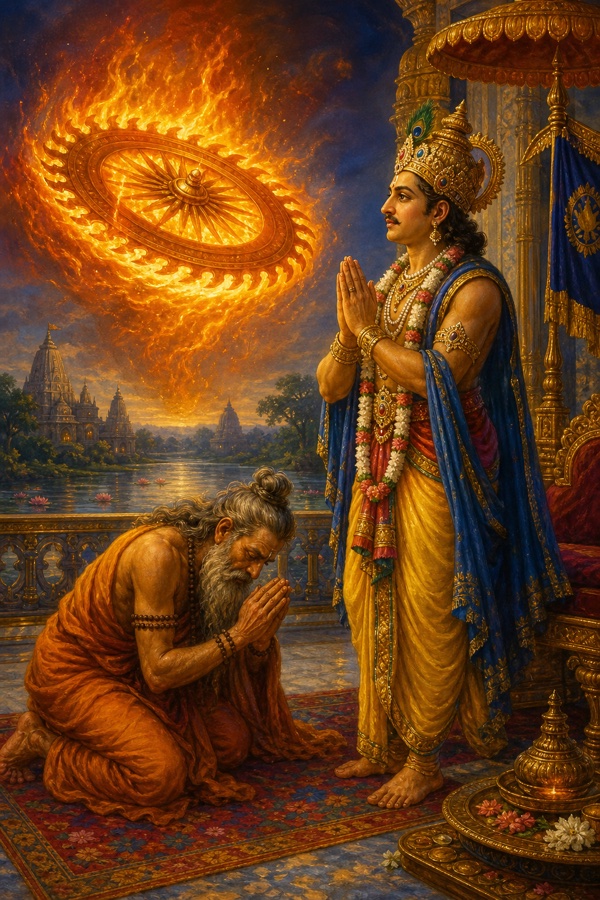
Then Ambarisha turned, folded his hands toward the burning discus, and prayed to it, and the prayer rose from his heart with the ease of long habit. “You are fire, and you are the glorious sun. You are the moon, lord of the night’s luminaries. You are the waters and the earth, the sky and the wind, the things the senses reach for and the senses themselves. I bow to you, Sudarshana, wheel of a thousand spokes, beloved of the deathless Lord, undoer of every other weapon; be gracious to this Brahmin, protector of the earth. You are dharma itself; you are speech that is true and kind; you are the even eye that looks on all beings as one. You are the lord of the yajna and the yajna itself, guardian of the worlds, soul of all that is, the highest splendor of the Supreme Person, whose glory no speech can sound. Beautiful-naved Sunabha, fire to demons who trample what is right, swift as thought, worker of wonders: by your righteous light the darkness that clouds people devoted to dharma is scattered and their own light kept safe, and all this creation, the seen of it and the unseen, is lit. When the Lord hurls you into the massed ranks of the Daityas and the Danavas, you stand blazing in that battle and shear off arms and trunks and thighs and necks without pause. The wielder of the mace has set you over the world as its shield, for the ending of the wicked. If ever I have given a gift rightly, if ever a yajna of ours was rightly served, if ever this royal line has honored Brahmins as gods, then let this Brahmin come free of his torment. If the Lord is pleased with us for seeing him in every creature, then grow cool, and let it be well with the sage. Grant us this as grace, for his death would sit on our house as sin.”
The heat of the chakra drew in on itself and cooled, at a king’s entreaty, and the wheel rose and returned to Sri Hari. Durvasa’s life came back to him.
He sank down where he stood, spent, as though someone had wrung the pride out of him from within.
“Rajan,” he said in a low voice, “today I have seen the greatness of the servants of the infinite Lord, and a whole lifetime of tapas never showed it to me. You strove for the good of the man who came to destroy you. And why should I wonder at it? What is hard for souls who have seated Sri Hari in their hearts, and what could such souls lack, when the mere hearing of his name washes a man clean? You looked past my offense and gave me back my life. That kindness I have no way to repay.”
“I had taken you for an ordinary king. I did not know that Sri Hari himself sits in his devotee’s heart.”
Ambarisha seated the sage with every honor and fed him with his own hands, dish after dish suited to every taste, until Durvasa was sated at heart. Then the sage pressed the king to eat as well, and blessed him: the women of heaven would sing this spotless deed of his again and again, and the earth herself would proclaim his glory. Taking his leave, he rose through the sky toward Brahmaloka, the world of the Creator, which no one reaches whose deeds are done for himself. A full year had turned between his going and his coming back, and through all of it the king had lived on water alone. Only when Durvasa had gone did Ambarisha eat, and what he chose for his meal was the food left from the Brahmin’s own plate, holding it the holier for having been his guest’s. So the parana held off for a year was completed at last, and in everything that had passed, the sage’s fall and the sage’s rescue and his own strength to endure, Ambarisha saw one thing only, the glory of the Lord.
Literary context
The episode of Ambarisha and Durvasa comes in the ninth Skandha of the Shrimad Bhagavata, in chapters 4 and 5. The portrait of Ambarisha there (9.4.18-20) is among the most loved passages of the text: his mind rests at Hari’s feet, his speech in Hari’s glory, and every sense of his body is set to Hari’s service. The driving of Durvasa by the Sudarshana chakra through the three worlds for a full year (9.4.46-52) belongs to this same Skandha.
Sri Hari’s reply to Durvasa (9.4.63-68) stands among the deepest passages in this collection: he declares himself under the will of his exclusive devotees, held by their love as a faithful husband is held by a faithful wife. This ideal of dasya bhakti, the devotion of the servant, sits beside Gajendra’s cry and Prahlada’s fearlessness.
The heart of the katha
Ambarisha’s strength lay in no army and in no weapon, and the year-long severity of his vow was never kept for the sake of his own name. Power earned by one’s own tapas must be carried by one’s own strength, and that is the lesson Durvasa took away. For the one who has laid everything at Sri Hari’s feet, the Lord’s own chakra stands guard behind him, unasked.