On this page
The Syamantaka Jewel
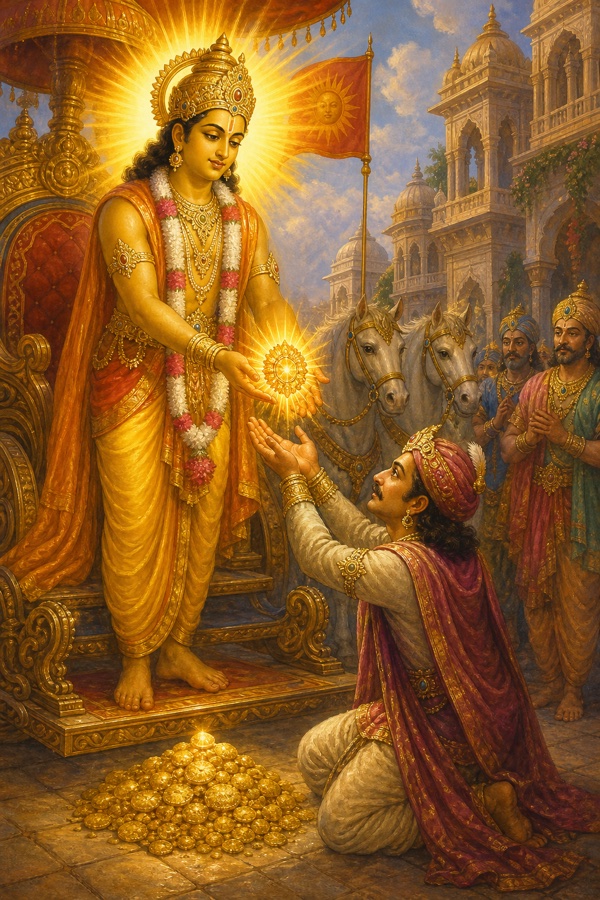
In Dwarka, the fortress city Krishna had raised for his people out of the sea itself, lived a Yadava named Satrajit, rich and honored, and above all a devotee of the Sun-god Surya. His worship was the steady kind that goes on year after year whether or not anyone is watching, and it pleased Surya so deeply that the god who crosses the sky came to befriend him the way one man befriends another. Out of that friendship he gave Satrajit a jewel called the Syamantaka.
The gem was no ordinary stone. When Satrajit hung it at his throat and walked back into Dwarka, he blazed so brightly that no one could look straight at him; people shielded their eyes from a distance and took him for the Sun-god himself, come down to visit the city. They ran to tell Krishna, who was in the middle of a game of dice, that Surya was approaching to see him. Krishna laughed. “That is no god,” he said. “That is Satrajit, lit up by his jewel.”
Satrajit had the Syamantaka installed by Brahmins, with proper rites, in the shrine of his house, in the place kept for the gods themselves. Every single day it gave up eight bhara of gold. And wherever the gem was kept and honored, famine, plague, and every calamity stayed away; snakes did not bite, thieves did not enter, and sickness and fear and ill fortune all kept their distance.
Krishna thought a treasure like that belonged with the king, held in trust for every house in the city, and he asked Satrajit to give the Syamantaka to Ugrasena, the king Krishna had himself seated on the throne of the Yadus. Satrajit was too greedy to part with it. He refused, and never stopped to think what a refusal aimed at Krishna might one day cost him; the daily river of gold had already closed his fist.
Then one day Satrajit’s brother Prasena hung that same mighty jewel at his own throat, mounted his horse, and rode into the forest to hunt. In the noon light it burned on his chest, flashing between the trunks as he rode, as though a second sun had come down to travel through the trees.
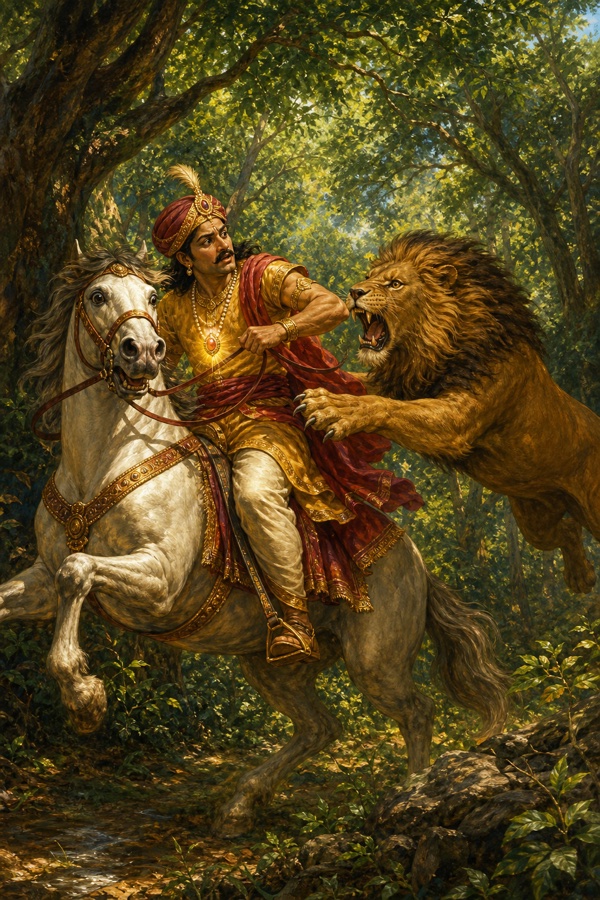
Deep in the woods a lion sprang on the lone rider and brought down horse and man together. It tore Prasena open, and then the strange fire lying in all that blood caught its eye. The beast took up the jewel in its jaws, a chip of the sun in a field of red, and turned back toward its den in the hills.
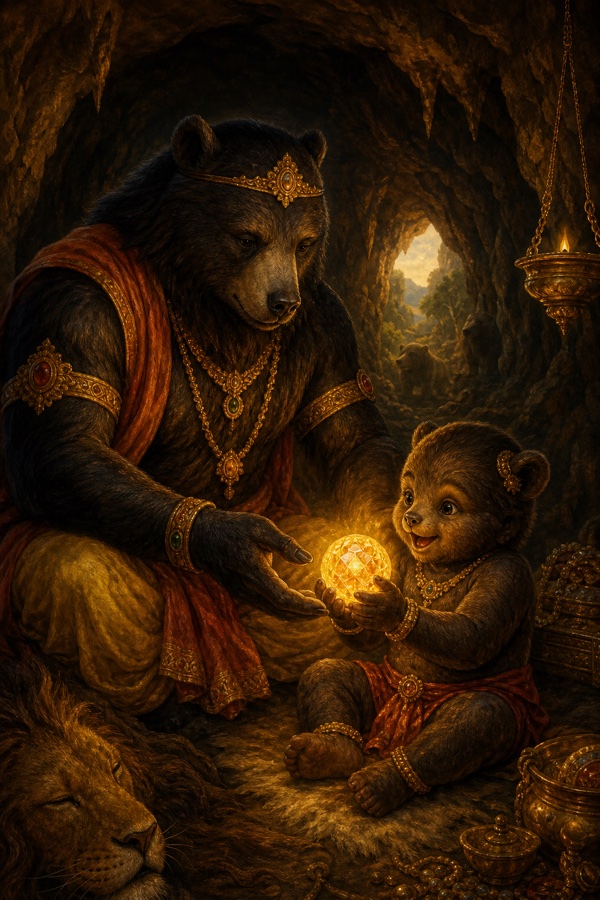
It never reached that den. In those same hills lived Jambavan, king of the bears, old as the yugas. He wanted the shining thing the lion carried, so he struck the lion down at the mouth of its own cave, lifted the jewel, and took it home into his dark cave, where he handed it to his infant cub as a toy. The stone that poured out eight bhara of gold a day, the stone men had already died for, sat in a bear cub’s small palms, and the cub turned it over and over and gurgled with delight.
In Dwarka, Satrajit counted the days. His brother did not come home. No rider brought word of him, no hunter had seen him, and the silence grew heavier the longer it went unbroken.
Grief wants a face to blame, and Satrajit’s suspicion went straight past every lion in the forest and fixed on Krishna. He said it out loud, to anyone who would listen. “It would be just like Krishna to have my brother killed. Prasena rode out with the jewel around his neck, and Krishna had wanted that jewel. He asked me for it once already, and I refused him.”
The words traveled lane to lane, faster than any rider and growing as they went. The people of Dwarka leaned close and whispered to one another, and every whisper left another smear on the name of Shri Hari.
It lodged in Krishna’s mind like a thorn. Even a little dust settling on a good name will sting, and this was more than dust; the city he had raised for his own people was calling him a thief and a murderer in its lanes. Yet he challenged no one, punished no one, and spoke not a single word in his own defense.
“A stain laid by words will not lift by more words,” he thought. “Let the truth speak for itself.” So he gathered a few respected men of the city, elders whose word carried weight in any assembly, witnesses no one could later call his creatures, and set out for the same forest Prasena had ridden into.
Footprints in the grass, a snapped branch, blood going dry on the leaves. Reading each sign in turn, they pressed deeper. First they came on Prasena’s body, torn apart along with his horse, and the men behind Krishna saw with their own eyes what had really killed the missing rider. Beside the body the heavy pad-marks of a lion led away in the direction the jewel had gone. They followed, and higher up the slope they found the lion itself dead, struck down by some far greater paw. And those broader, deeper prints ran on, straight to the black mouth of a hill cave, the den of the bear-king.
Krishna left his companions at the entrance, where the daylight ended, and went down alone into the thick dark.
Inside hung the smell of damp earth and old stone. The great jewel that had blinded the streets of Dwarka lay in a far corner like a child’s plaything. A small cub sat with it, dancing it in its palms and babbling to itself, and beside the cub a nurse kept watch. When a stranger stepped out of the dark, human and beautiful and impossible in that place, she screamed in fright.
Krishna moved slowly toward the stone to take it up.
At the nurse’s scream the shadows of the cave shifted, and something enormous detached itself from them. Jambavan came and stood before him, huge with anger, and his body filled the passage and shut out the last of the light.
“Who are you, standing so close to this child?” His voice hit the stone walls and came back doubled, deeper than before.
Krishna answered calmly and gave his name. But Jambavan, who had once known God by sight, could not see past the man in front of him to the God inside him. He took Krishna for an ordinary mortal who had wandered in where mortals die, believed nothing he said, and saw only a thief come to snatch his cub’s bright toy.
“I am Shri Hari, no robber,” Krishna told him. “That jewel is the witness to a lie told about me, and I have come to carry it into the open, where it can speak. Give it to me.” To the bear-king the words sounded like the smooth talk of a brazen thief.
And then the fight began, the one that still seems to echo in the stone of that cave.
Jambavan was no common strength of arm. Ages before, in the days of the Rama avatar, he had been a pillar of the army that leapt the ocean for Sita’s sake. He had watched the sea grant passage under Rama’s angry glance, watched the bridge of stones take shape across the water, seen Lanka burn and the heads of ogres fall to Rama’s arrows. The power of the Satya and Treta yugas was packed into his arms, and in all that long life no opponent had ever outlasted him.
He did not give a single step.
They came at each other like two starving hawks over one scrap of meat. First it was weapons, then flung boulders, then whole trees torn up by the roots and hurled through the dark, and at last bare arms and fists. Stone cracked, dust boiled up, the cave floor shook, and in the corner the cub cowered with the jewel hugged to its chest, the only light in all that violence.
One day went by. Then two. Then a whole fortnight.
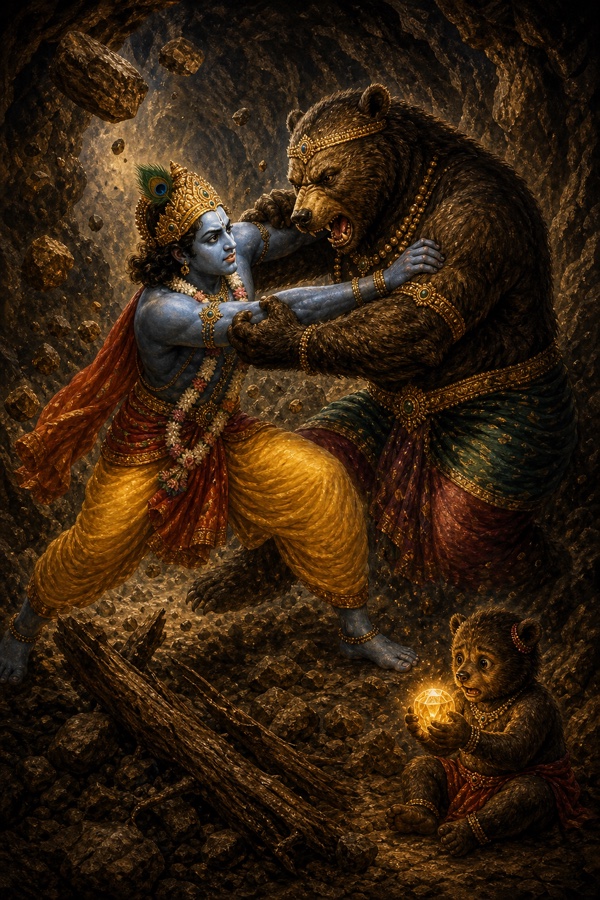
For twenty-eight days, without rest, sleep, food, or water, they grappled day and night in the dark, trading blows that landed like strokes of lightning, and neither the man nor the bear would be the first to stop.
At the end of those twenty-eight days, for the first time in a life older than kingdoms, Jambavan’s arms began to shake. Every joint and muscle in his body had been battered loose, sweat ran from his limbs, his spirit was draining out of him, and the strength that had never once failed him across the yugas was leaking away at the mere touch of this single, unhurried man. Still he would not bow.
And then, somewhere in the depths of his exhausted mind, an old memory lifted its head. This heat, this touch, this unbreakable calm that no fury of his could dent, he had felt them all before, ages ago, on another shore, in the one master whose service had filled his whole life.
His hands went slack. Amazed, gasping for breath, he said, “Stop. Who are you? This strength is not of this world. It is the life inside all that lives, the force inside every arm that was ever strong.”
“I am Krishna.”
“The same one who in that age was Rama? For whom I carried stones across the sea, and watched the ocean part and Lanka burn?”
“Yes.”
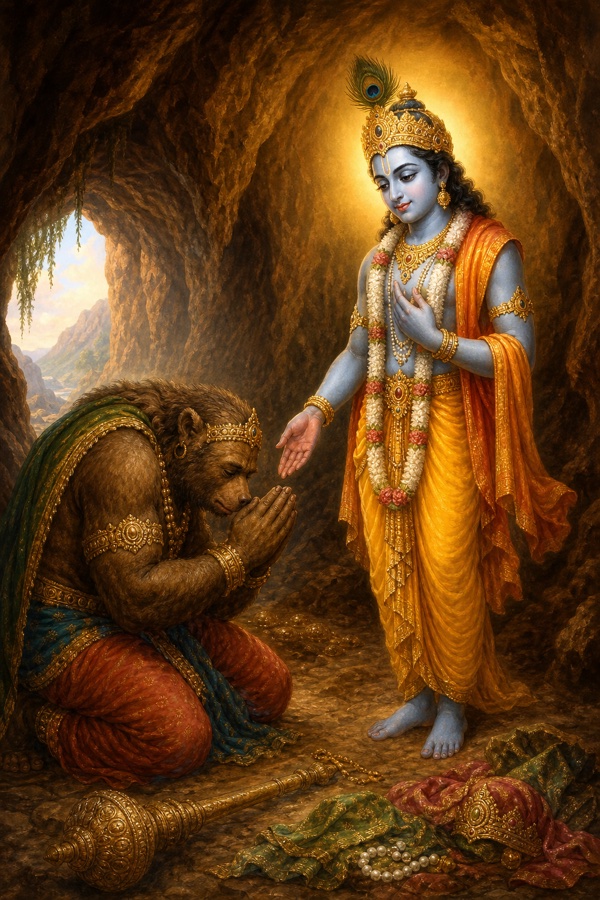
The bear-king’s great head sank slowly, and in that bow the whole force of twenty-eight days melted and turned into bhakti. The fists that had hammered at God unfolded, and the war was over without another blow.
“Prabhu, I know you now. You are the lord and protector of every living being, the most ancient Purusha, Bhagavan Vishnu himself, the maker of Brahma, the very self within all that breathes. Forgive me. I was blind. The one I searched for through every age stood in my own cave, and for twenty-eight days I lifted my hand against him.”
“There is no fault in you,” Krishna said, his voice gone deep with feeling, and he passed his cool, blessing hand over the old devotee’s battered body, and the ache of twenty-eight days began to loosen under it. “This time I have come in another form. It is this gem that brought me to your cave: a lie has been told about me in Dwarka, and the Syamantaka is the one witness that can clear it.”
Jambavan went in, took the jewel from his cub’s palm, and came back and set it in Krishna’s hands, gladly, the way a man lays an offering before his chosen god.
“One more thing I would ask, Prabhu,” he said. “My daughter, the maiden Jambavati. Give her a place at your feet. What greater fortune could I hope for than that?”
Krishna took her hand in marriage with the proper rites.
The men Krishna had left at the cave mouth waited twelve days for him, watching a darkness that gave nothing back, and at last turned home to Dwarka with the news. Devaki, Rukmini, Vasudeva, and all their kin fell into grief. The people of the city cursed Satrajit’s name for setting it all in motion and turned to the great Goddess Durga, worshiped in that country as Candrabhaga, praying for Krishna’s safe return. And even as the Goddess’s blessing was being spoken over them, Krishna walked back among them, the jewel at his throat and a new bride, Jambavati, at his side. Those who had given him up for dead were flooded with a joy like watching a dead man walk home.
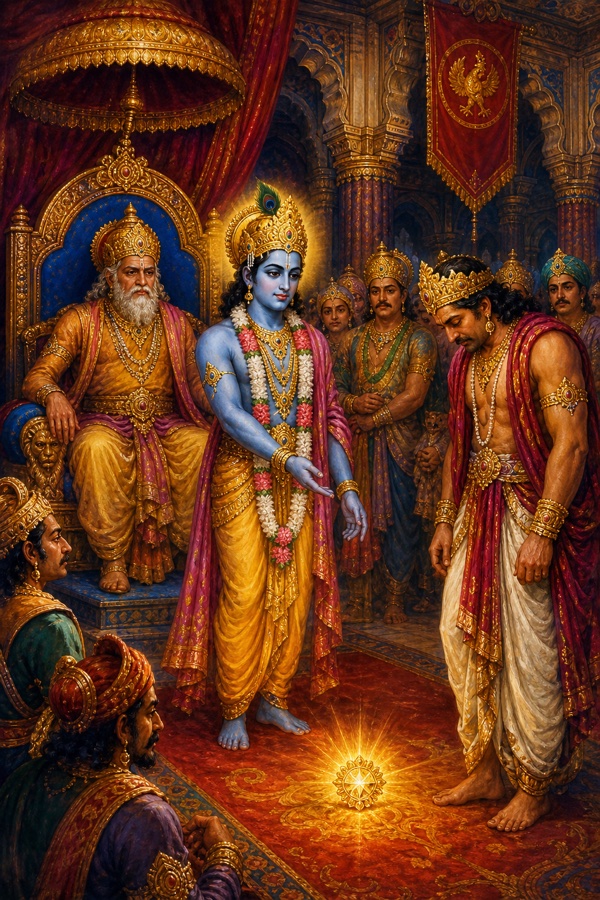
The royal assembly was called, and Satrajit was summoned into it. Before Maharaja Ugrasena and the gathered court, Krishna laid the jewel down in front of the man who had accused him and told the whole story from beginning to end: the lion, the bear, the cave, the twenty-eight days. Then he handed the Syamantaka back to its owner. Satrajit took it with a head bent so low with shame that he could not lift his eyes.
He went home heavy with remorse, the gem in his hands heavier now than all the gold it had ever given. He had set himself against Krishna, and now a fear of that mighty man and his kin sat in him and would not leave; his offense played before his eyes day and night. At last he made up his mind. “Greed for gold has made a fool of me. Let me give Krishna both my daughter Satyabhama and this jewel. That is the only atonement worth the name; nothing smaller will end this.”
He carried both to Krishna himself, with no messenger to soften the errand, and clasped his feet. “Forgive me, Prabhu. I flung filth at a man as clean as you. My greed drew a veil across my eyes. Take the jewel and take my daughter, both.”
Satyabhama had been sought by many suitors, for she was a jewel among women, gracious and lovely and large of heart, and Krishna married her with the proper rites. But the gem he would not take. “I will not keep the Syamantaka,” he said. “You are a devotee of the Sun-god, and it came to you from his own hand; let it stay with you. I ask only for its fruit, the gold it yields. That you may send to me.” And so the stone stayed in the house of the man it had already cost a brother.
So at the end of a single search, the man who had set out only to wipe away a lie came home with two queens: Jambavati, the bear-king’s daughter, won out of the dark of a cave, and Satyabhama, daughter of the very man who had framed him.
But the Syamantaka was not finished with the world, and it would cost more lives before it came to rest.
Some time later, word reached Dwarka that the sons of Pandu and their mother Kunti had burned to death in a house of lac, raised for them so that it would burn. Krishna knew better; he knew they had slipped away unharmed before the fire was ever set. Yet he went to Hastinapura with Balarama all the same, to sit with the grieving Kuru elders, Bhishma, Kripa, Vidura, Gandhari, and Drona, and to carry a share of a sorrow he alone knew to be unfounded. “What a calamity,” the brothers said with the mourners, and stayed.
With Krishna away, three men found their opening. Akrura and Kritavarma, Yadavas of standing who had never forgiven Satrajit for smearing Krishna’s name, went to a third named Satadhanva, a man whose own bitterness needed little feeding, and worked on him. “Why should that house keep the jewel? Satrajit swore his daughter to us, and then handed her to Krishna as if we counted for nothing. Why should he not follow his brother Prasena?”
The poison did its work. One night Satadhanva walked into Satrajit’s house while the whole household slept and killed him in his bed, as a butcher fells a beast, without anger and without hesitation. The women of the house woke and screamed and wailed around the body like the masterless, and he took the Syamantaka from among them and slipped out into the dark.
Satyabhama found her father murdered. Half out of her mind, crying “Father, oh my father, I am undone,” fainting and waking and fainting again, she had his body laid in a vat of oil so that it would keep until it could be honored properly, then drove her chariot through to distant Hastinapura to bring Krishna the news herself. He already knew it; nothing is hidden from him. Even so, out of regard for the ways of the human world he had made his own, he and Balarama wept with brimming eyes and said, “A great grief has come on us.” Then they turned for home with her, to take Satadhanva’s life and bring the jewel back.
Satadhanva heard they were coming and went cold. He ran first to Kritavarma, and the man who had talked him into the murder shut the door on him. “I will not stand against those two brothers. Look what enmity with them did to Kamsa, who lost his throne and his life at a single stroke, and to Jarasandha, master of armies, who came at them seventeen times and seventeen times crept home without so much as his chariot.” He ran next to Akrura, the other voice that had lit this fire, and Akrura refused him too, and spoke of Krishna the way a frightened man speaks of God: of the boy of seven who lifted the whole of Govardhana on one hand and held it there as easily as a child holds a mushroom. Turned away on both sides, Satadhanva left the jewel with Akrura for safekeeping, mounted a horse that could cover a hundred yojanas in a single run, and fled.
Krishna and Balarama came after him on their chariot under the banner of Garuda, the great eagle who carries Vishnu himself, four horses at a dead run. In an orchard on the outskirts of Mithila the horse gave out beneath him, and Satadhanva left it where it fell and ran on his own feet, with Krishna’s wrath close behind. Krishna came down from the chariot and went after him on foot as well, unwilling to ride down a man who had nothing left to ride, and took off his head with the discus. Then he searched the dead man’s garments, upper and lower, for the jewel, and found nothing. He came back to the chariot. “I have killed him for nothing,” he told Balarama. “The Syamantaka is not on him.”
“Then he left it with someone in Dwarka before he ran,” Balarama said. “Go back and trace it out. As for me, I have long wanted to see my friend the king of Videha.” And he walked into Mithila, where Janaka rose from his seat the moment he saw him, honored him with every gift the scriptures prescribe, and kept him as a beloved guest for years. In that time Duryodhana, eldest son of the blind king of Hastinapura, came to Mithila and learned the art of the mace at Balarama’s feet.
Krishna returned to Dwarka and told Satyabhama that her father’s killer was dead, though the jewel was still lost; it was all the comfort he had to bring her. Then, with his kinsmen around him, he saw to every last rite owed to her murdered father, each offering made in full, so that Satrajit’s journey onward would want for nothing.
When Akrura and Kritavarma heard that Satadhanva had been cut down, fear drove them both out of Dwarka. And with Akrura gone, and the jewel gone with him, the city began to suffer. The omens turned foul; ailments of body and mind, and troubles no physician could name, came again and again. The elders, forgetting what they knew perfectly well, that no true calamity can visit the city where the Lord himself dwells, blamed it all on Akrura’s absence. They recalled how his father Swaphalka had once come to Kashi in a long drought, how the king there gave him his daughter Gandini in marriage, and how the rains broke soon after. Wherever a man of that line lives, they said, Indra opens the clouds, and no plague or untimely death comes near.
Krishna knew the omens ran deeper than one man’s absence, and he also knew exactly where the jewel was. He had Akrura brought back with every honor, received him warmly, spoke kindly with him of many things, and then, smiling, said aloud the thing everyone had been stepping around. “We have always known that Satadhanva left the Syamantaka with you, friend. Satrajit died without a son, so its gold falls by right to the sons Satyabhama will bear, once the water and the rice have been offered for him and his debts are cleared. Keep the gem itself; a man strict in his vows can hold such a thing safely, and other men cannot. But my own brother Balarama half believes that I took it and hid it away, and the whole house is uneasy over it. Bring it into the open, and let them breathe. I know it is with you. No one else could be raising sacrificial altars of solid gold, rite after rite, the way yours have risen all this while.”
Won over, Akrura brought out the jewel from its hiding place, wrapped in a piece of cloth and blazing through the weave like a small bound sun, and laid it in Krishna’s hands. Krishna held it up before Balarama, before Satyabhama and Jambavati, before all his people, and the last of the blame slid off him in that light. Then he gave the stone back to Akrura, to keep openly and in plain sight, with his blessing on the keeping.
So the Syamantaka came to rest at last. It had passed from a greedy hand to a murdered one, from a murderer to a schemer, and only in the keeping of a devotee who lived by his vows did it stop taking lives and simply shine. Twice that one stone had gotten Krishna named a thief, once in the lanes of Dwarka and once inside his own house. Both times he answered the same way. He said nothing for himself, walked the truth out into open daylight, and let the sight of it clear him.
Literary context
This katha of the Syamantaka jewel runs across two discourses in the tenth Skandha of the Shrimad Bhagavata. Satrajit’s getting the jewel from Surya, the slaying of Prasena, the twenty-eight-day battle in Jambavan’s cave, and the marriages of Jambavati and Satyabhama fill Chapter 56. The murder of Satrajit by Satadhanva, egged on by Akrura and Kritavarma, the pursuit and killing of the thief, and the jewel coming to rest at last with Akrura fill Chapter 57. The Bhagavata closes the episode with a promise of its own: whoever reads, hears, or remembers this story of the Lord is freed from ill fame and sin and finds lasting peace.
In tradition this episode is linked to the folk custom of avoiding the sight of the moon on the night of Bhadrapada Shukla Chaturthi; on that night a fear of false blame is held, such as the one that fell on Shri Krishna. The Gita Press Gorakhpur edition is the basis here. Krishna twice declines to keep the Syamantaka for himself; at the close it stays openly with the devotee Akrura, with Krishna’s leave, since only a man strict in his vows can safely hold it.
Why this katha matters now
The Syamantaka gave gold and safety to a pure keeper and death to a greedy one. Wealth, fame, and strength all work the same way. Placed in worthy hands, they become service and shelter for others. Placed in unworthy hands, they curdle into arrogance, theft, and blood, and in the end they ruin whoever grips them. Prasena, Satrajit, and Satadhanva all reached for the stone and lost their lives to it; only Akrura, who lived by his vows, could hold it in the open and come to no harm. And when mud is thrown at an innocent man, this is Krishna’s way: he stays silent, goes quietly after the truth, and lets it clear him; and when it does, the ones who accused him come and bow on their own.
The same katha elsewhere
- Harivamsha · The Syamantaka Jewel
The Harivamsha’s telling of the Syamantaka jewel