On this page
The Previous Birth of Narada
The account now turns to a rain-season hut from a distant age.
“A doubt was troubling Vyasa ji that day, a heaviness all his learning had failed to lift, and to settle it Narada opened his own story.”
“Vyasa ji,” Narada had said, “I was not always Narada.”
“My last birth fell in the kalpa now gone, the age of creation before this one, when the worlds last rose out of the great waters. I was the son of a serving woman.”
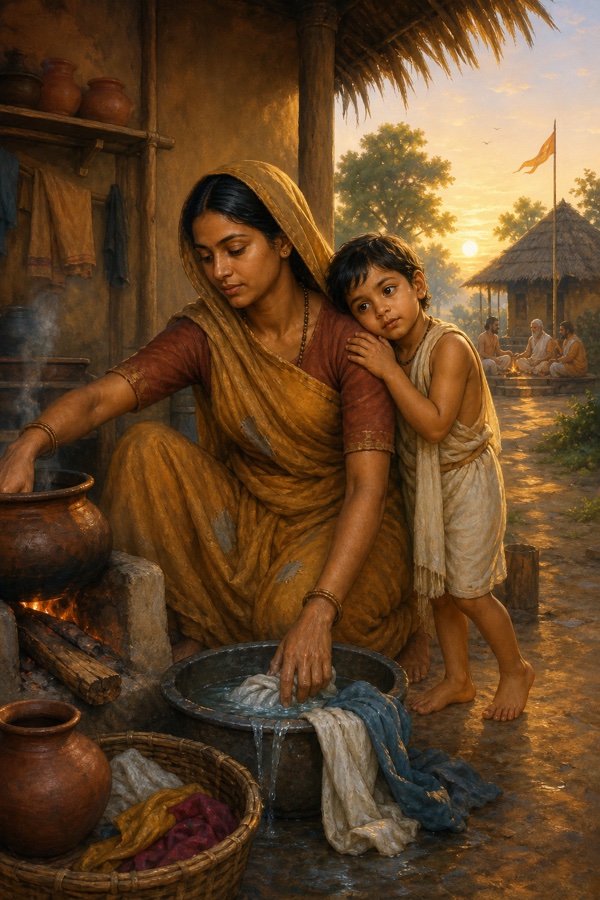
“My mother was a maid in the house of some Brahmins learned in the Vedas. She cooked their food, washed their clothes, did whatever was asked of her. Of my father I knew nothing, not so much as a name.”
“I lived with my mother in a hut. I was very small then. Five years old.”
“Then one day something happened that has shaped every birth I have had since.”
“Some sadhus came to stay in the home of those very Brahmins my mother served. Wandering renunciants, men who owned nothing, slept nowhere twice, and sang of the Lord as they walked. They stayed four months. It was the season of rains, when the roads drown and the rivers swell, and men of their kind keep an ancient vow for exactly those months: settle in one place, wander nowhere, and let the mind grow still while the sky pours.”
“Those Brahmins were good people. They gave the sadhus room under their own roof and fed them through the whole of the rains.”
“My mother was given the work of serving them. And she took me along.”
“I spent those four months in front of them.”
“And what did those men do, all day? They took the Lord’s name. Sometimes they listened to hari-katha, the stories of the Lord, and sometimes they told it, one voice picking up where another left off. The incense smoke of their yajna, the daily fire-rite, hung over the courtyard. As evening fell, the sound of their kirtan drifted all the way to our hut.”
“And when they ate, I would watch.”
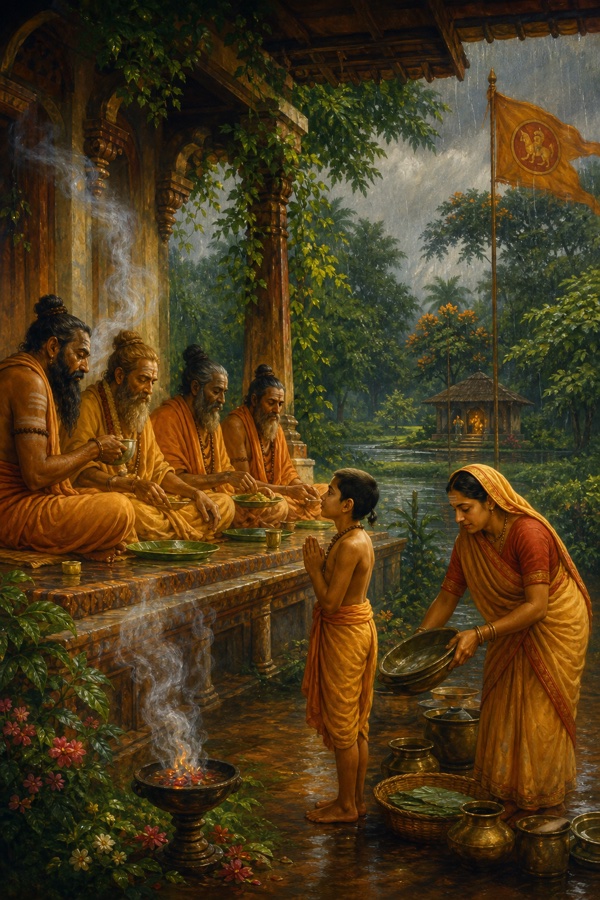
“After their meals, whatever ucchishta remained, the leavings a renunciant’s hand had touched and turned from scraps into grace, my mother would clear away. I did not run and shout the way small children do. I spoke little, kept away from toys and games, and did whatever small service those men needed, fetching, carrying, sitting quiet at the edge of their circle. They looked on everyone with the same even eye, and still they grew especially fond of me, this silent child who would not leave.”
“One day the Brahmins gave their consent. After that, once in each day and night, when the sadhus rose from their meal, I ate the little that was left clinging to their vessels.”
“That daily handful of leavings washed every old stain out of me. Sins carried in from births I could not even remember loosened and let go, and my mind grew clear and light, the way a dark room changes when someone carries a lamp into it.”
“And a mind made clean leans somewhere. Mine leaned toward the path those men walked, toward the very Lord they named from morning to night.”
“Those sadhus spent the whole day singing and telling the enchanting stories of Shri Krishna, the Lord who had walked the earth as a cowherd and a king. By their grace I too began to hear those stories, three times over each day, morning and noon and evening, their voices carrying his praises across the courtyard while I listened with everything in me.”
“Line after line, taken in with faith, my taste for the Lord’s glory grew deeper and deeper. All through the rains and on into the clear autumn that came after, a devotion took root in me of the kind that burns restlessness and dullness out of a person at the root. My mind settled on him and stayed, and through that stillness I began to see this whole world, the coarse and the subtle of it together, as something resting inside him, spun out of his own power and drawn back into him again.”
“When the four months were over and it was time for those men to move on, they did one last thing for me. I was a servant’s child with nothing to give and no claim on anyone, and they were men who felt the suffering of every creature as their own. Before they walked out of that village, these sadhus set their most guarded possession into my hands: the secret wisdom the Lord himself had once revealed to them.”
“Through it I came to see the maya of Vasudeva, the veiling power by which he spreads out these worlds and hides himself within them, and I understood that whoever truly sees through that veil comes home to him. They taught me what to do with a life as well. Work chains a man to the wheel of birth and death, they said, yet the same work offered up to the Lord loses its power to bind, just as a physician takes the very substance that caused a disease and, rightly prepared, cures the disease with it. And they gave me the meditation of the four names, obeisance to Vasudeva, to Pradyumna, to Aniruddha, to Sankarshana, the Lord of all yajnas whose true body is mantra and who wears no material form at all. I carried that instruction out, and in time Keshava himself filled me with knowledge of the self and a love for his feet that has never once cooled. A child of five, and the mahatmas had put the highest wisdom of all into my hands as they left.”
“The four months ended. The sadhus left. I stayed where I was.”
“I was no longer the same, though. My heart had been made pure, and it had already chosen whom it belonged to. At five years old.”
“Their stories kept sounding inside me all day, under everything, even while I worked beside my mother.”
“I was my mother’s only child, and she had wound her whole heart around me. She was an unlettered woman, a servant in another man’s house, and for all her longing to keep me safe and lay something by for my future, she could not. A bondswoman lays nothing by. The world moves at its Ruler’s will the way a wooden puppet moves on its strings, and her strings had never once been in her own hands.”
“For her sake I stayed on in that settlement of Brahmins. I was five years old. I did not yet know north from south, and I had no more idea of distance and time than of the quarters of the sky.”
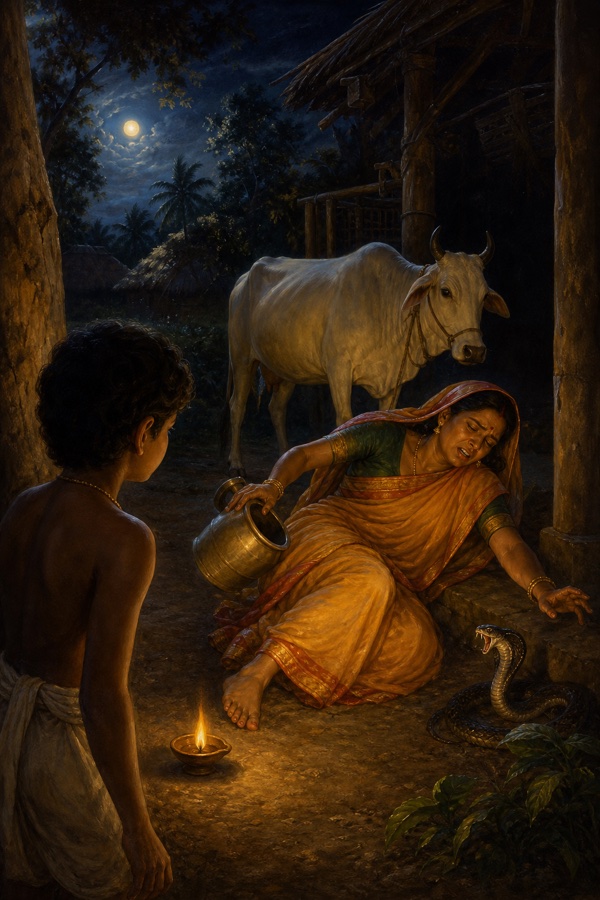
“Then one night she went out into the dark to milk the cow. Her foot came down on a snake lying across the path. It struck, as fate had long arranged it would, and she died there on the bare earth, the pot still beside her.”
“I was alone.”
“I had no one left in the world. And I did a strange thing with that grief. I took it as the Lord’s own kindness. He watches over those who lean on him, and it seemed to me he had quietly cut the last cord holding me to one place, so that nothing now stood between me and the search for him.”
“So I turned my face north and set out, a child walking alone into a country he did not know. I passed through rich lands and great cities, through villages and the camps of cowherds, past mines and hamlets and the scattered huts that cling to riverbanks and the flanks of hills. I crossed plantations and groves and flower gardens, hills veined with ore of many colors, trees with their limbs torn down by elephants, cool lakes of sweet water, and lotus ponds that seemed made for the gods, loud with the calls of a hundred birds and humming with bees that drifted from bloom to bloom.”
“And then the country ended, and I stood alone at the edge of a vast and fearful forest. It ran on without any far side, choked with reeds and bamboo and blades of sharp kusha grass, hollow canes knocking against each other in the wind, and the dark of it hissed and hooted and howled. Snakes lived in it, and owls, and jackals. I walked in.”
“By then my body and senses were failing me. Thirst had me by the throat, and hunger with it. I found the pool of a river close by, bathed in it, drank, rinsed my mouth, and felt the tiredness lift out of my limbs like a fever breaking.”
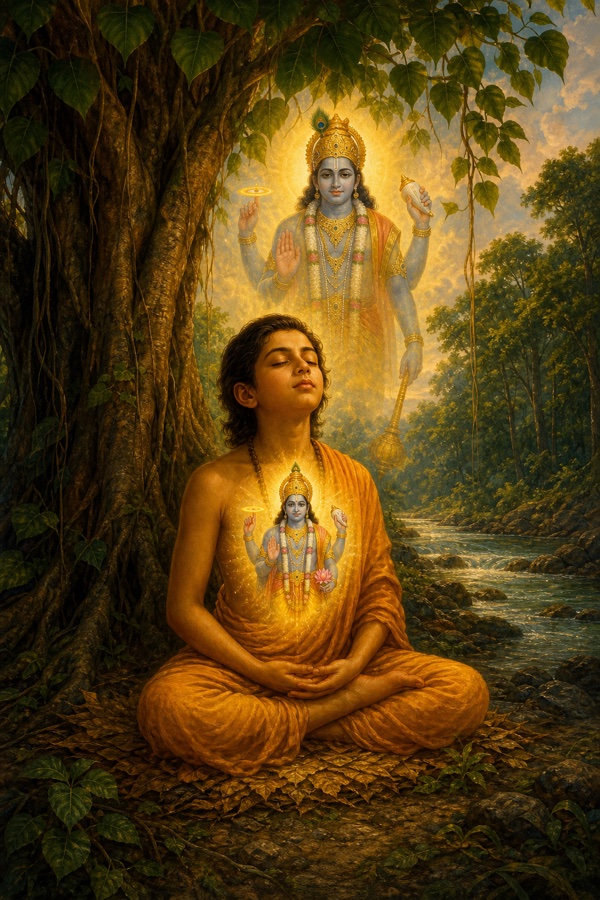
“In that forest where no one lived, I sat down at the foot of a peepal tree, the fig with heart-shaped leaves under which seekers have sat since seeking began. I closed my eyes. And exactly as the mahatmas had taught me, I began to hold in mind the Paramatma who sits within every heart, in the very form they had given me to remember.”
“As I meditated on his lotus feet with a mind that love had overpowered, tears rose in my eyes from the sheer longing to see Hari. And slowly, on the screen of my heart, the Lord appeared.”
“Love broke over me like a wave, and the hair on my body stood up. A joy and a stillness past anything I had ever felt flooded my heart in the same instant, and I sank so deep into that flood that I lost all sense of myself and of the one I was beholding.”
“Then the form was gone. All at once, without warning, that form beyond all description, the sight of which had lifted every grief out of my heart, simply vanished. I sprang to my feet like a man robbed. I gathered my mind back into my heart and reached for the vision again and again, and it would not come. I stood there in that empty forest, wretched and aching, like one whose one hunger has been left unfed.”
“And then a voice reached me, deep and grave and sweet at once, and the grief in me began to settle at the first word of it.”
“‘It grieves me that in this birth you will not see me again. To those only half ripened in yoga, whose old cravings have not yet burned wholly away, the sight of me is very hard to win.’”
“‘Sinless child, I showed you this one glimpse of my form for a single reason: to wake in your heart the burning desire to reach me. The seeker who carries that desire sheds every craving inside him, little by little and in the end completely, until nothing is left that can hold him.’”
“‘The short service you gave those saints has already fixed your thought on me past all undoing. When you lay down this coarse and perishable body, you will come to me and stand among my own attendants. This resolve of yours to reach me will never break. And by my grace, even when the whole of creation has dissolved and time itself sleeps, the memory of me will stay alive in you.’”
“The great unseen Being who rules all things, present everywhere the way the sky is present everywhere, said this much and fell silent. I felt the size of the grace that had just been shown me, and I bowed my head to him, the greatest of the great.”
“After that I let go of all shyness and hesitation. I sang his names, the mysterious, auspicious names, and held his deeds in my thought wherever I walked. Craving, pride, and envy had already fallen away from me. Content at heart, wanting nothing, I wandered the earth and waited for my end. And when the appointed hour came and the karma that had built this body was fully spent, death reached me like a stroke of lightning, one flash and no pain, and even as I passed into the pure form of the Lord’s own attendant, this body of the five elements dropped away, its every debt reaped.”
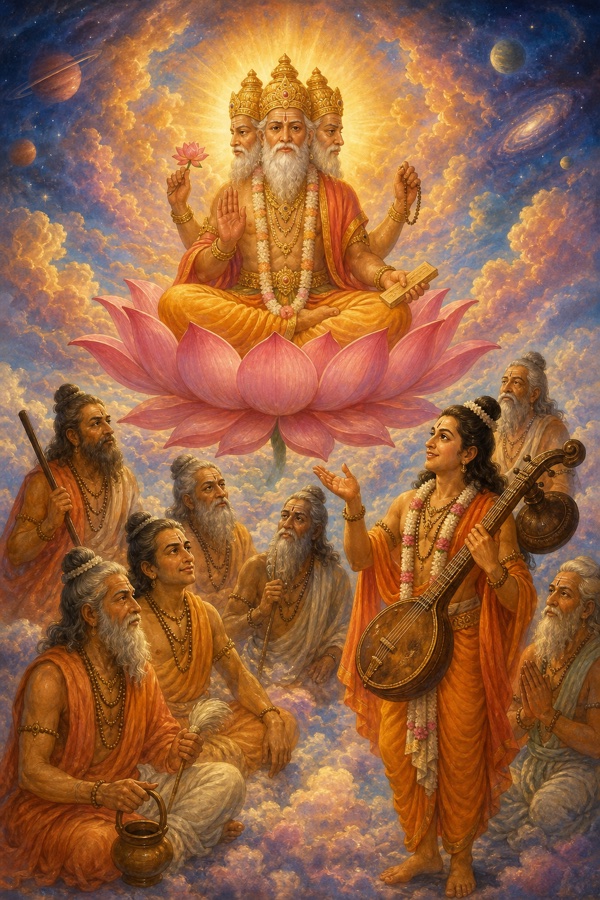
“And how, you will ask, does a memory outlive the end of everything? Like this. When that kalpa closed, Narayana drew the whole of creation back into himself and lay asleep on the waters of the great dissolution, and as Brahma, the maker of worlds, entered the Lord’s body to sleep out that long night, I was carried in with him, riding the Lord’s own indrawn breath. A thousand cycles of the four ages went by. Then Brahma woke and stirred himself to bring the worlds out once more, and Marichi and the other rishis came forth from his senses, and I came forth with them. That was my next birth. The birth of Narada. And the memory of him had crossed with me, whole.”
“I came back with one work to do: to carry the story of Narayana to every ear in every world. The Lord set this veena in my hands himself, and the seven notes of its strings carry Brahman itself in the form of sound. No door in the three worlds is shut to me, none above them and none below, for Mahavishnu’s grace goes ahead of me wherever I walk. And whenever I sing of what he has done, he rises in my heart as though I had called him and he could not stay away. I will tell you what all that wandering has taught me, Vyasa ji. For people whose minds the senses gnaw at day and night, the story of the Lord’s deeds is the raft that carries them over the ocean of birth and death. Self-control and the long disciplines of yoga quiet such a heart slowly and uncertainly; the loving service of Mukunda, the giver of freedom, quiets it surely.”
“That, Vyasa ji, is my story. You asked for the secret of my birth and my doings, and now you hold the whole of it.”
Vyasa joined his hands. For a long time he said nothing.
“Narada, now I understand.”
“That is why,” Narada said with a smile, “the great text you are about to write should carry this story of mine as well. Where a servant woman’s son once set out, from that very place all of this set out.”
Narada rose. He plucked one string of the veena, and the note trembled out through the sunlit courtyard and kept traveling long after it should have died. Then, singing that same name of Narayana, drunk on his own song, with no errand of his own left anywhere in the three worlds, he vanished into the open air, and Vyasa sat gazing a long while at the empty courtyard, lighter somehow than the sage had found it, where only a soft hum of the strings remained.
Literary context
The previous birth of Narada appears in Skandha 1, Chapters 5 to 6 of the Shrimad Bhagavata, where he recounts it to Vyasa himself. This journey from a servant woman’s son to devarshi is the root of the role Narada plays across the whole Bhagavata, where he arrives again and again as the first spark of story after story, from Dhruva onward.
The previous birth of Narada: a servant woman’s son who once spent a single season of rains in the company of sadhus, and in the next birth became Narada. So many inner journeys begin with one evening of satsang, and the rest of a lifetime is simply that one evening opening out.