On this page
Prahlada’s Prayer
Hiranyakashipu was dead. The tyrant who had made the three worlds flinch at the lift of one eyebrow lay torn open at the entrance of his own assembly hall, and from the garland of entrails slung around Narasimha’s neck a slow thread of blood was still working its way down to the polished floor.
Long before, the demon had squeezed a promise out of Brahma himself, the creator, whose word cannot be recalled: death would never reach him through any creature Brahma had made, through man or beast, by day or by night, indoors or outdoors, on the earth or in the sky, by any weapon ever forged. He had sealed, he believed, every door death had ever used. So the one who came for him came through the single door that carried no seal. A being beyond man and beast, a lion’s head burning on a man’s shoulders. The copper hour of twilight, the long copper minute of twilight. The threshold between room and courtyard, the threshold of his own hall. The raised seat of the killer’s lap, the killer’s lap. And for a weapon, claws, which are born and which no forge ever touched. Every clause of the boon was honored, letter by letter, and the letters spelled his end.
But the wrath had outlived its reason. The enemy it had risen for was gone, and it went on rising.
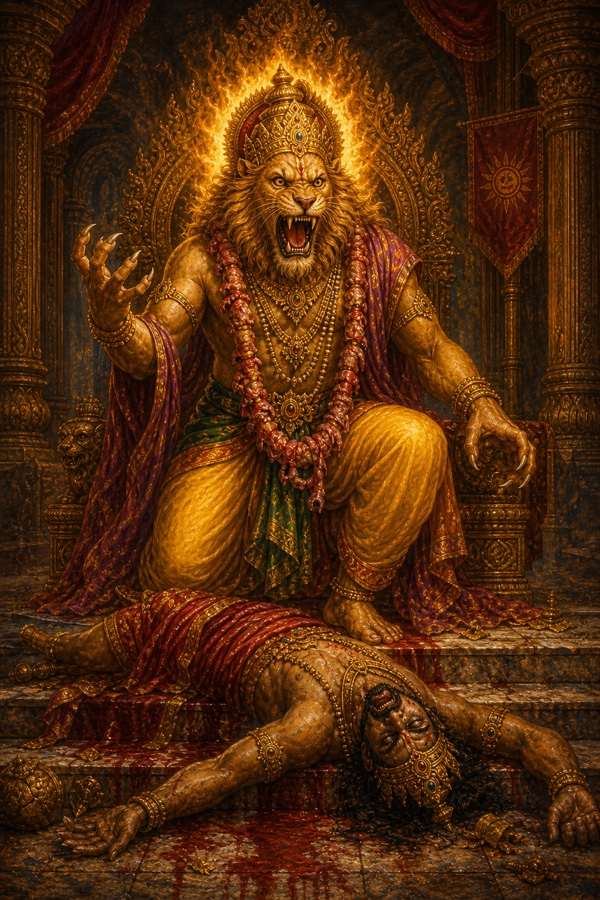
Narasimha went on roaring. His tongue lashed out and back like lightning hunting for a place to strike; his brows had climbed into a knot like two hills driven together; the mane, soaked and stiffened with blood, stood out around his face in blades. Each breath left him as a roar that made the great elephants who guard the eight quarters of the world trumpet in fear, and every roar broke against the walls of the hall and came rolling back. His glances alone dimmed the planets. The wind of his breathing worried the oceans into swell. When he mounted the dead king’s throne and sat there blazing, the fury had no adversary left anywhere to spend itself on, and it burned on regardless.
By then the sky above the palace was filling. The scourge of the three worlds had fallen, and all of heaven came to see: Brahma the creator; Indra, whose stolen sovereignty had just been handed back to him; Shiva down from Kailasa; seers, ancestors, perfected sages, serpent kings, the Manus who father mankind, musicians of the upper air with their dancing wives. Flowers fell in drifting showers. Drums sounded overhead. Order after order of beings sang his praise, each counting up what the dead tyrant had taken from it, and every hymn was offered from a careful distance, palms joined, feet planted. The singing rose and rose and moved nothing. Approach was another matter entirely, and no one’s courage reached that far.
Brahma stood foremost among them, and even Brahma failed. He had authored this creation; he must have reasoned that the one who wrote the world’s laws could speak to any fire burning inside them. He gathered himself to try. Before those eyes his own language died unspoken in his throat, and the maker of speech stood wordless.
Rudra came forward next, and if anyone could have faced it, it should have been him: the lord of endings, who dances creation down to ash when its hour arrives, who wears fire as a habit. He measured this destruction against his own, and he too went still.
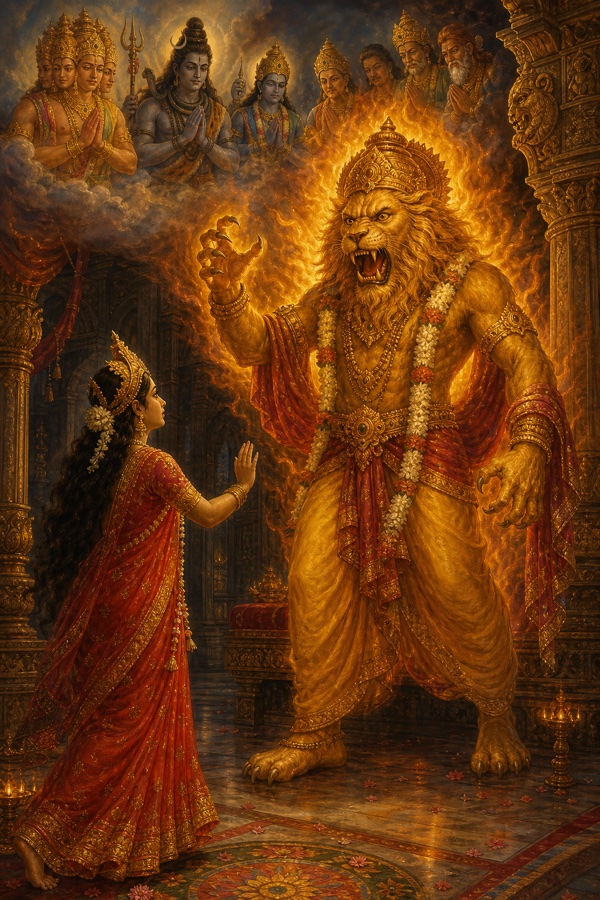
So the gods went to Lakshmi and pleaded. The one raging there was her own lord in another body; if the blaze would soften for anyone alive, surely for the goddess who had rested at his side since before time began counting. She agreed, and went. Halfway across the hall her steps died beneath her. In all her ages beside him she had never seen this form, never heard so much as a whisper that it existed, and the sight of it, vast and wholly strange, closed around her like cold water. Fear of her own beloved held her where she stood, and she could not cross the remaining distance by a single step.
When Shri herself came back with the floor uncrossed, the rest of heaven quietly gave up the idea of trying.
Then Brahma noticed who was standing beside him. A boy, silent in all that thunder, waiting. The dead king’s son. Prahlada.
Brahma stooped to him. “Go, child. It is on your father’s account that Bhagavan’s anger rose. Go near him, and make him calm.”
Consider what was being asked. The blood on those claws was his father’s; the boon that had shaped the killing had come from the very god now bending down to send him. The boy took it in without a flicker. “So be it,” he said, and that was the whole of his answer, as if consent were simply his native tongue.
His face carried no fear because there was none in him to carry. Fear had gone looking for lodging in that boy before and never found it: a father’s rages could never plant it, poison could never, cliffs and elephants and fire could never. A roar that frightened the guardians of the quarters was arriving very late to try.
He went, barefoot, a small figure walking straight into the sound. Behind him the gods stood with joined palms and forgot, all together, to breathe.
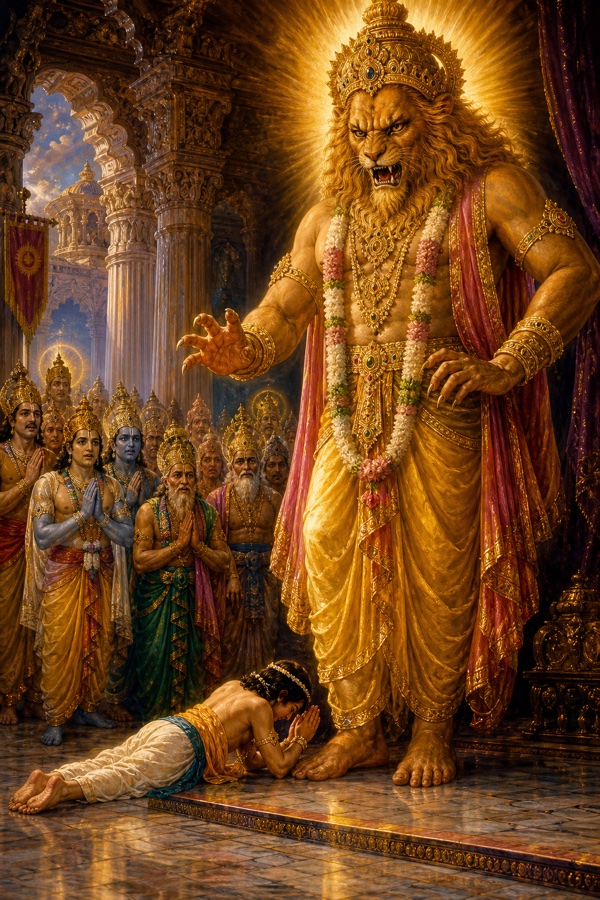
Narasimha gave no sign of seeing him. The boy did not slow. He walked to the feet themselves and went down before them full length, the whole small span of him flat against the stone, palms joined past his head, forehead resting at the base of Bhagavan’s feet.
A child’s body, pressed to the earth, directly beneath a fire still climbing.
Narasimha looked down.
The eyes that had dimmed planets rested on the small shape lying against his feet, and deep within Bhagavan something turned. Compassion rose up through the wrath the way spring water rises through rock, from below, from the source.
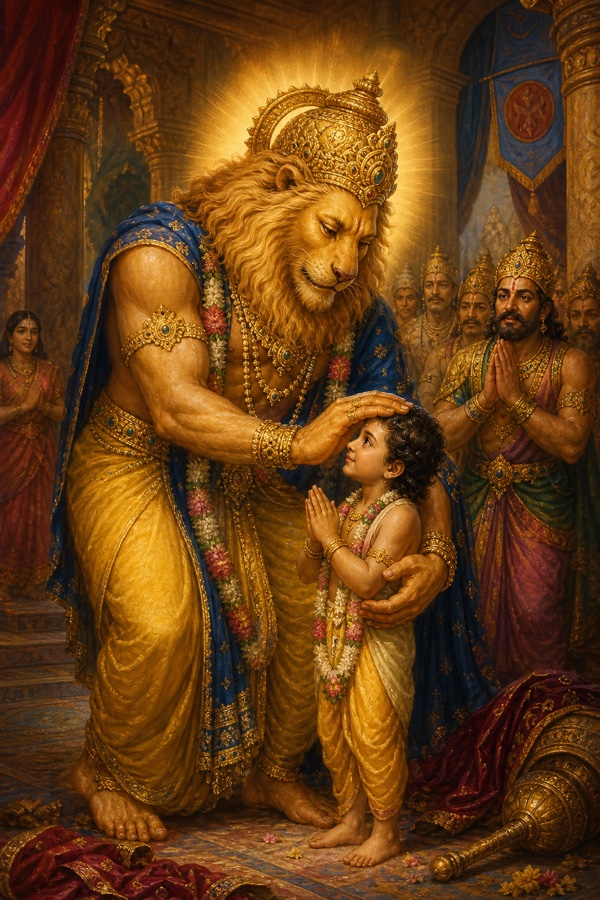
He bent his enormous arms, gathered the boy up off the stone, and laid on his head the lotus of his hand. The same hand. The claws that had just unmade a tyrant rested light as leaf-shadow on a child’s hair, doing their older work, for this is the hand that has always given fearlessness to every creature whose mind runs from the serpent called Time.
At that touch, whatever residue of old darkness still slept in the boy was gone, the entire sediment of former lives wiped away in one stroke. And with nothing left to stand in the way, the Supreme itself opened to him in that instant, direct, unmediated, seen.
Every hair on his body stood up. He took those lotus feet and installed them in his heart the way a priest installs a deity, and love came through him with nowhere to drain; his eyes brimmed and ran over, his throat shut, and for a long while he only looked, refusing to blink, as though the darshan might slip out through a closed eyelid. Then he drew his scattered self into a single point, steadied his voice against the love flooding it, and began.
“The first beings of creation have been trying to please you since creation started, and they have failed. Brahma leads them: gods, seers, perfected souls, minds seated in pure goodness for lifetimes past counting. All their rivers of praise, all their heaped and polished virtues, and to this day the current of it has never once carried them to you. Where does that leave me, born into the fierce race the worlds call demonic? And still I will sing. Even the lowest creature comes out clean from telling your greatness, so the telling itself is my whole hope.”
His voice cracked, mended itself, and cracked again. “I know the list, Prabhu. Wealth, noble birth, beauty of form, austerity, learning, keen senses, splendor, glory, strength, effort, intelligence, yoga: twelve endowments, and the wise say they win favor everywhere. Stacked to heaven, they have never yet bought one glance from you. Then a wild elephant, the lord of his herd with a crocodile’s jaws locked on his leg, called out to you holding nothing at all except love, and you tore the sky open getting to him. Love is the one road that arrives. Every other road circles your gate.”
“Weigh an outcaste against a Brahmin, then. Give the Brahmin all twelve of those glories and let him keep his face turned away from your feet; give the outcaste nothing except a mind, a tongue, a pair of hands, a purse, and a breath, all of them laid at your feet for good. I hold the outcaste higher. He carries his entire line across the water when he crosses; the proud man cannot ferry even himself. And none of this serving adds anything to you. You are filled to the brim with your own bliss; you want nothing from any hand. Whatever honor a small devotee offers you comes straight back to him, the way ornament put on the face returns in the mirror to the one who wears it. The worship was always for our sake. That is why you allow it.”
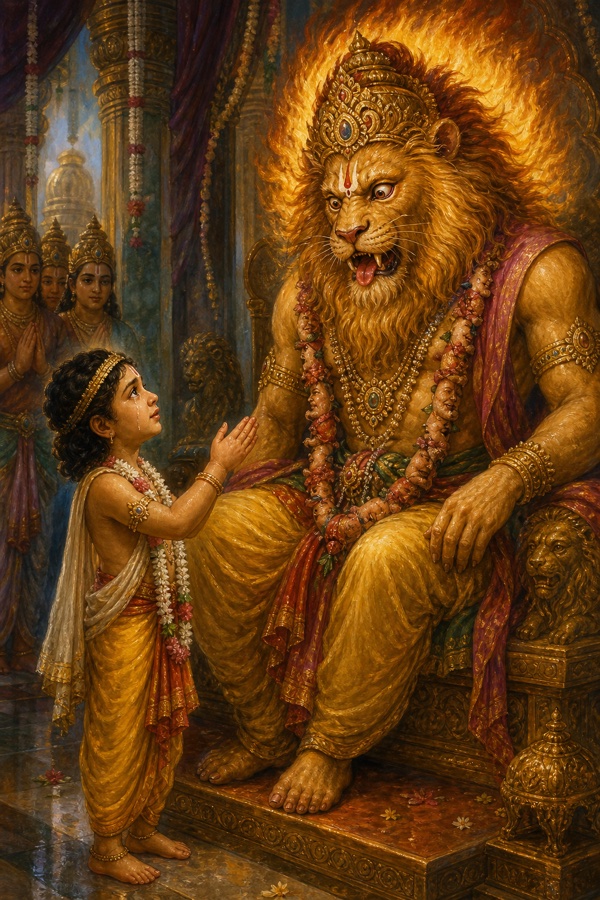
Then he lifted his small palm toward the form that had emptied heaven of its courage, and when he spoke, his tone was almost domestic. “Paramatman, this face you are wearing is a dreadful one. This tongue flickering like a whip of lightning. These eyes with a sun alight in each. The climbing brows, the ears standing stiff and sharp, the mane clotted with blood, this garland made of what my father was, and these claws, still wet, that opened him. I have looked at every piece of it, and nowhere in me can I find any fear. The worlds are lighter tonight; even the gentlest beings are glad when a scorpion dies. And this same form that terrifies them now, the frightened will remember age after age, and borrow their courage from the memory of it.”
“One thing does frighten me. The wheel. This unbearable, grinding round of birth and death, where a soul is tied in the rope of its own past deeds and lowered again and again among creatures that devour one another, wearing womb after womb, scorched every time by parting from what it loves and by lying against what it dreads. I have made that circuit, Prabhu, more times than any memory holds. And every remedy the world prescribes for the burning turns out to be one more symptom of the disease. Friend of the broken, when will you call me in to those feet of yours, the one shelter where the wandering finally stops?”
“I have audited the world’s protections. A father and a mother cannot keep their child, in the end. Medicine loses its grip on the dying. The boat drowns with the drowning once the sea has decided. Each cure the afflicted reach for holds for an hour and then opens its hand, for every being you have never taken into your own keeping. And the great prizes, long life, wealth, glory, the thrones of the guardians of the worlds, I have seen those at their absolute height. My father gathered every one of them. When he laughed in anger, the mere knitting of his brow set the three worlds trembling. You closed his account in a single breath. So lay those prizes in front of me and I will walk past them. Your grace is the one holding that keeps, and it never weighs rank on the way down. Today it passed over Brahma’s seat, and Rudra’s, and the place of Lakshmi herself at your side, and came to rest on a demon’s son lying on the floor of this hall.”
Far back in the furnace of those eyes, something began to settle.
And the boy went on. He had just received the seeing that yogis pursue through whole lifetimes of austerity; the way out of birth and death stood open in front of him, his for one step. His mind was somewhere else altogether.
“Prabho,” he said, and his throat thickened again, “the great renouncers mostly rescue one person each. They go into the empty forests alone, bind their tongues with the vow of silence, and labor in solitude for their own release while the world goes on drowning behind them; and there are those whose fasts and vows and recitations quietly become a livelihood, a piety kept for what it earns. I cannot want a freedom shaped like that. These lost, stumbling, defenseless beings: any crossing that leaves them behind on the bank is a crossing I refuse.”
“All my grief is for them. They turn their faces from the taste of your story, and then, hungry for sweetness anyway, they buy the counterfeit sweetness maya keeps in stock, and they haul the whole load of family and gain and fear on their own heads down the slope of a well with no bottom. My own fear of that terrible river dissolved long ago; the songs of your deeds are nectar, and a mind soaked in them cannot be pulled under. The ones still in the current are my grief. Grace was made for exactly these, the deluded and the sinking; and what would the lifting cost you? You raise worlds, sustain them, and fold them away again without spending one breath of effort. Carry these too, Lord standing on the far bank. Ferry them over with me. Sending me across alone would be no kindness I could bear.”
And the blaze that the gathered strength of the three worlds had failed even to lower was gone from those eyes entirely.
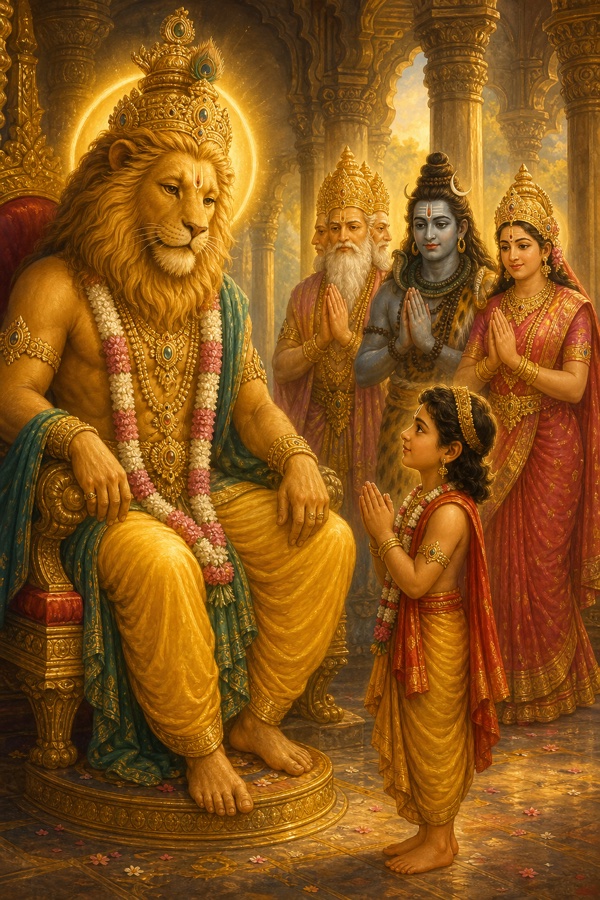
Bhagavan Narasimha’s anger had ended. The terrible form began to fold itself away on its own, with no one asking: the mane settled, the brows came apart, the growl under the breathing smoothed out into one long, deep, quiet exhalation, and what stood before the boy now was the other face, the original one, the face of pure compassion at whose mere darshan the mind lies down and rests.
He spoke, and the voice was made of affection. “Prahlada. All blessings on you, best of the Daityas. I am pleased with you, deeply and completely pleased. Ask for any boon you can name; I grant the wishes of every living being. And whoever has once truly seen me has nothing left in his heart that can burn.”
So everything the world spends itself chasing was spread before a small boy, with the giver of it standing there in person. His love had one object and no vacancies. Against the one making the offer, the offerings weighed nothing; boons that have bent great rishis and emptied kingdoms lay in the open in front of him, and his hands never left his sides.
Only then could the others come near. Brahma, Rudra, Lakshmi, the whole shining company drew in with joined palms, and each of them arrived holding the same unanswerable arithmetic: all the power in the three worlds had gone against that fire and lost, and a barefoot child with empty hands had just quenched it.
Literary context
Prahlada’s hymn stands in the seventh Skandha of the Shrimad Bhagavata, in its ninth chapter (7.9). The scene is prepared at the close of the eighth: after the killing, every order of celestial being gathers and praises the Lord from a careful distance, and none dares draw near. Brahma, Rudra, and finally Lakshmi herself fail to quiet the anger, and it is the child at Brahma’s own side whom Brahma sends forward (7.9.1-3). Prostrate on the earth, Prahlada offers the praise this katha retells, pleading at its height that the Lord ferry the deluded across along with him (7.9.41-44), and closing on the teaching that he is reached through service with six limbs: bowing, praising, offering one’s actions, attending on him, holding his feet in the mind, and listening to his story (7.9.50). Pleased, Bhagavan invites him to choose any boon, and Prahlada, whose love leaves no room for a second wish, declines them all (7.9.52-55). In the tenth chapter he gives his reason: a servant who bargains for gifts has turned himself into a trader (7.10.4). His one request there is for his father, and Bhagavan answers that Hiranyakashipu was purified the moment the corner of that compassionate eye fell on him, and that a son like Prahlada sanctifies twenty-one generations of his line (7.10.15-18).
The hymn, which within the text Narada recites to Dharmaraja Yudhishthira, fills most of a chapter that runs to fifty-five shlokas. What stands here is its voice and its marrow, told as story; the verse-by-verse argument belongs to the original.
In the tradition
The tradition still rises early for this hymn; it is recited with devotion at sunrise. In that hall Prahlada was the youngest present, the smallest, and the least powerful, and he alone asked nothing for himself.
Stay with this scene
The greatest beings in creation stood in that hall, each gripping a power that could shape worlds, and no one’s foot moved. Then a barefoot child walked in under the fire with empty hands and lay down, carrying one thing only, a plea on behalf of others. Ask yourself what that child had that all of them together lacked.