On this page
The Narasimha Avatar
Prahlada folded his palms, and his answer came without a tremor anywhere in it. “The strength I stand on, father, is the strength you stand on. He is the strength of the strong. Everything that moves and everything that holds still, from Brahma who shaped the worlds down to a single blade of grass, is held under his sway. He is the one ruler. He is Kala, Time itself, the power no other power commands. He is the master of the three strands out of which all nature is spun, and by his own energies he creates this universe, carries it, and draws it back into himself at the end. Give up this demon’s way of seeing, father. Make your mind even, and level it toward every being, for there is no enemy anywhere except a mind left unconquered. Some men count the ten directions their own without ever curbing the six thieves inside them, the five senses and the mind that leads them. For the man who has mastered those and looks on all creatures with one steady gaze, where would an enemy even come from?”
The answer burned Hiranyakashipu hotter than any defiance could have. He rose off the throne. “Plainly you are eager to die, since you brag with such freedom. Men about to die talk exactly this kind of scatter, witless one. Where is he, this lord of the universe you set above me? Everywhere, is he? Then why does he fail to show himself in this pillar? I am the all of things here, and I am going to strike your head from your shoulders where you stand. Now let Hari save you, this refuge of yours you lean on so hard.” And he went on tormenting the boy, that great devotee, with abuse after abuse, in a rage that filled the hall.
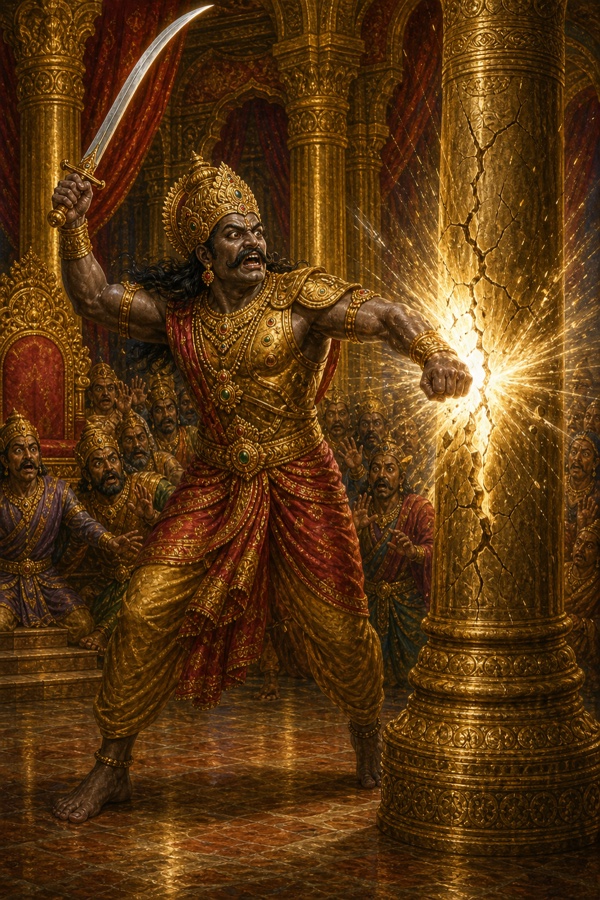
He snatched up his sword, sprang from his high seat, and drove his fist into the pillar with the whole force of a body the thunderbolt itself had never marked. In that instant a crash came out of the pillar so vast that the shell of the cosmic egg, the closed sphere inside which all the worlds hang, seemed to crack along its whole curve. The sound climbed sphere by sphere until it reached Brahma and the high gods in their far realms, and they, who knew every noise the universe makes, took it for the breaking up of their own abodes. Down in the court, Hiranyakashipu, still burning to be rid of his son, hunted for the source of that impossible sound and found nothing, and around him the chiefs of the Asuras, the lords of his demon host, stood where fear had rooted them.
The boy had said the Lord is present in everything. To make his servant’s word stand true, present in all things and present in that pillar too, the Lord came out of it. What rose from the split stone had no place among beasts and no place among men, and the king, staring at it, could only murmur to himself: this is no animal and this is no man, this strange creature with the frame of a man and the head of a lion. What is it?
Hiranyakashipu stood still for one moment.
The thing he was looking at, no god had ever seen. No Danava had seen it either, in all the elder generations of the demon race. The form was beyond the complete form of a lion or a man.
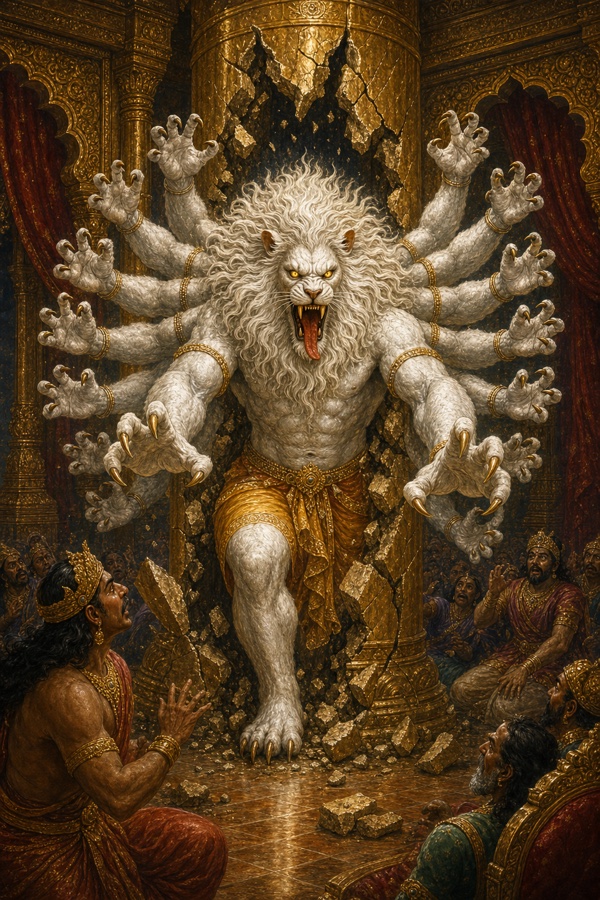
A living being. Half lion, half man. The eyes were the furious yellow of molten gold, and something burned in them like the sun of the world’s last morning. The face sat huge and swollen inside its blazing mane, and one yawn set that mane tossing around the neck. The fangs were monstrous. The tongue moved like a swung sword and carried the edge of a razor. Frowning brows bent the face into something more dreadful still. The ears stood erect and motionless, the nostrils flared, and the mouth gaped like a cave driven into a mountainside, so that the mere parting of the jaws sent terror through the hall.
The body climbed until it touched the sky. Under the mane the neck was short and thick, the chest broad, the waist slender. Hair white as moonbeams shimmered over the whole enormous frame. Arms past counting reached out on every side, and the claws that tipped them were weapons complete in themselves. Already that form had scattered the Daityas and the Danavas who flew at it with the best weapons either race owned, the thunderbolt’s own order among them, and no one found the courage to close with it again.
Hiranyakashipu studied it and steadied himself. This, he decided, was a device of Vishnu, the great trickster of the gods, one more conjuring trick arranged for his death, the same magician’s hand that had taken his brother. And what could the tricks of Vishnu do against him now, armed, rested, and fenced on every side by the word of Brahma himself?
He took up his mace, and roaring like a lion himself, that elephant among the Daityas charged the Lord. He fell into the ring of Narasimha’s radiance and vanished from sight, the way a moth vanishes the instant it drops into flame. And there was nothing strange in that. He was darkness in a body, and he had thrown himself into the one light that had swallowed the whole primal dark by its own shining at the first dawn of the worlds.
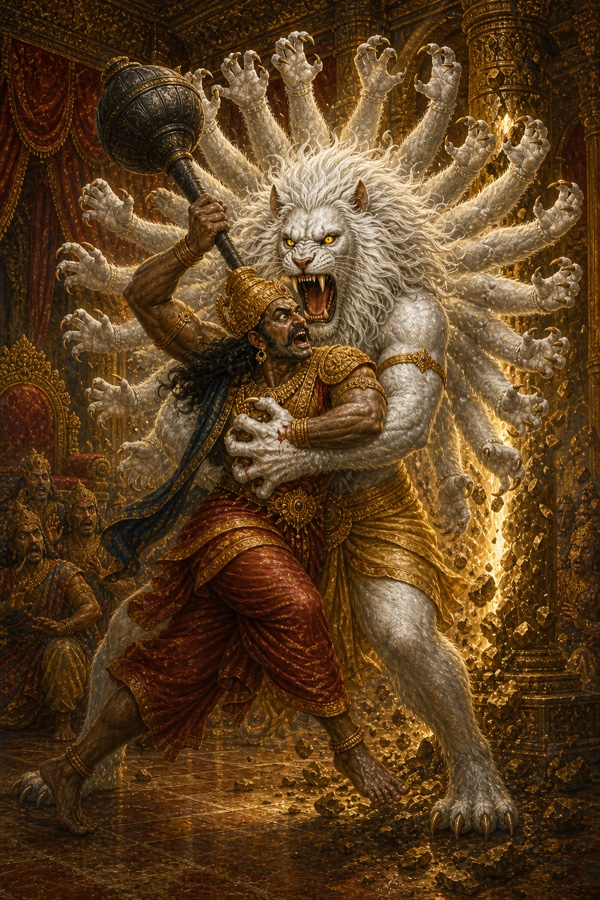
Then he was out of the blaze and coming again, in full fury now, and he swung the mace with all his weight behind it and brought it down. As the blow fell, the Lord caught him, mace and all, the way Garuda, the great golden eagle who carries Vishnu across the sky, catches a serpent. For a while he played with him. And in the middle of that play the demon slid out of his grip, exactly as a snake slips free of a Garuda that is only sporting with its catch.
Behind a curtain of cloud the gods were watching, the guardians of all the spheres this demon had seized, exiles hovering over their own stolen heaven, and to them that escape looked like an evil sign. Hiranyakashipu read it his own way. Narasimha had let him go, he was sure, out of dread of his strength and valor. Fatigue had never touched him in any battle, and it did not touch him now. He took up his sword and his buckler and went in again.
He fought like a hawk, leaping high and dropping low, weaving the sword and the shield through guard after guard so fast that no opening showed anywhere on him. Then Sri Hari laughed. It came as one shrill, enormous peal riding on a roar, and between that sound and that blaze Hiranyakashipu’s eyes slammed shut. In the instant of that blindness, the Lord took him.
This was the demon whose skin Indra’s thunderbolt, the weapon that shears the wings off mountains, had never once scratched. Now he writhed with everything in him, wild at being held, straining to tear himself out of those claws.
Carrying him, the Lord walked to the doorway of the assembly hall. To the threshold stone itself.
There he threw him down across his thighs, with no more effort than a serpent spends pinning a rat.
The body lay pinned across that lap, and the hands above it held nothing except claws. Throughout that battle the Lord used only his claws; blade, weapon, summons, and missile were absent.
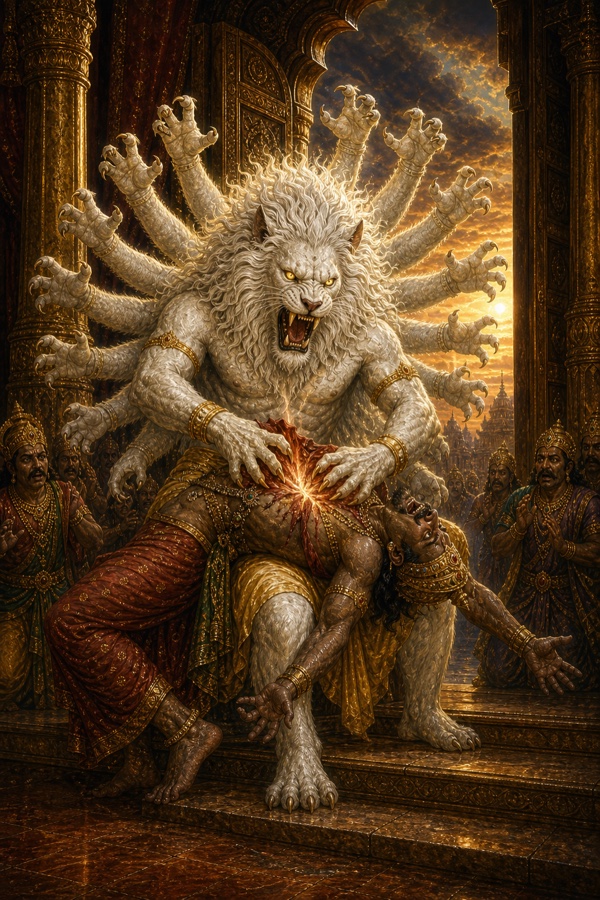
Narasimha’s fingers settled on Hiranyakashipu’s chest. The pointed claws went in and began to open his breast, unhurried, almost in play, the way Garuda tears open a venomous snake no other creature dares to touch.
Hiranyakashipu screamed. In the whole reach of his long life, this was the first sound of fear that had ever left his throat. Around him, one after another, the boons of Brahma were failing, and every one of them was failing along the same line, the seam he himself had left in the asking. Each clause of that great grant had its opening. Each opening had been found.
“I am deathless,” he was still thinking. “What is happening to me?”
He had forged himself an armor of boons and left a seam in every plate of it. Through those seams his deathlessness was draining away now, all of it at once. And the one deathlessness in that doorway that could never drain away belonged to the form bent over his chest.
With those claws Narasimha tore open the lotus of his heart and flung him aside to the floor. The emperor of the three worlds fell.
Before the body had settled on the floor, his bodyguard arrived, thousands of Daitya soldiers who had run in behind their king with weapons raised. The Lord met them with an army that was his own body, arms past counting, heels, and claws, and drove them back on every side, and killed them all.
No one in the three worlds could have met his gaze then, the eyes so charged with fury that looking into them burned. His tongue swept the corners of his gaping mouth. Spattered blood had turned his face and mane red. A garland of the demon’s entrails hung at his throat, and he shone the way a lion shines standing over the elephant it has brought down.
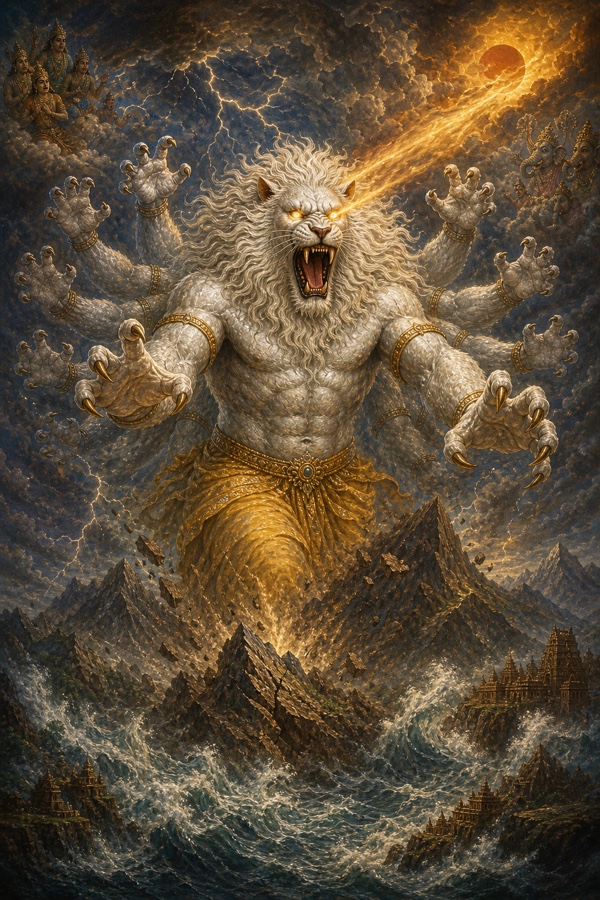
The lash of his mane tore the clouds to shreds. The glance of his eyes pulled the light out of the sun and the planets. The gusts of his breath heaved the oceans off their beds, and at his roar the great elephants who hold up the quarters of the world trumpeted in terror. His mane flung the flying chariots of heaven upward until the firmament stood crowded with them, knocked out of their courses. The tread of his feet shook the earth loose from its foundations, whole mountains went airborne at the speed of his turning, and his splendor wiped the sky and every direction out of sight.
By then nothing that lives could have stood in front of Narasimha, and still his anger climbed. He walked back through the hall and took his seat on Hiranyakashipu’s own high throne, all that annihilating brilliance gathered into a single seated form. The face went on blazing, terrible with wrath, and in that whole assembly of the rescued no one found the courage to approach and offer the smallest service.
The gods stood far off with folded hands. Not one of them could close the distance.
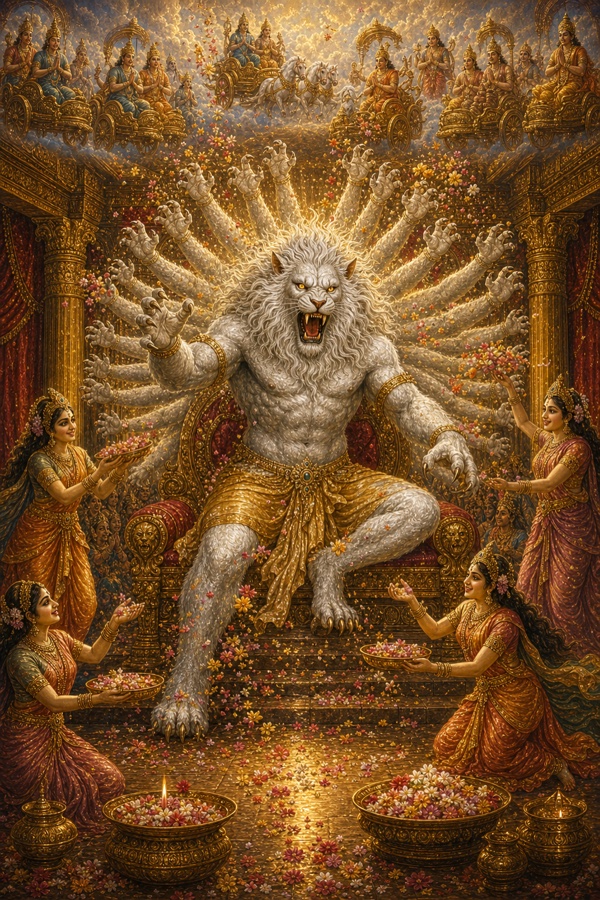
High above, the word went out among the women of heaven: Hiranyakashipu was dead, killed in open combat at the Lord’s hands, the first of the sons of Diti, the mother whose children gave the Daitya race its name, the standing headache of the three worlds made flesh. Their faces broke open with joy, and they poured flowers down on him, shower after shower, again and again.
The sky jammed with the vimanas of celestial beings pressing in for a look at him. The tabors and the drums of the gods began to sound, the chiefs of the gandharvas, heaven’s own singers, lifted their voices, and their wives, the apsaras, danced.
Then they came down to the court itself. Brahma the creator came, and Indra the king of the gods, and Shiva from Mount Kailash. The rishis came, the seers of the first wisdom, and the pitris, the fathers of the dead who live on what their sons offer them. The siddhas came, born with every mystic power in hand, and the vidyadharas, the artists of the sky, and the mighty nagas, serpent-lords with human faces, and the Manus who father mankind age after age, and the Prajapatis, the lords of generation. Gandharvas and apsaras came, charanas, the wandering bards of heaven, yakshas, the attendants of the god of riches, kimpurushas and vetalas and the horse-headed kinnaras, singers every one, and with them the Lord’s own eternal attendants, Sunanda and Kumuda at their head. They stopped a short distance from the throne, laid their joined palms on their bowed heads, and one order at a time, each in its own voice, they sang to the blazing form seated above them.
Brahma spoke first. You have no end, he said, and no one has ever touched the floor of your power. Your prowess is a marvel and your deeds are clean, and through the three strands of nature you carry the making, the keeping, and the unmaking of the universe as easy play, while nothing in you ever ages or decays. Then Shiva: the proper hour for your anger is the end of a kalpa, when a thousand cycles of the four ages have run out and the worlds themselves come due for burning. This puny demon is already slain. Turn now to his son. Protect Prahlada, your devotee, who stands here in need of shelter; you have always been won by the ones who love you. Then Indra: in saving us, Lord, you have recovered what was yours to begin with, our shares in the sacrifice, for every offering poured into fire is eaten finally by you. The lotus of our hearts is your own house, and this demon had shut it against you; today you have opened it again. And what is the sovereignty of the three worlds beside that, a throne Time will swallow in its turn, to servants whose one hunger is to serve? They set no great store even by liberation, and the lesser prizes never enter their minds.
Then the rest, order after order. The rishis said: the austerity of stillness you once taught us is your own glory, the discipline by which you drew out this cosmos when it lay dissolved in you, and this fellow had stopped it; by taking this body for the sake of the sheltered you have set it moving in the world again. The pitris said: he swallowed the rice-balls our descendants offered us at the ancestral rites and drank the sesame water they poured for us at the sacred fords, and you have recovered every offering from his torn-open belly; hail to Narasimha, the keeper of righteousness. The siddhas said: this swaggerer, proud of his conquests, stole the powers we had earned by concentration of mind, using his own breath-craft and austerity as the lever, and your claws have opened him. The vidyadharas said: he banned the art of vanishing we had won by long discipline, and you have finished him in combat the way one finishes a beast; we bow to the one who wears this man-lion form as play. The nagas said: he wrenched away the jewels we carry and dragged off the jewels among our wives, and the splitting of his breast has given their joy back to them. The Manus said: we are the keepers of the moral bounds of the world, and this demon kicked those bounds aside; your servants stand ready, Lord, only command us. The Prajapatis said: we are the lords of generation you yourself evolved, forbidden by him to people the worlds, and now he lies with his chest laid open; your descent is the good fortune of creation. The gandharvas said: we are your dancers and your singers, and he broke us to his service by plain force of muscle and valor; can a creature who takes that road ever arrive at happiness? The charanas said: your lotus feet end the long wandering from body to body, and this demon was a thorn lodged in the heart of the pious; now that you have drawn it, we return to those feet for good. The yakshas said: we count ourselves the first among your servants, and this son of Diti harnessed us to his palanquin like animals; you are the ruler of the twenty-four elements of the world, and you knew the whole weight of our humiliation, and you have ended its author. The kimpurushas said: we are small folk and you are the almighty Person; the moment the pious cried out against this wretch, he was already finished. The vaitalikas said: we sang your unstained glory in the assemblies and at the great sacrifices and were honored for it, and he silenced us; you have removed him the way a physician lifts out a disease. The kinnaras said: he drove us at unpaid labor year upon year, and you have struck him down; be our prosperity now, Lord Narasimha. And after all of them, the Lord’s own attendants said the strangest and the most tender thing spoken in that hall. Only today have we seen this form of yours, they said, half lion and half man, and the worlds are safer for it. But this demon was once one of us, your own servant at your own gate, until the sages of Sanaka’s line cursed him down into a demon’s birth. We know this death, Lord. It was your grace, and it has carried him home.
Even then, Rajan, that fearsome form did not cool. What follows belongs to the next telling. The gods went on praising him from their careful distance, and not one rank of heaven dared shorten that distance by a step. Who finally quieted the half-lion, and how, is the story ahead.
Let this much stand for tonight, Rajan. On that evening a king fell who had named himself deathless. And the form no god dared approach gave its lifelong enemy release with its own claws, across its own lap, at twilight, on the threshold, over thighs raised above earth and sky.
Literary context
This katha of Prahlada and Narasimha spans Skandha 7 of the Shrimad Bhagavata. Brahma’s boon to Hiranyakashipu, with its full lattice of clauses, is set out in Chapter 3 (7.3.35 to 38): no death from any being of Brahma’s creation, none indoors or outdoors, none by day or by night, none from any quarter outside that creation, none by weapons, none on the earth or in the air, none from man or animal, none from anything animate or inanimate, god, demon, or great serpent, together with supremacy in battle, lordship over embodied beings, glory equal to Brahma’s own among the guardians of the spheres, and the unfailing powers of the great ascetics. Prahlada’s own story fills Chapters 4 through 7, and the ninefold path of bhakti spoken from his mouth belongs to the same stretch (7.5.23 to 24). The slaying of Hiranyakashipu and the hymns of Brahma, Shiva, Indra, and the celestial orders fill Chapter 8, which closes on those hymns. In Chapter 9 the gods send Lakshmi to calm the Lord, even she cannot approach a form she has never seen or heard of, and Brahma sends the child Prahlada forward to touch his feet, after which come Prahlada’s own boons. The verses of Chapter 8 themselves give the man-lion form, the doorway of the hall, the thighs, and the claws (7.8.29); the fixing of the hour at dusk, and the reading that maps every clause of the boon at once onto twilight, threshold, lap, and claws, comes from the commentarial tradition, Shridhara Swami foremost among them, who called this killing the purest form of grace.
The same katha elsewhere
- Prahlada’s Rebellion
Shrimad Bhagavata (Skandha 7): Prahlada’s rebellion against Hiranyakashipu - Prahlada’s Inward Absorption
Yoga Vasistha: Prahlada’s contemplation of Vishnu and self-realization