On this page
The Grief of Chitraketu
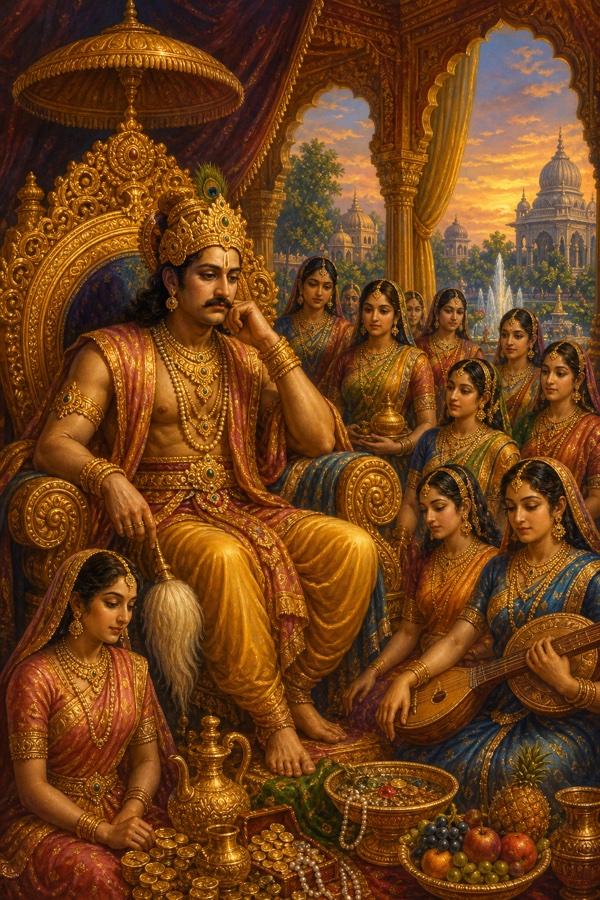
In the country of Shurasena, the tract of land that lies about the city of Mathura, where the Yamuna makes her slow bends through pasture and grove, ruled a king named Chitraketu. He was a chakravartin, an emperor whose writ ran to the edges of the earth, and the earth answered him the way a devoted servant answers, yielding her grain and her riches before he had finished asking. He had ten million queens, and he was himself a man well able to father children. Beauty, generosity, youth, high birth, learning, sovereignty, wealth, all of it had been poured into this one life.
Yet not one womb among them all had borne him a child.
The court stayed full, the storehouses stayed full, and inside the palace sat an emptiness that had no cure. Ten thousand lamps could burn on a festival night and no small hand would ever reach for one. The whole earth lay under his hand, riches of every kind waited on him, and none of it could reach the place where the ache was; his fair-eyed queens, his treasuries, the circle of the world itself brought him no delight that lasted past the thought of who would come after him. So a private worry walked with the emperor wherever he went, sat beside him at audiences, and paced with him on the terraces at night.
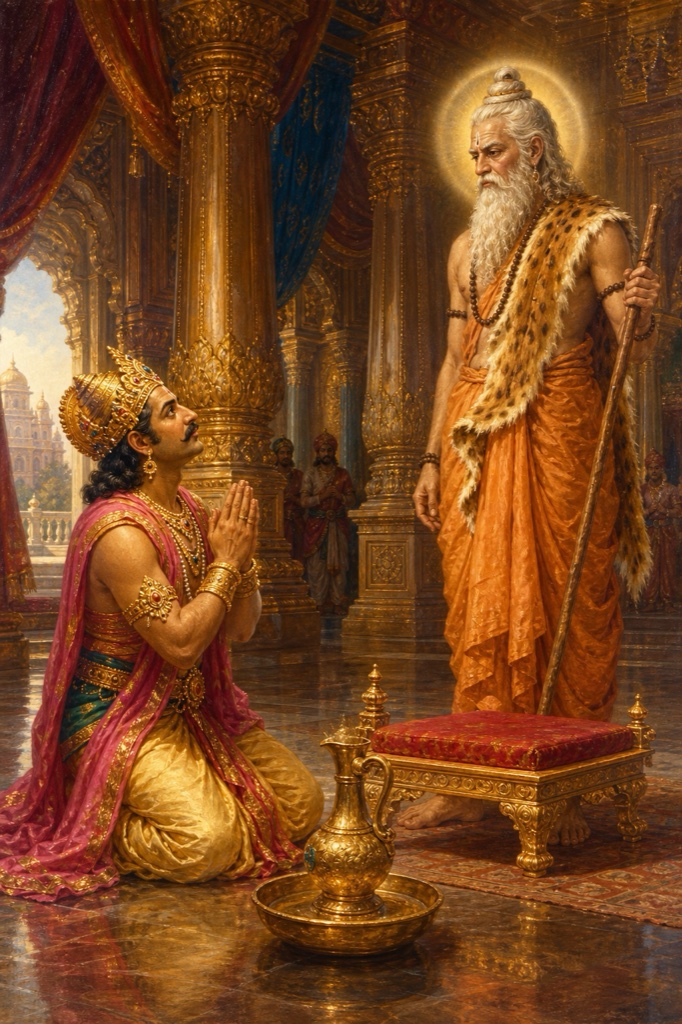
One day the sage Angira, a son born of Brahma’s own mind, a rishi with the power to bless and the power to burn, wandering at his own will through the many worlds, came by chance to Chitraketu’s palace. The king rose and honored him in the proper way, with arghya water for his welcome and a seat of respect, everything offered with his own hands. When the sage had been made comfortable, the emperor folded his hands and sat down on the bare ground beside him, lower than his guest, an emperor of the whole earth choosing the floor, and said nothing.
Angira was watching. Sages of his order read faces the way farmers read the sky. Here was a king of deep humility, and across his face, under all the composure of a man trained from boyhood to show nothing, trembled the shadow of some inner worry.
“Rajan,” the sage said, “your subjects, your ministers, your army, your treasury, your priests, your fortresses, your allies, is all of it well? A king is wrapped in these seven limbs of his rule the way the soul is wrapped in its seven sheaths, and when they thrive, he thrives.” Then he paused, and looked straight into the king’s eyes, with the look of a man who already knows the answer and is only opening a door for it. “But I can see that you yourself are not at peace. Some unmet longing has drawn a line across your face. This discontent, has another laid it on you, or is it your own?”
Chitraketu bowed his head and for a long while said nothing. What stays hidden from a yogi whose sins have burned away in austerity? The sage knew already; the king had only to find the strength to say it aloud. Then, very low, he spoke. “Bhagavan, I have been given the empire of the earth, I have been given every splendor a man can hold. But a man faint with hunger and thirst finds rest in nothing except food and water. I have no child. My forefathers wait in their world for the pinda, the offered rice and water that reach them there as food and honor, and they grieve, fearing the line ends with me and the offerings end with it. I grieve with them. We are sliding together toward a darkness that has no floor. Lift me out of this dark pit.”
⁂
The sage’s heart went out to him. He had come, in truth, carrying something far greater than what this king wanted; he could see now that the craving for a son sat so deep in this man that any word of wisdom would fall on soil too dry to hold it. A seed needs broken ground. Let the longing be answered first. The rest could wait, and the waiting itself would do the plowing.
So he performed a yajna, a fire offering fit for Tvashta, the celestial craftsman who shapes the forms of things and the bodies that wear them, and the sacred remnant of that offering, heavy with the god’s favor, he gave to Kritadyuti, the eldest and the finest of all the king’s queens. Then he said, “Rajan, a son will be born to you from this queen’s womb. But hear the whole of it, and hear it now. He will bring you joy, and he will bring you grief.”
With that the sage went his way. Half of his sentence had been a promise and half a warning, and the king took home only the half he had prayed for. He had heard the rest, and having heard it, let it slide off him, the way a thirsty man pays no heed to the color of the water he is handed.
Kritadyuti ate the consecrated food and conceived, as the Krittika, the six star-mothers of the Pleiades, once conceived and nursed a son for the god of fire. Like the moon through the bright fortnight, the child in her grew fuller by the day, and when the months were full a beautiful son was born. Word ran out through the palace gates and down every road of the kingdom, and a wave of joy ran with it through the whole land of Shurasena.
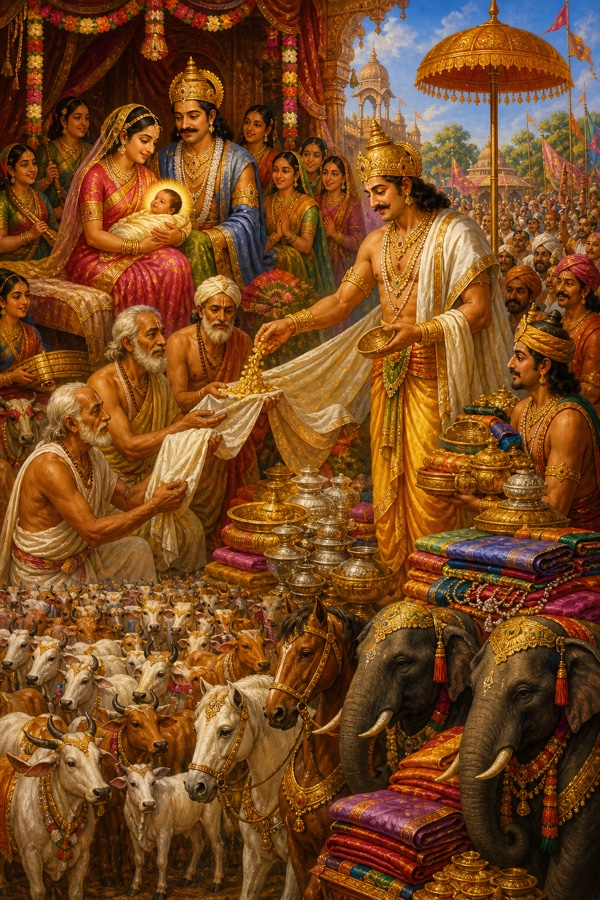
There is no measuring Chitraketu’s joy. He bathed, had the Brahmins pronounce their blessings over the child, had the birth-rites of his son performed with every observance the books prescribe, and then began to give, as if giving were the only language large enough for what he felt: gold and silver, cloth and fine ornaments, villages, horses, elephants, and six arbuda of cows, six hundred million in all. As a raincloud pours on everything below it without preference, on field and rock and river alike, so the king poured himself out on everyone.
But something came with the joy, something quieter, and it grew the way roots grow, out of sight. As a pauper who lays hold of a little money after long hardship only clings to it the harder, so the king’s love for this hard-won son drew tighter by the day, past love and into clutching. Kritadyuti’s love needed no explaining. It was a mother’s.
⁂
There were other queens in that palace. Co-wives, each one once chosen, each one once dear. Not one of their wombs had come to fruit.
The king now sank so far into his doting on the one child that his heart slid away from the rest of the women, and they felt it happen day by day, in visits that grew shorter, in eyes that looked past them toward a nursery. They had already carried the sorrow of their childlessness, and now the sorrow of his neglect was laid over it, weight upon weight. They began to reproach themselves, and to smolder quietly within, and a fire kept covered is the kind that takes a house whole.
Among themselves they said, “Sisters, a woman with no son is fortune’s most abandoned creature. A co-wife who has a son treats her like a serving girl, and does it smiling. Worse, even her own husband stops counting her as a wife. And what real sorrow does a serving girl carry? She at least earns respect by her service, and eats her bread with some honor. We have been dragged below even that, wives in name, shadows in the corridors of our own palace.”
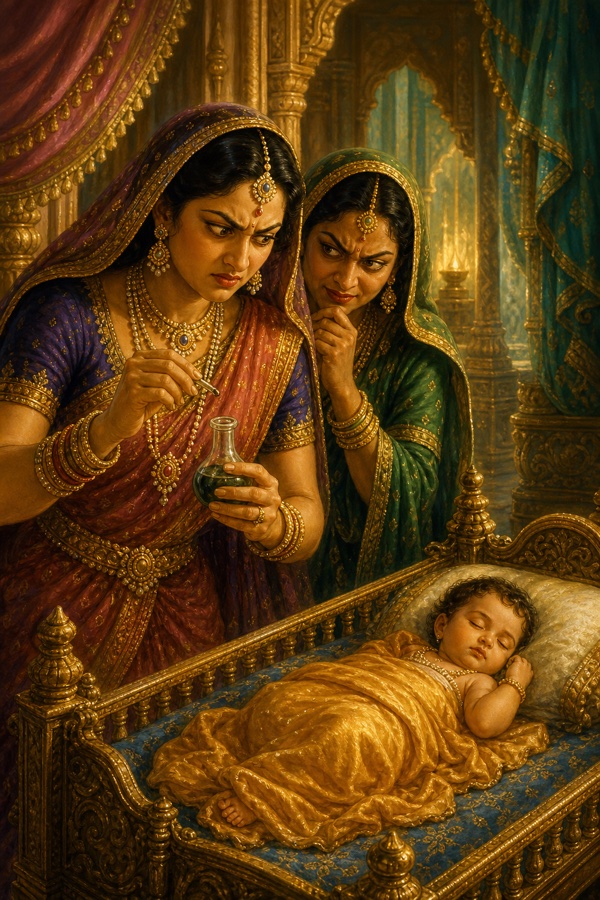
The envy grew heavier by the day, and one day it curdled into hatred. Hatred is a patient workman. It killed their judgment first, then filled the emptied place with cruelty, until they could no longer bear the sight of their husband’s love for that child, until the sight of the child himself became unbearable. And one day, quietly, in the ordinary noise of a palace afternoon, they fed the little boy poison.
Kritadyuti knew nothing of it. She thought the child was sleeping, and there is no crueler mercy than the hour a mother spends not knowing. She glanced over now and then from a distance, saw the small shape lying still, and went about her work through the palace. When a long time had passed she said to the nurse, “Bring me my little one, good woman. He has slept his fill.”
The nurse went to the child, bent down, and looked. Then she looked closer, and her hands went still. The pupils of his eyes had rolled up and back. Breath and sense and life had already gone out of that small body, and had been gone some time.
“I am undone,” she cried, and dropped where she stood, and beat her breast with both hands, and wailed aloud.
Kritadyuti came running at the sound. And she saw that her little child was suddenly, wholly dead.
⁂
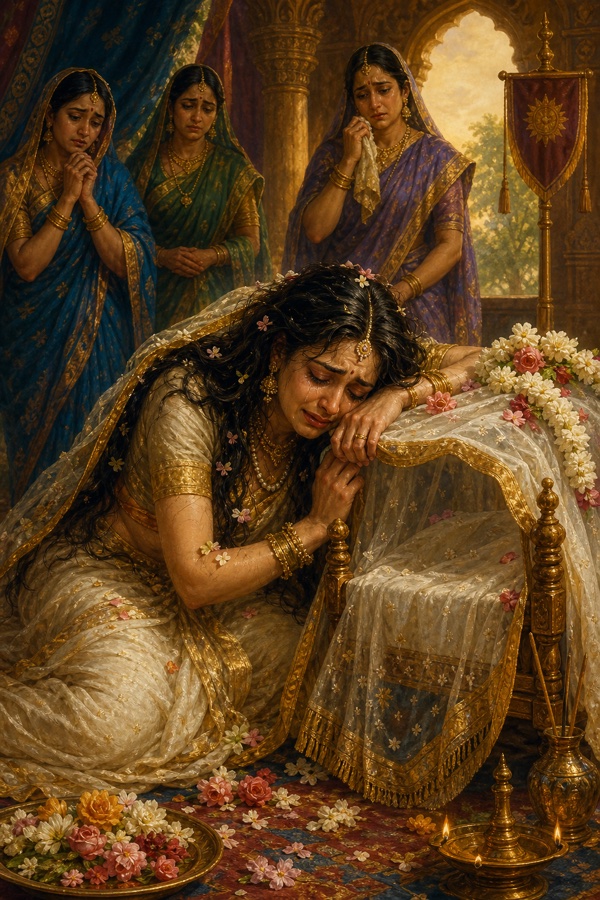
The queen fainted and fell beside him. Her hair came loose, her garment slipped into disarray, and no one dared touch her. When she came to, she wept like a kurari bird whose mate has been taken, the river bird whose crying over the night water is the sound this land has always given to grief. The saffron and sandal painted on her breast ran wet with tears. The flowers braided into her hair loosened and fell one by one onto the floor around her, and she, who had never let a single blossom fall, had no presence of mind left to gather them.
“O Maker of the world,” she cried out, and her voice carried through the stone halls, “what kind of maker works against his own making? In your creation the elders should go first and the children should follow after; that is the one order even grief can live with. Instead the old go on living and the young die. If this backwards order is simply your nature, or, worse, your deliberate cleverness, then you are the standing enemy of every living thing.”
Then she turned to the small still body, as if it could still be reached, and her voice changed, softened, became the voice she had used over his cradle. “And you, my darling, you must not leave a helpless woman so. Look at your father there, burning alive with grief. With you to lead us we could have crossed the dark country of the sonless with ease. Do not walk off so far in the company of cruel Death. Rise, child. Your little playmates are calling you out to romp with them. You have slept so long, too long. You must be hungry by now. Take my breast, drink, and lift this grief from all of us who are your own.” She waited. But no sweet answering word came, and she understood, the way the body understands before the mind consents, that she would not hear his voice again.
The men and women of the royal house came running and broke into weeping. Even the murderous queens came and put on a false show of tears, and stood wailing over the small body their own hands had emptied.
Word reached Chitraketu, and grief pushed a darkness across his eyes before he had crossed the first courtyard. With his ministers and his priests around him, stumbling and falling on the way, the emperor of the whole earth came to where the child lay, and fainted, and went down at its feet. When he rose, his breath came in long heavy pulls. Tears crowded his throat until it closed, and the man whose one word could move armies could not bring out a single one.
Husband and wife wept so long and so hard that from the ministers down to the last serving girl the whole city went numb with them, shops unopened, cooking fires unlit. This had been their only child, and he had come to them through such hardship, after so many empty years.
Then the great sage Angira came again to that city, and this time the divine sage Narada came with him, the wanderer who carries kathas from world to world on the strings of his veena and arrives, always, exactly where a soul stands ready to turn.
The king lay beside his dead son like a second corpse, and the household had stopped trying to raise him. The two sages saw the emperor slipping out of his senses under the weight of his grief, with no one near who could steady him, no minister, no priest, no queen with any steadiness left to lend.
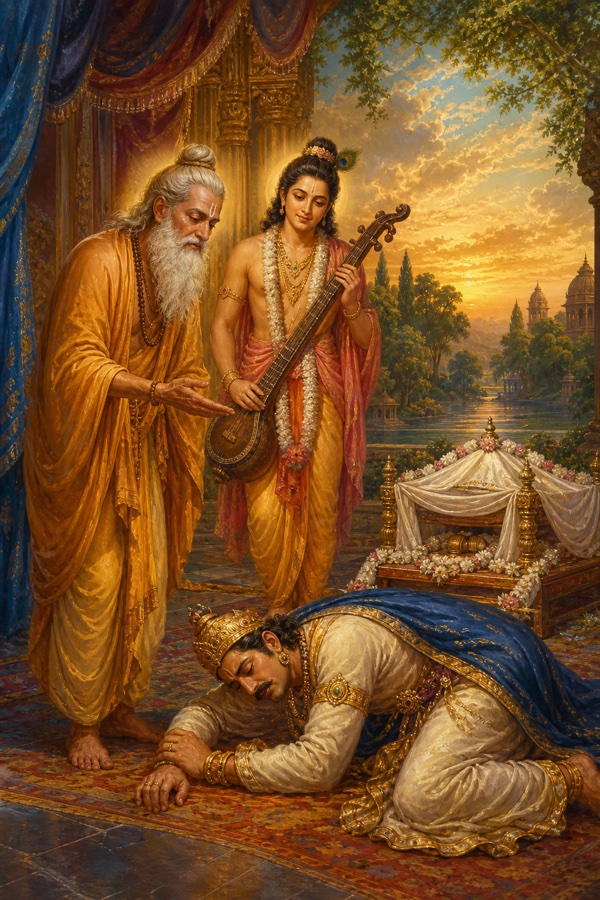
Angira spoke, and his first words were a question, laid down as cool and precise as a surgeon’s instrument. “King of kings, this boy you grieve for so terribly, what was he to you in this birth, and in the births before it? And you, what were you to him? And in the births still to come, what will the two of you be to each other?”
“As grains of sand are carried together and carried apart by the running of a stream, gathered a while on one bank and scattered again, Rajan, so in the current of time are living beings brought together and drawn apart. Father and son, wife and husband, every bond we hold to be ours is a meeting of currents. As one seed sometimes springs from another and sometimes does not, so, moved by the Lord’s maya, one being is born from another and one being ceases in another. You, and we, and all these creatures gathered here at this moment, we were not here before we were born, and we will not be here after we die. Even now, in the way you take us to be, we are not quite real.”
The king kept listening. The tears still came, but the gale that had been tearing everything loose inside him began, a little, to drop. Words spoken at the right hour fall the way rain falls on a burning field, steadily, until it yields.
He lifted his ruined face and looked at the two of them for a long moment, and something in him, even through the wreckage, recognized what stood before him. “Who are you,” he said slowly, “that you come to me in the plain dress of wandering ascetics, with no wish of your own left in this world? I know that sages of deep realization walk the earth in disguise, sometimes playing the madman, keeping their glory folded out of sight, only to wake sleepers like me. Have you come to me that way?”
“I am Angira,” the sage said, “the same who gave you your son when you begged for one. And this is Narada, born of Brahma himself.” He let that settle, watching the king’s eyes find their focus. “Hear me now, king. When I first came to your house, it was the highest wisdom I meant to place in your hands. But your whole heart was set on a son, and nothing else could get in, and so I gave you the son and held the rest back. Now you have learned in your own body what those who are blessed with sons come to learn. A wife, a house, wealth, power, the pleasures of the senses, the glory of a throne, lands and armies and treasuries and ministers and friends, all of it looks solid, and all of it is a city glimpsed in the clouds, a shape thrown up in a dream, a mirage trembling over hot sand. It is put together for a while and then it is gone, and while it lasts it is a well of grief and fear. The man who leans his whole weight on it is leaning on smoke.”
⁂
Then Narada did one thing more.
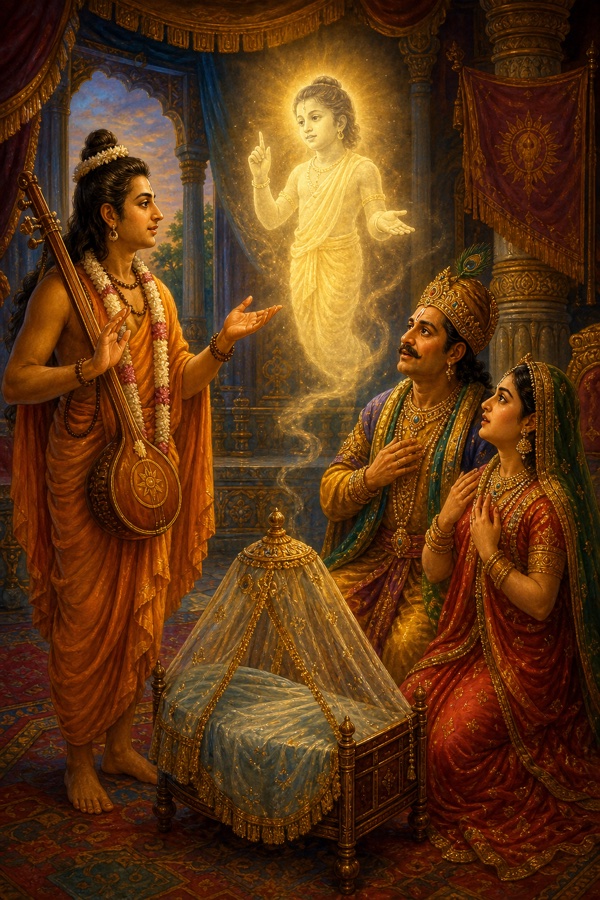
By the strength of his yoga he called the soul of the dead child back for the space of a breath, into a subtle form the grieving parents could see hovering near the small body, and bid it speak. “Jivatman, may it go well with you. Look how your mother and father, your own people, are torn apart at losing you. Come back into this body of yours; it lies here waiting, whole and unburned. Live out the years that are left among your kin. Take your seat one day upon your father’s throne, and let this whole house breathe again.”
The voice that answered from that small form was not the voice of any child.
“Devarshi, I have been driven by my own deeds through gods and men, through beasts and birds, through more wombs than I could ever count. In which of all those lives were these two my mother and father? Which pair, out of the thousands who have held me? Turn by turn, across the births, every soul becomes every other soul’s brother, its grandchild, its enemy, its friend, its stranger, its foe. As a piece of gold or silver passes from one trader’s hand to the next, minted and melted and minted again, the soul passes from one womb to the next, and calls each one home only for as long as it stays there.”
“The sense of mine lasts only as long as the tie to the thing lasts, and not one breath longer. But the soul itself is deathless. It has no ego. It stands beyond darling and foe, kin and stranger. It is the still witness of every cause and every deed, and it is free. And so it is never truly born, and it never truly dies.”
Having said that much, the soul was gone.
And a strange stillness came down over the palace.
Chitraketu and Kritadyuti sat stunned by what they had heard. The one they had held to be their son had never, in truth, been anyone’s son at all; a traveler had lodged a night in their house, and they had taken the lodging for a bond of blood. The cord of their affection was cut clean through, and the unbearable grief drained away with it, like floodwater when the dam that held it is gone. They performed the last rites for the small body, and they set down the attachment that is so hard to set down, the attachment out of which grief and delusion and fear and sorrow are all born.
As for the queens who had given the poison, they could no longer raise their eyes to anyone, so heavy was the shame of what they had done. The sin of killing a child had drained the light out of their faces the way a lamp goes dim when its oil runs low. Remembering what Angira had taught, they went down to the bank of the Yamuna, there in Mathura, and made the atonement the Brahmins prescribed for a sin that dark.
⁂
So it was that the counsel of Angira and Narada woke the power of discernment in Chitraketu, the clear inner eye that sorts the lasting from the passing. He hauled himself up out of the deep dark well of house and household, of birth and rebirth, the way an elephant drags itself out of the mud of a drying pool, heaving, streaming, and free at last on firm ground.
He bathed in the Yamuna as the rites require and made the water offering to the departed, the same offering he had once feared no son would live to make for him. Then, his senses gathered in and his mouth fallen silent, he bowed his head at the feet of the two sages, both of them sons of Brahma.
Narada was well pleased. He saw a king who now held his senses in hand, a devotee of the Lord, a man who had truly taken refuge. So he gave him a vidya, a mantra-hymn of the kind a teacher entrusts only to a vessel that will not crack, and said, “King of men, hold this in a gathered mind, and within seven nights you will stand in the presence of Lord Sankarshana. In the oldest of days Shankara himself, and others of his stature, took shelter at the feet of that same Sankarshana, and reached the greatness beyond which nothing rises and nothing stands even equal.”
Having placed the vidya in his hands, Narada and Angira departed for the realm of Brahma.
For seven days the king took nothing but water, and held the practice of that vidya with his whole concentration, the attention he had once spread across an empire now narrowed to a single name. When the seven nights had passed, the unbroken sovereignty of the Vidyadharas came to him unasked, lordship over that shining race who travel the roads of the sky. And in a few days more, as the vidya went on working in him and his mind grew clearer still, he came near the feet of Shesha, of Lord Sankarshana.
⁂
He saw.
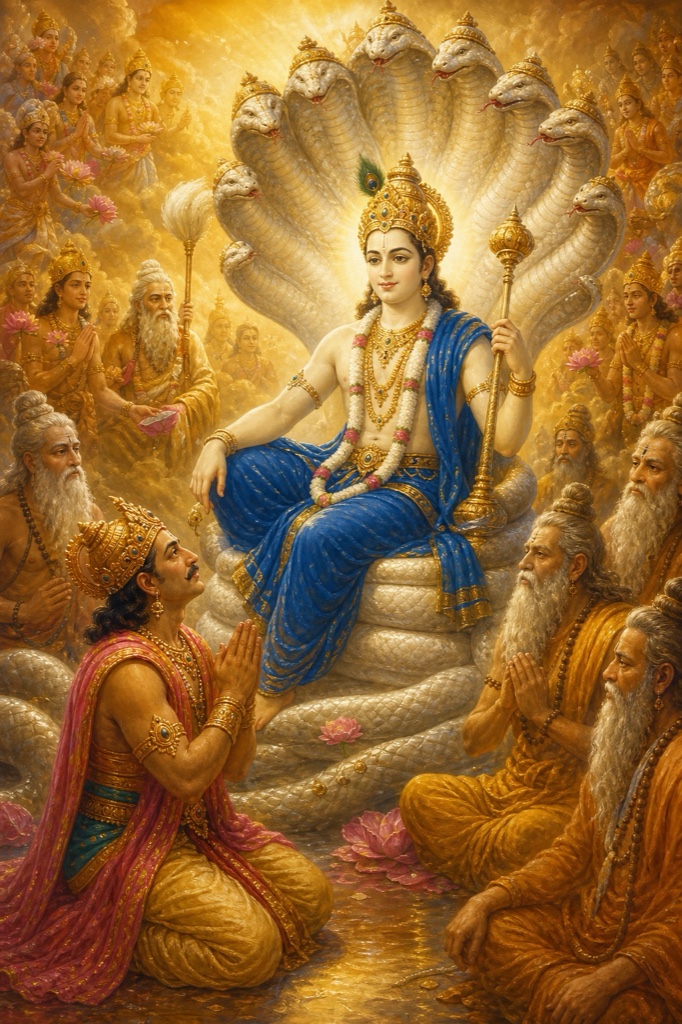
Lord Shesha, the endless serpent on whose heads the worlds rest as lightly as seeds, wearing now a form an emperor’s eyes could bear, sat in the midst of a ring of the masters of perfection. His body was pale as the fiber of a lotus stem, and a blue garment lay across it like dusk lying on snow. A crown was on his head, armlets on his arms, a girdle at his waist, bangles at his wrists. His eyes were touched with red, and over his face lay a gladness with nothing of command in it, the look of one who has been waiting a long time for exactly this guest.
At the first sight of him every sin in Chitraketu fell away, the whole soiled accumulation of lifetimes, and his inward being ran clear the way rivers run clear in autumn. A flood of bhakti rose in his chest, and tears of love came drop by drop until the very footstool where the Lord’s feet rested was wet with them. Every pore of his body opened like a flower at first light.
For a long time he could not say anything at all. Not one syllable would come.
Then his breath returned, and softly, in a voice still wet, he began. “Unconquered One, whom no power in the three worlds has ever brought down, the holy ones who have mastered their senses and look on all things with a level eye have conquered you. And you have let yourself be conquered, and taken them in turn, with your beauty, your sweetness, your mercy. To those who worship you wanting nothing back, you give away nothing less than your own self.”
“Bhagavan, the men who are little more than beasts, who want only the feeding of their senses, leave you aside and worship Indra and the other gods, who are only sparks thrown off from your splendor. But as the servants of a royal house lose their bread when the house falls, so when those lesser gods reach their own end, as even gods do, the pleasures they handed out end along with them.”
Lord Sankarshana was pleased, and his voice, when it came, was quiet as deep water. “Chitraketu, through the vidya that Narada and Angira gave you concerning me, and through the sight of me, you have come fully to your goal. It is I who stand here as all beings. I am their inmost self, and I am their maker. Those with the skill to grasp the truth of the path of yoga should know this one thing: the whole interest of the soul, its highest gain and its highest good, is only to come to know the oneness of the individual self and the Supreme.”
Having said this, before Chitraketu’s open eyes, Shri Hari, the soul of all that is, vanished from the spot.
Now Chitraketu was the lord of the Vidyadharas.
For ten thousand million years he ranged the valleys of Mount Sumeru, the golden mountain that stands at the axis of the worlds, and in all that time the strength of his body and the power of his senses never once dimmed. Great sages and siddhas and celestial singers praised him wherever he passed. At his word the women of the Vidyadharas would sing beside him of the virtues and the play of the Lord, hour into shining hour.
One day he was traveling somewhere aboard the shining aircraft the Lord had given him, going where he pleased along the roads of the sky, with the ease of a man who has nothing left to fear in any world.
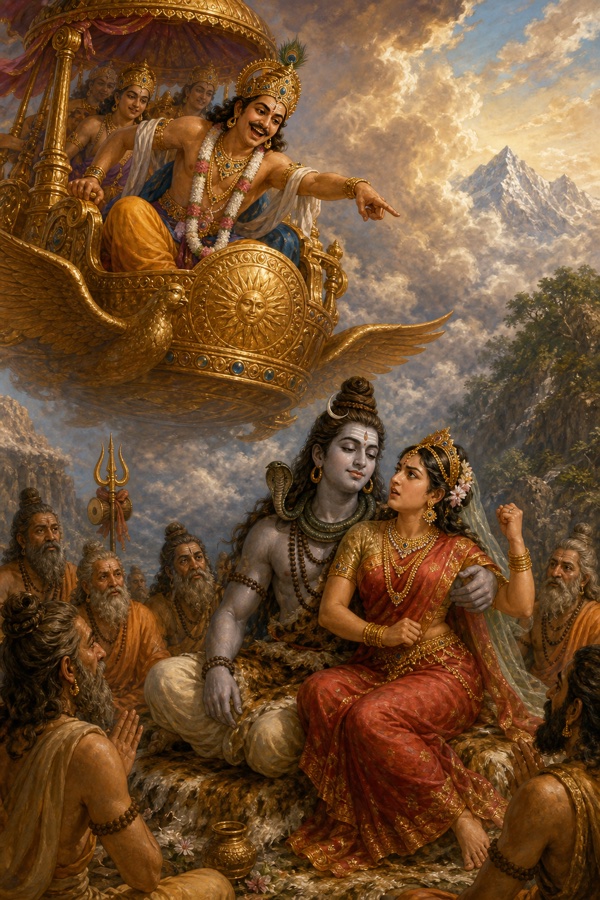
Then he looked down. Lord Shankara sat in an assembly of great sages, among siddhas and celestial singers, and he had drawn the goddess Parvati onto his lap and held her there with one arm, as easily as if the two of them were alone on Kailasa.
He did not land. Still up on his aircraft, and making sure the goddess would hear him, Chitraketu began to laugh out loud.
“Well now,” he said, “here is the teacher of dharma for the whole world, the guru of every guru, the first among all living beings. And look at the state of him, seated in a crowded hall with his wife pressed against his body. A wearer of matted locks, an ascetic of that rank, the head of all who expound Brahman, and he holds a woman in his lap like any common householder. Even common men, as a rule, keep such things to private rooms. And here is this great keeper of vows doing it in an open assembly, under the eyes of the holiest company in creation.”
Lord Shankara’s mind runs too deep for any line to sound. He heard the jibe and laughed easily, the laugh of one to whom praise and mockery weigh the same, and said nothing. The others in the assembly, taking their cue from him, held their peace as well.
Parvati did not hold hers.
⁂
Chitraketu had no measure of Lord Shankara’s greatness, of a lord so far beyond shame and honor that the two had long since become one word to him. A thin thread of pride had worked its way into the king, pride in his mastery of the senses, in his vidya, in all he had attained, the finest of threads, and the hardest to see when it is your own. Seeing that insolence, the goddess spoke in anger.
“So this is the one lord left in all the world,” she said, “fit to rule shameless wretches like us with the rod of punishment. It would seem that Brahma, and Bhrigu, and Narada, and the sons of Sanaka, and Kapila, and Manu, all these great ones, know nothing of the secret of dharma. Why else would they never stop this Lord Shiva, who so plainly tramples the bounds of dharma?”
“This low kshatriya has held the guru of the worlds in contempt, whose lotus feet Brahma and the rest hold in their meditation. He is swollen with his own importance. This fool is not fit even to stand at those feet of Shri Hari that the highest of the holy long to worship.”
Then she turned her eyes up to the man in the aircraft. “So, you of the crooked mind, go. Take your birth in the womb of the demons. That way, my child, you will never again find the power to wrong someone established in spiritual knowledge.” Even inside the curse, the old word slipped from her: my child. The mother in her could not be angry in any other voice.
The assembly went quiet.
But the one who had been cursed did not tremble. Everyone present understood what they were watching. A master of vidya carries power enough to hurl a curse straight back, and Chitraketu had it in him, that very moment, to answer her in kind. He let it go by. He folded the power away and chose instead to receive what she had given him, with both hands, the way one receives prasad. That choosing, more than any vidya, was the measure of what he had become.
⁂
Chitraketu brought his aircraft down at last, stepped from it, and bowing his head before the mother of the worlds, began to gentle her anger.
“Mother Parvati, with a glad heart and both hands joined I accept your curse. When gods pronounce a thing over a mortal, they are only announcing early the fruit that was already ripening for him, according to his prarabdha, the load of old karma he carries into a life and must spend before it ends.”
“Devi, this soul is bewildered by its own ignorance, and so it wanders on and on through the wheel of the world, tasting sweetness and tasting pain in every place, in every age. The one who deals out that sweetness and that pain cannot be assigned to the soul or to anyone else. Only the ignorant lay the blame on themselves, or on another.”
“This whole world is the natural running-out of the three gunas. Inside it, tell me, what is a curse and what is a blessing, what is heaven and what is hell, what is pleasure and what is pain? The Lord alone, with no one’s help, by the power of his own maya, shapes the bondage and the freedom and the joy and the sorrow of every creature. He regards all beings beyond dear and hateful, his own and stranger. When there is not even attachment to pleasure in him, how could there be an anger born of attachment?”
“Devi, you whose whole life is your husband, I am not gentling you in the hope of slipping free of the curse. I ask only this, that you forgive whatever in my words struck you as unfit.”
Having so calmed Shankara and Parvati, Chitraketu mounted his aircraft before their eyes and went his way, carrying the curse with him as calmly as a traveler carries the road. Everyone who watched was filled with wonder. Shankara turned to Parvati. “You see, beloved, the greatness of these desireless servants of Hari. He accepted your curse and never once asked you to lift it. They belong wholly to Narayana, and so there is nothing anywhere they fear, and they look on heaven and hell and liberation with one and the same steady gaze. I too am the Lord’s, and that is why his mockery never once touched me.”
Literary context
This story of Chitraketu falls in the sixth Skandha of the Shrimad Bhagavata, Chapters 14 through 17. Chapter 14 tells of the son’s birth and death. Chapter 15 brings the counsel of Angira and Narada, along with Angira’s own disclosure that he had first meant to give the king liberating wisdom and gave a son only because the king insisted. Chapter 16 holds the dialogue with the dead child’s soul and the darshan of Lord Sankarshana. Chapter 17 tells of Parvati’s curse. That same curse carries Chitraketu into his next birth as Vritra (Skandha 6, Chapters 9 through 13), and so this story stands as the prelude to the story of Vritra as well.