On this page
The Churning of the Ocean
There was a time when the gods had lost everything.
It began with a garland. The sage Durvasa, whose temper was feared through all three worlds, had carried down from the Lord’s own realm a wreath of divine flowers, given to him as a token of grace, and he offered it to Indra, king of the gods, as the highest honor he had to give. Indra, riding his great elephant Airavata and sure by now that every tribute was simply his due, let the garland fall to the animal’s head; the elephant dragged it down with its trunk and ground it into the dust. The curse came on the spot: Indra and the three worlds he ruled would be emptied of their splendor. And so it happened. On the battlefields the asuras began cutting the gods down with edged weapons in such numbers that the dead no longer rose. Strength, radiance, lordship, and luster drained out of heaven, the great rites of the world fell silent one by one, and Shri, the fortune of the worlds herself, was nowhere to be found.
Dimmed and helpless, Indra, Varuna, and the rest took counsel among themselves and came away with nothing. So they climbed to the summit of Mount Meru, the golden axis of the world where Brahma the creator holds his court, and laid the whole disaster before him. Brahma looked at Indra and Vayu standing there with the light gone out of them, looked at the demons flourishing, and understood that the cure lay past anything he himself could grant. He turned his mind wholly to the supreme Person, and then he spoke to the gods with a brightening face. Everything that exists, he told them, gods and demons, men and beasts, the trees and the smallest sweat-born insect, has come forth from that one immortal Being. No one is marked for death in his eyes and no one for favor; yet for the making, the keeping, and the unmaking of the universe he takes on the quality of the hour, and this hour belongs to preservation. Let us go to him, Brahma said. He is fond of his own; he will see to our welfare. And he set the gods behind him and led them past the reach of Maya, beyond the boundary of everything made, to the realm of the unconquerable Lord.
There Brahma prayed, in the oldest language there is, to a Being he had never seen and had heard of all his life: the changeless One, older than the most ancient thing, quicker than the mind, from whom speech turns back; the One whose mouth is fire and whose eyes are the sun, from whose strength Indra rose, from whose grace the gods, from whose wrath Shiva, from whose intellect Brahma himself; the One to whom a work once surrendered can never be wasted, since watering the root of a tree feeds every branch of it at once. Show yourself, the hymn ended, in a form our senses can bear. And Shri Hari appeared before them with the blaze of a thousand suns rising together. The gods stood blinded; they could not find the sky, the quarters, the earth, or their own bodies in that light, let alone the Lord. Only Brahma, with Shiva beside him, beheld the form itself: dark as flawless emerald, the eyes carrying the soft red of a lotus heart, a cloth of burning gold at the waist, a wreath of forest flowers at the neck, and the Lord’s own weapons standing around him in living, personal form.
He needed to be told nothing; the whole of it lay open to the one who watches every heart from the inside. The gods, seeing at last the refuge they had sought so long, felt what elephants tormented by a forest fire feel when they come down into the water of the Ganga. And in a voice deep and unhurried as a raincloud, the Lord gave them their course.
“Time itself is carrying the asuras just now,” he said. “You will never break them alone. When the work at hand is great, one makes peace even with an enemy, and keeps it until one’s own fortune turns of itself. Go to your cousins, the sons of Diti and of Danu, and bind a truce with them. Once the thing is done, you may deal with them again as a snake deals with a rat.”
“And then, Lord?”
“Then churn the Ocean of Milk, all of you together. In the depths of that sea lie treasures beyond price, and among them is amrita, the nectar of deathlessness; even a man already going down under Death’s hand rises and lives if a drop of it touches his tongue. Tell the daityas the nectar will come, and that all who drink it live forever, you and they alike. Gather every plant, grass, creeper, and healing herb you can find and cast them into the milk. Take Mount Mandara for your churning-rod and Vasuki, the king of the serpents, for your rope, and churn without tiring, with me for your helper. Whatever the asuras demand along the way, let them have it; a kind word wins what anger loses. The toil and the burning will fall to them. The fruit will come to you.”
“And will they consent, Bhagavan?”
“For amrita they will consent; who lets go of that? Only hold to this. Keep your patience through everything the sea gives up. The first thing to rise will be the Kalakuta poison; do not be afraid of it. And whatever treasure comes after, covet none of it, and be angry at nothing, even should it be torn out of your hands.”
The gods went down to Bali, son of Virocana, king of the daityas, who had taken all three worlds in conquest and sat in state among the captains of his host. At the sight of the old enemy walking in, his generals came up off their seats, ready to strike; Bali, who knew the hour for war from the hour for treaty, held them where they stood. Then Indra laid the whole design before him in careful, courteous words, exactly as the Lord had framed it. The proposal pleased Bali, and it pleased the demon lords around him, Shambara and Arishtanemi and the dwellers of Tripura, and from that day the two hosts, gods and asuras who had been bleeding each other for ages, turned their joined strength toward the winning of the nectar.
The first labor was the mountain itself.
Roaring like lions, gods and asuras together wrenched Mount Mandara whole out of the earth and started for the sea with it, arms like iron bars locked under a weight no army had ever carried. Long before the shore their strength gave out. Indra, Bali, and the rest felt it going and could do nothing; the mountain came down like a second Sumeru falling out of the sky, and where it fell, whole companies of gods and demons were crushed beneath it.
Then the Lord came, riding the great eagle Garuda. One look from him knit the broken bodies whole and raised the fallen as though the mountain had never touched them. He lifted Mandara with one hand, laid it on Garuda’s back as lightly as play, mounted, and flew it the rest of the way to the shore with the two armies streaming after him. There he sent the bird away, and there was foresight in the dismissal: the helper still to come was Vasuki, and no serpent alive will approach Garuda, the ancient devourer of his race.
Now the rod stood ready at the water’s edge. Only the rope remained.
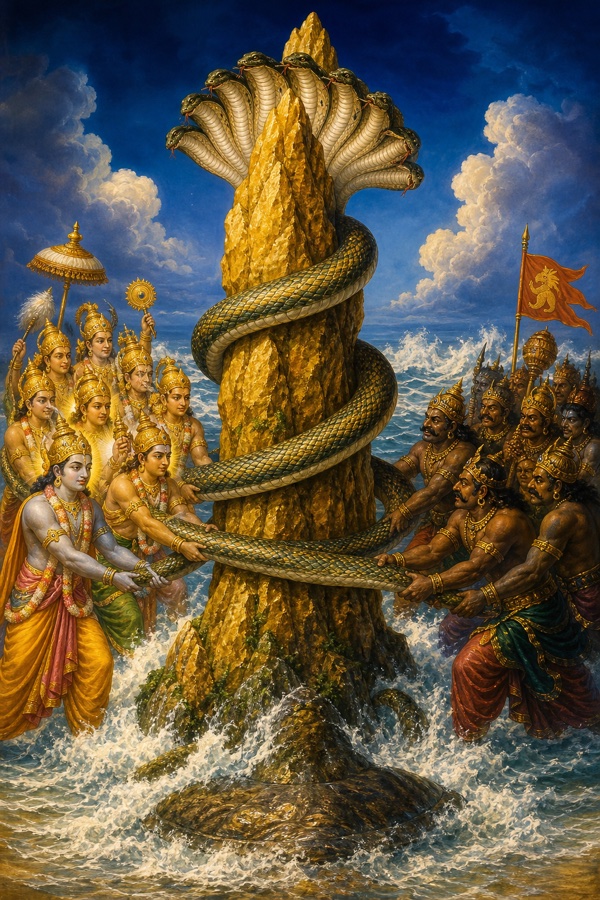
They summoned Vasuki, king of the serpents, won him over with the promise of his own share of the nectar, and wound his measureless body around the mountain’s waist for a churning-cord.
At the outset the Lord took hold toward Vasuki’s head, and the devas gathered on that side with him. The daitya generals would have none of it. They were proud men, proud of their birth, proud of their deeds, proud of their learning in the Veda, and they refused to stand where the omens ran poor. “The tail is the inauspicious end of a serpent,” they said. “We will not hold it.” And they stood motionless, going nowhere. The Lord smiled, released the head, and moved with the devas to the tail, and the end with the hoods passed into the daityas’ hands.
It occurred to none of them that the end they had won by pride was the end with the mouths.
So the sons of Kashyapa, gods and demons, cousins descended from a single ancient sage, set themselves against the rope and began. The devas hauled from one side, the daityas from the other. The mountain groaned and turned, the sea rose in whirlpools around it, and far below, the hosts of crocodiles were thrown into a boil.
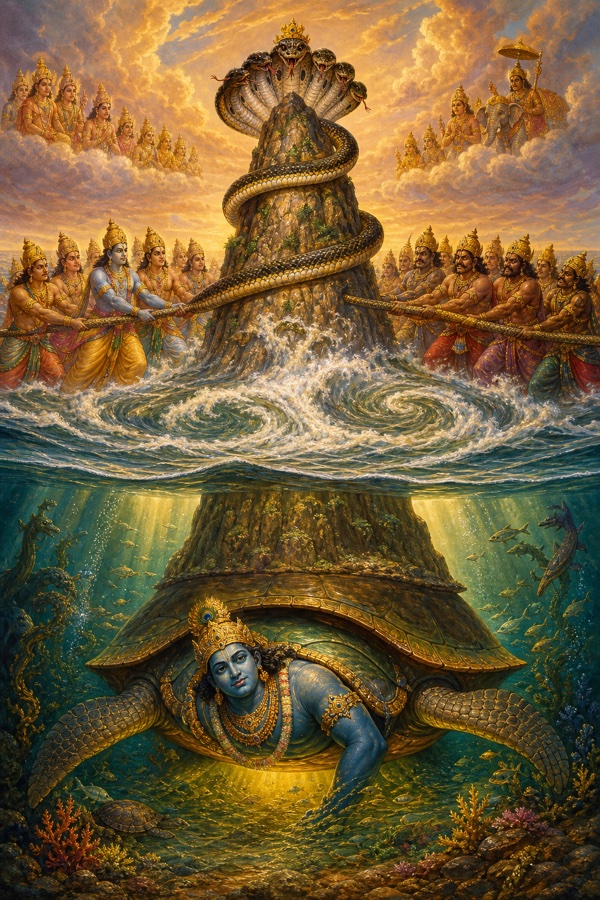
The first trouble came at once. The mountain had nothing to stand on. Under its own weight it began to go down, and though the strongest hands of both armies held it, they watched it sink out of their grip into the sea, and their faces went gray; a power older than their effort had simply overruled them. Then the Lord of unfailing resolve took the shape of a tortoise, vast past measuring, slid beneath the water, and rose under the drowning mountain until it sat upon his back. His shell spread a hundred thousand yojanas from rim to rim, eight hundred thousand miles, ground enough to be counted a continent of the world; and when Mandara began to spin again with the whole might of gods and demons behind it, the First Tortoise felt the grinding of that weight as a pleasant scratching of his back. The two hosts bent to the rope with new heart, and god and asura alike failed to guess that the floor they worked upon was alive, and was the Lord.
He was more than the floor beneath them. Into the demons he entered as the demons’ own dark vigor, into the gods as the gods’ bright steadiness, and into Vasuki, dragged and scoured between two straining armies, he entered as a merciful numbness, so that the serpent felt nothing of what should have been agony. And while he bore the mountain from below, he stood upon its summit too, in a form with a thousand arms, one hand pressing the peak down to its work, while overhead Brahma, Shiva, and Indra sang his praise and the sky let down a slow rain of flowers.
As the churning gathered violence, the thousand eyes and mouths of Vasuki began to run with smoke and fire. His breath rolled down the hooded end in waves, and the daityas holding it, Bali and Ilvala, the Paulomas and the Kaleyas, the whole flower of the asura host, were scorched where they stood like a stand of sarala pines in a forest blaze. Over the devas at the tail, at the Lord’s word, clouds emptied cool rain, and breezes that had crossed the waves came to fan them.
Hour upon hour the ocean was worked, and still no nectar came. Then the unconquerable Lord himself took the serpent in his four arms and churned: dark as a rain-heavy cloud, gold cloth at his waist, earrings flashing like paired lightnings, his eyes a soft copper-red, so that against Mandara he looked like a second mountain come to wrestle the first.
And the sea yielded its first gift, the poison. Out of waters teeming with timis and with the whales that swallow timis, with sea-elephants and sharks and shaken tortoises, the Halahala rose: black, thick, alive, pouring upward and downward and into every quarter at once, and the mere heat of its nearness set the breath trembling in every living body.
God and demon alike dropped the rope and fell back, and there was nowhere to fall back to; against a thing like that the three worlds held no shelter. So all the peoples of creation, with the Prajapatis, the first fathers of living beings, at their head, fled to the one refuge left and climbed to Shiva, where he sat on Kailasa in the austerity he keeps for the sake of the worlds. They praised him, and their hymn was the plain truth: that he alone can bind and free the whole universe; that Brahma, Vishnu, and Shiva are one power wearing three names for the making, the keeping, and the dissolving of things; that fire is his mouth, the earth his feet, and time itself only his moving; and that for him, who once burned the god of desire with a glance, who brought down the three flying cities, who has subdued death itself, this poison would be no labor worth praising. Save us, they said. It is burning the three worlds alive.
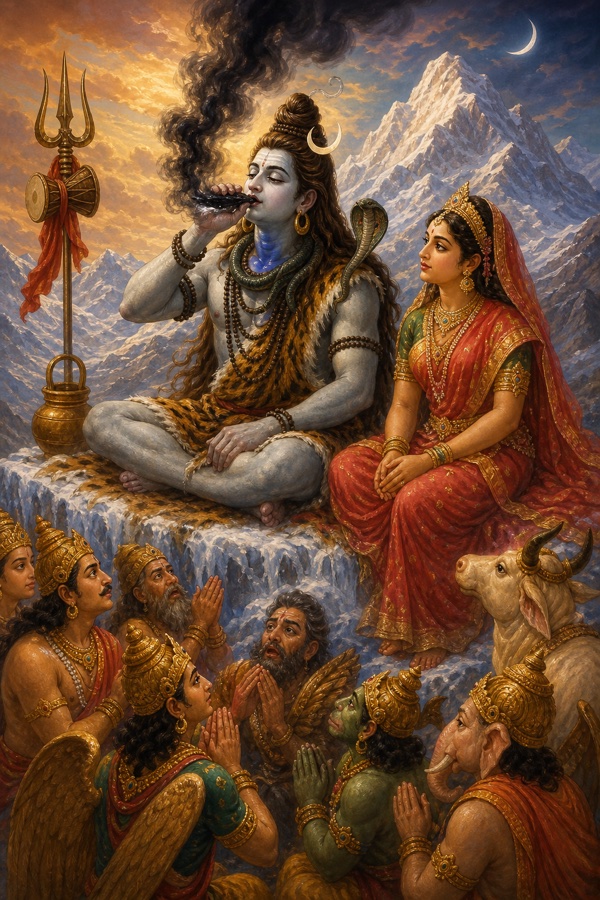
Shiva sat with Sati beside him, and his heart moved with pity. He turned to her. “Look at this, Bhavani,” he said. “Look at the misery this Kalakuta out of the churning has laid on every creature that breathes. They want to live, and they have no one. Whoever has strength owes its whole use to the helpless; the good will spend their own passing lives to buy the lives of others. And there is no worship of the Soul of the world higher than mercy toward what he has made. When Hari is pleased, I am pleased, and all that moves and all that stands still is pleased with me. So I will drink this poison, and let my creatures live.” Sati knew what her lord was; she saw the greatness of the thing he asked, and gave her consent. Then Shiva, perfectly calm, gathered the spreading Halahala into the cup of his palm and drank it down, the way a man takes a sip of medicine.
The poison was the gathered impurity of an entire ocean, and it showed its force even on that body. It rose as far as his throat and lodged there, and the throat turned blue; on him the wound became an ornament. Blue-throated, Nilakantha, the worlds have called him ever since, and the worlds understood what they had seen, for the great are pierced by the pain of others as by nothing else, and to take that pain on willingly is the highest offering there is. Sati praised the deed, Brahma and Vishnu praised it, and every watching creature blessed him. The little that leaked from between his fingers as he drank was taken up by the scorpions and the snakes, by the venomous herbs and roots, and by every biting, stinging thing that carries poison to this day.
The churning began again.
And now the sea, its bitterness surrendered, began to hand up its treasures one by one.
First came Surabhi, the cow of plenty, the Kamadhenu who answers every wish, from whom flow the milk and the ghee that feed the sacred fires. The rishis who expound Brahman took her into their keeping, for the sake of the yajnas that hold open the road between earth and heaven.
Then rose Uchchaihshravas, a horse white as the moon at full. Bali wanted him and took him; and Indra, remembering the counsel given on the shore, felt the old craving rise, and let it pass, and made no claim.
Then came Airavata, the white king of elephants, his four great tusks lifted like the four summits of Kailasa, Shiva’s own white mountain.
Then the Kaustubha broke the surface, a great gem of the ruby kind, burning from within, and Shri Hari took it to wear upon his breast, where it burns to this day.
Then the Parijata tree, the flowering glory of the heavens, which never tires of giving and answers whoever asks with the very thing asked for.
Then a whole troop of apsaras came up out of the milk, robed in fine cloth and hung with gold, dancers of the celestial courts, the chime of their anklets arriving before them, unhurried in their step, playful about the eyes.
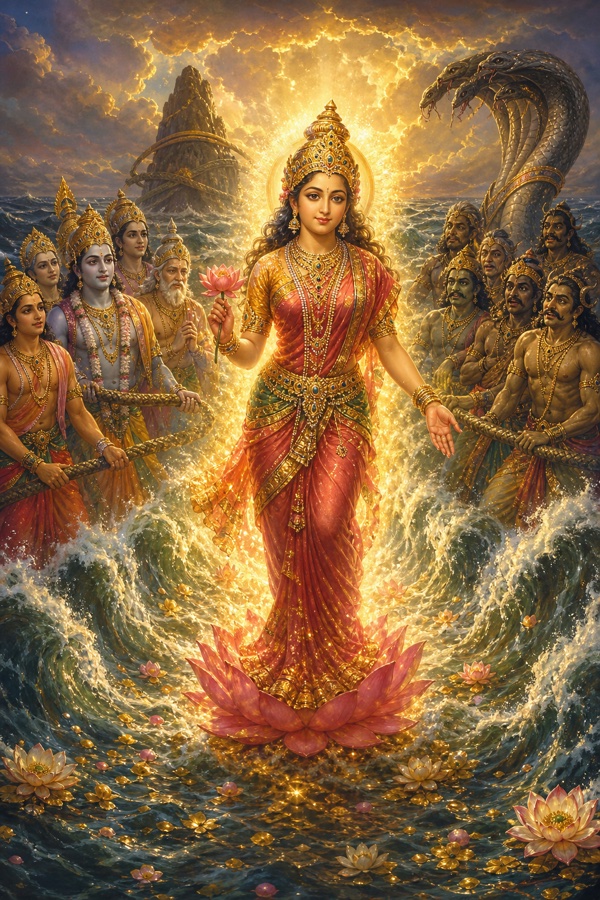
And then the waves themselves seemed to hold their breath. Out of the parted water rose Shri Lakshmi herself, fortune in person, splendor pouring from every limb of her, and her radiance ran across the quarters like lightning playing on the crystal flanks of Mount Sudama.
Gods, demons, sages, everything that stood on that shore stopped where it stood. The churning-rope hung slack in every hand. Her beauty, her nobility, her youth, her glowing color overwhelmed every mind that turned toward her, and one single longing rose in all of them together: let her come to me. For where the glance of Shri settles, every fortune follows; whoever her eyes chose would hold the wealth of the worlds.
Indra himself brought her a wonderful throne. The great rivers took on human bodies and came bearing holy water in jars of gold; Mother Earth gave every herb the consecration calls for; the cows gave the panchagavya, their five sacred gifts; and Spring came in person with the flowers and fruits of its two soft months. The rishis set the rite of her bathing in the order the scriptures fix, the gandharvas, heaven’s own musicians, raised auspicious song while their wives danced to it, and the cloud-spirits sounded drum and double-drum, tabor and clarion, conch and flute and vina, until the shore rang. Then the great elephants of the four quarters lifted golden jars in their trunks and bathed her, a lotus resting in her hand, while the Brahmins chanted over the water.
The ocean gave her two lengths of yellow silk. Varuna offered the Vaijayanti garland, so heavy with honey that the black bees riding it reeled as they flew. Vishvakarma, artificer of the gods, brought ornaments of his own making; Saraswati, a necklace of pearls; Brahma, a lotus; and the nagas, a pair of earrings.
Then Lakshmi took up a fresh garland of lotuses, loud with bees drunk on its nectar, and carried it down the whole of that assembly, past gandharvas and yakshas, siddhas and charanas, demons and gods, a creeper of gold moving to the small music of her own anklets, reading every face for the one thing she sought: a lord with every virtue, flawless, lasting, and whole, who owed nothing to anyone.
And face after face fell short. In one she found towering austerity, and beside it an anger the austerity had never conquered. Another held knowledge, and clung with attachment to the very thing he knew. A third was great past measure and still a servant of his own wanting. One leaned his whole power on someone mightier, and a dependent can be no one’s lord. In one there was dharma kept to the letter, with no warmth in it for living creatures; in another an open hand, and behind the giving, a motive. One was heroic, and time would take him like the rest; another was free of every attachment, and for that very reason would never be a companion to anyone. She found long life with no sweetness in it, and sweetness whose span of years no one could promise; found one rare being who carried both, and carried them with an unlucky bearing; and where at last everything met in a single person, that person had no wish for her.
One alone stood apart from the whole survey: every virtue entire in him and none of it borrowed, beyond time, beyond decay, sought by every excellence at once, and asking for nothing, from her or from anyone.
She went to him. She stood a moment before Shri Hari, who did not reach for her, and then she laid the fresh lotus garland on his shoulders, and with a shy smile blooming in her eyes she made his breast her lasting home and took her place at his side, where the three worlds and their guardians have looked for her ever since; for seated there she pours well-being over everything the Lord has made, with nothing more than the kindness of her glance.
Shri gave herself to the one being on that shore who had no craving for any treasure of the sea.
Where her look came to rest, virtue and grace and plenty sprang up of themselves, and the devas overflowed with joy. The daityas stood outside that look, and something went out of them as they stood; passed over by Lakshmi, they grew dispirited, idle, shameless, and grasping from that day on.
After her the ocean sent up Varuni, goddess of wine, and with the Lord’s leave the daityas took her.
But the treasure the whole labor had been driving toward was still below.
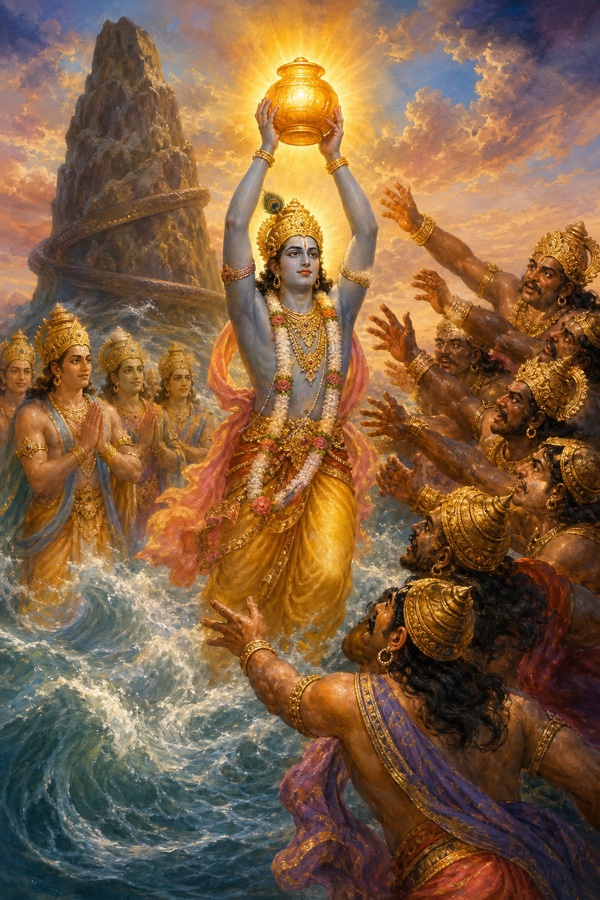
Last of all, the sea parted around a figure no one had summoned and no one could look away from: a young man dark of body, his neck ringed like a conch, his eyes faintly red, gold cloth at his waist, gems at his ears, a lion’s ease in his stride, and in his hands a jar filled to the lip with amrita. This was Dhanvantari, risen out of a single minute ray of Vishnu’s own being; it is he who opened the science of healing to the world, and he takes his share in every sacrifice offered since.
The daityas saw one thing only, the jar. Every pledge made on that beach died in a single instant. “The amrita is ours.” They lunged, wrenched it from Dhanvantari’s hands, and ran.
The gods, robbed of the fruit of everything they had endured, turned to Shri Hari. “Do not be cast down,” he told them. “I will breed a quarrel among these thieves, and by my own maya I will finish this for you, in a shape not one of them will be able to refuse.”
He hardly needed to breed it; among the daityas the feud was already alight. “I drink first.” “No, I do. Not you.” And the weaker ones, whose hands had never once touched the jar, discovered a sudden reverence for justice and began pleading the enemy’s cause: the devas had pulled the same rope and borne the same fire, and when a rite is performed in common, a share to every hand that labored is the eternal law. The amrita they had emptied an ocean to win had become, before one drop of it was drunk, the seed of their war with one another.
Then the Lord, who knows every expedient there is, took on a form past the reach of words, the wonder called Mohini. But that, Rajan, is the tale ahead, and you will hear it in its own hour.
Literary context
The churning of the ocean fills chapters 5 through 8 of the eighth Skandha of the Shrimad Bhagavata; this telling carries it from the appeal of the beaten gods to the rising of the nectar and the Lord’s first turning toward the form of Mohini. The story appears in the Mahabharata and in several other Puranas as well, though the Bhagavata’s account is unusually well ordered and alive as narrative, binding the churning-rod of Mandara, the rope of Vasuki, and the tortoise beneath the mountain into one continuous scene.
The image of Nilakantha, the blue-throated Shiva who drank the world’s poison and kept it, has stayed among the most loved of all the Shiva stories, and across India’s temple sculpture the procession of the fourteen treasures out of the milk ocean has been carved again and again, century after century.
Go deep into anything, your own mind, a relationship, a great piece of work, and the first thing that rises is exactly what you have been avoiding. The churning teaches that the road to the nectar runs straight through that bitterness, and that Shri, when she finally rises, passes over every grasping hand and stays with the one who kept calm hold of the rope and wanted nothing for himself.