On this page
The Tapas of Dhruva
Dhruva was five years old the first time he understood that he had no one he could call his own.
His father was King Uttanapada, a son of Svayambhuva Manu, the first sovereign of men, whose own line ran back to Brahma the creator. The king had two queens. The first, Suniti, was Dhruva’s mother. The second, Suruchi, had borne his half brother Uttama.
The king loved Suruchi more. In a royal household nothing stays hidden; favor moves through a palace the way heat moves through a house, and everyone from the kitchens to the council chamber knew exactly which rooms it warmed and which rooms it never reached. Suniti lived in the cold ones, and her son lived there with her.
One day King Uttanapada sat with Suruchi’s son Uttama on his lap, playing with him as fathers do. Dhruva watched, wanted what every five-year-old wants, crossed the great hall, and reached up to climb into that lap too.
The king did not reach for him.
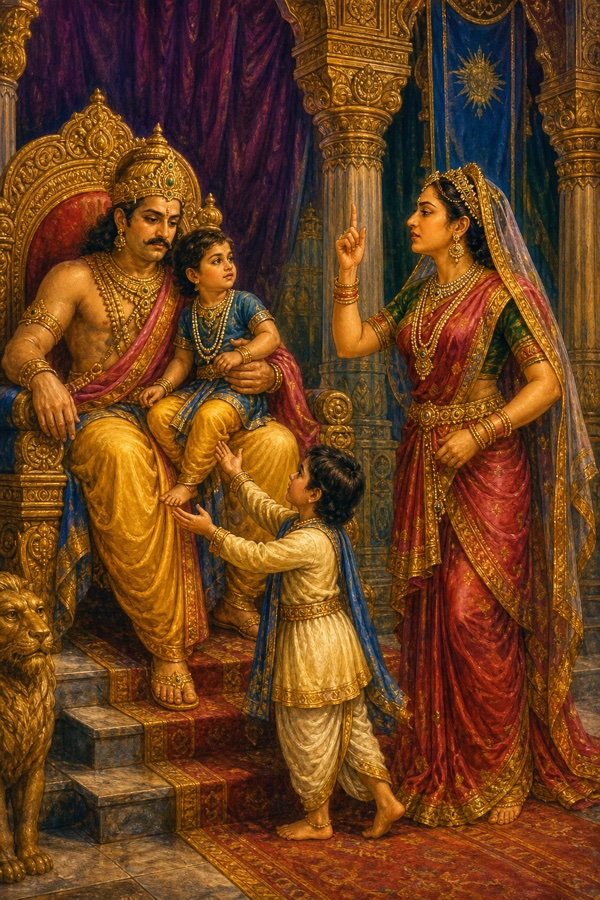
Suruchi had waited a long time to be that sure of her standing. She looked at her co-wife’s son straining toward the king’s knee, and with the king sitting right there, listening, she chose this moment to speak to the child. Her voice stayed sweet the whole way through. Every word in it had been sharpened beforehand.
“Child, the royal throne is no seat for you. You are the king’s son, true enough, and still you never took shape in my womb. You are too young to understand that another woman carried you, and that is why you reach for a thing so far past your reach. If you want the throne, then go win the favor of the Supreme Person, Narayana, through hard penance, and by his grace take birth again. Through my womb, the next time.”
The five-year-old could not follow everything in that. He followed enough. In that lap there was no place for him.
A snake struck with a staff rears up hissing, the whole length of it awake at once. Something of that kind rose in Dhruva. Cut open by his stepmother’s words, he stood drawing long, burning breaths, and his father, the one man who could have ended it by lifting a hand, watched the whole of it and said nothing.
Then the boy stepped back from the throne. He turned, and ran crying through the corridors to his mother’s rooms.
Suniti saw him crying and lifted him into her arms. She asked what had happened. The child told her everything.
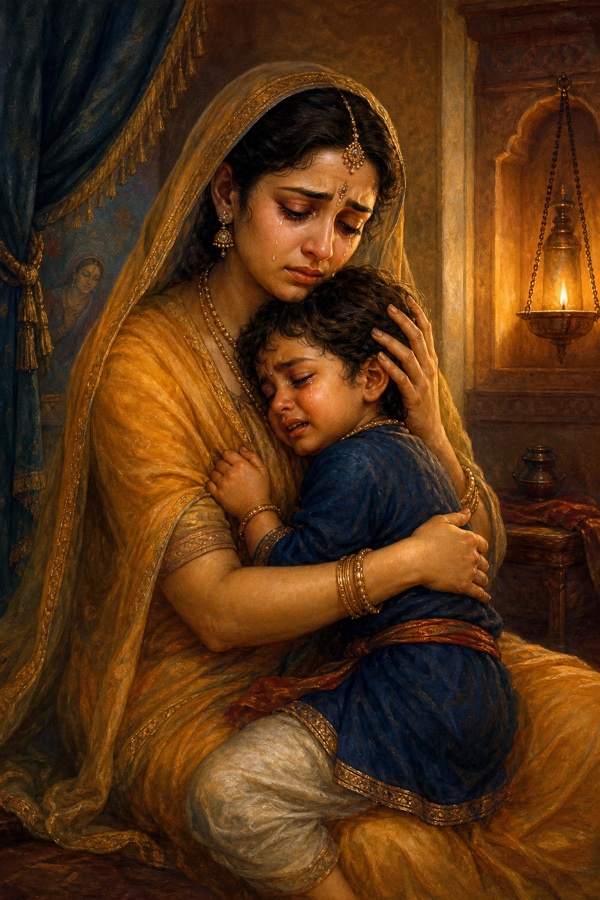
For a moment she could not move. The women of the palace had already carried Suruchi’s words to her, every syllable, and they had cut her as deep as they had cut the boy. Now her patience, which was most of what she owned in that house, gave way. She wilted like a forest vine scorched by a passing wildfire, and her eyes, lovely as a pair of lotuses, brimmed and ran over. The child’s sobs kept breaking against her chest, and she had no way to quiet them. What place could she promise him? She had been set aside herself. She had nothing of that kind left to give.
At last she drew a long breath and spoke. “Lala, never wish harm on anyone, whatever they have done to you. Whoever hands pain to others ends up holding that same pain himself. And what Suruchi said was no lie. You were carried in my womb and raised on my milk, and the king is ashamed to own me as his wife; there are days he would be ashamed to own me as his servant. You will find no seat in that lap, my son. Listen, though. There is one more lap in this world. In that one, nobody asks whose womb carried you. There, a single cry is enough to win you a place. Your great-grandfather Brahma, who shaped this universe, earned his high seat by serving the feet of Shri Hari; sages who have conquered mind and breath bow toward those same feet. Your grandfather Manu won this earth, and heaven beyond it, and the freedom beyond both, the same way. Even Shri, the goddess of fortune, whom the whole world begs after, waits on him with a lotus in her hand. No one else can wipe out what you are feeling tonight, child. Call on him.”
Dhruva looked up at his mother. The crying had stopped somewhere in the middle of her words. Something had settled in his eyes, poured metal, cooling, already keeping its shape.
He bent and touched her feet, the way a child asks an elder’s blessing, and said, “I will go.”
“Where?”
“There. Where you said. To find him.”
And the five-year-old went. He mastered his own mind with nothing except his own will, walked out of his father’s capital, alone, and turned toward the forest.
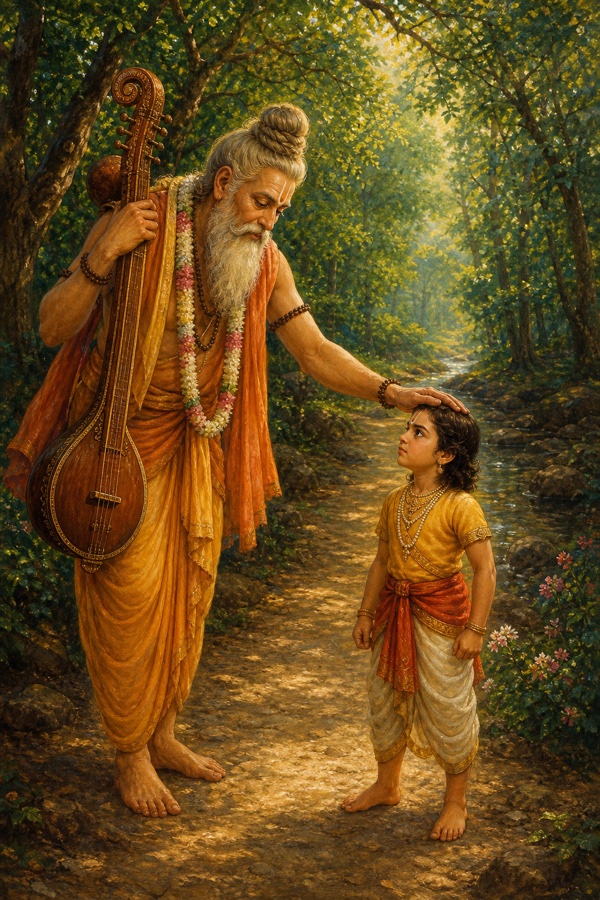
On the road the sage Narada found him. Narada crosses the three worlds as he pleases, and news of a five-year-old marching out to meet God travels fast. He passed his purifying hand over the boy’s head and marveled to himself: the warrior blood, awake this early; one stinging sentence from a stepmother, and the child has taken it all the way to heart. Aloud, he tried to turn him around. “Son, you are a child still. This is the age for games. What can honor and insult weigh at five? And even when they weigh something, a wise man rests content with whatever Providence sends him, since every lot follows a man’s own past deeds. The One you are going out to find is hard to reach, little one. Yogis lose his road through whole births of discipline. Go home. When you are grown, and the time for the deeper search arrives, take it up then.”
Dhruva said only this: “The fire in me is lit today. Tomorrow it may have gone cold. I have to go today.”
Narada stopped arguing. The child in front of him was asking for a road to a place no forefather of his line had ever reached, and he was asking the one sage in the three worlds most likely to hand it over. Narada gave him the whole of it. “The path your mother showed you is the path of your highest good. Vasudeva himself is that path; whatever a person truly seeks, duty or wealth or joy or final freedom, all of it waits at Shri Hari’s feet. Go to Madhuvana, on the sacred bank of the Yamuna near Mathura. He is present there always. Bathe three times a day in the Kalindi’s water, spread a seat of kusha grass, and slow your breath until it obeys you. Then build the Lord inside your heart, piece by piece: the glad face that is always about to give, the eyes with their long reach of kindness, the four arms with conch and discus, mace and lotus, the Shrivatsa curl on the dark chest, the Kaustubha gem, the yellow silk, the garland of forest flowers, the gold anklets. Hold that form until it holds itself.” Then he bent down and gave the child the mantra of twelve syllables, Om Namo Bhagavate Vasudevaya, and taught him to repeat it while the vision stood. “Worship him with clean water, wild fruit and roots, and tulasi leaves. Keep the mantra moving for seven days and nights, and you will begin to see the Siddhas, the perfected ones who cross the sky unseen. After that, what comes will come.”
Dhruva walked until the trees of Madhuvana closed over him, chose a spot on the bank of the Yamuna, and sat down.
Sitting, for this boy, became a campaign. Month after month he pared his own life away: first the food, then the water, then the breath itself.
The first month he ate only wood apples and jujube fruit, one small meal every third night, enough to keep the body serving the vow and no more.
The second month, withered grass and fallen leaves, once every six days.
The third month, water alone, once every nine days.
The fourth month, a mouthful of air, once every twelve days.
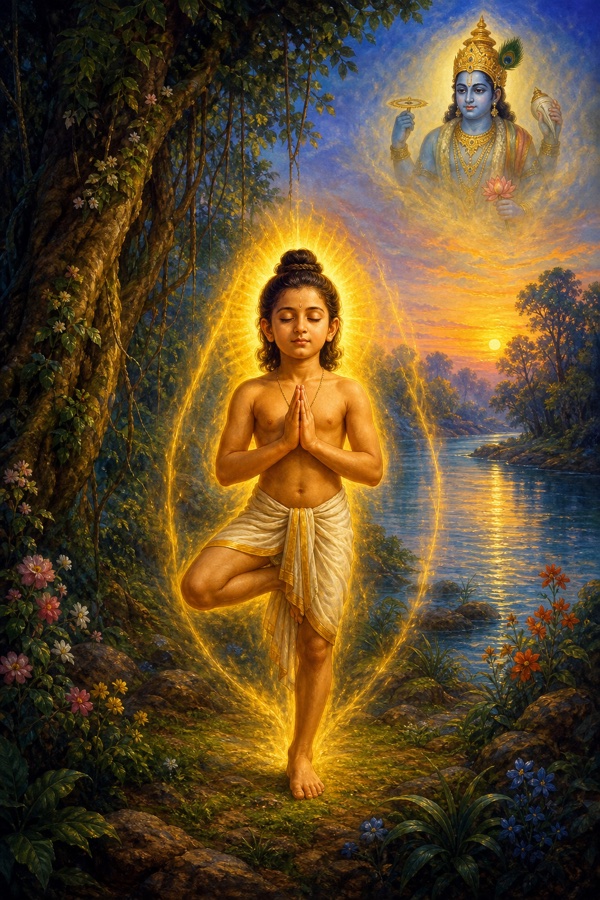
In the fifth month even that ended. Breath mastered, Dhruva rose onto one leg and stood like a post driven into the riverbank, motionless, his mind called home from every object it had ever wandered toward and fixed on the one form standing in his heart. He perceived nothing else.
And his tapas, the heat that austerity builds in the body the way a kiln builds fire, grew so fierce that all three worlds began to shake.
When he pressed down on the earth with his one big toe, the earth tilted, the way a river boat lurches left and right under the tread of a bull elephant that has climbed aboard. His mind sank so completely into Shri Hari, the Soul of the universe, that his single small breath merged with the one breath moving through all things. And the breathing of every living creature in creation stopped.
The gods choked in their own heavens. With the guardians of the worlds they ran to Shri Hari for shelter. “Lord, the breath of every being has stopped at once. We have never seen this, and we cannot end it. You are the refuge of everyone who comes to you; free us.” The Lord calmed them. The boy on the riverbank, he told them, had identified his self with the Self of all creation; no power would break that penance from outside, so he would go himself, and end it with his presence.
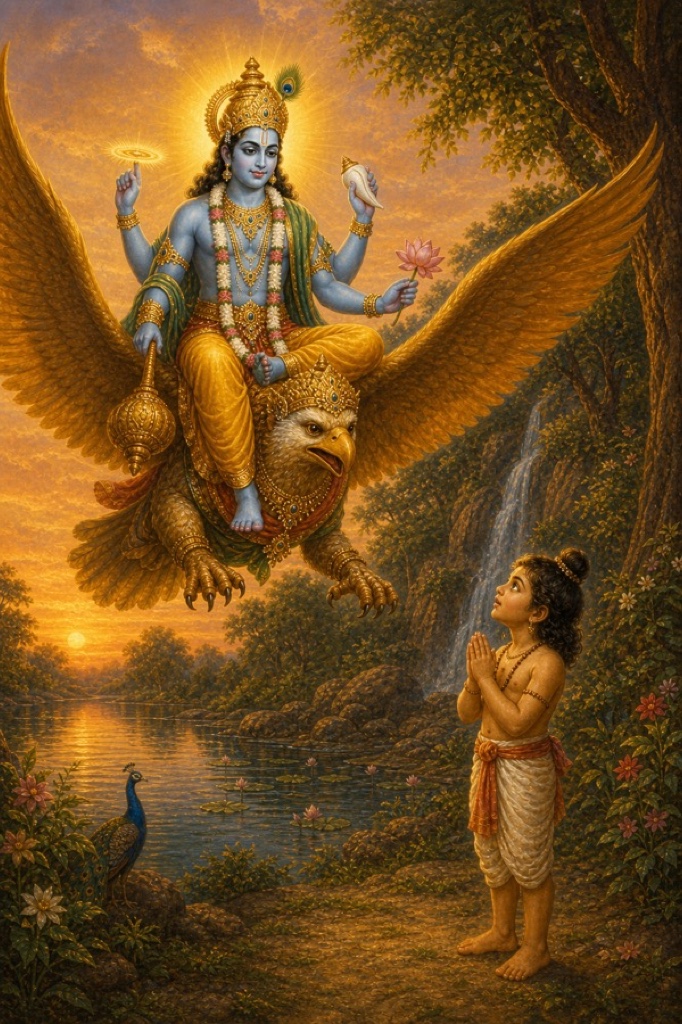
Then Vishnu came, riding the great eagle Garuda, drawn down out of his own abode by the wish to see this devotee with his own eyes.
At that instant, inside Dhruva’s heart, the form he had built there, brilliant as standing lightning, suddenly dissolved. His eyes flew open in alarm, and the same form was in front of him on the riverbank, complete, out here in the world. The boy dropped flat to the earth like a felled sapling. When he rose he stood staring, gazing as though he meant to drink the Lord in through his eyes, kiss him with his lips, and close both arms around him.
A hymn was swelling in the child with no words to carry it. Shri Hari, who is seated in every heart and had long been seated in this one, saw the trouble at a glance: the joined palms, the open mouth, the praise with nowhere to go. So the Lord raised his conch, which is the Veda gathered into a shape a hand can hold, and touched it, gently, to Dhruva’s cheek.
Speech woke in him like a house lit at every lamp at once. Dhruva began to praise the Lord, steadily, devoutly, and the words that came to the five-year-old were the Veda’s own. You entered me, he sang, and my sleeping voice sat up; my hands, my feet, my ears are lit from within; you are one fire burning in many pieces of wood. And at the crown of the hymn stood the image that held everything this child had walked away from and everything he had walked toward: as a cow stands over her newborn calf, feeding it, guarding it from every tooth in the forest, so you stand over even a wanting, wounded devotee like me.
Vishnu smiled and asked, “What do you want?”
Dhruva had starved five months and shaken three worlds to ask for a throne higher than his brother’s. He said, “Lord, I came to ask you for a royal seat.”
Vishnu laughed, and the laugh held nothing except tenderness. “You will have what you came for. When your father hands you the earth and walks into the forest, you will rule it in dharma for thirty-six thousand years, and your strength will stay whole to the last day of them. And I am giving you something you never asked for. There is a station in the sky that does not move. Around it the planets, the lunar mansions, and the whole host of stars, the sun and the moon among them, wheel and keep wheeling, holding it always to their right, the way oxen tread their circle around the center post of a threshing floor. The seven seers themselves turn beneath it. It outlasts the lives of those who live a full day of Brahma; when the three worlds dissolve, it remains. That is Dhruvaloka, and I give it to you; no one has held it before you. Your road there will run through a whole life. Your brother will ride into the mountains one day, hunting, and will never ride home, and grief for him will lead his mother into fire. You will rule, and give, and worship me with yajna upon yajna, and when age comes you will set your son on the throne and remember only me. Then you will rise past the seven seers, to the place from which no one returns.”
In time, every sentence of it came true.
The Lord rose on Garuda and was gone. Dhruva stood looking at the empty air for a long while, and then he turned toward home, and with each step his heart grew heavier. Six months. In six months this child had crossed a distance that costs perfected sages whole chains of lifetimes, had stood at the feet that end birth and death, and had spent the moment ordering a throne. The wound had chosen his wish for him. Suruchi’s words were still lodged in him when the Lord said ask, and so, face to face with the untier of every knot in the world, he had never once thought to ask to be untied. Only now, with the bitterness rinsed out of him by that one sight, was there room in the boy for regret. Regret moved in and filled it.
He walked and accused himself out loud. “Look at my foolishness. Sages like Sanandana wear out lifetimes of absorption to touch what I reached in six months, and I stepped back from it with my eyes on rank. A pauper wins the favor of an emperor who owns the whole earth and asks him for a fistful of unhusked rice; that pauper is me. From the giver of the soul’s own bliss I begged for seats that feed nothing except pride. From the breaker of the world’s bonds I asked for the world. I called Narada’s truth a lie to his face; the gods themselves, dreading a mortal’s luck outclimbing theirs, must have leaned on my judgment and bent it. And a brother. I made an enemy out of a brother, the way a dreaming man makes a lion out of his own sleeping mind and then trembles at it. No second person was ever standing there. There was only me.”
The news ran ahead of him to the capital. King Uttanapada heard that his son was coming home and could not make himself believe it, the way no one believes a story of the dead walking back. What luck like this, he asked, could belong to a wretch like me? He had earned the word, and he knew where. From the day the boy vanished, the king had barely slept and barely ruled. Narada had visited him in that first grief and found a man gray with self-reproach, able to talk of nothing except a five-year-old asleep on forest ground among the wolves, his small face thinning with hunger, sent there by his own father’s silence. The sage had left him a promise: grieve nothing; the Lord himself is guarding that child; the world will learn his name, and he will come back to you soon, trailing your honor behind him. Now the promise stood at the city’s edge. Joy took the king whole. He hung a rope of costly pearls on the man who had brought the word, called for his chariot with its gold fittings and its fine horses, and drove out through the gates with brahmanas and the elders of the house and his ministers around him, conches crying, kettledrums rolling, Vedic hymns riding loud over the noise, and flutes running bright above all of it.
Behind him, dressed in gold, his two queens came out in a palanquin with prince Uttama. Near the pleasure-gardens the king saw a small figure on the road, and royal bearing ended there. He came down off the chariot at a jump and ran, and then he had his son against his chest, this child scrubbed of every stain by the touch of Vishnu’s feet, and he could not stop sighing, and he smelled the boy’s head again and again, the oldest rite a father has, and bathed him in tears.
Dhruva bowed at his father’s feet and took his blessing, and then he bent low before both his mothers. Both of them. Suruchi lifted the child up from her feet, pressed him to her breast, and got out, through a closing throat, “Live long.” Toward a person in whom Shri Hari has taken delight, all beings bend of their own accord, the way water left to itself finds the low ground and runs there.
Uttama and Dhruva threw their arms around each other and wept, let go, and wept again. Suniti held the son who was dearer to her than her own breath, and grief left her body at the touch of him; milk ran from her breasts and mixed with the tears falling on his hair. The whole city blessed her aloud: the son so long lost has come back, your pain is wiped away, one day he will rule the wide earth; surely you have worshiped the Lord who ends the sorrow of anyone who calls him, the Lord whose remembrance has walked even the wise past death.
The king set both boys on the back of a royal she-elephant and entered his capital, Barhismati, through streets turned into one long blessing. The roads had been swept and sprinkled with sandalwood water. The gateways stood dressed in plantain trunks and young areca palms heavy with blossom, arched over with festoons, flanked by water jars with small lamps burning at their lips, mango leaves and cloth and strings of pearls about their necks. Gold shone on the walls and gate-towers, and the high roofs caught the light like the domes of celestial vimanas. All along the way the women of the city showered Dhruva with white mustard seed, whole rice, curds, water, blades of durva grass, flowers, and fruit, singing blessings after him, and through that sweet rain the boy walked into his father’s palace.
He grew up inside that welcome. The royal sage Uttanapada, who had once only heard from Narada what his son’s tapas had done to the three worlds, now watched the glory of it move through his own halls. When the prince came of age, when the ministers gave him their esteem and the people their devotion, the king did what the Lord had foretold: he crowned Dhruva sovereign of the whole earth, weighed his own years in his hand, found the pleasures of the senses had gone tasteless, and walked out toward the woods with his mind turned to the Self.
In time Dhruva married Bhrami, daughter of the Prajapati Shishumara, and she bore him two sons, Kalpa and Vatsara. Through a second wife, Ila, a daughter of the wind-god Vayu, he had a son, Utkala, and a daughter counted a jewel among women. He ruled the earth in dharma.
Then the day the Lord had spoken of arrived. Uttama, still unmarried, rode into the Himalaya on a hunt and was killed there by a Yaksha mightier than himself. Suruchi went into the forest after her son, searching past the borders of reason, and a wildfire took her.
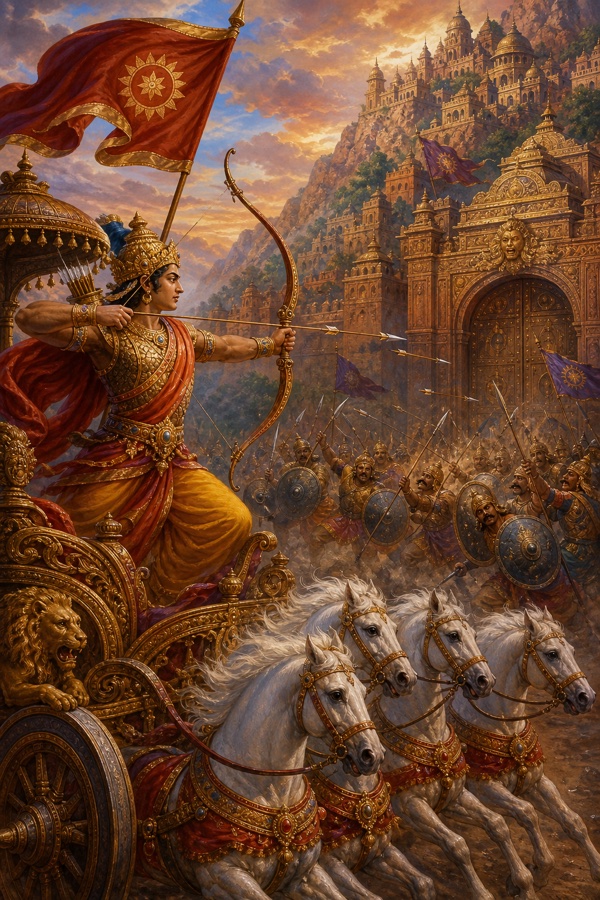
When the news reached Dhruva, grief, rage, and turmoil rose in him as one tide. He mounted his war chariot and drove north into a valley of the Himalaya, to Alakapuri, the city of the Yakshas, thick with Guhyakas, walked by spirits and ghosts, the stronghold of Rudra’s attendants. There he blew his conch, one long blast that rebounded off the sky and all four quarters, and inside the city the wives of the Yakshas looked up from their lives in sudden fear.
The Yaksha warriors could not sit under that sound. They poured out of the gates with weapons high, and Dhruva met them with his terrible bow and put three arrows into every man of them at one stroke. Struck in the brow, the Yakshas paused, took his measure, and saluted the feat out loud. Then, like serpents that will never forgive a footfall, they answered with six arrows each, and after the six, everything: one hundred thirty thousand of them rising at once, raining iron on a single chariot, clubs, swords, lances, pikes, axes, javelins, double-edged blades, bhushundis, arrows feathered in every color, until Dhruva and his charioteer vanished under the storm the way a mountain vanishes under a cloudburst. From the sky where the Siddhas stood watching, a cry went up: the sun of Manu’s line has drowned in the Yaksha sea, and it has set. And then, out of the middle of the enemy’s roar of triumph, the chariot came back into the light, the way the sun comes out of mist.
His bowstring sang, and the storm of missiles came apart in the air like clouds torn up by a blast of wind. His arrows opened their armor and sank in whole, the way thunderbolts sink into a mountain, and soon the field lay strewn with crowned heads and gold-braceleted arms, jeweled ears, costly turbans, thighs like golden palmyra trunks, a field so terrible it turned rich to look at. The Yakshas still able to run ran, like bull elephants scattering when the lion stands up. Dhruva looked across the emptied ground at the open city and held his chariot back. “No one can guess,” he told his charioteer, “what enchanters keep in reserve.” The words were still in the air when a sound came from everywhere at once, an ocean roaring where no ocean was, and dust rolled in on a hard rising wind. The sky sealed itself with cloud and cracked with thunder. Rain came down, and the rain was blood, and after the blood came worse: pus and filth and fat, and headless trunks dropping out of the ceiling of the storm. A mountain condensed overhead and poured down maces and boulders. Serpents came on hissing like thunderheads with fire in their eyes, and behind them herds of maddened elephants, lions, tigers, and behind those the sea itself, vast as it looks on the day the worlds dissolve, climbing the valley from every side to drown him. On the hills the hermits who had gathered began to pray aloud: may the Lord of the Sharnga bow stand with this boy; his Name alone, spoken or heard, has carried people past death itself.
In the middle of that apocalypse, Dhruva did one small, exact thing. He cupped river water in his palm and sipped it, the old rite of purification that a great weapon demands, and set to his bow the missile of the sage Narayana. The moment it touched the string, the conjured world went out, all of it at once, the way night and everything hiding in it goes when the lamp of wisdom is lit. From his bow leapt arrows with golden shafts and feathers like swans’ wings, and they entered the enemy ranks with a cry like peacocks pouring into a forest. The Yakshas flew at him with hoods raised, serpents rushing Garuda, and he cut them apart as they came, arms, thighs, necks. And the strangest mercy in the whole battle: every Yaksha who fell to those golden arrows rose past the sphere of the sun into the high realm that renunciates spend austere lifetimes earning.
Before the bow could speak again, his grandfather was standing on the field. Svayambhuva Manu had come down with a company of sages, moved to pity by the heaped dead, and he began, gently, to take the war out of his grandson. “Enough, child. Put this rage down; it is a gateway, and hell is on the far side of it. These were the Punyajanas, the holy folk of this mountain, and most of your dead never touched your brother; you have punished a nation for the deed of one man. Killing bodies as though bodies were selves is how the beasts see the world, and it does not belong in our house, least of all in you. You adored Shri Hari at five years old, looking on every creature as your own self, and won a realm the guardians of the worlds cannot enter; the righteous were to learn their conduct from you. The Lord is pleased by forbearance, by compassion, by friendship, by an even eye. And learn what actually kills, my son. No Yaksha ended Uttama. Time ends everyone. God alone, moving as Time, brings every creature out of the dark and gathers every creature back, the way dust rides a wind wherever the wind is going; he shortens a life and lengthens a life and stands outside every life, untouched. The schools give him different names for it, Karma, Nature, Time, Destiny, Desire, and none of them has seen his intention. So put the anger down, Dhruva. A man with your learning can curb it the way medicine curbs a disease, and a man who wants to live unafraid must, since the whole world lives afraid of the man that anger owns. Last of all: the Yakshas you have cut down belong to Kubera, the friend of Shiva. Go to him. Bow. Speak softly, and appease him, before the wrath of a great one comes looking for our line.” Then Manu blessed him and turned back toward his own city, and the sages went with him.
Dhruva laid the enmity down, the enmity the wise call hardest of all things to lay down, at one word from his grandfather. And almost at once Kubera himself stood on the field, lord of the Yakshas, keeper of all the treasure in the world, with celestial bards singing around him, come in person to see the boy who had emptied his city and then unclenched his heart. “Kshatriya prince,” he said, well pleased, “you dropped a hatred that men carry into their graves, and you dropped it because one elder asked. I am pleased with you. Hear the truth of it now, cleanly. You never killed the Yakshas, and the Yakshas never killed your brother. Time alone moves every birth and every death; the ‘I’ and ‘you’ that trade blows down here are a dream the mind has inside a body. So ask. Whatever boon stands first in you is yours; even we have heard how near you stand to the feet of the Lord.” Dhruva stood before the god of riches, the one being who could put anything in the world into his hands, and asked for the one thing no treasury holds: that his remembrance of Shri Hari never break, since the man who carries that remembrance crosses the shoreless ocean of the world with ease. Kubera granted it gladly, and vanished where he stood.
Then Dhruva went home to Barhismati and became the king his boon had promised. He worshiped the Lord of sacrifices with yajna after yajna, open-handed with the priests, and the vision from the riverbank never closed: he saw the same Lord seated in himself and in every creature that breathed. His people gave up telling the difference between their king and a father. Tender to the afflicted, exact about dharma, he protected the earth for thirty-six thousand years, a god’s full lifespan, wearing his merits down by enjoying them and his sins away by restraint.
When age came at last, Dhruva looked at everything a long life had gathered around him, wives and sons and treasury, army and palace gardens and the sea-belted earth itself, and read one small signature on all of it: already claimed by Death. He set his son Utkala on the throne and left for Badarikashrama, high in the mountains.
There he bathed in the sacred water and sat down, and the boy who had once climbed out of food and water and breath, month by month on a riverbank, made the same climb one last time in an old man’s body. His breath slowed and came under his hand. His senses came home from the world. His mind fixed on the form of the Lord until the line between the one seeing and the thing seen wore thin and gave way, and bliss ran over him in tears, and his limbs thrilled and were forgotten, and at the last even the sentence “I am Dhruva” let go of him.
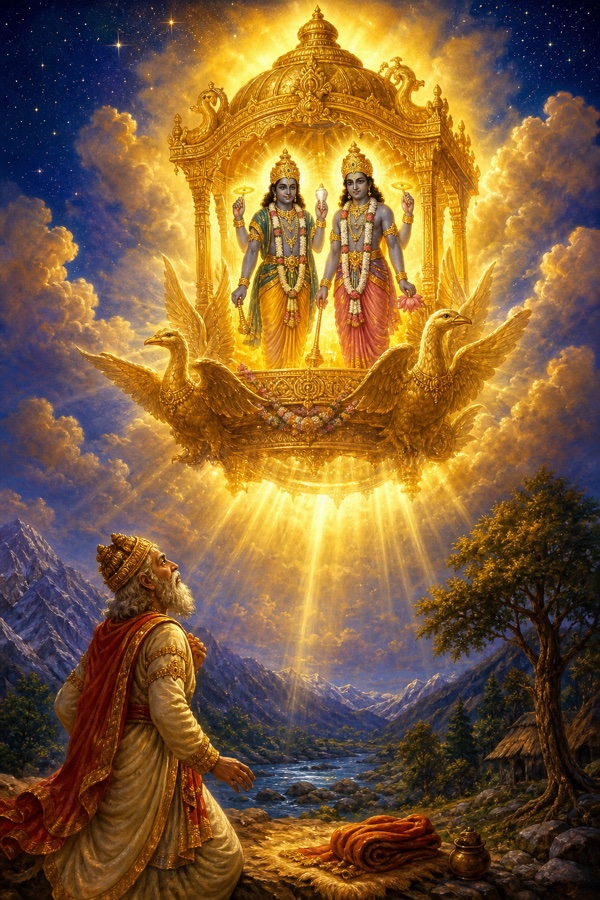
At that very moment a light moved in the sky. A vimana was descending, bright as the full moon rising, pouring luster on all ten directions, above it, below it, around it. In it stood two beings of Vishnu’s own country: four-armed, dark as rain-heavy clouds, eyes like a pair of red lotuses, crowned and hung with pearls, in the first freshness of a youth that never ends, each leaning easily on his mace.
Dhruva sprang to his feet. Every form of the prescribed welcome went out of his head at once, and what stayed was the oldest form there is: joined palms, and the names of the Lord on his lips. The two smiled at that. “Rajan, blessings on you. At five years old you did the tapas that won the Lord of everything; we serve him, and he has sent his own vimana for you. The realm of Vishnu stands past almost every reach; the seven seers themselves only look up at it from below, and no ancestor of yours ever touched it. The sun and the moon, every planet, every lunar mansion, every star wheels around it and keeps it on the right. Come, long-lived one, and live there. The Lord sent this vimana for you himself.” Their names were Sunanda and Nanda.
At words that fell like nectar, Dhruva bathed and did his worship a last time, put on his auspicious ornaments, and bowed to the munis of Badarikashrama for their blessing. He walked sunwise around the shining vimana in reverence and bowed to the two attendants. And as he made ready to board, his own body changed in front of them, and stood there gleaming like worked gold.
One more figure came to that mountainside before he could climb: Death himself, arrived to collect the debt every body owes. Dhruva set his foot on Death’s head and used it as his step up into the vimana. In that instant the sky broke open with sound, kettledrums and tabors playing themselves, the chief singers of the Gandharvas in full voice, and flowers falling in showers that would not end.
Seated, on the very edge of leaving for the Lord’s country, Dhruva thought of his mother. Am I to go up alone to Vaikuntha, he thought, a place this hard to reach, and leave my poor mother behind on the ground?
Sunanda and Nanda read the thought as it formed, and pointed. Ahead of them, higher already, a second vimana was climbing, and in it rode the lady Suniti, shining. The mother in whose lap this whole journey had begun was going on before him, leading the way up.
The route itself became a festival. Gods leaned from their own vimanas to cheer him and rain down flowers as he passed the planets one after another, crossed the three worlds, and climbed past the circle of the seven rishis to the eternal abode of Vishnu, farther on and higher up, a realm that shines by its own light while the three worlds below it live on the reflection. No one whose heart has stayed closed to other creatures arrives there; that road is walked on ceaseless kindness, a cool mind, an even eye, and the company of those who love the Lord. Dhruva arrived. Fastened to his station, the whole wheel of the stars turns to this day, oxen circling the post of a threshing floor, and the pole star has never once slipped from its place.
Literary context
The story of Dhruva runs through the fourth Skandha of the Shrimad Bhagavata, chapters eight through twelve. Narada initiates the boy with the twelve-syllable mantra, Om Namo Bhagavate Vasudevaya, and sends him to Madhuvana, on the bank of the Yamuna near Mathura, to perform his tapas.
The Vishnu Purana also tells the life of Dhruva, with a few details of its own. The order of events and the speeches here follow the Bhagavata.
Philosophical view
The Madhuvana where Narada sent Dhruva is a real forest on the Yamuna’s bank, in the stretch of country around Mathura. The Bhagavata likes to plant its stories in named ground, and the effect is quiet and deliberate: the events stay on this earth, in places a pilgrim can still walk to.
Dhruva’s discipline moves month by month, from fruit to withered grass and leaves, to water, to air, and at the end to the stilling of breath itself. The fourth Skandha gives exactly this sequence, and the force of the boy’s tapas opens out through that staircase of letting go.