On this page
Parashurama
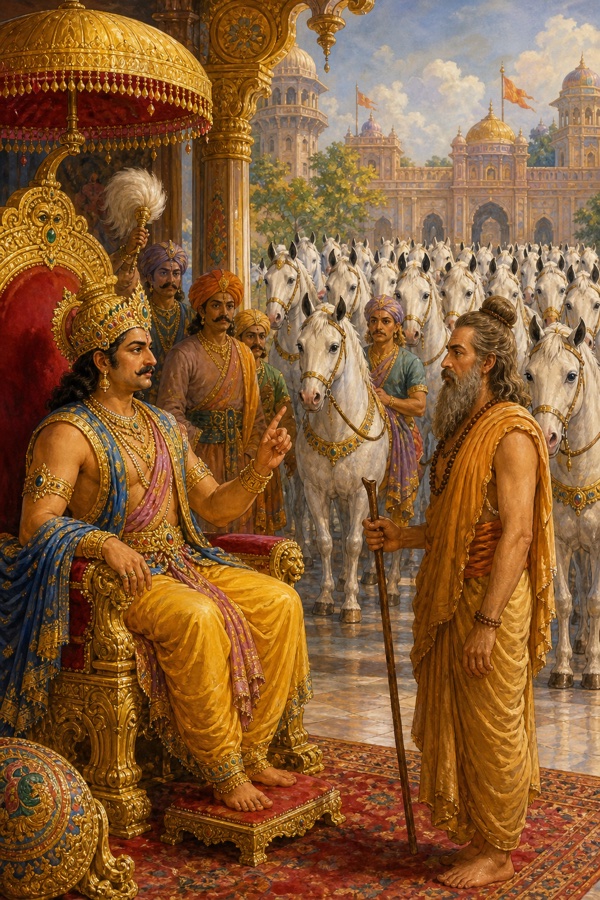
“In the line of Pururava there rose, after many generations, a king named Gadhi, and Gadhi had a daughter, Satyavati. A sage named Richika, born in the house of Bhrigu, came to the court and asked for her hand. Gadhi looked at the lean ascetic standing before his throne and could not see in him a husband for a princess of the proud Kushika line, so he named a bride-price meant to close the matter forever: one thousand horses, each one white as moonlight, and each with a single ear of solid black. Richika bowed, went to Varuna, the lord of the waters, obtained from him exactly such a herd, drove one thousand moon-white, black-eared horses to the gates of Gadhi’s city, and married Satyavati.”
“In time two women came to Richika carrying the same longing. His wife Satyavati wanted a son, and so did her mother, the queen. The sage prepared a charu for each of them, rice and barley and milk boiled with butter into a consecrated offering, and over each vessel he set a different power: into his wife’s, mantras to draw down a son with a Brahmin’s serenity; into the queen’s, mantras to draw down a son with a kshatriya’s fire, an heir for a royal house. Then he went to the river to bathe. While he was gone the queen studied the two vessels and reasoned that a husband would surely have kept the finer charu for his own wife, so she asked her daughter to trade. Satyavati handed over her portion and ate her mother’s. When Richika returned, the sight his tapas gave him showed him at once what had been swallowed and by whom, and his face went dark. ‘You have made a grave mistake,’ he told his wife. ‘Your son will now be a chastiser, cruel by nature, and your brother will stand among the foremost knowers of Brahman.’ Satyavati pleaded with him, let it not be so, until he yielded a single step. ‘Then it will pass over your son and settle on your grandson.’ So Jamadagni was born of Satyavati, calm as still water, and the fire waited one generation, exactly as the sage had said. The brother grew into Vishvamitra, born to a throne yet destined to be counted among the greatest of Brahmin sages. And Satyavati herself, when her days were done, became the Kaushiki, the river the world calls the Kosi, whose current purifies whatever it touches.”
Jamadagni grew into a rishi soaked in tapasya. He married Renuka, daughter of the rishi Renu, a woman whose quiet dignity seemed to steady the whole ashram around her. Sons were born to them, Vasuman and his brothers, and last of all came the youngest, a boy named Rama. The world would learn to call him Parashurama, Rama of the axe, for the parashu that rode his shoulder so constantly it seemed to have grown there.
Even as a child he carried something the hermitage could not explain. A strength in his arms that surfaced in every game, however gently he tried to play. A banked heat inside him that the smallest wind could wake. An ordinary eye saw a striking boy gathering firewood and learning his verses. The learned saw further. Into that boy a portion of Lord Vasudeva himself had descended, and for one purpose: the kshatriyas of that age, sunk in rajas and tamas, had turned hostile to the Brahmins and pressed their strength down on the earth like a stone on its chest, and someone was coming to break them.
Jamadagni owned one treasure, a cow named Kamadhenu who gave whatever was asked of her. Her milk and ghee fed the sage’s yajnas, and through her no guest ever left that ashram without honor, however large the party at his back.
One day the guest was an emperor. Kartavirya Arjuna, overlord of the Haihayas, had been hunting through the deep forest and came, almost by accident, into the grounds of Jamadagni’s hermitage, trailing his army, his ministers, and his animals behind him. He was no ordinary king. By long worship of Dattatreya, a part manifestation of Bhagavan Narayana, he had won a thousand arms and nearly everything else a man can be given: unbroken health of body and sense, wealth, glory, prowess, mastery of yoga, and powers so complete that he could shrink himself to the size of an atom or move through the worlds as freely as wind. Once, sporting in the Narmada with his women around him, he had flung his thousand arms across the river and dammed it, and the water, forced backward, rose and flooded the camp of Ravana himself. The ten-headed king came raging at the insult, and Kartavirya seized him in front of the laughing women, carried him back, kept him caged in Mahishmati the way a child cages a monkey, and let him go when the game grew stale. A man who has done that to Ravana no longer believes the earth holds anything able to refuse him.
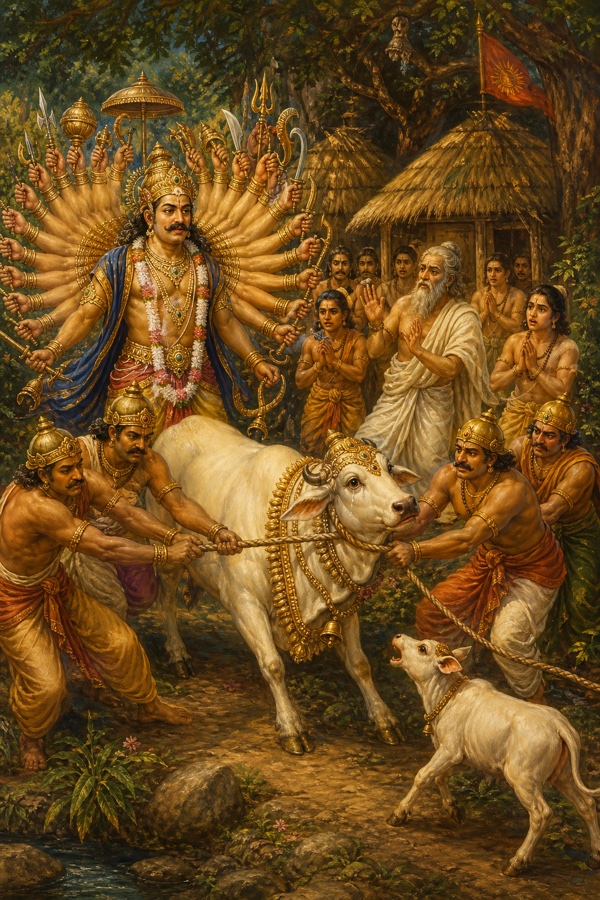
The sage received the entire royal column the only way a forest hermit could have, through Kamadhenu. Whatever the army needed simply appeared: food for every soldier, fodder for every animal, comfort beyond anything a camp in the wilderness could reasonably hope for. And that hospitality became the danger. Kartavirya looked around at an abundance that outshone his own capital, traced every drop of it to one cow, and wanted her. Asking never entered his mind; a king with a thousand hands gets little practice holding one of them open. He gave the order, and his soldiers roped Kamadhenu and drove her off toward Mahishmati with her calf, and her screaming carried back over the ashram until the distance swallowed it.
Parashurama was away when it happened. He came home to a hermitage gone wrong in its silence: the tethering post empty, the pen broken, and in his father’s eyes a pain that all the sage’s discipline could not cover. When he heard what had been done, rage rose in him the way it rises in a serpent that has been struck. Instant. Total. Aimed.
He took the parashu down from his shoulder and ran his thumb along the edge. He took up his bow, his quiver, and his shield. Then, clad in the skin of a black antelope, his matted hair burning in the light like a second sun, he went after the king the way a lion goes after the leader of an elephant herd.
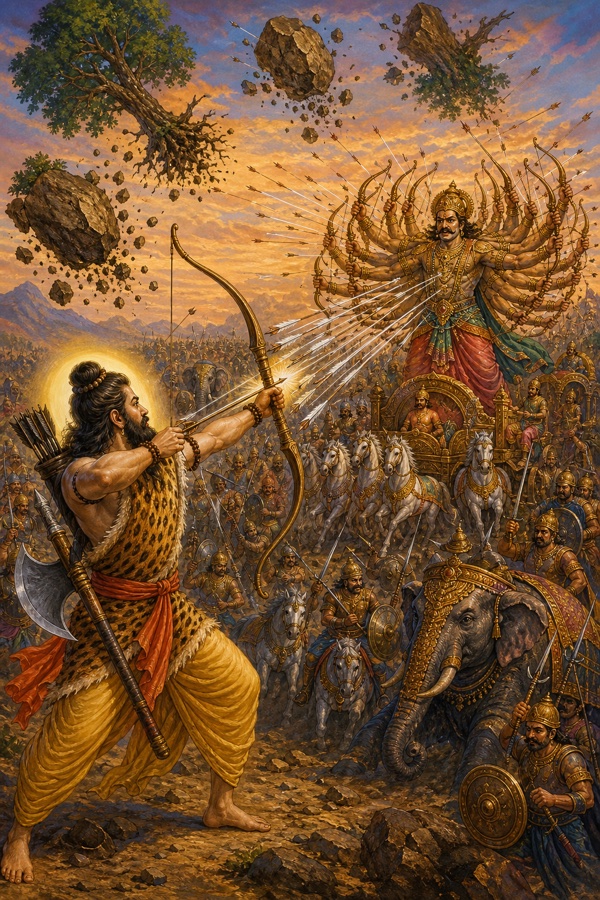
Arjuna was entering his own capital when he looked back and saw a single figure closing on the city, axe and bow in hand, moving with a speed that did not belong to men. He read it correctly, and he answered with everything he had: seventeen akshauhinis, elephants and chariots and horses and foot soldiers beyond counting, bristling with maces, swords, arrows, javelins, iron-spiked shataghnis, and darts. Parashurama destroyed them alone. Wherever he turned, quick as mind, quick as wind, warriors came apart with arms and thighs and necks severed, charioteers and animals falling with them, until the field turned to mire under streams of blood. Seeing his army in pieces, Arjuna himself charged in fury. He fitted arrows to five hundred bows at once, a thousand hands drawing as one, and Parashurama cut down every shaft with the arrows of a single bow. The king began tearing rocks and whole trees out of the earth and hurling them as he came, and the axe met each one in the air. Then it met him. It sheared away the thousand arms as though lopping the hoods of an enormous serpent, and it took his head from his shoulders the way a peak breaks from a mountain. His ten thousand sons watched their father fall, and they ran.
Parashurama untied Kamadhenu and her calf, still trembling from their captivity, and led them home through the ruin of an imperial army. He set the cow before Jamadagni and made her over to his father with a bow of his head, and then he told him everything, the theft and the battle and the king’s death, while his elder brothers listened.
Jamadagni did not praise him. He was quiet for a long moment, and when he finally spoke there was sorrow in every word. “Rama, my strong-armed son, you have taken a great sin on yourself. You killed a ruler of men when nothing required his death, and a king whose head has received the waters of coronation carries all the gods within his person. We are Brahmins, child. Whatever reverence this world offers us, it offers for our forgiveness. Forgiveness lifted Brahma to the seat from which he governs the universe. Forgiveness makes a Brahmin’s glory blaze like the light of the sun, and nothing wins the almighty Shri Hari faster than a heart that pardons. To slay a consecrated king weighs heavier than to slay a Brahmin. Go, my son. Fix your mind on Vishnu and carry it through the tirthas, the holy fords of this land, for a full year, and let the sin be washed from you.”
The young man who had just cut down a thousand-armed emperor bowed his head and answered only, “So be it.” For one year Parashurama walked the holy places as a penitent, the axe silent on his shoulder and his mind held on Vishnu, and when the year had run out he came home to the ashram.
Then came a morning that broke the family from within. Renuka went down to the Ganga for water, and there in the river was Chitraratha, king of the gandharvas, wearing a garland of lotuses, sporting among the apsaras. She stood and watched. Only a moment, only the faintest stir of longing toward him, but the moment stretched, and the appointed hour of her husband’s fire offering slipped past unnoticed. When she came back to herself she was terrified of the sage’s curse. She hurried home, set the pitcher down before him, and stood with her palms joined. He needed no confession. His tapas had already shown him the lapse in his wife’s mind, and his anger came up past all measure. “My sons,” he said, “kill this sinful woman.” The elder sons stood frozen; no hand among them would move against their mother. He commanded them again, and his youngest stepped forward. Parashurama obeyed his father’s command. He killed his mother and, with her, the brothers who had refused. Jamadagni’s fury turned to satisfaction, and he told the boy to ask for any boon he wished. “Let them rise,” Parashurama said, “alive and whole, and let no memory of this hour remain in their minds.” They rose at once, with no memory of what had happened.
But the first killing had never finished its work. In Mahishmati the sons of Kartavirya could find peace nowhere. Waking and sleeping they saw their father cut down, and the grudge turned inside them year after year, patient, feeling for its opening.
The opening came on a day when Parashurama and his brothers had gone far from the ashram, deep toward the forest. The princes slipped in without a sound. They found Jamadagni seated in the fire-shed, unarmed, eyes closed, his whole mind resting on the Lord it had rested on for a lifetime. Renuka saw them and begged, a helpless woman pleading for an old man lost in prayer. They did not pause. They cut the sage’s head from his body where he sat, and they fled, carrying it away with them.
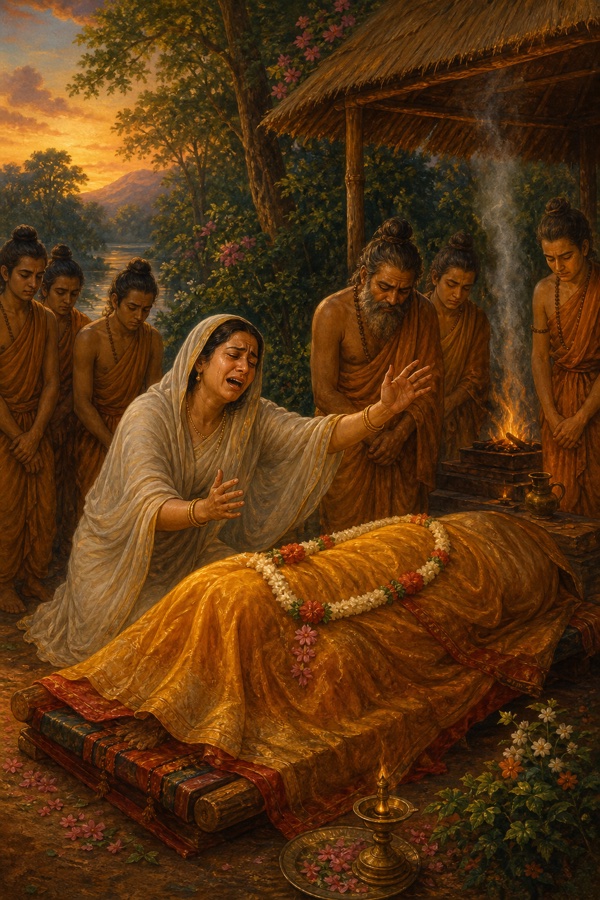
Renuka fell on her husband’s severed body. She beat her breast with both hands, blow after blow, crying out, “Rama! O Rama! Come, my child, come!” The old tellers count those blows. Twenty-one times, they say, her hands came down, and every one of those blows was heard, and every one would be answered.
Far away, Parashurama caught the cry, his own name in a voice torn open by distress. He ran. At the gate of the ashram his feet stopped, because everything the cry had promised was true: his father’s body in the fire-shed with nothing above its shoulders, and his mother bent over it, still striking herself. Agony, anger, indignation, and grief broke over him in a single flood. “Father,” he cried, “noblest and most righteous of men, you have left us and risen to heaven.”
Then the crying stopped, and there were no tears in his eyes at all, only fire. He gathered his father’s body against his chest, gave it into his brothers’ keeping, and closed his hand around the haft of the axe. When he spoke again his voice was quiet, and the quiet was more terrible than any scream.
“The arrogance that can murder an unarmed sage in his meditation will not remain on this earth. Again and again I will empty this ground of every kshatriya line that has turned its strength into an instrument of injustice.”
He began at Mahishmati, a city whose luster had already drained away under the sin its princes carried home, the murder of a Brahmin. In the heart of that city he raised a mountain of their heads, and from their blood he set a ghastly river running through the streets, so that every hater of Brahmins who heard of it would understand exactly what had become possible. Then he moved outward, kingdom after kingdom. His father’s murder was the occasion he named; the kshatriyas’ own descent into adharma was the deeper warrant. Kings who ground their subjects under them, kings for whom maryada had become a word other men used, he sought out one by one and finished. The parashu did not rest.
But seeds outlast harvests. Some kshatriya children were still in their mothers’ wombs when their fathers fell. Others were hidden away by Brahmins inside their own ashrams, sheltered by the very order their fathers had persecuted. They survived, they grew, and within a generation the old arrogance sat crowned on the old thrones as though the axe had never come.
So Parashurama returned. And returned. Twenty-one times he emptied the earth of its armed arrogance, one campaign for every blow his mother’s hands had struck against her breast, until the vow stood complete. At Samantapanchaka, on the plain men would one day call Kurukshetra, he left tanks brimming with blood where water should have been.
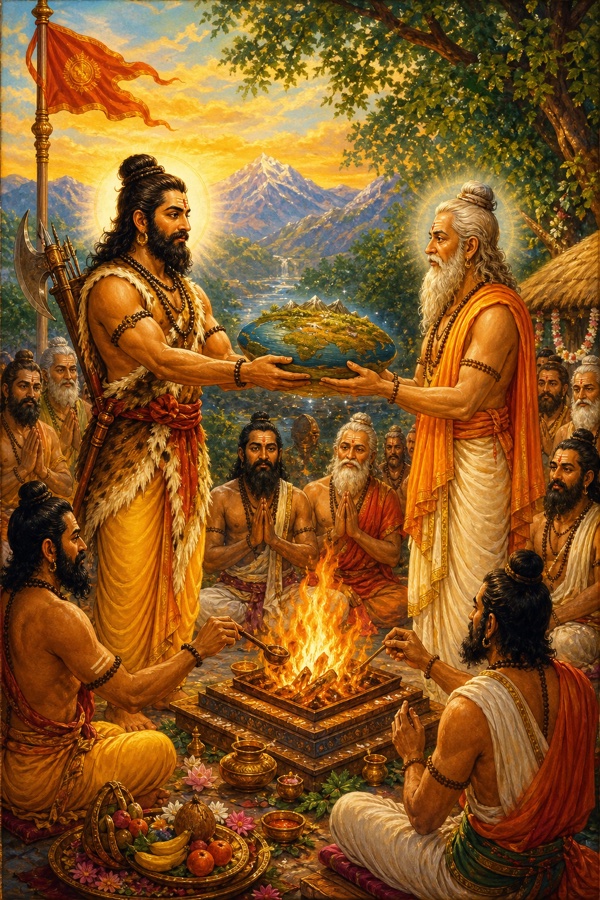
When the last campaign was over and the vow had nothing more to claim, Parashurama brought back his father’s head and joined it to the body, and laid the sage on blades of sacred kusha grass. Over that body he performed sacrifice after sacrifice, and through every one of them he worshiped the supreme Deity, his own inmost Self, the one Person who carries all the gods within him. Then he gave the world away. To the hota, priest of the eastern fire, he gave the east; to the brahma, the overseeing priest, the south; to the adhvaryu the west; and to the udgata, the priest of the chants, the north. The corners between the quarters went to the attending priests, the central heartland to the sage Kashyapa, the whole sweep of Aryavarta between the Himalayas and the Vindhyas to the supervisor of the rites, and the lands beyond the Vindhyas to the sitting witnesses of the sacrifice. The earth that kings had cut one another’s throats to hold, a Brahmin handed out from an open palm in the space of a rite, as lightly as if it were a piece of fruit. Then he stepped down into the Saraswati, the river that carries the Vedas in its current, and bathed, and the sin of numberless killings left him with the water. He came up shining like the sun in a cloudless sky. And one more thing was restored that day. Jamadagni rose, alive, his body now made wholly of spirit, and took his place as the seventh of the seven seers who keep watch over the welfare of the universe.
Then Parashurama turned from all of it and climbed to Mount Mahendra, where the air stays cool with the resin of deodar and the waterfalls talk on through the day and the night.
Literary context
This story appears in the ninth Skandha of the Shrimad Bhagavata, in Chapters 15 and 16. Parashurama is honored as the sixth avatar of Shri Hari, a part manifestation of the Lord, who rid the earth of the kshatriyas’ arrogance twenty-one times, restored his slain father Jamadagni to life and to a place among the seven seers, gave the conquered earth away at the close of his sacrifices, and withdrew to Mount Mahendra, where tradition holds that he lives still. His celebrated meeting with Rama, the son of Dasharatha, does not occur in these chapters; that episode belongs to the Ramayana tradition, so only the Bhagavata’s own telling is kept here.
Why this katha matters now
Twenty-one times Parashurama emptied the earth of its arrogant kings, and twenty-one times the arrogance grew back, because pride is a root, and roots outlive harvests. The blood and the battles fill the middle of this katha. Its true ending happens somewhere much quieter, on a mountain where the most feared warrior on earth sits down alone with the anger that made him, and stays with it, year after year, until it finally lets him go. Whatever we cannot put down owns us. Parashurama put the axe down.