On this page
The Renunciation of Rishabhadeva
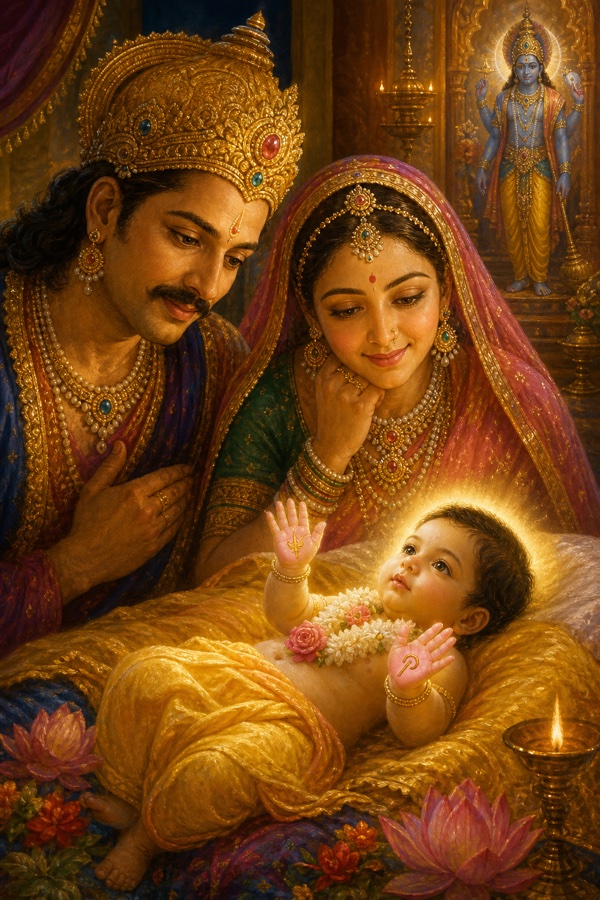
King Nabhi, of the line of Priyavrata, ruled his portion of the wide earth with Queen Merudevi beside him, and the one grief of their long life together was that they had no child. So they turned to the oldest remedy a king possesses: a great sacrifice. They worshiped Vishnu, the Yajna-purusha, the person to whom every offering poured into every fire finally travels, and they did it with a single, concentrated heart. Now the Lord is hard to reach even when everything is done perfectly, the right materials, the right ground, the right hour, the right mantras, the right priests, the right fees; yet while the opening rites were still under way, affection for his devotee overcame him, and he did what no ritual can compel. He appeared. He stood in the sacrificial enclosure in a form that seized the eye and would not release it: four arms, tawny silk, the Srivatsa curl shining on his chest, conch and lotus and discus and mace in his hands, a wreath of forest flowers swinging across his chest, the Kaustubha gem at his throat, and crown, earrings, bracelets, girdle, and anklets all cut from radiant jewels. The priests bent low with water for his hands, the way destitute men receive a sudden treasure, and their hymn held no flattery at all. We are ignorant men, they said; the wise have taught us to say Namah, obeisance, and nothing more, for no tongue can measure you. Only let your name find our mouths when we stumble, when we sneeze, when we fall, when we lie dying, in every moment when we have no strength left to remember you on our own. And forgive us, they said, for calling you across the worlds to ask you for a child, like a pauper walking up to Kubera, the lord of all treasure, to beg for husks. Then they gathered themselves and asked it anyway: let a son exactly like you be born to Nabhi.
The Lord smiled at the difficulty they had set him. “You have put me in a corner,” he told them, “because your speech never fails. You ask for a son like me, and I have no equal; I alone am my own measure. But the word of Brahmins must never fall to the ground, for the race of Brahmins is my own mouth. So I will give Nabhi what no one else can give him. I will come myself, born into his house, with a part of my own being.” Then he was gone, and the promise settled into Merudevi. The Lord chose that birth with a double intent: to give an honest king the son he longed for, and to live out before the whole world, in his own person, the vows of the wind-clad sages who own nothing, go clothed only in air, and keep a lifelong celibacy. So the child came wrapped in pure sattva, untouched by the coarser strands of nature, and on the soles of his feet, from the first day, lay the marks that belong to the Lord alone, the thunderbolt and the goad, set where only those who bowed at those feet would ever read them.
The boy resembled no other child. There was a settled stillness in his eyes, as if a lamp burned inside him where no wind could reach. As he grew, the signs deepened: an even regard that weighed a beggar and a minister on the same scale, a quiet command over his own senses, an indifference to pleasure that had nothing cold in it. The ministers, the Brahmins, the common people, even the gods watching from above began to wish the same wish, that this one and no other should hold the rule of the earth. King Nabhi would gather the child into his lap and murmur, my son, my darling, in a voice that kept faltering, and the Lord’s own maya let the old king forget, for the length of those evenings, exactly whose child he was holding. And seeing the boy’s flawless body, his strength, his splendor, his fame, and his courage, Nabhi gave him the name that stayed: Rishabha, the foremost.
He was God, complete in himself, carrying a bliss that nothing could add to and nothing could dent, and he still lived the whole life of a man, point by point, because people copy whatever the greatest among them do, and he had come to be copied. When his turn came to rule, he ruled by dharma, guided in everything by the Brahmins, restoring duties the world had let fall away over the long ages, and he honored the Lord through every sacrifice the scriptures name, each performed a hundred times over. His country answered him in kind. In the land called Ajanabha no one asked anything of his neighbor, and no one let his eye rest on another man’s field or gold; the only thing that grew without limit there was the people’s love for their king. Once Indra, the king of the gods, who holds the rain in his gift, grew envious of all that shining contentment and shut the sky over Rishabha’s land. Rishabha, master of every yoga, laughed out loud at the pettiness of it and sent his own rain across Ajanabha by his yogamaya, in such abundance that his people never learned the heavens had turned against them.
When the time was right, Maharaja Nabhi placed the kingdom in the hands of this finest of sons, entrusted him to the care of the Brahmins, and left with Queen Merudevi for Visala, the retreat of Badarikashrama high in the snows. There he took up an austerity fierce toward himself and harmless to every other living thing, and he worshiped Vasudeva as Nara and Narayana, the twin sages of that mountain, until one day, deep in meditation, he passed into the very form he had been adoring, the way a drop of water slips into water and cannot be found again.
Rishabhadeva himself began where every student begins, in the house of his teachers, and when they released him, satisfied with the parting gifts he chose for them, he married Jayanti, the bride Indra gave him, and lived the householder’s dharma to its full measure. A hundred sons were born to him, each one cast in his own likeness. The eldest was Bharata, a master of yoga even as a prince, and after this Bharata the whole land came in time to be called Bharatavarsha, the name its own scriptures carry to this day. Nine brothers came after him, Kushavarta, Ilavarta, Brahmavarta, Malaya, Ketu, Bhadrasena, Indrasprik, Vidarbha, and Kikata, and these nine stood at the head of the younger ninety. Out of those ninety, nine, Kavi, Hari, Antariksha, Prabuddha, Pippalayana, Avirhotra, Drumila, Chamasa, and Karabhajana, grew into great devotees of the Lord and became teachers of the path of devotion; their story is kept for the closing books of this same Bhagavata, in a dialogue between the sage Narada and Vasudeva, Krishna’s father. The remaining eighty-one, obedient and modest, gave themselves to the Vedas and the fire-rites, and their conduct so purified them that they came to be counted as Brahmins.
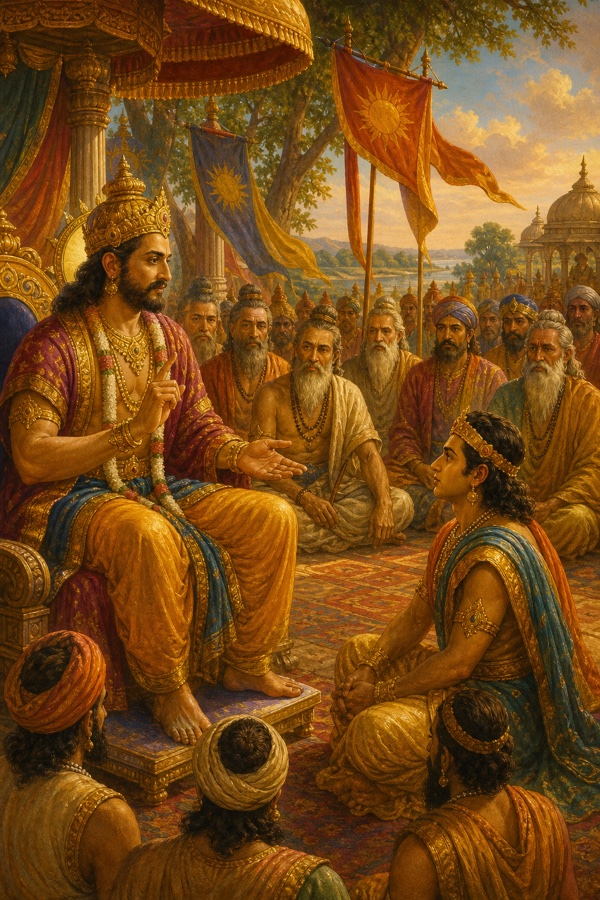
For years Rishabhadeva ruled this way. What other men read in the shastras and forget by nightfall, he simply lived, in the open, where anyone could watch. Then one day, touring his kingdom, he came to Brahmavarta, and there, in an assembly of the foremost brahmarshis, with his own subjects gathered close, he called his hundred sons to him. They were grown men, disciplined and devoted, in need of no correction at all; he was speaking through them to everyone in that gathering, and past that gathering to everyone who would ever hear the words.
“My sons,” he said, and though his voice was low, every word landed as if cut into stone. “This human body, here in the world of the dying, is not given so that a man may grind it down chasing the pleasure of his senses. Pleasure of that kind is misery wearing a pleasant face for an hour, and the pig rooting in filth gets exactly as much of it as any king in any palace. This body deserves tapas, the slow clean burning that purifies the inner being; and out of that purity comes the one happiness that has no end, the bliss of absorption into Brahman. The man who will not set out today, tell me, which day is he waiting for?”
“Serving the great is the open gate of liberation, and keeping company with men who live for their appetites is the door that opens into hell. The great are easy to recognize. They are even-minded and deeply calm; anger cannot find them; they are gentle, and their conduct is pure; they count love for me as the one thing worth possessing, and they want nothing from the world beyond what keeps the body standing. Every sin a man commits, he commits reaching for his senses. This body, which is never even finally real, still becomes a house of suffering for the soul that signs its name to it. The self stays hidden under ignorance for exactly as long as you fail to question it; and as long as the mind stays busy wanting and doing, it will fasten you to a body, birth after birth after birth. Until love for Vasudeva rises in you, the knot in the heart does not loosen. Watch a man say my house, my fields, my children, my kin, my gold; every one of those words is the knot speaking. So loosen it. Adore him and lean on him. Endure heat and cold, honor and insult, without flinching, and see clearly that calamity waits everywhere a body can go. Question the truth of things. Bear austerity. Give up work done for reward, and do what you do for his sake. Hear his stories daily, keep the company of those who see him and nothing else, and sing of him. Hold an even mind, quarrel with no one, loosen your grip on house and body, study the scriptures of the spirit, live where it is quiet. Master the breath, the senses, and the mind; keep faith; guard the tongue; stay watchful. And with wisdom lit by realization until you see him standing in everything, with steadiness, effort, and clear judgment, tear through the veil whose name is I. Then, when it lies torn, set down even the effort of tearing.”
His eyes moved over them. “And understand what authority is for. A king who longs for my abode, a father, a teacher, anyone who holds my grace to be the true wealth, must teach the ignorant in his charge exactly this, and must never harness them to work done out of craving, however loudly they mistake such work for the road to happiness, and must not even grow angry when they persist. What does a man gain by driving his fellow man deeper into wanting? He is walking a blind man farther down the wrong road and calling it guidance. A guru who cannot carry his disciple past death is no guru. A father who cannot do it is no father, a mother is no mother, a god is no god, and a husband who cannot do it for the wife who trusts him is no husband at all. My own descent is hard to fathom; pure sattva is my heart, dharma lives there, and for that reason the wise call me Rishabha, the foremost. But the whole of worshiping me fits in one sentence, if you will take it. Every creature that lives, the moving and the rooted alike, is a house I am living in; honor those houses at every step, and you have worshiped me. Everything the mind, the tongue, and the eyes do finds its harvest there; without it, no one slips the noose of Death.”
Then his gaze traveled down the line of his sons and came to rest on the eldest, and what entered his voice was the tenderness of a father who knows he is saying a thing for the last time. “All of you were born from my heart. So hold no envy, and serve your brother Bharata, the noblest among you. Serve him, and you have served me, and you have held up the people in the same act. That is my true worship.”
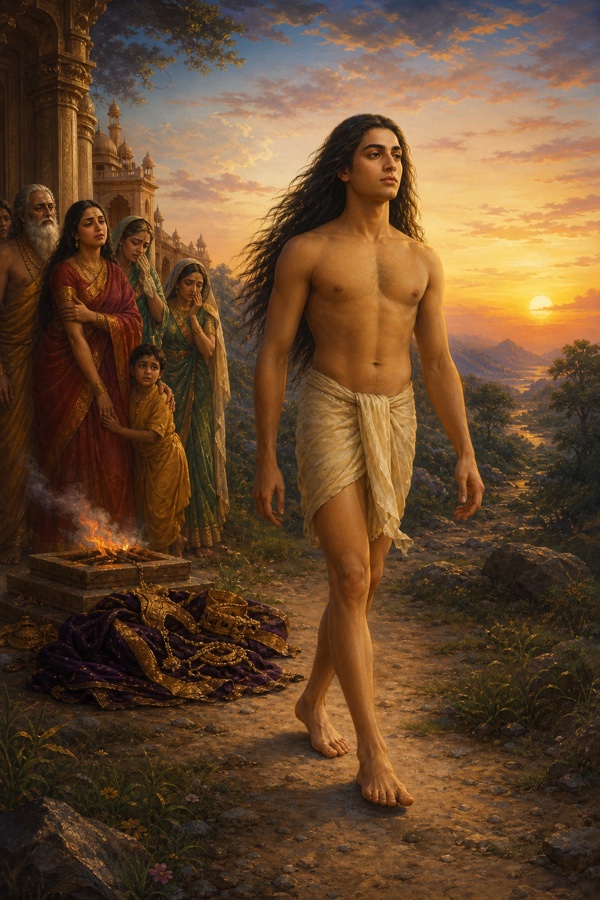
With that, he set Bharata on the throne, a son who loved the Lord and loved the Lord’s servants, and gave the earth into his protection. And then, in front of them all, Rishabhadeva kept nothing. His fires went first: the agnihotra flames a householder tends every day of his life, fed at dawn and dusk, the standing proof of his place in the ordered world. He drew them off their altars and took them into his own body, so that no hearth anywhere would hold his name again. The royal garments came off. And exactly as he had entered the world, covered by nothing, his hair loose, looking to every eye like a man whose mind had broken, he walked out past the border of Brahmavarta and did not look back, laying down for every age to come the renouncer’s path: devotion, knowledge of the self, and a finished indifference to everything the senses can hold.
And in the forest he took up a road at the sight of which the world, even now, stands still.
He took the avadhuta’s way, the way of the one who has shaken everything off. He accepted a vow of silence, and after it every question, plea, and insult met his silence. He moved through the world as if inert, as if blind, deaf, mute; he let himself look witless, let himself look possessed. The being who had been an ornament to Indra and to every guardian of the worlds now drifted along the roads with the manner of a lunatic, of a goblin, so that the God inside him would catch no one’s eye.
Sometimes his wandering took him through towns and villages; sometimes past mines and hamlets, through flower gardens and the settlements under the hills, through army camps, cow-pens, the huts of herdsmen, and the halting grounds of caravans; sometimes into the mountains, the forests, and the hermitages of sages.
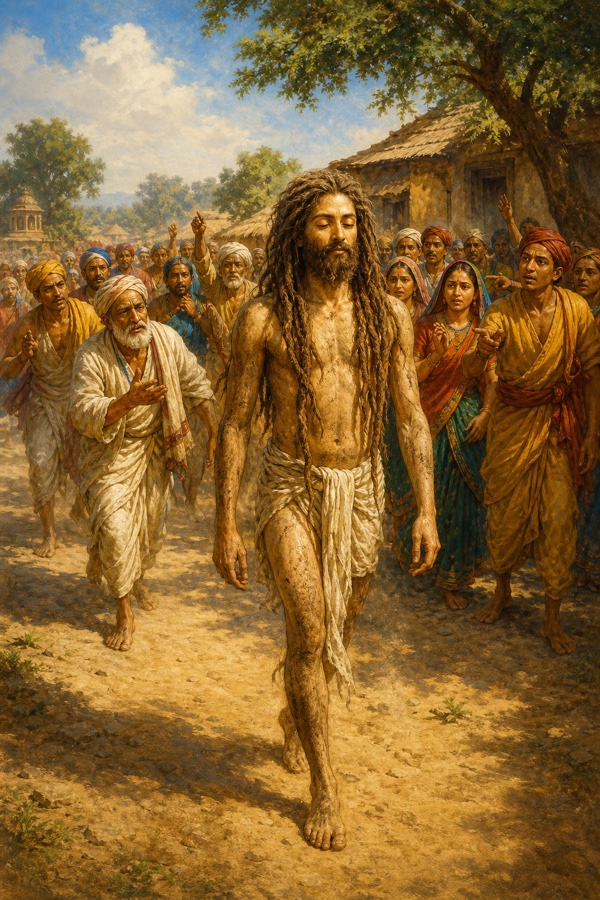
And on every one of those roads, vile men found him, the way bees find and torment a wild elephant moving through the forest. One threatened him. One beat him. One passed water on him, one spat, one threw stones, one flung dust and dung, one fouled the air beside his face and laughed, one heaped him with abuse and walked away satisfied. None of it reached him. In that frame of clay which people, inside their own confusion, went on calling “Rishabha,” there survived no thread of I and no thread of mine. He stood witness to the whole parade, and no closer to it than a witness, settled in his own atman, and he walked the earth alone with a mind nothing could divide.
The strange thing was how beautiful he remained. The hands and feet and chest were soft, the arms long and rounded, the face lovely, and about the mouth floated a faint, unforced smile that had survived everything; his large reddish eyes were as cool and refreshing as the petals of a lotus just opened. Over that face fell curled, matted, auburn hair, and the body beneath it wore its dust and grime like a garment, so that he looked like a man ridden by some spirit. The women of the towns felt desire stir at the sight of that half-smile and could not say why, and they settled their confusion the only way a town knows how, telling one another that the man was mad.
Then, seeing the world set itself so squarely against his practice, and unwilling to spend even the effort of resisting it, he took a harsher discipline still. He adopted the way of the python, which lies where fate has placed it and does not stir. Wherever he happened to be, there he lay down; lying down he ate, lying down he drank, lying down he passed his urine and his stool, and then he rolled in what he had passed until his body was smeared with it. And here the wonder began: the air around that smeared body turned sweet. A fragrance rose from it, and the wind took it up and carried it, and for ten yojanas around, the whole countryside breathed that sweetness and went looking for the flower. After the python he lived as the bull lives, then as the deer, then as the crow, eating and moving and resting in their manner, letting go, one by one, of every posture that lets the world call a man dignified.
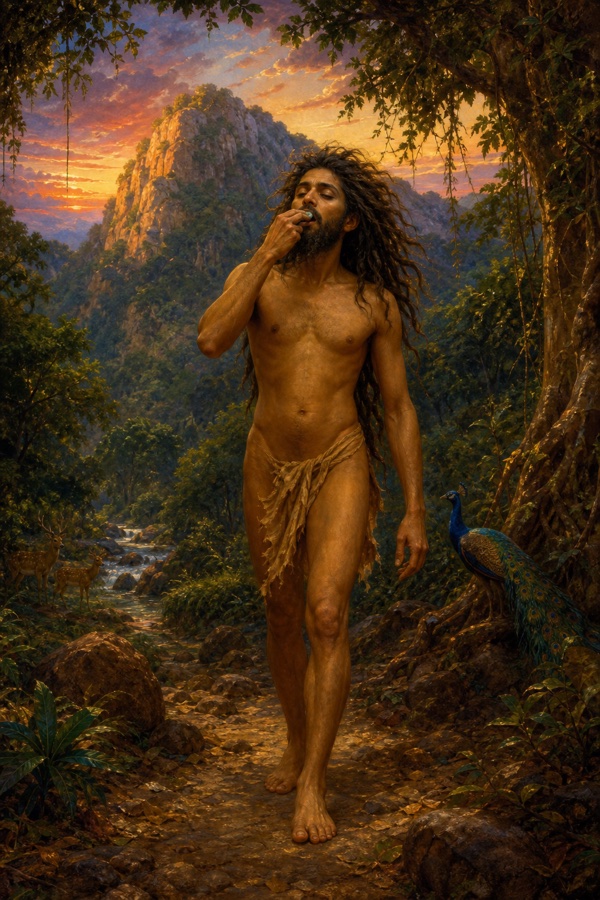
By now he had loosened even the last and thinnest of ties, the subtle inner body of mind and habit that ferries a soul from one birth into the next. He held the Supreme Spirit present within him as his own self, steadily, and released everything else, and what still walked the earth walked on momentum, the trailing edge of his own yogamaya, the way a wheel keeps turning a while after the hand that spun it has withdrawn. Providence steered those steps south. Through Konka, Venka, and Kutaka, the country of southern Karnataka, he came at last to the forest at the foot of Mount Kutakachala. There he bent down, picked up a small piece of stone, and set it in his mouth, so that even the tongue lost its final liberty, and in that wild figure, hair scattered, clothed in sky, he wandered the empty forest.
And just then the wind in the forest changed.
First it came as a gust, then as a gale. The stands of dry bamboo began to grind, stem against stem, and out of the grinding came a crack, and out of the crack a spark. The bamboo ground again, and the spark took its first mouthful of dry leaves and wanted more.
Rishabhadeva stood where he stood. He did not turn his head.
The fire came from below first, hissing through the dead grass toward his ankles. Then the bamboo began to burst, cane by cane, with a sound like far-off clapping. Smoke packed itself into the spaces between the trees, and the air grew heavy with hot ash, that doubled smell of burnt timber and burnt green leaf. The flames ran red now, their tongues jumping upward, taking the forest lick by lick.
In all that roar stood one body that did not move. The stone still lay in the mouth. The breath kept its pace, slow and level, the breath of a man asleep. No hand rose to shield the face; no foot turned to run. The heat found the back first, then the chest, then climbed into the scattered auburn locks that no comb had touched in years, and lock by lock they flared, lifted, and came down as ash.
Inside, nothing stirred. No thought said, this is the end; no thought said, this body was mine. A man who had laid down kingdom, honor, insult, and the very ownership of his body years before had nothing left to hand over now; the surrender was old, and the fire had arrived late. Even this, his stillness in the burning, was the closing lesson of a teacher who had never once stopped teaching: this, yogis, is how a body is put down. What the flames were taking already lay like a garment someone else had dropped by the roadside, and the fire was only picking it up to carry it away.
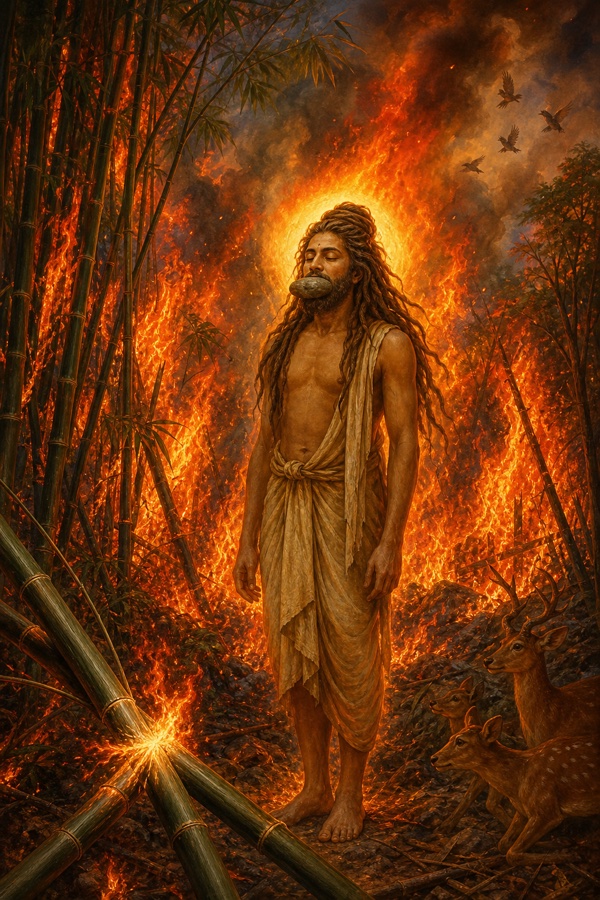
Born of the rubbing of two dry bamboos, the blaze widened until it held the whole forest, and with the forest it gathered in the one body that had been standing in it. The smoke went up straight, without a tremor, and thinned into the sky.
What had lived within stood past the reach of any fire, and there had never been a question of reach. It went back to its own abode, quietly, as if returning were simply its nature.
Literary context
The story of Rishabhadeva comes in the fifth Skandha of the Shrimad Bhagavata, Chapters 3 through 6. In the Gita Press edition he is presented as an avatar of Bhagavan Vishnu and the ideal renouncer-king, who showed his hundred sons the road to liberation and then took up the life of an avadhuta.
His son Bharata is the hero of the next story of this same Skandha (Jadabharata). The Jain tradition also honors Rishabhadeva as its first Tirthankara; the telling here follows the Gita Press text of the Bhagavata alone.
A short note
What Rishabhadeva says to his hundred sons in the fifth chapter of the fifth Skandha is counted among the densest teachings in the whole Bhagavata. And notice one thing about it: between what he says and what he does, no distance survives. He speaks in the assembly, and he leaves the assembly the same day.
An old verse has come down about his father, one the Bhagavata itself repeats: who could ever imitate the deeds of the rajarshi Nabhi of stainless conduct, whose piety drew Shri Hari himself to be born as his son?
One last thought
In the forest at Kutakachala there is only ash now, and a fragrance that held in the air a little while before it went. The fire born of the rubbing bamboo took the forest and fell quiet. But the one for whom that fire was simply an open door left no trace in the ash to find. To find him, you may have to look in the direction he was looking.