On this page
The Dialogue of Rahugana and Jadabharata
Rahugana ruled the twin lands of Sindhu and Sauvira, the river country in the far west. He had strength, he had a schooled mind, he had sat at the feet of sages and worked through the shastras, and over all of it lay a quieter conviction: that he already knew. In those days he had set out to find Kapila, the master of yoga whom the wise held to be Hari himself, God come down into the world to hand men the knowledge of the Self, the first teacher of all who teach it. The king carried a single question for him, the one no book had ever settled: what, in this whole moving world, is a man’s true refuge.
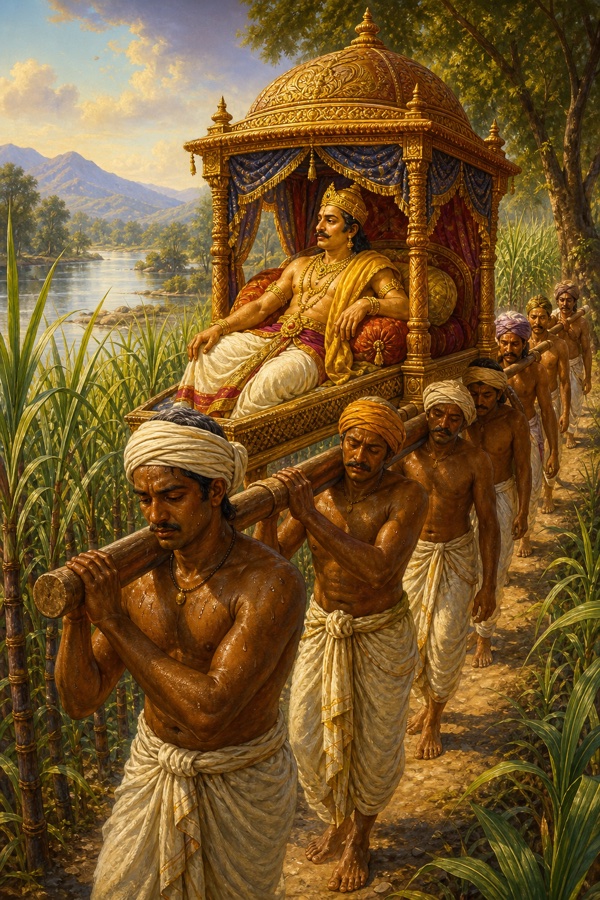
The king rode the palanquin. The bearers carried it on their shoulders along the bank of the Ikshumati, the river that waters the sugarcane country. The air held the sweet damp of the cane fields, and the bearers’ breathing had gone heavy.
On the way one of them gave out, and a shoulder fell short. The foreman needed another carrier, and quickly, and his eye swept the riverbank as if Providence had already set a man there for him to find.
The forest came down nearly to the road. At its edge stood a sturdy, well-built man, his hair matted into ropes, his body smeared with earth, and under the dirt the arms were strong and the shoulders broad.
“Seize him,” the foreman said. “The body is stout. Young, thick in the limb. Fit to haul a load like an ox or a donkey.”
It was Jadabharata.
They took him by force and set him under the palanquin pole, unpaid, the way the poor are pressed into a king’s labor. He asked no questions about the people or the purpose. A soul of the highest dignity accepted a humiliation he had done nothing to earn, and did not flinch.
Jadabharata raised no objection. He set the pole on his shoulder.
But one thing marked him off from the other bearers. As he walked, he studied the ground before he placed each foot.
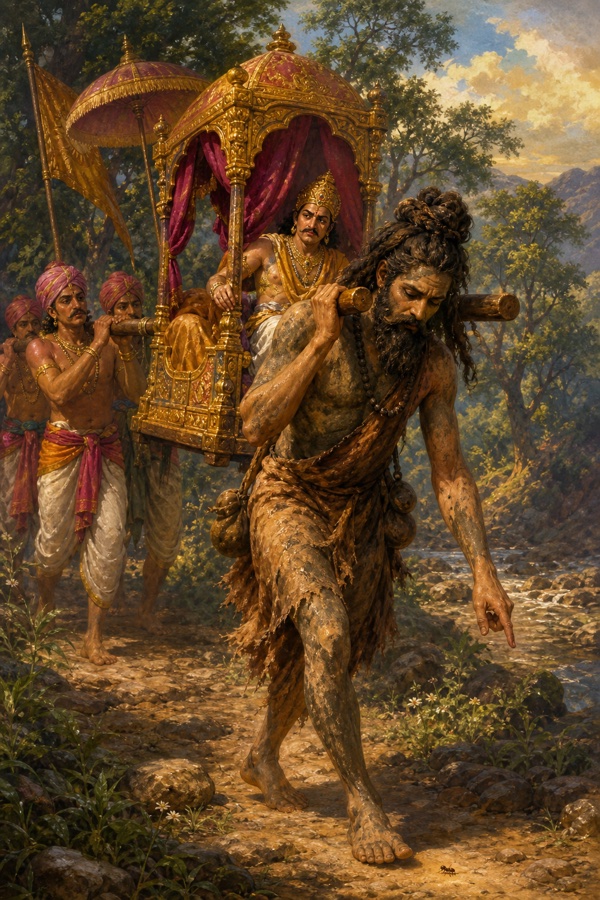
In every creature he saw the same one consciousness he saw in himself, and so he could not bring himself to crush an ant, or anything small that breathed. Before each step he read the earth an arrow’s length ahead, about three feet of road, to be sure no living thing lay where his foot would fall.
So at every step his feet hesitated, came down aslant, steadied, and moved on.
And the palanquin lurched.
The king felt a jolt, and then another.
“You bearers! Walk properly. Why is my palanquin pitching up and down like this?”
Jadabharata said nothing. He kept to the same gait, exactly as unhurried.
The other bearers went cold, for when a king has finished with words, the rod usually follows. With folded hands they said, “Maharaj, this is no negligence of ours. We carry the palanquin correctly, by your own rule and measure. It is this new bearer, only just put to the pole. He does not walk quickly. With him we cannot keep the palanquin level.”
Hearing their frightened plea, Rahugana drew a ruler’s conclusion, that a fault entering through one man becomes the fault of every man yoked beside him. He had sat with sages, yet the old Kshatriya heat rose in him, rajas clouded his judgment, and he turned on the sage the way a proud man does, with a smooth and cutting tongue. What stood in front of him he could not see at all; the glory in that mud-caked body lay hidden the way fire sleeps in embers banked with ash. “Poor fellow,” the king said, in mock concern. “You must be worn out. Clearly you have hauled this palanquin single-handed all this long way, for hours together, and none of these companions of yours has shared your burden. And your frame is less stout and less iron-clad than it looked, and old age is on you besides.” Jadabharata took the taunting in silence. Of the body he wore, a bundle of the five elements, the ten senses, and the stored residue of old karma, tied together by ignorance and called a man, he had long since stopped saying “I” or “mine,” and he carried the palanquin on as before.
At last the king had the palanquin halted and stepped down. The vein on his forehead stood out taut.
“What is this? Are you dead while you still breathe? You ignore me. You trample the command of your lord. It seems you are negligence itself. As Yamaraja corrects offenders, he who weighs every soul when its breath runs out, so will I now administer your cure, and then your senses will find their place.”
And then, for the first time, Jadabharata opened his lips.
No anger came with the words, and no fear. The sage who had merged into the Infinite, a friend to every living being, spoke with the faintest of smiles, wholly free of pride, and what he said stands among the quietest and deepest utterances in the whole of the Bhagavata.
“Rajan,” said Jadabharata, “whom are you scolding?”
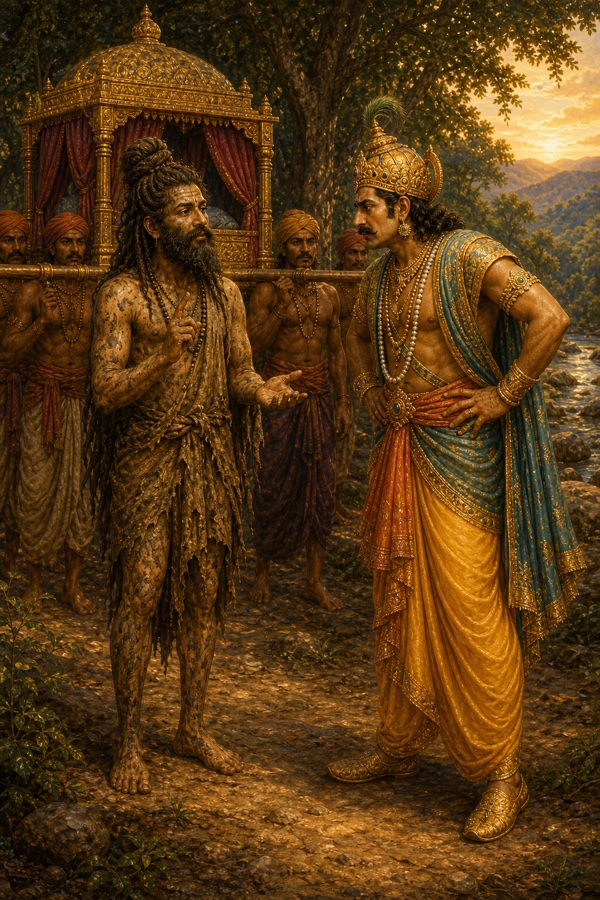
“You mocked me just now for being tired, and if you look closely, the mockery turns out to be plain truth. If a burden exists anywhere, it rests on the body that carries it. If a road exists, it belongs to the feet that walk it. Stout and lean are words about flesh. The one who only watches, the atman, carries no load, covers no distance, and has no thickness or thinness for anyone to name.”
“Watch where all of it gathers. Fat and lean, the body’s sickness and the mind’s worry, hunger and thirst, fear and quarrel, desire and old age, sleep and craving, the pride and rage that sprout from the little word ‘I’, and grief over all of them: every one of these visits the man who has decided he is the body. None of them so much as brushes the Self. And wherever there is change, death sits folded inside life from the first hour, for whatever takes a shape and shifts had a beginning and must find an end.”
“You say, do not rock my palanquin. Your palanquin? The body you sit in, when was even that yours? This kingdom, this land of Sindhu, all of it is left with you a little while, the way a traveler sets his bundle down beside a stranger and walks on. And command and obedience hold firm only where master and servant stand fixed forever. Between us nothing is fixed. One turn of fortune, and you would carry while I rode. Custom hands out these titles, and custom is all that stands behind them. So tell me first who here is the ruler and who the ruled, and then give your orders. And if the title still pleases you, Rajan, tell me what service I may do for you.”
“You say you will administer my cure. The cure of whom? I stay settled in my own state, and to the world I look drunk, or mad, or dull as a stone. And if I truly am dull and heedless, then your schooling grinds what is already flour.”
“So the man you mean to punish, who is he? And the one who has decided he is the punisher, who is that? Find those two first, Rajan. Then scold.”
Rahugana’s breath stopped for a moment.
A bearer, from under the palanquin pole, had said this to a king.
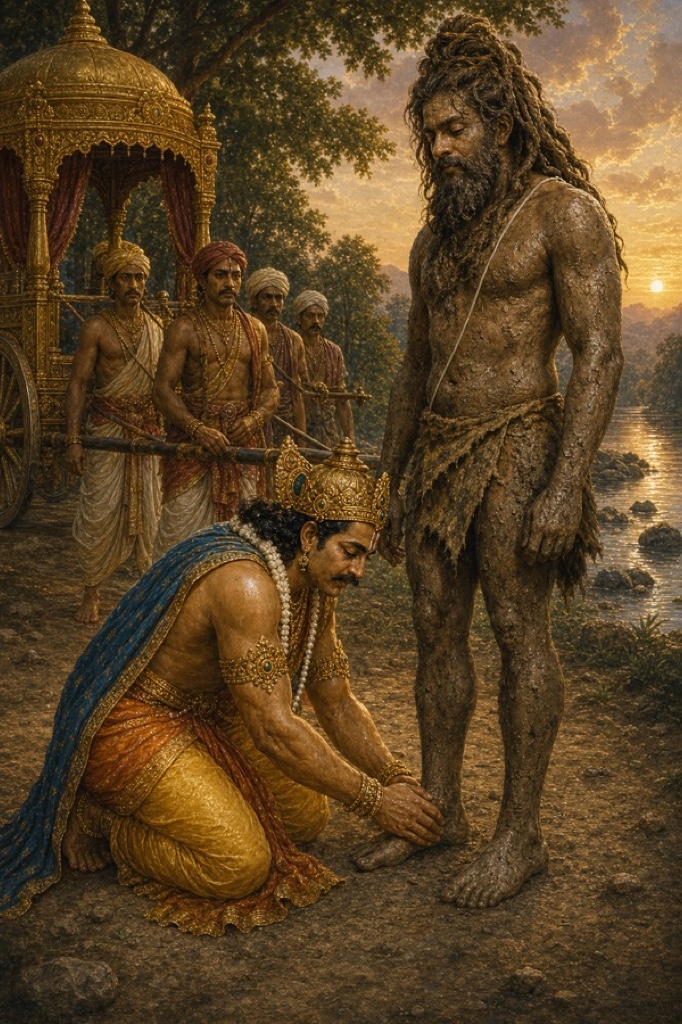
The sage had already bent to the pole again. He asked for no release; the karma that had laid this load on his shoulder had begun to bear its fruit, and he meant to carry it until that stock was spent. But the words had gone in. The reply was of the kind that cuts the knot of ignorance where it sits in the heart, and every work of Self-knowledge the king had ever studied stood behind it. Rahugana, whose honest faith had earned him at least the right to ask, came down onto the earth then and there, careless of the dust. The intoxication of kingship left him altogether, and laying his head at Jadabharata’s feet, he begged forgiveness for his offense.
“Who are you, Munivar? You walk hidden, yet you wear the yajnopavita, the sacred thread of the twice-born. Are you one of the avadhutas, those wanderers who have shaken off every worldly tie and obligation, the line the divine Dattatreya walks? Whose son are you? Where were you born? What has brought your feet to this road? I do not fear the thunderbolt of Indra, or the trident of Shiva, or the rod of Yama, or the weapons of the gods of fire, sun, moon, and wind, or the mace of Kubera, lord of riches. One thing alone terrifies me, and that is to have shown contempt to a Brahmin. Your words are full of the knowledge of the Self, and I cannot sound their depth; no intuition of mine reaches their floor. I was on my way to ask Bhagavan Kapila the one question that will not let me sleep, what a man’s true refuge is in this world. And now I wonder. Could you be Kapila himself, walking the roads unknown to see how the world fares? How would a man like me ever tell? My eyes are tied to home and throne, and eyes like those make nothing of the ways of the masters of yoga.”
A faint smile came to Jadabharata’s lips.
“In a former birth I was a king, as you are. Bharata was my name. I had cut loose from everything the eye sees here and everything the ear is promised in heaven, and I gave myself to the worship of Bhagavan alone. Even so I grew attached, to one orphaned fawn, and by that single attachment I fell from the aim of my life and had to be born a deer. But the memory of what I had been, kept alive by the worship of Sri Krishna, stayed with me even inside the deer’s body. So in this birth I keep apart. I let the world take me for a fool, I wander unattached, and I am shy of company, so that no crowd and no fondness can ever bind me again.”
It came back to Rahugana then. He had heard the katha of Bharata the royal sage, the emperor who had walked away from the whole earth, the king from whose time men call this land Bharata.
The king rose, then bowed again at Jadabharata’s feet.
“Forgive me, Munivar. Pride made me blind. Your speech has been medicine to me, the cooling draft they give a man burning with fever, cold water on scorched skin, for the serpent of this body-thought had bitten my very seeing. And still one knot holds in me. I am a man trained in argument, and the argument will not lie down. I have known weariness myself, in war, under armor, and from that I can infer the weariness of a man walking under a load. The world that presses on us cannot be wholly empty; an unreal jar fetches no water. Set a kettle on the fire and the water in it heats, and the heat of the water enters the rice, grain by grain to the core, and nothing in that chain of touch is false. Just so, it seems to me, the body’s tiredness must travel inward and reach the soul that wears it. And is a king nothing at all? For his hour a king does stand protector of his people, and the man who does the duty given him as service to the Lord grinds no ground flour; that service burns away his sins. So look kindly on me, friend of the afflicted. Out of the vanity of rule I slighted a holy man, and the man who despises the great is destroyed by it, and soon, though he carried the strength of Shiva himself. Lift that from me first. Then untie my knot, and untie it so that I can follow.”
“Rise, Rajan. Sit beside me.”
Rahugana sat down where he stood, in the dust of the road, king and bearer both forgotten.
And Jadabharata gave him the teaching that spreads through the Bhagavata as a full episode in its own right.
He began by setting the king’s learning gently aside. Men who know the truth, he said, do not carry questions of master and servant into an inquiry about the Real; those relations are usage, and usage is never the bottom of anything. The Vedas themselves, in their chapters of ritual, mostly glorify heaven and the rites that purchase it, and only rarely speak the naked truth. Even the Upanishads, the crown of that whole edifice, stay closed to a man until the day he can look at heaven’s promised pleasures and set them aside the way a waking man sets aside a dream. Then he came to the mind. As long as a man’s mind stays under the sway of sattva, rajas, or tamas, the three strands that weave all of nature, it keeps harvesting virtue and sin through his senses and never lets the jiva go. It is a storehouse of every impression his actions have ever left in it, the foremost of the sixteen parts of the subtle body that travels with the soul from death to birth, and, taking name after name and form after form, it lifts the jiva into higher wombs and drops it into lower ones, handing over in season pleasure, pain, and a third fruit that is neither. It runs out into the world through eleven currents, the five senses that take the world in, the five organs that act upon it, and the sense of I that claims the body for its own, and those currents, meeting the endless variety of things, divide into hundreds, then thousands, then tens of millions, every one of them proceeding from God and none with any standing of its own. While the mind runs, the waking world and the dream world go on rising and being seen. Still it, and both fall quiet. This is why the wise call the mind the single cause of a man’s bondage and, just as truly, the single door to his freedom. A mind soaked in the craving for things burns like a lamp fed on a ghee-soaked wick, throwing up a flame crowned with soot. Starve the craving and the same flame comes back to its clean, unsmoking light. And through it all the Lord, forever untouched, only watches these waves heave up and sink back, the way breath enters every moving and unmoving thing and quietly steers it from within. Vasudeva, all-pervading, self-luminous, older than the universe and ruler of its rulers, has entered this whole world as the witness seated in each heart, and a man circles through birth after birth exactly as long as he has not burned off this delusion with the lamp of wisdom, dropped his attachments, and put down the six inner enemies, craving, anger, greed, delusion, arrogance, and envy.
“Rajan,” Jadabharata went on, “today you are lord of Sindhu. It is a garment. Count how many such garments the atman has slipped on and shrugged off. One day other shoulders will carry this palanquin, and you will be in some other land, some other birth, under some other name. Now look at what actually moves along this road. A modification of earth, walking the earth for reasons of its own, and men call it a man. Above its feet come ankles, shanks, knees, thighs, a waist, a chest, a neck, two shoulders. On one of those shoulders rides a frame of wood, the palanquin, and inside the frame sits another lump of the same earth, and on that one men have hung the title king of Sauvira. You fastened yourself to the title and began calling yourself ruler of the Sindhus, blind with pride. And to carry it you seized men already ground down by want, men owed pity, and put them under your weight without a wage, and then called yourself the protector of the people. In the assemblies of those who see clearly, a man who does that cuts a sorry figure.”
“So what will you gain by hauling this load of ‘I’? Everything that moves and everything that stands still rises out of earth and sinks back into it, and between the rising and the sinking, men trade in names. Even earth is only a word; press it and it crumbles into atoms, and the atoms themselves are a guess that ignorance makes with the tools of reason. Whatever the eye lands on, thick or thin, small or great, cause or effect, alive or inert, is a weaving of maya wearing one name or another. Consciousness alone is real: pure, absolute, one, without an inside or an outside, wanting nothing, turned wholly toward the Self, and unchanging. Those who know it call it Bhagavan, and the sages call it Vasudeva, the dwelling of all beings. It is the kshetrajna, the knower seated in the field of the body, one and the same in all, in that tired bearer, in the ant your foot spared this morning. And no one reaches it by austerities, or fire-rites, or feeding the hungry, or the duties of the house faithfully kept, or the study of the Vedas, or worship offered to water and fire and sun. It comes only when the dust of a holy man’s feet has settled on you. In the company of such men the talk turns to the Lord and shuts the world’s noise out, and a seeker who listens to it day after day finds his mind gathering of itself onto Vasudeva. This mind of yours is an enemy with real strength, grown insolent on your own indulgence, and though it is illusion through and through, it robs you of your very self. Stay awake, and cut it down with the one weapon it cannot turn, worship at the feet of Hari and of the guru, whetting the sword of knowledge in the company of the free, for the man who tells and retells the Lord’s story severs the last ties of delusion and comes home to the end of the whole journey, the Lord himself. Then no one will stand high and no one low.”
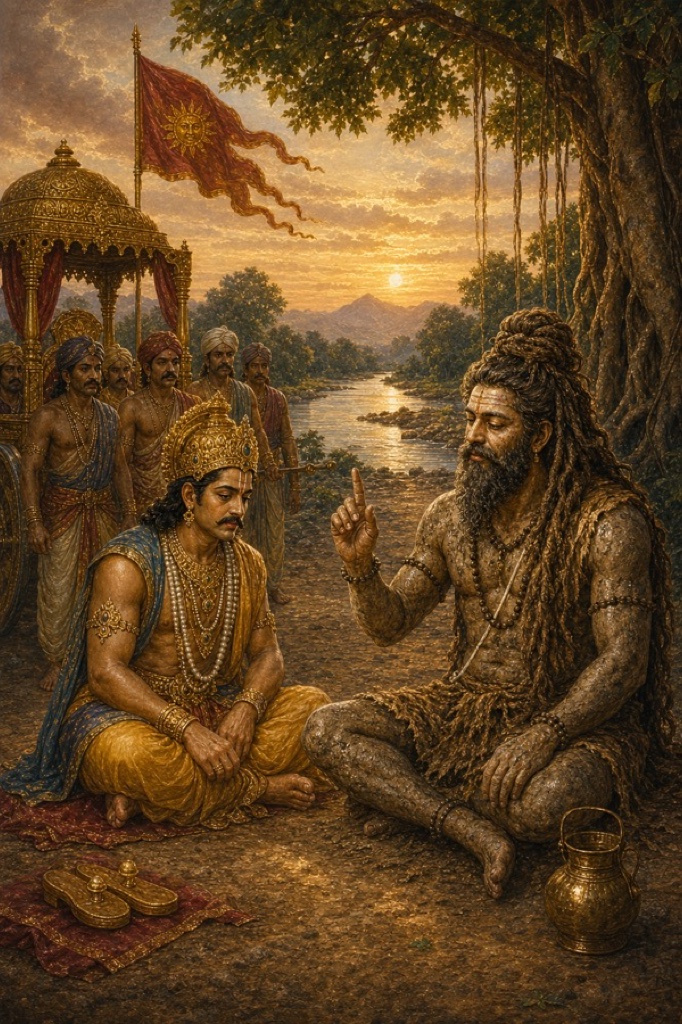
Rahugana bowed his head. His eyes brimmed over, and the tears came down into the dust and pitted it with small hollows.
He rose from that place a different man. The wrong notion that ignorance had planted in him, the belief that he was this body, fell away like a garment set down, and with it the throne lost its grip on his heart. And the sage whose feet a king now worshiped took up his road again and walked the earth as before, like an ocean full on every side, its waves stilled.
The man who had set out that morning as a king returned as a seeker, and the man he had ordered seized as a bearer stood revealed as his guru.
Literary context
The dialogue of Rahugana and Jadabharata spreads across the fifth Skandha of the Shrimad Bhagavata, Chapters 10 through 12. Rahugana, king of the twin lands of Sindhu and Sauvira, loses his temper over the halting, careful gait of the Jadabharata carrying his palanquin, and the reply he receives, the teaching on the difference between the atman and the body, is the one Shukadeva recounts here to Parikshit.
The episode belongs to the shanta rasa, the quiet flavor, and to the way of jnana, in which the falling away of identification with the body is itself called liberation. In Chapter 13 that follows, Jadabharata lays the whole of worldly life before the same king as a bewildering forest, the bhavatavi, where a caravan of traders wanders after wealth that never lasts, robbed along the way by six highwaymen, and by the end of it the king has shed the belief that he was ever the body at all.
The philosophical lens
At the heart of this katha stands the fact that knowledge answers to no rank and no costume. Jadabharata kept himself looking dull and slow by deliberate choice, caked in mud, so that no one would honor him and the love of honor could never bind him again. The truth he carried he kept sealed away from the identity the world saw.
And so the lord of Sindhu, a man who had studied the shastras and set out for the darshan of Kapila himself, collided under his own palanquin with the very knowledge he had gone hunting. Every label rides on the body. Bearer or king, the flesh is a shaped handful of earth, and the breath inside it moves by the same one consciousness. Rahugana came armed with a scholar’s arguments, and the sage answered them by showing him where the “I” doing the arguing had quietly seated itself.
Why this katha matters now
Rahugana rode out hunting knowledge, and it reached him from the very shoulder he had priced like an ox’s and yoked under his palanquin. Someone we pass over as dull and silent may be holding the deepest stillness of all.