On this page
Shiva and Mohini
The story of Mohini’s lila spread through the three worlds, and in time it reached Mahadeva.
The devas had their amrita, the asuras their defeat, and the matter might have ended there. But the telling had settled into one more mind and would not lie still.
Shankara.
Shiva, the Great God, whom those who love him call Shankara, the kindly one. He sat with Parvati in the vast quiet of Kailasa, his mountain seat, where the silence is so complete that a single breath is loud.
He had heard that Vishnu had worn the body of a woman, and that this single body had emptied an army of asuras of their wits.
A curiosity rose in him, slow, unspoken. “What must that form have been? I will see it too.”
He rose, mounted his bull, and set out with the whole thronging host of his ganas, the spirit companies that go wherever he goes, for the realm where Shri Hari keeps his eternal abode. Parvati rode at his side.
Shri Hari received him with every mark of honor, rose for him, embraced him, welcomed Uma beside him, and gave them ease. Two elders of the universe sat face to face, each holding the other in deep, unhurried regard. Rested, Shankara offered his homage in return, and Shri Hari smiled and waited for him to speak.
Shankara spoke his praise first. “Devadeva,” he said, “god of gods. You pervade this world, you rule this world, you are this world; every moving and unmoving thing has you for its cause and you for its controller, and the self within it is you. The beginning of this universe is traced to you, its middle and its end likewise, and yet beginning, middle, and end lay no hand on you. You are the truth. You are Brahman, pure consciousness, sorrowless, absolute bliss, without a second and yet distinct from all you hold. The sages who want the highest good let go of this world and the next together, and they worship your lotus feet alone.”
“You alone are cause and effect, and you are neither, since both arise from you. Gold worked into an ornament and gold left plain is one gold; no second substance hides in either. So it is with you. The many-ness men see in you is the work of ignorance, the three gunas laid over what has no seams. And as air moves through every creature that breathes and fills the open sky besides, so you move through this entire universe. You are its very soul.”
“Some call you Brahman, the absolute. Some call you dharma itself. Some set you past prakriti and purusha both and name you Parameshvara, and others know you as the imperishable Purusha bearing nine shaktis: Vimala, Utkarshini, Jnana, Kriya, Yoga, Prahvi, Satya, Ishana, and Anugraha. And here is the truth of all of us who guess at you. I cannot cross the maya you have spun. Brahma cannot, though his one lifetime runs to a pair of parardhas, a count of years that exhausts human counting. The rishis of Marichi’s line cannot, and we are the children of your own sattva. If we cannot find its far shore, what will asuras and men make of it, whose minds it already holds and drives through rajas and tamas?”
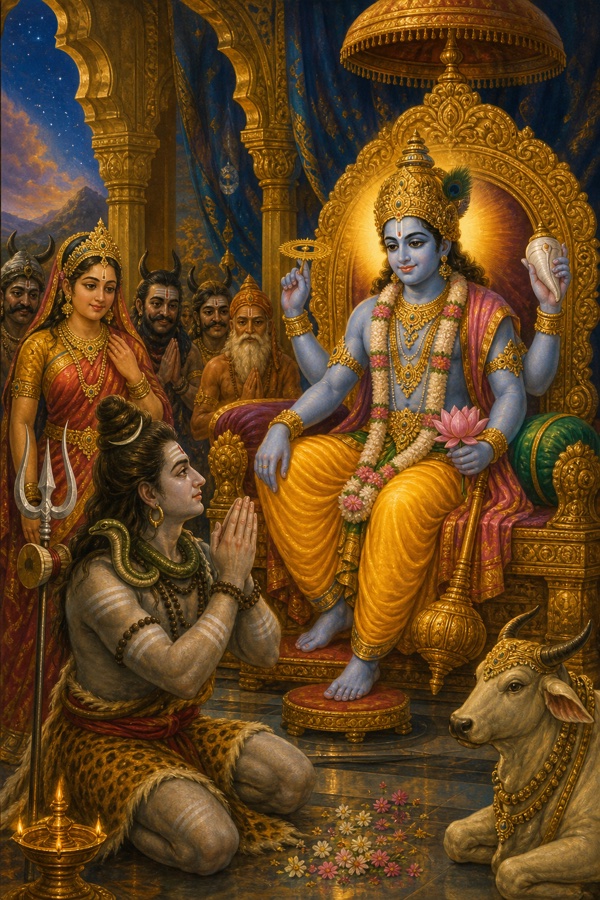
“Whenever you descend for your lila, I come for the darshan; I have seen those forms with my own eyes. One is left. Show me the form you took as a woman, the form that bewitched the daityas while the amrita went safely down the throats of the devas. For that one sight, Swami, all of us have come. The curiosity is on us, and it will not be talked down.”
Shri Hari laughed, a full, hearty laugh with something folded deep inside it. “Shankara ji, the jar of amrita had passed into the daityas’ hands; I took that form for the devas’ sake, to bewilder the very ones who had snatched it. Since you wish to see it, I will show you. But understand the thing you are asking for. That form was made to wake kama. Men ruled by desire hold it dearer than their lives.”
With that, on the very spot where he stood, Shri Hari vanished.
For a moment the air itself seemed emptied. Shankara kept his seat, Uma beside him, his eyes making slow circles of everything around them.
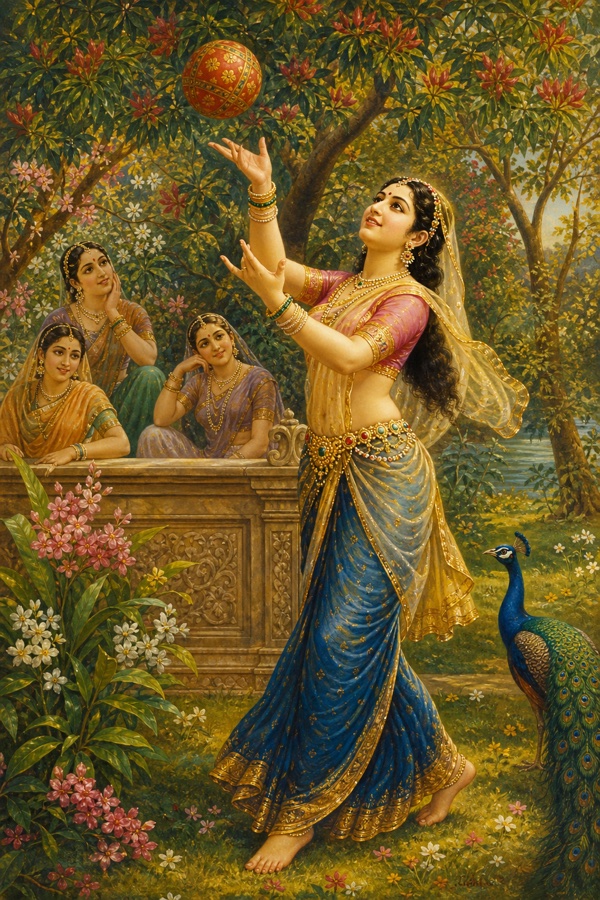
Then the garden was simply there. Trees of every kind stood heavy with blossom, their new leaves red at the tips, and among them a woman of astonishing beauty was playing with a ball. She wore a fine sari; strands of a jeweled girdle swung at her hips; she tossed the ball high and caught it falling, and the game seemed the only thing in the world she cared for.
Every throw moved through her whole body. Her garments shifted, her heavy necklaces swung, and her waist was so slender that at each step it seemed it must break under their weight. Her large restless eyes chased the ball everywhere it went; her earrings flashed against the dark spill of her hair. When the sari slipped, when the braid began to loosen, her left hand gathered them in while her right kept the ball alive, and playing just so, she was binding the whole world into her maya.
Shankara saw her.
This was the yogi at whose name yogis fold their hands. A single glance of his had once burned Kamadeva, the god of desire himself, to a drift of ash; no age of the world had produced the thing that could shake his meditation. Now he gazed at her, and she glanced back with a covert smile, half shy over her game, and somewhere between his gaze going out and hers coming in, his hold on himself left him. Uma sat an arm’s length away. The ganas stood everywhere around. He remembered none of them.
The ball sprang from her fingers and bounded away, and she ran after it. In that instant the wind lifted her thin sari clean off her, and the girdle with it.
Mohini smiled with a small show of shyness and cast one sidelong glance at Shankara. It was enough. His mind slid out of his keeping and his heart went with it. With Uma herself watching, with shame set aside and thought nowhere at hand, he rose and started toward her.
Shankara stepped forward. Mohini stepped back.
His stride quickened. She fled.
What the shastras record next is hard to believe.
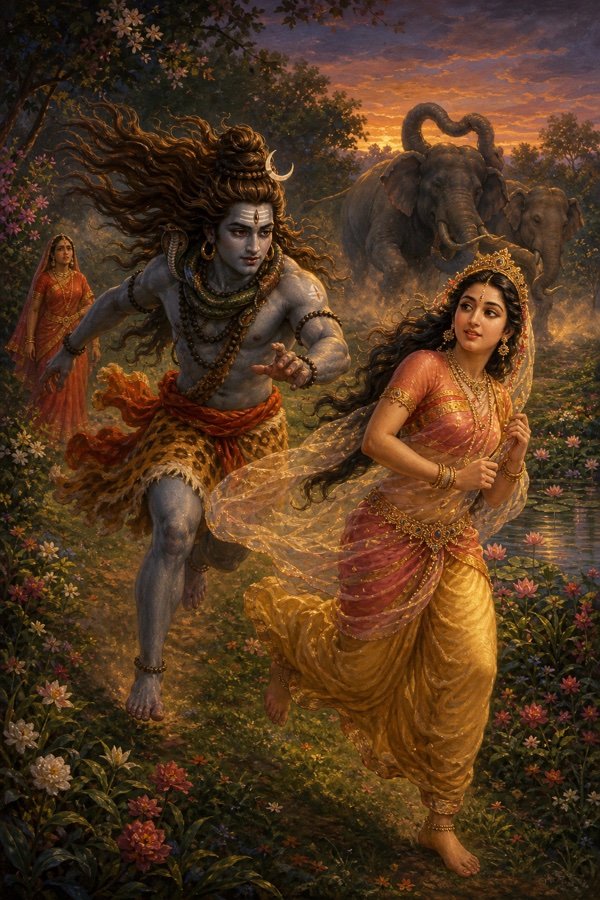
Shankara, Mahadeva, wearer of the matted jata and the crescent moon, keeper of the eye of fire, left every shred of himself behind and ran after that fleeing shape the way the rutting leader of an elephant herd crashes after a she-elephant.
She slipped from tree to tree ahead of him, laughing behind the trunks, never once holding still. He ran her down with terrible speed, caught the braid of her hair from behind, and pulled her into both his arms, though she strained against them.
She twisted one way and the other, working herself loose, and in the struggle her hair came all the way down. Then she broke out of the circle of his arms and fled again, faster than before, this girl who was the Lord’s own conjured maya and nothing besides.
And still he ran. Watching him in that hour, you would have sworn that Kamadeva, his old enemy, the god he had burned to ash with a look, had risen from that ash and taken his revenge in full.
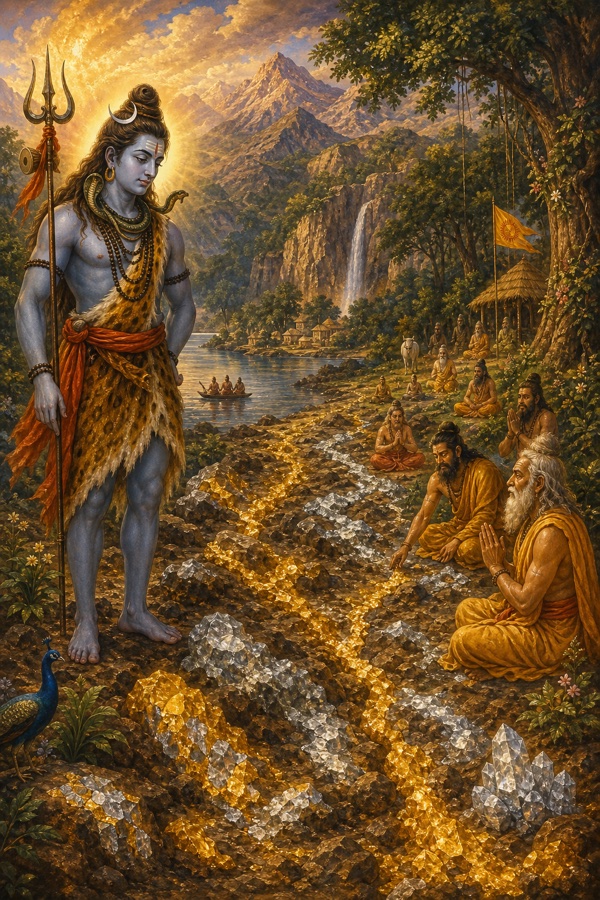
Past rivers and lakes the chase ran, over hilltops, through forests and groves, past every quiet clearing where rishis kept their hermitages. And in the extremity of it the seed of Mahadeva, whose potency has never failed, broke from him and fell to the earth. Wherever it touched the ground, the soil turned to fields of silver and of gold.
The moment the seed fell, his awareness came home. He stopped where the chase had carried him and saw the whole of it plainly: Bhagavan’s maya had played him, and played him thoroughly.
And seeing it, he felt no astonishment at all. This was the glory of the Lord who is the soul of all things, his own innermost Self among them, whose powers no reckoning has ever come to the end of. Who was he to be startled by it? He set the entire episode down at once. No shame remained in him, and no grief.
Then Shri Hari, delighted to find him unshaken and unabashed, resumed his own male form and stood before him, and the pleasure was plain in his voice when he spoke.
“Jewel among the devas. My maya put on a woman’s body and deceived you with ease, and still you walked back to your own ground, and walked back alone. That gladdens me. Consider what it means. This maya of mine conjures object after object worth running after, and a man who has never mastered his mind, once it catches him, stays caught. What male besides you has ever come out of it?”
“It is woven of the three gunas, and it bewilders the very greatest. It will never hold you again. I am the one who stirs it when the hour of creation arrives, I joined to it as kala, time itself, and it moves only part by part, strand by strand, at my bidding. Against my will it can begin nothing.”
With that, Shri Hari honored him, drawing him close against the Srivatsa, the whorl of white hair on his chest by which the worlds know him. Shankara asked his leave, walked around him in parikrama, the slow circle of reverence, and turned with his ganas toward Kailasa.
He hid nothing from Uma. In the assembly of the foremost rishis, with his ardhangini before him, the woman who is half of his own body, he told the whole play of that maya exactly as it had run, and he told it with love. “Did you see it?” he asked her. “The maya of the unborn, the highest Person? I fell to it helpless, I whom they call a master of yoga. What hope then for those who have never governed themselves at all? He is the one you asked me about long ago, when I rose from a thousand years of meditation. The ancient Purusha himself, whom time cannot enter and the Vedas cannot fence.”
Shankara carried one more thing home from that day, a thing no guru had ever taught him.
That no yogi stands taller than the one who knows he too can sway, and walks on anyway.
Literary context
The Shiva-Mohini episode fills the twelfth chapter of the eighth Skandha of the Shrimad Bhagavata; the Gita Press edition titles it the Infatuation of Lord Shankara. Shiva hears how Vishnu’s Mohini form recovered the amrita, rides to the Lord’s abode with his retinue to ask for that darshan, and loses his composure completely at the sight of her; the text follows the chase past the hermitages of the rishis and says that his fallen seed turned the ground it touched into fields of silver and gold. The consort at his side through all of it is Uma, that is, Parvati: she watches, she is forgotten, and she is the one to whom he afterward recounts the whole event in the assembly of seers.
The birth of Ayyappan, the Hariharaputra, from a meeting of Shiva and Mohini belongs to later South Indian temple tradition; the Bhagavata itself records no union and no child. The chapter states its own point through Vishnu’s mouth: this guna-woven maya bewilders the very greatest, and the measure of a yogi is that he can rise from the bewilderment without shame.
Why this katha matters now
Maya makes her breach at exactly the wall we count our strongest. That a yogi like Shankara could sway for a moment, and then own the moment without shame before everyone he loved, is this katha’s largest lesson, and its greatest relief.