On this page
Markandeya’s Vision of the Deluge
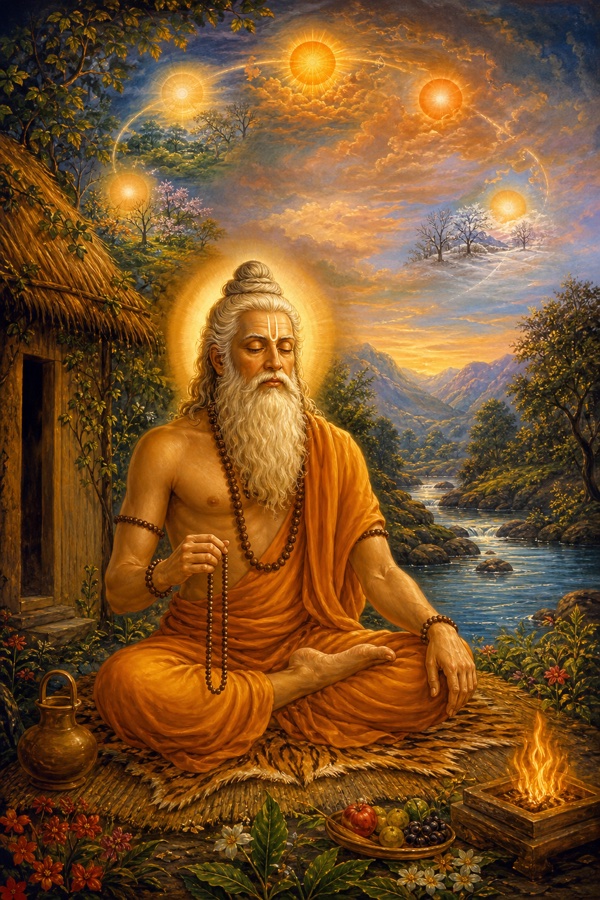
Such was Markandeya’s tapas, his austerity, that even Time would halt its feet before it and stand still. His father had led him through the sacred thread rite in due season and set him to the Vedas, and the boy took to that discipline the way a flame takes to ghee. In boyhood he had taken up the vow of lifelong celibacy, and he never once set it down. He wore matted locks and bark for clothing, carried the staff and the water-pot and a handful of kusha grass, kept a rosary of rudraksha beads; morning and evening he brought back alms for his teacher, ate in silence only when his teacher permitted it, and on the days no permission came, he simply went without. Seated on a single asana, telling his beads, remembering Shri Hari, he watched six manvantaras pass before him, six vast cycles in which one Manu gave way to the next and the world was made and unmade again. Age could not so much as touch his body. For ten million years he worshiped the Lord through the fire, through the sun, through his teacher and the holy ones, and through his own indrawn self, and by that long worship he did the one thing almost no one does. He conquered death. Brahma and Shiva, Bhrigu and Daksha, the gods and the fathers and the sages, all of them marveled at it.
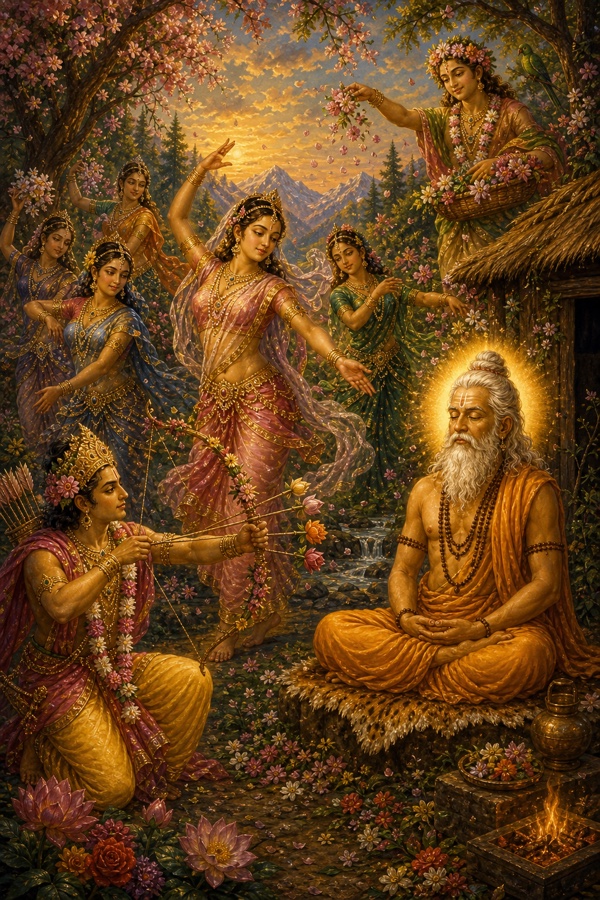
In the seventh manvantara, Indra came to learn of this tapas, and he grew afraid. Fearing that such austerity might one day unseat him from his throne, he sent an army of distraction to Markandeya’s hermitage, which stood on the northern slopes of the Himalayas, where the river Pushpabhadra runs past a rock called Chitra. It was a place already made for the undoing of vows: pools of clear water, sacred trees hung with creepers, bees drunk on honey, cuckoos calling, peacocks dancing, and a breeze that came in off the waterfalls carrying cool spray and the scent of flowers. Into it Indra sent the Gandharvas with their musicians, a troupe of apsaras, Kamadeva the god of love, Vasanta the spring, the soft Malaya breeze off the southern hills, and Greed and Pride besides. They found the sage seated beside his sacred fire with his eyes closed, formidable as fire itself standing in a human shape. The drums and the lutes began. Beauties like Punjikasthali rose up dancing, chasing a ball this way and that before him, until the wind carried off her fine garment and her girdle slipped loose. Vasanta spread out all his blossoming maya. Kamadeva, certain by now that the sage was won, fitted his five flower-arrows to the string and loosed them. Yet Markandeya did not waver by a hair, and not even a trace of pride entered his mind. In the end Kamadeva himself began to scorch in the sage’s radiance and fled with his whole troupe, the way small children wake a sleeping snake and run. And Indra, hearing how it had gone, felt his fear give way to wonder.
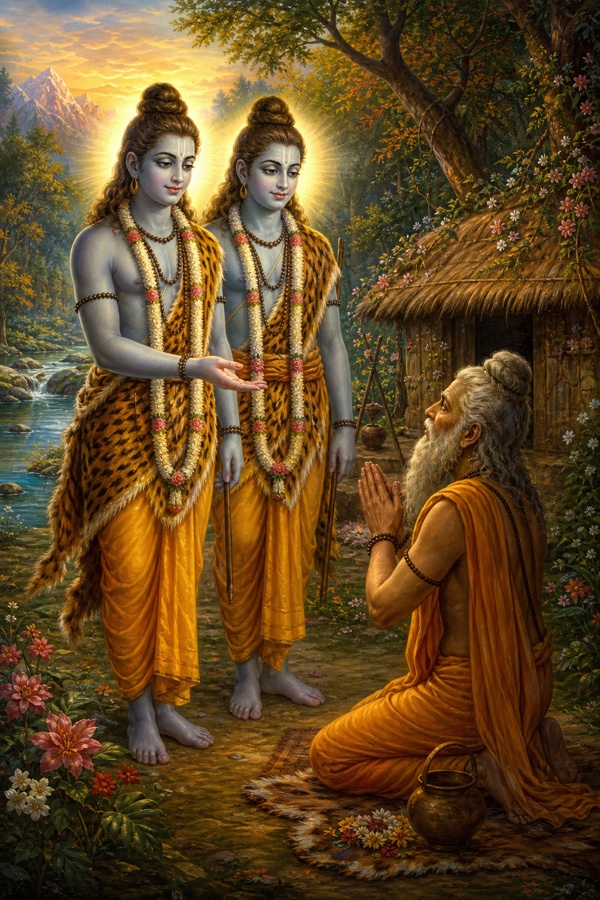
Then, pleased with this unshakable practice, the Lord appeared before him in two forms at once, as Nara and Narayana, the twin sages whom even Brahma and the chiefs of the gods adore. One was fair and one was dark, each with four arms, each tall and lit with a gold like lightning, clad in bark and the skin of a black buck, wearing rings of kusha grass and beads of lotus seed, carrying the water-pot, the straight bamboo staff, and the soft broom with which such sages sweep the ground before them so that no small creature dies beneath a step. They looked like austerity itself, twice embodied and walking. They told him to ask for a boon. Markandeya fell flat before them like a log, rose, and stood with joined palms, so flooded with joy that his hair stood on end and his eyes filled and for a long moment he could not look at them at all. Then he said only one thing.
”Lord, what more could I ask? You have stood within the reach of these eyes, and Brahma himself is contented with far less, a glimpse of your feet caught in the stillness of the heart. Yet one desire remains. Show me that maya of yours by which this whole world is made and into which this whole world returns. Under its spell even the guardians of the spheres look upon the one Reality and see many. I wish to see it.”
Narayana smiled. ”So it will be,” he said, and the two of them withdrew, still smiling, toward their abode at Badarikashrama, their ancient hermitage high in the snows. No day was named, no warning given; what had been asked for was exactly what he was about to receive.
Markandeya went on sitting in meditation by the Pushpabhadra near his hut. He saw Shri Hari in the fire and the sun and the moon, in water and earth, in the air and the open sky, in his own self and in everything around him, and he worshiped that presence with offerings shaped in his mind, flowers and lamps and sandal made of thought alone. Some days the love in him rose so high that the worship itself slipped from his hands, and he simply sat, overwhelmed. So the seasons turned, and then came one particular evening. The day sank. The red of evening spread out over the water, and then it too went dark.
Whether midnight had come or not, this he could never afterward decide.
Then a wind sprang up, furious, roaring, a wind with no season behind it, and on its heels came clouds like nothing he had seen, black and towering, cracking with lightning, pouring down rain in ropes as thick as the axle of a chariot. The four oceans rose at once, each with its whirlpools, its crocodiles, and its long roar, and their waves, driven mad by the wind, came reaching over the land from every side to swallow it. Markandeya opened his eyes and looked all around.
The river was nowhere. The forest that had stood around him for years was nowhere. The distant mountains, whose outline he knew even with his eyes closed, went under and were gone. The earth with its continents and their divisions, the sky and the heaven above it, the lights that hang there, the whole fourfold world of living things, born of womb and egg, of sweat and seed, all of it sank together into a single rising sea, and of everything that had ever breathed, one sage was left.
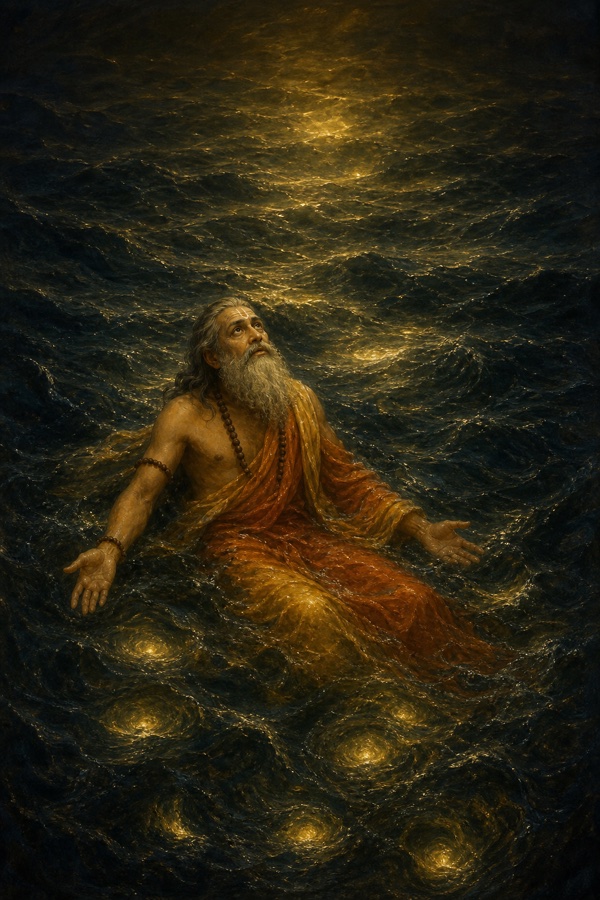
There was only water. From one end to the other, above and below, on every side, water. A fathomless sea, silent and shoreless. There was no sky. Sun, moon, and every direction-giving star had vanished. Light was coming from somewhere and from nowhere; the water was giving off a murky glow from within itself.
Markandeya began to swim alone in that water.
And then he felt fear. For the first time in his life. Through so many kalpas, through so many austerities, even death had never come near him; yet in this silence, in this endless cold water, something within him began to tremble. Fear, which he had outlived, had been waiting for this water.
“Lord, what is this?” he called out.
No answer came. Only his own voice slid across the water and returned to him.
He kept swimming. His hands kept moving, his feet kept moving, his matted locks streamed and tangled behind him, and the water stayed exactly as it was. He, who had known every direction by the ridge of a mountain, could no longer have said which way was east, or whether he swam upward or down. How many watches passed, how many years, was hard to say; where there is no sun, time keeps no hold. But afterward it seemed that this had been no small stretch of time; drifting in the waters of that pralaya, his judgment clouded by the maya of the Lord, millions upon millions of years passed over him.
Hunger and thirst began to torment him. From somewhere great crocodiles lunged at him, from somewhere came the timingilas, fish vast enough to swallow whales, their jaws opening for him out of the dark; the creatures of that sea fought one another for the right to seize him, and their teeth found him again and again. The blows of the waves left his body wounded, whirlpools caught him and spun him under and let him go, and all sorts of diseases closed in on him. Now grief, now delusion, now fear, now for a moment some happiness; more than once something passed over him that felt like dying. Weariness sank into his shoulders, then into his chest. His breath grew heavy. That tapas which had held Time back through six ages of the world began to run out in this water.
Just then, in the midst of that endless water, he saw something.
A raised mound of earth, where no earth was left in all the worlds, and on it a young banyan tree hung with leaves and fruit, green as though no deluge had ever touched it. On a branch toward the north-east, a fresh and tender leaf had curled itself into the shape of a cup.
And on that leaf lay an infant.
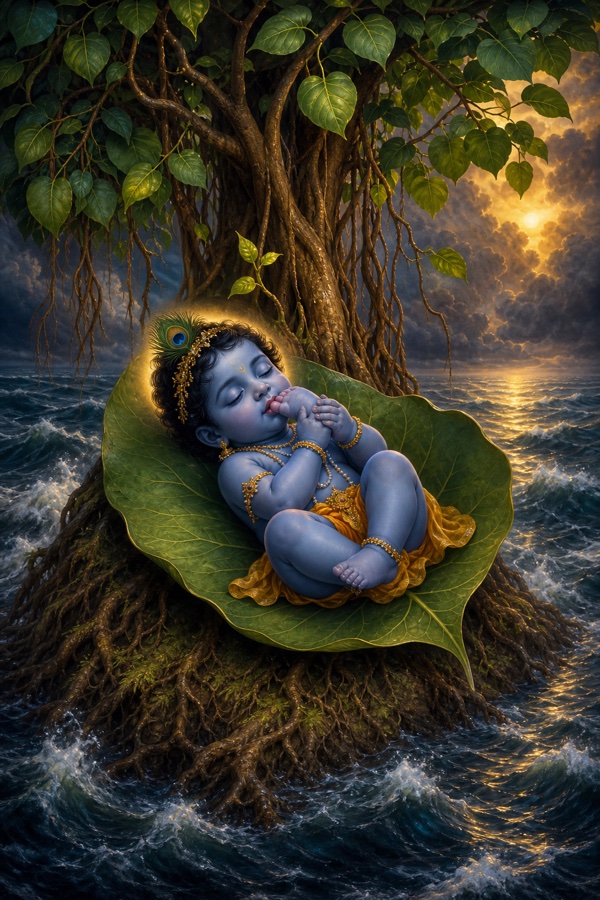
Small as a newborn. Dark green as an emerald, the color of a rain cloud. A face such that at the mere sight of it all the fear within began to melt. From his body such a bright glow scattered outward that the darkness around him kept drawing back. In all that shoreless dark, one small body, breathing. His neck rose and fell in curves like a conch, his chest was broad, his nose finely shaped, his brows most charming. Dark, dark curling locks hung over his cheeks, and stirred now and then with the passing of his breath. In his ears, which curled like conches, blossoms of pomegranate glowed. From the luster of his coral-red lips, his nectar-white smile carried a faint blush of red. The corners of his eyes were reddish like the inside of a lotus. His navel was deep, his belly like a peepal leaf, and with each breath the folds upon it and the navel moved. He lay asleep, drawing one lotus-foot into his mouth with both his tiny lotus-hands and sucking it, and on his lips a light smile trembled, as though even in sleep something had made him laugh.
Markandeya, swimming on with weary arms, reached it, and stopped, and went on gazing. At the sight of that child the whole tiredness of his body fell away, the lotus of his heart opened, and the hairs of his body stood on end. Questions crowded him, who this child could be, how it had lived through the death of everything, and he drew closer through the water to ask, half in awe and half in tenderness.
Then he noticed one thing.
The infant was breathing. Slowly, easily, the way a child breathes in sleep. But with each of his breaths something was happening that does not happen with any child’s breath.
When he drew his breath inward, Markandeya was drawn along with it, toward that tiny mouth, and then inside, into him, small and helpless as a mosquito carried in on the air.
And inside?
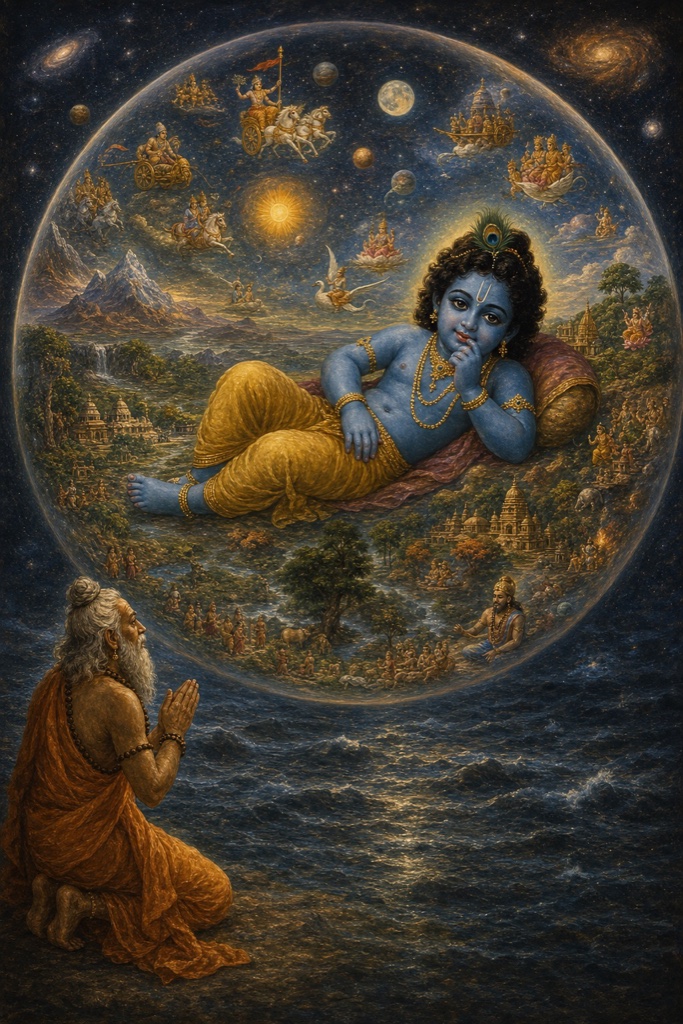
A whole universe was within, arranged exactly as it had stood before the flood, nothing missing and nothing moved. The very sky that had been wiped away outside, the very sun, the very moon and stars. Mountains standing in their places, rivers flowing along their courses. Continents and all their divisions, the four quarters, cities, villages, mines, the fields of farmers and the camps of herdsmen. Gods on their vimanas, asuras in their assemblies, humans busy at their work, the four orders of society and the four stages of life, each about its own task. The five great elements and everything they become. Time itself, laid out in its yugas and its kalpas. And there, unmistakable, the Himalaya, the river Pushpabhadra, his own hut that had been lost, the sages who lived nearby, and in the midst of it all Markandeya saw himself as well, seated in meditation by that same water, waiting for that same boon.
He kept swimming inside, watching his whole lived life pass by once more.
Then the infant would let his breath out, and Markandeya would be carried back outside, into that same cold water of the pralaya, where once again there was nothing.
Then the breath inward, and the whole universe would return. Then the breath outward, and everything would go dark. This happened many times, so many times that Markandeya forgot to count.
And then he understood.
”This infant is the Lord himself,” a steady understanding settled within him. ”In one breath of his, all creation springs up; in one breath, it returns. What we call the making and unmaking of the ages is only his breath, going out and coming in. He puts the worlds forth and draws them back the way a spider lets out its web and gathers it again. And Time, which swallows everything else, before which even Brahma trembles in his high place, is only the small play of his brows.”
He joined his palms.
“Lord, I have seen it. The one who upholds all the worlds, and this tiny infant lying on the leaf, are one and the same.”
The infant turned his face toward him. For a moment that generous, fathomless gaze touched Markandeya, a sidelong glance brimming with the nectar of love, the ghost of a smile in it, and through the door of his eyes the child entered the sage’s heart and settled there, as though he had always had his seat in it.
And then the sage, aching to hold that child, reached out to gather him in. In that same instant the infant was gone. His arms closed on nothing, the way the hopes of an unlucky man close on nothing.
And with the child went everything. The banyan, the leaf, the shoreless water, the whole dissolution of the world, all of it vanished at once, in the time an eye takes to close. Markandeya was in his hut. The river was flowing between its banks, the forest stood in its place, the sun in the sky was shining just as it shines on any morning. Before him lay that same rosary of beads.
He looked at his hands, at his palms. The same as before, the same lines. Outside, all stood as it had been.
Inside, everything had changed.
Now he knew that this whole world, this river, this sun, even his own tapas, is only the breath of an infant. One breath goes in and everything springs up; one breath comes out and everything returns. And that infant, and the breath coming and going, and the water, and the whole vision, is none other than Shri Hari, throwing the many out of the One and drawing them back again, and letting us call it the world.
Markandeya sat down once more in meditation. This time there was no question in his mind, and no fear. His senses had gone quiet, the way a sea goes quiet, its waters and its fish grown motionless once the storm has passed. There was only that infant, and his faint smile.
It was then, while he sat in that great calm, that Shiva came riding across the sky, the Lord of Kailasa abroad with all his court. He was crossing on his great white bull, Uma beside him and his hosts behind, when he looked down and saw the sage so utterly at rest that his stilled mind might have been that very sea after the wind dies, its waters and its creatures no longer moving.
“Look at him,” Uma said. “His body, his senses, his mind, all of it has gone quiet. You are the one who gives every seeker the fruit of what he has done. Give this one the fruit of all his penance.”
Shiva smiled. “This Brahmin will take nothing from us, Bhavani. Not wealth, not power, not even final release. He already holds the one thing that leaves a man with nothing left to ask, his whole heart poured out upon the deathless Lord who lives in every heart. Still, we will go down and speak with him. There is no greater gain in all the worlds than the company of such a soul.”
He came down. But Markandeya, sunk so deep that he no longer felt his own body or the world around him, did not notice even the Lord of Kailasa arriving at his door. So Shiva slipped into the cave of the sage’s heart the way air slips in through a small opening, and there, all at once, Markandeya saw him: tall, three-eyed, ten-armed, matted locks the red-brown of lightning, bright as the rising sun, a tiger’s skin about his waist, the rosary of beads and the small hourglass drum in his hands, the trident, the sword and the shield, the bow, the beggar’s bowl made of a skull, all ten hands filled. Startled awake, the sage opened his eyes, and there stood the same Lord before him in the flesh, with Uma and all his following.
Markandeya bowed his head to the ground. He brought them seats and water for their feet, sandal and garlands, incense and burning lamps, and did them worship, and asked what service could possibly be offered to the one who rests full in his own bliss, and by whose contentment the whole world is fed. Then he praised him, the all-propitious, all-peaceful Lord, who wears the strand of Rajas without ever growing fierce and the strand of Tamas without ever falling into delusion.
Shiva laughed, pleased, and spoke. ”Ask for a boon, whatever you wish. We three, Brahma and Vishnu and I, are the givers of every boon. No one meets our eyes in vain; it is through us that a mortal comes to the deathless. And we ourselves bow to a Brahmin like you, calm, without envy, without grasping, who sees no difference between Vishnu and Brahma and me, and none between himself and any other living thing. The holiest waters work slowly, and so do the images in the temples; a place of pilgrimage takes long ages to make a person clean; one look from you does the same. Even the worst of sinners is washed merely by hearing of a man like you.”
Markandeya drank in the words, each one nectar poured into the ear, and could not have his fill of them. Spun so long through the Lord’s maya and tried so hard by it, he felt the last afflictions of that endless water dissolve in this presence. When at last he spoke, it was only to wonder aloud at the strangeness of it, that the Lords of the worlds should stoop to honor those who ought to be bowing to them, and to say that they did it so the rest of us would learn how to live.
Then Shiva, with Uma at his side, granted the boons. “Devoted as you are to Vishnu, let every good thing you wish be yours. Let your fame stand until the end of the kalpa. Let old age and death keep their distance from you. Let the whole of time, what has been and what is and what is still to come, lie open to your sight, and let steady wisdom and dispassion be yours, and the giving of a Purana to the world.” And having said it, the three-eyed Lord withdrew with Uma, telling her as they went of all that the sage had done and all that he had seen.
And so Markandeya walks the earth even now, they say, ageless, his own to command, given wholly to Shri Hari.
Literary context
Markandeya’s vision of the deluge comes in the Twelfth Skandha of the Shrimad Bhagavata, the final book of the Purana, across Chapters 8, 9, and 10, one of the last deep resting points before the text takes its leave. Chapter 8 tells of his austerity and of Nara and Narayana granting him a first boon; Chapter 9 gives the vision of maya, the deluge and the infant on the banyan leaf, which is the heart of the episode; Chapter 10 brings Shiva and Uma across the sky to grant him the further boons of undying fame, freedom from old age and death, and unwavering wisdom. Markandeya, a son of Mrikanda and a great one of Bhrigu’s line, asks the Lord to show him the maya by which the single Reality appears as this crowded, manifold world, and in the waters of the great dissolution he is shown it: the Lord as an infant on a banyan leaf, within whose one breath the whole universe rises and returns.
This form of the Lord as a child, Balamukunda upon the leaf, was sung a great deal in the later bhakti tradition, in poem after poem and painting after painting. The Bhagavatam itself sets it at the meeting point of the peaceful and the wondrous, where amazement comes at last to rest in a bow of reverence.
The philosophical lens
One knot in this story is how Markandeya could keep watching once the pralaya had wiped everything away. The Bhagavatam’s answer is plain: he had conquered death and stood outside the reach of Time, and so he could remain a witness while the worlds went under. The maya he had asked to see is exactly this, the power by which the one Reality shows itself as many, so that even the guardians of the spheres look upon the single Lord and take him for a divided, populous world. What Markandeya is shown is that the whole of it, creation and dissolution together, is the going out and coming in of a single breath. The Lord puts the worlds forth and draws them back the way a spider spins its web and swallows it again, and Time, which eats everything, is only the flicker of his brows.
The heart of the story lies in the moment his strength gives out and the infant appears. Near the close of the Bhagavata, the whole cycle of creation and dissolution settles into one image: creation and dissolution, both the coming and going of a child’s breath. The Bhagavatam is careful to add that this was a grace given to one man alone, set apart from the ordinary turning of the ages that everyone undergoes. Here the wondrous rasa, reaching its peak, dissolves into the peaceful, and for the one who beholds it nothing remains but a bow of reverence.
The note this katha ends on
Everything has its own dissolution. What has been made will one day break apart; what has broken apart will be made again. Through all of it a witness remains, the way Markandeya remained upon that water. The flow of these stories pauses here for a moment, upon a single breath of that infant, in which the whole world springs up and returns.
The same katha elsewhere
- Chapter 14 · The Abduction of Draupadi (Jayadratha), the Markandeya Tales
Mahabharata (Vana Parva): the Markandeya stories and the vision of the deluge - Devi Mahatmya
Devi Mahatmya, which forms part of the Markandeya Purana