On this page
The Rama Katha of the Bhagavatam
Ayodhya, seat of the Ikshvakus, the line that traced itself back to the sun. Khatvanga’s son was Dirghabahu; Dirghabahu’s son was Raghu, whose fame ran so wide that the whole family came to be called by his name; Raghu’s son was Aja, and Aja’s son was the great king Dasharatha. The palace held his queens and everything a kingdom could pour into it, and one corner of it stayed bare, the corner where no child’s laughter ever rang.
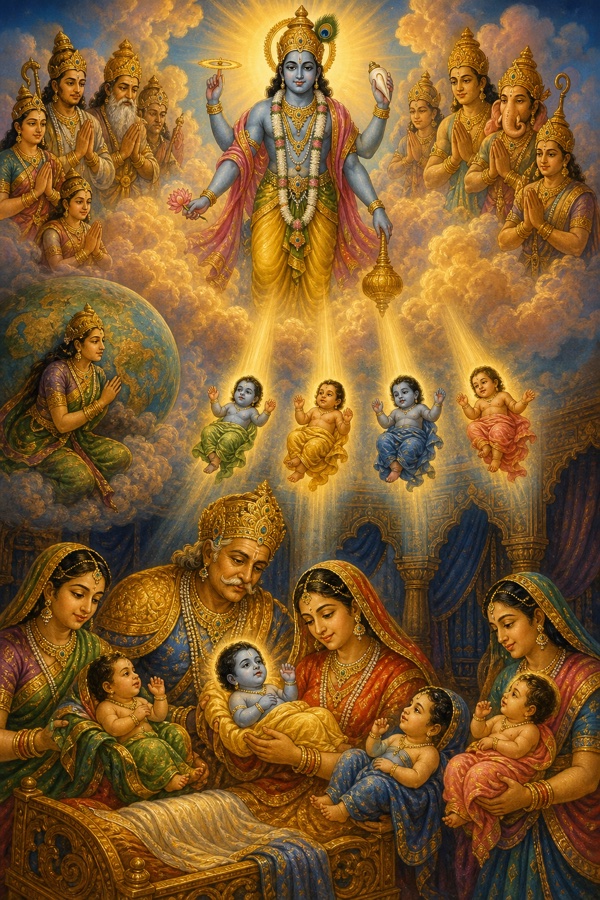
Then the gods came with folded hands, because the weight of the rakshasas on the earth had grown past bearing, and they begged the Lord to come down. In answer, the supreme Brahman himself, Shri Hari, the same Lord who had once guarded the unborn king inside his mother’s womb, consented to be born as the sons of King Dasharatha. He came in four forms. In Rama he came entire, his whole self in one body; Bharata, Lakshmana, and Shatrughna each carried a portion of him.
The bare corner of the palace filled with sound at last, and the four brothers grew up side by side.
The boys grew. Rama was the eldest, and from his earliest years there was a stillness in his eyes that could stop even his elders where they stood.
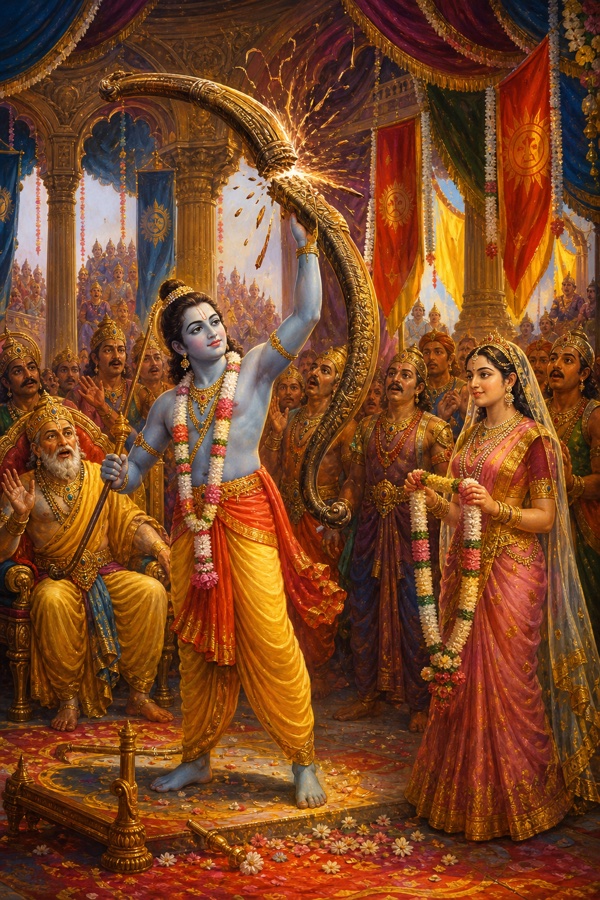
The sage Vishvamitra came asking for the princes to guard his fire-rite, and took them into the forest, where demons had made a sport of fouling every sacred flame lit under those trees. There, with Lakshmana standing aside as nothing more than a witness, Rama alone beat back Maricha and the whole crew of demons who prowled by night. Then came Janaka’s court at Mithila, and the hall his people had built for the choice-marriage of his daughter. In it, before an assembly of the most celebrated heroes of the world, lay the terrible bow of Shiva, a weapon so heavy that three hundred men together had strained to carry it into the hall. Rama picked it up as if it were a toy, strung it, and as he drew the string back he broke the bow clean in the middle, the way a young elephant snaps a stick of sugarcane in play. So he won Sri herself. The goddess of fortune, who rests as a streak of gold on the Lord’s own chest, had come down to earth to be his bride, matched to him in virtue, temper, age, and form, and in this birth she bore the name Sita.
On the road home they met Parashurama of the Bhrigu line, the axe-bearer who had swept the earth clean of the kshatriya race twenty-one times over. His swollen pride went quiet in front of Rama on the spot. Then they reached Ayodhya, and the city began to dress itself for a coronation. In a single night the wind turned.
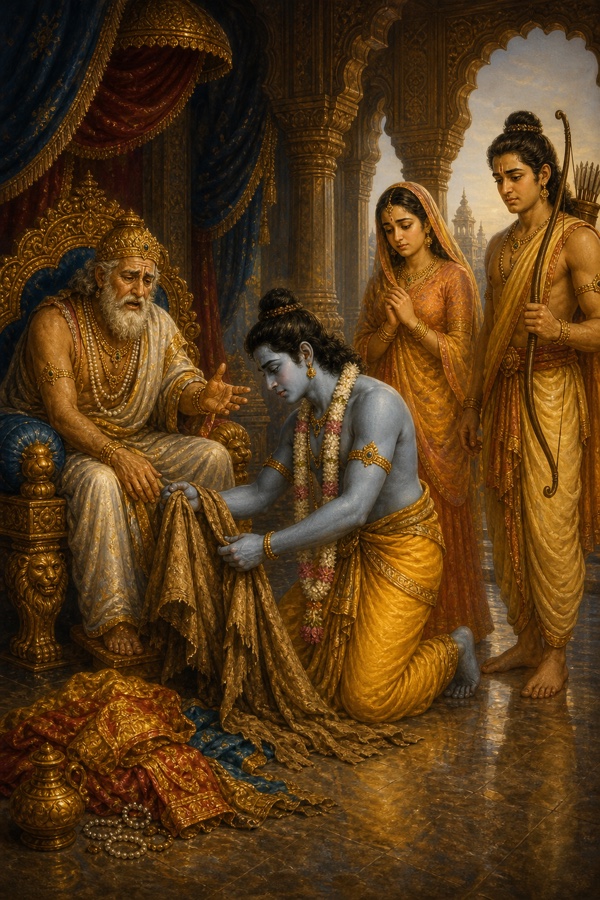
Dasharatha had given a queen his word, and the cords of his own truthfulness now bound him tighter than any rope. Caught between the promise and the son, the old king’s throat closed on him, and somehow he brought himself to say it. Not a line moved on Rama’s face. He bowed his head to his father’s command and accepted exile that same hour, so that his father’s word would stay true.
Throne, imperial fortune, mother, kin, friends, and palace: he let them all drop the way an ascetic who has cut every tie lets the breath itself go. The silk came off and the bark went on. Sita and Lakshmana fell in beside him without a word, as though the forest had always been their home too. His feet were so tender that even the petal touch of Sita’s palms had once seemed almost too rough for them, and now they would walk a country of thorns.
In the forest, when the stony paths wore those feet down, Hanuman and Lakshmana would knead the ache out of them. There Shurpanakha came circling the hermitage, and there her nose and ears were cut away, and she was sent off disfigured. Her kinsmen rose to avenge her, Khara, Dushana, and Trishira at their head, fourteen thousand rakshasas in one tide, and Rama, the great bow never leaving his hand, destroyed them to the last. Through all of it he lived hard, slept on ground, ate what the forest gave, a prince keeping court with thorn trees so that anyone who ever watched him would know how a man carries hardship.
Shurpanakha carried her account of Sita’s beauty to her brother Ravana, the ten-headed king of Lanka, and the telling of it set him on fire. He sent the demon Maricha ahead in the shape of a wondrous deer to draw Rama away from the hermitage. Rama followed it and brought Maricha down with a single arrow, the way Virabhadra had once cut down Daksha, and in that emptied hour Ravana carried Sita off, a wolf taking a lamb while the shepherd’s back is turned. Robbed of her, Rama wandered the forest with Lakshmana like a man undone, showing in his own body the plight of every creature whose heart is fastened to another. The old vulture king Jatayu had spent the last of his strength fighting Ravana in the open sky for Sita’s sake, and that one fight burned away every debt the old bird’s karma still carried; Rama gave him the funeral fire with his own hands, the rite a devoted son gives a father. He killed the demon Kabandha, sealed a friendship with the monkey lord Sugriva, brought down Vali, and through Sugriva’s searchers, with Hanuman ranging farthest of them all, learned at last where Sita was held. Then the feet that Brahma and Shiva bend to worship turned south, like any man’s, toward the sea.
The Bhagavata crosses this vast campaign at speed, like a hand tracing a distant mountain range. The seers had already sung its full extent. The sea still had to be crossed, and Lanka had to fall.
Rama sat down at the water’s edge and waited three days and three nights without food or drink, asking the ocean to open him a road. The ocean gave nothing back. On the third day his brows drew together, and that one look was enough: the crocodiles and sea-beasts of the deep began to thrash, and the roar of the surf went silent with fear. Then the lord of the ocean rose up in a living body with offerings held above his head, laid them at Rama’s feet, and spoke. “We are dull creatures, and we did not know you. You are the most ancient Person, the unchanging ruler of all the worlds, the master of nature itself. Out of your light the shining gods were born; out of your restlessness, the fathers of all creatures; out of your darkness, the lords of the ghosts. Cross at your own will. Kill Ravana, who makes the three worlds weep, the disgrace of the sage Vishrava who fathered him. Take back your wife. And build a bridge over me here, so that as long as kings ride out to conquer the quarters of the earth, they will come to this place and sing your name.”
So the bridge went up, built of mountain peaks still shaggy with whole trees, their boughs swaying in the hands of the monkey chiefs who carried them. Guided by Vibhishana, Ravana’s own youngest brother, who had chosen Rama’s side over his house, Rama crossed into Lanka with the armies of Sugriva, Nila, and Hanuman behind him, into a city Hanuman’s single visit had already left black with fire. The monkey host poured through its pleasure grounds, granaries, treasuries, gateways, and council halls; the gold jars at its doorways went down, its platforms and flags went down, and the whole city shook the way a river churns when a herd of elephants wades in. Ravana flung his captains out against them, Nikumbha and Kumbha, Dhumraksha, Durmukha, Surantaka and Narantaka, Prahasta and Atikaya, his own son Meghanada, and last the giant Kumbhakarna, while Rama’s generals, Angada and Jambavan and the rest, met steel and spear with trees, rocks, maces, and arrows. One by one the captains fell, and every follower Ravana had fell with them, for their king’s luck had run out on the day he took Sita.
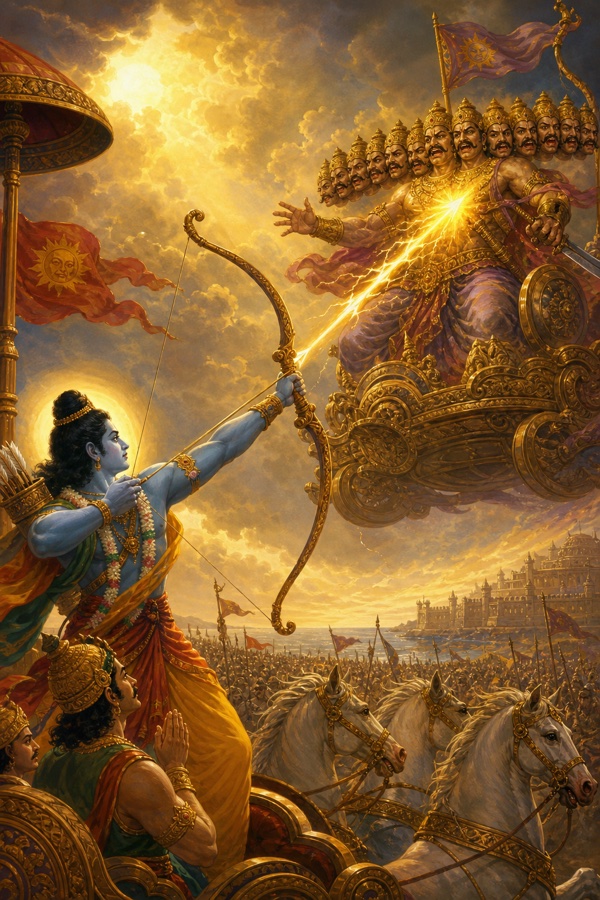
At the end Ravana himself came on in fury, mounted in the Pushpaka, the flying chariot he had long ago seized from Kubera, the god of riches. Against him Rama stood shining in a chariot of heaven, sent down from Indra himself with Matali, Indra’s own charioteer, at the reins. Ravana’s sharpened, crescent-headed arrows raked him, and Rama answered with words that cut deeper than the steel: “You stole my wife while my back was turned, the way a dog slinks into a kitchen when the house stands empty. You are the refuse of your race, and today I give you the fruit of that act, the way Time itself settles with a sinner.” Then he loosed the one arrow already fitted to his string. It split Ravana’s heart, hard as adamant, clean through. Blood poured from all ten of his mouths, and he pitched from the chariot like a virtuous man falling from heaven the moment his merit runs dry, while his people cried out around him as he fell.
Out of Lanka’s gates the rakshasa women came in their thousands, Mandodari the chief queen at their head, and threw themselves weeping on their dead. Beating their breasts, they keened over the body: “You made the whole world weep, and now Lanka weeps for you. Overrun by the enemy, widowed with us, whom is this city to look to now? Passion ruled you, and you would never see what the power of Sita’s virtue could do. This is where it has set you down: your body food for vultures, your soul gone to answer for itself.” At Rama’s bidding Vibhishana gave his fallen kinsmen every rite the scriptures ordain for the dead, and Rama set him on the throne of Lanka with lordship over the rakshasas and a life stretching to the end of the kalpa. Then he came to the Ashoka grove and found Sita beneath a shimshapa tree, worn thin by the sickness of separation, and compassion flooded him at the sight; and at the sight of him her face opened like a lotus at sunrise. His fourteen years of forest exile were complete.
He flew home in the Pushpaka with his brothers beside him and Hanuman in attendance, flowers raining down along the way as Brahma and the guardians of the worlds sang his deeds. But one report pierced him on the road: his brother Bharata, all these years, had been sleeping on strewn kusha grass at Nandigrama outside the capital, wrapped in bark, his hair matted, living on barley boiled in cow’s urine, with Rama’s wooden sandals set on the empty throne and the whole kingdom governed in their name. Bharata came out to meet him with the citizens, the ministers, and the family priests behind him, with Veda chanters and gold-edged banners and gilded chariots around him, and the sandals carried on his own head. He laid them at Rama’s feet and dropped to the ground, and Rama pulled him up, held him a long time, and bathed him with his tears. Then Rama entered his festive city the way a moon rises among planets: Bharata bearing the sandals, Vibhishana and Sugriva holding the chowrie and fan at his right and left, Hanuman lifting the white umbrella over his head, Shatrughna carrying his bow and quivers, Sita bearing a vessel of water gathered from the holy rivers, Angada his sword, and Jambavan, king of the bears, his golden shield. In the palace the old queens rose like dead bodies given back their breath and gathered their sons into their laps, washing years of grief away in tears. Vasishtha unbound Rama’s matted hair and bathed him with the waters of the four seas, the way Brihaspati, teacher of the gods, once bathed Indra.
Bharata pressed the throne on him, and Rama took it and kept his people the way a father keeps his children, and the people, each settled in the duties of their own station and stage of life, took him for their father in return. Though the Treta age was running, his reign wore the face of the golden first age. Sickness of body and mind, old age, grief, fear, and exhaustion went out of the world, and death itself took no one who was unwilling to go. Forests, rivers, mountains, islands, and oceans handed the people whatever they asked. He held to one wife his whole life, lived like a sage inside a king’s duties, did each household rite in its own season, and never once bent what was right, so that the world would have a pattern to walk by. And Sita, by her love, her service, her sweetness of temper, her intelligence, and her shy grace, so understood her husband’s mind that she held it captive entirely.
Guided by Vasishtha, he offered the great sacrifices with the richest materials a kingdom could gather, and worshiped through them his own Self in the form of Vishnu, in whom all the gods stand. When the rites were done he gave the earth away as the priests’ fee: the eastern quarter to one, the southern, western, and northern quarters to the other three who had carried the rite, and all the land that lay at the center to his own teacher, judging that this whole earth rightly belonged to the Brahmin who craves nothing. He kept only the two cloths on his body and the ornaments he wore, and Sita kept only the marriage thread at her throat, the little band of gold a wife wears while her husband lives. The Brahmins, undone by an affection that treated them as a father treats his children, pressed it all back into his hands and said, “What have you ever left ungiven, Lord? You enter the heart itself and burn away its darkness with your own light. What is land, next to that?”
Then one night Rama went out through his capital unmarked and unattended, to hear for himself how his people spoke when no king was listening. At one door he heard a man shutting his wife out of the house. “I will not keep you. You have lived under another man’s roof. Rama is fond of his wife; let him keep his Sita if he pleases. I will not take you back.”
Something settled inside Rama then, a stone that dragged downward with every breath. The world has ten thousand mouths, and no king has ever talked them quiet. He was afraid of what those mouths would do to the throne’s name, and so he sent Sita away to the forest, heavy with child, alone, into the very woods the two of them had once walked together.
The hermitage of the poet-sage Valmiki took her in. There, when her time came, Sita gave birth to twin sons, Kusha and Lava, and raised them through the years on the strength of those two boys. Valmiki himself performed their birth rites and every sacrament in its turn.
The family went on around them. Lakshmana’s sons were Angada and Chitraketu, Bharata’s were Taksha and Pushkala, Shatrughna’s were Subahu and Shrutasena. Bharata rode out to conquer the quarters, broke the gandharvas in their tens of millions, and laid their wealth at the king’s feet. Shatrughna killed the demon Lavana, son of Madhu, and on the ground where Madhu’s forest had stood he raised a city and named it Mathura, the same Mathura where, ages later, this whole Bhagavata’s own Lord would take birth.
Through those years, alone in Ayodhya, Rama carried her absence like a fever that would not break.
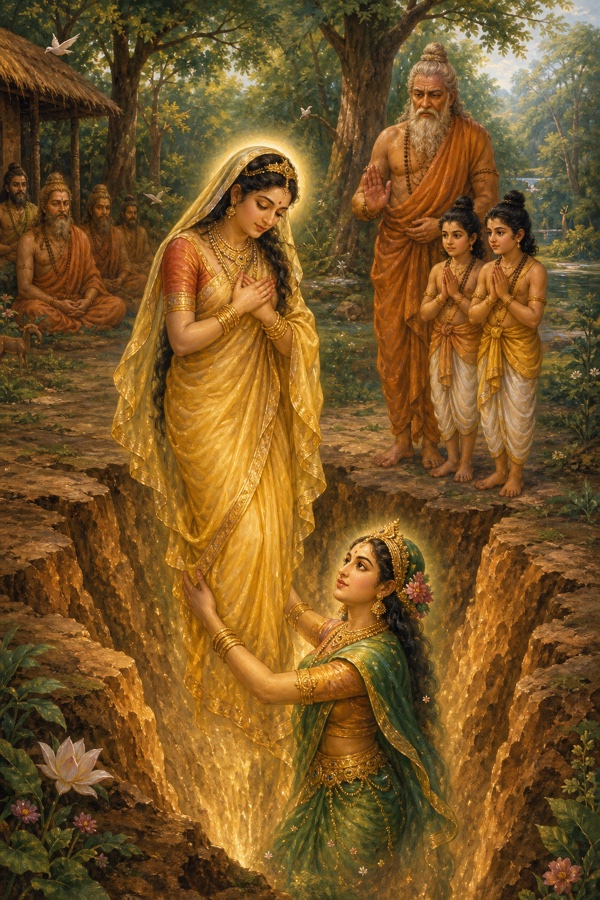
In Valmiki’s hermitage, when the separation could be borne no longer, Sita placed her two sons in the sage’s hands, fixed her whole mind on Rama’s feet, and looked down at the ground. The earth parted and took her. She passed into the world of the earth goddess, back into the same soil that had once given her up in the furrow of Janaka’s plow.
When the word reached Ayodhya, Rama called up all his reason to hold the grief down, and the grief would not be held. And here the Bhagavata stops to say a plain, hard thing. The fondness of a man and a woman for each other carries fear and sorrow inside it even for the mighty; how much harder, then, does it fall on the householder whose whole mind lives inside his house. Even the Lord, wearing a man’s body, let that grief be seen on his face.
He stayed on in Ayodhya, king and husband and God all at once, the three of them pulling against one another inside a single chest.
Literary context
Within the Bhagavata the Rama story arrives compressed into two chapters of the ninth skandha and read wholly through bhakti, seated inside Valmiki’s larger tradition, with Rama present as the avatar in person, well past the figure of a dharma-minded king. The slaying of Tadaka, Kaikeyi’s boons, and the extended Lava-Kusha episodes belong to Valmiki’s tradition; the Bhagavata does not repeat them, and it sets certain details in its own way (Maricha and the night-demons beaten off at Vishvamitra’s sacrifice with Lakshmana looking on, the three hundred men who carried the bow, the quieting of Parashurama’s pride, the fourteen thousand rakshasas led by Khara, Dushana, and Trishira).
Tulsidas’s Ramcharitmanas sings the same story at full length in Awadhi, and its Rama, too, is the supreme Brahman from the opening book onward; the Bhagavata gathers that same devotion into two chapters.
For the full Ramayana there is Valmiki. The Bhagavata places the same story in the palm of your hand, its essence alone, so that even a reader short on time can reach the heart of Rama’s endurance in a single sitting. Today, when hardly anyone can spare an hour to sit still, this compression brings it within everyone’s reach.
The same katha elsewhere
- Valmiki Ramayana
Valmiki Ramayana: the complete Rama katha - Sati and Shri Rama
Shiva Purana: Sati’s test of Shri Rama - How Many Years Did Rama Live
Essay: how many years Rama lived