On this page
Gajendra Moksha
In the middle of the Ocean of Milk, the white sea the Lord himself names among his favorite dwelling places, there stood a mountain called Trikuta. It rose ten thousand yojanas out of the water and spread just as far across, and its three great peaks were three different metals, one silver, one iron, one gold, so that the sea below and the sky above and every direction between them took their light. Lesser summits crowded its shoulders, glittering with shrubs of gemstone and mineral color, hung with trees and creepers and the sound of falling water, and its caves belonged to beings a traveler hears of only in songs: siddhas and charanas, gandharvas and vidyadharas, great nagas, kinnaras and apsaras. When the kinnaras sang in those caves, the lions of the mountain answered the echoes with challenge-roars, certain that some rival lion had entered their country. In one of its valleys lay a pleasure garden of Varuna, lord of the waters, called Rituman, where the women of heaven came down to play and where some tree stood in flower or in fruit through every season of the year: mandara and parijata, champak and ashoka, mango and sandalwood, date palm and sugarcane and rose-apple. And in that garden spread a great lake. Golden lotuses stood open on it, blue lilies and white crowding between them, bees drunk on the pollen, swans and ruddy geese and cranes calling across water dusted gold, the sand of its banks a scatter of gems.
On that mountain lived a herd of wild elephants, and at its head walked Gajendra. He was immense, and nothing on the mountain disputed his rule. He fed by tearing whole thickets of bamboo and cane and thorn out of the earth; when he moved, his weight shook the slopes, and the dark fluid of musth ran down his temples while a retinue of black bees rode the air behind him to drink it. Lions caught his scent and fled. Tigers, rhinoceroses, the eight-legged sharabhas that hunt lions, even the great serpents gave up their ground and moved away. And in the shadow of that one animal’s rule the meek of the forest, the boars and bears and porcupines, the wolves and hyenas, the monkeys, the antelope, the hares, roamed wherever they pleased and feared nothing, because everything that might have hunted them was itself afraid of him. Around him moved his wives, and their calves came behind.
Then came a day of heat, the herd heavy with thirst. The wind shifted and carried them, from a long way off, the cool breath of that lake, sweet with lotus pollen, and Gajendra turned toward it. They came down through the trees half wild with wanting it, his own eyes rolling with musth and heat, and when the water finally showed itself the whole herd went in after him.
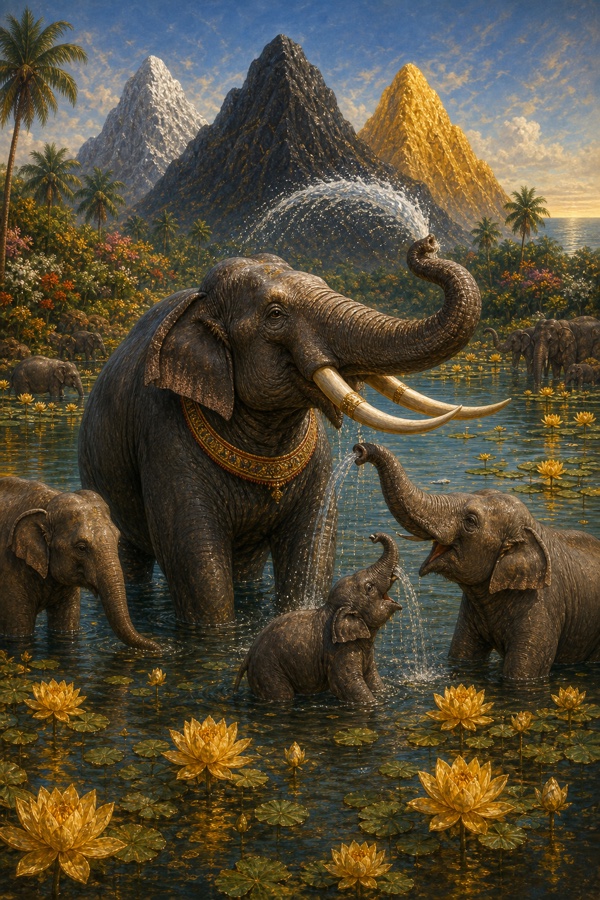
Gajendra went down into the water and bathed the weariness of the march out of his hide, and then he drank, long and unhurried, the clear water tasting of the gold and blue lotus pollen it carried. Then, sunk in fondness like any householder home among his own, he began to tend his family. Fountain after fountain arched from his trunk over his wives and calves; he slid his trunk into the small mouths one by one and gave them water to drink. He was proud and full of tenderness, and the deluding power of the eternal Lord lay over him like the glare on the water, so that he had no inkling of how vast a disaster was gathering beneath his feet.
Under the surface, something moved.
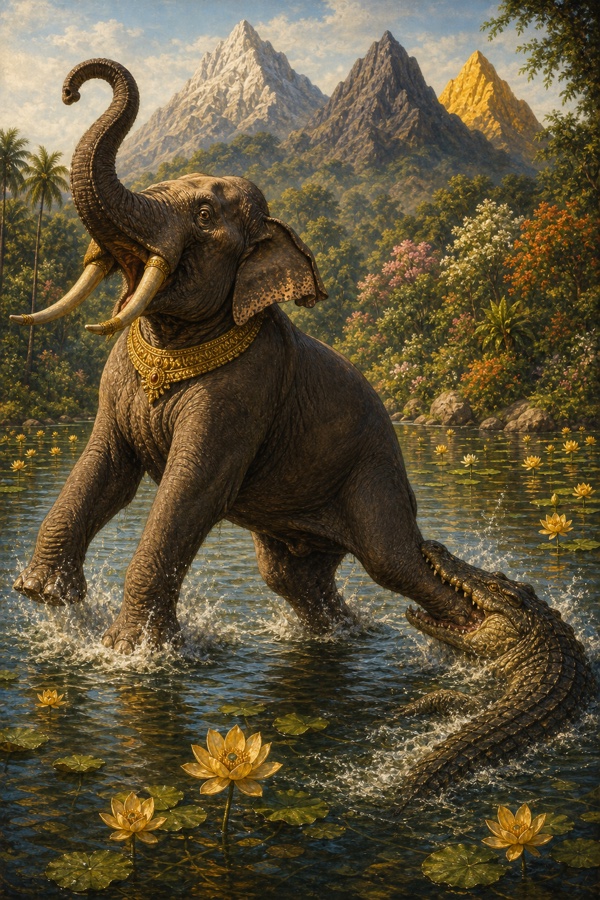
It had him before he understood what had him. A graha, a crocodile of enormous strength, had seized his foot in a cold fury. Destiny had steered the beast to that leg on that day. The jaws closed on bone and locked.
Gajendra pulled. It was the first answer his body knew, the answer that had never once failed him: mass, muscle, and rage. He planted his three free feet and heaved. He heaved again. The water churned white around him, and torn lotuses spun away across the lake.
He threw everything into it. The crocodile bit deeper.
The herd crowded the bank in a panic. His wives saw him dragged by something under the water and could do nothing; they screamed, and their screaming was all they had. The bulls waded in behind him and pushed and pulled and gained nothing. The crocodile hardly seemed to notice any of it. The water was its country. An elephant is a creature of land, and every gift that had made Gajendra a king on land, the weight, the footing, the leverage, was worth nothing once the fight moved into the water.
Gajendra dragged his attacker toward the bank; the crocodile dragged him back into the lake. One fought from the land and one from the water, and each gave the contest its whole strength.
The struggle ran on for a thousand years, a span almost beyond human measure. Both animals remained alive, and the gods looked down on it as a thing without precedent. Dragged into the water again and again for so long, Gajendra felt his spirit, his strength, and his vitality drain out of him; the crocodile was born in water and fed by water, and over those same years its strength doubled.
Then came a moment.
The moment when everything within reach has been tried. Every heave, every angle, every ally, all of it spent, and the jaws still locked. He saw himself at last as he was: a body that had believed itself the whole of him, powerless, with no way out. He thought for a long time, and the thought came to this: “These kin of mine cannot pull me out of this. How could the cows do it? The crocodile is the noose of fate itself, and it has me. There is one refuge left, the one the whole world runs to in the end, the Supreme who stands over everything. He who shields the frightened from the serpent of death, that serpent of terrible speed that moves in every direction, and from whom Death himself runs: to him I go.”
In that moment, something surfaced in Gajendra that was older than the elephant.
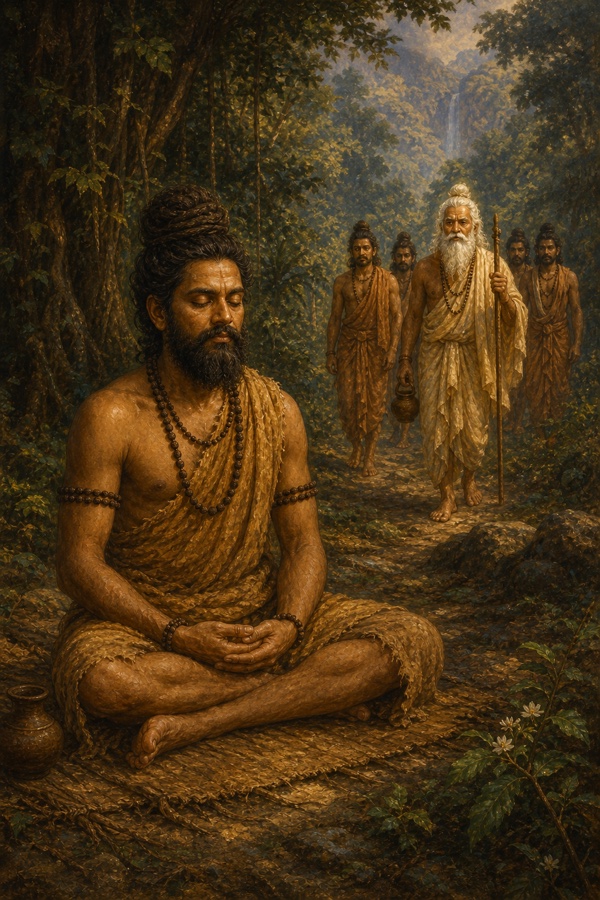
He had not always been this body. Long before, in another birth, he had been a man: a king named Indradyumna, of the Pandya line that ruled the Dravida country in the far south, and his devotion to Vishnu outweighed everything else he owned. In time it outweighed the throne itself. He laid the kingdom down, let his hair mat into jata, and withdrew to a hermitage on Mount Malaya, where he took a vow of silence, mastered his mind, and gave his days to a single occupation: the worship, at the appointed hour and after the appointed bath, of the almighty, immortal Hari.
One day the sage Agastya came up the mountain with a company of disciples and found the king seated alone in worship, silent and motionless. Indradyumna did not rise. He offered no water for the guest’s hands, none of the welcome a Brahmin of that stature is owed on arrival, and the sage, as the story goes, took fire. “This impious, ill-minded, uncultured man has insulted a Brahmin this very hour. Let him sink into blinding ignorance, and since his wits are an elephant’s, let him be born an elephant.” Agastya went his way with his disciples. Indradyumna took the curse as the shape his own destiny had chosen, and entered the womb of an elephant, the womb that wipes out the memory of the Self.
One thing survived the curse. So deep had his worship gone that even inside an elephant’s body, the remembrance of the Lord woke in him at the hour it was needed.
Now the hour had come. Trapped, emptied, dying, the elephant did what the king had done every day of his last human life. He steadied what remained of his mind, drew it down into the heart, and began, in silence, the prayer Indradyumna had learned by heart a lifetime ago. It rose the way water rises in a well, from very far down. “Om. I bow to that supreme Lord, the first seed of all things, from whom this body and this world take their light of awareness, who enters every form as the matter it is made of and as the spirit that watches from inside it. In him all this rests; from him it came; by him it was made; he is it himself, and he stands beyond it and beyond the unseen root it grows from. To him, who has no cause before him, I go for shelter. He sees, with sight nothing can obstruct, the whole of this universe that his own maya has set inside him, now shown, now hidden; he watches both as a witness, wanting nothing from either. May he protect me, the root of his own being, higher than the highest. When time has worn the fourteen worlds and their guardians down to the five elements, and the elements down into their cause, a darkness falls that nothing can measure or enter, and he shines on the far side of that darkness, filling everything. May he protect me. Gods have never found where he stands; the seers have never found it; how should a creature like me reach it or put it in words? He moves through his own shapes the way an actor moves through costumes, and no one in the audience has ever caught the actor. May he protect me. Sages who have cut every attachment, who are friends to every living thing and see themselves in all of them, keep vows in the forest that ordinary people cannot keep, for one wish, to see his blessed feet. He is my refuge.”
“He has no birth and no deed, no name, no form, no merit and no fault, and still, whenever the worlds must be made or unmade, he puts them all on by his own maya, each in its season. To him I bow: the Lord over all lords, Brahman, whose powers have no end, who has no form and has every form, whose every act is a wonder. I bow to the light that shows itself by itself, the witness, the Self above every self; I bow to the one that speech cannot reach, nor the mind, nor any faculty of knowing. I bow to the one the wise attain by a mind made clear and by letting go of the doing of things, the master of the final freedom, who is the very taste of that freedom’s peace. I bow to the one who wears the three strands of nature and so appears serene, or dreadful, or lost in delusion, and who in himself has no divisions at all, the same everywhere; I bow to him who is knowledge grown solid. To you, knower of every field, every body ever lived in; overseer of all; witness; to you, the Person, root of the self, and root of nature itself, I bow. To you who see through every sense and see every object the senses see; to you, source of every cognition; to you, whom this shadow-world and the ignorance behind it point toward, the way a reflection points toward a face; to you, the real that shines through all appearing, I bow and bow again. To you, cause of everything, yourself uncaused, cause past all wondering; to you, the great sea into which every Veda and every scripture runs like a river; to you who are freedom itself, the final shelter, I bow. I bow to the fire of consciousness hidden in the kindling of the gunas, whose will flares when their balance is disturbed, who shows himself of his own accord to those who have set the commands and prohibitions of the shastras aside and ceased to act for themselves. I bow to the Lord of measureless compassion, free from the beginning, who loosens the cords that bind beasts like me when we fall at his feet, and who never tires of loosening them; to you, the vast one, who by a portion of yourself sit in the mind of every embodied being as the seer behind the eye, I bow. Those who cling to body, children, friends, house, wealth, and kin can never reach you; you have no clinging to the strands of nature; the freed hold you in their own hearts and look at you there; you are knowledge itself, the Lord, and I bow to you. Those who worship you wanting virtue, or pleasure, or wealth, or release, receive the thing they came for, and you give them more than they asked, even a body that will never decay. Let the Lord whose mercy is past counting bring about my release. Those who belong to you alone, who have given themselves over to you, ask you for nothing at all; they sing of your deeds, which are wonderful past telling and bring only good, and they drown in an ocean of joy. That imperishable one I praise: supreme Brahman, Lord above all lords, unmanifest, found by turning the mind inward in yoga, out of reach of the senses, so fine, seeming so far away though nearer than my own breath, without end, before every beginning, whole and lacking nothing. Brahma and the gods, the Vedas, the worlds, everything that moves and everything that stands still: all of it was made from a sliver of you, parted into names and forms. As flames leap out of a fire and fall back into it, as rays go out from the sun and return, so this whole river of the gunas, intellect and mind, the senses, the bodies that come and go, pours out of you, who shine by your own light, and pours back. You are no god and no demon, no human and no animal, no woman, no man, no one who is neither, no creature at all; neither quality nor act, neither being nor nonbeing; you are what is left when every denial has been spoken, and you are the whole of it. Let that one triumph. I have no wish to go on living. What would I do with more years inside this elephant’s body, blind within and blind without? What I want is release from the one covering over the light of the self that time will never wear through. I am what I am, and so I bow to the maker of the universe who is the universe and is other than the universe, who knows it through and through, who is its soul, unborn, Brahman, the last place to go. I bow to the master of yoga whom the yogis see in their own hearts, hearts cleansed by yoga, their old deeds burned away in devotion. To you I bow again and again: your threefold power cannot be withstood; you are what every mind and every sense are reaching for; you keep those who come to you; your power has no end; and those whose senses run outward never find your road. This soul does not know its own self; your power has struck it with the thought of I. To you, whose greatness no one gets past, I have come.”
The prayer ended, and for a moment nothing in heaven moved. The hymn had named no one. Brahma heard it and did not come; it did not describe him. Shiva heard it, and the gods of every station, each of them bound to his own particular form, and none of them stirred, because a prayer aimed past every form can be answered by none of the forms. So the one who wears all the gods as a single body, Hari, the self of all that is, answered it himself.
And he came.
He had seen the elephant’s distress and he had heard the hymn. Discus in hand, the Lord in whom the universe has its home mounted Garuda, the great eagle whose speed is his own will, and came swiftly to where the king of elephants was, the gods behind him singing his praise.
Gajendra had come down to his last breaths, the crocodile still holding the leg it had held for a thousand years. And lifting his eyes, the elephant saw above the water what his hymn had been describing all along: Hari on Garuda in the open sky, the discus raised in one of his hands. Near his trunk a lotus trembled on the water. With the strength left in him he plucked it and lifted it above the surface as an offering.
And he called.
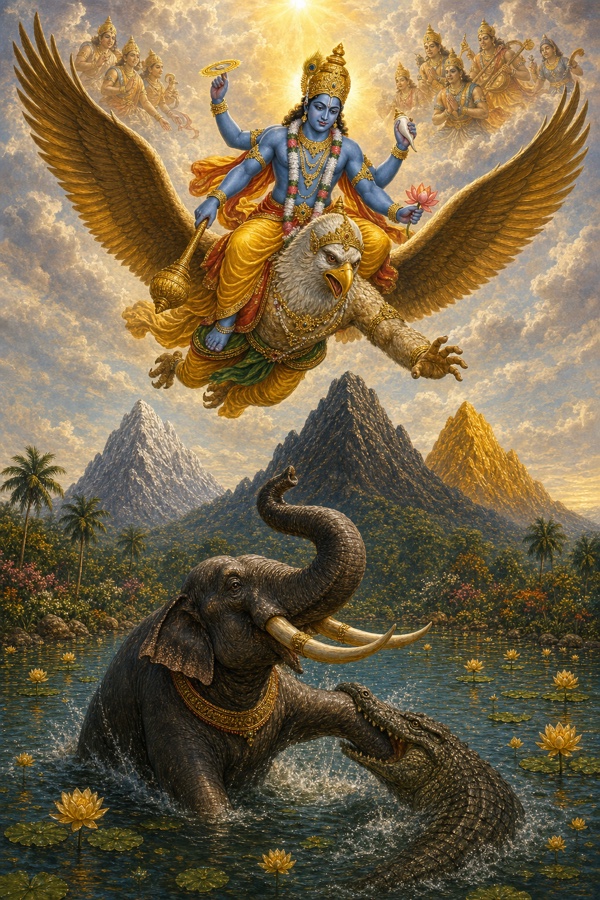
Aloud, in great pain and with great difficulty, he said: “Narayana, teacher of all the worlds, Lord, I bow to you.”
Hari did not wait for Garuda to land.
He had seen the elephant in that state, and compassion took him. He came down from the eagle’s back all at once, into the shallows, and laid hold of him.
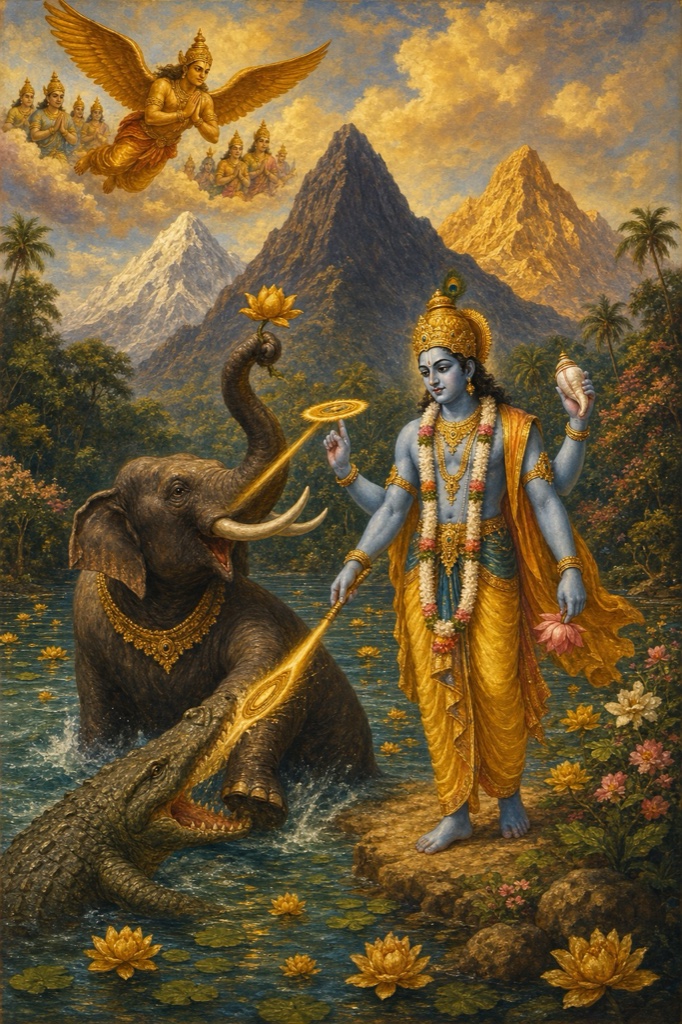
He hauled him out of the lake whole, crocodile and all, one immense motion dragging both animals up onto the bank together. Then, with every god in heaven watching, he set the edge of Sudarshana to the crocodile’s jaws and tore them open, and the leg came free.
Flowers came down out of the air. Brahma and Shiva and the gods, the seers, the gandharvas, all of them had seen what Hari had done, and they rained flowers on him; the drums of heaven sounded, the gandharvas danced and sang, the siddhas and charanas praised him. And out of the crocodile’s body rose a figure of extraordinary beauty. The crocodile had been Huhu, a chief among the gandharvas, who had worn that body under the curse of the sage Devala. Freed by the Lord, he bowed his head to the ground and sang the praise of the supreme, undying one, whose deeds and whose stories are the only things worth singing, and with every sin washed from him he walked around the Lord keeping him on his right, saluted him, and went home to his own world, while the whole assembly looked on.
The Lord’s touch freed Gajendra forever from the bondage of ignorance, and he rose from the bank in a form like the Lord’s own, four-armed and dressed in yellow.
Before departing, Vishnu gave the episode its final gift. With the whole assembly listening, he spoke to the elephant. “Those who rise at the close of night, purified and composed, and remember me, and remember you, and this lake, and this mountain with its caves and its forests, its canes and bamboos, its celestial trees and these three peaks; who remember the realms of Brahma and Shiva and my own, the ocean of milk, and shining Shvetadvipa, my favorite home; who remember the Srivatsa curl and the Kaustubha gem on my breast, my forest garland and my Vaijayanti, my mace Kaumodaki, my discus Sudarshana, my conch Panchajanya, Garuda the king of birds, Shesha who is a part of me, Lakshmi who lives in me; who remember Brahma, Narada, Shiva, Prahlada; the deeds of my descents as Fish and Tortoise and Boar, which never run out of merit for the one who hears them; the sun, the moon, and fire, the syllable Om, truth, the unmanifest, the cow and the Brahmins, the deathless dharma, the daughters of Daksha, the rivers Ganga, Sarasvati, Nanda, and Kalindi, the white elephant Airavata, Dhruva, the seven sages, and the men of sacred renown: all of these are my manifestations, and those who remember them are freed from every sin. And whoever wakes at the close of night and praises me with this hymn of yours, to him I give a clear remembrance of myself at the moment of death.” Then Vishnu sounded Panchajanya, gladdened the assembled gods, mounted Garuda, and with Gajendra beside him, a divine attendant now, returned to his own realm, while the gandharvas and siddhas and gods sang of what they had seen.
Literary context
The katha of Gajendra Moksha spans the eighth Skandha of the Shrimad Bhagavata, Chapters 2 through 4. Its prayer addresses the supreme Purusha, the first cause and witness of all. The text explains that this is why Brahma and the other gods did not answer, while Hari, present as the self of all the gods, appeared (8.3.30). The episode closes with a promise: whoever rises in the last watch of night and recites Gajendra’s hymn receives clear remembrance of the Lord at the moment of death (8.4.25).