All eighteen chapters below are now in English: the whole conversation on the chariot, from the moment Arjuna’s bow slips to the moment he lifts it again, ready whenever you are.
The Bhagavad Gita
↓ Download the Sanskrit shlokas of the Bhagavad Gita
One day every human being becomes Arjuna. The fight he wants most to avoid becomes the fight he must wage. The people before whom his hands tremble stand exactly where his decision has to fall. And then, standing on his own chariot, he turns to the charioteer within and asks: what do I do? The Gita exists for that moment.
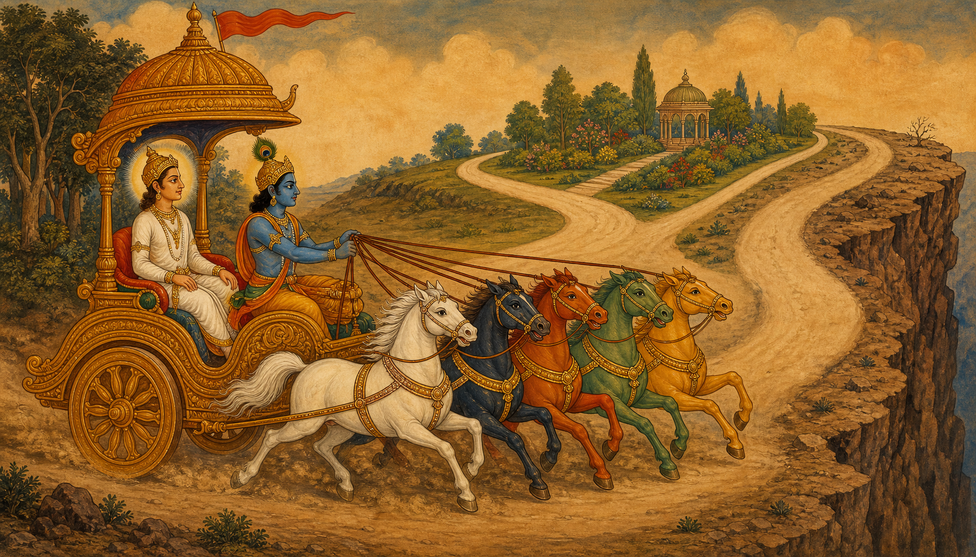
The Bhagavad Gita is a section of the Mahabharata’s Bhishma Parva, chapters twenty-five to forty-two. Seven hundred shlokas in all, arranged in eighteen chapters. The setting: two armies stand face to face on the field of Kurukshetra, minutes remain before the war breaks out, and on a chariot between them Arjuna asks his charioteer Krishna whether he should fight. Everything that follows is that one question opening.
The form is dialogue, question and answer between guru and disciple, the old style of Upanishadic literature. Around the tenth to ninth century BCE, the voices of the Brihadaranyaka and the Chhandogya were bound in just this way. The Gita carries that lineage forward, and perhaps that is why Shankaracharya placed it, in the eighth century, inside his “prasthana-trayi” (the triple foundation), alongside the Upanishads and the Brahma Sutras. Three entry gates, one path of philosophy.
The text’s central teaching now circulates like a proverb. Your claim is on the work itself; the fruit lies beyond your reach. Drop the worry, do the work. The sutra comes from the forty-seventh shloka of the second chapter, and half the Gita’s weight rests on that single sentence. The rest of the text keeps opening its layers, as knowledge, as bhakti (devotion), as meditation, as surrender.
The story in brief
In the first chapter a man breaks. Two armies stand facing each other on the field of Kurukshetra. Arjuna has his chariot driven into the open ground between them, looks up, and sees his own uncles, his teachers, his brothers and kin waiting across the line. His hands tremble. The bow slips and falls. Arjuna says, I cannot fight. This is where the Gita begins, and the chapter is named for that very state of mind, Arjuna Vishada Yoga.
Across the next five chapters Krishna’s answer arrives as a gift of philosophical knowledge. The atman (self) is deathless; the body alone perishes. What a weapon strikes down is never the atman. And with this comes the sutra of karma yoga: your claim runs to the action, the fruit lies past your reach. Release the worry over outcomes and keep working. The forty-seventh shloka of the second chapter says it, and the four chapters that follow keep opening the layers of that one sentence.
The middle portion, chapters seven through twelve, belongs to bhakti. Krishna names his vibhutis, his glories, and begins to unveil his cosmic form. In the eleventh chapter Arjuna receives the vision of the vishvarupa itself, the image that rose to J. Robert Oppenheimer’s lips after the Trinity test in 1945, “Now I am become Death, the destroyer of worlds.” Arjuna shakes before it, and in that same moment Krishna draws him back to calm.
The last six chapters return to knowledge. The anatomy of the three gunas, the nature of Purushottama, the divine and the demonic endowments. And then the final teaching sentence of all, the sixty-sixth shloka of the eighteenth chapter: leave every dharma and come to my refuge alone; I will free you from all sins, do not grieve. There Arjuna’s doubt dissolves, the bow rises again, and the war begins.
A few starting questions from the reader
How many Upanishads are there, and how is the Gita tied to them. The traditional count is one hundred and eight, but the principal Upanishads number ten, the ones on which Shankaracharya wrote commentaries. They are the final portion of the Vedas, which is why they are also called “Vedanta”. The Gita’s philosophy stands on their soil, and many shlokas are direct restatements of Upanishadic sentences.
Which are the ten principal Upanishads. Ishavasya, Katha, Kena, Prashna, Mundaka, Mandukya, Taittiriya, Aitareya, Chhandogya, and Brihadaranyaka. Each has its own style. The Katha in the dramatic form of the Nachiketa-Yama dialogue, the Chhandogya full of stories, the Brihadaranyaka the most expansive and centered on Yajnavalkya.
Why read the Gita. The question is old, and every reader arrives carrying an answer of their own. One answer that holds: the Gita is a text that stays beside your decisions and keeps lightening them, little by little. Let a single line rise and settle in the mind, and the whole day changes shape.
How much is there, in numbers. Eighteen chapters, seven hundred shlokas. Thirty-nine shlokas per chapter on average, though the chapters range from twenty shlokas to seventy-eight. The whole text, read straight through, takes about an hour.
Chapters 2 and 18 hold the gist of the whole Gita. Pressed for time? Begin with those two.
Begin with chapter 1. The armies are already in position.
Read alongside · Companion Texts
- Ashtavakra Gita The voice that stands across from the Gita, pure Advaita.
- Yoga Sutras A working manual of the mind’s machinery, the Gita’s natural companion.
- Adi GranthHindi The founding canon of the Sikh tradition, the Gita echoing through every one of its composers.
The Gita on one page: eighteen chapters in a line each and twelve verses →
Find a verse
Type chapter and verse, such as 2.47 or 18 66.
By theme: from a question to its verse
The most direct verses for the question you carry. Every line opens that verse with its word-by-word meaning.
Grief and delusion 8
- 1.28 कृपया परयाविष्टो विषीदन्निदमब्रवीत् · Overcome with deep compassion and filled with sorrow, he spoke these words. Krishna, I see my own people standing here, eager for battle.
- 1.47 एवमुक्त्वार्जुनः संख्ये रथोपस्थ उपाविशत् · Having spoken thus on the battlefield, Arjuna, his mind overwhelmed by grief, cast aside his bow and arrows and sat down in the back of the chariot.
- 2.11 अशोच्यानन्वशोचस्त्वं प्रज्ञावादांश्च भाषसे · You grieve for those who should not be grieved for, and yet you speak words of wisdom. The wise grieve neither for the dead nor for the living.
- 2.13 देहिनोऽस्मिन्यथा देहे कौमारं यौवनं जरा · Just as the embodied self passes through childhood, youth, and old age in this body, so does it pass into another body. The wise person is not bewildered by this.
- 2.20 न जायते म्रियते वा कदा चिन्नायं भूत्वा भविता वा न भूयः · It is never born, nor does it ever die; nor, having once been, will it ever cease to be. Unborn, eternal, everlasting, and ancient, it is not slain when the body is slain.
- 2.22 वासांसि जीर्णानि यथा विहाय नवानि गृह्णाति नरोऽपराणि · Just as a person casts off worn out garments and puts on new ones, so the embodied self casts off worn out bodies and enters others that are new.
- 2.27 जातस्य हि ध्रुवो मृत्युर्ध्रुवं जन्म मृतस्य च · For one who is born, death is certain, and for one who has died, birth is certain. Therefore you should not grieve over what cannot be avoided.
- 2.30 देही नित्यमवध्योऽयं देहे सर्वस्य भारत · O Bharata, this dweller in the body of every being can never be slain. Therefore you should not grieve for any creature.
Action without clinging to results 8
- 2.47 कर्मण्येवाधिकारस्ते मा फलेषु कदा चन · Your right is to action alone, never to its fruits. Do not let the fruit of action be your motive, and do not let your attachment be to inaction.
- 2.48 योगस्थः कुरु कर्माणि सङ्गं त्यक्त्वा धनंजय · Established in yoga, perform your actions, Dhananjaya, giving up attachment and remaining the same in success and failure. This evenness of mind is called yoga.
- 2.50 बुद्धियुक्तो जहातीह उभे सुकृतदुष्कृते · One endowed with this understanding leaves behind both good and evil deeds even here in this life. Therefore devote yourself to yoga; yoga is skill in action.
- 3.8 नियतं कुरु कर्म त्वं कर्म ज्यायो ह्यकर्मणः · Perform your prescribed action, for action is superior to inaction. Without action even the maintenance of your body would not be possible.
- 3.19 तस्मादसक्तः सततं कार्यं कर्म समाचर · Therefore, unattached, always perform the action that is to be done, for a person who acts without attachment attains the Supreme.
- 3.30 मयि सर्वाणि कर्माणि संन्यस्याध्यात्मचेतसा · Surrendering all actions to me with a mind fixed on the Self, free from desire, free from the sense of mine, and free from feverish anxiety, fight.
- 4.18 कर्मण्यकर्म यः पश्येदकर्मणि च कर्म यः · One who sees inaction in action and action in inaction is wise among human beings. That one is a yogi and has accomplished all action.
- 18.47 श्रेयान्स्वधर्मो विगुणः परधर्मात्स्वनुष्ठितात् · One’s own duty, though imperfect, is better than another’s duty well performed. Doing the work determined by one’s own nature, a person incurs no sin.
The person of steady wisdom 7
- 2.55 प्रजहाति यदा कामान्सर्वान्पार्थ मनोगतान् · Partha, when a person gives up all the desires that dwell in the mind, and is content in the self by the self alone, he is then said to be one of steady wisdom.
- 2.56 दुःखेष्वनुद्विग्नमनाः सुखेषु विगतस्पृहः · One whose mind is untroubled in sorrow, who has no longing for pleasures, and who is free from attachment, fear, and anger, such a sage is called steady in wisdom.
- 2.58 यदा संहरते चायं कूर्मोऽङ्गानीव सर्वशः · When a person withdraws the senses from their objects on every side, as a tortoise draws in its limbs, his wisdom is firmly established.
- 2.62 ध्यायतो विषयान्पुंसः सङ्गस्तेषूपजायते · When a person dwells on the objects of the senses, attachment to them arises. From attachment desire is born, and from desire anger arises.
- 2.63 क्रोधाद्भवति संमोहः संमोहात्स्मृतिविभ्रमः · From anger comes delusion, and from delusion the confusion of memory. From the confusion of memory comes the loss of understanding, and when understanding is lost, a person perishes.
- 2.70 आपूर्यमाणमचलप्रतिष्ठं समुद्रमापः प्रविशन्ति यद्वत् · As the waters enter the ocean, which stays unmoved though it is being filled from every side, so do all desires enter the one who attains peace. The one who hankers after desires does not attain it.
- 2.71 विहाय कामान्यः सर्वान्पुमांश्चरति निःस्पृहः · The person who abandons all desires and moves about free from longing, free from the sense of “mine,” and free from the sense of “I,” attains peace.
Meditation and the restless mind 8
- 6.5 उद्धरेदात्मनात्मानं नात्मानमवसादयेत् · Let a man lift himself up by his own self and never let himself sink. For the self alone is the friend of the self, and the self alone is the enemy of the self.
- 6.6 बन्धुरात्मात्मनस्तस्य येनात्मैवात्मना जितः · For him who has conquered himself by his own self, the self is a friend. For him who has not conquered himself, the self itself behaves with hostility like an enemy.
- 6.16 नात्यश्नतस्तु योगोऽस्ति न चैकान्तमनश्नतः · Yoga is not for one who eats too much, nor for one who does not eat at all, nor for one given to too much sleep, nor for one who keeps awake too long, Arjuna.
- 6.17 युक्ताहारविहारस्य युक्तचेष्टस्य कर्मसु · For one whose eating and recreation are measured, whose effort in actions is measured, and whose sleep and waking are measured, yoga becomes the destroyer of sorrow.
- 6.19 यथा दीपो निवातस्थो नेङ्गते सोपमा स्मृता · As a lamp in a windless place does not flicker, such is the likeness recalled for the yogi of subdued mind who practices the yoga of the Self.
- 6.26 यतो यतो निश्चरति मनश्चञ्चलमस्थिरम् · Wherever the restless and unsteady mind wanders, from there let him draw it back and bring it under control in the Self alone.
- 6.34 चञ्चलं हि मनः कृष्ण प्रमाथि बलवद्दृढम् · For the mind is restless, Krishna, turbulent, strong, and obstinate. I consider restraining it as hard as restraining the wind.
- 6.35 असंशयं महाबाहो मनो दुर्निग्रहं चलम् · Without doubt, mighty armed one, the mind is restless and hard to restrain. Yet by practice and by detachment, son of Kunti, it is brought under control.
Devotion and refuge 8
- 7.16 चतुर्विधा भजन्ते मां जनाः सुकृतिनोऽर्जुन · Arjuna, best of the Bharatas, four kinds of virtuous people worship me: the distressed, the seeker of knowledge, the seeker of wealth, and the one who knows.
- 9.22 अनन्याश्चिन्तयन्तो मां ये जनाः पर्युपासते · For those who think of me alone and worship me with undivided devotion, ever united with me, I myself provide what they lack and preserve what they have.
- 9.26 पत्रं पुष्पं फलं तोयं यो मे भक्त्या प्रयच्छति · Whoever offers me with devotion a leaf, a flower, a fruit, or water, that offering of devotion from one whose heart is pure I accept.
- 9.34 मन्मना भव मद्भक्तो मद्याजी मां नमस्कुरु · Fix your mind on me, be my devotee, worship me, and bow to me. Having joined yourself to me in this way, with me as your supreme goal, you will come to me.
- 12.13 अद्वेष्टा सर्वभूतानां मैत्रः करुण एव च · One who hates no being, who is friendly and compassionate, free from possessiveness and free from ego, the same in sorrow and in joy, and forgiving,
- 12.14 संतुष्टः सततं योगी यतात्मा दृढनिश्चयः · ever content, a yogi, self controlled and firm in resolve, with mind and understanding offered to me, that devotee of mine is dear to me.
- 18.65 मन्मना भव मद्भक्तो मद्याजी मां नमस्कुरु · Fix your mind on me, be my devotee, worship me, and bow to me. You will come to me alone; this I promise you in truth, for you are dear to me.
- 18.66 सर्वधर्मान्परित्यज्य मामेकं शरणं व्रज · Abandoning all duties, come to me alone for refuge. I will free you from all sins; do not grieve.
The descent of God and the guarding of dharma 7
- 4.6 अजोऽपि सन्नव्ययात्मा भूतानामीश्वरोऽपि सन् · Though I am unborn and imperishable in nature, and though I am the lord of all beings, I take command of my own nature and come into being through my own maya.
- 4.7 यदा यदा हि धर्मस्य ग्लानिर्भवति भारत · Whenever righteousness declines and unrighteousness rises, Bharata, at that time I bring myself forth.
- 4.8 परित्राणाय साधूनां विनाशाय च दुष्कृताम् · For the protection of the good, for the destruction of evildoers, and for the firm establishment of righteousness, I come into being age after age.
- 4.9 जन्म कर्म च मे दिव्यमेवं यो वेत्ति तत्त्वतः · Whoever knows in truth my divine birth and action in this way, Arjuna, does not take birth again after leaving the body. That one comes to me.
- 4.11 ये यथा मां प्रपद्यन्ते तांस्तथैव भजाम्यहम् · In whatever way people approach me, in that same way I favor them. Human beings follow my path in every way, Partha.
- 10.41 यद्यद्विभूतिमत्सत्त्वं श्रीमदूर्जितमेव वा · Whatever being is endowed with glory, with splendor, or with might, know that to have sprung from a fragment of my radiance.
- 11.32 कालोऽस्मि लोकक्षयकृत्प्रवृद्धो लोकान्समाहर्तुमिह प्रवृत्तः · I am Time, grown mighty, the destroyer of worlds, set in motion here to gather in the worlds. Even without you, none of the warriors arrayed in the opposing ranks will survive.
Knowledge: the self and the body 8
- 2.16 नासतो विद्यते भावो नाभावो विद्यते सतः · The unreal has no being, and the real never ceases to be. Those who see the truth have perceived the final nature of both.
- 2.17 अविनाशि तु तद्विद्धि येन सर्वमिदं ततम् · Know that to be indestructible by which all this is pervaded. No one is able to bring about the destruction of this imperishable one.
- 2.23 नैनं छिन्दन्ति शस्त्राणि नैनं दहति पावकः · Weapons do not cut this self, fire does not burn it. Water does not wet it, and the wind does not dry it.
- 2.24 अच्छेद्योऽयमदाह्योऽयमक्लेद्योऽशोष्य एव च · This self cannot be cut, cannot be burned, cannot be wetted, and cannot be dried. It is eternal, all pervading, stable, immovable, and everlasting.
- 4.38 न हि ज्ञानेन सदृशं पवित्रमिह विद्यते · Nothing in this world purifies like knowledge. One who has become perfected in yoga finds that knowledge within the self, by oneself, in the course of time.
- 13.1 इदं शरीरं कौन्तेय क्षेत्रमित्यभिधीयते · Son of Kunti, this body is called the field. The one who knows it is called the knower of the field by those who know these truths.
- 13.2 क्षेत्रज्ञं चापि मां विद्धि सर्वक्षेत्रेषु भारत · Descendant of Bharata, know me also as the knower of the field in all fields. The knowledge of the field and of the knower of the field is what I hold to be true knowledge.
- 15.7 ममैवांशो जीवलोके जीवभूतः सनातनः · The eternal one who has become the individual soul in the world of living beings is a portion of me alone. It draws to itself the mind and the five senses, which rest in prakriti.
The three gunas and one’s nature 8
- 3.27 प्रकृतेः क्रियमाणानि गुणैः कर्माणि सर्वशः · Actions are in every way performed by the qualities of nature, yet one whose mind is deluded by ego thinks, I am the doer.
- 3.33 सदृशं चेष्टते स्वस्याः प्रकृतेर्ज्ञानवानपि · Even a person of knowledge acts according to his own nature. All beings follow their nature; what can restraint accomplish?
- 14.5 सत्त्वं रजस्तम इति गुणाः प्रकृतिसंभवाः · Sattva, rajas, and tamas, the qualities born of nature, bind the imperishable embodied one in the body, mighty armed one.
- 14.6 तत्र सत्त्वं निर्मलत्वात्प्रकाशकमनामयम् · Of these, sattva, being pure, is luminous and free from affliction, sinless one; it binds through attachment to happiness and attachment to knowledge.
- 14.7 रजो रागात्मकं विद्धि तृष्णासङ्गसमुद्भवम् · Know rajas to be of the nature of passion, born of craving and attachment; it binds the embodied one, Kaunteya, through attachment to action.
- 14.8 तमस्त्वज्ञानजं विद्धि मोहनं सर्वदेहिनाम् · And know tamas to be born of ignorance, deluding all embodied beings; it binds, Bharata, through heedlessness, indolence, and sleep.
- 17.2 त्रिविधा भवति श्रद्धा देहिनां सा स्वभावजा · The faith of embodied beings, born of their own nature, is of three kinds: sattvic, rajasic, and tamasic. Hear about it now.
- 18.40 न तदस्ति पृथिव्यां वा दिवि देवेषु वा पुनः · There is no being on earth, nor again in heaven among the gods, that is free from these three qualities born of nature.
Death and what lies beyond 8
- 2.20 न जायते म्रियते वा कदा चिन्नायं भूत्वा भविता वा न भूयः · It is never born, nor does it ever die; nor, having once been, will it ever cease to be. Unborn, eternal, everlasting, and ancient, it is not slain when the body is slain.
- 2.22 वासांसि जीर्णानि यथा विहाय नवानि गृह्णाति नरोऽपराणि · Just as a person casts off worn out garments and puts on new ones, so the embodied self casts off worn out bodies and enters others that are new.
- 8.5 अन्तकाले च मामेव स्मरन्मुक्त्वा कलेवरम् · Whoever at the final hour departs, leaving the body while remembering me alone, attains my own being. There is no doubt about this.
- 8.6 यं यं वापि स्मरन्भावं त्यजत्यन्ते कलेवरम् · Kaunteya, whatever state of being a person remembers when leaving the body at the end, that very state he reaches, having always been absorbed in that thought.
- 8.7 तस्मात्सर्वेषु कालेषु मामनुस्मर युध्य च · Therefore remember me at all times and fight. With your mind and understanding offered to me, you will surely come to me alone.
- 8.12 सर्वद्वाराणि संयम्य मनो हृदि निरुध्य च · Having closed all the gates of the body, having confined the mind in the heart, and having fixed one’s own life breath in the head, one is established in yogic concentration.
- 8.13 ओमित्येकाक्षरं ब्रह्म व्याहरन्मामनुस्मरन् · Whoever departs, leaving the body while uttering Om, the one syllable that is Brahman, and remembering me, reaches the supreme goal.
- 15.8 शरीरं यदवाप्नोति यच्चाप्युत्क्रामतीश्वरः · When the lord of the body takes on a body and when he departs from it, he goes taking these with him, as the wind carries fragrances from their source.
One’s own dharma and work 7
- 3.35 श्रेयान्स्वधर्मो विगुणः परधर्मात्स्वनुष्ठितात् · One’s own duty, though imperfect, is better than the duty of another well performed. Death in one’s own duty is better; the duty of another brings danger.
- 18.41 ब्राह्मणक्षत्रियविशां शूद्राणां च परंतप · O scorcher of foes, the duties of Brahmins, kshatriyas, vaishyas, and shudras are apportioned according to the qualities that arise from their own nature.
- 18.45 स्वे स्वे कर्मण्यभिरतः संसिद्धिं लभते नरः · A person devoted to his own duty attains the highest perfection. Hear how one who is devoted to his own duty finds that perfection.
- 18.46 यतः प्रवृत्तिर्भूतानां येन सर्वमिदं ततम् · By worshiping with his own duty the one from whom beings come forth and by whom all this is pervaded, a person finds perfection.
- 18.47 श्रेयान्स्वधर्मो विगुणः परधर्मात्स्वनुष्ठितात् · One’s own duty, though imperfect, is better than another’s duty well performed. Doing the work determined by one’s own nature, a person incurs no sin.
- 18.48 सहजं कर्म कौन्तेय सदोषमपि न त्यजेत् · O son of Kunti, one should never give up the work that is natural to oneself, even if it carries a flaw. All undertakings are wrapped in flaw, as fire is wrapped in smoke.
- 18.63 इति ते ज्ञानमाख्यातं गुह्याद्गुह्यतरं मया · Thus I have declared to you a knowledge more secret than the secret itself. Reflect on it fully, and then do as you wish.
Food, faith and discipline 8
- 6.16 नात्यश्नतस्तु योगोऽस्ति न चैकान्तमनश्नतः · Yoga is not for one who eats too much, nor for one who does not eat at all, nor for one given to too much sleep, nor for one who keeps awake too long, Arjuna.
- 6.17 युक्ताहारविहारस्य युक्तचेष्टस्य कर्मसु · For one whose eating and recreation are measured, whose effort in actions is measured, and whose sleep and waking are measured, yoga becomes the destroyer of sorrow.
- 17.3 सत्त्वानुरूपा सर्वस्य श्रद्धा भवति भारत · Bharata, the faith of every person accords with the nature of his inner being. Man is made of faith; whatever his faith is, that is what he is.
- 17.7 आहारस्त्वपि सर्वस्य त्रिविधो भवति प्रियः · The food that is dear to each person is also of three kinds, as are sacrifice, austerity, and giving. Hear this distinction among them.
- 17.8 आयुःसत्त्वबलारोग्यसुखप्रीतिविवर्धनाः · Foods that increase life, vitality, strength, health, happiness, and cheer, which are savory, rich, substantial, and pleasing to the heart, are dear to the sattvic person.
- 17.14 देवद्विजगुरुप्राज्ञपूजनं शौचमार्जवम् · Worship of the gods, the twice born, teachers, and the wise, along with purity, uprightness, continence, and nonviolence, is called austerity of the body.
- 17.15 अनुद्वेगकरं वाक्यं सत्यं प्रियहितं च यत् · Speech that causes no agitation, that is truthful, pleasant, and beneficial, together with the regular practice of scriptural recitation, is called austerity of speech.
- 17.16 मनःप्रसादः सौम्यत्वं मौनमात्मविनिग्रहः · Serenity of mind, gentleness, silence, self restraint, and purity of motive are together called austerity of the mind.
The ending through Sanjaya’s eyes 4
- 18.73 नष्टो मोहः स्मृतिर्लब्धा त्वत्प्रसादान्मयाच्युत · O Achyuta, by your grace my delusion is destroyed and I have regained my memory. I stand firm, my doubts gone, and I will do as you say.
- 18.74 इत्यहं वासुदेवस्य पार्थस्य च महात्मनः · Thus I heard this wonderful dialogue between Vasudeva and the great-souled Partha, a dialogue that makes the hair stand on end.
- 18.76 राजन्संस्मृत्य संस्मृत्य संवादमिममद्भुतम् · O King, remembering again and again this wonderful and holy dialogue between Keshava and Arjuna, I rejoice again and again.
- 18.78 यत्र योगेश्वरः कृष्णो यत्र पार्थो धनुर्धरः · Where Krishna, the lord of yoga, is, and where Partha, the wielder of the bow, is, there are fortune, victory, prosperity, and unfailing right conduct; such is my conviction.