On this page
Putana
Kamsa called for a rakshasi. Her name was Putana.
Nothing about her was ordinary. Shapes came to her as easily as thoughts, and whatever form she put on, she wore it with a beauty that stopped the watcher where he stood. And in her breast she carried poison. Any infant who drank her milk let go of its life within the hour.
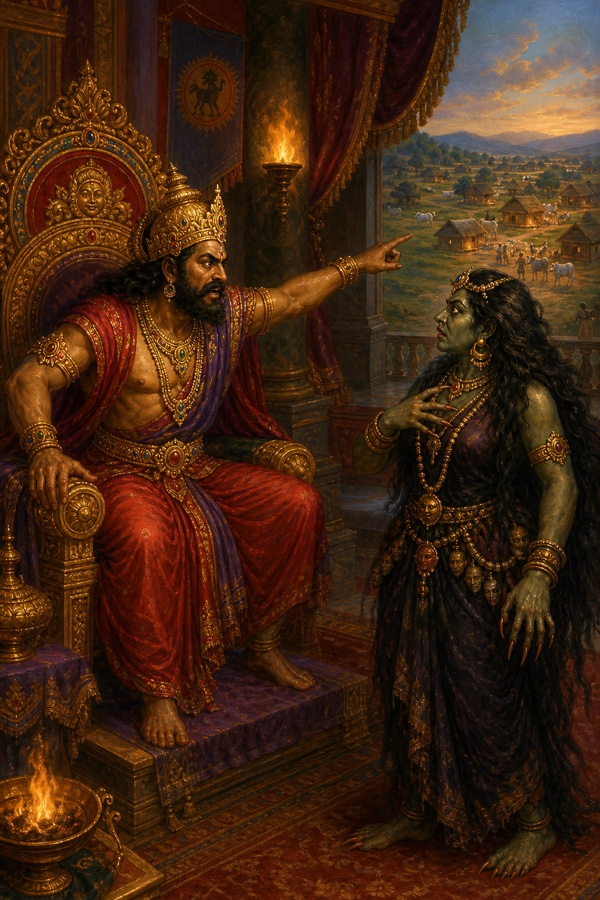
Kamsa told her, “Towns, villages, the camps of the cowherds, search them all. Wherever you find a small child, go to that child. Give every one of them your milk, and kill them, one by one, until none is left.”
Putana bowed and went. The work asked nothing new of her. She had been at it for years, town after town, and behind her, house after house, the cradles stood empty.
One law governs a creature of her kind. A creature of her kind finds a door only where a door already stands open. In houses where people work honestly at their duties yet never speak the names of Vishnu, never let his stories pass from mouth to ear in the evening, a thin seam opens in the air of the house, and through that seam she enters. Where his name stays alive on the tongue, she can circle the walls until dawn and find no crack wide enough to take her.
She changed her form.
A young woman stood where the rakshasi had been. Silk sari, gold at her throat and wrists, a bindi on her forehead, bangles along her arms, her braid dressed with jasmine whose fragrance ran ahead of her down the lane, earrings swinging bright beside her cheeks with every step.
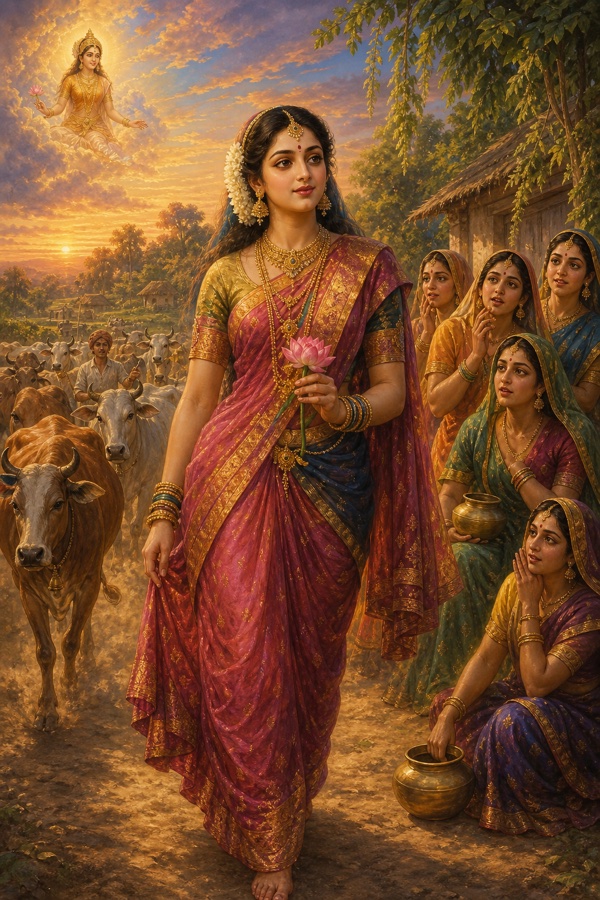
She came down out of the sky-path near Nanda Baba’s Gokul, set her feet on the ground like any traveler, and walked into the village. The dust of the lane was still warm under her soles from the evening return of the cows.
The women of Gokul stopped where they stood. Who was this stranger? Where had a face like that come from? She walked with a lotus resting in one hand, her glance sliding sideways to each of them beneath a small sweet smile, and the gopis caught themselves thinking that Lakshmi herself, the goddess of fortune who carries the lotus and belongs at Vishnu’s side, had come down to walk their cow-dust lanes in search of her husband. They stood nearer the truth than they knew. Her husband was in the village that very hour, asleep in a cradle in the house of Nanda.
For the children of Vraja, that same lovely figure was death moving in a second shape. She drifted from lane to lane, admiring, greeting, hunting, and a power that had nothing to do with her own choosing steered her steps through one doorway in particular: the door of Nanda, chief of the cowherds.
Inside, in a cradle, lay Krishna, only days in the world, his eyes closed. The closed eyes were a decision. The one lying in that cradle was the soul of everything that moves and everything that holds still, and he had known her the moment she crossed the threshold: the killer of infants, arrived at last within his reach. As a fire banks itself under ash and gives no sign of the blaze inside, he drew his immeasurable radiance inward, sealed his eyes, and waited to be lifted.
Rohini was in the room, Vasudeva’s other wife, mother of the baby’s elder brother Balarama, and Yashoda stood near her. Both watched the radiant stranger come in. Everything on the surface of the woman was a mother’s manner, warm, unhurried, openly fond, and beneath the warmth sat a heart ground down to an edge, so that the whole of her was a sword sheathed in silk and gold. Her splendor poured over the two mothers and pinned them in place. The daze held back every question, challenge, and cry of warning; they only stood and looked.
Putana lifted Krishna from the cradle and settled him against herself. What she gathered up with such ease was her own death, and she held it close the way a man in a dark room lifts a sleeping serpent and carries it in his arms, easy in his mind, certain he has picked up a coil of rope.
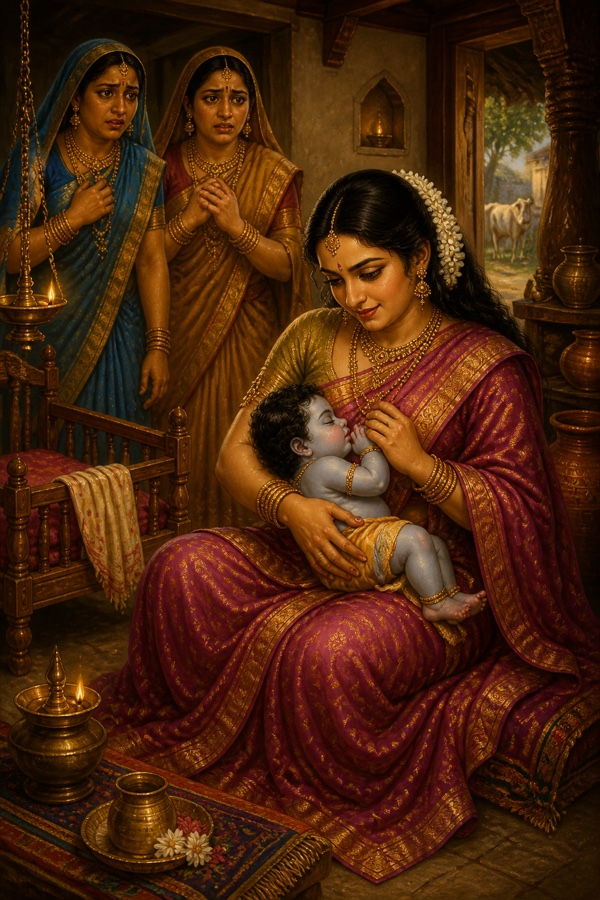
In her breast waited the poison, worked into it for exactly this use, a poison nothing that drank it had ever survived. She bared that breast without one tremor of fear and gave it into the small mouth.
Krishna closed his lips over it and began to drink.
Putana’s plan ran exactly this far: the milk goes in, the poison rides in with it, and one more cradle in one more village falls silent.
Krishna had other business with her. He took anger itself for his companion, clamped both small hands down hard on her breast, and drew. With the milk came the poison, and with the poison, slowly, her life, drawn out the way time draws out a lifespan, so gradually that the living never feel the level fall.
The tearing began everywhere in her at once, in every knot where life ties itself to a body. She screamed, “Let go! Let go of me! Enough, enough!” She beat her arms and legs against the earth again and again, weeping; her eyes rolled back white, and sweat broke over her until her whole body ran with it.
Then the disguise itself gave way. The young woman’s face loosened and slid, the borrowed beauty fell from her the way plaster falls from a cracking wall, and the thing that had been living underneath came through.
A rakshasi vast as a hill, hair like a wild black forest, a mouth crowded with long fangs, limbs already going rigid.
The scream she loosed then traveled through the fabric of things. The earth shuddered with all its mountains, the sky swayed with its planets, the seven worlds below the world rang like struck bronze, the directions rang back, and across the countryside people flung themselves flat on the ground, certain a thunderbolt was about to fall on their heads.
She heaved herself up to run. Krishna stayed fastened at her breast, and nothing she did would break him loose. There was strength in her to shake a hillside, and all of it together could not move him a finger’s width.
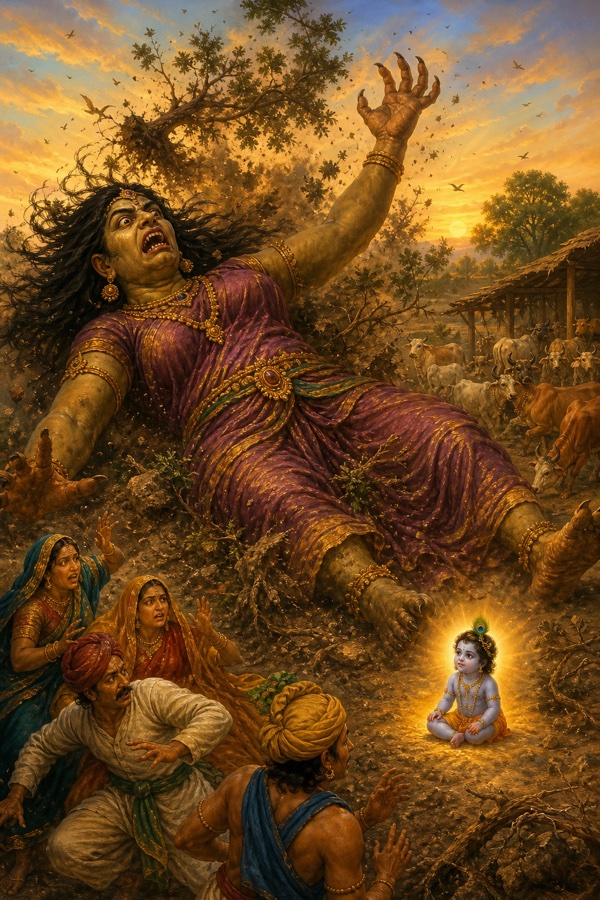
Lurching, staggering, half in flight, she cleared the edge of Vraja and got as far as a cowshed, and there she came down full length, mouth gaping, hair flung wide, arms and legs thrown out, the way the demon Vritra, who once dammed up the waters of the whole world, came down when Indra’s thunderbolt finally broke him.
The body was vast past believing. In its fall it crushed the trees for six kos around, and even the oldest in Vraja had no memory to set beside such a thing. Her mouth was fenced with fangs as long as the pole of a plow. Her nostrils opened like caves in a mountainside. Her breasts lay like boulders sheared off a cliff, her eyes sank deep as wells gone green with weed, her hips rose like sandbanks in a dead river, her arms and thighs and feet stretched across the ground like the embankments of ruined dams, and her belly spread flat and empty as a pond in drought, her coppery hair thrown loose over all of it. The scream had already split the ears and hearts of the cowherds; the sight lying before them now finished whatever the scream had left standing.
And Krishna? He was where he had been all along, at that same breast, drinking, smiling faintly, content as a child at an ordinary morning feeding.
Only when the very last of her life had come away did he lift his mouth, and the smile he raised with it was the same sweet smile as before.
The people of Gokul came running from every lane, breath gone.
“What happened?” “What is that thing lying there?” “Where is our lala, where is our boy?”
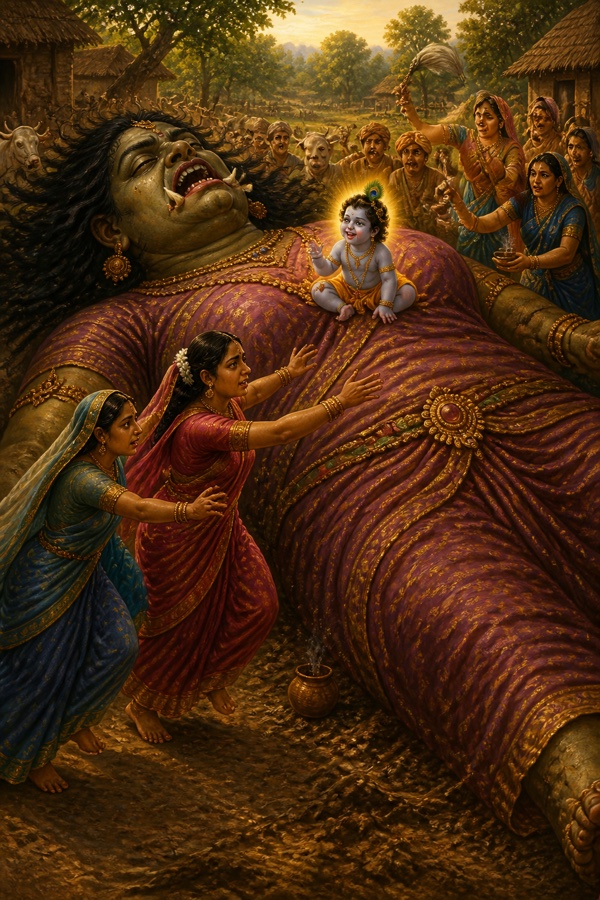
Then they saw him. On the chest of that felled mountain sat a baby, playing, fearless, laughing, turning his head this way and that at all the commotion, exactly as if someone were holding him in her lap.
Yashoda and Rohini reached him ahead of everyone. They snatched the child off that enormous chest and crushed him to their own, holding him as if the world would end before their arms loosened, and only when they felt his breath against their skin did their own breathing return. Then the gopis closed around him, and the whole quiet science of Vraja’s mothers went to work. They circled the tail of a cow over him, seat of the goddess of fortune, to sweep away whatever unseen thing might still be clinging. They bathed him in the urine of a cow, held as cleansing as Ganga water, dusted him with earth lifted from the print of a cow’s hoof, and touched cowdung to twelve points of his small body, speaking a different name of the Lord at each point. They sipped water, set the seed-syllables of eleven of his names on their own limbs and hands first, then laid the same syllables on his, building him an armor made of names. May Aja guard your feet, Maniman your knees, Yajna your thighs, Achyuta your waist, Hayagriva your belly, Keshava your heart, Isha your chest, Ina your throat, Vishnu your arms, Urukrama your mouth, Ishvara your head. May the bearer of the discus stand before you and Hari of the mace behind you, the slayer of Madhu with his bow on one side and the birthless one with his sword on the other, the conch-bearer at the corners between the directions, Vamana above your head, the rider of Garuda on the earth beneath you, and Sankarshana of the plow on every side. May Hrishikesha keep your senses and Narayana your breath, Vasudeva your intellect, Aniruddha your mind, Prishnigarbha your understanding, Sankarshana the sense of I within you. May Govinda guard you at play and Madhava in sleep, Vaikuntha as you walk, the Lord of Shri as you sit, and the enjoyer of offerings, the dread of every evil spirit, while you eat. Then they named, so that the naming itself would rout them, every creature of the dark that preys on the young, Dakinis and Yatudhanis and Kushmandas, Bhutas, Pretas, and Pishachas, Yakshas, Rakshasas, and Vinayakas, Kotara, Revati, Jyeshtha, the Matrikas, the spirits that bring madness and the spirits that bring seizures, the shapes that walk through evil dreams, and Putana herself: may every one of them hear the names of Vishnu and perish of the hearing. When the armor was complete, Yashoda gave her son the breast of a mother who loved him, and rocked him until he slept.
Only now did Nanda and the men of Vraja come up the road from Mathura. Nanda had walked the whole way with Vasudeva’s warning pressing on his chest, telling himself that the son of Shura had never once in his life spoken an untrue word, and he had already placed his family and his village in Shri Hari’s keeping against whatever was coming. At the edge of Vraja the men stopped in the road. A corpse lay across the flattened trees like a fallen headland. They turned to one another and said that a seer must live in Vasudeva, or a master of yoga out of some earlier birth, for here in front of them stood the very calamity he had named in Mathura, arrived and already spent. Then they brought axes, cut the huge body into pieces, carried the pieces far from the houses, stacked them with firewood, and set the pyre alight.
And as the body burned, the smoke that climbed from it carried a fragrance, the fragrance of agarwood, costliest of incense, and the sweetness of it spread far across the fields on the wind.
Why?
Because inside the whole dreadful business, one thing had happened on which nobody’s eye had fallen.
Putana came carrying poison; that stands, and nothing in the story softens it. She had also given milk from her own breast into the mouth of a child. Giving milk from the breast is the act of a mother. There is no other name for it.
And Krishna answered the act itself. While he drank he had drawn his small feet up and rested them on her body, the feet that Brahma who makes the worlds and Shiva who unmakes them hold inside their hearts and bow their heads to. Her life went out of her through his lips, and in that same instant, under the touch of those feet, the sin of a lifetime of emptied cradles burned off her whole, the way ground-mist burns off a field at sunrise.
And when a woman has once held Shri Hari to her breast and fed him, whatever errand carried her to his cradle, her going out of the world is a mother’s going. The agarwood riding the wind over Vraja was that going’s testimony.
The katha says it without one softening word. Putana, a drinker of blood, a killer of the world’s infants, gave suck to Shri Hari with murder for her motive, and she attained the destiny of the saintly. More than that. She rose to Vaikuntha, the Lord’s own realm past the reach of birth and death, into the standing held there for his mothers, for Devaki who bore him in Kamsa’s prison and Yashoda who was raising him in Gokul. And further still. Of the mothers and the cows of Vraja whose milk Krishna drank with love, looking on him always as their own son, the text says that rebirth, which grows out of ignorance, can never touch them again; having once fed him, they are finished with the long wheel forever. That is the company Putana entered, and she entered it through the worst door in the world.
The katha lets the size of that settle, and then it turns to its listener with a question of its own. If this much came to her, who walked in with a child’s death folded inside her breast, what must be waiting for the one who takes the dearest thing he owns and lays it before Krishna out of love, and love alone?
Her intent was sin from its first breath to its last. Beneath the intent lay one small true thing, the nursing itself. Krishna reached past everything else and closed his hand around that.
The poison, the plotted murder, the monstrous body under the borrowed beauty: all of it he let fall away, unweighed and unremembered.
And in Gokul, Nanda took his son into his arms, the boy come back from the very rim of death, bent his face to the crown of the small head, and breathed him in, the way fathers do, and a gladness rose through him too large for his chest to hold.
Literary context
The Putana episode occupies Skandha 10, Chapter 6 of the Shrimad Bhagavata. The pivotal shloka, 10.6.35, declares that although she gave her breast meaning to kill him, Putana attained the destiny of the saintly, and verses 10.6.37 and 38 carry the point past all doubt: she ascended to the heaven kept for Krishna’s mothers, for Devaki and Yashoda, and for the cows and women of Vraja whose milk he drank with love. The chapter then closes on its own promise, in 10.6.44, that whoever listens with reverence to this deliverance of Putana comes to love Krishna. The stories of her earlier births found in other texts form no part of this telling; here the katha runs exactly as far as Shukadeva carries it for Parikshit.
The philosophical lens
Two streams flow from a single breast in this katha, one of poison and one of milk. From the breast of the very woman who came bearing death, in the very act of the crime, the road of her liberation opened. And notice what the story never once does: it never shrinks the sin. The sin stood whole, every grain of it. The Lord’s touch fell across it, and that touch alone was enough.
Hatred that reaches him changes on arrival, the way a river changes when it reaches the sea. What happened to Putana had already happened, in its own shape, to Hiranyakashipu, and would happen again to Kamsa and to Shishupala. Even the one who remembers him through enmity, without pausing for a single moment, dissolves into him at the end.
Why this katha matters now
Kamsa sent Putana to kill the infant Krishna with a poisoned breast. That child drew her life out through her own weapon, and handed her the destiny of his mothers along with it. Whatever comes to Shri Hari carrying deceit and hatred melts in the moment of arrival, and even the hatred, at the last, finds its way home into him.
The same katha elsewhere
- Harivamsha · The Slaying of Putana
The Harivamsha’s telling