On this page
Ashvatthama’s Brahmastra
The war of eighteen days had burned itself out.
On both sides the great warriors had fallen as heroes fall, in numbers no one would ever finish counting. Bhimasena’s mace had come down on Duryodhana’s thigh and shattered it, and the prince who had driven the whole war lay broken on the field. Out of all that slaughter, one fighting man of the Kaurava cause still moved beneath the night sky. Ashvatthama.
Dronacharya’s son. A Brahmin by birth, bred to weapons from the cradle, the child of the master who had trained every prince on both sides of the war. His command of arms ran so deep that even the Brahmastra, the missile that answers to Brahma the creator himself, waited on his word. His father had been brought down by deceit in the fighting, and that grief had settled into him and hardened into fire.
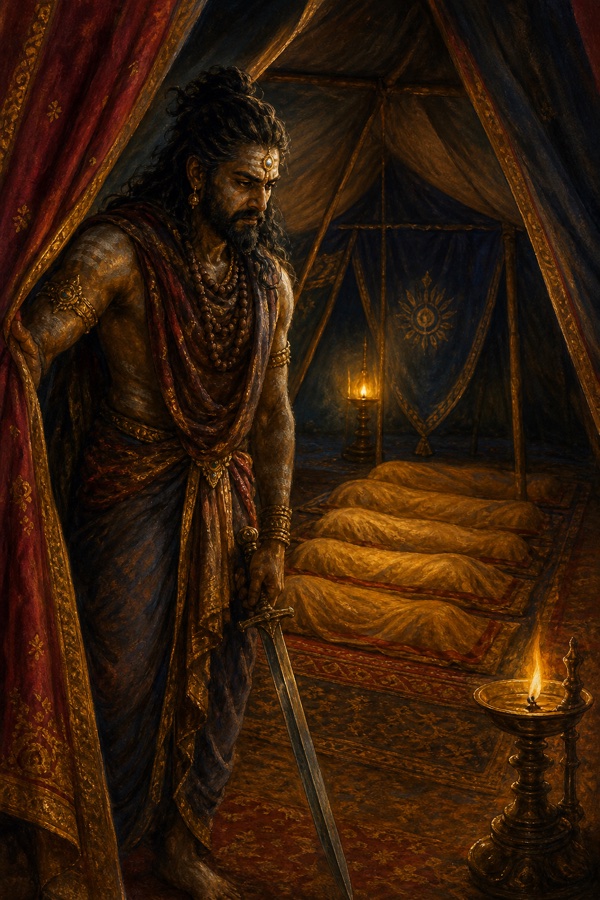
That night he crept into the sleeping Pandava camp, imagining he carried a gift that would gladden his master Duryodhana. He found the five sons of Draupadi asleep on their beds, the Upapandavas, boys still, and severed their heads. Then he bore the heads through the dark to the dying prince. Even Duryodhana turned his face from them, and the whole world has gone on condemning what was done in that tent ever since.
When the Pandavas came back to camp, Draupadi stood over the five small bodies of her sons.
Her eyes flooded until she was blind with tears, and the wailing tore out of her without end. Arjuna came to her side, and to steady her he swore a vow.
“Kalyani, I will have wiped these tears only on the day I cut the head from that fallen Brahmin, that killer, with arrows loosed from the Gandiva, and lay it before you. When the cremation of your sons is done, you will set your foot upon that head, and then you will bathe.”
With these sweet, strange words Arjuna consoled her. Then he fastened on his armor, took up the Gandiva, the terrible bow whose voice whole armies had learned to dread, and climbed into the chariot that flew the ensign of the monkey, his friend Bhagavan Shri Krishna holding the reins, and drove hard after his teacher’s son.
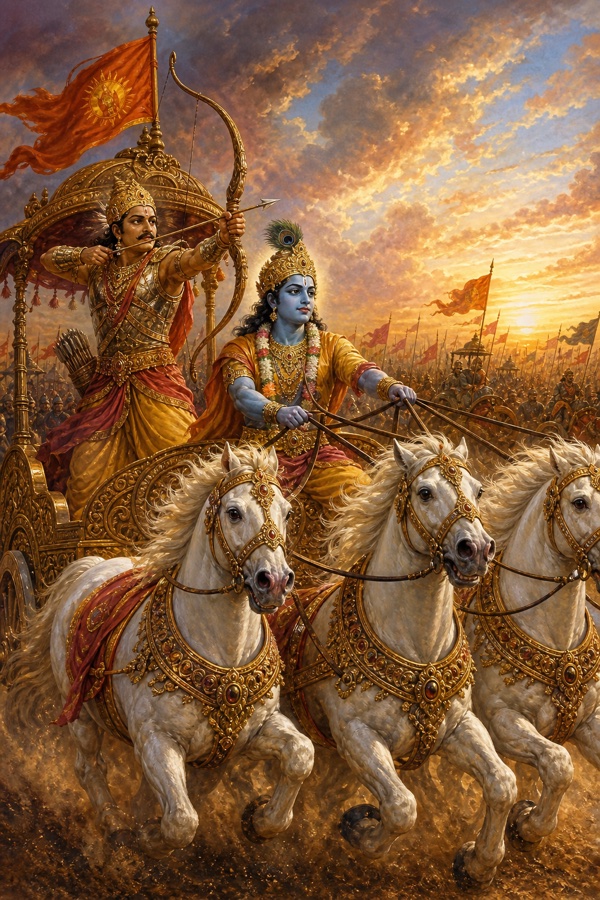
Ashvatthama saw from far off that Arjuna was bearing down on him, and heaviness took his heart. He fled for his life as far as the earth would carry him, the way the sun-god himself once fled across the sky before the fury of Rudra. Then his horses failed under him, and he stood alone on the open ground, and he judged that one shield remained to him. The Brahmastra.
He had never learned how to call the weapon back once it flew. With death rushing at him even so, he sipped the ritual water, gathered his mind to a single point, fitted the Brahmastra to his bow, and released it.
A savage light burst from the missile and ran out to every quarter, as though the fire that ends the universe had risen at once from all ten directions. Arjuna saw that his own life now hung on the next few moments, and he turned to Shri Krishna. “Krishna, Krishna, mighty of arm, you who take fear away from those who are yours. You alone lift out the souls who burn without relief in the fire of birth after birth after birth. You are God himself, the first Person, standing beyond all matter; by the power of your own wisdom you have set maya aside and you rest whole in your own being. It is you who grant dharma and every other blessing to the soul your maya has bewildered. And this descent of yours into the world serves one purpose, to lift the burden pressing down on the earth and to give your own people, those who hold to you and nothing else, one object for the mind to rest on. Lord of your own light, a flame more dreadful than anything I know is closing on me from every side, and I cannot tell what it is or where it was born.”
Bhagavan answered him. “Arjuna, this is the Brahmastra, the missile presided over by Brahma, and Ashvatthama loosed it with his life in extremity. He has fired it, and he does not know how to bring it home again. No other weapon can master it. You know the science of arms as well as any man breathing; quench the flame of this Brahmastra with the counter-flame of your own.”
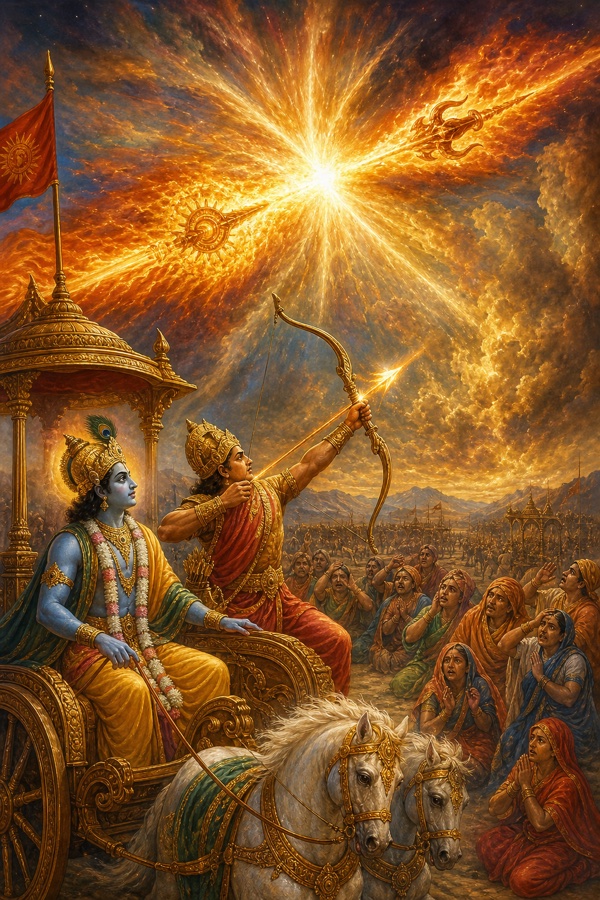
Arjuna sipped the ritual water, walked once around Bhagavan in reverence, and set his own Brahmastra against the first. The two flames met, ringed about with arrows, and joined, and swelled like the sun and the fire of the world’s last day, filling the heavens and the whole space between heaven and earth. The blaze bore down on all three worlds, and the people, scorched under its heat, believed the samvartaka fire of the great dissolution had come for them at last.
Arjuna watched the worlds beginning to char and the people in their distress, and with Bhagavan’s leave he drew both weapons back into himself.
His eyes were burning red now. He sprang on the hard-hearted son of Kripi, seized him, and lashed him with rope the way a man ropes a beast marked for sacrifice, and hauled him by force toward the camp.
As he made to bring the prisoner in, Bhagavan Shri Krishna spoke, and rage rode on the words. “Arjuna, do not spare this fallen Brahmin. Kill him. During the night he murdered innocent boys buried in their sleep. A man who knows dharma never strikes an enemy who is drunk, or off his guard, or out of his senses, or asleep, or young, or witless, or terror-stricken, or fallen at his feet, or stripped of his chariot, and he never strikes a woman. But the merciless wretch who keeps his own life fed on the lives of others earns his death, and that death is a mercy to him, for left alive he will do it again and drag himself further down with every crime. More than this, you gave Draupadi your word within my own hearing: I will bring you the head of the man who killed your sons. This sinner butchered your children and disgusted even the master he thought to please. So kill him, Arjuna. Kill him.”
Bhagavan pressed him this way only to test where Arjuna’s dharma stood, and Arjuna’s heart proved large enough for the test. Though Ashvatthama had slaughtered his sons, no desire stirred in him to take the life of his teacher’s own child.
So he came back to his camp with Sri Govinda for friend and charioteer, and there he set Ashvatthama before Draupadi, who had been grieving for her murdered sons all the while.
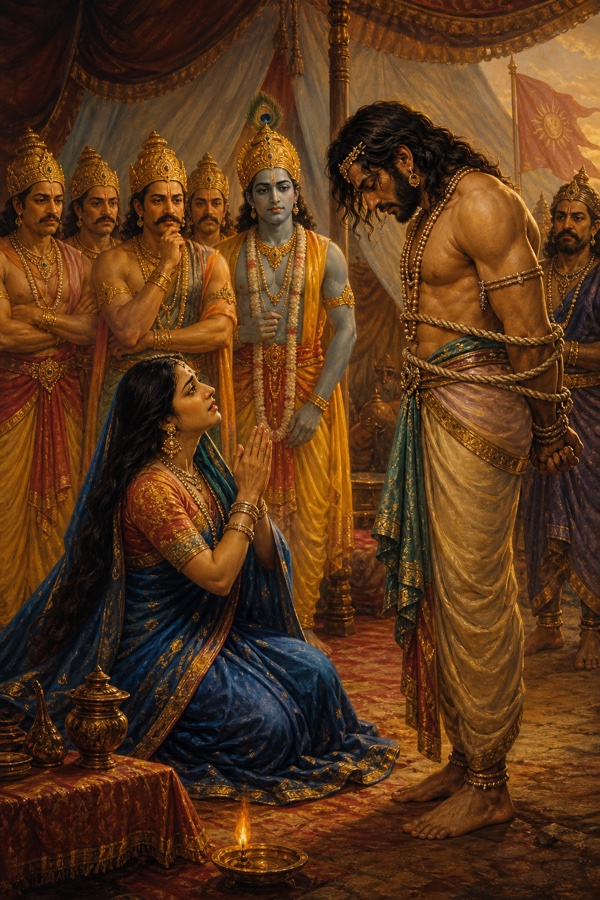
Draupadi looked long at Ashvatthama, roped like a sacrificial beast, his face bent to the earth under the shame of what he had done. She was tender by her very nature, and the sight of the teacher’s son dragged in bonds was more than she could bear. She bowed to him, the killer of her children, and said, “Release him, release him. He is a Brahmin, and for all of us a Brahmin is worthy of the utmost reverence.
“The worshipful Drona, by whose grace you learned the whole science of the bow with its hidden depths, and the knowledge of every missile, how to loose each one and how to call it back, that same Drona stands before you now in the person of his son. And Kripi his wife, sister of Acharya Kripa, still lives; when Drona fell she did not climb his funeral pyre, and only this, that she had borne a valiant son, held her back from the flames. You know dharma as well as any man alive. Your teacher’s house deserves your adoration and your salutation every day you draw breath; to hand it agony does not become you. We are weeping today, ruined by the death of our children. Do not make his mother weep so, the devoted Gautami, who worshiped her husband as her deity, shedding tears again and again as I shed them now. And remember this too: when a royal house rouses the anger of the Brahmin race, that whole house is plunged into grief and soon burns away, root, branch, and kin.”
Her words stood square with dharma and with justice, compassionate and noble, without one thread of guile in them, even toward the man who had widowed her of her sons. King Yudhishthira, son of Dharma himself, welcomed the queen’s plea. Nakula and Sahadeva, Satyaki, Arjuna, the divine Shri Krishna, and every man and woman standing in that tent gave their voice to what Draupadi had said.
Bhimasena alone flared up. “He murdered sleeping boys, and the murder served no purpose for himself or his master. For a man like that, the scriptures call death a blessing.”
Bhagavan Shri Krishna, his four arms revealed upon him, heard Draupadi out and heard Bhimasena, then looked into the face of his friend Arjuna and spoke as though a smile lay just behind the words.
“A Brahmin who has fallen must never be slain. A ruffian who preys on others surely deserves to die. I myself taught both of these precepts in the shastras, so now carry out both of my commands at once. Redeem the promise you made while you were consoling your beloved wife, and at the same time do what pleases Bhimasena and Draupadi, and what pleases me.”
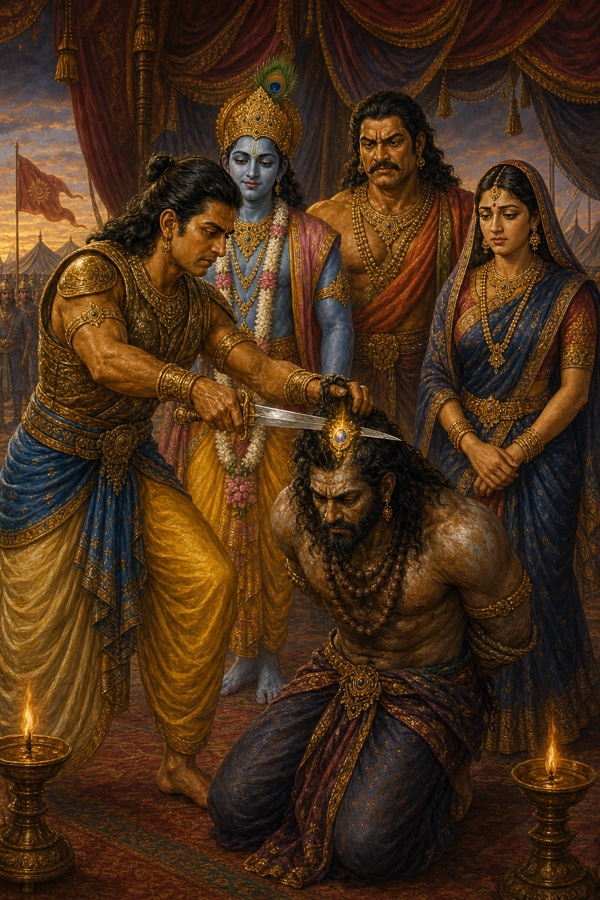
Arjuna read the mind of Sri Hari in an instant. With his sword he cut the gem from the crown of Ashvatthama’s head and took the locks of his hair away with it. The murder of the boys had already stripped the man of his luster; now the gem was gone too, and with it the brahma-tejas, the inborn fire of his priesthood. Arjuna loosed the cords and drove him out of the camp.
The shaven head, the seized wealth, the expulsion from the place where he stands: for a fallen Brahmin, this is the death sentence the shastras prescribe, and they name no other punishment of the body beyond it. So Ashvatthama kept his life, while the splendor, the honor, and the name he had lived by all went out of him.
Then the sons of Pandu, with Draupadi, still bowed under grief for their dead, performed the cremation and the last rites for their departed kinsmen.
The account then turns from the warriors to the unborn heir they had placed in danger.
The days moved on. With the women of the house walking at their head, the Pandavas went down to the Ganga to offer water to the departed souls who awaited it, spoke aloud the virtues of each one they had lost, wept for them long, and bathed once more in that river whose water is made holy by the dust of Sri Hari’s feet. Lord Madhava and the sages sat with the bereaved, with Yudhishthira and his brothers, with old Dhritarashtra, with Gandhari mourning her sons, with Kunti and with Draupadi, showing them gently that death spares no created being and can never be turned aside. Bhagavan Shri Krishna then secured to Yudhishthira, the king so good that no enemy was ever born to him, the kingdom that gamblers had stripped away by fraud; the wicked kings who had laid hands on Draupadi’s hair had already cut their own lives short by that touch, and they were destroyed. And Krishna had Yudhishthira perform three Ashvamedha yajnas with the finest priests and offerings, so that his sacred fame ran out to every quarter like the fame of Indra, who wins his high seat only after a hundred such rites.
At last Bhagavan Shri Krishna took his leave of the sons of Pandu and paid his respects to the holy Brahmins, Dwaipayana Vyasa among them, and they honored him in return. He had mounted his chariot with Satyaki and Uddhava and was on the point of setting out for Dwarka when he saw Uttara, Abhimanyu’s young widow, the daughter of King Virata, running straight toward him, out of her senses with fear.
For the Brahmastra that Ashvatthama had loosed had bent its course toward Uttara’s womb, where the one surviving shoot of the Pandava line lay growing. She felt its heat sink through her, deeper and deeper, as though a burning arrow were hunting for the child she carried.
“Great Yogi, protect me. God above all gods, Lord of the universe, save me, save me. In this world, where every creature is death waiting for some other creature, I see no refuge anywhere except in you. A dart of burning steel is racing at me. Master, let it burn me if burn it must; only let it not touch the child in my womb.”
Bhagavan, who holds his devotees close, understood the moment her cry reached him. Ashvatthama had loosed the Brahmastra to leave the line of Pandu without seed on the earth.
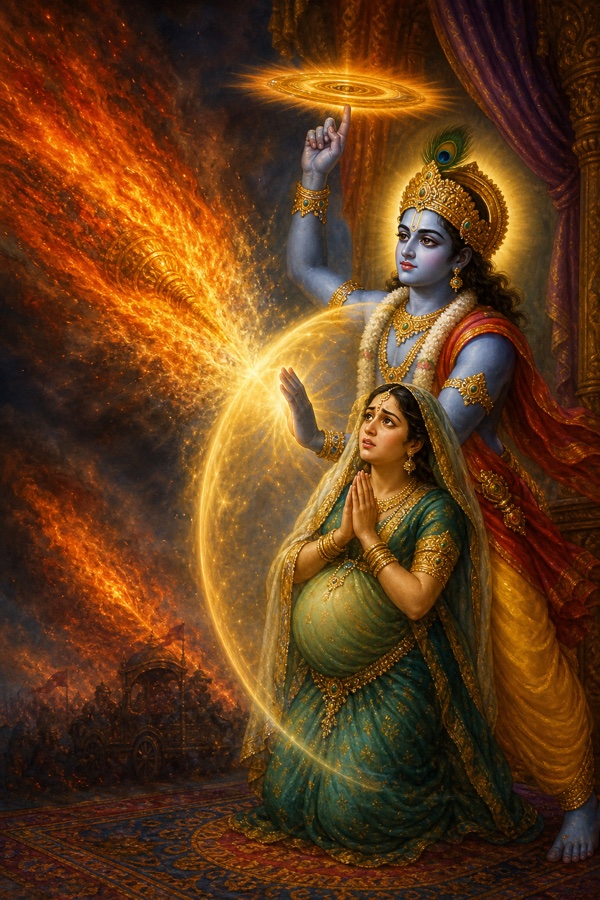
In that same moment the sons of Pandu saw five blazing shafts streaking toward them, and their hands flew to their own weapons. Seeing his people in peril, they whose minds held no one else in all the worlds, the almighty Lord sent his discus, the Sudarshana, to stand guard over them. And Shri Hari, the Master of Yoga, the one Self who dwells inside and outside every living being alike, wrapped the womb of Uttara in the armor of his own maya, so that the line of Kuru would not fail from the earth. The Brahmastra never misses; no power can turn it aside; yet when it came against the effulgence of Vishnu it lost its force there and went still. Count this no miracle in Acyuta, who is the body of every wonder there is, who, himself unborn, creates and keeps and unmakes this whole universe by his own power.
The womb was saved. When the months had run their course, from that same womb a boy was born who would one day be called the rajarshi Parikshit.
Textual note
This episode occupies Chapters 7 and 8 of the first Skandha of the Shrimad Bhagavata. The Bhagavata closes Ashvatthama’s punishment at the point where, at Bhagavan’s word, his crest-gem is cut away and he is shorn and cast out of the camp; the curse of three thousand years of wandering comes from the Mahabharata, from its Sauptika Parva, and forms no part of the Bhagavata’s telling.
Uttara’s cry and the rescue of the unborn Parikshit come in Chapter 8 of the Bhagavata, at the moment of Bhagavan’s setting out for Dwarka, and Kunti’s celebrated hymn of praise (1.8) rises out of this same episode.
Draupadi, whose five sons were killed in a single night, asked that their killer’s life be spared, because she had seen that vengeance plants hatred in the generation that follows. Between that fire and that forgiveness, inside his mother’s womb, Parikshit was kept safe, the royal sage whose birth, deeds, and liberation Suta had promised to tell the sages of Naimisharanya when he began this account.
The same katha elsewhere
- Chapter 32 · Ashvatthama’s night massacre, the Brahmastra, the thread of Parikshit
Mahabharata (Sauptika Parva): Ashvatthama’s night massacre and the Brahmastra