On this page
The End of the Yadava Line
The laughter died on their mouths. With shaking hands they unwound the cloth from Samba’s belly.
Inside it lay a small pestle of iron.
Now fear stood where the laughter had been. What have we done, they kept saying to one another on the road home, and what will the city say of us? They carried the thing back and brought it, with sick and colorless faces, into the court, and before all the assembled Yadavas they laid it in front of their king, Ugrasena, and told him what had happened.
Ugrasena had the pestle ground down to powder and cast into the sea, as though a curse could be dissolved in salt water. The last lump of iron, too hard to grind, he had thrown in after it.
A fish swallowed that lump. The fish was later taken in a fisherman’s net along with the rest of his catch, and the sharp sliver cut from its belly came into the hands of a hunter, who fixed it to the tip of his arrow and thought no more about where it had come from.
The Lord knew all of this from the first. He could have unmade the sages’ word with a single breath. He let it stand and gave it his blessing, for he was himself the ender of that age.
And so the curse settled down to wait, quietly, for years, for its hour.
Years passed. The Yadava line spread, into the thousands. There was strength, there was splendor, and along with them the pride that eats a house from the inside the way termites eat a beam: the beam stands, and looks sound, and holds nothing.
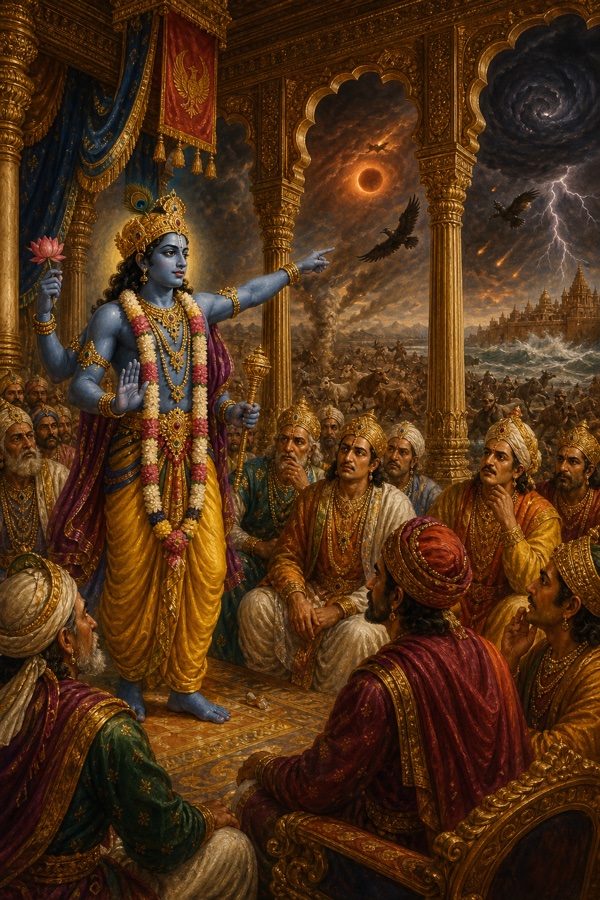
Then one day Dwarka began to fill with omens. In the sky, on the earth, and in the air between, signs appeared that no one could read as anything but ruin. Krishna spoke to the Yadavas seated in the Sudharma hall: “Noblest of Yadavas, these disturbances are the banners of our own destruction, plain as the standard of Yama, the lord of death. We must not stay here even an hour longer. Let the women, the children, and the aged go to the Shankhoddhara region, and let the rest of us set out for Prabhasa, where the Sarasvati runs west to meet the sea. There we will bathe and be made clean, keep a fast, worship the gods, and perform the rites of blessing, giving the Brahmins cows and land, gold and cloth, elephants and horses, chariots and homes. Worship of the gods, of the Brahmins, and of the cows is the surest way to turn misfortune aside and the best road to lasting peace.”
All the elder Yadavas took his word, with no single voice raised against it, and after crossing the sea by boat they went on to Prabhasa by chariot.
There, at Prabhasa, they performed the peace recitations and the rites of blessing with great reverence and devotion, exactly as Krishna had asked, and for a day it seemed the omens might be answered.
But their judgment had been marked for ruin, and they began to drink a strong liquor called Maireya, which fouls the mind at the root. One cup, then a second, and then the count was lost. Over the drink lay Krishna’s own maya as well, the enchantment by which he clouds a mind or clears it as he pleases.
In their drunkenness the old grudges woke, slights nursed for decades, insults every man had sworn he had forgotten. First the words turned hot, then hands were raised, then bows and arrows, swords and spears, maces and javelins. They fought from chariots and from the backs of elephants, from donkeys and camels, bulls, buffaloes, and mules, striking one another the way tusked elephants strike in a forest. Pradyumna fell upon Samba, Akrura upon Bhoja, Aniruddha upon Satyaki, Gada upon Sumitra, Nishatha and Ulmuka upon each other, every pair fiercer than the last. The Dasharhas, Vrishnis, Andhakas, Bhojas, Satvatas, Madhus, Arbudas, Mathuras, Shurasenas, Kukuras, and Kuntis, people of every branch forgot their kinship and began to cut one another down. Sons struck at fathers, brothers at brothers, nephews at uncles and grandfathers at their daughters’ sons, friend at friend.
At last, when their arrows were spent, their bows broken, and their weapons gone, they reached down with clenched fists and tore up a grass called eraka that had grown along the shore. This was the very grass sprung from the powder of the cursed pestle, which the sea had refused to keep and had carried back, wave by patient wave, to the land.
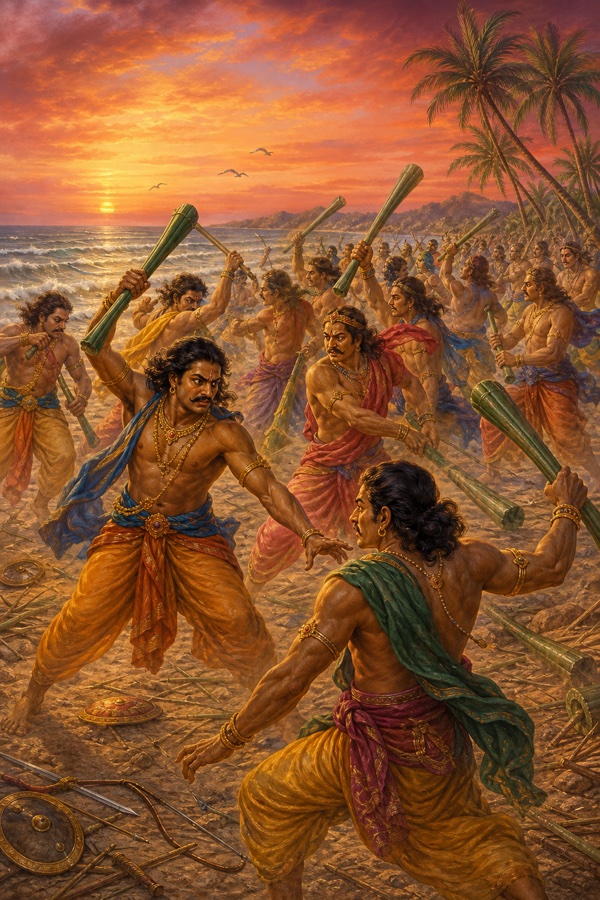
The moment each blade came into a hand it turned into a club as hard as a thunderbolt. With these grass-clubs the Yadavas fell on one another again, and no one could hold his hand back, for the drink held them from without and the curse from within. Krishna and Balarama moved to check them, but the drink and the curse had so blinded the men that they took even the two brothers for enemies and rushed at them to kill. Provoked at last, Krishna and Balarama took up the eraka reeds themselves, and in their hands too the reeds became clubs, and they struck the maddened men down. So the clan that had once been the glory of Krishna’s court destroyed itself, possessed by the sages’ curse and clouded by the Lord’s own maya, the way a bamboo grove set alight by its own rubbing burns a whole forest to the ground.
When Krishna saw that every last Yadava had fallen, he drew a slow breath, knowing that the earth’s remaining burden too had been lifted.
Balarama watched all of it end. Then he went down to the sea’s edge, where the waves came in and drew back as they always had, gathered his mind to a single point, and by yoga fixed his self in its own true nature. He gave up the human body without a sound and returned to what he had always been, the endless one, Sankarshana, whose realm lies deep beneath the world.
Now Krishna was alone.
When he saw that Balarama had merged into the supreme state, he walked to a peepal tree, set his back against its trunk, and sat quietly down upon the earth.
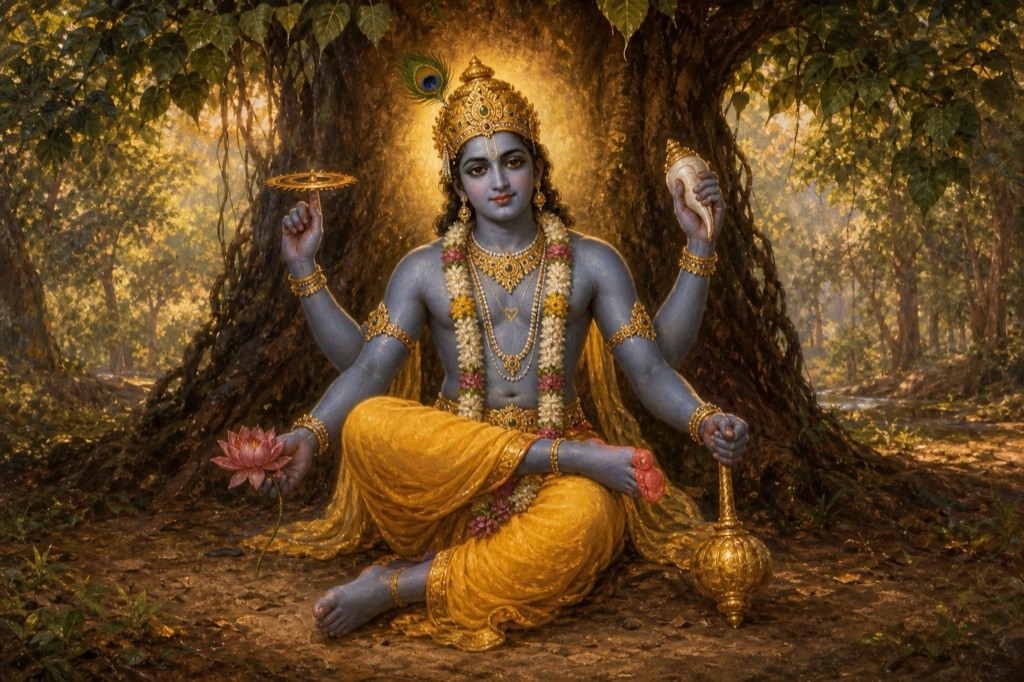
He wore now his radiant four-armed form, its own luster ablaze, a form that lit the four directions like a smokeless fire. His body was dark as a monsoon cloud, the Shrivatsa mark upon his breast, the silken yellow pitambara about him, a garland of forest flowers at his throat, the Kaustubha gem at his neck, and his weapons standing near in living form to serve him. He rested his left foot on his right thigh, the way a tired traveler settles to rest, and the sole of that foot shone red as a lotus.
Just then a hunter came into that forest, Jara by name.
Through the distant thicket he saw only that reddened sole, a small warm patch of color moving in the green, and it seemed to him the face of a deer.
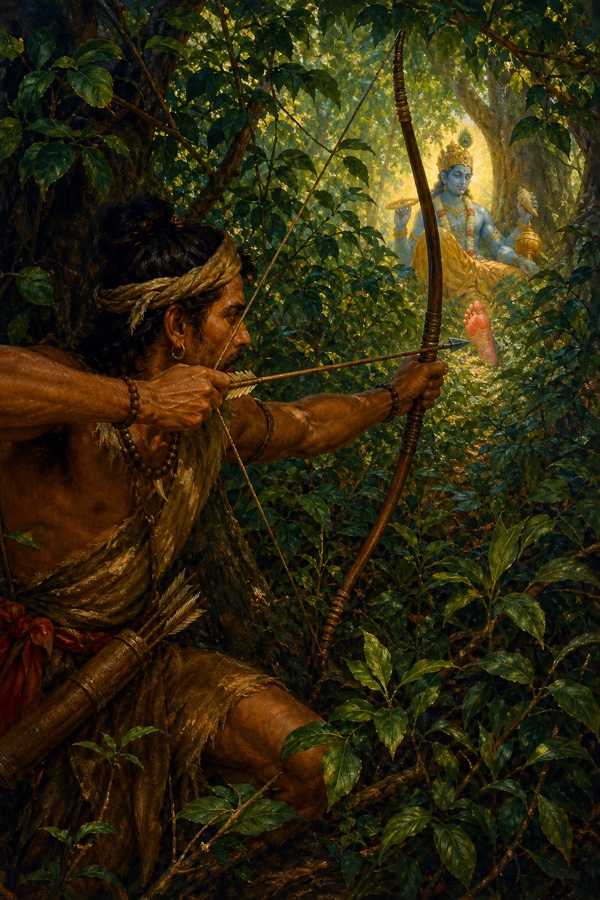
He drew out his arrow, the very arrow to whose tip that sliver of iron had been fixed years before, the last unspent grain of the sages’ word.
He took aim. The arrow flew.
And it struck Krishna in the foot.
Jara came running to gather his kill, and what he saw rooted his feet where he stood. Where he had aimed at a deer sat a four-armed man, dark-skinned and calm, dressed in yellow silk, blood flowing from his foot.
“Alas! What have I done?” The bow slipped from his hand. In terror he fell and laid his head at the Lord’s feet.
“Madhusudana, I have done this in ignorance. All-pervading Lord, the sages teach that at the mere memory of you the darkness of a man’s ignorance breaks apart, and here I have brought harm to your very self. Kill me now, a wretch who hunts innocent deer, so that I may never again commit such a sin against great beings like you.”
But the one he had pierced sat calm. No pain touched his face. Only a deep peace rested there.
“Do not be afraid. Rise. In this you have done only what was already in my own mind. Go, and by my leave dwell in that heaven which the greatly virtuous attain.”
The veil before Jara’s eyes lifted, and he understood everything: whose foot he had pierced, and whose mercy was now lifting him past his own deed.
Receiving this command, he walked three times around the Lord, joined his palms, bowed his head, and boarding a heavenly chariot went off to the world above.
Meanwhile Krishna’s charioteer Daruka came searching for his master, the man who had held those reins through every battle of the age. Catching the scent of tulsi on the breeze, the fragrance that goes wherever the Lord goes, he guessed where the Lord might be, and walking on he came beneath that same peepal tree. Seeing Krishna seated there, ringed by his weapons in their living form, his heart brimmed over. He leaped down from the chariot and fell at the Lord’s feet, his eyes full of tears.
“Lord, since I lost the sight of your lotus feet my eyes have gone dark, the way a traveler’s road goes dark when the moon sets at night. I cannot tell one direction from another, and there is no peace anywhere in my heart.”
As Daruka spoke, the chariot behind him rose from the earth, horses and Garuda banner and all, and lifted into the sky, and the Lord’s weapons rose after it, the discus and the mace and the bow going home ahead of their master. Daruka stood with his face turned upward, watching them go.
Then Krishna gave him this charge: “Daruka, go to Dwarka, and tell them there of the Yadavas’ mutual destruction, of Balarama’s return to his own state, and of my own departure to my abode. Tell them they must no longer stay in Dwarka with their families, for once I am gone the sea will drown that city. Let each take his wealth and household, and our parents Devaki and Vasudeva, and go under Arjuna’s protection to Indraprastha. And you, Daruka, take refuge in the Bhagavata-dharma I have taught you. Stand firm in knowledge, look past all of this, know this whole scene for a work of my maya, and be at peace.”
Daruka circled him, placed his lotus feet upon his own head and bowed to him again and again, and with a heavy heart set out for Dwarka.
There beneath the peepal, Krishna gently closed his eyes.
Above him the sky filled. Brahma came, and Shiva with Parvati, and Indra with the gods, and the sages with the lords of creation, Siddhas and Gandharvas, Vidyadharas and the great Nagas, Yakshas, Kinnaras, and Apsaras, all of them crowding the heavens with their bright chariots, raining down flowers, longing to see the Lord go home. Krishna turned a last look upon them, drew his mind into his own essence, and closed his lotus eyes. He rose then, body and all, to his own abode, the fire of yoga never touching that form which upholds the whole universe. Kettledrums sounded in the heavens, and flowers came down like rain, and with him went truth and steadfastness and fortune and glory, leaving the earth poorer than it knew.
Literary context
This story is drawn from Book Eleven, the eleventh Skandha, of the Shrimad Bhagavatam. The curse of the sages is told in its first discourse; the Yadavas’ mutual destruction at Prabhasa and Balarama’s withdrawal by yoga come in the thirtieth; and Krishna’s ascent to his own abode is told in the thirty-first. The drowning of Dwarka in the sea appears here only as Krishna’s prophecy; Arjuna’s coming to Dwarka to perform the funeral rites and the crowning of Vajra belong to Book One, Chapter 15, of the Bhagavatam, and not to this passage.
The tale of the iron pestle born of the sages’ curse opens Book Eleven, and here, many years on, its fruit ripens. With this same episode the Bhagavatam marks the close of the Dvapara age and the opening of the age of Kali.
Why this katha matters now
The clan that had been given nearness to the Lord wiped itself out by its own hand, in pride and drink and the memory of an old insult. When greatness begins to rot from the inside, it needs no enemy from outside to bring it down. And the one who quietly settles every account settled his own the same way, in his own time, and went home in peace.