On this page
Prahlada’s Rebellion
Hiranyakashipu, firstborn of Diti’s demon sons, was emperor of the entire universe, and a thorn sat buried in him that no empire could pull out.
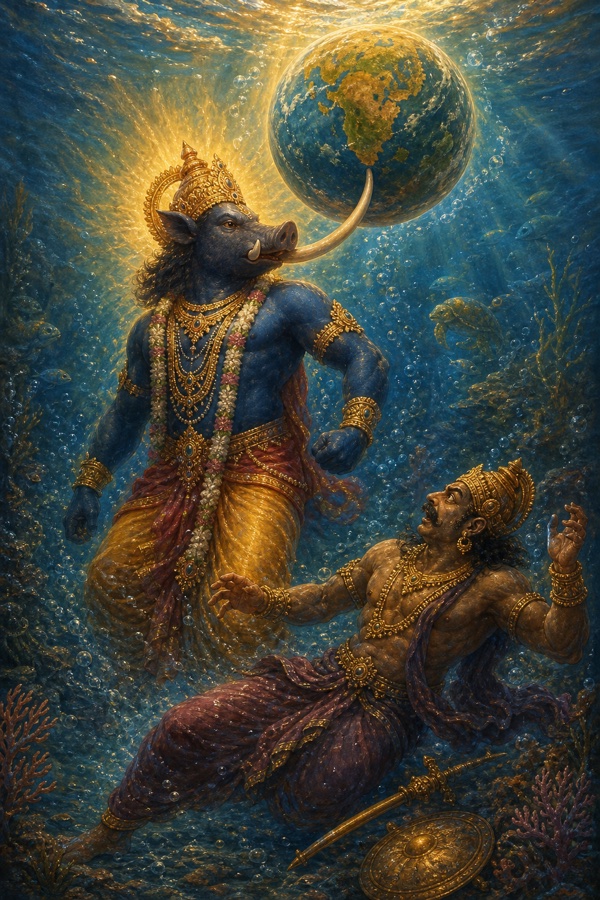
He had had a brother, Hiranyaksha, mighty, the companion of every game of his boyhood, a giant who had once dragged the earth itself down to the floor of the cosmic ocean. Vishnu had gone into the water after him wearing the form of Varaha, the great boar, had raised the drowned earth on the point of one tusk, and had killed Hiranyaksha in the deep. From that day the name of Vishnu sat in Hiranyakashipu like a wound that never closed, that only seeped. Rising and lying down, eating and sleeping, he remembered that one enemy. Hatred, too, is a form of remembering, and Hiranyakashipu hated Vishnu with a concentration that love has rarely matched in any devotee.
The wound drove him to a valley of Mount Mandara, where he set out to pray his way past death itself. He stood on the tips of his toes with his arms flung upward and his eyes fixed on the sky, and he held that posture while the years went over him. Ants raised their hill around his body and ate away fat, skin, flesh, and blood until his life hung on the bare bones, and still he stood, and the heat of that austerity poured from the crown of his head as smoke and fire and began to scorch the worlds. Rivers and oceans heaved. Stars shook in their places. The scalded gods fled to Brahma, the creator, crying that the demon meant to win Brahma’s own seat and turn the order of the worlds on its head. So Brahma came to the anthill, amazed in spite of himself, for no one before had carried a body so far on will alone, a hundred years of heaven without one mouthful of water. He poured water from his own vessel over what remained, and Hiranyakashipu rose out of the anthill the way fire rises out of kindling, young again, his frame hard as diamond, his skin the color of poured gold. Then he asked for his boons, and he had designed them like a man walling a fortress: let no death come to me from any creature you have made; none indoors and none outdoors; none by day and none by night; none on the earth and none in the sky; none from man, none from beast, none from god, demon, or great serpent; none from any weapon held in the hand or flung from it. Give me no rival in battle, lordship over every embodied thing, glory beside your own, and powers that never fail. Brahma granted all of it. Hiranyakashipu walked out of that valley counting himself immortal, and set about proving it. He took the three worlds, threw Indra down from the throne of heaven, and moved into Indra’s own palace, where the stairs were coral, the floors emerald, the walls crystal, and celestial women watched their own faces in pavements of gems. The earth gave him her harvests without a plow touching her. The oceans rolled jewels onto their shores for him. Trees fruited for him out of season. Every guardian of the worlds except Brahma, Vishnu, and Shiva stood before him with tribute in hand. And none of it filled him, since the one appetite that mattered, his own senses and mind, had never been mastered. Meanwhile, far beyond his hearing, the exiled gods prayed, and a voice deep as banked thunder answered them: do not be afraid; I know this demon; wait. When he raises his hand against his own son, a boy without anger and without fear, I will end him, boons and all.
The son that voice had named was already growing up inside his palace. His name was Prahlada.
Four sons were born to the demon king, and the finest of them was this one. From his first breath the boy’s heart leaned toward Shri Hari, and no one had taught it to lean. The name his father burned on day and night was the same name the child carried quietly inside him, growing as he grew.
He was gentle, and his word held. He honored the learned, kept his senses in hand, and moved through the world of living things as their friend, wishing each of them well as he wished himself. Before the venerable he bent like a servant. Toward the poor he was a father. Among boys his own age he was a brother, and on his teachers and elders he looked the way other men look on God. Learning, wealth, beauty, and the highest birth in the three worlds had among them left no fingerprint of pride on him. Trouble could not shake him, and the pleasures other people chased he let pass by, having seen through to their unreality. He had been born into a demon’s body, and everything demonic in it had fallen away.
And there was something in him past all of that, something the palace had no word for. He had set his toys down while he was still very small. His mind stayed so deep inside the Lord that he often passed for a slow child, absent, half asleep to the world, like a boy possessed and carried off by something no one else could see. Sitting, walking, eating, lying down at night, he barely knew he was doing any of it, held the whole time somewhere else, in arms nobody saw. Some days he wept as though the dearest thing in creation had just been torn from him; then he laughed aloud; then he sang at the top of his voice, or went suddenly still, the hair on his arms risen, his half-shut eyes filling and shining. And the demon boys who shared his lessons, restless and unhappy without knowing why, grew calm whenever he was near, and never knew why that was, either.
For his sons’ schooling Hiranyakashipu kept the best. Shukracharya, the venerable preceptor of the demon race, was his family priest, and Shukracharya’s two sons, Shanda and Amarka, kept a house close by the palace. There the king sent Prahlada, quick-witted and skilled in argument young as he was, to be trained beside the other highborn asura boys in statecraft, in the science of wealth, in everything a demon prince would one day need. Prahlada heard each lesson and gave it back word-perfect. And his heart refused all of it, because under every lesson lay one single root: this is mine, that is another’s.
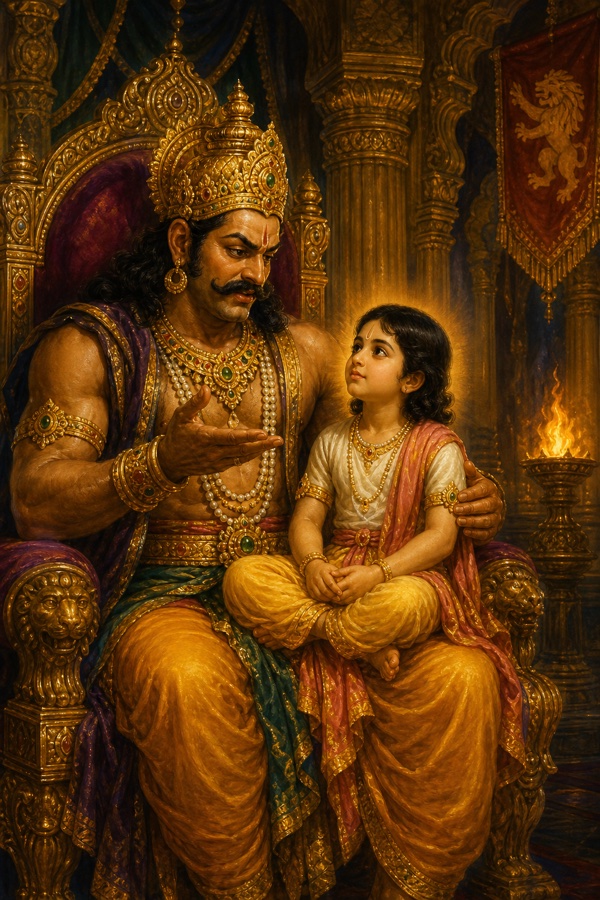
One day Hiranyakashipu took his son onto his lap with great affection. On that chest, the same chest that had shouldered Indra off the throne of heaven, the small boy sat weighing nothing at all.
“Tell me truly, child,” the father said. “Of everything you have learned, what seems best to you?”
Prahlada said, “Father, every creature in this world lives in torment, twisting on two small words, I and mine. For all of them I can see one good thing only: to walk out of this house that drags the self down, this covered well with its mouth hidden in the grass, waiting for whoever steps there, and go to the forest, and take shelter in Shri Hari.”
Praise of the enemy, on his own son’s lips, from his own lap. Hiranyakashipu threw back his head and laughed. “This is how children’s wits get bent, when clever men reach them.” Then the laughter stopped, and the order that followed was cold: watch the boy at his teachers’ house, day and night, for somewhere a brahmana loyal to Vishnu had to be slipping in to him in disguise, and it was going to end.
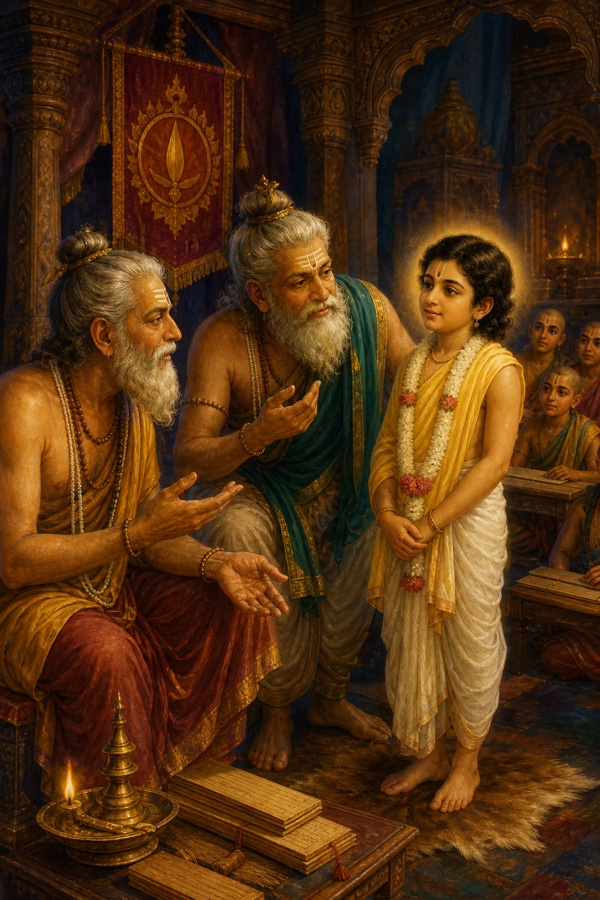
So Prahlada was brought back to the school, and the priests tried honey first. They petted him, praised him, and questioned him in the softest voices they owned. “Child Prahlada, blessings on you. Tell us the truth now, and no lies. Where does it come from, this crook in your thinking? No other boy in this school has it. Did someone plant it in you, son, or did it grow there by itself? We are your teachers. We wish to know.”
Prahlada said, “Only when the Lord’s own maya has hold of a man’s mind does the world split for him into mine and another’s. I bow to that Lord, the master of the spell. When he turns toward a man in kindness, that animal way of seeing drops off like a shed skin, and the false line down the middle of the world goes with it. His trail is hard to follow; Brahma himself, who made the worlds and carries the whole Veda, has lost it hunting him. And it is he who has turned my seeing. As iron stirs toward a magnet with no will of its own, revered sirs, so my mind is drawn toward Vishnu, the bearer of the discus, with no contriving of mine. The one this house calls its enemy is the self standing inside every creature. Inside me. Inside you.”
The elder of the two masters heard that answer all the way through, and his face darkened. He was a brahmana who ate the king’s bread, and a pupil praising the king’s enemy could cost him everything he had. “Someone bring me a cane,” he said. “A ruler works with four instruments: soothing words, gifts, division, and the rod. For this one, only the rod remains. Diti’s line is a forest of sandalwood, and look what has come up in it, a thorn tree. Vishnu is the ax laid to this forest’s root, and the little fool has offered himself as the ax’s handle.”
He kept his word. For a long season he drilled the boy, threats hanging over every lesson, in dharma as kings live it, in the getting of wealth, in the arts of pleasure, and in nothing beyond those three. When at last he judged that his pupil had the four royal instruments cold, conciliation, gift, division, and force, he sent him to his mother, who bathed him, dressed him in ornaments, and delivered him to his father’s hall. The boy went straight down at the king’s feet. Hiranyakashipu blessed him, gathered him up with both arms, and held him against his chest a long time. Then he set him on his lap, bent his head, and breathed in the scent of the small head, the gesture with which fathers of that world sealed a blessing, and his eyes ran over, and for that one hour the heart of the demon king was full.
“Son Prahlada, long life to you,” he said, warm with pleasure. “All this time with your teachers. Say me back one fine thing you have mastered, the best of everything they gave you.”
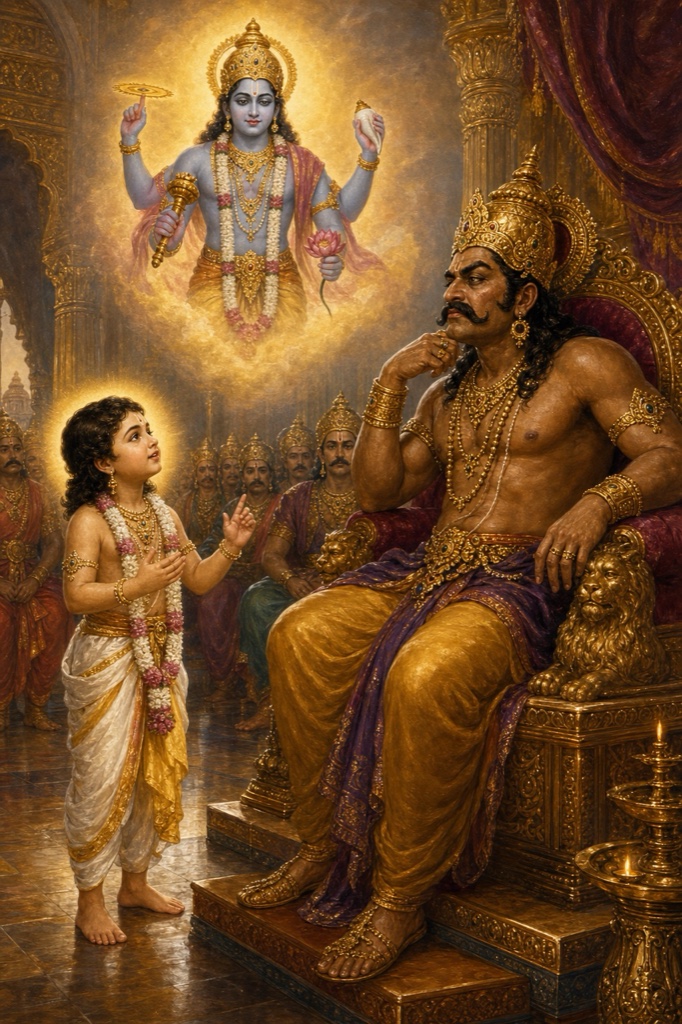
Prahlada said, “Father, devotion to Bhagavan Vishnu has nine limbs. To hear of him, his names, his qualities, his play. To sing what one has heard. To keep him in remembrance, always. To serve his feet. To offer him worship. To bow before him. To work for him as his servant. To love him as one’s friend. And, at the last, to hand over one’s whole self, body, house, and everything in it, into his keeping. If a person practices these nine as an offering laid directly in the Lord’s hands, I hold that to be the finest thing anyone has ever learned.”
The words were barely out before Hiranyakashipu’s lips were trembling with rage. He rounded on the teacher’s son. “Vile brahmana. What work of yours is this? You took my enemy’s side, you cared nothing for me, and you poured this hollow rot into my child. The world keeps impious men who walk about in a friend’s clothing, and their mischief shows itself when its season ripens, like the hidden disease of sinners. Beyond any doubt you have taken shelter with my enemies.”
The teacher’s son pressed his palms together, and in that court he reached for the safest title he knew. “O enemy of Indra, what your son says comes from no coaching of mine, and from no one else’s either. This understanding was born with him, O king. It rises in him by itself. Calm your anger, and lay no blame at our door.”
Hiranyakashipu turned back to the boy on the floor of his hall. “Well then. If this ruin of a mind never came out of your teachers’ mouths, then tell me where you got it.”
Prahlada said, “Father, men sunk in the life of the house, their senses loose, chew over and over what they have already chewed, and their minds never once turn toward Hari, by their own effort, or by another’s urging, or by the two together. They take what the eye can reach for the highest thing there is, the blind walking in a file behind the blind, every one of them stepping into the same pit; and all the while our true wealth, here and hereafter, is Vishnu himself, in whom every human aim is gained at one stroke. When a mind once touches his feet, the whole long calamity of birth and death is finished for good. And no mind touches those feet, Father, until it has bathed in the dust of the feet of the ones who own nothing and love him with everything.”
Having said this, Prahlada fell silent. Wrath took the king’s sight. He lifted the boy off his lap and hurled him to the ground.
“Daityas,” he said, and his voice was strange and quiet before it rose, “take him out and kill him now. He has earned death. He has walked away from his own blood to worship, like a bought slave, the feet of the Vishnu who slaughtered his uncle. Who knows, Vishnu may have crawled inside the boy himself. Five years old, and he has already dropped his mother’s and father’s love, a love that should be impossible to put down; what will an ingrate like that ever be worth, even to Vishnu? An enemy who heals you like medicine is worth more than a son who sickens you from within; a man cuts off his own limb when it turns against the body, so that the rest of him can live. Kill him any way that serves. Poison his food. Take him while he sits unguarded. He wears the face of my son, and he is the enemy quartered inside my own house.”
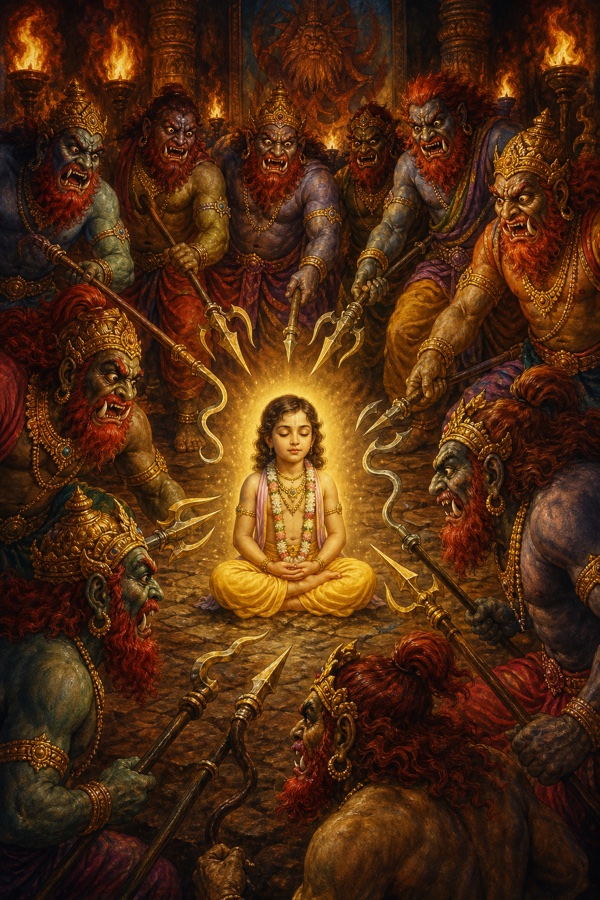
The order was obeyed. Daityas with sharp fangs, dreadful faces, and beards and hair the color of hot copper closed in with tridents, bellowing “Cut him down! Tear him apart!”, and drove the points into every killing place on the small body. Prahlada sat through it without moving. His mind had gone where minds go only after everything is surrendered, into the Supreme that no word and no thought reaches, the soul of all things, the ground under every power, Parabrahman, and against a boy held there the trident points glanced aside like the grand undertakings of the luckless, achieving nothing.
When the tridents left the boy without one mark, something colder than anger moved into Hiranyakashipu, and he gave himself over, with a tyrant’s patience, to the inventing of deaths.
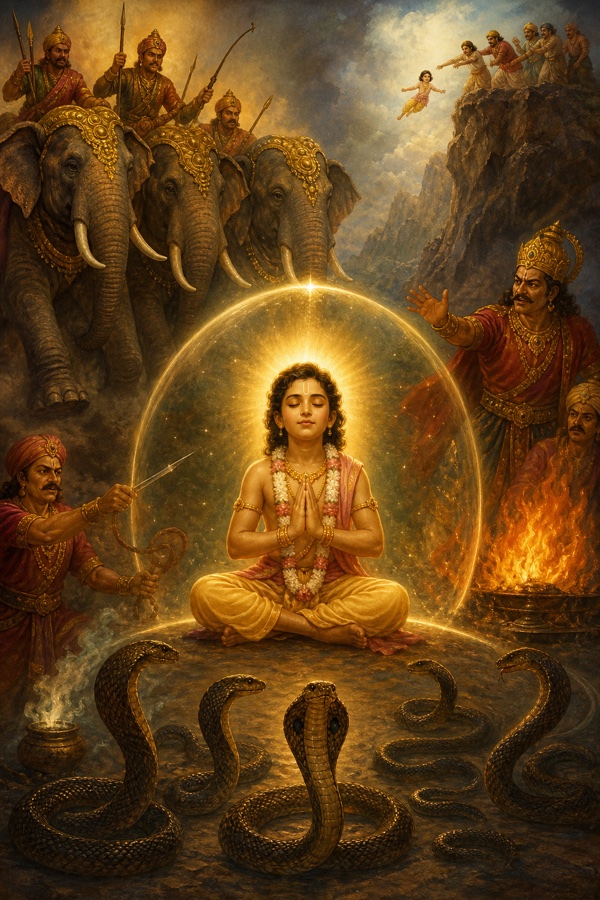
He had the boy dragged under the feet of the great elephants that hold up the quarters of the sky, and thrown among serpents whose bite kills at a touch. He had his priests raise kritya against him, killing rites chanted over fire. He had him flung from the lip of a mountain, worked on with maya of a hundred kinds, walled into dark cells, fed poison with his meals, and starved of food and water altogether. He had him staked out on ice fields, pushed into blazing fire, thrown into the sea, left standing in a screaming gale, and buried under rocks.
And none of it touched him, no hair of him. Every assault ended the same way: the boy sitting exactly where they had left him, breathing quietly, the name of Hari moving on his lips, kept whole by nothing anyone could see, his mind resting in the one place no weapon has ever reached.
Helplessness settled over Hiranyakashipu, and under it a worry he would confess to no one. No new death would come to him. He turned it over alone. I have cursed the boy, shamed him, sent every instrument I own against him, and he walks out of each one by some power of his own, needing no rescuer. He is a child, and he stands next to me without one grain of fear. There is strength in him whose floor I cannot find. He will never forget what I have done to him; Shunahshepa did not forget either, the boy whose own father sold him away for a king’s sacrifice, and who crossed over to his father’s enemy Vishvamitra and took that sage’s line for his own. He fears no one. He does not die. My death will come out of my quarrel with him. He sat with that a moment, and then the mind that had bargained death itself away added: or possibly it will not.
He was still turning it over, his face fallen, when Shukracharya’s sons found him. Shanda and Amarka drew him aside where no courtier could hear. “Master, you conquered the three worlds by yourself. The guardians of the worlds tremble when one of your brows moves. We can find nothing here for you to worry about. Weighing good and ill in the doings of a child, is that any work for you? Keep him bound in Varuna’s cords, the sea-lord’s noose that no strength slips, only until our father Shukracharya returns, so that fear does not send him running off somewhere. Age mends a boy’s understanding, and so does the service of his elders.”
Hiranyakashipu let himself be persuaded, and the priests took Prahlada back to the school and resumed the syllabus of kings, dharma first, then wealth, then pleasure, each in its careful order. The boy lived among them like the meekest of servants and gave the lessons nothing of himself, for that teaching is built for men who relish grasping, hating, and feeding the senses, and there was no such man in him.
Then came a day when the teachers were called away on some errand of the household. A free hour opened, and the demon boys of his own age shouted for Prahlada to come and play. He rose, though play had long since gone out of him, and he was wise far past the measure of his years; he knew how those boys loved him, and he called them close in the sweetest voice he had, the way an elder brother gathers in the younger ones to give away a secret.
“Brothers, listen,” he said, and the voice was so gentle that the games died where they stood. “A human birth is the rare thing in this universe, rarer than anything our fathers have piled up in their treasuries, and it does not keep. Through it, and through it alone, the imperishable can be reached, and no one is ever told the hour it ends. So the wise borrow no time from youth or old age. Begin in childhood itself, in this childhood, the practices that carry a person to Bhagavan. Shelter at his feet is the one success a life can have, because he is the master of every creature, its well-wisher, its dearest one, and its very self.”
One child spoke for all of them: we are still small, why must it start now? Prahlada turned to him.
“See it clearly. Whatever pleasure the senses can give comes to every creature on its own, in every birth, by the ripening of old deeds, exactly the way sorrow comes without anyone laboring for it. So why spend yourself chasing it? The chase buys you nothing except the loss of your years and your strength. And count those years. A man is given a hundred of them if he is fortunate. Night takes fifty in sleep. Twenty go while he is an infant who understands nothing and a boy who wants only to play. Twenty more wait at the far end, when the body has stopped obeying and the mind chews on what is gone. Whatever lies between drains away in fever over a house, its money, and the people tied to him with soft, strong cords, and tell me who has ever cut those cords once they hardened. This body, exactly as it is, is enough for reaching Bhagavan. Begin while it is sound, before sickness and grief drag it down to the mouth of death.”
The children were listening now with their whole faces; their fists had slowly fallen open around the forgotten toys.
“One thing alone travels with you. Remembrance of Bhagavan. Hear of him, his names, his deeds, his play. Sing what you have heard. Hold him in the mind until the holding is as constant as breath. Serve his feet, offer him worship, bow to him, live as his servant, love him the way you love a friend, and at the end place yourself, whole and without remainder, into his hands. None of it asks for high birth. None of it asks for money or muscle. Only love reaches him, love plain and undivided; charity, austerity, hard vows, and proud lineage all stand outside his door unless love opens it. So what if our fathers are demons? Demons have reached him before us, and ogres, and women, and servants, cowherds, birds, beasts, even men who lived by sin. He keeps no ledger of his own against strangers. He sits inside every creature there is, one and the same, and that includes every boy in this courtyard.”
A boy asked the thing all of them had been circling. “But who taught you this, Prahlada? You sat in the room we sat in, in front of the same two masters, and we never heard one word of it from them. And before that you were an infant shut inside the women’s quarters. Where could you have met a saint? Give us a reason to believe you.”
“You are right that they never taught it.” He came near to smiling. “I heard it before I was born. My father had gone away to Mount Mandara to stand in his long austerity, and the gods had waited years for exactly that opening. The armies of heaven broke over his capital, his generals scattered to save their own lives, and Indra, the king of the gods, seized my mother, the queen, and carried her off along the road, trembling, crying like a snared river bird. He meant to hold her until her child was born and then kill it, because the child would carry my father’s seed. And on that road a wanderer crossed their path, the sage Narada, who goes where he pleases through all the worlds. He stopped the king of heaven with a word: the child this woman is carrying is sinless, a great servant of the Lord, and no hand of yours will ever kill him. Indra set her down, walked around her in reverence, and went home to heaven. Then Narada led my mother to his hermitage and told her, stay, daughter, until your husband returns. She stayed. She served the sage, and day after day, for the sake of the child she carried, he spoke to her of the self that does not die and of the Lord who holds it. My mother has forgotten most of it; the years took it from her. The child listening from inside her forgot nothing.” He said it evenly, a boy stating the one fact of his life he was surest of.
“So take my word for it. Begin now. Do not wait to be old.”
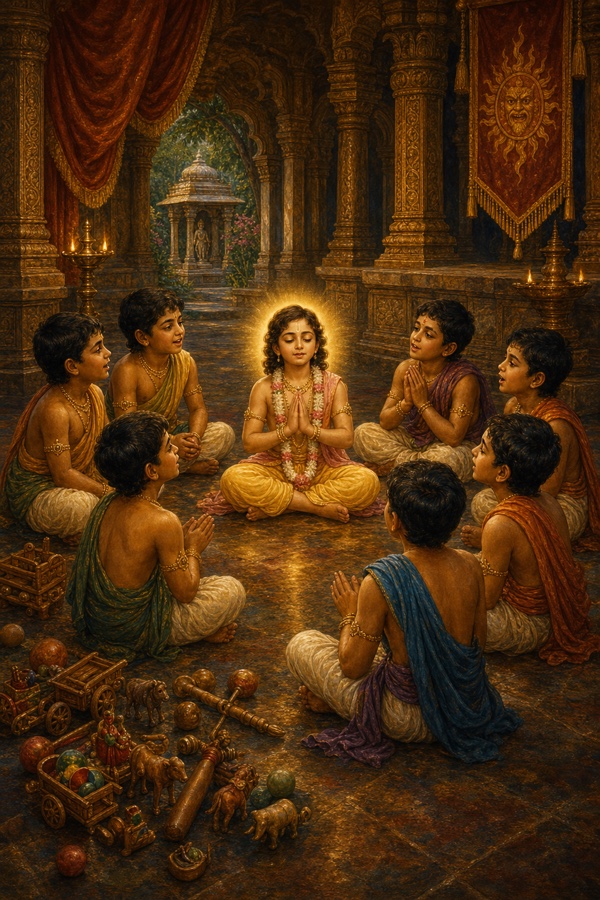
They were all still children. Grasping and hating and the taste for pleasure had written nothing on them yet, and they loved Prahlada besides; so the playthings went down into the dust, and the boys came and sat in a ring around him, eyes on his face, minds handed over whole, and somewhere inside each of them something loosened and gave way.
Demon children, yes. But children. A child’s heart still opens at one honest knock.
And Prahlada’s own heart went out to them, flooded with compassion and friendship, and one by one, in that palace built on hatred of the name, small voices began to say it. Hari. Hari.
The teachers heard it and went cold. Word ran to the palace.
This time the rage had a new taste, because the wound was new: his own son, a child of his own body, had set the enemy’s name ringing through the middle of his own kingdom, and the sons of his generals were singing it. Hiranyakashipu heard the report through to the end, his limbs shaking, and arrived at the decision he had been circling for years. No more instruments. He would kill the boy himself. He summoned Prahlada to the court.
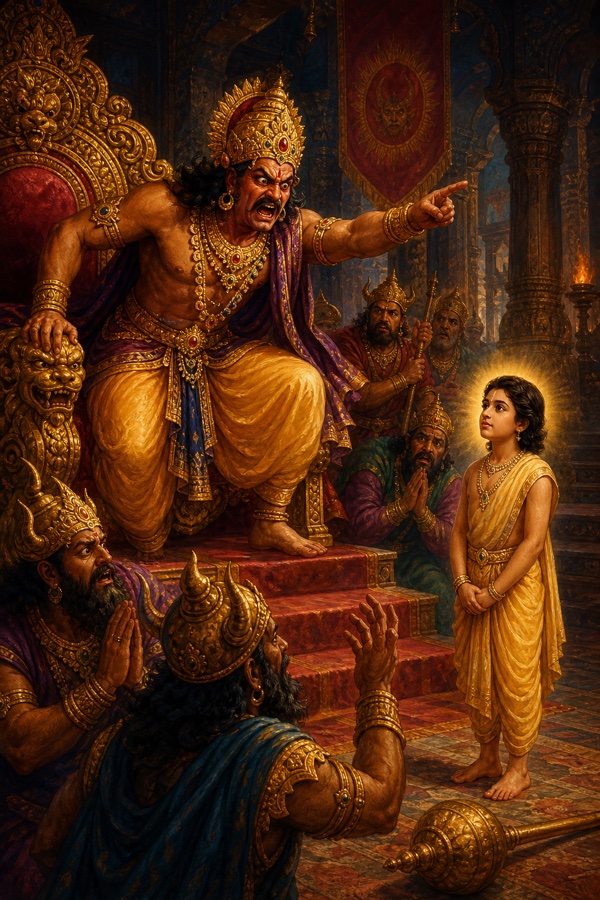
The hall was a file of high pillars with the throne at its head. Between the pillars stood the small boy, palms joined, head a little bowed, and the emperor of the three worlds looked down at him and hissed like a serpent stepped on. “You unruly little wretch. This day I send you to the house of Yama, the lord of the dead. The three worlds and every guardian in them shake when I am angry. By whose strength do you defy me?”
The answer came back without heat and without hurry. “By his, Father. The same strength that is mine is also yours. Every strong thing in creation is strong out of him, from Brahma on his lotus down to the grass.” And when the king spoke again, a crack of weariness ran through the old fury. “Then where is he, this Vishnu of yours?”
“Everywhere, Father,” Prahlada said softly.
“Everywhere.” He came up off the throne. “Then in this pillar too?” His hand flung out at the nearest column.
“Yes, Father. In this one too.”
There was no grain of hesitation in it, and that, of everything, was what Hiranyakashipu could not bear. He had wanted one flinch, a single tremble he could build on, and the child only looked at him steadily, as though he could see the same presence standing inside his father that he saw inside the stone. The king heard his own voice go flat and cold. “Then let him keep you. I am going to take your head off your shoulders, and this everywhere-lord of yours can come and save you.”
He snatched up his sword, came down from the throne in one motion, and drove his fist into the pillar with the whole force of his arm.
A roar answered him, a sound no one in any world had ever heard, god or daitya, a crash that seemed to run through the very shell of the universe; it carried all the way to the world of Brahma himself, where the makers and keepers of worlds looked up and wondered whether their own spheres had begun to end. Hiranyakashipu searched the hall for its source and found nothing. His generals were already stepping backward, weapons loose in their hands. Then the pillar burst open.
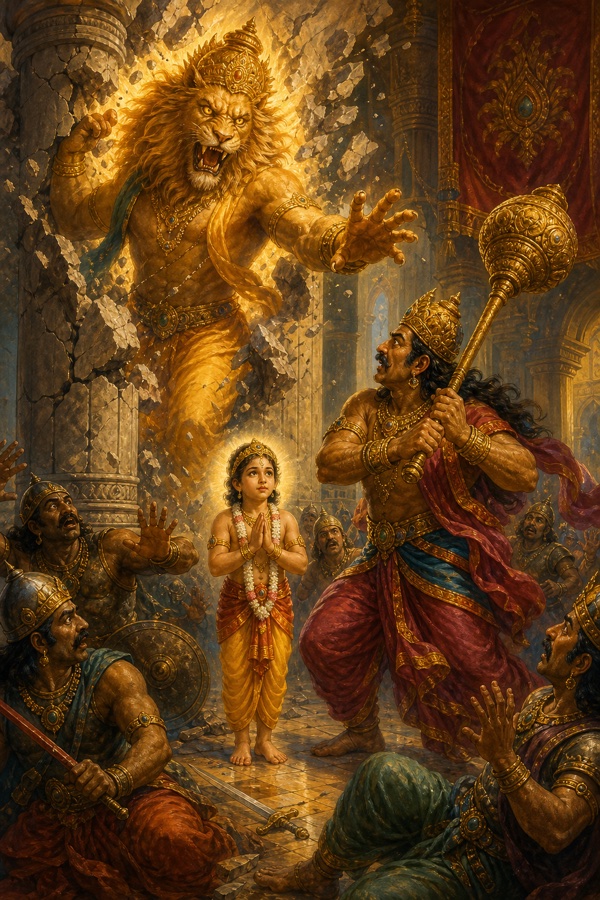
What came out of it had no name yet. A lion’s head and mane on a man’s towering trunk, eyes the color of molten gold, a tongue that moved like a sword blade, ears erect and utterly still, nostrils deep as mountain caves, a chest that filled the hall, a body that went up and up until it stood against the roof of the sky, hair pale as moonlight, arms past counting, and on every hand, claws. Weapons rang on the stone floor. Screams died where they started. A form beyond man and beast stood in the court of Hiranyakashipu, and it was looking at him.
For one heartbeat the king stood fixed. It had been in the pillar. It had been in this hall, in his own house, all this time, exactly as near as the boy had kept saying, near as stone, near as breath. And now it stood before him.
And even then, face to face with that form, what rose in Hiranyakashipu was the old enmity and nothing else, the single concentrated flame he had fed all his life. A trick, he told himself. One more conjuring of Hari’s, some device built for my death, and what can he do to me, whatever he has prepared? No fear came. His hand found his mace.
Narasimha.
The hour was twilight, which belongs outside day and night. The form was outside every known human and animal form. And what was coming would come from no weapon held in the hand and none flung from it, on no ground the boons had fenced. Lock by lock, every door that Brahma’s word had bolted against death was about to swing open, without one syllable of that word being broken. But that telling is the next story.
Only know this much, Rajan. In all that frozen assembly, one being did not tremble at the roar: the boy, standing exactly halfway between his father and the blazing form out of the pillar, palms joined, loving the one as he loved the other, afraid of neither.
⁂
Literary context
The story of Prahlada runs across Skandha 7 of the Shrimad Bhagavata, Chapters 4 to 10. The dialogue on his father’s lap and the ordeal of the schoolroom belong to Chapter 5, the teaching given to the demon boys, “kaumara acharet” (practice from childhood itself), to Chapters 6 and 7, and the Narasimha avatar arrives in Chapter 8. The ninefold bhakti Prahlada lists for his father (7.5.23-24) is held to be the spine of the entire Bhagavata.
One line, to sit with
A child surrounded by danger kept returning to the teaching he trusted: the Lord dwells within every being, including the person one has learned to call an enemy.
The same katha elsewhere
- The Narasimha Avatar
Shrimad Bhagavata (Skandha 7): the Narasimha avatar for the protection of Prahlada - Prahlada’s Inward Absorption
Yoga Vasistha: Prahlada’s contemplation of Vishnu and self-realization