On this page
Saubhari the Sage
Saubhari was an ascetic of the first rank, an acharya of the Rigveda and a master of its most powerful mantras. He had kept his vows across an age of years, and his brahmatejas, the inner fire a man earns through tapas (austerity), had burned undimmed the whole of that time.
The form his tapasya took was strange even among ascetics. He practiced it underwater.
In a deep pool of the Yamuna he stayed submerged, folded into meditation on the riverbed. Above him the sun climbed and sank, shadows trembled across the surface, seasons turned along the banks. Below, nothing moved.
His breath stood still. His mind stood still. Everything stood still.
An immense stretch of time went by that way. Around him lay the cold press of the river, and inside him a quiet so deep and so settled that no current of the world could reach down and touch it.
One day he sat in his usual place, far under the water.
And something crossed in front of him.
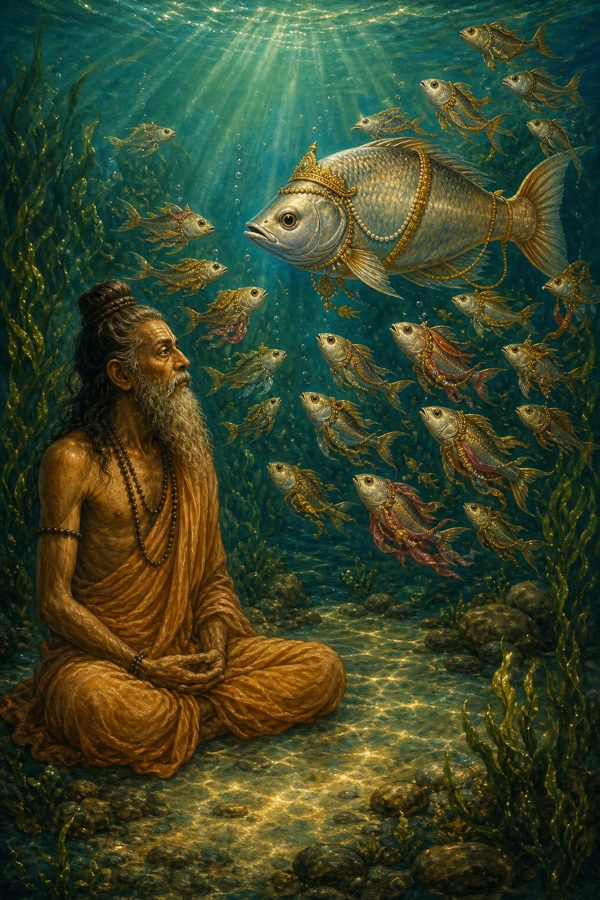
A fish-king, lord of his shoal, gliding through the water among his mates, deep in an easy, complete happiness.
One fish, and around him such company, such motion, so much life.
Saubhari’s eyes went to him and stayed.
In all his years in that green silence he had never once watched such a thing. And here, an arm’s length from his stillness, a small creature of the river swam at the center of a whole flourishing world of its own, paired, surrounded, content.
From some sealed depth of his mind a thought worked itself loose, very thin, very old: a longing for the shared life, for a companion, for the delight of marriage itself.
“Even a fish finds a world of happiness of his own. And I, so great a muni, sit here alone. Should there be no one at my side?”
He rose. He broke the surface and came up into the open air.
For the first time in longer than he could count, wind moved across his face.
His body had shrunk to skin over bone, yet the glow of his tapas lay over it still, like late light on old bronze.
He walked straight to the court of King Mandhata.
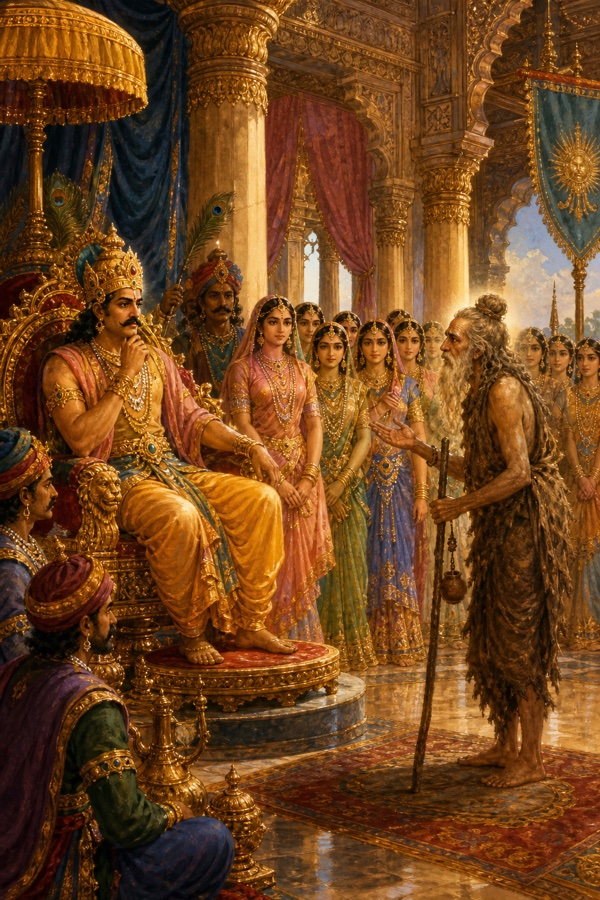
Mandhata’s own beginning had been a wonder. His father Yuvanashva, childless and near despair, had retired to a forest hermitage with his hundred wives, and the sages there, moved to pity, had raised a rite to win him a son. In the night the king woke thirsty, found the priests asleep, and drank the pot of water they had charged with mantras and set aside for his queen. So the child grew in the king’s own body and was born from his right side, and when the newborn cried for milk and the brahmanas asked in alarm who would nurse him, Indra, king of the gods, put his own index finger, wet with nectar, to the baby’s mouth. “He will drink of me. Do not cry, my child.” The words fastened to the boy and became his name: Mandhata. That boy now ruled the entire earth and all seven of its continents; men said that whatever ground the sun crossed between its rising and its setting belonged to Mandhata, son of Yuvanashva. Through his queen Bindumati he had three sons, Purukutsa, Ambarisha, and Mucukunda the mystic, and fifty daughters besides, all of them grown, all of an age to marry.
“Rajan,” said Saubhari, “give me one of your daughters in marriage.”
Mandhata went still. Refusing so great a muni to his face carried its own danger; a sage of that stature could burn a dynasty with a word. So the king reached for a condition instead. “Holy one, take a daughter gladly, if one of them chooses you of her own free will.”
Saubhari read the king’s meaning in a moment.
He thought to himself, “The emperor has handed me this careful answer because he knows women find me unwelcome. I am old. My skin hangs in wrinkles, my hair has gone white, my head trembles on my neck. He has refused me without once saying no.”
Then a resolve set inside him. “Very well. I will make this body so faultless that even the women of the gods will covet it, to say nothing of a human princess.”
And the sage had the power to do it. He turned his yoga inward on his own flesh, and in the space of a breath the wrinkles smoothed, the trembling stilled, and where the dried ascetic had stood there was a young man of such radiance that an eye once caught on him did not want to leave.
The king’s chamberlain led him through to the inner palace, the guarded, luxurious quarter set apart for the princesses.
All fifty chose that one man for their husband.
And what a choosing it turned into. Each of the fifty set her heart on him so completely that sisterhood dissolved on the spot, and the daughters of the emperor fell to open quarrel.
“He is meant for me.” “No, sister. For me.”
A contest ran through all fifty of them, every one set on the same husband.
Saubhari, singer of the Rigveda, took the hands of every one of them in marriage.
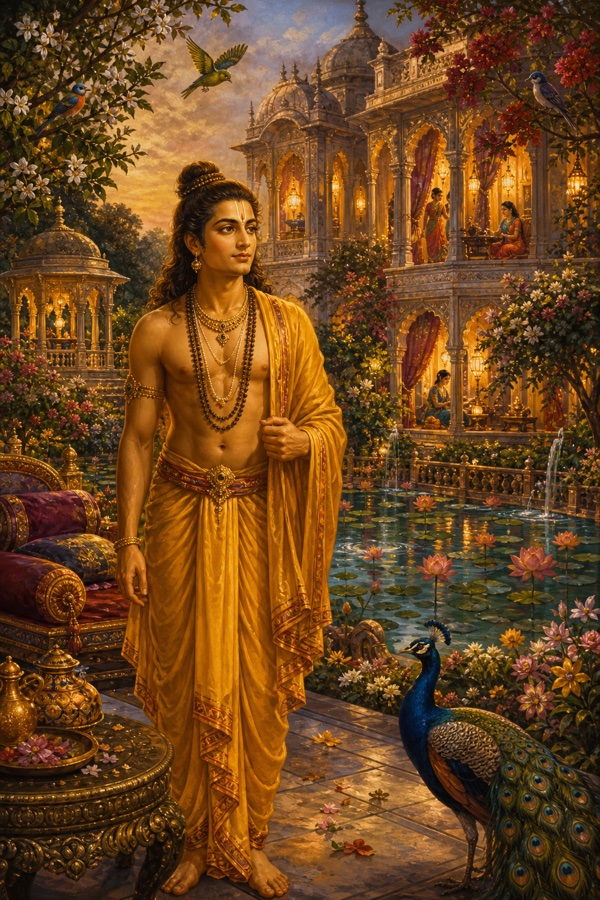
Then he opened the one treasury that had never run empty, the stored wealth of his austerity, and spent it without counting. Mansions rose, furnished with beds and seats beyond price, with fine garments and heavy jewels. Around them spread lakes of clear water thick with beds of white water-lilies, and parks and pleasure-gardens of every kind, loud with singing birds and the drone of bees, while bards sang his praises through the halls and servants and maids moved everywhere, themselves hung with ornaments.
There he lived with his fifty wives in the middle of every pleasure the senses can name: baths and fragrant unguents, rich food, garlands and flowers, each delight handing him on to the next.
Each wife bore him a hundred sons. Five thousand children in all.
The man who had once sat under a river holding his breath now lived in palaces that rang with children’s voices from first light until the lamps were put out.
One day Mandhata himself, master of the seven continents, came to see the household his son-in-law had made. The splendor of it stopped him where he stood. He walked through halls richer than his own, and the pride he had carried all his life, the pride of the one universal monarch, of the man who owned everything under the sun, quietly left him.
Yet one thing was missing from all of it.
Saubhari tasted every pleasure and found no satisfaction in any of them. As a fire is never quenched by the ghee poured into it, as each ladleful only feeds the blaze, so his mind was never filled. Every delight opened his appetite for another.
Then came a day when he sat quietly alone, and he saw his fall entire, and saw the strangest part of it besides: the fish had done nothing. The whole of it had been worked on him through the agency of his own mind.
“What have I done?”
“Look at this fall. I was an ascetic under sacred vows. Penance guarded across an age of years, and one moment of company with creatures in the water carried the whole of it away. I was one man, an ascetic with no companion. Through the company of a fish I became fifty. Through fifty I became five thousand. Infatuation and the other attendants of maya have clouded my judgment until the objects of the senses look to me like things worth seeking, and now the wants that come with being husband to fifty wives breed and breed, and I search for the far edge of desire and cannot find one.”
He looked inward and measured the damage. His mind was more restless now than it had ever been in his life, restless in exact proportion to the stillness it had once kept under the river.
And his error stood before him in full daylight. Whoever seeks moksha (liberation) must give up, with mind and body and senses all together, the company of those who have bound themselves to pleasure and to the householder’s round, and must never once let the senses drift outward toward their objects. Let him live alone in some hidden place and fasten his whole mind on the infinite Lord. And if he must have company at all, let it be the company of devotees who have given themselves to the Lord and want nothing further.
He rose and called his fifty wives together.
“Listen to me. I made an error. I followed one small desire out of the water, and it has cost me my tapas. Now I must go back.”
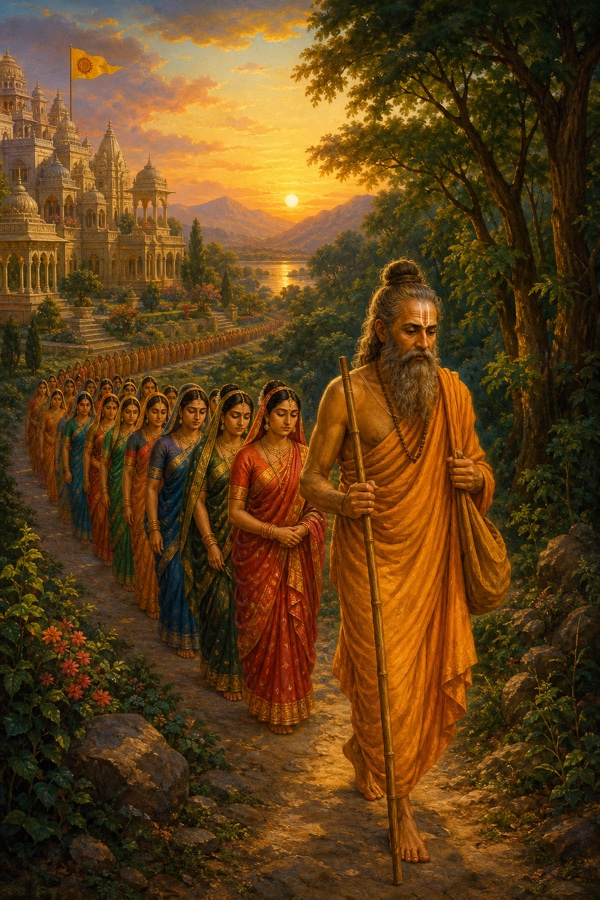
Home had finally sickened him. He left the mansions, the gardens, and the whole conjured kingdom of his comfort standing where it stood, took up the hermit’s life, and walked out toward the forest.
His wives held their husband to be their god. Where he went, they went. All fifty of them rose and walked out behind him.
In the forest Saubhari gave himself to austerity of a severity that wore his body down to its frame, and, master of himself at last, he merged his soul, together with his sacred fires, into the supreme Spirit.
And his wives, watching their husband pass into that final absorption, followed him in on the strength of his spiritual power, the way flames sink and go out into a fire that has cooled beneath them, and they reached the very state he reached.
Literary context
The story of the muni Saubhari stands in the ninth Skandha of the Shrimad Bhagavata, in its sixth chapter, set among the kings of Ikshvaku’s line and the reign of Mandhata. His long austerity in the water of the Yamuna, the desire that woke at the sight of a fish-king happy among his mates, the marriage to Mandhata’s fifty daughters, the five thousand sons, and the repentant return to the forest are all told there, alongside Mandhata’s own strange birth from his father’s side and Indra’s finger given to the crying child.
The episode marks the distance between vairagya and simple restraint. A craving that is merely buried keeps its whole strength; it waits, and one small occasion is enough to raise it, even after an age of discipline. The Bhagavata is exact about where the fault sits. Saubhari says it himself: the fish did nothing to him, and everything that followed was carried in through the agency of his own mind.
Why this katha matters now
A desire held down and a desire dissolved can look the same for years, and only an occasion will tell them apart. Much of what we call mastery over ourselves is a sleeping thing that has never once been tested awake. Saubhari’s story sets a finger on that self-deception, and then it adds the gentler half of its news: a man who has fallen can still stand up, turn around, and walk the entire way back.