On this page
Rantideva’s Compassion
Rantideva was no ordinary giver. No one who came to his gate ever left it empty-handed, and yet his mind held not one grain of pride in the giving. He gave the way a hand carries food to its own mouth and claims no favor for the service. In his eyes the beggar in the dust and the king on the seat were limbs of one body, and that body belonged to the Lord.
He hoarded nothing and clung to nothing. Whatever fortune brought him unasked, that alone he used. Whatever a supplicant asked of him, that he set down before the man without weighing it. So his wealth thinned from one day to the next, until there was no store left for the evening meal, let alone for the day after, and he watched it go without a flicker of regret.
Even the little that still reached him he shared out, and went hungry himself. He bore it with a patience nothing could crack, and his family bore the hardship at his side, wife and children thinning with him.
Then came a stretch that outdid all of it. For forty-eight days together no food reached him, and not so much as a mouthful of water passed his lips. His wrists narrowed, his cheeks fell in, his family trembled around him with hunger and thirst. Yet the stillness in his eyes never moved. It was the calm of a man who had already given himself away and kept back nothing he was afraid to lose.
On the morning of the forty-ninth day, food came to him at last, from where he never knew.
A little ghee, some kheer, rice simmered soft in sweetened milk, a little halwa, a little milk, and cool water to drink.
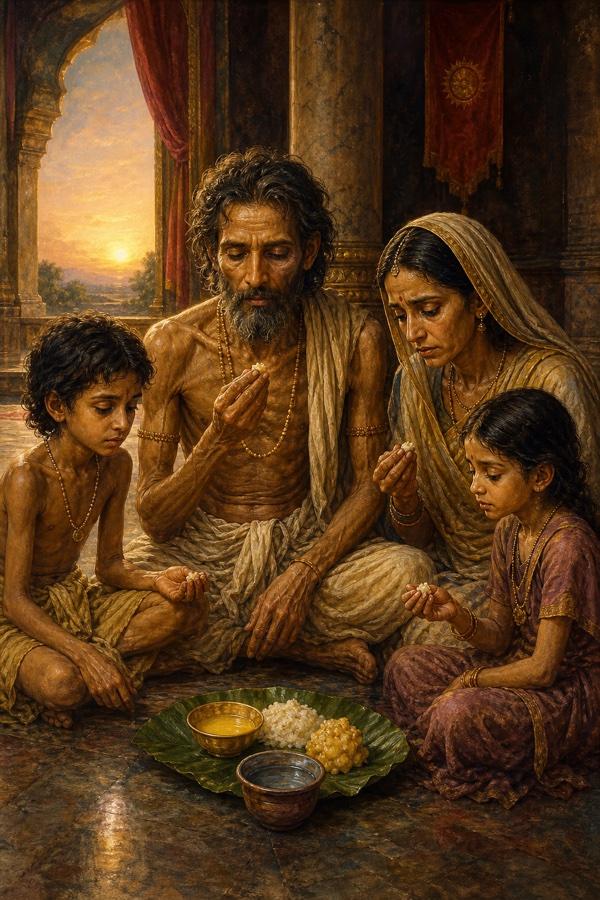
Rantideva sat down before it with his family. Forty-eight days of famine ringed that one small plate. His wife and children were trembling with hunger and thirst, and he had just reached for the first morsel.
In that instant a shadow filled the doorway. A Brahmin stood there, a man of the priestly order that a king is bound to feed before he feeds himself, caked in road dust, hollowed by distance, swaying where he stood.
“Rajan, I am hungry. Give me something to eat.”
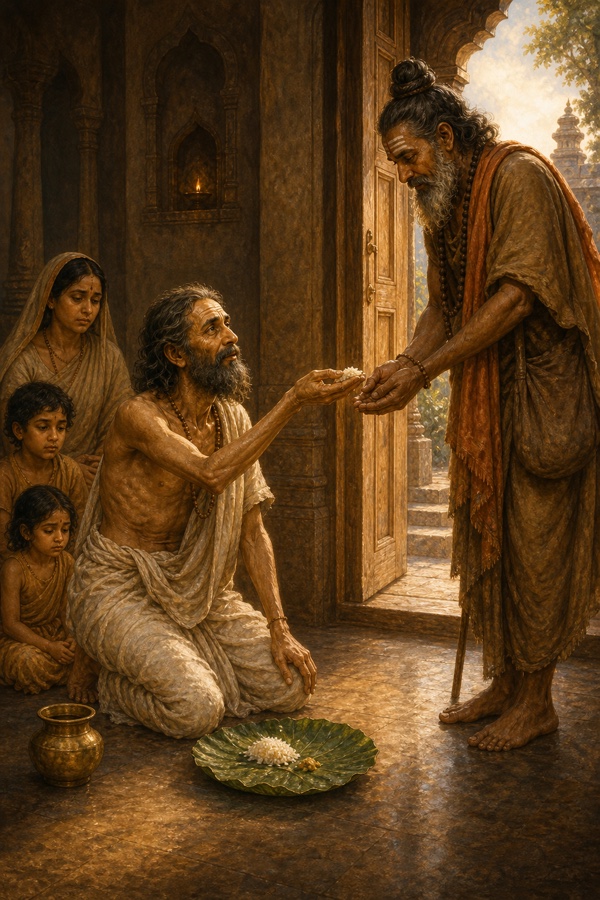
Rantideva saw the Lord looking out of every living thing. To his eyes the worn man in the doorway was Bhagavan himself arrived as a guest, and a guest, to this king, outranked his own starving body. With reverence he welcomed the man, lifted a fair share of the food, and laid it in the Brahmin’s hands.
The Brahmin ate, blessed him, and went his way.
Rantideva divided what remained among his family and drew his own portion toward himself. Before he could lift a morsel, a second stranger stood at the door, a shudra, a laborer of the serving order, a man the custom of that age would never have seated within sight of a king’s plate.
“Rajan, let me too have something to eat.”
Rantideva heard only the hunger in it. Remembering the Lord, he placed a portion of the divided food into the man’s hands, and this guest too went away satisfied.
He had only just slid the last of the food toward himself when a third guest arrived, and this one came with a whole pack of dogs panting at his heels.
“Rajan, my dogs and I are faint with hunger. Give us something to eat.”
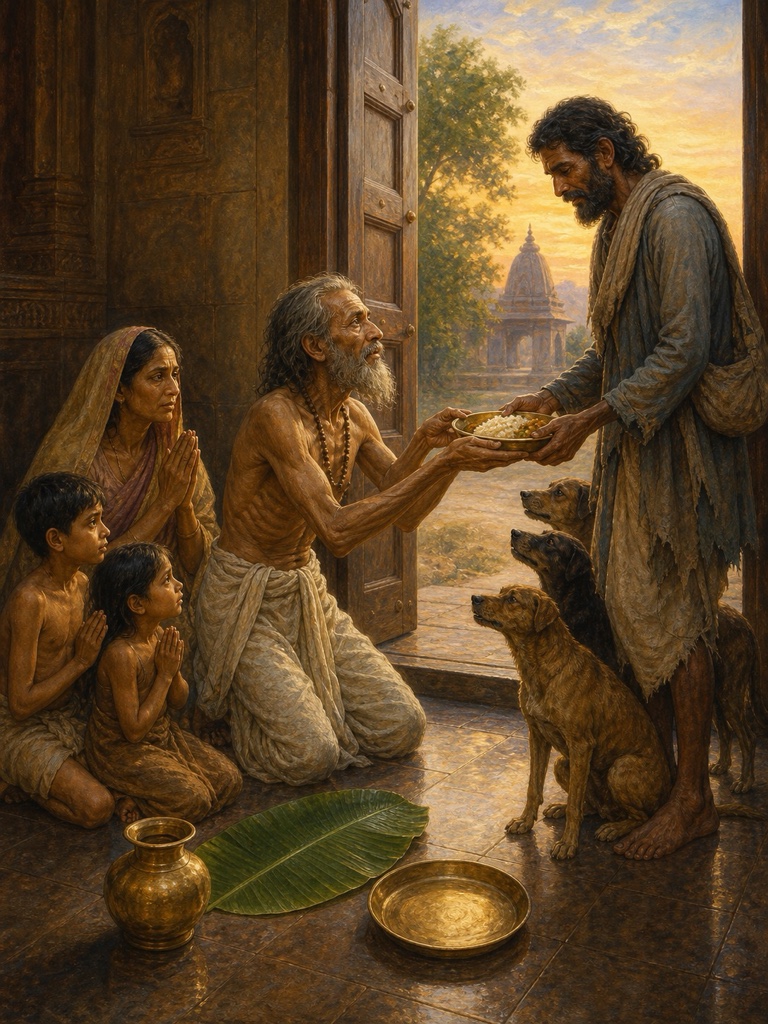
Receiving him kindly, Rantideva set everything that was left, down to the last grain, before the dogs and the man who kept them. Then he bowed his head to the animals and to their master, folding his hands to street dogs as to gods, for in them too Bhagavan had come walking to his door.
Now only the water remained, a single cupped handful, barely enough to slake one throat.
His own throat had closed to sand, and his lips had split. The water was too little to divide. He had lifted it at last, about to drink.
Then another voice reached him from the doorway. A chandala stood there, panting, barely keeping his feet, a man of the burning grounds, of the rank that world had pushed below every other, whose very shadow the orthodox stepped around.
“I am the lowest of the low, Rajan, an unlucky man. Give me water. My throat is closing.”
The words came out of him in fragments, each one costing him pain, and hearing them Rantideva was wrung through with pity. He looked once at the water on which his own life now hung, and once at the dying man in his doorway, and something in him had already decided.
His cracked lips parted, and a prayer rose out of him, words with nectar in them, asking nothing for the man who spoke them. It rose on its own, from a place deeper than thought.
“I do not ask the Lord for the highest state a soul can win, the one crowned with the eight great yogic powers, beginning with anima, the mastery that lets a man shrink to the measure of an atom. I do not even ask for moksha, release from the whole turning wheel of birth and death.”
“I ask for one thing only. Let me stand within the heart of every living being and take their whole burden of suffering onto myself, so that no creature anywhere is left carrying pain.”
“Look at him. This poor man drinks, and lives. And in the act of handing him the water, the water his life was begging for, my own torments are leaving me: the exhaustion of hunger and thirst, the ache of my limbs, the low spirits, the languor, the grief, the despondency, the delusion, all of it going quiet along with his thirst. This is everything I ever wanted. In this I am already content.”
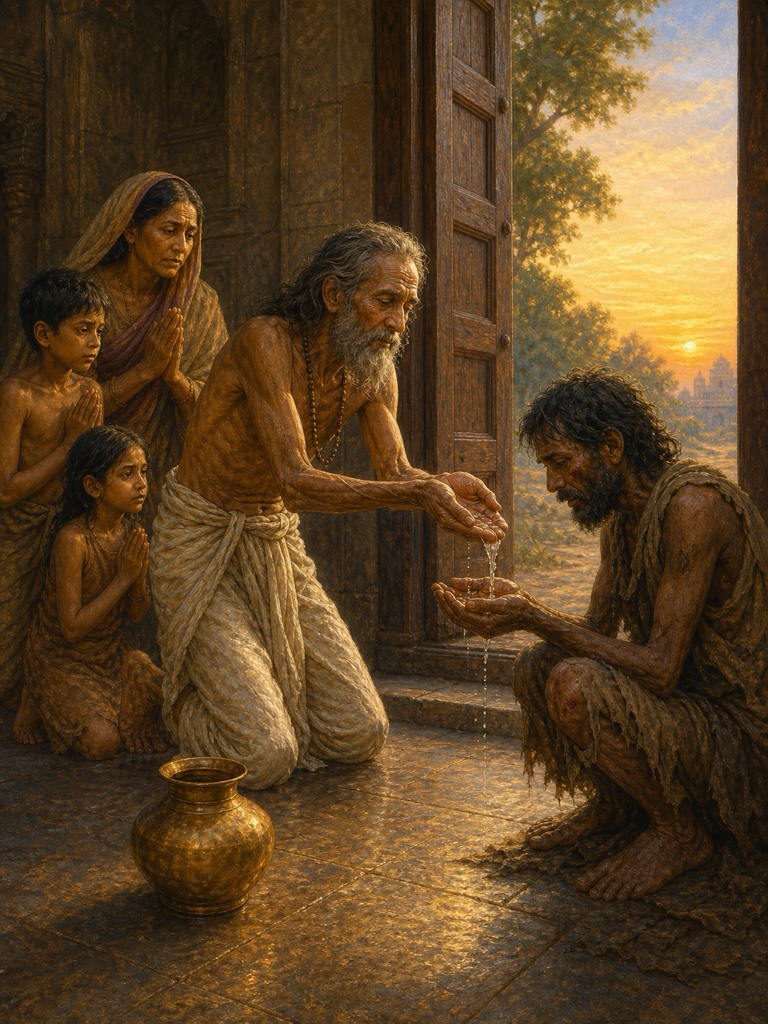
With that, though the want of that water was pulling the life out of him, he poured every drop into the chandala’s hands, steady as a man performing worship. Compassion was the whole make of him, and holding it back lay no more within his power than a spring can seal its own mouth.
Forty-eight days of fasting, and now he had nothing at all. Food and water were gone. Two empty palms remained and the ease of one stranger drinking his fill.
Then the doorway changed. The guests had all been shapes fashioned out of the Lord’s own maya, forms Vishnu had raised to weigh the fortitude of his devotee, and the weighing was finished. Before Rantideva now stood the three lords of the worlds, the powers that create, sustain, and dissolve everything that is, the three who grant their devotees whatever they long for and who had come to his door as a Brahmin, a shudra, and a chandala: Brahma, Vishnu, and Shiva themselves.
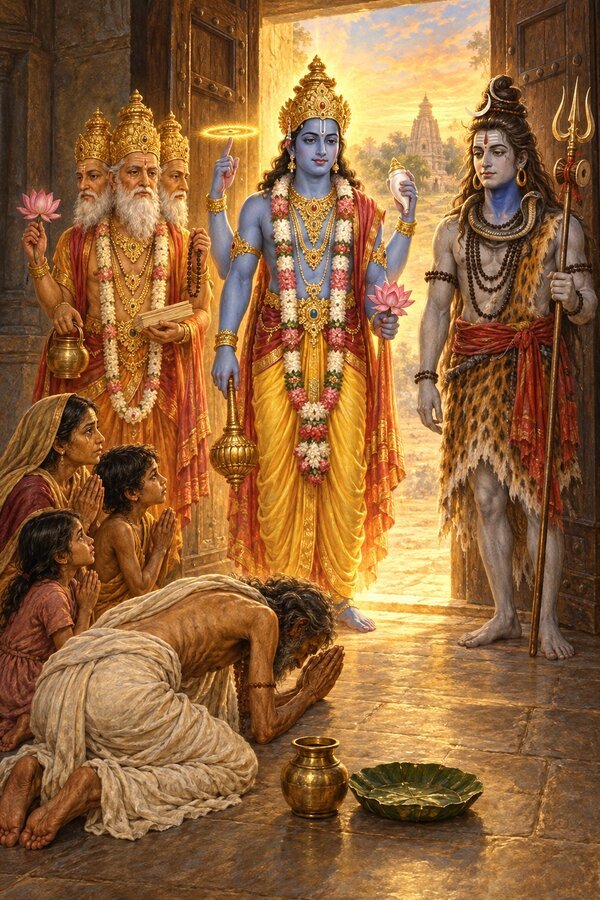
Rantideva bowed at their feet. Three gods stood in his bare hall with every boon a man could name in their keeping, and there was nothing he wished to take from them. By the Lord’s grace attachment and craving had already gone out of him, and with a love as pure as love can be made he sank his mind wholly into Bhagavan Vasudeva. He asked for nothing at all.
He wanted nothing the Lord was absent from. He fixed his mind on Bhagavan and sought no boon beyond devotion to his feet, and the maya of the three gunas, the threefold weave of brightness, restlessness, and dullness out of which every appearance is spun, dissolved for him the way a dream dissolves at the first touch of waking, back into the Spirit that had held it.
His people, merely by keeping his company, ripened into yogis, every one of them taking refuge in the Lord and given wholly to Narayana. In Rantideva’s own eyes the royal seat had never carried any shine. All his life the same old summons kept its place there, answering every hunger and every thirst that came to his gate.
Literary context
This story sits in the ninth Skandha of the Shrimad Bhagavata, in its twenty-first discourse. After forty-eight days of fasting, the little food and water that finally reach Rantideva he gives away guest by guest, to each hungry and thirsty stranger who comes to his door. ‘Na tv aham kamaye rajyam’ (9.21.12), I crave no kingdom, is the famous stavan remembered in his name, a prayer that lets go of every longing, for a kingdom, for heaven, even for moksha, and asks for one thing alone, an end to the suffering of afflicted beings.
The philosophical lens
One quiet, piercing detail in the katha is that among the guests of the final hour there is a chandala, a man his age had pushed to the far edge of the human world, and Rantideva gives him water with the same gladness and the same respect with which he had earlier fed the Brahmin. His compassion knows nothing of the rankings of birth and lineage.
That is the depth of the verse. What Rantideva sees is the suffering of a living being, never its caste or its outward shape. In the Bhagavata’s vision, the only compassion worth the name is the kind that treats no one alive as a stranger.
Why this katha matters now
Rantideva went hungry for forty-eight days, and when food finally came he saw the pain of the hungry man at his door before he saw his own failing body. To set your last mouthful and your last swallow of water before another’s hunger and thirst, that is the compassion of Rantideva. It has not gone out of the world. It goes on in everyone who cuts into their own share to feed others through famine and calamity, the same old summons, still answered.