On this page
Banasura and Aniruddha
Banasura was a king among the asuras, the eldest of the hundred sons of Bali. It was Bali who once gave away the whole earth to the Lord when he came to his sacrifice in the small body of the dwarf and measured the three worlds away in two strides; giving ran in that blood, and out of that same open-handed line came Bana, forever absorbed in the worship of Shiva. The world held him in high regard; his generosity and his intelligence drew praise, his given word never bent, and he was truly a man who kept his promises. In those days he ruled from the lovely city of Sonitapur. He had a thousand arms, and in those arms lived so much strength that his hunger for battle never went quiet.
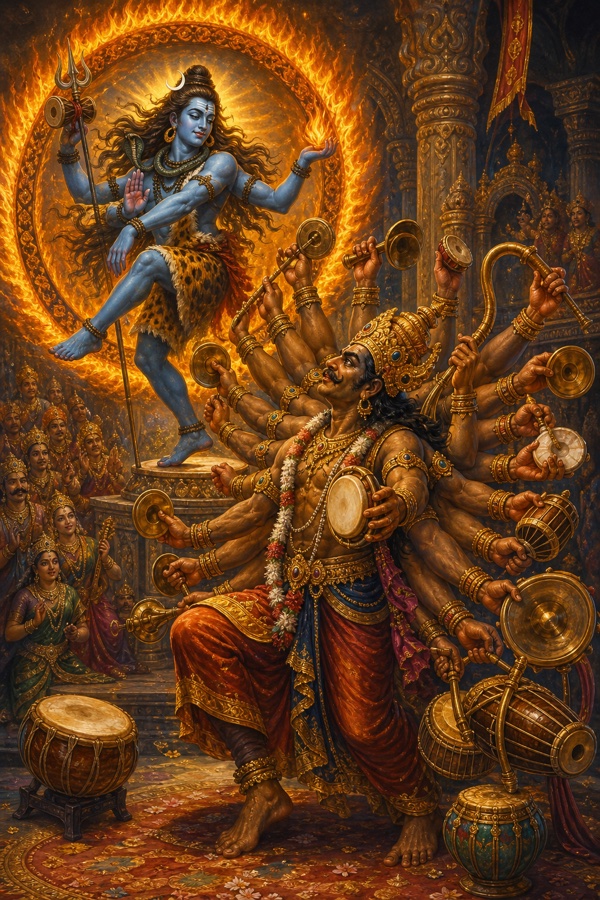
One day Lord Shiva was lost in his Tandava, the dance in which the destroyer of worlds gathers all his storm into rhythm, and Banasura saw his moment. With his thousand hands he took up every kind of drum and instrument at once, a whole orchestra in a single body, and played to the beat of that dance until the dancer himself was pleased. Shiva was delighted, and the Lord who is the one master of all beings, tender to his devotees and the shelter of those who seek him, said to Banasura, “Ask of me whatever you wish.” Banasura said, “Bhagavan, stay here and guard my city.” And so it was; the guarded city’s guardian was now Mahadeva himself, and by his grace even Indra and the other gods, adorable in their own heavens, served Banasura like hired attendants.
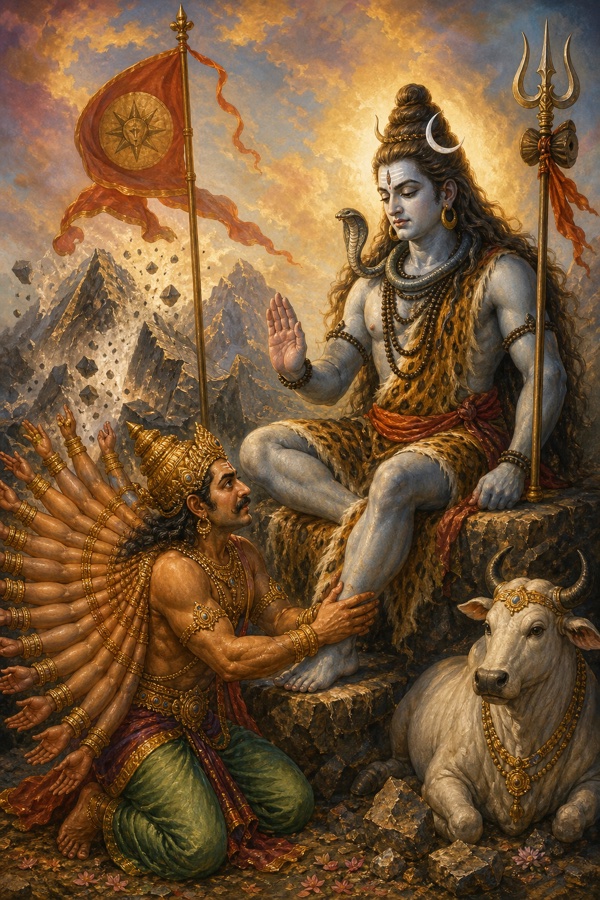
But this very assurance had left Banasura restless. When Mahadeva himself is your protector, no enemy worth the name is left to face you, and strength with nothing to spend itself on begins to eat its owner. One day he touched Shiva’s feet, his crown flashing like the sun as he bent, and said, “God of gods, you are the guru and the lord of all that moves and does not move, the wish-granting tree that completes every unfinished longing. You gave me these thousand arms, yet they have become nothing but a weight on me. In all three worlds, apart from you, I find no warrior my equal who can stand against me in a fight. Once the itch took me and I marched against the great elephants who stand at the quarters of the sky holding up the directions, but even they turned and fled in fear. That day, merely from marching, I broke and shattered many mountains with the blows of my arms.” Shankara’s eyes darkened, and he said with a touch of anger, “You fool. The day your banner snaps and falls, on that day you will meet a warrior my equal, and he will grind your pride to dust.” Any other king would have heard a sentence of doom in those words. Banasura’s mind had soured so far that this news only gladdened him, and he went back to his palace happy, waiting for the very war in which his strength was destined to be undone.
Banasura had a daughter, Usha. She had grown up in the inner chambers of the palace, behind watches that never broke, a stranger to the world her father’s arms had mastered.
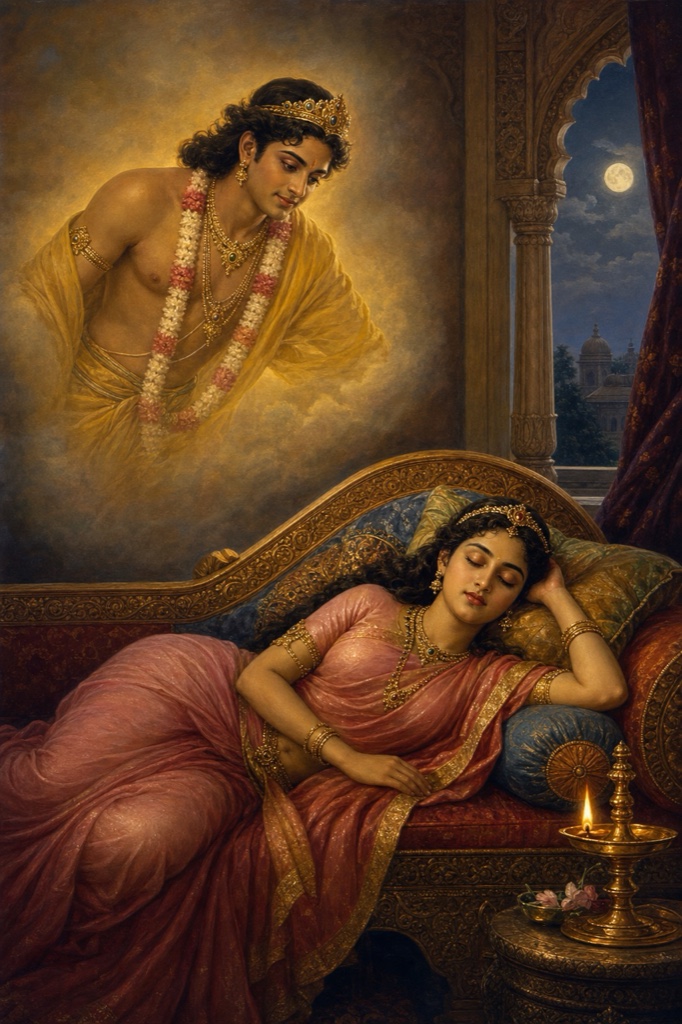
One night Usha had a dream. A young man, dark of complexion, with eyes like lotuses, dressed in yellow silk and impossible to look away from, came to her, and within the dream he stayed with her and gave her the sweet honey of his lips to drink. She had never seen that face before, never heard it described, and yet the dream carried the certainty of memory. She had not yet drunk her fill when he left her adrift on an ocean of longing and went away, she knew not where.
When her eyes opened she cried out, “Beloved of my heart, where are you?” But no one was near. Overcome, she sat up, and seeing that she was among her friends, and that the cry had left her lips aloud, she flushed with shame. The one she had not even touched, without him the nights had turned hard to pass.
In the morning her friend Chitralekha came, the daughter of the minister Kumbhanda, a girl of Usha’s own age and her constant companion. Seeing Usha’s fallen face, she sat down beside her, curious. “Lovely one, princess, I see that no one has yet taken your hand in marriage. So whom are you searching for, and what is the shape of this longing of yours?”
Usha said softly, “Friend, in a dream I saw a most beautiful young man. His complexion is dark, his eyes are like the petals of a lotus, and yellow silk flutters about his body. His arms are long, and he is a thief of women’s hearts. First he gave me the sweet honey of his lips to drink, but before I could drink my fill he cast me into the deepest sorrow and went away, I know not where. It is that beloved I am searching for, and I do not even know his name.”
Chitralekha said, “Friend, if this thief of your heart exists anywhere in the three worlds, on the earth, above it, or below it, and you can recognize him, I will surely calm this ache of separation. I will draw portraits; you pick out your beloved and tell me. Then, wherever he may be, I will bring him to you.” She said it evenly, the way one speaks of a thing already decided.
So saying, Chitralekha drew portraits of many gods, gandharvas, siddhas, charanas, serpent-folk, daityas, vidyadharas, yakshas and human beings, the whole census of the three worlds passing through her brush, each likeness so faithful it seemed about to speak. One after another the faces rose up on the paper. Usha kept shaking her head, “No, not this one… not this one either…”
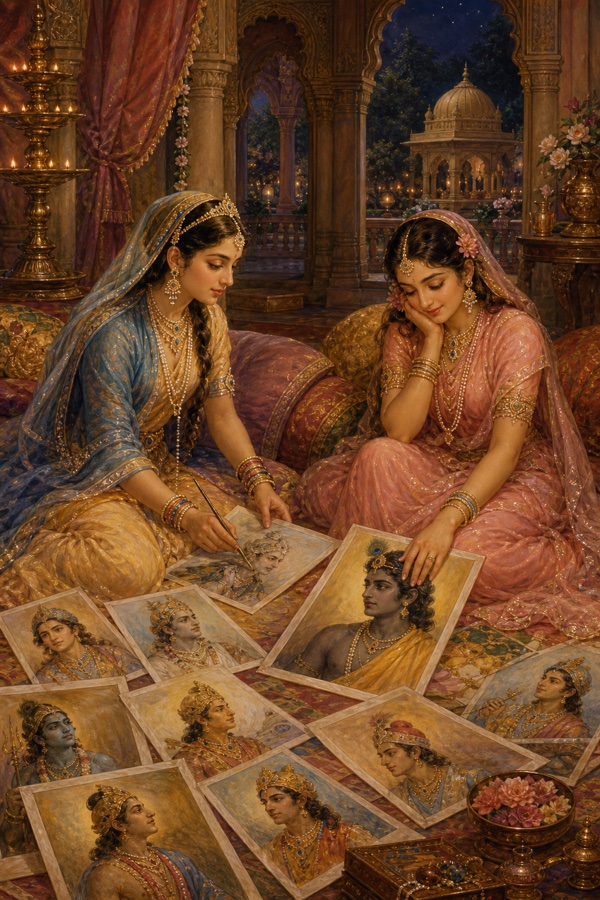
Then among the humans she drew the Vrishnis: Shura, the father of Vasudeva, then Vasudeva himself, Balarama, and Lord Krishna, and others of that line. At the sight of Pradyumna’s portrait Usha grew shy, for something in that face came close to her dream. And when Aniruddha’s portrait rose up, drawn with particular care, her head bowed low with modesty and stayed there. Her palm came to rest on that portrait of its own accord. Smiling faintly, she said, “This one. My beloved is this one, this one.”
Chitralekha studied the portrait closely and said softly, “Do you know who this is? This is Aniruddha, the son of Pradyumna, the grandson of Krishna himself, a prince of Dwarka.” Usha’s face fell; Dwarka lay far to the west, and it was guarded by Krishna in person. Chitralekha took her hand. “Do not lose heart. Tonight I will bring him here.”
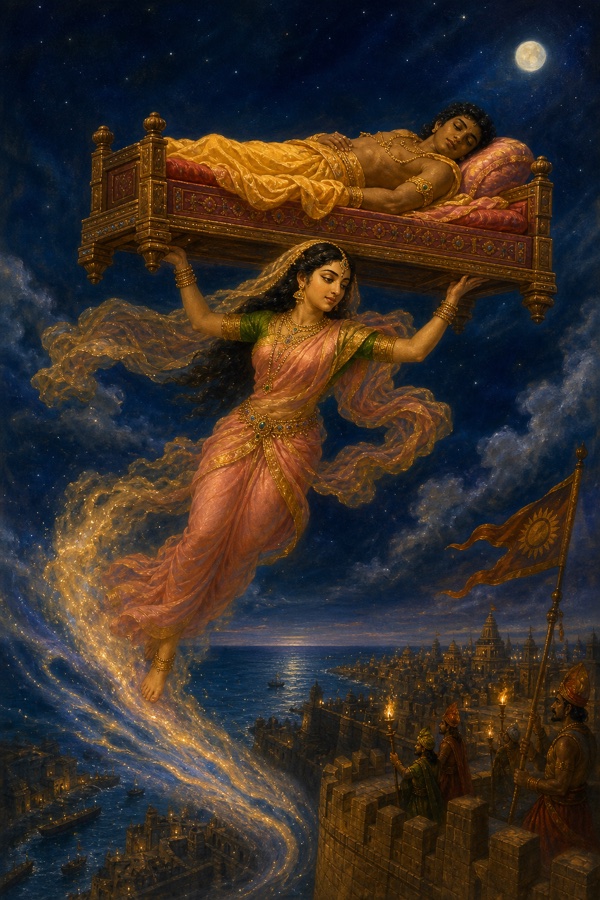
As the night deepened, Chitralekha rose through the air by her yogic power and crossed the long distance to Dwarka, the city Krishna himself kept guarded. There Aniruddha lay asleep on a beautiful bed. She did not wake him. By the force of her yogic attainment she lifted him, bed and sleep and all, carried him through the night sky to Sonitapur, and gave her friend Usha the sight of her beloved.
Finding her beautiful beloved before her, no longer a dream and no longer a drawing, Usha’s face bloomed like a lotus in joy. The two of them kept gazing at each other, as though the thread of a dream had suddenly come into the hand while waking.
Usha began to spend her days with Aniruddha in her inner palace, chambers no man’s eye could reach. With costly garments, garlands of flowers, perfumes and scented oils, incense and lamps, fine seats, sweet drinks and food, charming words and every kind of tending care, she honored Aniruddha, and with a love that grew by the day she made his heart her own. Hidden in that maiden’s chambers, Aniruddha forgot himself, forgot Dwarka, forgot the very shape of time. He did not even notice how many days had passed since he came there.
Usha’s maidenhood could no longer be hidden. Signs appeared on her body that spoke plainly and could not be concealed by any means. The guards understood that she must have taken up with some man. They went to Banasura and said, “Rajan, the ways of your unmarried princess threaten to stain the family’s name. We keep watch over the palace day and night, our shifts unbroken; no outsider can so much as look at her. How then has she come to be marked?”
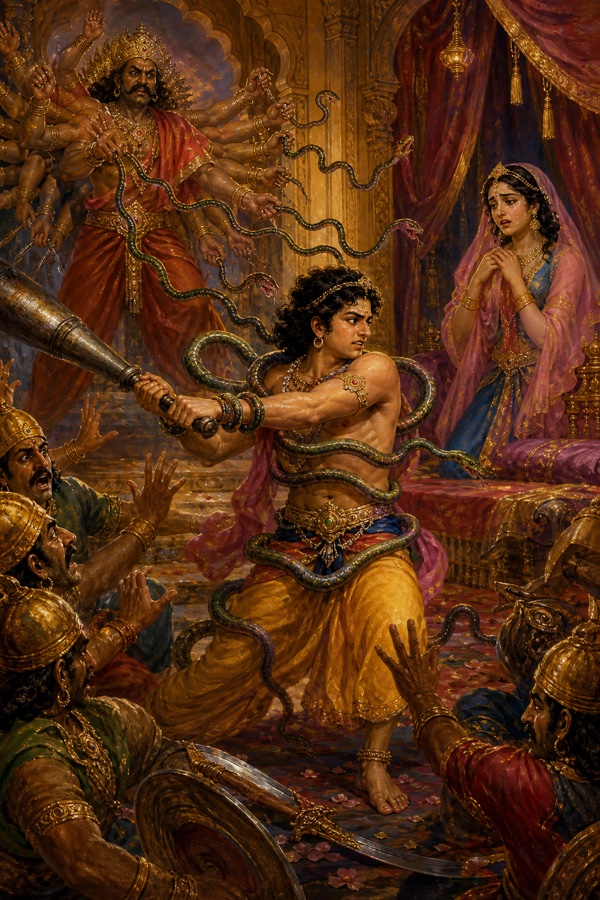
Shaking with rage, Banasura stormed up to the chamber himself with his soldiers, and the sight that met him stopped him where he stood. There sat Aniruddha, the son of Pradyumna, who was Love himself come to earth again, and the father’s beauty lived on in the son: dark of hue and clad in yellow, lotus-eyed and long-armed, his face lit by his earrings and his glancing smile, a wreath of spring jasmine caught between his arms and still stained with the saffron from Usha’s breast, throwing dice with her as though no army in the world could reach that room. When the soldiers rushed in, Aniruddha alone took up an iron club and held them off, and like Death itself standing there with the rod of doom, whoever sprang forward to seize him he struck down, the way the leader of a herd of boars kills off a pack of dogs, until broken men were dragging themselves back out of the palace. But then Banasura loosed his nagapasha, his serpent-noose sorcery, and while the club still swung, living coils closed over the young man’s arms and chest and gripped him fast, and he was left a prisoner. Hearing of it, Usha broke down in grief and despair, and a stream of tears ran from her eyes.
In Dwarka, meanwhile, there was an uproar. The prince had vanished from his bed in the night, out of a guarded city, without trace or clue. The four months of the rains passed, the roads drowned and the skies emptied themselves, and no one learned a thing; Aniruddha’s household was sick with grief.
Then Narada arrived, the wandering seer who crosses the three worlds carrying exactly the news each place is waiting for, arriving as he always does in a time of trouble. He told Dwarka where Aniruddha was, how he had been carried off to Sonitapur, what he had done single-handed to a contingent of Banasura’s soldiers, and in whose nagapasha he now lay bound.
Then the Yadus, who held Krishna alone as their chosen deity, set out for Sonitapur. With Krishna and Balarama went Aniruddha’s father Pradyumna, and Satyaki, Gada, Samba, Sarana, Nanda, Upananda and Bhadra, at the head of twelve akshauhinis, twelve full oceans of chariots, elephants, horsemen and foot soldiers, and they laid siege to Sonitapur from every side, until nothing moved in or out of the city.
When Banasura saw the Yadu army tearing down the city’s gardens, ramparts, watchtowers and great gates, no fear crossed his face; a light came into his eyes instead. This was the very war he had craved from Mahadeva, arrived at last at his own door. He too marched out of the city at the head of twelve akshauhinis, and on his way he fell down before Shiva in his temple.
“Prabhu, do you remember your word? The Yadus are at the gate. Now keep the honor of your servant.”
Shiva was bound by his word. He sent the army of his Pramatha hosts, put at their front his own son Kartikeya, the commander of the armies of heaven, and, mounted on the great bull Nandi, came and stood on the field of battle himself, on the side of an asura, for the sake of a devotee.
And then came the hour that halted the gods of all three worlds in the sky to watch, Brahma at their head, with the siddhas, charanas, gandharvas and apsaras crowding their shining chariots above the field.
Shri Hari and Shankara, face to face.
Within them both the same supreme reality, and between them a deep regard. Yet in this hour one stood on one side and the other on the other, and neither would step back.
The battle broke open. On one side the Yadus and Pradyumna’s bow; on the other Shiva’s Pramatha hosts and the spear of Kartikeya. The field sorted itself into duels worthy of the watchers: Shankara fought Krishna, and Kartikeya fought Pradyumna. Kumbhanda and Kupakarna closed with Balarama, Samba with Banasura’s son, and Satyaki with Banasura himself.
Arrows fell in sheets and covered the sky until midday dimmed toward dusk. Celestial weapons flew, struck one another, and went out.
Between Krishna and Shiva there was a wondrous and grinding war, such that the hair of the watching gods stood on end. Shankara loosed weapon after weapon of every kind from his great bow Pinaka, and Shri Hari, without the least astonishment, as calm as a teacher hearing a familiar recitation, quieted each one with the weapon that countered it. Against the Brahmastra a Brahmastra; against the weapon of the wind, the weapon of the mountain, which no gale can move; against the weapon of fire, the weapon of the rain cloud; against the Pashupata, Shiva’s own final word in arms, the Narayana, which was Krishna’s.
Shankara’s followers too rushed at Krishna, the night side of creation emptying itself onto one man, but with the sharp arrows of his Sharnga bow Krishna struck and drove off the bhutas, pretas, pramathas, guhyakas, dakinis, yatudhanas, vetalas, vinayakas, hosts of ghosts, the mother-spirits, pishachas, kushmandas and brahma-rakshasas.
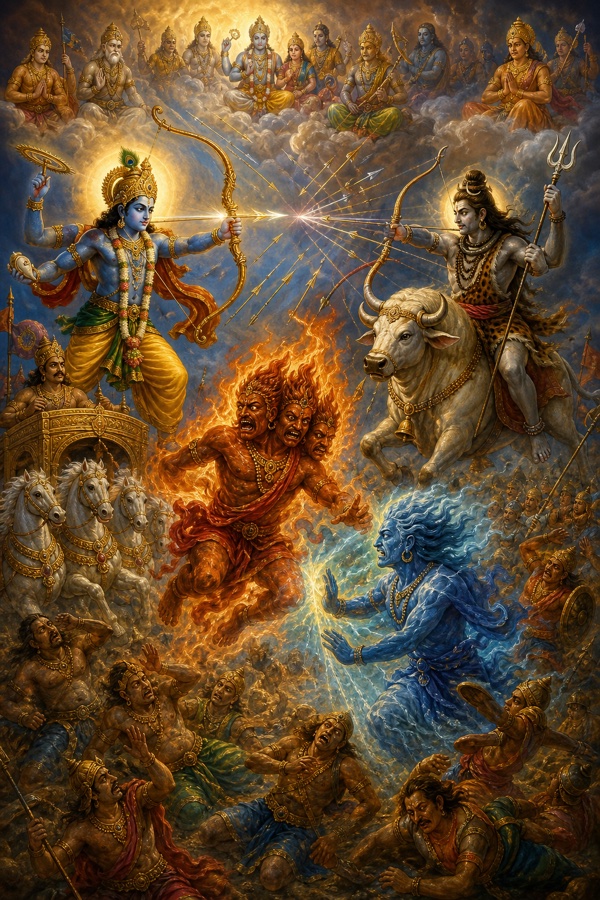
From Shiva’s side rushed the Maheshvara-jvara, a blazing fever given form, three heads and three legs, burning the ten directions as it came at Krishna; before it the Yadu army began to scorch. Krishna released his own Vaishnava-jvara. The two fevers clashed, heat against heat, and the Maheshvara-jvara, tormented by a burning fiercer than its own, was beaten. Finding shelter nowhere in the three worlds, it came in fear with folded hands to take refuge in the very one it had been sent to burn, and began to praise him. Pleased, Krishna granted it safety. “Whoever recalls this exchange between the two of us will have nothing to fear from you.”
Then came the moment when the war climbed to its height.
Krishna fixed on a rare weapon, the jrimbhana-astra, which brings on yawning and lassitude, a weapon that wins with sleep what no blade can take. At its touch Shiva was overcome; yawn followed yawn, his eyelids grew heavy over his own battle, and seated there on Nandi he withdrew from the fight.
The destroyer of all creation, in the middle of the battlefield, came to a stop. Seizing the moment, Krishna began to cut down Banasura’s army with sword, mace and arrows. At the same time Pradyumna wounded Kartikeya with a shower of arrows, until blood ran from every limb of heaven’s own commander and he fled the field on his mount, the peacock. Balarama, with the blows of his pestle, wounded Kumbhanda and Kupakarna, and they fell on the field. Seeing their commanders struck down, Banasura’s whole army scattered.
A few moments later Shiva recovered himself and shook off the borrowed sleep. With a faint smile he looked toward Krishna.
“Govinda, that was a fine move.”
There was a smile on Krishna’s lips too. “Forgive me, Prabhu. There was no way to reach my grandson without holding you back.”
When Banasura, mounted on his chariot, saw his army scattering under the blows of Krishna and the others, a great rage took him. He left Satyaki standing and rushed to attack Krishna, and drunk with battle he did what no other archer alive could attempt: with his thousand hands he drew five hundred bows at once, fitting two arrows to each string. But Krishna cut down every one of his bows at a single stroke, brought down his charioteer, chariot and horses together, and sounded his conch.
Just then Kotara came and stood before him, a goddess, the one Banasura honored as his mother. To save the life of the son who worshiped her, she came before Krishna with her hair loose and her body unclothed. So that his eyes would not fall on her, Krishna turned his face away and looked to the other side, and courtesy held him there. In that interval, his bows cut and his chariot gone, Banasura slipped away into his city.
But that pride was still alive inside him, and pride of that size does not learn from a single fall. Before long Banasura returned, mounted on a fresh chariot, bearing weapons of every kind in his thousand hands, raining arrows on Krishna.
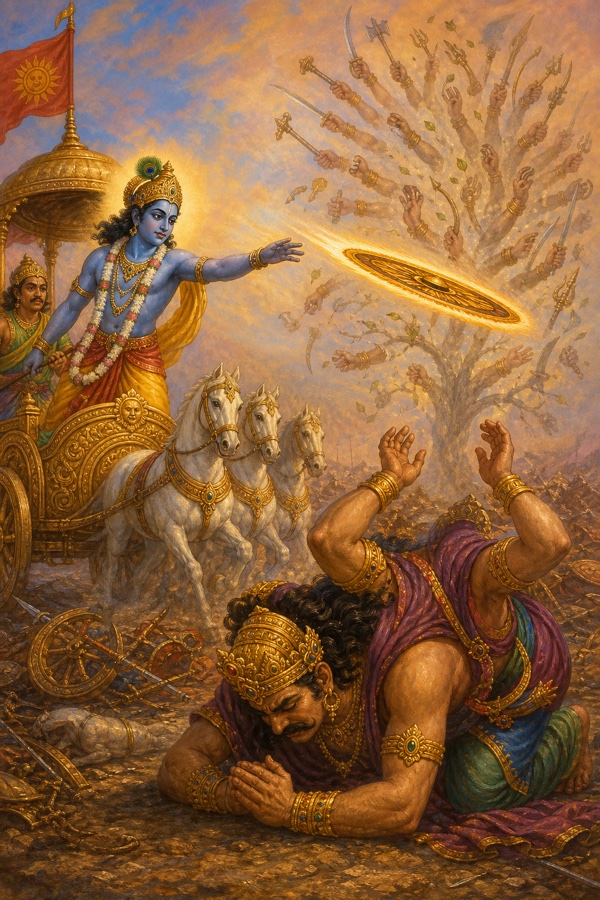
Krishna released the Sudarshana chakra, the discus keen-edged like a razor. As one might trim the small branches from a tree, the discus cut away Banasura’s arms one by one, leaving only four. The burden of a thousand arms, which he had never quite been able to carry, fell from him in a moment.
Bathed in blood, Banasura bent to the ground amid the wreckage of his own arms. The discus was still poised, bright and patient, to cut away the arms he had left.
Then Lord Shankara, tender to his devotees, who had watched each arm fall from the man who had spent a lifetime at his feet, stepped forward. “Govinda, hold.”
Krishna stayed the discus in the air and looked toward Shiva.
“Prabhu, you are the Parabrahman, the very form of supreme light, hidden as the inner meaning of the Veda’s mantras. People whose minds are purified see your form, all-pervading like the sky and free of change. The firmament is your navel, fire your mouth, the heavens your head, the four directions your ears, the sun your eye, the earth your feet, the ocean your belly, and Indra and the guardians of the worlds your arms; we who guard the seven worlds guard them by a strength that flows wholly from you. This Banasura is dear to me above all, an object of my grace and my servant. I have granted him refuge, and my word stands pledged for his life. As your grace rests on his great-grandfather Prahlada, the king of the daityas, the boy who clung to your name though his own father made war on him for it, let the same grace rest on him. You have taken away his pride; now grant him his life.”
Krishna paused a moment, then said in a gentle voice, “Bhagavan, as you wish, I make him free of fear; what you have decided for him, I have already approved. Banasura is the son of Bali, the grandson of Virochana, the great-grandson of that same Prahlada who was king of the daityas. For that reason I will not slay him, for I gave Prahlada a boon long ago that I would slay no one born in his line. His arms I cut away only to break his pride, and his great army I cut down only because it had grown into a burden the earth could no longer carry. The four arms that remain to him will stay ageless and undying, beyond the reach of time itself. He will be foremost among your attendants, and though he is an asura he will have no fear of anyone in any form. Only this: let him loose Aniruddha’s bonds and send him, with Usha, to Dwarka.”
Banasura accepted with bowed head. He came to Krishna, pressed his forehead to the earth, and made his obeisance, the four arms he had left folding more easily than the thousand ever had. The bonds of the nagapasha loosened and fell open. Aniruddha, for the first time in these months, could breathe the open air, and Usha stood beside him with no more need to hide. Banasura himself seated the two of them on a chariot.
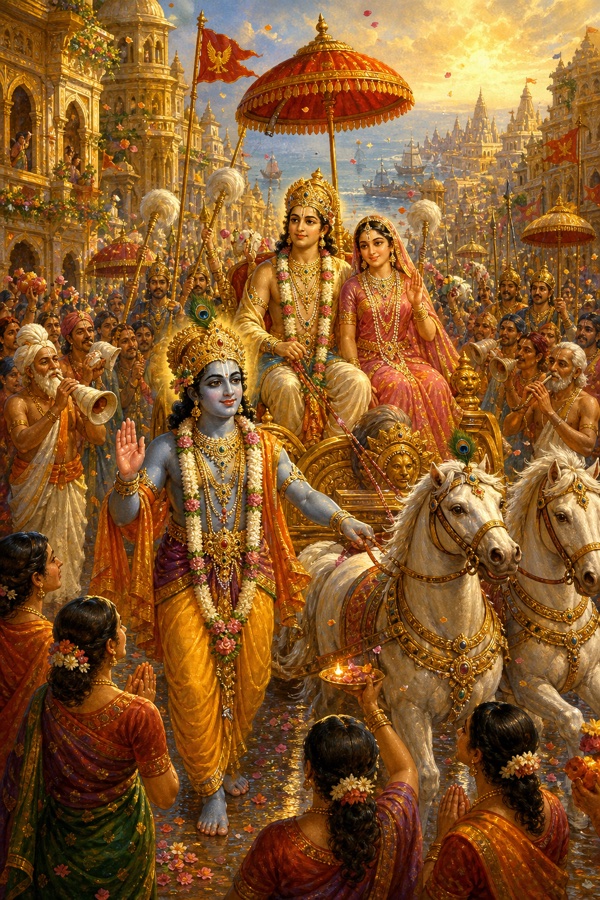
Then, with Mahadeva’s assent, Lord Krishna set out for Dwarka, placing Usha and Aniruddha, adorned in fine garments and ornaments, at the head of the column with an akshauhini of troops. In Dwarka every corner of the city was decorated, flags and festive arches stood over the lanes, the great roads and crossings were sprinkled with sandal-scented water, and the citizens, kinsfolk and Brahmins came forward to welcome the Lord with great festivity. Conches, kettledrums and dhols sounded in a tumult. The face Usha had first known in a dream and then in a portrait was now hers for life.
And Banasura, with his four remaining arms, became foremost among Mahadeva’s Pramatha hosts, ageless and fearless as the Lord had spoken, and stayed forever at his feet.
Literary context
This katha appears in the Tenth Skandha of the Shrimad Bhagavata, chapters 62 and 63. This war between the Shiva-devotee Banasura and Krishna is a singular picture of the Lord’s tenderness toward his devotees, in which Hari and Shankara, holding each other in mutual regard, come face to face to protect their respective devotees, and in the end it is Shankara who asks Krishna for Banasura’s life. The Bhagavata closes the episode with a quiet promise: whoever rises at daybreak and recalls this meeting of Krishna and Shankara, and Krishna’s victory in it, will never in life meet defeat.
The love story of Usha and Aniruddha is a part of this same katha, and through their marriage the line of the devotee Prahlada and the line of Krishna become one family. Tradition identifies Banasura’s city of Sonitapur with modern Tezpur, in Assam, where the fort of Agnigarh is the center of the folk memory tied to Usha.
Why this katha matters now
A mighty king with a thousand arms, and a daughter raised inside the ring of that same strength, who crosses every wall of the palace on the strength of a single face seen in a dream. Banasura’s pride and Usha’s quiet, settled longing: the whole katha flows between these two, and in the end strength bows and love is what remains.
The same katha elsewhere
- Harivamsha · The War with Bana (Usha and Aniruddha)
The war with Bana in the Harivamsha (Usha and Aniruddha) - Banasura
Shiva Purana: Banasura the Shiva-devotee and the boon of a thousand arms