On this page
Vritrasura, the Demon Devotee
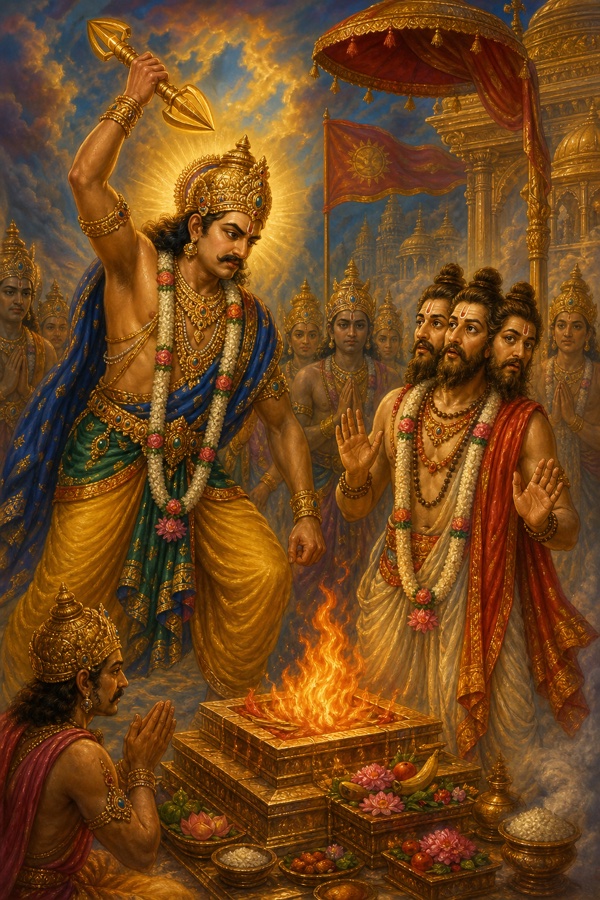
It began with a wrong Indra could never call back. The gods of heaven had lost their guru in those days; Brihaspati had walked out on them over a slight born of Indra’s pride, and the empty priesthood had passed to Vishvarupa, a young Brahmin of immense attainment, son of Tvashta, the craftsman of the gods. Vishvarupa carried three heads on his shoulders: with one he drank the Soma pressed at the sacrifice, with the second he drank wine, and with the third he took his food. At the fire he sang out the gods’ portion of every offering for all of heaven to hear, since the gods were his father’s people. But his mother, Rachana, was a daughter of the asuras, the gods’ old rivals, and her blood pulled at him quietly, and even as he poured the ghee he slipped a hidden share toward the demons. Indra saw the rite being bent, read in that secret stream the slow starving of the gods, and let his fury decide. He struck off all three heads. The head that had drunk Soma flew away as a francolin, the wine head as a sparrow, the food head as a partridge, and the king of heaven stood at the altar with a Brahmin’s blood on him.
Killing a Brahmin leaves a stain that does not lift on its own. Indra had power enough to shrug it aside; instead he received it with joined palms and carried it for a full year. Then he divided the sin into four parts and gave the parts away. The earth took a quarter, and shows it still wherever soil goes barren, and took in exchange the promise that every pit dug into her would fill itself again. The trees took a quarter, and it bleeds from them as gum, and their boon was that a lopped branch grows back. Women took a quarter, visible in the course that visits them month by month, and carried away with it a desire that never tires. And water took the last quarter, wearing it as froth and foam, with the boon that its springs and wells would always rise again.
Tvashta had lost a son, and he answered his grief with fire. Into the southern altar flame, the Anvaharya-pachana, he poured oblation after oblation with a single prayer riding each one: rise, enemy of Indra, grow past all measure, and kill my son’s killer. Out of that fire climbed a shape that looked like Death arriving at the end of an age. He was dark as a hill burned black, lit like a wall of evening thundercloud; his beard and hair glowed red as heated copper, and his eyes carried the glare of the midday sun. Every day he grew the length of an arrow’s flight. He danced with the vault of heaven balanced on the point of his blazing trident, roared until the ground shuddered, and breathed through a mouth so deep, a cavern fenced with teeth, that it seemed ready to drink the sky, lick the stars from their places, and take the three worlds down whole. Creatures fled in every direction at the sight of him. Because his darkness wrapped the worlds, they named him Vritra, the coverer. This was Vritrasura.
He fell upon heaven, and heaven could do nothing with him. The generals of the gods rushed him with their legions and their whole arsenal of celestial missiles, and he swallowed the weapons out of the air as they came. The light went out of the gods the way lamps go out inside cloud. Beaten and hollowed, they turned at last to the shelter that had never once failed, Narayana, the ancient Lord seated within their own hearts, and prayed. A creature who runs anywhere else for refuge, they said, is trying to cross the ocean holding a dog’s tail. This was the Lord who, as a colossal Fish, had towed the boat of King Satyavrata through the waters of the great deluge with the earth itself aboard. Let him carry them past Vritra now.
The Lord rose first within them, where he had been all along, and then stood before their eyes, bearing conch, discus, and mace, attended by sixteen companions shaped exactly like himself except for the Srivatsa curl on the chest and the Kaustubha gem, the two marks no attendant wears. The gods fell flat like logs, rose slowly, and poured out their trouble. “No weapon you own will end this demon,” he told Indra. “You need the bones of an ascetic, bones that mantra, discipline, and long austerity have made harder than any metal in the worlds. From them Vishvakarma will forge a thunderbolt, and I will fill it with my own power. With that in your hand you will take Vritra’s head, and with him gone your glory, your weapons, and your fortunes return to you. Enemies do not finally destroy those who are devoted to me.”
“Which ascetic, Lord?”
“Dadhichi. Go to him, and ask him for the gift of his own body.”
Indra and the gods came to the ashram of Dadhichi, the son of the sage Atharva, where havan smoke hung in the trees and the air smelled of tulsi. This was the rishi who had once taught the twin Ashwins a forbidden knowledge through the mouth of a horse’s head, worn so that the head Indra struck off in punishment would never be his own; he had already treated his body as a thing to be spent on someone else’s good. He heard the whole errand through, and his first answer was a tease. “Have the gods no notion of what dying costs? The pain of it swallows a creature’s very awareness. Of all that a living being owns, the body is the dearest thing. Who would hand his over if Vishnu himself stood at the door asking?” The gods answered him in kind: for souls of your measure nothing is too dear to give; the selfish never see what a gift costs its giver, and whoever saw that cost clearly would lose the heart to ask; and a giver like you has never once said no. At that the old rishi laughed outright.
“I teased you only to hear dharma spoken back from your own mouths,” he said. “This body will drop from me one day whether anyone asks for it or not. A man who will not use so brief a thing to earn merit and to be kind is pitied even by the trees, and the trees cannot so much as move. The one virtue that lasts is fellow-feeling: grieve when another grieves, be glad when another is glad. Wealth, kinsmen, body, none of it stays, none of it was ever truly ours, and the sorrow of this world is that men die without once spending any of it on someone else. Take mine, and be welcome to it.”
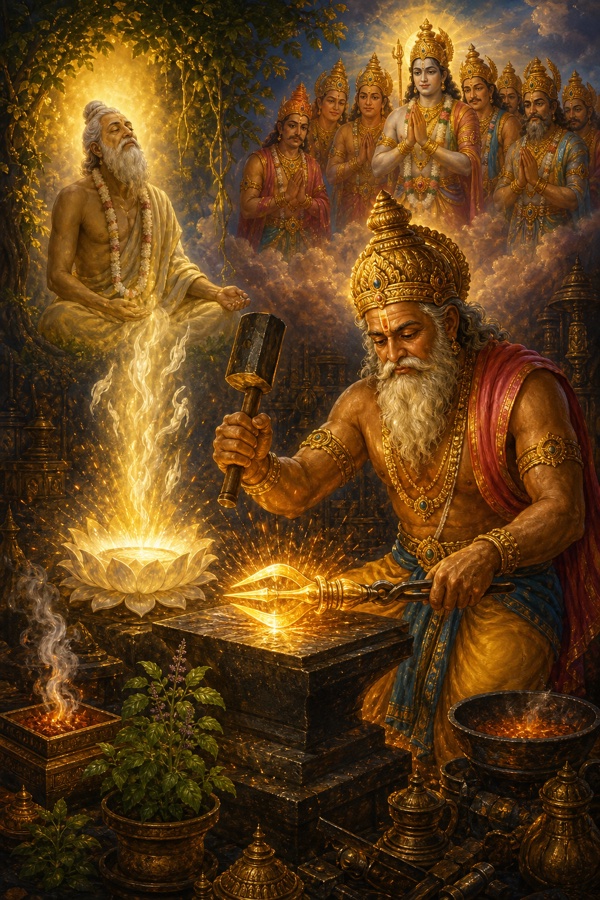
He sat down in yoga. He gathered in his senses one by one, then his breath, then his mind, set his inner gaze on the Truth that does not move, and the knots parted so quietly that he never felt the body fall. They lifted the bones from that frame, and Vishvakarma forged them into a vajra of a hundred joints. Indra mounted Airavata, the white elephant of heaven, took up the weapon with the Lord’s own power seated in it, and rode out to war while crowds of sages sang him forward.
Then the battlefield again.
The armies met on the bank of the Narmada at the beginning of the first Treta age, and the sky went black with arrows. Namuchi fought under Vritra that day, and Shambara, and Puloma, Vipracitti, the two-headed Dvimurdha, thousands upon thousands of Daityas and Danavas glittering in gold. They poured maces, iron clubs, barbed darts, lances, axes, and spiked shataghnis onto the celestial lines until the generals of the gods disappeared from view the way stars disappear behind cloud. The gods, archers without equal, cut the volleys to pieces in the air; the demons tore up mountain peaks and whole trees and hurled those instead, and the gods split them too, and every assault dropped away as harmless as curses flung at someone grounded in dharma. When their stock ran out, the demons looked at an enemy still standing unmarked, felt fortune tilting off them, and ran, leaving their leader alone on the field.
Vritra watched his army break and laughed. “Namuchi! Puloma! Shambara! Listen to me,” he called after them. “Everything born dies. No craft in any world has found the way around it. And when death itself offers fame here and brighter worlds beyond, who with any blood in him would refuse the price? Two deaths alone are counted noble, and both are rare: the yogi’s, seated, breath gathered, mind laid on Brahman as the body drops away, and the soldier’s, taken at the front of the field with his face to the enemy.” They kept running. He turned back to the war alone.
And yet there was something inside the demon that the king of the gods could never quite read. The huge arm did the fighting. The center of him rested somewhere else, on something no weapon on that field could touch.
Between blows his lips kept moving. Cut, bleeding, striking back, he returned over and over to the same few syllables.
“Narayana.” “Vasudeva.” “Hari.”
The god who had come to kill him kept faltering mid-swing. Whose names were these, spoken in a demon’s mouth, in the middle of a war?
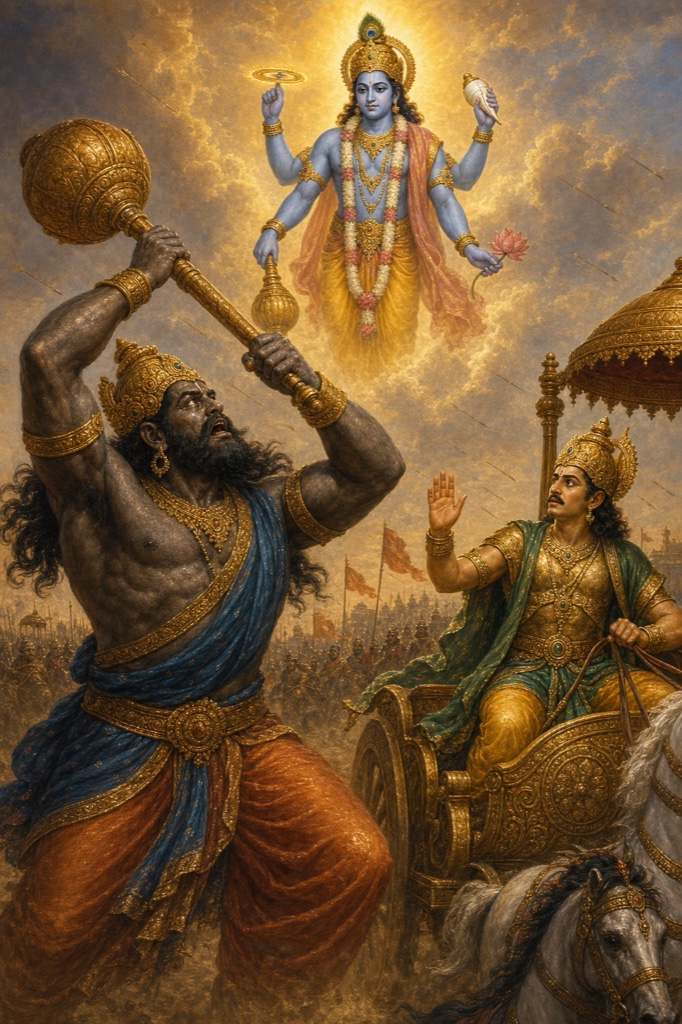
The fight deepened. Vritra roared once, a sound so vast that gods dropped where they stood as if lightning had passed through their bodies, and he strode across their senseless ranks the way a bull elephant tramples a bed of lotuses. Indra hurled his great mace at him; Vritra caught it out of the air with his left hand, easily, and swung it into the skull of Airavata. The king of elephants reeled backward twenty-eight cubits, mouth shattered, coughing blood, and both armies cried out at the feat. Then Vritra lowered the mace. He refused a second blow at a shaken god whose mount was down. Indra laid his palm on Airavata, and that hand sheds nectar at its touch; the elephant’s pain drained away, and the king of the gods stood to face the demon once more.
Vritra looked at him, and something older than the war crossed his face, for the god standing in front of him had beheaded his brother. “How well it falls out,” he said, laughing over grief, “that the slayer of a Brahmin, of his own priest, of my brother, has come to stand within reach of my trident. Vishvarupa trusted you. He sat working at your own sacrifice, and you took off his heads the way a man takes the head from a sacrificial beast. Shame, mercy, glory, all of it has left you; when my trident opens that stone heart of yours, my debt to my brother will be paid, and the vultures may collect the rest. And if instead your thunderbolt takes my head, then let my body feed the birds and beasts of this field. My debts will be finished, and I will reach the dust of the feet of the enlightened. So throw, Indra. Do not doubt the bolt as you now doubt the mace. It was forged out of Dadhichi’s austerity and filled with the power of Shri Hari, and where Hari stands, victory already stands. My mind is set on the feet of the Lord, exactly as he himself once taught me to set it; your vajra will only cut the last cords that hold me, and send me the way of the sages.” Then he hurled the trident, its prongs burning like the fire that ends an age. Indra split it in the air with the vajra and sheared away the arm that had thrown it. Vritra closed the distance with the arm still left to him and brought an iron club down on Indra’s jaw, then on the jaw of his elephant, and the thunderbolt dropped out of the god’s stunned hand. Gods, demons, and siddhas groaned together at what they saw. The king of heaven stood disarmed before his enemy.
Indra could not bring himself to reach for it. Vritra saw the hesitation and swept it aside. “Pick it up,” he said. “Take up your thunderbolt and kill your enemy. This is no hour for despair. Victory does not stay with whoever happens to hold the weapons; every fighter who has ever lived hangs in the net of the Lord of time, the one cause, the one controller, the way netted birds hang in the fowler’s mesh. Strength of body, strength of mind, life itself, deathlessness, death, all of it moves at his pleasure. A wooden puppet dances because a showman moves it; understand every creature on this field to be exactly that. Take fame and disgrace, victory and defeat, life and death evenly as they come. And look at me: beaten, my weapon gone, my arm in the dust, still working with everything left in me to kill you. This war of ours is a game of dice. Lives are the stake, the arrows are the throws, the mounts we ride are the board, and no one on either side knows until the last throw whose the victory will be.” Indra bent and lifted the vajra, and now he was staring at him.
“You feel no fear?”
“Of what? This body is a rakshasa’s, true enough. But the one who lives inside it is a servant of Shri Hari. When this body falls, a chain falls off me with it.”
“You are a devotee.”
“The form changed. The womb changed. The heart stayed what it was. In all of it there has been no moment, none, in which he slipped out of my remembrance.”
His breathing had gone ragged, and no bitterness rode anywhere on it. “He keeps the riches of the three worlds away from the people who are wholly his,” Vritra said quietly, “because riches breed fear, hatred, arrogance, quarrel, and pain. When the Lord frustrates everything a man reaches for, the frustration is his grace, and it comes only to those with nothing left to call their own.”
Indra listened, and wonder crowded the war out of him. Here stood a being who had crossed the Maya of Vishnu, the veil no striving crosses; the demon nature had burned off him entirely; born of the restless darker energies, he had given himself wholly to Vasudeva, who is purity itself. And what use, Indra thought, has a soul swimming in an ocean of nectar for the ditch-water of heaven and its little pleasures?
Then Vritra closed his eyes, and out of him came the prayer that has gone on sounding through the heart of the Bhagavata ever since. He was speaking past Indra entirely, to the Shri Hari seated within him.
“I ask you for no heaven. I do not want Dhruva’s station set above the heavens, or the realm of Brahma, or sovereignty over the whole earth, or the thrones of the regions below it, or the eight attainments of yoga, or even freedom from birth and death itself. Let those beg for such things who imagine there is anything worth more than you.”
“I want one thing. In my next birth, whatever shape you give me, whatever womb opens on me, let my mind stay a servant at your feet. Let my tongue keep telling your excellence. Let this body, whatever it is, do your work. And let me never fall out of the company of the people who love you, nor into friendship with anyone whose heart lies buried in his house, his children, his wealth, his own skin. Only that.”
“A fledgling whose wings have never opened cries for the mother bird. A starving calf strains at its rope toward the udder. A wife alone in the house aches toward a husband gone far from home. Lord, that is how my heart goes toward you, and toward nothing else.”
“For the rest, let it be exactly as you wish.”
Having prayed, he went looking for the death the scriptures set above every other, the death taken face forward in battle. He whirled his iron club up in his left hand, the one hand remaining to him, and flung it; the hundred-jointed vajra met club and arm together and took them both. Armless, blood sheeting from both shoulders, Vritra stood like a mountain whose wings have been cut from it, and still he would not fall. He set his lower jaw against the earth and stretched the upper jaw to the height of the heavens, until the opening between them was as deep as the sky itself, and he came on with mountains shaking at his tread, fierce as Death out walking, and swallowed Indra whole, elephant, thunderbolt, and all. A single cry went up from the watching worlds, from Brahma’s sages down. The king of heaven was gone into the dark of the demon.
Inside that darkness, Indra lived. Around him held the armor of Narayana’s name, the mantra-shield that had come down to him from Vishvarupa’s own mouth, and death could find no way through it. He set the vajra against the wall of the demon’s belly, tore it open, and climbed out into the light.
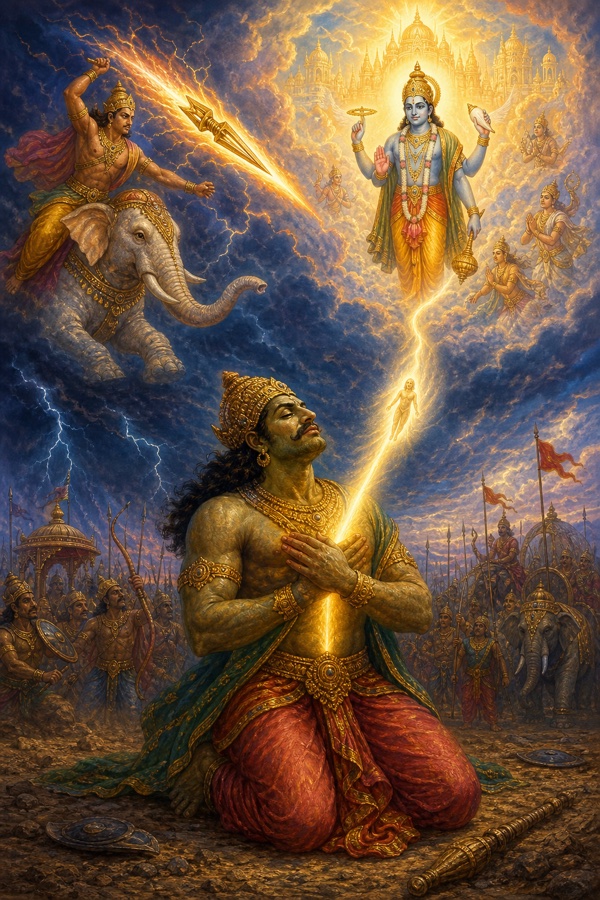
Then he laid the vajra to Vritra’s neck. That neck refused him for a full year of days, the whole northern and southern journey of the sun, while the thunderbolt turned and turned against it, and at the appointed hour the great head came away at last like the summit breaking off a mountain. Drums rolled through the upper air. Gandharvas and siddhas and hosts of sages rained down flowers and hymns on the slayer of Vritra.
And Vritra’s body fell. Out of it rose a light, and every soul on that field watched what the light did. It did not scatter, it did not wander, it did not pause. It went past the worlds of the gods altogether, steady as a man walking home at last after years on the road, and entered Shri Hari, and was gone.
The price came due for Indra. He had dreaded it before he ever struck; when the gods and sages first pressed him to kill Vritra he had refused outright, since Vritra was Tvashta’s son and Brahmin-born, and the sages had won him over with a promise: a horse-sacrifice to Narayana would burn the sin away, for the bare name of the Lord purifies even a Brahmin’s killer. The sin did not wait for the rite. It came for him in a body of its own, a hag with gray hair flying, wrapped in blood-stained rags, limbs trembling with age, wasted by disease, fouling the road behind her with breath like rotting fish, shrieking “Stop! Stop!” at his back. Indra fled through the sky, fled through every quarter, and went to ground at last in the far northeast, in the Manasa lake, where he hid inside the fibers of a lotus stalk for a thousand years without food. Heaven did not stand empty: the mortal king Nahusha, rich in merit, ruled it in his place, until power went to his head and he dared to claim Indra’s own queen, and her stratagem sent him down into the body of a serpent. Only when the long remembering of Hari inside the lotus had worn the stain thin did the sages call Indra home; and the horse-sacrifice they had promised burned off what remained of it, the way morning sun takes hoar-frost off a field.
And Bhagavan kept the demon’s prayer. Those who will ask him for nothing, who wave away even liberation itself, are the ones he gathers in and keeps at his own side.
Literary context
The story of Vritrasura runs through Chapters 9 to 13 of the sixth Skandha of the Shrimad Bhagavata. Dadhichi’s gift of his bones and Vishvakarma’s forging of the vajra fall in Chapter 10, the battle and Vritra’s hymn to Bhagavan in Chapters 11 and 12, and the brahmahatya that pursued Indra in Chapter 13.
Vritra enters the telling as an asura, yet in his former birth he was King Chitraketu, sent into this womb by Parvati’s curse (6.17). His remembrance of Hari at the moment of death stands as the Bhagavata’s living proof that bhakti transcends caste, womb, and form.
Why this katha matters now
Vritra was a rakshasa, and a devotee all the same. He died with Shri Hari’s name moving on his lips. The demon’s form never managed to hold the feeling that lived inside it; a love that could send a life smiling onto the point of Indra’s vajra was never going to stay within the limits of any body.