On this page
The Allegory of Puranjana
Narada’s voice, when he began, was very quiet.
“There was a man named Puranjana, a king of wide renown. One friend went with him everywhere, a friend called Avijnata, the Unknown, because no one had ever managed to learn what he did, where he came from, or where he went, though he had never once been absent. And in Puranjana’s heart lived a single appetite: somewhere in the world there had to be a place that was his, a home where he could take his fill of every pleasure a body can hold.”
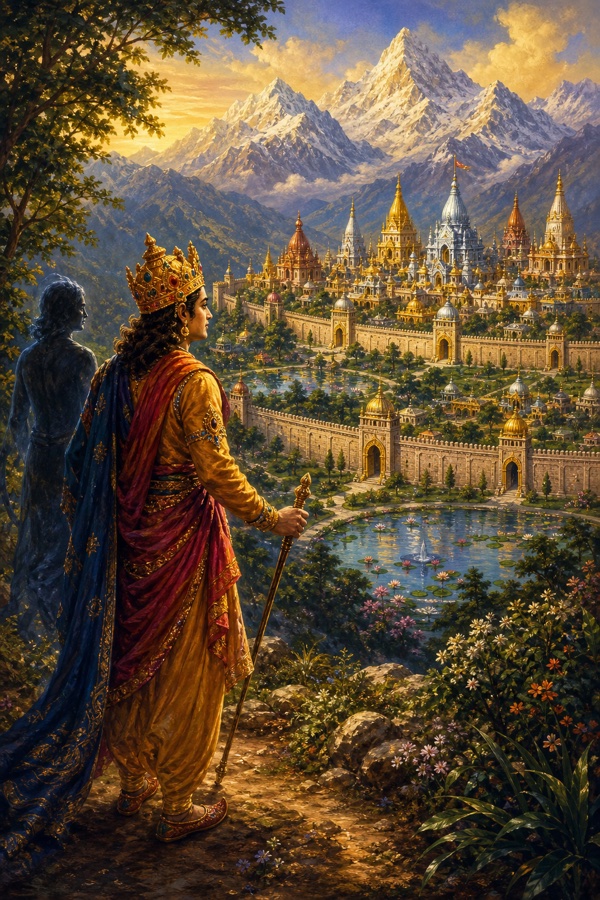
“He ranged over the whole earth looking for it. As many cities as stood on the face of the world, that many he examined and turned down as unfit for the enjoyments he had in mind, until a quiet dejection settled over him. Then one day, on the southern ridges of the Himalayas, in Bharatavarsha, the land where deeds ripen into destiny, he saw a city such as he had never seen in all his wandering.”
“The city had nine gates. A rampart ran around it, ringed with groves and watchtowers and moats, its walls pierced with lattice windows and broken by arched gateways, and inside, packed shoulder to shoulder, stood mansions crowned with turrets of gold, of silver, of iron. The floors of those mansions were paved with sapphire and crystal, cat’s-eye and pearl, emerald and ruby, and the glow that came off them made the whole city shine like Bhogavati, the jeweled capital of the serpent kings under the earth. There were assembly halls and crossroads and broad royal highways, markets and gambling houses and rest houses for travelers, banners riding the wind above terraces built of coral.”
“Seven of the nine gates were set high in the walls and two low. Five opened toward the east, one toward the south, one toward the north, and the last two, the low pair, faced the west. Each gate had its own name and its own errand, and in time the master of this city would come to use every one of them.”
“Outside the walls lay a park of trees that might have been lifted out of heaven, laced with flowering creepers and studded with lakes where waterbirds called and bees kept up their low murmur. A breeze moved off the flowerbeds carrying spray from cool cascades, and it stirred the boughs that leaned over the lotus ponds. The animals of that park had put violence away, hunter and hunted grazing side by side, gentle as hermits, and the cuckoos sang from the branches in a way that made every passerby feel personally invited.”
“Puranjana said to himself: this is good. This is the place. I will live here. And he walked in through the gate.”
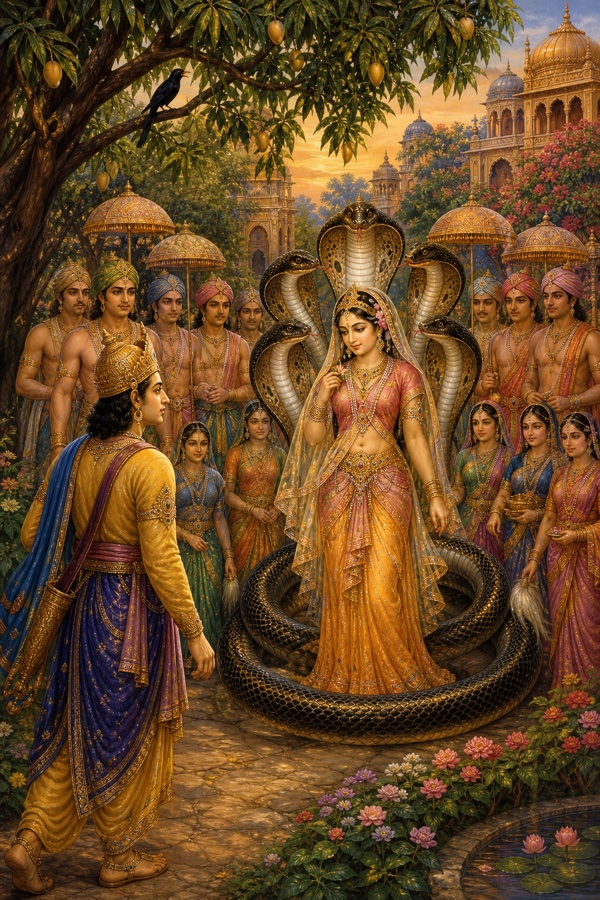
“Inside, a young woman came strolling toward him, as if chance itself had arranged the meeting. Ten attendants walked with her, and every one of the ten was lord of a hundred women of his own. A serpent with five hoods went ahead of her, keeping guard on every side of her at once. She was sixteen, able to wear any form she pleased, and she was out searching for a husband. Earrings burned softly along her cheeks, a girdle of gold rode her tawny skirt, and her anklets rang at every step like small bells announcing her.”
“Puranjana stopped where he stood. Her sidelong glance had already gone through him like a shaft. ‘Who are you?’ he asked, and his voice came out low. ‘Whose daughter are you, and what brings you to the edge of this city? Who are these ten warriors, and their hundreds of women, and what is this serpent that walks before you? Are you Hri, modesty itself out walking the woods? Are you Parvati, strayed from Shiva’s side, or Vak, the goddess of speech, or Lakshmi herself, hiding from her Lord in this forest? No. Lakshmi’s lotus never leaves her hand, and your feet are touching the ground. Stay, then, and grace this city with me, the way Sri graces the halls of Vaikuntha at her Lord’s side.’”
“She looked at him a long moment. ‘I do not know who I am,’ she said. ‘I do not know my father, or yours, or the name of whoever built this city where I find myself. I know only this much: I am here today, and I have no companion of my own. These men and women are my friends, and when I sleep, this serpent stays awake and keeps the city. Stay. With the help of my people I will serve you every pleasure you could ask for, for a hundred years. Everything worth having in this world, the merit, the wealth, the delight, the sons, the fame, lives inside a house with a wife in it; ask the renouncers what they own that compares. And what woman searching for a husband would pass over a man like you?’”
“Puranjana heard all of it, and everything in him said yes. So he said yes.”
“The two of them set up house in that city, and a hundred years began to slip through it. Once, early on, he remembered he was a king. He put on gold armor, took up a great bow and a quiver that never ran empty, mounted a chariot drawn by five swift horses, a strange chariot with two wheels on one axle, three flagstaffs, five cords, a single rein, one charioteer, one seat, twin yoke-poles, and seven plates of armor around it, and rode out without her to the forest called Panchaprastha, where he slaughtered game until his arms ached, deer and boar and hare and porcupine falling to his arrows far past anything the scriptures allow a king. When he came home, bathed and perfumed and pleased with himself, she would not look at him. She was lying on the bare ground, hair undone, face stripped of its ornaments. And the king of the nine-gated city knelt, touched her feet, gathered her into his lap, and begged. He never rode out without her again. From that day her word was his law. When she drank, he drank; when she ate, he ate; when she sang, he sang, and when she wept, he wept. She laughed, and he laughed with her; she ran, and he ran after; she lay down, and he lay down beside her; she listened, and he leaned in to listen too. Whatever she did, he did after her, faithfully, helplessly, the way a tame monkey copies the mistress who keeps it.”
“Children came, and kept coming: eleven hundred sons and one hundred ten daughters, every one of them a credit to the house. In time the sons took brides and the daughters took husbands, and a hundred sons were born to each of his sons, until the line of Puranjana had spread across the whole country of Panchala. And to hold all of it, to keep the gods and the ancestors on his side, he took to sacrifice, and animals died at his altars, consecration after consecration, in numbers he never counted.”
“He came to feel he owned the place entire. Every lane, every tower, every breath drawn inside the walls seemed to answer to him. He knew each of the nine gates by name, and through each he went out to take a different country. Through the two bright gates called Khadyota and Avirmukhi, built side by side, he traveled with his friend Dyuman to Vibhrajita, the shining land. Through the twin gates Nalini and Naalini he went with Avadhuta to Saurabha, the country of fragrance. Through the great fifth gate, Mukhya, he sallied out with two companions at once, Rasajna and Vipana, to the rich lands of Bahudana and Apana. Through Pitrhu, the southern gate, and Devahu, the northern, he journeyed with a friend named Shrutadhara into south Panchala and north Panchala. Through Asuri he rode down with Durmada to Gramaka, and through Nirriti, with Lubdhaka, to the grim country of Vaishasa. Two doors of his house, Nirvak and Peshaskrit, opened onto no view at all, and yet with those two he did all his work and made all his rounds. It was a good life, he told himself. It would go on.”
“Half his life went by like that. He never felt a single day of it leave.”
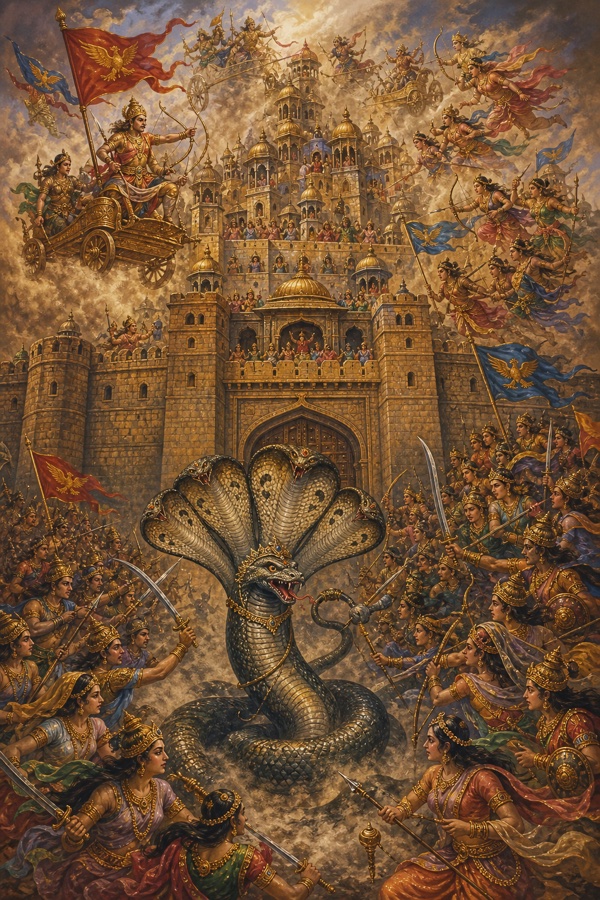
“Then one morning a cloud of dust climbed over the walls. A Gandharva king had marched against the city, Chandavega, a name that means dreadful speed. Three hundred sixty Gandharva warriors came in his train, and three hundred sixty Gandharva women, half of them fair as moonlight and half of them dark, and they did their looting in shifts, wave after wave, circling the city in a rotation that never broke and never rested.”
“The serpent with five hoods met them at the gates alone. One guard against seven hundred twenty raiders, and he held them, year over year, for a hundred years.”
“But no single guard holds every wall forever. Puranjana could see his one true defender, Prajagara, the one who never sleeps, thinning and failing against so many, and a heavy dread for his city, his kingdom, and his kin moved into him and stayed. Yet he lived so deep under his companion’s spell, so busy drinking down the tribute of pleasures his own household carried to him, that the true size of what was coming never quite reached him.”
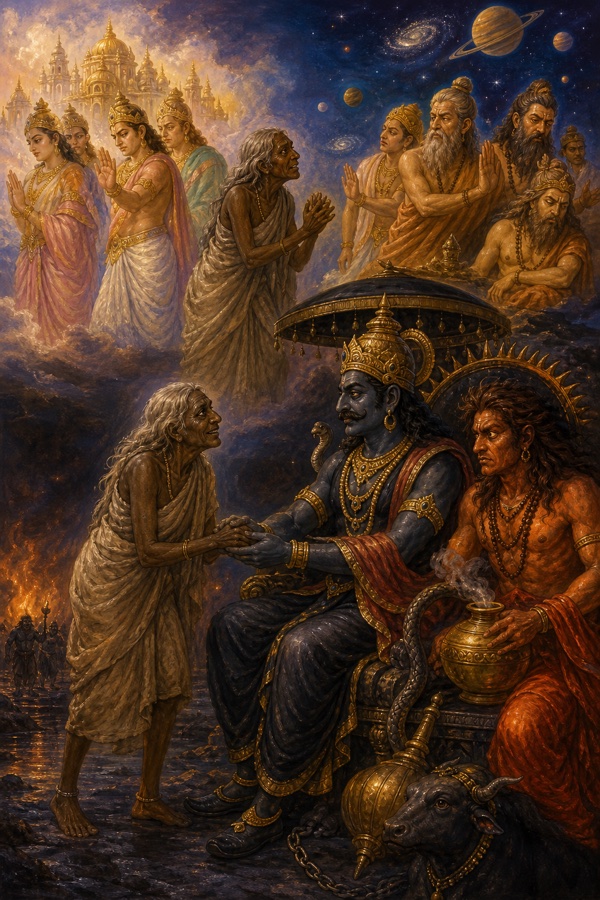
“In those same days a dark daughter of Kala, of Time itself, was roaming the three worlds in search of a husband. No one would take her. Door after door closed against her, and the world settled a name on her, Durbhaga, the luckless one. She was Kalakanya, the maiden people call Jara: old age itself, the one bride nobody wants.”
“She had been accepted exactly once. Ages before, the royal sage Puru, that youngest son of Yayati who once agreed to carry his own father’s decrepitude in his young body, took her without flinching, and in her delight she handed him back a kingdom. And once,” Narada said, and something rueful crossed his face, “she came for me. I had just stepped down to this earth from Brahma’s realm, and she wooed me on the open road, though she knew I was vowed to lifelong celibacy. I refused her, and the refusal cut her so deep that she cursed me where I stood: you have spurned me, sage, so from this day you will never stay long in any one place. She had her wish. That is why you find me forever arriving and forever leaving, Rajan. And it was I, all the same, who told her where to go next.”
“At my direction she went to the lord of the Yavanas, the king whose name is Bhaya, Fear, death’s own commissioned agent among the living, and she offered herself to him as a wife. ‘Compassion for the afflicted is a man’s plainest duty,’ she told him. ‘Whoever refuses what is honestly offered is a fool, and the wise grieve for him.’ Bhaya smiled at that, and answered her more kindly than anyone ever had. ‘What the world will never give you, I can. You are inauspicious to every creature that breathes, so no one will ever stand beside you at a wedding fire. Take creation itself for your husband instead. Move through it unseen, with my army at your back, and claim every being that karma has built, one by one. Be a sister to me. And here is my elder brother, Prajvara, the fever with two faces, the one that burns and the one that shakes with cold. With the two of you beside me and my host behind, I will range over this world, and no eye will mark us coming.’ So old age found her family at last: death for a brother, fever at her side, and the whole breathing world for a husband.”
“One day that army arrived at Puranjana’s city, the city an old serpent was still holding with the last of his strength, and it struck fast. Kalakanya seized the town, and whatever she embraced went slack and powerless on the instant, its luster gone. The Yavana soldiers found the nine gates and poured through all of them at once, and the breaking of everything alive inside those walls began.”
“Puranjana came apart with his city. He watched the place he loved as his own self crack brick by brick. His sons and grandsons turned insolent to his face; his servants and ministers stopped obeying, then stopped pretending to obey; the companion of his hundred years grew cold and indifferent, a stranger in the inner rooms; and he himself lay caught in the arms of the daughter of Time, every pleasure turning tasteless at her touch even as he reached for it. Panchala was overrun. The kingdom had become enemy country. He hunted for a way out of the ruin and found nothing in any direction.”
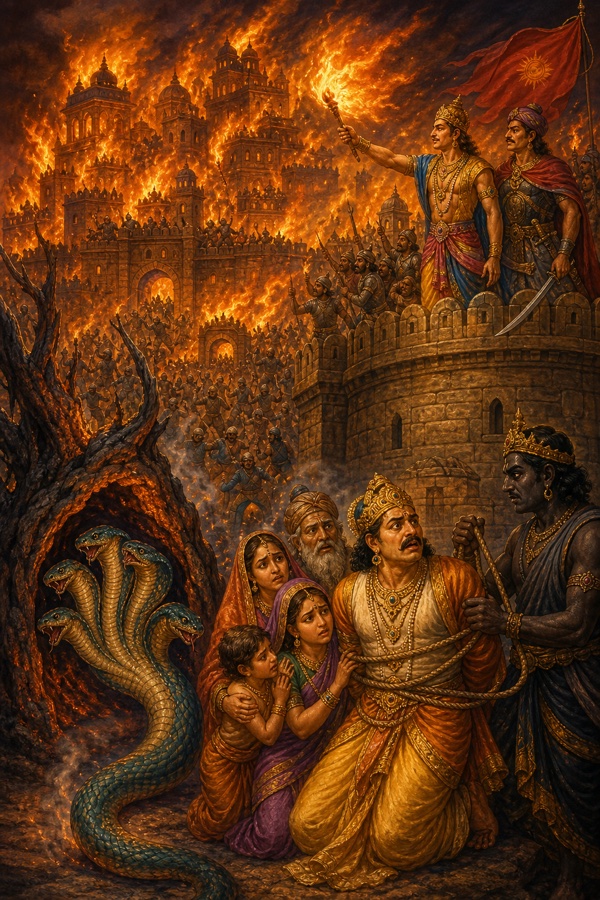
“Then Prajvara made his brother a gift. He set fire to the whole city at once. Flame ran the ramparts, took the mansions, rolled through the nine gates; and the old guardian serpent, his coils gone slack, his strength long since bled away by the Gandharvas, writhed for escape like a snake twisting out of the hollow of a burning tree. And when the Yavanas cut off his retreat, the sleepless one, who had fought alone for a hundred years, wept.”
“And even then, in a burning city, Puranjana could not open his fist. ‘I’ and ‘mine’ held him tighter than the enemy did. He counted what he was losing, sons, grandsons, daughters-in-law, sons-in-law, servants, treasury, house, and grieved over each in turn. He thought of his wife: she never ate until I had eaten, never bathed until I had bathed, went silent with fear when I so much as raised my voice; how will she live? He thought of his children: they will go down like passengers in a ship that breaks apart in mid-ocean. While he was still counting, Bhaya took him, bound him the way a beast is bound at the sacrificial post, and dragged him away, his whole retinue stumbling behind in tears. The serpent left the abandoned city then, and the city itself crumbled back into the five materials it was built from. And dragged into the dark, Puranjana never once remembered his oldest friend. The animals remembered him instead: every creature he had ever slaughtered at his altars stood waiting with axes, anger fresh after all those years, and they cut at him as he had cut at them, and he went down into a blind darkness where agony keeps no calendar, and stayed there past all counting.”
“But the mind takes the shape of its last thought, and his last thought, under everything, had been her. So the soul that had been Puranjana woke as a girl, a daughter born beautiful into the house of the king of Vidarbha, carrying no memory that this exact story had already run its full length once before.”
“When she came of age, Malayadhvaja, king of the Pandyas, beat every rival on the field of battle and won her, the prize of valor. She bore him a dark-eyed daughter first, a girl the sage Agastya would one day marry, and after her seven sons, who grew into the seven kings of the Dravida country; and to each of those seven a hundred million sons were born, whose descendants would hold this earth for a full age of Manu and beyond it. In time Malayadhvaja divided the land among his sons and went away to Mount Kulachala to give what remained of his life to the Lord, and Vaidarbhi, the daughter of Vidarbha who had once been Puranjana, left her house, her sons, and every luxury behind and followed him, the way moonlight follows the moon.”
“They lived where three rivers run, the Chandravasa, the Tamraparni, and the Vatodaka, and he washed body and mind in their waters and lived on roots and seeds, fruit and leaves, until his frame had wasted to its outline. He mastered every pair of opposites that drives a body: heat and cold, wind and rain, hunger and thirst, the sweet and the bitter, pleasure and pain, until each weighed the same as its twin. He burned his cravings out in austerity, gathered senses, breath, and mind into stillness, and sat unmoving in one posture, like a stump the forest had grown around, for a hundred years of the gods. Sri Hari Himself rose in his heart as a teacher, and by that inward light he saw the Self at last: the witness that watches even the mind at work, distinct from every layer wrapped around it, the way a dreamer watches harm come to his own body in a dream and stands apart from it, untouched. He knew himself as one with Brahman, then let even that knowing go, and one day he rose out of this world and did not come back to his body. Vaidarbhi, in rags, her hair matted, thinned by her vows to a flicker, shone beside her still husband like a low flame beside coals that have gone quiet, and she went on serving him, because no one had told her, and love had not let her guess. Only when she took his feet in her hands and found no warmth left in them did she understand. Then she cried out in that empty forest like a doe cut off from her herd, tears bathing her breast: rise, rajarshi, rise; the earth with its belt of oceans is afraid; there are robbers in it, and kings no better than robbers; who will protect it while you sleep? And when the forest gave nothing back, she piled a pyre of logs, laid her husband’s body on it, set it alight, and made up her mind to walk into the fire behind him.”
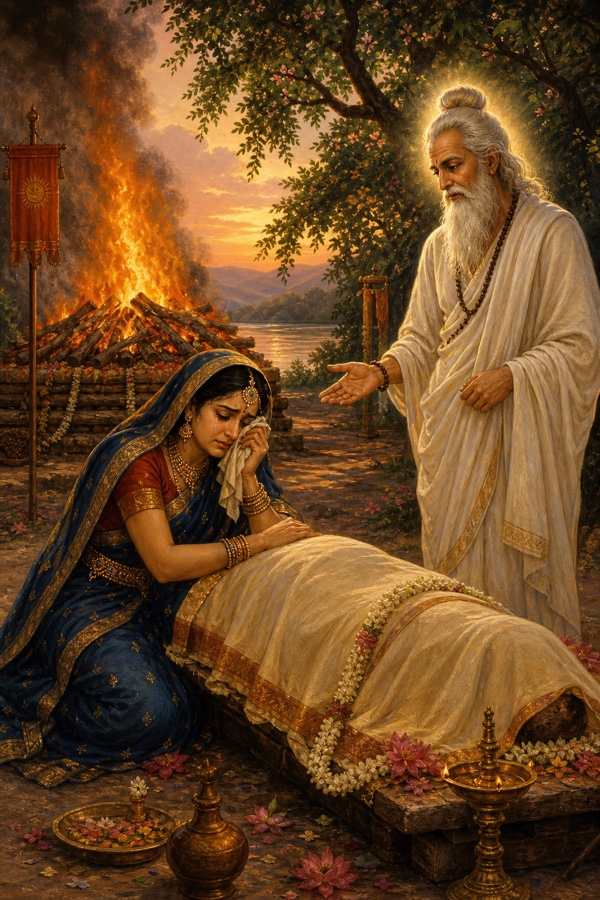
“At that moment her oldest friend came and stood beside her, this time wearing the form of a Brahmin who knew the Self. His voice was gentle. ‘Who are you?’ he asked the weeping woman. ‘Whose daughter are you? And this man asleep on the pyre, who is he to you, that you grieve so? Look at me. Do you truly remember nothing? Once you had a companion called Avijnata, and you left him to go looking for a home of your own. You and I, friend, were swans together on the Manasa lake, and for thousands of years we lived there needing no shelter at all. Then your heart turned toward enjoyment, and you left me, and came down to this earth; and on your wanderings you found a house that some woman had raised: five pleasure gardens around it, nine doors into it, one porter, three encircling walls, six families of merchants trading inside, five markets, the whole of it built from five materials, and a woman for its mistress. You walked in, and in her company you forgot what you were.’”
“‘So hear me now. You are no daughter of Vidarbha. This hero on the pyre was never your husband, any more than you were ever truly Puranjana, wedded to Puranjani and locked in the city of nine gates. Every one of those costumes was illusion, a veil I myself let fall over you. You took yourself for a man once; you take yourself for a woman now; in truth you are neither, and never were. You and I are two swans, the same two swans of the Manasa lake. I am you, and you are no other than I. The wise have looked for a difference between us and never found one, for whatever difference appears is the kind a man finds between himself and his own reflection, in a mirror, or in the dark of another’s eye.’ And at those words the swan of the Manasa lake woke, came home to its own self, and the long forgetting that had begun the day it left its friend was over.”
“‘I have told you this truth slantwise, Rajan,’ Narada added, ‘inside a story, because the Lord who made this universe loves to stay unrecognized in it.’”
“That is how the soul travels when no friend’s voice reaches it: birth after birth, each time a new body, a new name, a new city, and inside each city the same story running to the same end, a companion, children, and one day a cloud of dust rising over the walls.”
Narada let the story stand and said nothing more. Prachinabarhi sat looking at him.
“Did you follow it, Rajan?”
The king shook his head slowly. “No, Munivar. I heard every word, and the meaning stayed locked. A lifetime of ritual has left my mind too coarse for this. The wise may catch such a thing in flight. I could not.”
Narada smiled a little.
“Then take the key. Puranjana is you. Puranjana is every soul that breathes. The soul is a maker of cities: it raises itself fortress after fortress of flesh to live in, bodies with two feet, with four, with many, with none, whatever the birth grants. And when this soul went out craving enjoyment, it surveyed every form there is and judged the human body, two hands, two feet, nine gates, the finest pleasure-house ever raised, and moved in. Puranjani, the girl who could not say where she came from, is your own intelligence, the buddhi, which has never yet told anyone its origin. The soul takes her hand, calls her judgments its own, and through her it enjoys the world; and out of that marriage comes the whole long dream of ‘I’ and ‘mine’.”
“The city is this body, and the nine gates are its nine openings, through which you go out again and again toward the things of the world. Five gates face east, at the front of the head: the two eyes, the two nostrils, and the mouth. The eyes are the paired gates Khadyota and Avirmukhi, built side by side; Dyuman, the friend who went through them, is sight, and Vibhrajita, the shining land he reached, is everything that can be seen. The nostrils are the twin gates Nalini and Naalini; Avadhuta, who went out through them, is smell, and Saurabha is the country of fragrance. The mouth is Mukhya, the chief gate, and the two friends who used it together are Rasajna, taste, and Vipana, speech, trading in the lands of food and talk. The right ear is Pitrhu, the gate of the fathers, and the left ear Devahu, the gate of the gods; Shrutadhara, who traveled through both, is hearing. Through one ear a man takes in the scriptures of works and walks the southern road, the way of the ancestors; through the other he takes in the scriptures of stillness and walks the northern road, the way of the gods. The two low gates facing west are the organ of generation, Asuri, through which Durmada, lust, rides down to Gramaka, and the organ of excretion, Nirriti, through which Lubdhaka goes out toward Vaishasa. And there are two doors that open onto no view at all, Nirvak and Peshaskrit: the hands and the feet, which see nothing and do everything.”
“The lady’s ten attendants are the ten senses, five that know and five that act, and the hundred women each attendant commands are the countless habits and hungers every sense breeds. Over the ten stands an eleventh, their marshal, the strongman Brihadbala: the mind, commander of both companies. The innermost chamber of the city, the private room the mind keeps slipping back into, is the heart, and Vishuchina, the steward of that chamber, is the same mind in its inner dress, dealing out contentment here, delight there, infatuation everywhere, as sattva, rajas, or tamas takes its turn. The five-hooded serpent at the gate is the fivefold breath of life, prana, apana, vyana, udana, samana, one breath wearing five hoods, named Prajagara because it never sleeps; and while it seems to be defending the city, it is quietly spending the city down. And the friend Avijnata, the one Puranjana could never place, is the Paramatma, the Lord Himself seated inside you, called the Unknown for one reason only: name, deed, and attribute have always failed to disclose Him fully. He was there before the first brick was laid, and He is there after the last one falls.”
“And when Puranjana rode out hunting, look at what carried him. The body is a chariot. The five senses are its horses, and though the chariot itself never moves, it races like the year. Its two wheels are your good deeds and your bad. Its three flagstaffs are the three gunas flying their colors above you. Its five cords are the five breaths, its one rein is the mind, and its charioteer is the intelligence; the heart is the seat, the pairs of opposites are the twin poles that take the yoke, the five sense-objects are its weapon racks, and the seven stuffs of the body are its sevenfold armor. In that chariot the soul goes galloping after a mirage, the ten senses riding behind it for an army, and the slaughter of all those animals in the forest is exactly this: the reckless spending of a life on the pleasures of the five senses.”
“The country of Panchala, where the city stood, is the field of the five sense-objects; everything the senses can seize lies inside its borders. Chandavega, the Gandharva king, is Time. His three hundred sixty warriors are the days of the year, and his three hundred sixty women, the fair ones and the dark, are its moonlit and moonless nights, and in rotation, turn by relentless turn, they carry your life away with them.”
“Every year that army marches on your city. And every year a few more bricks slide silently out of the walls, and you do not hear one of them fall.”
“Kalakanya is old age, Jara herself, the unwanted bride who reaches every door in the end. Bhaya, the Yavana king who made her his sister, represents death. His soldiers are the torments of the mind and the diseases of the body, and his elder brother Prajvara is the two-faced fever, the one that burns and the one that freezes. One day those three stand at your gates, and no wall ever built has kept them out. And in that hour, whatever image fills the mind becomes the seed of the next birth. Puranjana went out of his body thinking of a woman, and a woman is what he woke as.”
The king sat very still, holding his breath without knowing it.
“Then what is the way off this wheel, Munivar?”
“There is a way,” Narada said. “Live in the city. Rule it well, keep its gates, repair its walls. Only stop believing you are the city. You are the one seated inside it who watches, the witness of everything the walls let in and everything they cannot keep out. Consider the deer, Rajan. It grazes in a garden of flowers, nibbling its blades of grass, ears drunk on the humming of the bees, and it is so pleased with all of it that it never sees the wolves circling ahead, and never hears the hunter behind. You are that deer. The garden is your household; the grass is the thin sweetness of the pleasures you graze on; the humming bees are the voices of the women and children you love; the wolves are your own days and nights, taking pieces of you as they pass; and the hunter is death, whose arrow left the string the day you were born and has been in flight ever since. So pull the mind inside the walls of the heart and hold it there. Turn the stream of the ear inward, away from the world’s chatter, toward the stories of the Lord. Remedies within the world only shift the world’s weight, a load carried on the head, moved to the shoulder, and called relief; a dream inside a dream is still a dream. What breaks the round outright is devotion. Set your love on Sri Hari, the Lord Vasudeva, the teacher seated in every heart, and keep company with those who cannot stop telling of Him, for where such people gather, streams of nectar run in every direction, and the ones who drink from them with open ears are never again gnawed by hunger or thirst, fear, grief, or delusion. In the one whose devotion has grown firm, this entire wheel of birth and death comes apart on its own, the way a dream comes apart the instant you wake.”
The king bowed his head, and for a long while he did not speak.
Literary context
The allegory of Puranjana fills chapters 25 through 29 of the Bhagavata’s fourth Skandha, where Devarshi Narada unfolds it for King Prachinabarhi; the sage Maitreya, retelling that whole exchange to Vidura, is the frame around the frame. The cipher runs: Puranjana is the jiva, the embodied soul; the nine-gated city is the body; Puranjani is the buddhi, the intelligence; the five-hooded serpent is the fivefold prana; the unrecognized friend Avijnata is the Paramatma; Chandavega is time, his seven hundred twenty raiders the days and nights; Kalakanya is old age. The story’s whole weight comes to rest on one word, sakshi, the witness: time takes every city, and the one who watches from within is beyond its reach. The closing image, two swans on the Manasa lake who were never really two, gives the Bhagavata its other name, the Paramahamsa Samhita, the scripture of the supreme swans. The same craft, speaking of the atman by drawing the body as a figure, returns in the chariot allegory of the Katha Upanishad.
Why this katha matters now
Puranjana made himself master of a city and forgot that the city was on loan from the day he moved in. Time ate at his walls every single year, and he never once counted the loss. Anyone who still points at a job, a house, a body and says ‘I’ is standing exactly where he stood, and the allegory puts a single question to each of us: behind the eyes reading this, who is the one watching?