The Yoga Sutras of Patanjali
Two thousand years ago, someone tied the whole tangle of the mind into 196 short lines, the way a weaver ties a whole pattern into one thread. No weighty text, no sermon. Just one question, asked and answered with great patience: what is the mind, and how does it grow still.
First, one thing
Who was Patanjali? Honestly, no one knows for certain. Two or three centuries on either side of the Common Era, one person (or perhaps a whole tradition working across generations) decided to press the whole of yoga down until it could be threaded onto a single string. That is exactly what “sutra” means: a thread, the kind that runs unseen through a garland and holds every flower in its place. The fewest possible words, the most possible meaning, and nothing left loose.
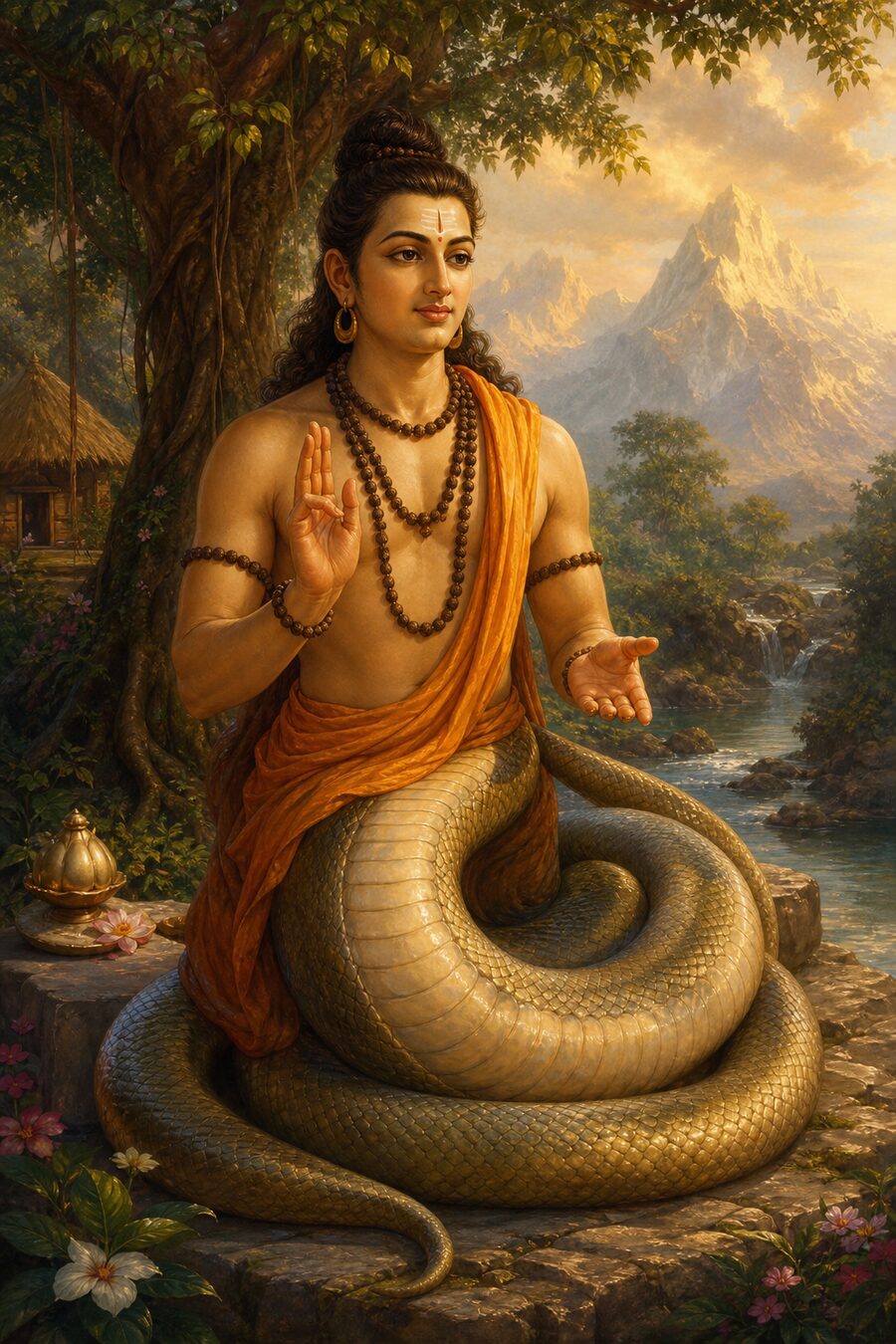
It holds no story, no gods quarreling, no hero setting out. It is a guide to the inner workings of the mind, written by someone who had taken the thing apart and watched it run. Patanjali writes almost like a seasoned craftsman: first he tells you the destination, then the road, then the road’s fine features and its slippery patches, where travelers before you have lost their footing, and at the end the place where everything comes to rest.
If you have ever tried, even a little, to quiet the mind, in any way, in any tradition, this book will light up for you, line after line, like a lamp carried into a room you thought you knew. And if you never have, no matter. As you read, the trying begins on its own.
How to read the whole thing
First time: Pada 1 through 4, in order. Do not rush. In each pada a few sutras are the real pillars, and the rest stand around them the way the smaller rooms of a house gather around its hall.
Only have time for one pada? Take Pada 2. It is the most grounded, the one with its feet in the soil, and the famous eight-limbed yoga lives there.
Already have a practice? Read Pada 1 and Pada 4 together. The two are two ends of one thing, the question and its answer, and everything in between is the bridge that joins them.
What about the powers? Pada 3 brings some startling capabilities. They are fascinating, and they stop well short of the destination. Patanjali himself calls them an obstacle on the road. Read them as a catalogue of what is possible, the way one reads an inventory of a treasury without needing to carry anything out, with nothing on the page you are obliged to do.
Samadhi Pada · The chapter on absorption
The map. What the mind is, what the waves rising in it are, and what remains behind once it grows still and the water clears. The two-word formula of practice and dispassion is right here (1.12).
Pause here: 1.2, 1.3, 1.12, 1.14, 1.33, 1.41
Sadhana Pada · The chapter on practice
The road. Where suffering comes from (the five kleshas, named one by one), and the first five limbs of the eight-limbed yoga: yama, niyama, asana, pranayama, pratyahara. The most useful pada of all, the one to carry into the day.
Pause here: 2.1, 2.3, 2.16, 2.29, 2.30, 2.46, 2.47, 2.49
Vibhuti Pada · The chapter on powers
The fine features. The last three limbs of the eight, the method of samyama, and the startling powers that open from it, which Patanjali both describes and, in the same breath, warns you about.
Pause here: 3.1 to 3.4, 3.9, 3.38, 3.50, 3.51, 3.53
Kaivalya Pada · The chapter on liberation
The destination. The mind’s true face (it does not shine by its own light), the workings of karma and latent desire, the dharma-megha samadhi, the cloud that rains without being asked, and kaivalya. The shortest pada, the deepest.
Pause here: 4.1, 4.3, 4.7, 4.18, 4.19, 4.22, 4.25, 4.29, 4.34
The one marvel of the whole book
One suggestion for reading the four padas together: carry the opening question with you as the work unfolds, the way a traveler keeps the name of the city in mind through every turning of the road.
In the very second sutra (1.2) Patanjali lays the whole thing down: yoga means the stilling of the waves of the mind. And in the next sutra he names the reward, without waiting a line longer: then the “seer” settles into its own true form, the one who was watching all along, now at home.
The discussion continues through practice and discernment, through the five afflictions and the eight limbs and the long list of powers. When you reach the description of kaivalya in the final sutra, 4.34, return to the opening pair, 1.2 and 1.3, and read them alongside it, with the whole road now behind you.
Sutra 1.1 announces the teaching of yoga, and its first word, “atha”, now, assumes that something has already happened in the reader’s life. The definition follows in 1.2, and in 1.3 the seer rests in its own nature. Reading the beginning beside the ending can reveal another layer of the work, the way the first line of a song means something new once the last line has been sung.
After this
The Ashtavakra Gita shows this very destination by a reversed road. Patanjali’s path goes step by step, Ashtavakra’s in a single leap. Read the two together and each will light up the other, as two lamps in one room do. And Chapter 6 of the Gita is on meditation, in direct conversation with Patanjali, down to its lamp in a windless place that does not flicker.
As you read, keep one question beside you: which wave does my own mind stay drowned in most? Just watching that, for a day or two, does more than weeks of study.
Read alongside
- Bhagavad Gita, Chapter 6 Dhyana yoga, an echo of Patanjali’s eight limbs.
- Ashtavakra Gita Yoga’s final destination is where Ashtavakra begins.
- Narada Bhakti Sutra Bhakti-yoga, the full bloom of Patanjali’s “ishvara-pranidhana.”
September 2026 source note
Numbering checked against the Agashe Sanskrit edition at GRETIL and Vivekananda’s independently published text and commentary, 1.1 to 1.3. For the ending, see Vivekananda IV.33, corresponding to Agashe 4.34. Vivekananda prints the additional aphorism numbered 4.16 by Agashe in an editorial note, outside his main count. Interpretive differences remain distinct.