On this page
The Discontent of Vyasa
It was the Dvapara, the third of the world’s four ages, when strength has already begun leaking out of things. He was the son of the sage Parashara, born of Satyavati, and the wise knew him for an amsha of Shri Hari himself, a portion of the Lord walking the earth in a man’s body. One morning he bathed in the Sarasvati at first light and sat down alone, and with the eye that reads what has been and what is still on its way, he watched the age thin. Time was slipping past unnoticed, and under that flux the duties of the seasons were sliding into one another and losing their edges. The old potency was draining out of material things. People were turning irreverent, weak, dull of mind, short of years. He looked at that luckless generation, and then he turned the same far-reaching sight inward and searched for the one thing that could still carry every kind of person, of every order and every stage of life, across to their own good. And he found where it lay. The fire sacrifice is what makes people clean, and the sacrifice stands only as long as the sacred word stands under it.
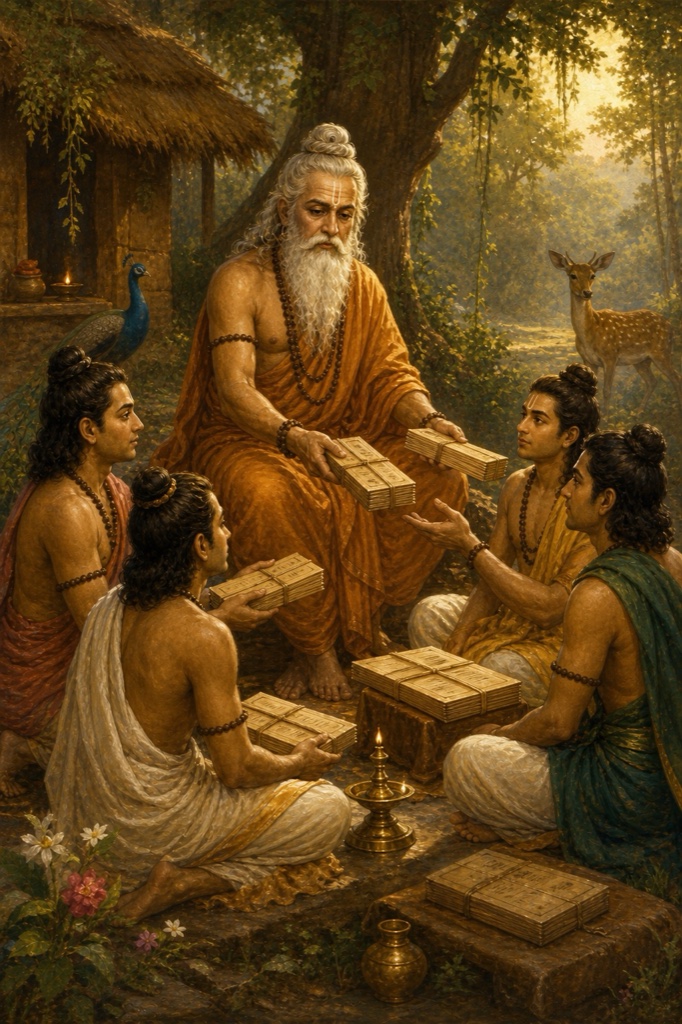
A full Vedic offering needs four priests, each holding a different corner of the rite. One summons the gods with the hymns. One measures the ground, raises the altar, fetches the wood and the water, and pours the oblation into the fire. One chants the melodies. And one sits watch over the whole performance in silence, catching the smallest slip and setting it right. Each office leans on its own portion of the sacred word, so Vyasa cut the one Veda along those four seams, into the Rik, the Yajuh, the Sama, and the Atharva, the act for which every later age would call him Vyasa, the divider. Then he placed each part in a disciple’s hands, the way a father settles each of four sons into one wing of the ancestral house. The Rik went to Paila. The Sama went to Jaimini, the singer. The Yajuh went to Vaishampayana. The Atharva went to Sumantu, son of Daruna. And the Itihasa-Purana, the histories and the ancient lore that the wise call the fifth Veda, he gave to Romaharshana, father of the very Suta whose voice now carries this telling to Shaunaka and the sages. From those rishis the branches divided, and divided again, until through disciples and disciples’ disciples the countless branches of the Veda were spreading across the earth. He had done it for the slow of memory as much as for anyone, so that a person who could not hold the whole might at least keep a living part.
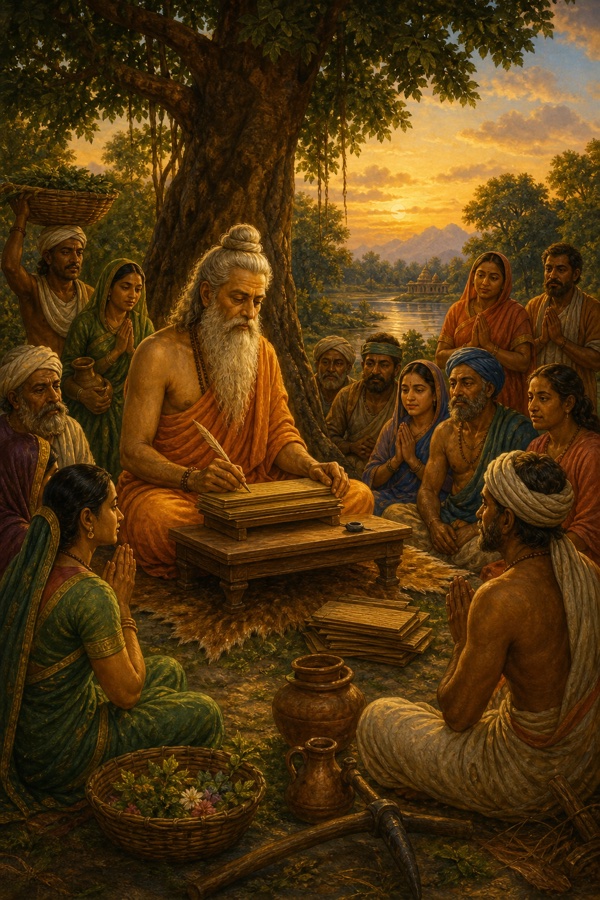
Even so, something remained. Women, shudras, and those born into the twice-born castes yet never brought to Vedic study were barred from so much as hearing the Veda, and with that door shut on them they kept slipping off the road to their own welfare. Vyasa could not bear to watch it. The tender heart under all that austerity spoke: someone has to take their hand too. So he composed the Mahabharata, the great itihasa, so that people who would never be allowed the Veda’s language could still reach their own dharma through a story they were allowed to love.
Kings and rishis, war and statecraft, dharma, wealth, desire, moksha, he poured everything into it. Through the Mahabharata he opened the meaning of the Veda outward, wide enough that even those the mantras had been fenced against, the women and the laborers, could come to know their own duty and their own good.
And then, with everything composed, with the moment come at last to lay the pen down, something rose inside him for which he could find no name.
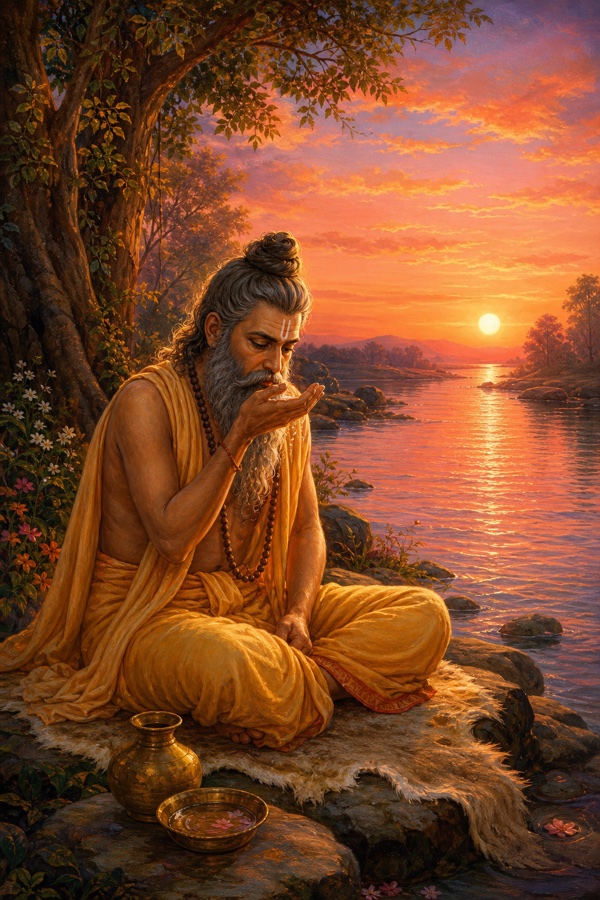
He was sitting on the holy bank of the Sarasvati. The sun had just cleared the far water, and its red lay scattered across the current. It was a solitary, clean place; he had bathed, sipped the ritual water of achaman from his palm, and settled onto his seat. His mind, though, was like water the wind will not let rest, even for a moment.
He was full of brahmatejas, the banked radiance a lifetime of discipline earns. He knew this about himself, and there was no vanity in the knowing; it was plain fact. He had kept brahmacharya and the other great vows without guile, studied the Vedas with reverence, honored his elders and the sacrificial fires, and obeyed their word in everything. And still one corner of the heart lay unfilled, the way a feast can be laid, every dish served, and one bowl at the center left standing empty.
He asked himself, inside his own mind: “I kept the vows honestly. I honored the Veda and my gurus and followed their precepts. Through the Mahabharata I opened out the Veda’s very meaning, so that even women and shudras might know their dharma. I stand foremost among those who carry sacred knowledge, and no task lies past my strength. Then why does my heart sit in me like the heart of a man whose desire never arrived? Which bowl is still empty?”
An answer began to flicker. Surely it was this: he had left mostly untold the dharmas that carry a person straight to the Lord, the very dharmas the paramahamsas, the great swans among ascetics, hold dearest, the ones dear to the Lord himself. The thought had not finished opening when something else reached him first.
A single string of a veena sounded on the air.
Far off, then near. Narada.
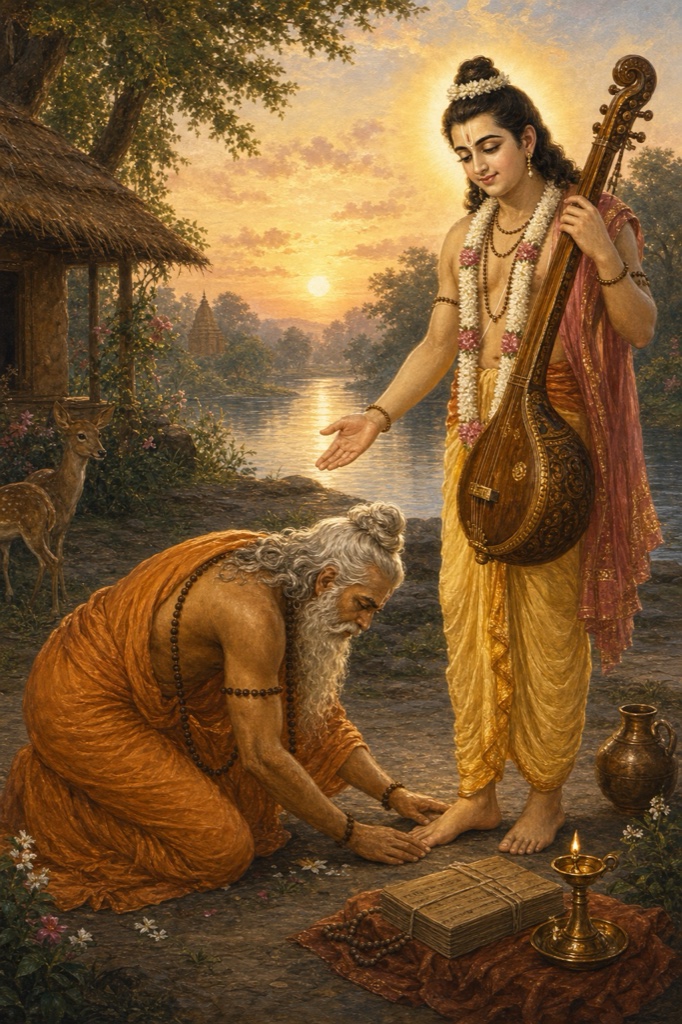
He traveled like that, unannounced, the wandering seer of the gods, pacing the three worlds with his veena, and he had a way of arriving at the exact hour when someone’s inside stood emptiest. Vyasa sprang to his feet. He worshiped that devarshi with the full rite owed to one whom the gods themselves honor, brought him the seat of respect, and bowed at his feet. And through all of it his eyes stayed lowered, like a student’s before his guru, though this was the same Vyasa who had just cut the Veda into four.
Narada took the seat and smiled. It was his habit, that small smile before speaking, the smile of a man who already knows the question he is about to be asked.
“Son of Parashara,” he said, “is your body content with its work? Is your mind? This Mahabharata you have made is a marvel. Every aim a human life can pursue, dharma and all the rest, is dealt with in it fully. The eternal Brahman-truth too you have pondered all the way down and come back knowing. And yet, prabhu, you grieve over yourself like a man whose work came to nothing. Why?”
Vyasa bowed his head. “Devarshi, everything you have said of me is true. And still my heart finds no satisfaction, and I cannot name the root of it. So I am asking you. Your knowledge is fathomless; you are the mind-born son of Brahma who shaped this world. You have worshiped the most ancient Person, the ruler of matter and spirit alike, who by bare thought creates and sustains and draws back this universe through the three strands of nature and stays untouched by all of it. You move through the three worlds the way the sun does, seeing everything, and like the breath of life you move inside every creature and read minds from within. I have kept my yoga and my vows; I have realized Brahman, both the supreme silence and the Veda’s own word-body. Tell me yourself, then: what great lack is left standing in me?”
Narada set the veena gently to one side. For a moment he looked into Vyasa’s eyes the way a physician lays two fingers on a wrist and reads the illness out of the pulse.
“You have scarcely sung the spotless glory of the Lord,” he said, and this time there was no smile with it. “You mapped dharma, artha, kama, moksha, every human pursuit, and mapped them fully. But the greatness of Vasudeva, the glory by which this whole world is made pure, that song you left mostly unsung. And I hold any wisdom deficient that fails to please the Lord, however complete it looks from every other side.”
Vyasa said nothing.
“Vyasa, listen.” The voice softened while the matter hardened. “Speech that never once carries the Lord’s praise, be it brimming with rasa, dressed in every ornament, bound in flawless meter, is reckoned as unclean as the ground where kitchen scraps are flung to the crows, and the men who delight in such speech are the crows wallowing there. But a verse of plain make, even a faulty one, in which one name of the unfading Lord appears, that verse scrubs the sins out of the people who hear it, sing it, and say it to one another. The paramahamsa bhaktas who live in the Lord’s own heart never step into that dirty water, just as the swans that make their home among the lotus beds of Manasarovar never come down to a ditch.”
He was not finished. “Turn a tongue to anything other than his deeds,” he said, “and it falls into the trap of names and forms, a jungle of them, breeding difference wherever it looks. A mind caught there is a boat in a crosswind, beaten, spun, resting nowhere. Even stainless knowledge, the kind that goes straight to release, sits on the soul only half-adorned while love of the unfailing Lord is missing from it. As for work, work done for reward carries grief at both ends, grief while it waits to be done and grief when its fruit burns out; and even selfless work, scoured clean of wanting, if it was never laid at his feet, tell me what height it finally lifts a man to. A wise man reaches for the one thing that cannot be had anywhere from Brahma’s shining seat down to the lowest world under the worlds, because pleasure arrives on its own everywhere, unlooked for, the way sorrow does, riding in on time. And know this too. A servant of Mukunda, the Lord who frees, does not come back to this round of dying the way other men come back. Let him even stumble from the path; the memory of having once held the Lord’s feet, the taste of that sweetness, will never let him leave them for good.”
“And there is one thing you did that I will not walk past.” The voice stayed level, which gave it weight. “You wrote rites of slaughter into the books and called them dharma, and you laid them before men already leaning toward the knife. Now the ordinary man reads your authority over the act and takes the killing itself for holiness, and he stops his ears against the very teaching that would have turned him back. Only a rare soul, standing apart from the world’s enjoyments, ever tastes the bliss that is the Lord’s own nature; the rest run blind on the three strands of their nature, and they needed you to sing them a better road. That is a heavy thing to leave lying in the world’s hands.”
Vyasa did not lift his eyes. Narada went on, gentler now. “Take a man who lets his own appointed duty fall from his hands because he has caught hold of Hari’s feet and cannot do both. Say the worst for him: he dies before the love ripens, or he slips from the path partway. Show me the harm that has ever found that man, in any birth, in any world. Now take the other one, flawless in every duty to his last day, who never once turned his face toward the Lord. When the account closes, tell me what he is left holding.”
“The wise settled this long ago,” he said. “All the austerity a man burns through, his learning, his sacrifices, the Veda recited at its exact pitch, the hard-won seeing, the wealth given away with an open hand, the whole of it converges on one purpose, to recount the virtues of the Lord of matchless fame.” He let that settle. “And this universe you have spent a life explaining is that Lord himself, who yet stands free of it, the one out of whom it rises, in whom it keeps its footing, into whom it goes back down. You know all of this already, Vyasa. I am only laying a finger where it hurts.”
A shadow crossed Vyasa’s face. Everything he had ever composed went past his inner eye in a single moment, the whole vast architecture of it, and nowhere in all those verses was that one note.
“Then what I have built,” he said slowly, “is scraps for the crows?”
Narada gave no direct answer. He lifted the veena back into his lap, touched one string with a finger, and let it ring, a long while, until the note sank of its own accord into silence.
“Let me tell you my own story,” he said, “from the kalpa before this one, the last great day of Brahma, from another birth. I was no Narada then. I was somebody’s small son, and my mother was nobody the world counted.”
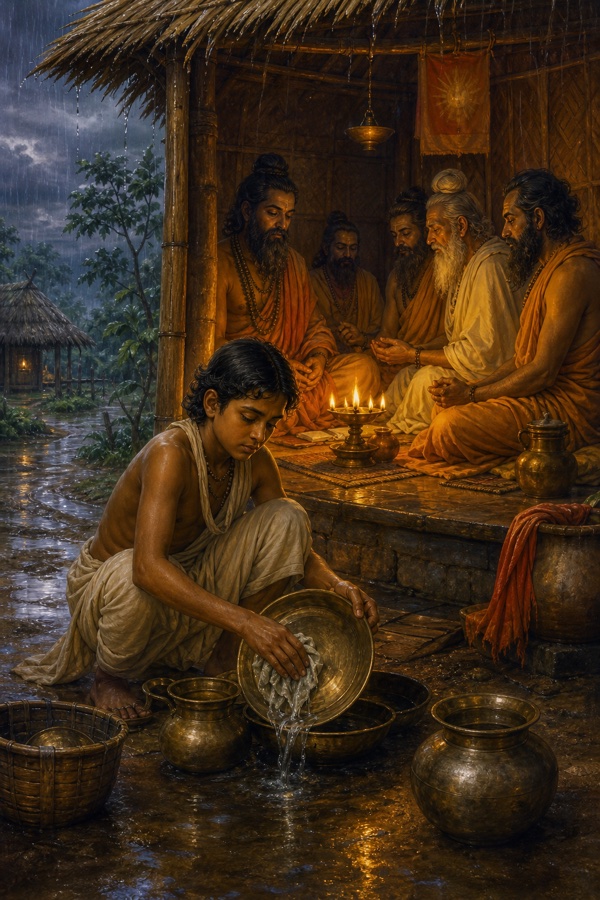
And Narada told it. A boy, the child of a serving woman who worked in a household of Vedic Brahmins. One monsoon, when the rains sealed the roads with mud and standing water, a company of yogis halted in that one place for chaturmasa, the four bound months when wandering renouncers must stop wandering. The small boy was set to wait on them. He spoke little and kept clear of the games of other children; his senses obeyed him early; he scrubbed their vessels, carried their water, and served those sadhus exactly as he was told. They were men who looked on all souls alike, and yet on this child they let a particular kindness rest. Once each day, with their leave, he ate whatever remained in their dishes after they had eaten. And with those leavings, Narada said, every sin in him was washed out. The very scraps the world calls impure made his heart clean, day after day, until the worship those mahatmas kept began to pull at the boy like a current.
“By the grace of those mahatmas,” Narada said, and his voice now was touching something very far away, “I sat near them every day and listened to the enchanting stories of Shri Krishna. Through the rains and through the bright autumn that followed, three times a day, the singing; and as I heard it with faith, line upon line, a taste for the Lord of delightful fame woke in me and set a footing that nothing since has shaken. And when the season turned and they rose to leave, those mahatmas, tender to the lowly, poured into a servant’s boy the most secret knowledge that the Lord himself had once given them, the knowledge by which a man sees the whole reach of Vasudeva’s maya and the way through her to his abode. From that one seed, Vyasa, this Narada grew. Take away the leftovers in that household, take away that katha, and the son of Brahma sitting before you does not exist.”
Vyasa heard all of it with great attention, head bowed. And inside that story he found the empty bowl he had been unable to name. The leavings that carried a serving woman’s son across outweighed the whole of his own brahmatejas, because the Lord’s name was dissolved in them. And that same name had drained out of all his shlokas.
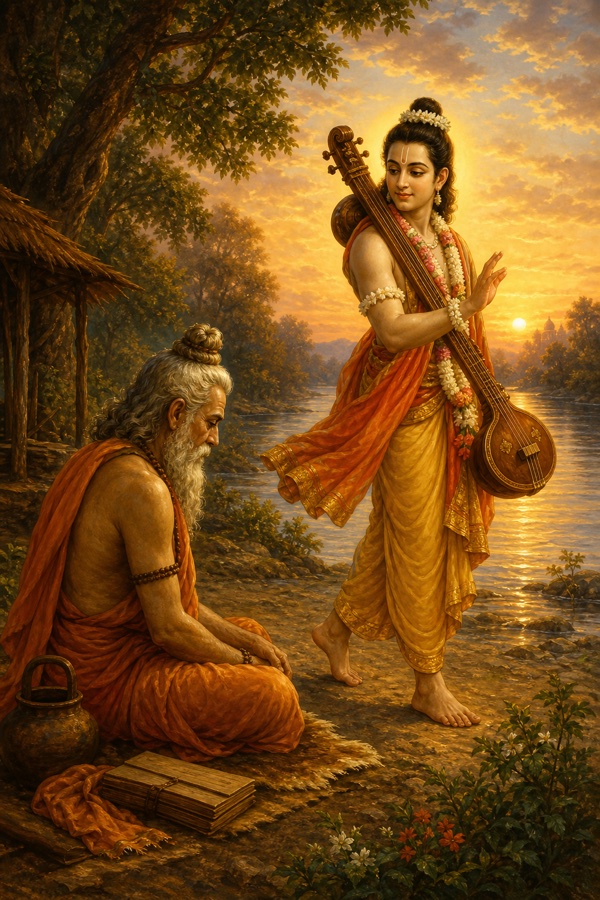
Narada stood and slung the veena over his shoulder. “One thing more, and hold it close, because it is the physician’s whole art. The same substance that breeds a disease will cure the disease, once a healer has compounded it rightly. Deeds chain a man to the wheel of birth; the same deeds, offered to the Lord, lose the very nature that chains. Your verses are the substance, Vyasa. Compound them. Now sit. For the freeing of every bound creature, go down into samadhi, and this time remember, one by one, the lilas of the Lord whose power thought cannot circle. You are yourself a ray of that highest Person, unborn, and born even so for the good of the world. Your sight has never failed. What you have not yet seen, no one is going to tell you. You will see it yourself.”
The veena’s note thinned into distance, and a moment came when it could not be heard at all. Vyasa was left alone inside that silence.
He went back to his own hermitage of Shamyaprasa, on the western bank of the Sarasvati, the river the seers count as Brahma’s own, in its grove of jujube trees, on ground where the sages kept their long fire sessions burning. He sat down. He sipped a little water from his palm. Spine straight, hands open in his lap. He closed his eyes, and by his own steady effort he gathered the whole of his mind into a single point.
This time the mind did not run.
He drew one long breath in, and as it settled into his chest, the sounds of the world began to fall away in order. First the birdsong stepped back, then the river’s running, then the beat of his own heart. A deep hush opened inside, the kind of hush that arrives already full. And in that hush his sight, washed clean by bhakti, turned toward the place Narada had pointed to.
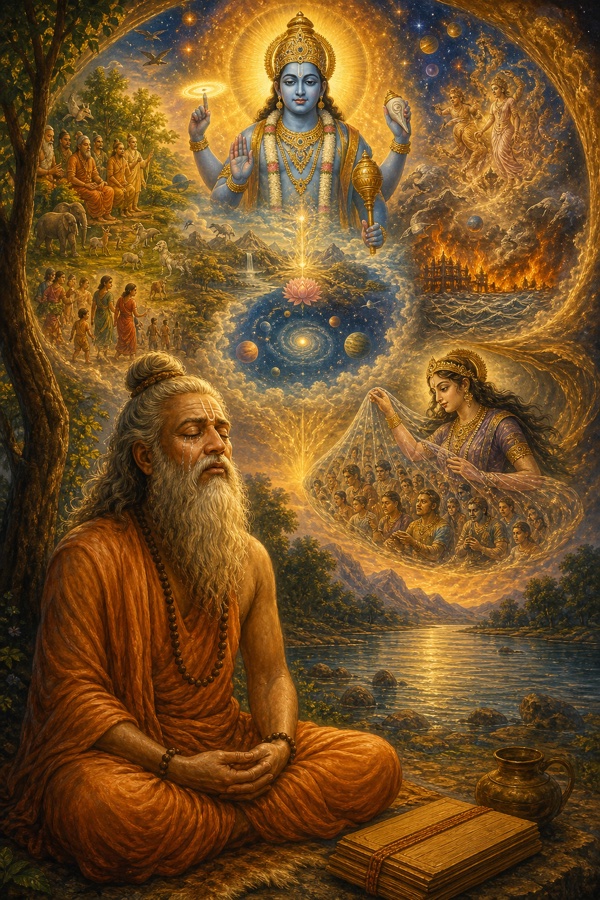
And there, on the far side of the silence, he beheld him: the Purushottama, the Primal Person out of whom this entire universe comes, in whom it stands, into whom it goes down at the end. He saw that this one supreme Lord wears the whole world as his form and at the same time stands wholly apart from it, untouched. And close behind the Lord he saw the Lord’s own maya, the great enchantress, and saw that she owns nothing of her own, that her very existence leans on him. Then he watched her work. The jiva, the single living soul, in its own nature clear of the three strands that weave the world, falls under her and takes itself to be woven of them, names itself the doer and the enjoyer of everything, and on the strength of that one mistake wanders the long round of birth and death, forgetting, by her force, the very one it came from.
Water began to run from under Vyasa’s closed lids. He could not stop it. He understood now what amrita that empty bowl had been thirsting for. Devotion to this Lord who lies past the reach of every sense is the direct remedy, the one medicine that carries a soul back across her; and the glory of this Purushottama, whose lila ferries the drowning over, was the single glory he had never sung in all his texts.
Every form of it breathed before his inner eye, near enough to reach out and touch. And touched, it did not break.
Vyasa’s lips trembled. “This was here,” he said within himself, and the inner voice caught. “All of it was here in front of me, all along, and I never sang it. I gave my years to dharma and conduct and law. And the glory a heart could lose itself in, I walked past it with open eyes.”
A long time he sat like that, eyes shut, the water running. Then he opened his eyes. The sun stood high. The river went on exactly as before. And the empty bowl was full.
He lifted the pen.
And he composed the holy katha of Shri Hari, the song of that Purushottama’s glory Narada had pointed him toward, and he built it for ordinary people, the ones who are never told what it is that holds them inside the round of birth and death. A song with this property: let it only fall on the ears, and love for the Lord begins to rise in the heart, and where that love rises, grief and delusion and fear lose their grip, finger by finger. He finished it. He went back through it and made it exact. And then he called his son Shuka to him and had him take the whole of it by heart.
Literary context
The discontent of Vyasa occupies Skandha 1, Chapters 4 and 5 of the Shrimad Bhagavata. Born in the Dvapara to Parashara and Satyavati, Vyasa divides the one Veda into four for the continuance of the sacrifices and entrusts the parts to disciples, the Rik to Paila, the Sama to Jaimini, the Yajuh to Vaishampayana, the Atharva to Sumantu, son of Daruna, and the Itihasa-Purana, called the fifth Veda, to Romaharshana (1.4.20-22). For the welfare of women, shudras, and the twice-born deprived of the Veda he composes the Mahabharata, and still his heart finds no contentment on the Sarasvati’s bank (1.4.25-31).
Narada arrives carrying the veena and names the lack (1.5). Speech empty of Hari’s glory is as unclean as the place where scraps are thrown to the crows, while one verse bearing his name purifies its hearers: the simile comes from there (1.5.10-11). Narada presses further, faulting Vyasa for enjoining rites of violence in the name of dharma (1.5.15), teaching that one who abandons his own duty for the Lord’s feet comes to no harm in any birth (1.5.17), holding that penance, learning, sacrifice, and gifts all aim at singing the Lord’s glory (1.5.22), and adding the analogy of the medicated substance: what breeds the disease, rightly compounded, cures it, as deeds offered to the Lord lose their binding nature (1.5.33-34). He then tells the story of his own previous birth, a servant woman’s boy made pure by the sages’ daily leavings who became Brahma’s mind-born son (1.5.23-31), and directs Vyasa into samadhi on the Lord’s lilas (1.5.13). At his hermitage of Shamyaprasa, on the western bank of the Sarasvati, Vyasa beholds the Supreme Person and his Maya and composes the Bhagavata for the common people, teaching it to his son Shuka (1.7.4-8).
The hour it all sprang from
One sunrise. The bank of the Sarasvati. The man who has divided the Veda into four, who has done everything a mind can do, sits with his eyes closed while one corner inside him lies bare. From far away a single note of the veena comes looking for that corner, and finds it. The text that will one day bind even the liberated is waiting to be born here, out of this one hour.