On this page
Vamana and Bali
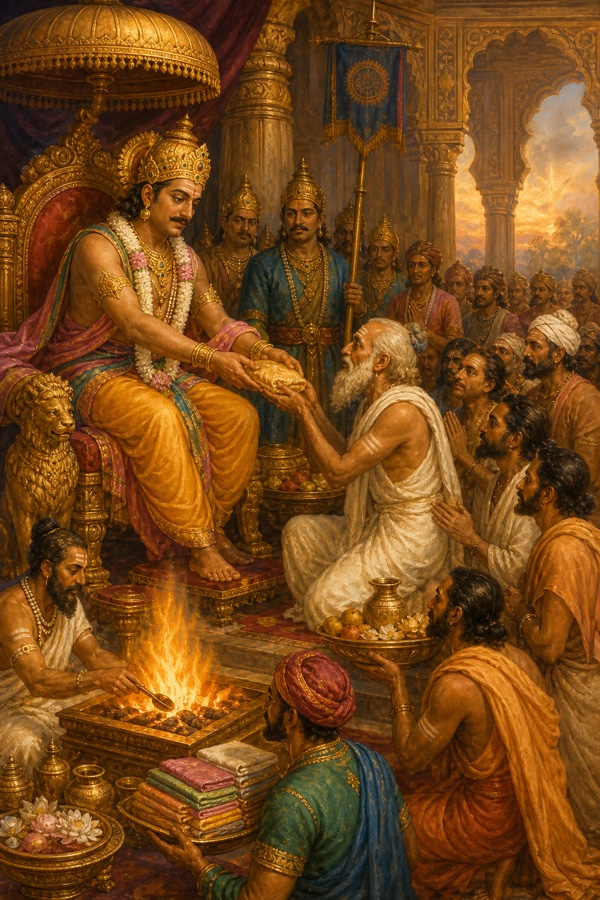
Bali ruled the asuras. He was Virochana’s son and Prahlada’s grandson, born of the line of Diti that had warred with the gods since the first mornings of the world, and yet that same line had produced Prahlada, the boy who went on loving Vishnu through every torture his own father could invent. The grandfather’s temper ran true in Bali. In his house no Brahmin had ever been turned from the door, and no gift, once promised, had ever been called back. Charity, sacrifice, and a spoken word kept to the letter were the family’s real inheritance, and they were guarded more jealously than the treasury.
There had been a war, and Indra had won it completely. He broke Bali’s armies, stripped him of his splendor, and took his very life. The priests of the house of Bhrigu, with his teacher Shukracharya at their head, gathered up the dead king and raised him out of death by their secret art. Bali, restored to breath, laid everything he owned at the feet of the Brahmins who had done it. Well pleased, the Bhrigus bathed him in the grand consecration proper to an emperor and set him to the sacrifice called Vishvajit, the conquest of the worlds, the rite in which a man pours his entire fortune into the fire and asks the fire for the one thing he wants most.
The fire answered. Out of it rose a chariot plated all over with gold and a team of horses green as Indra’s own, an ensign blazoned with a lion, a celestial bow sheathed in gold, a pair of quivers whose arrows never ran out, and armor with no weight to it at all. Prahlada laid over his grandson’s shoulders a garland of flowers that would never fade, and Shukracharya set a conch in his hand. Bali walked around the Brahmins, keeping them always to his right, bowed low to his grandfather, and mounted the chariot, shining like a flame above a sacrificial pit.
Then he led the whole gathered strength of the asuras against Amaravati, Indra’s own capital, and earth and sky trembled at the advance. Vishvakarma, the architect of the gods, had built that city: gardens like Nandana loud with paired birds and honey-drunk black bees, ponds where swans moved among the lotuses, ramparts of gold set with watch-towers, gates of crystal, streets paved with gems, and the heavenly Ganga drawn around the whole of it for a moat. Its gates barred cheats, cruelty to living creatures, pride, lust, and greed; its gates opened only to the clean of heart. Bali ringed it with his army, settled into the siege, and blew the conch his teacher had given him until the sound crawled through the golden halls and the women of Indra’s household shook with fear.
Indra went to Brihaspati, the teacher of the gods, and asked how one asura had climbed past the reach of every weapon in heaven. Brihaspati gave him the truth without cushioning it. The strength was borrowed. The Bhrigus had poured their own hoarded power into their disciple, and against a man carrying the force of the Brahmins nothing in creation could stand its ground, god and army alike failed; Sri Hari alone could stand, any more than a living creature can stand its ground against Death. Leave heaven, he counseled. Vanish. Wait for time to turn, because time always turns; the day this king slights the very Brahmins who raised him up, everything they gave him will drain away. So the gods slipped out of their shining city by every gate, wearing whatever shapes they pleased, and Bali walked into Amaravati without drawing a sword. The three worlds settled one by one into his hand. To set his rule past all challenge, the Bhrigus, fond of their disciple, had him undertake a hundred horse-sacrifices, and his fame moved out over the worlds like moonlight.
Far from the victory drums, in a forest hermitage, a mother counted her losses. Aditi had watched her sons driven out of their own home to scatter and hide, and she grieved the way any woman grieves whose children have been turned onto the road. In those days her husband, the Prajapati Kashyapa, whose offspring fill the worlds, rose from a long absorption in meditation and came back to the ashram, and found the gladness gone out of it. He asked after everything by which a household is measured: whether any stranger had ever left their door unhonored, whether the sacred fires had gone unfed at the proper hours, whether her sons were well. All of that is cared for, Aditi told him, and then she said what was not. The sons of Diti had taken heaven itself; her children owned nothing anymore, and she begged her husband to think of some way their home might come back to them.
Kashyapa began with the thing she did not want to hear. No weapon of her sons would bite against enemies standing under the Brahmins’ shield, and even her grief itself was a knot tied by ignorance, for one refuge alone had never failed anyone who took it whole: Vasudeva, the Lord seated in every heart, who feels the distress of the distressed as his own. Then he taught her the way to reach him, a vow that Brahma had disclosed to Kashyapa long ago. It was the Payovrata, the vow of milk. For twelve days across the bright fortnight of Phalguna, the keeper of the vow lives on milk alone and worships Vishnu with the twelve-syllable mantra, Om Namo Bhagavate Vasudevaya. She would sleep on the bare ground, bathe at dawn, at noon, and at dusk, harm no living creature down to the smallest, let no idle or unholy word cross her lips, and feed everyone who came, from the learned priest to the outcaste at the field’s edge, treating their satisfaction as the satisfaction of Vishnu himself. This vow, he told her, is the essence pressed out of every austerity there is, and it goes straight to the pleasure of God. Aditi kept it without a single lapse. She reined in her senses the way a driver reins in unruly horses, gave her mind one direction only, and called from inside her own heart, day after milk-white day: Lord, give my children back their home.
When the twelve days were done, he came. The Lord stood before her, the most ancient Person, four-armed, robed in yellow, bearing conch, discus, and mace. Aditi rose to praise him and her voice failed her; her eyes flooded, her body shook, and for a long moment no words would come at all. Then she poured out what her heart had rehearsed for twelve days: that from him, when he is pleased, come long life and wealth and heaven and every power there is, even liberation itself, and that beside all this the defeat of an enemy is a small thing to ask. He answered that he already knew the whole of her long desire. Her sons could not take heaven back by force, for the asuras stood guarded by Brahmins, and time itself was running in the Brahmins’ favor; valor spent against them would buy nothing except grief. Yet her worship could not be allowed to fall to the ground fruitless. So he would come by another road. He would enter, by a portion of his own being, the seed of Kashyapa, take birth as her son, and set the worlds right from inside her own house. One condition he laid upon her: tell no one, not even under questioning, because the plans of the gods hold only as long as they are kept dark. Then he vanished where he stood. Kashyapa, deep in concentration, felt a part of Sri Hari pass into him, and he placed that fire in Aditi as the wind lays a spark into dry wood.
The child arrived on a day the almanacs still honor: the twelfth of the bright fortnight of Bhadrapada, the moon standing in the mansion of Shravana, the sun at the exact height of noon, in the victorious hour named Abhijit. The wise call that day Shravana Dwadashi, and because of this birth they also call it Vijaya Dwadashi, the twelfth of victory. Conches and kettledrums sounded, Apsaras danced, the chief Gandharvas sang, and sages, gods, and ancestors crowded the sky over the hermitage to rain flowers onto its roofs. For one moment the newborn blazed in his full four-armed glory, dark as a rain cloud, the Srivatsa curl on his chest and the Kaustubha gem at his throat, jeweled and armed and blinding, and the quarters brightened, the waters cleared, and all six seasons put out fruit and flower at once. Then, while Aditi and Kashyapa stood gazing, he folded the whole of it away, the way a master actor steps into a small role, and became a short Brahmin boy. They named him Vamana, the dwarf.
The sages performed his birth-rites, and when the time came for the sacred thread, all of heaven arrived to dress one small student. Savita, the sun himself, taught him the Gayatri. Brihaspati hung the sacred thread across his shoulder, and his father Kashyapa knotted the girdle of munja grass at his waist. The Earth gave him a deerskin, Soma the moon-lord gave him a wooden staff, his mother gave the cloth for his loins, and the sky held out an umbrella. Brahma set a water-pot in his hand, the seven seers laid blades of kusha grass on his palms, and Saraswati strung a rosary of aksha beads for him. Kubera, lord of treasures, brought the begging bowl, and Uma, the mother of the universe, put the first handful of alms into it with her own hands. The boy swept the ground, kindled the sacred fire, and fed it with butter-dipped sticks like any dutiful student, and then, hearing that King Bali was worshiping the Lord with horse-sacrifices on the Narmada, he set out toward the smoke. At every step of those small feet, the earth bent low under a weight it could not explain.
Bali was deep in the final stretch of his hundred sacrifices, at Bhrigukachchha on the northern bank of the Narmada, the ancient rite-field of the Bhrigus. Smoke stood over the ground in pillars, the smell of clarified butter hung in the wind for miles, and over every rite the king held to the vow of his house: whoever came asking would never leave with empty hands.
Into that field walked Vamana, umbrella and staff in one hand, the full water-pot in the other, small steps, lowered eyes, and a brightness that traveled with him. As he came near, the officiating priests, the attendants, and the sponsor on his high seat felt their own luster go out like lamps at sunrise, and they murmured to one another: is this the sun-god come down to watch the rite, or the fire-god, or Sanatkumara himself, the boy-sage older than the worlds?
The gatekeepers stood aside at once. One small student of the Veda. What danger could fit inside a boy that size?
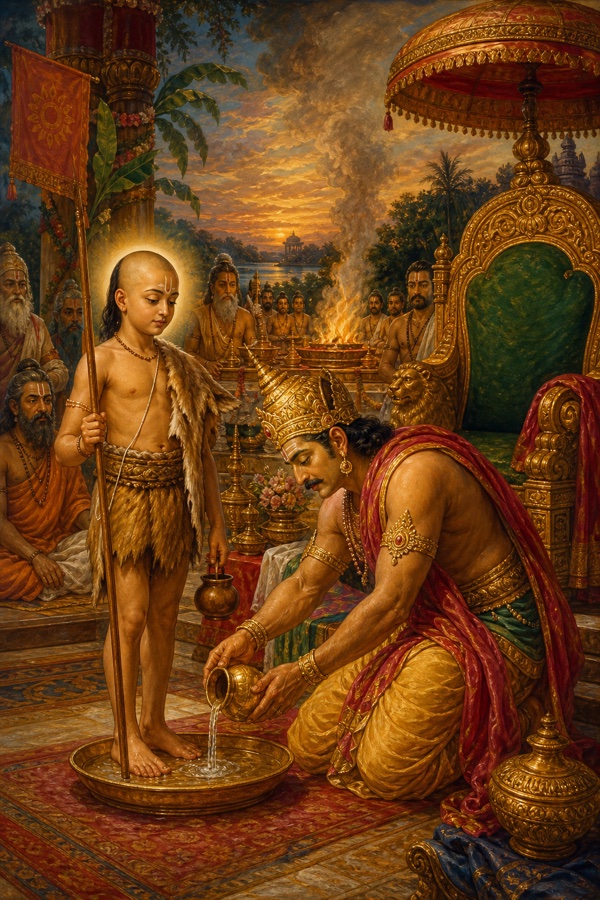
When Bali saw him he came down from his seat, led him to a place of honor, and washed the small feet with his own hands, and then he lifted that water to his own head, the same water that Shiva, who wears the crescent moon, carries on his matted hair as the Ganga. “Bhagavan,” he said, palms joined, “your coming has satisfied my ancestors. My whole line stands cleansed today, my fires are served at last as the scriptures order, and this sacrifice has reached its real completion, because your feet have touched my ground. Ask me for whatever you want. A cow, gold, a furnished house, food and drink, a maid to wait on you, prosperous villages, horses, elephants, chariots: name it. No one asks at this king’s door and turns back with nothing.”
Vamana smiled, and the smile approved of everything it had heard. “Rajan, your words are worthy of your house. In the affairs of this world your guides are the Bhrigus, and in the world beyond, Prahlada, the moon of your line, and under such guides no man of this family has ever refused a beggar at the door or promised a gift and then held it back. Your own father Virochana was approached by the gods themselves wearing the dress of Brahmins. He knew exactly who stood before him, and he knew what they had come to take, and because they had asked, he gave them his life. So from the king of such a line I ask something small: three paces of ground, measured out by these feet of mine, and nothing else. A man who knows the worth of things accepts only as much as his need, and keeps himself free of sin.”
Bali laughed, and the pavilion laughed with him. “Child, the elders would applaud that speech, and still it comes from a boy who does not know his own good. You have won over the one ruler who could sign a whole continent across to you, and you bargain for three little steps of dirt. A man must not beg twice, boy. Ask once, ask enough. Take land to live on for the rest of your days, and take it from me now.”
The small Brahmin did not blink. “Rajan, every desirable thing in the three worlds heaped together cannot fill one man who has never learned to govern his senses. Whoever finds three paces too little will find a continent of nine realms too little; give him the continent, and he will lie awake wanting all seven that ring the oceans. Prithu ruled them. Gaya ruled them. Emperors have held every island the seas surround, and we have heard of none who reached the bottom of his own wanting. A man content with whatever fortune brings sleeps easily anywhere on earth; a man whose wants rule him stays poor on the throne of the three worlds. Discontent is the engine that drags a soul from birth to birth; contentment with what comes unlooked-for loosens the knot and opens the road out. A Brahmin’s inner light grows on contentment, and craving puts it out the way water puts out fire. So I will take from you, most generous of kings, exactly three paces. Wealth is worth wanting up to the measure of a man’s need, and I have told you mine.”
Bali gave up with a shrug of delight. “Take what you will, then,” he said, and reached for the water vessel, for a gift becomes irrevocable in the moment the giver pours the water of the vow over his own hand. And close by stood his teacher Shukracharya, the most learned being of the age, and Shukracharya’s eyes had already stripped the disguise off the boy.
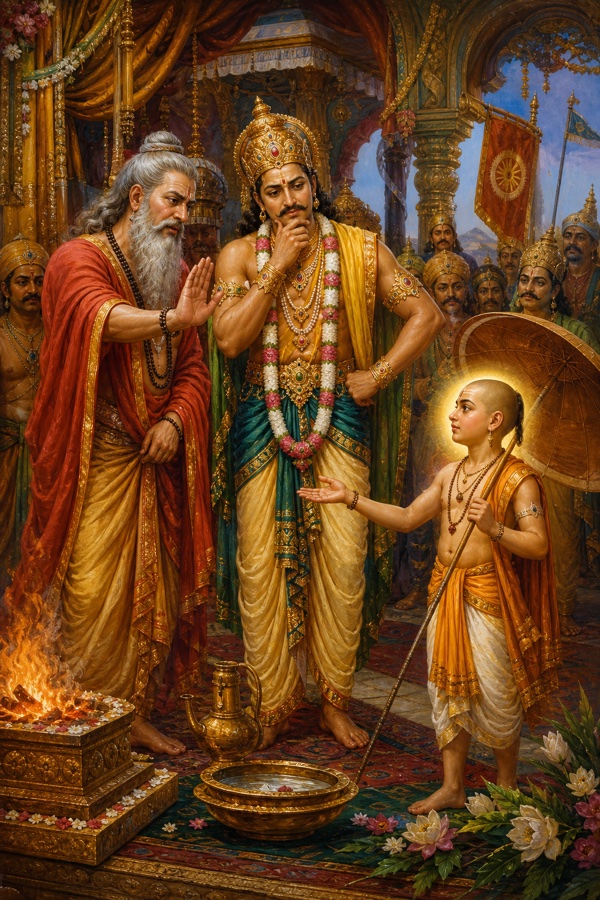
“Stop, Rajan.” The old master’s voice cut across the pavilion. “This is no Brahmin child. This is the deathless Vishnu himself, born to Kashyapa and Aditi to do the work of the gods, and you have promised him your own ruin without recognizing what you were promising. A calamity has walked into the camp of the asuras today. Grant this dwarf his three steps and he will swell until he wears the universe. One stride will take the whole earth, the second will take the heavens, his body will fill everything in between, and then, with no ground left anywhere for the third step he is owed, where will you stand? He will strip you of throne, dominion, fortune, splendor, and name, and lay all of it in the hands of his own elder brother, Indra. And you, who gave away the very ground under your feet, how will you keep body and soul together, you fool? A promise you cannot complete buys you a firm footing in hell, and I can already see you standing there. Hear the dharma of this, because the wise have weighed it. No one praises the gift that destroys the giver’s own livelihood; charity, sacrifice, and austerity exist for the man who first has the means to live. A householder divides what he has five ways, for dharma, for good name, for increase, for his own enjoyment, and for the people who depend on him, and so he prospers in this world and the next. And listen to the verdict the seers of the Rigveda gave on truth and untruth. The word yes is truth, and the word no is untruth, and yet truth is only the flower and fruit on the tree of the body: keep the tree standing, or flower and fruit will disappear with it. A tree torn out of the earth dries where it lies, and a man who tears out his own root dries the same way. Every yes drains wealth away from the one who says it; a no at the right moment keeps him whole. Only the man who swears he has nothing at all to give earns the world’s contempt and walks it as a breathing corpse. Refuse this boy the whole, then, and offer him a part. Even the codes forgive an untruth spoken to soothe a woman, or in jest, or at a wedding, or to keep body and soul together, or when life itself is threatened, or for the sake of cows and Brahmins, or to keep violence off an innocent head. Your case is all of these at once, Rajan. Do not pour the water.”
Bali stood in the silence that followed. On one side was his guru, the man who had pulled him back through the door of death by his own science, whose counsel had never once failed him, and whose argument was flawless. On the other stood a Brahmin no taller than his hip, holding out an open hand.
When Bali finally spoke, it was quietly, and to his teacher. “Gurudev, forgive me. Everything you have said of the householder’s duty is true; a man should guard his wealth, his standing, and his means. But I have already said the words: I shall give. I am Prahlada’s grandson. How can I take those words back from a Brahmin, like a common swindler, for the sake of property? The Earth herself once said that she can carry any burden laid on her except one; no adharma weighs heavier than a lie, and the man given to lying is the single load she cannot bear. I am not afraid of hell, Gurudev. I am not afraid of poverty, or of the deepest sorrow, or of losing my throne, or of death itself, the way I am afraid of cheating a Brahmin who trusted my word. Whatever a man owns walks away from him on the day he dies; if it must leave anyway, why should it not leave now, doing the one thing wealth is for? Dadhichi handed over the bones out of his living body. Shibi carved the flesh from his own limbs to keep his word. What is a little ground beside that? Time has swallowed every pleasure the great Daitya kings ever tasted, kings who ruled this whole earth and never once turned their backs in battle, and their empires went down with their pleasures; the fame of their giving is the one thing time has never touched. Warriors who fall facing forward are found in every generation, Gurudev. The man who gives with reverence in the moment a worthy hand opens before him is far rarer than that. And if giving beggars me, so much the better; poverty met on that road sits on a man like an ornament. I will give this child what he asks. If he is only a student, I have fed a student. If he is truly Vishnu wearing a boy’s body, then let him bind me for it if he chooses; he has come to my door faultless and asking, and I will not lift a hand against him. And what greater fortune could there be than this, that the Lord of everything should stand in front of Bali with his palm open?”
Then something moved through Shukracharya that the wise would later call the push of fate itself, and the teacher’s hurt hardened into a curse. “You think yourself learned, you conceited fool, and you set your own teacher’s command aside to play the great giver. Then fall. Everything you have, all of it, will be swept from you, and soon.” Even under the curse Bali did not move from the truth. He worshiped the small Brahmin, and his queen Vindhyavali, pearls at her throat, came to his side carrying a pitcher of gold. Bali washed the small feet once more, bore that water on his head, and let the water of the vow fall from his palm, and with that falling water the three worlds changed hands. High overhead, the gods who were his sworn enemies rained flowers down on him. Kettledrums sounded in the thousands, and Gandharvas, Kimpurushas, and Kinnaras sang across the sky that a thing almost past doing had been done, for this noble soul had given the three worlds to his adversary, and he had given them knowingly.
“Vamana, the three paces are yours. Measure them out wherever you will.”
The water had scarcely left his palm when the small body began to grow.
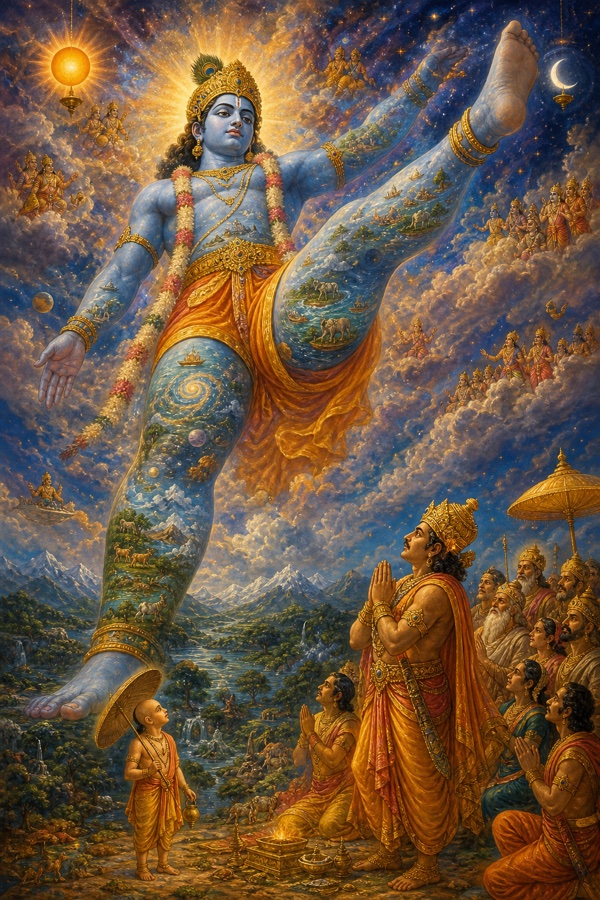
It rose to the height of a man, then past the awning of the sacrificial hall, then past the clouds, and it did not stop. Beside that body the sun and the moon dwindled to a pair of small lamps. Earth, sky, the quarters, heaven, the deep worlds below, the oceans, and every species that draws breath began to gather into it, and Bali stood with his priests and watched the entire universe find its place inside the boy they had been about to pity. They saw the netherworlds in the soles of his feet and the earth itself on his instep, the mountains in his shanks, the winged nations at his knees, the hosts of the wind in his thighs. Twilight was the hem of his garment. The seven oceans lay along his sides, and the stars were strewn across his chest; dharma beat in his heart, the moon moved through his mind, and Sri herself, lotus in hand, rested on his bosom. Every sound ever uttered lived in his throat, the gods with Indra at their head were his arms, the quarters his ears, heaven his brow, the clouds his hair. The sun burned in his eyes and fire spoke in his mouth; the Vedas were his voice, day and night were the beat of his eyelashes, Death walked in his shadow, and maya, the power that enchants every world, was his laughter. Rivers ran for his veins, rocks set themselves as his nails, and Brahma sat in his intellect. The asuras looked at all of this and went cold, because his weapons had risen with him, alive and waiting: the discus Sudarshana too bright to face, the bow Sharnga with its thunderclap string, the conch Panchajanya roaring like the sea at the end of an age, the great mace Kaumodaki, the sword Vidyadhara paired with a shield studded like a hundred moons, two quivers that could never be emptied, and his companions around them all with Sunanda at their head.
Then he moved. One stride, and the whole earth that had belonged to Bali lay under a single sole, while his body filled the sky and his arms held the four directions.
The second stride went up. Heaven itself covered barely a portion of that rising foot, which climbed past the realms of the gods, past Maharloka, past Janaloka, past Tapoloka of the austere, all the way to Satyaloka, where Brahma sits at the summit of created things. And Brahma, watching the foot of the Lord arrive at his own door, drew water and washed it with reverence, and that water, consecrated by what it had touched, fell back through the heavens as a river. The worlds below caught it and called it the Ganga, and it has been washing the three worlds clean ever since, the way the Lord’s own fame does. Through the four quarters, meanwhile, raced Jambavan, the king of the bears, swift as thought, beating his drum to proclaim the victory festival of Vamana.
Two strides, and the three worlds were spent. Not one handspan of ground remained anywhere for the third. He stopped.
Bali’s warriors had watched their master’s whole empire vanish under two footfalls, taken by what looked to them like a beggar’s trick, and their fury broke loose. Against their king’s own wish they snatched up pikes and spears to cut the Brahmin down. The Lord’s companions came forward laughing to meet them, Nanda and Sunanda, Jaya and Vijaya, Prabala and Bala, Kumuda and Kumudaksha, Vishvaksena, Jayanta, Shrutadeva, Pushpadanta, Satvata, and Garuda, each of them carrying the strength of ten thousand elephants, and the asura ranks began to break and die. Bali remembered his teacher’s curse, and he called his generals off by name. “Vipracitti. Rahu. Nemi. Hear me, and put up your weapons. This hour is against us, and no creature that ever lived has beaten the hour. The same power that once lifted us and pressed the gods down has swung to the other side. Strength will never override time; ministers, cleverness, fortresses, spells, herbs, diplomacy, and every other royal resource will also fail. When fate carried you, you routed these same attendants of Hari again and again; today they roar over us. Our turn will come round again when fate turns, and until it does, we wait.” And the asura host drew back and sank away into the deep world of Rasatala.
Then Garuda, Vinata’s son, the king of birds who reads his Master’s mind without a word spoken, bound Bali with the noose of Varuna, and he did it on the very day appointed for pressing the soma, at the crown of the king’s own sacrifice. A cry of grief went up from the earth and from the sky at once. And out of the immensity overhead came the voice. “Bali, you gave me three paces. Two have taken everything, this whole earth that the sun warms and the moon lights and the rain feeds, and every heaven above it. Show me ground for the third. You know what a man earns who promises a beggar and cannot pay. Your own teacher named the place, and his word and mine agree: for the false word of a rich man, hell, for as many years as the debt runs.” Even bound, even sentenced, Bali’s mind stood perfectly still.
Nothing at all stood in front of Bali now. The kingdom was gone. Heaven was gone. The wealth of a lifetime bound to dharma was gone, and his own arms were in cords. For one instant everything inside him emptied out too.
Then he bowed. His hands folded of their own accord, and over his face came a strange lightness, the look of a man who has just set down a load he had carried so long that he had stopped noticing its weight.
“Lord, if you count my word as broken, let me make it true. Set your third step on my head. It is the one piece of ground I have left, and it has never belonged to anyone else. I am not afraid of hell. I am not afraid of these cords, or of hardship with no door out of it, or of an empty treasury, or of any punishment your hand cares to lay on me. One thing alone frightens me, and that is disgrace, the name of a man who bent his word. Even this that you have done to me, I count as kindness. Punishment from the most worthy is a blessing beyond the gifts of mother, father, brother, or friend. You come to us asuras disguised as an enemy, and you do for us what no ally has ever done: we are a race blinded by staring at our own arrogance, and you put that light out so that we could finally see. Many of my people found their way to you through hatred itself, so fixed on you as enemies that you became their whole world. My grandfather Prahlada, whom your devotees honor, was tortured by his own father for loving you, and out of that torture he walked into your shelter and never left it, though your hand had cut down his own kin. What was he leaving behind? A body that abandons its owner at the end no matter how faithfully it is fed. Wealth that robbers wearing the name of kinsmen carry off. A wife and a house that tie a man to the turning wheel. He weighed all of it against your feet and did not look back. Now fate has dragged me, robbed and bound, to that same doorstep, and standing on it I feel free of shame and pain. Life sits within easy reach of Death every hour it lasts, Lord; only a fool calls it his own. Set the step.”
Just then, into that broken assembly, Prahlada came like the moon rising over the rim of the world. Bali saw his grandfather and could not honor him; the cords held his arms, so he greeted him the only way left to him, head bent low, eyes flooding, face turned down with shame. But Prahlada looked past everything else to the Lord standing there among Sunanda, Nanda, and the attendants, and joy and tears took him in the same moment. He bowed to the ground and spoke. “Lord, it was you who gave him Indra’s seat, and today it is you who have taken it back; you have only reclaimed what was always your own. And I think the taking is the greater kindness of the two. Wealth fuddles the soul. With riches in his hands, even a learned and self-mastered man loses sight of his own self, and you have set my grandson free of the very thing that blinds.” And he stood there with his head bowed.
Brahma himself had arrived and was gathering breath to plead, but before the creator could speak, a frightened woman spoke first. Vindhyavali, Bali’s queen, came forward to see her husband bound, palms joined, face bent low. “Lord, you built this universe of three worlds as a playground for your own delight, and men of confused understanding, shameless, imagining themselves owners, sign pieces of your toy over to one another. My husband offered you the worlds. What was ever in his hand to offer? You make it all, you keep it all, you end it all. Take his offering as the confession it is, and let him go.”
Then Brahma spoke for the gods. “Release him, Lord. He has been stripped of everything, and a man stripped of everything has passed beyond punishment. He gave you the whole earth, he gave you the worlds his merit had won, and at the end he gave you his own body, and his mind never winced through any of it. A guileless man reaches your highest realm by pouring plain water at your feet, by offering a few blades of grass. This man poured out the three worlds. How can his road end in suffering?” The Lord turned to them all, and his answer laid the whole design bare. “When I mean to favor a man, I take his wealth away. Riches stiffen a man with pride until he mocks the world and forgets me, and a soul drunk on its own fortune wanders womb after womb through the long dark. Rare is the man who carries high birth, great deeds, youth, beauty, learning, power, and treasure all at once and stays unproud; wherever you see that, know that my grace is already at work in him. Look at this lord of the Daityas. He has beaten my own maya, the snare that has never once let go of an asura. Stripped, thrown down, cursed by his teacher, deserted by his kin, bound in cords, mocked, and sentenced, and when I myself pressed him with slanted arguments dressed up as dharma, he would not let go of the truth. Such a man I have already made my own.”
Then he gave the beggared king a gift the gods themselves wait whole ages for. “Bali, in the age of the Manu called Savarni, you will be Indra, king of heaven, under my protection. Until that day, go and rule Sutala, the realm below the earth that Vishvakarma built and made lovelier than anything heaven owns. While my eye rests on that place, its people are spared sickness, weariness, dullness, defeat, and sorrow. The guardians of all the worlds together could not overpower you there, and my discus will destroy whatever wishes you harm. I will guard you, your people, and everything you keep, and you will find me present there, always. And if the company of the Daityas ever stirs the old darkness in you, one look toward my glory will end it where it stands.”
Bali tried to answer and heard his own voice break. All he could say, through tears, was this: that he had never even managed to be a devotee, and that one sincere attempt at bowing had brought a demon a grace the guardians of the worlds had never won. He had offered his head for the third step, and the offer was accepted in full; nothing in the promise remained unpaid, and the cords of Varuna fell open. He bowed to Sri Hari, to Brahma, and to Shiva. Then the Lord turned to Shukracharya and asked the teacher to complete the sacrifice his disciple had been forced to leave standing. Shukracharya answered with the honesty of a man twice humbled: what defect could survive in any rite whose patron had propitiated the very Lord of sacrifice with all he owned, when the mere chanting of his name repairs every flaw of mantra, procedure, time, and place? Still, he said, to carry out your command is the highest good a man can do, and he finished his disciple’s great rite himself. The Lord gave the kingdom of heaven back into the hands of his elder brother Indra. Aditi had the thing she had prayed twelve days for. And the Lord himself took up the guardianship of the worlds as Upendra, the younger brother of Indra, while Bali, with his brothers and his people around him, turned toward Sutala with a light heart.
And as he went down into the deep, Bali found that he was not making the journey alone. Prahlada walked beside him, sent to Sutala by the Lord’s own blessing, and something greater still went with them both.
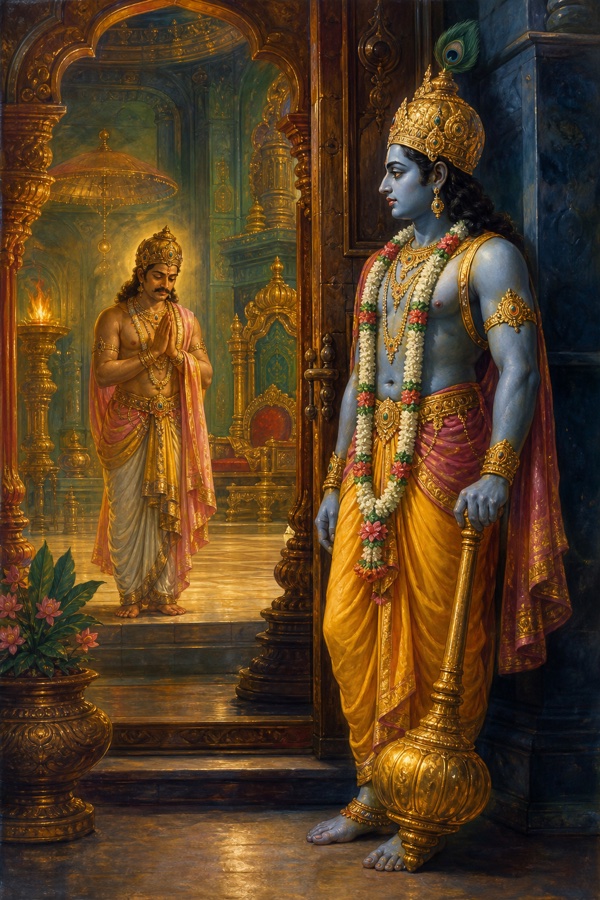
For Sri Hari had said one thing more, a thing no conqueror in any age had ever been given, and he said it to the house that had given him everything twice, once through Prahlada’s love and once through Bali’s open palm. “You will see me there always, stationed at your gate, mace in my hand, keeping the watch. When a man has put all he owns into my hands, I do not leave his door for anything in all the worlds, and the very sight of me will burn away whatever darkness is left in you.”
Bali owned no kingdom anywhere under the sun. And at his gate, on guard through every watch of the night, stood the master of the three worlds.
Literary context
The story of Vamana and Bali fills nine chapters of the eighth skandha of the Shrimad Bhagavata, the fifteenth through the twenty-third. The image at its center, three strides spanning everything that exists, is among the oldest in the tradition; the Rigveda already sings it at 1.22.17, ‘trini pada vi chakrame vishnuh’, Vishnu strode out these three steps. The Bhagavata takes that Vedic seed and grows a complete human drama out of it: a mother’s vow, a teacher’s warning, and a king’s word.
Bali’s renunciation lives on in Kerala as the festival of Onam, kept each year as the day the beloved king returns from the deep world to walk among his people for a single day. And the heart of the story sits past all its spectacle, in the quiet of Sri Hari making himself the gatekeeper at Bali’s door in Sutala (8.23).
Philosophical lens
The marrow of this katha is a reversal of rank: an asura king, through surrender alone, proves higher than Indra, the king of the gods, and is even promised Indra’s throne in an age to come. The Bhagavata quietly erases the hard line between deva and asura here, because the only test it honors is surrender, and birth carries no weight on that scale.
Sri Hari standing guard at his devotee’s door became one of the great threads of the bhakti tradition, the Lord placing himself in pledge against what the devotee has given him. Generations of later saints sang the same discovery as ‘the Lord bound by his devotee.’
Sooner or later the hour arrives for each of us, the hour of opening the hands and letting go of everything a lifetime of dharma and labor has gathered. Bali meets that hour without a struggle. He bows his head, and in bowing he learns that what left him had only ever been borrowed, and that what stayed on at his gate was worth more than the three worlds he lost.
The same katha elsewhere
- King Bali’s Awakening
Yoga Vasistha: King Bali’s inner awakening and dispassion