On this page
Bharata and the Deer: Jadabharata
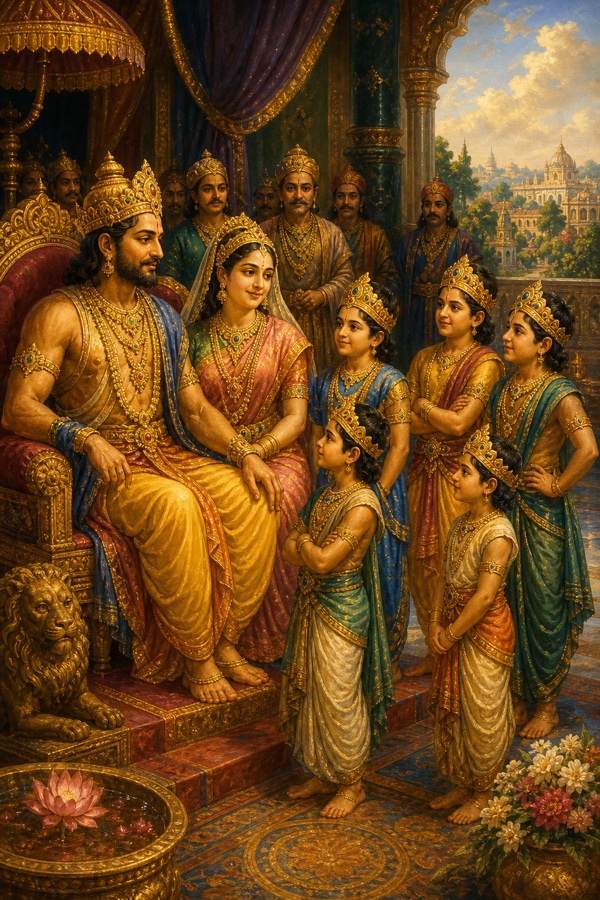
Rishabhadeva had already chosen his heir before he walked out of his own palace into the life of a wandering renunciant. The kingship of the earth settled on Bharata, and he took it up the way he took up everything his father asked of him, as obedience. He married Panchajani, daughter of Vishwarupa, and she bore him five sons made in his own mold: Sumati, Rashtrabhrit, Sudarshana, Avarana, and Dhumraketu.
He ruled the way his father and his grandfather Nabhi had ruled before him. Every subject kept to his own work and wanted for nothing, the treasury stayed full, the borders stayed quiet. And through all those years the king kept a second kingdom in order, an inner one. Season by appointed season he offered the great fire-rites, small ones and vast ones, complete and abridged, through the four officiating priests, the hota, the adhvaryu, the udgata, and the brahma. Then, each time the merit of a rite came due to him, he passed it on. He offered the fruit of every yajna to Vasudeva, the Lord who is the soul of all sacrifice and, hidden behind every priest and every flame, its true performer, and he trained himself to see the many gods invoked in the mantras as the limbs of that one Person. Under that long discipline his likes and dislikes wore thin, and something else began to grow in their place.
It was love. In the space inside his heart Bharata came to see the Lord as his devotees see him, the mark of Shrivatsa on his chest, the Kaustubha gem at his throat, a wreath of wildflowers, the discus and the mace, an image steady as a portrait and brighter every day, rising in him now without being summoned. Ten million years passed this way. Then the king read his own account and saw that the store of merit that had bought him his crown and his long good fortune was nearly spent. He did what his father had done before him. He divided the kingdom evenly among his five sons and walked out of a house that held every prosperity the earth can offer, taking the road to the forest with no complaint in his mind and no urge to look back.
He stopped on the bank of the Gandaki river, at Pulaha’s ashram, and built himself a small hut. Hermits have always prized that ground, for it is said that Shri Hari, out of a father’s tenderness for the devotees who live there, shows himself to them in whatever form they long for, even today. The river itself carries his sign. The Gandaki hallows every reach of the hermitage with round, wheel-marked pebbles, scored on both faces like the nave of a wheel, the shalagrama stones in which worshipers hold the Lord in their own two hands. Bharata’s worship now was offered alone, with flowers and tender leaves and tulsi, with river water, with bulbs and roots and wild fruit; his days passed on that same forest food, and his nights in the remembrance of Shri Hari.
Many years went by like this. Craving dried out of him, tranquility deepened, and worship stopped feeling like labor. His heart would melt in the middle of the rite; the hair rose along his arms, his eyes blurred with tears of longing, and his awareness sank so far into the joy welling up out of his own heart that he forgot the worship his hands were performing. He wore deerskin now, and his matted hair, tawny and curling, hung wet from bathing three times a day. It felt as if only a little distance remained.
Each dawn he stood before the climbing sun and worshiped the all-effulgent Narayana within its orb, praying to the Light behind the sun’s light: the Light beyond all matter, which dispenses the fruit of every deed, which thought this universe into being and then entered it to guard from inside every soul that seeks its shelter, the Light that sets our own intellect in motion. To that Light we go for refuge. One morning, after his bath and his daily rites, he settled on the bank and sat through three muhurtas repeating the single syllable Om. The water ran cold over the stones, birds called overhead, and the grass along the bank still lay heavy with dew.
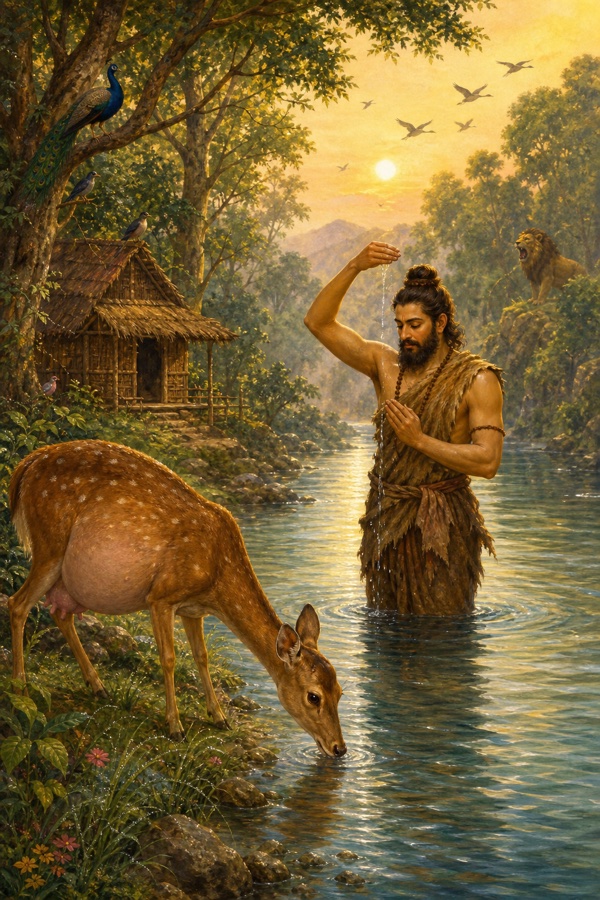
It was then that a doe came down out of the trees, alone, to drink. She was near her time, her belly heavy and swaying, her gait tired. She had barely lowered her mouth to the water.
When, from deep in the forest, a lion roared, one long, deep, hoarse note that put terror into everything that heard it.
The doe froze where she stood. She was timid by nature and had been drinking with one eye on the shadows, and the roar broke her. Eyes swimming, thirst unfinished, heavy with the fawn inside her, she gathered her whole body and leapt for the far bank.
The leap asked more of her than she had left. Fear had already shaken the fawn loose in her womb, and as she stretched over the water it slipped from her body and fell into the current. The doe came down on the far side finished, wrung out by a birth she had never completed, by the long jump, by the terror, and severed now from her herd; she stumbled into a cave and gave up her life there.
The newborn fawn went with the current, so small that the water spun him about like a toy.
Bharata saw it all from the bank. Pity took hold of the royal sage, pity for a creature orphaned in the first minute of its life, and he waded out and lifted the drifting fawn from the river in both palms.
The little body was cold, soaked through, and so thin it seemed nothing more than one trembling breath cupped in the hand. The mother was gone, the bank stood empty, and overhead the lion’s roar still seemed to hang in the air.
Bharata stood in the shallows holding him, and a reasoning rose in him with the full authority of dharma. The turning wheel of Time has torn this creature from its kind and its kin and set it down in my two hands. It has lost mother, herd, and protector; it has accepted me for all of them, and it trusts no one else. To forsake anyone who has taken shelter with you is sin, and the good will set aside even their own highest interest for the sake of the helpless. So he carried the motherless creature to his hut the way a man brings home a friend, as if it were his own kin.
He worked out what the fawn could take for food and drink, wrapped him in dry leaves for warmth, and sat beside him through the night with one hand resting on the small heaving ribs.
And the fawn lived.
Bharata set himself terms and thought them settled: care for him today only; in the morning, carry him into the forest and leave him where his own kind run.
But in the morning the fawn pushed himself up on legs that shook like reed stems, wobbled straight to him, and turned up a pair of guileless, entirely trusting eyes to his face.
“All right,” Bharata said softly. “One more day.”
A day became a week, the week a month, the month a year. The fawn grew, and stayed at his side, and Bharata sank by degrees into the whole occupation of him: feeding him, humoring him, scratching and stroking him, standing guard against wolves and tigers. Sitting, lying down, walking, standing, eating, whatever the hour held, the bonds of that love stayed knotted around his heart.
And quietly, with no single day he could have pointed to, the direction of his remembrance turned. The disciplines that had been the architecture of his life, the restraints, the observances, the daily worship of the Lord, were neglected one by one, and within a few days of one another they were gone.
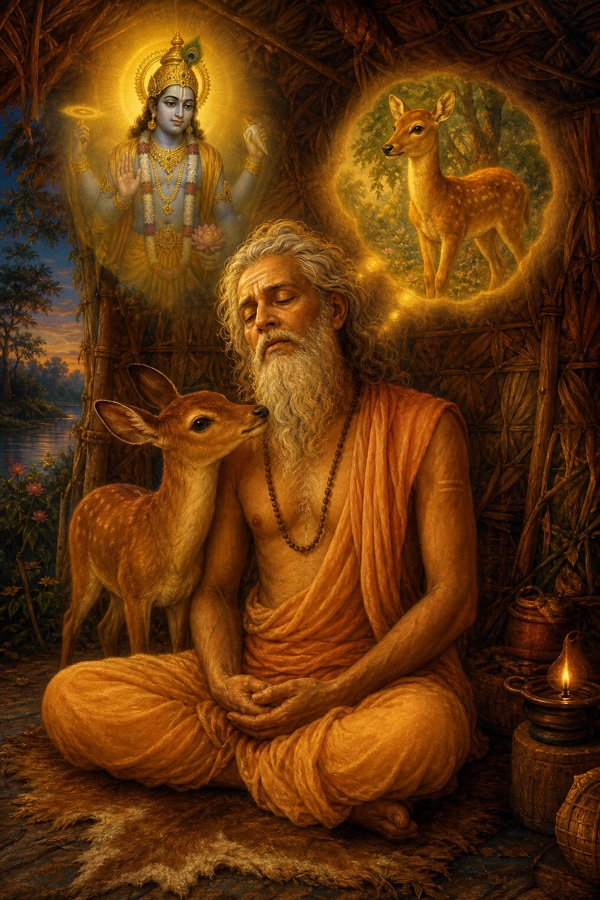
Now when he sat to meditate, the moment his eyes closed it was the fawn that came and stood in his mind, in the place where Shri Hari had stood. Midway through sadhana the thought would break in: “Where has he gone? What if he has crossed some wolf, some jackal?”
When he went into the forest for kusha grass, for flowers, firewood, leaves, fruit, roots, or water, he took the fawn along, afraid of wolves and wild dogs. Wherever its innocence left it stuck along the path, he lifted it to his shoulder and carried it, and with it riding there, or gathered into his lap, or held against his chest, he felt a happiness he had stopped questioning. At night he lay down beside it, so that it would not take a chill. Even in the middle of a rite he would rise again and again just to look at it, and only when he had seen it would his mind settle, and he would bless it: “May you be safe on every side, my darling.”
The detachment of ten million years was melting, quietly, before the guileless eyes of one small deer.
Sometimes he caught himself, appalled. “Bharata, what are you doing? You put down your own sons, the parting that costs a man most, because even they stood in the road to freedom. And now you have roped yourself to the young of a deer, a creature of another kind entirely?”
The reproach never outlived the next rustle in the leaves. His mind went after the sound, and when the deer was out of sight he paced like a miser whose hoard has been carried off, and the laments poured out of him. Will he come back to me, that poor orphan of a dead mother, trusting and credulous as he is, back to a graceless wretch like me, deceitful as a cheat, hard-hearted as a hunter? Will I see him again grazing the tender grass of this grove in safety? The sun himself, who rises for the good of every living thing, is going down, and the treasure the doe left in my keeping has not come home.
Years passed like this. The deer grew and ranged farther from the ashram to graze, and until it came back Bharata’s evenings were one long held breath. He would remember how it butted him with the tips of its horns, soft as drops of water, indignant with love, whenever he closed his eyes in a pretense of meditation; how, scolded once for nosing the sacred grass that carried the offering, it dropped its play on the instant and sat motionless, senses reined in, like the child of a hermit. He read its small hoofprints by the river as the tracks of his own fortune. He searched the dark blot on the rising moon and thought: the moon-god is kind to the afflicted. Had he taken in the fawn that lost its mother to a lion? Were these cool rays the comfort he poured on a grieving heart, whose heart burns with a wildfire of separation from a creature I love like a son. And when at last the shape of him stepped out at the edge of the trees, the old king’s body loosened, and even then he was murmuring, “Son, may well-being follow you everywhere.”
Then one day Bharata’s body began to fail. Death gives no notice; it travels with terrible speed, the way a snake pours itself into the burrow of a rat, and from within, Bharata knew that the hour of parting had come.
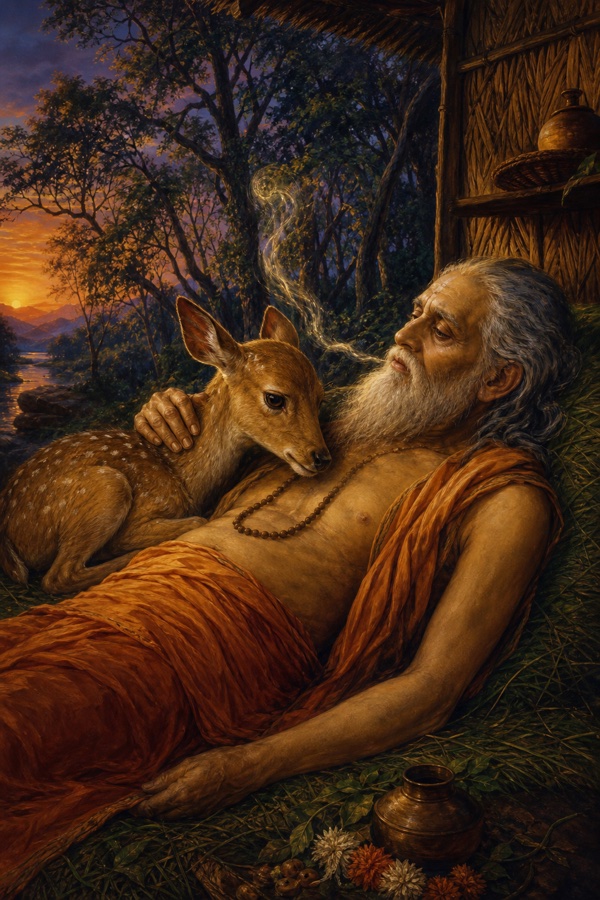
Even in that final hour it was the deer he wanted beside him. It sat pressed close, grieving like a son, and Bharata lay with his eyes on its face, and with his eyes still on its face the breath went out of him.
The last thought that stayed in his mind was this: “My deer.”
And the remembrance of the final hour sets the next destination. In whatever feeling the breath departs, into that very form the jiva, the traveling soul, is carried. So Bharata, royal sage, worshiper across ten million years, took his next birth in the body of a deer.
But this was no ordinary deer. The long momentum of his worship carried his memory whole across the crossing, and every detail of the life before stayed alive in him. He knew exactly what he was: an animal on the outside, and within, still awake, the consciousness of a rajarshi, a king who had made himself a seer.
He knew, too, exactly how he had earned the body he wore, and he lived inside one long remorse. “What a fall this is,” he would say to himself. “I had shaken off every attachment. I came away strong-willed to a lonely and holy forest, and I gave my mind wholly to Vasudeva, the Self of every self. Every hour I had went into hearing his names, chanting his praises, worship, remembrance. And after all of it, in almost no time, my mind slid away after the young of one deer. What a fool I have been.” He did not risk the error twice. He left even the doe who had borne him, kept to the edge of the herds without ever belonging to them, bound himself to no one, and waited, silent and watchful, more afraid of attachment than of dying, for the deer-body to spend out the karma that had made it.
At the last he left Kalanjara mountain, the highland where he had been dropped as a fawn, and came back to that same Pulaha’s ashram, the Shalagrama tirtha beloved of the calm-natured munis. He lived there alone on dry leaves and grass and low shrubs, wanting nothing a heart could fasten on, and when the time came he lay down with half his body immersed in the running water of the Gandaki, and in that place, in that posture, the deer-body too fell away.
The next birth came in a worthy Brahmin house of the line of the sage Angiras, to a father rich in austerity, Vedic learning, generosity, and self-command. By his first wife the Brahmin had nine sons, each one stamped with his own virtues; by the younger he had twins, a boy and a girl. The boy was Bharata, royal sage once, deer once, Brahmin now. And this time Bharata chose an altogether different road.
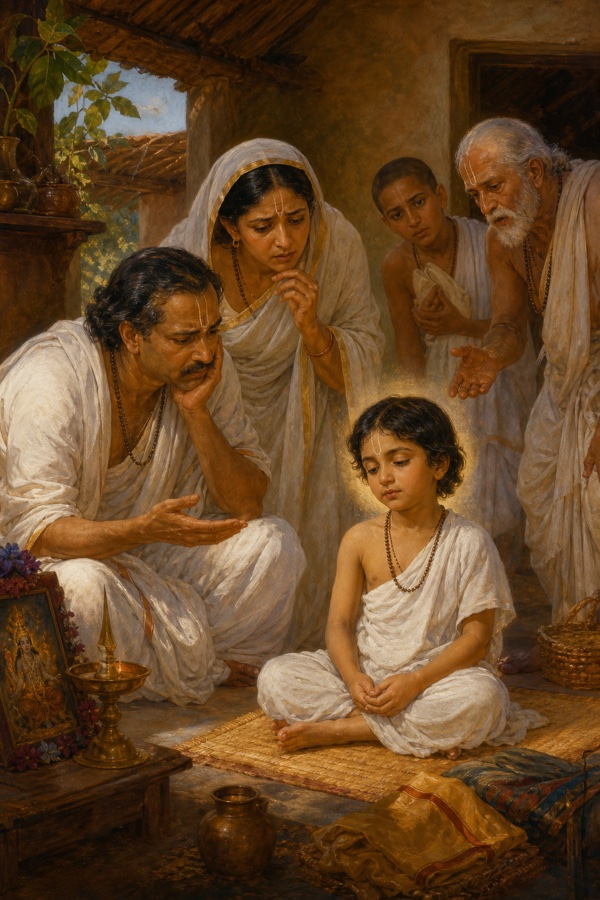
By the Lord’s grace the whole chain of his births lay open to his memory, and with it a settled dread of the force that had already cost him a lifetime: affection, and the fall hidden inside it. So he built a disguise and wore it from infancy. He showed the world a boy mad, dull, blind, and deaf. He spoke to no one, answered no one’s questions, entered no quarrel, while behind the blank face his mind clasped the lotus feet of the Lord, the feet that cut the fetters of karma for anyone who so much as hears of them, and would not let go. His mother and father took the child to be feeble-minded.
People began to call him Jadabharata: Bharata the inert, Bharata the dull.
He kept the fire in him hidden by deliberate choice, so that no one would honor him, court him, or love him into one more chain, and all the while his mind stayed fast at the feet of Shri Hari.
His father would not give the boy up. Holding hard to the conviction that a son must be taught, he performed for him every samskara in its season, the rites that walk a Brahmin’s child stage by stage toward learning, all the way to the ceremony of the return from a teacher’s house. He invested him with the sacred thread. He taught him cleanliness, the rinsing of the mouth, the daily observances, and set out to give him the Veda itself. And the boy, under his father’s own eyes, did every lesson exactly backward. Through the four months of spring and summer the old man labored to plant in him just the Gayatri, with its three mystic utterances and the crowning syllable Om, and even that came out broken and out of tune. Before his hope of seeing his son a learned man could ripen, death took the Brahmin quietly in his own home. His younger wife placed her twins in the care of the elder co-wife and followed her husband onto the pyre.
The nine half-brothers had no instrument that could measure what lived in the boy. To them the three Vedas of ritual were the whole of knowledge, and the knowledge of the Self appeared nowhere in their accounting; they weighed their brother, found a dunce, and let his lessons drop. When people hailed him as madman, dullard, deaf-mute, he gave back words that fit the name and did whatever work he was pushed toward. Food earned by labor, food begged, food offered unasked, coarse or fine, little or much, he ate what came and tasted none of it for pleasure, since honor and insult had long since begun to pass over him like weather over a mountain. In the end the brothers set him to mending the ridges of the fields, having decided he was fit for nothing else.
He would lie at the edge of some field, or out in the open forest, keeping nothing, storing nothing. Broken rice, oil-cake, husk, worm-eaten grain, the charred scrapings from the bottom of a pot, whatever dry scrap came his way he ate like amrita, the food of the gods, and stayed sunk within in Shri Hari. Through cold, heat, rain, and storm he lay out bare like a bull, broad-built and muscular under the grime, his sacred thread gone black with dirt, his brahmic radiance hidden the way a precious gem lies hidden in dust. Men who could not see his worth called him a dwija in mockery, a twice-born in thread alone, a Brahmin in nothing except the name.
It was on such a night, while he kept watch from a shed raised above a field, guarding the crop against deer and wild boar, that death reached for him a second time. In a settlement not far off, the chief of a band of robbers had set his heart on a son, and the price he had fixed for one was a man: a human life, offered whole to the goddess Bhadra Kali. The victim he had marked out slipped his guards in the dark and ran, and the chief’s men, beating the countryside all night for the runaway, came instead upon Jadabharata at his post.
They looked him over the way traders look over stock. A grown man, powerfully built, whole and unblemished in every limb: the rite could ask for nothing better, and their master would have his wish after all. Bright-faced with their luck, they bound the sage with a rope and led him off to the shrine of the goddess Chandika, and he went with them without a word.
There they made him ready with every ceremony their tradition kept for an offering. They bathed him and dressed him in new cloth, hung him with ornaments and a garland, marked his forehead, rubbed him with sandal paste, and fed him a full meal. Then they seated him before the image of Bhadra Kali with his head bowed low and gave the goddess her honors as their rule prescribed for a beast at the post: incense, lamps, garlands, parched grain, young leaves and sprouts, fruit and sweets, drums of clay and drums of wood, and singing that climbed louder and louder around the still center of the man they meant to kill.
Then the robber who served the chief as priest lifted the sword, a terrible keen-edged blade consecrated with Bhadra Kali’s own mantra, to slake the goddess with the hot blood of a man. And through all of it Jadabharata sat exactly where they had set him, unmoved. The knot in the heart that makes a man take himself for his body had been cut in him long ago; he had become one with the deathless Self, he wished no creature harm, he held every living thing a friend, and he did not so much as flinch as the blade went up.
The sword never came down. That men drunk on the pride of plunder, men in whom rajas and tamas ran unchecked, should dare to butcher at her own altar a Brahmin sage who had merged with the Infinite was more than the goddess would bear. Bhadra Kali broke out of her image. She came in the flesh, and her body blazed, scorching to look at, with the very brahmic fire of the man they had bathed and garlanded for the knife.
Her brows arched. Her eyes rolled red, and her face swelled into a thing that could have ended the world. She loosed one huge and dreadful laugh, sprang down from the altar, and with the same consecrated sword they had whetted for the sage she struck the heads from the robbers one after another. She and her attendant train drank the hot blood as it ran from their necks, and, wild with it, they sang at the pitch of their voices and danced, tossing the severed heads between them like balls.
A blow raised against a soul who has taken shelter at the feet of the Lord returns, whole and entire, upon the arm that raised it.
Jadabharata rose from the altar untouched and walked back to his fields and his silence as though nothing at all had passed. Fear had found no purchase in him before the blade, and triumph found none after it; the Lord watches over his surrendered ones from every side, wakeful, his discus more wakeful still, and Jadabharata had simply gone on resting where no fear reaches. So he lived on, season after season, a bull of a man in a dirty rag, letting the world believe him an idiot, until the day the palanquin-bearers of Rahugana, king of Sindhu and Sauvira, came up one man short by the Ikshumati river and yoked this dull-seeming laborer under the royal litter. What passed over that palanquin would at last bring Jadabharata’s true form into the light. But that, Rajan, is the next katha.
Literary context
This katha spans the fifth Skandha of the Shrimad Bhagavata, discourses 7 through 9. Bharata, eldest son of Rishabhadeva and the emperor from whose name the land once called Ajanabha became Bharatavarsha, left his throne for the hermitage of Pulaha on the Gandaki, bound his final hour to his love for a fawn, and was reborn a deer. Returning then in the line of the sage Angiras as the seemingly witless Brahmin Jadabharata, he stood guard against every fresh bond, and when a band of robbers dragged him to the altar of Bhadra Kali as a human offering, the goddess herself broke from the image to destroy them and spare him.
The Gita (8.6) carries this same teaching about the final remembrance: whatever a man holds in mind as he leaves the body, to that he goes. The dialogue of Rahugana and Jadabharata that follows (5.10-14) is the second part of this katha, where the man everyone took for inert finally opens his mouth.
The philosophical lens
In the Bhagavata, this turn in Bharata’s journey carries more than a warning; a compassion runs inside it too. Whoever has once found the courage to set out toward Shri Hari with a true heart cannot be pushed off the road by a single lapse. The lapse can only delay him. As a deer, Bharata forgot nothing, and as Jadabharata he came straight back to the same road, farther along it than before.
The rescue at Bhadra Kali’s altar carries the rest of it. A man who has truly given himself to the Lord is watched on every side, even with the sword above his neck, and the violence raised against him rebounds, whole, on those who raised it. Read Jadabharata’s silence in that light. It was the silence of a man who had fallen once and now watched every doorway through which a bond might enter, who had quietly decided that letting honor, respect, and possessions pass him by was itself his protection. The people who called him feeble-minded were looking straight at that vigilance and could not read it.
Why this katha matters now
Bharata did the tapas of a lifetime, and even so, one affection at the final hour turned him into a deer. The katha lets love stand. It asks one vigilance of you: wherever the mind rests at the end, there the jiva arrives, so keep the remembrance of Shri Hari as close as breath, all the way to the last moment.