On this page
The Gopi Geet
That night in Vrindavan was in full bloom. It was autumn, the season of washed skies, and the moon stood so high and so clear that every footprint on the riverbank could have been counted. The water of the Yamuna trembled without any wind. And at the very center of the rasa, where a moment earlier he had stood, only his absence was standing now.
Krishna had vanished.
At first the gopis thought he was somewhere close, just behind a branch, holding his laughter in. Then the flute did not sound. Then it did not sound for a very long time. The women of Vraja, who a breath ago had carried the whole night like a festival, went still the way a herd of elephant cows goes still when the great one who leads them is suddenly nowhere among them. And the moonlight, which until then had been a celebration, began to feel as vast and cold as an empty room.
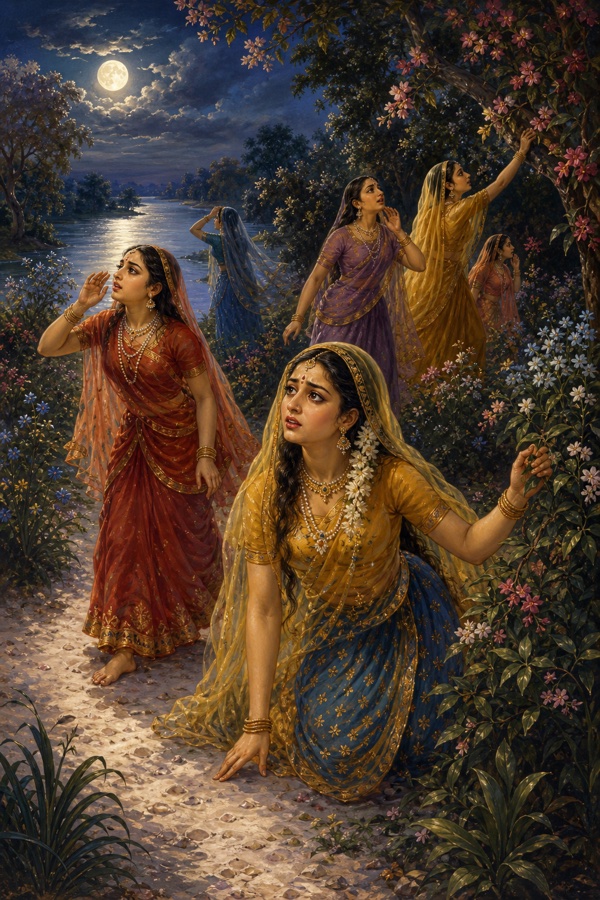
One by one they rose. Into the flowering thickets, through the groves, along the bends of the river, feet sinking into the cool sand, breath climbing, and on every lip the same question, put to no one and yet put to everything. They were so deep in him by now that his ways began to surface in their own bodies. One lifted the edge of her veil high over her friends and called out, “Do not fear the storm, I am holding it off,” the way he had once held a hill above all of Vraja through seven days of Indra’s rain. One stood over a companion and commanded, “Away, vile serpent,” as he had from the raised hoods of Kaliya. One called to far-off cows and played a flute that was not there. And one walked with her arm across a friend’s shoulder and said, “I am Krishna. Watch how I move,” and the others, watching, did not laugh.
One gopi stopped beside a kadamba tree, under its round golden blossoms, her hand resting flat on the bark as if listening for a heartbeat.
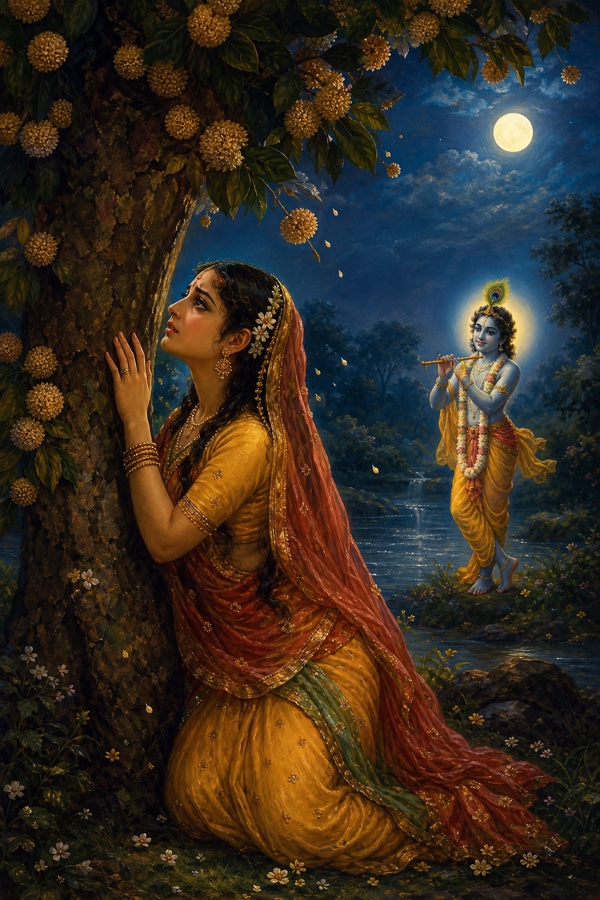
“Did you see him pass, the darling of Nanda? You of all trees would know him. His color is the dark of your own shade. A flute at his lips, a peacock feather at his brow, a smile that can take the pride out of the angriest woman alive. Fig tree, banyan, ashoka, champaka, all of you standing on the Yamuna’s bank for the good of others: our minds have gone away with him. Show us the road he took.”
The tree stayed silent. Only the scent of its flowers deepened into the night, the same scent that once used to walk beside them.
One gopi went to a doe and bent to look into her eyes.
“Gentle one, he has passed you, I know it. The air here still carries the jasmine of his garland. Those dark limbs of his, did they bring your eyes joy tonight? Which way did he go?”
The doe only looked back. Something quivered in her eyes, and no answer came.
One gopi stood questioning a vine, its leaves gathered up into her palm.
“Madhavi, look at you, thrilled into bud out of season. His nails brushed you when he pulled your blossoms loose; you of all creepers know his touch. It is still standing on your skin. In which direction is he tonight?”
They asked every living thing. One of them even bent to the earth itself: what austerity did you perform, that his feet rest on you all day and the grass rises out of you like joy rising on skin? Every one of them stayed silent. And when the tree, the doe, the vine, and the ground under their feet had all failed to answer, something rose inside the gopis that could no longer be said to any creature or any creeper. It could only be said to him.
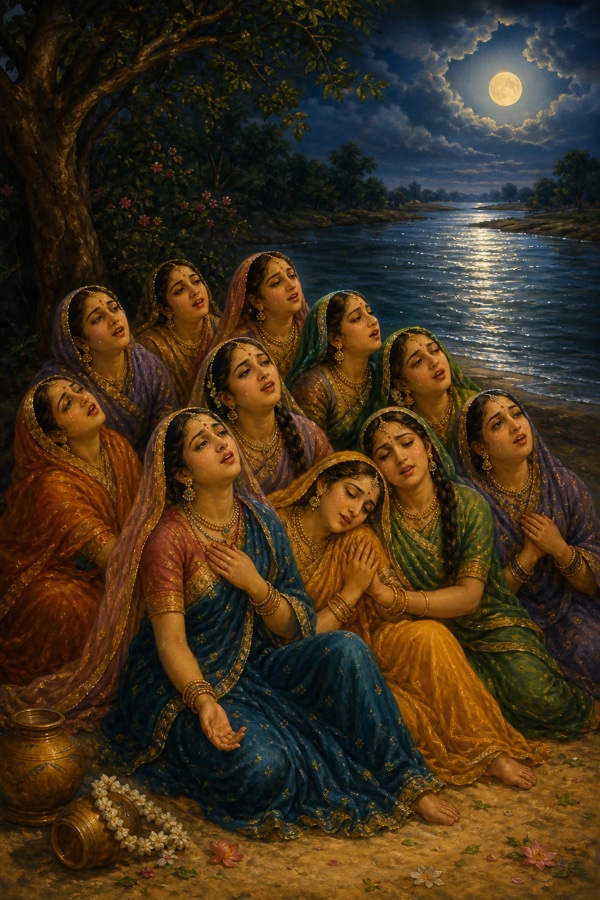
They drew together at one place on the Yamuna’s bank, sat down on the cool sand, and leaning shoulder against shoulder, with no single voice leading, they began to sing for his return. Nineteen times the melody rose, and each time it rose a little more broken.
The opening verse rose like pride, with the reproach still held back.
“Beloved, since the day you were born here, Vraja has outshone every realm the gods keep. Why else would Lakshmi, the goddess of fortune who rests nowhere for long, have left her own abode to dwell in this dust and never once leave it? And we? We laid our lives down at your feet in this same dust. Every breath we hold, we hold in you. Look at what you have made of us: women wandering forest to forest in the dark, searching every direction for you.”
The melody sharpened a little.
“We are your servants, and you paid nothing to have us. We came freely, asking no price or wage, for love of you. And with those eyes, eyes that steal the luster from a full-blown lotus in an autumn pool, you cut us down and walked away. Granter of every wish, answer us: is killing with a glance not slaughter? Does death count only when a weapon deals it?”
And then everything he had once done for them began to return to them, and their throats began to close.
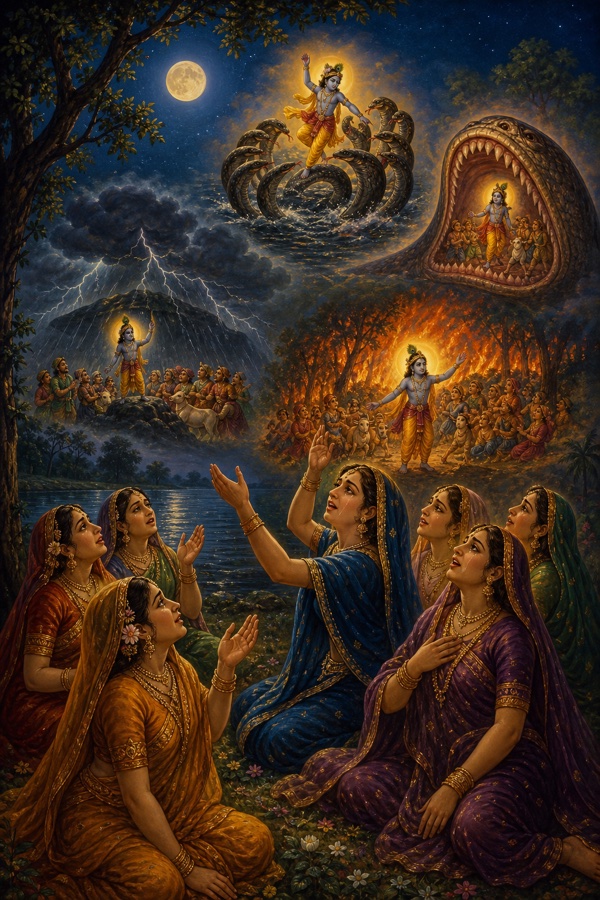
“Jewel among men! When Kaliya’s venom turned the Yamuna black, you carried us clear of the death in that water. When Aghasura lay across the forest road, a serpent with a gullet wide enough to take us all, you carried us out of him. Indra’s downpour and the gale that drove it, the lightning, the fire that ringed the forest, the demon who charged in wearing the body of a bull, Vyomasura, son of the demon Maya. Fear after fear, season after season, you put yourself between us and every one of them. And tonight, under this open sky, you are the one who has left us. The hand that saved us so many times is nowhere we can see.”
One gopi’s voice came from somewhere deeper, and the complaint began turning into worship.
“We know the cowherd’s son is a shape you put on. You are the witness seated in the heart of every creature that breathes, the one who watches from inside us all. When Brahma, the creator himself, begged protection for the universe, it was you who answered, and you answered by being born among the Yadus. So tell us how it can be: the one who sits within and knows everything does not know that our breath is failing now?”
Now the song began to beg for union, and the begging reached down into the body.
“Those who dread the turning wheel of birth and death run to your feet for shelter, and your hand comes over them like a roof and makes them fearless. That hand grants whatever is asked of it. That hand once closed over the hand of Lakshmi herself. Lay it on our heads. Only that much. You who end every grief Vraja has ever had, whose one smile breaks the pride of any woman who believes she can hold out against you, take us for your own. We are your servants. Turn your face to us and let us see it.”
“And set your feet on our breasts. Feet that draw the sin out of everyone who bows to them. Feet that follow the grazing cows through the grass all day for love of them. Feet that Lakshmi keeps for her home. Feet that stood on the raised hoods of Kaliya and danced there without a tremor. Set them here, over our hearts, and put out the fire you lit in them.”
“Bring us back to life with the nectar of your lips. Your speech alone, sweet enough to hold even the learned still, has already carried us out of ourselves. And the people who walk this earth telling the story of you, they are the openhanded ones: that story gives the grieving their breath back, the wise have sung it without ever tiring of it, it burns sin down to nothing, and it blesses the very ear it enters. Your laugh. Your long sidelong looks. The small jests you leaned in and murmured where no one else could hear. All of it went straight in and stayed, and now that you are gone it turns and turns inside us and will not be still. You knew it would, deceiver.”
Then rose the verse the whole song had been built toward, the verse in which love climbs above argument, above reproach, above everything.
“Your feet are softer than lotus petals. By day, when you follow the herds into the forest, we sit here and cannot stop seeing it: the cut stalks of the grain pressing into those soles, the grass blades, the young shoots sharp as thorns. The picture comes, and after it our minds will not sit still.”
Their voices dropped a little further.
“And every evening you come back out of that forest, your face under its dark curls dusted gold by the hooves of the herd, a lotus moving in its own cloud of bees, and the same longing lights in us all over again. Set those feet on our breasts, we ask it once more: the feet that Brahma, born of the lotus, bends his four heads to; the ornament of this whole earth; the one thing a heart can still hold in the hour when everything else is stripped away. And give us the nectar of your lips, the nectar your flute drinks its fill of before we ever taste it, the nectar that deepens every joy, kills grief outright, and makes whoever receives it forget every other bond they ever knew.”
Their voices began to tremble.
“And the time without you. When you walk into the woods at daybreak, half a moment swells into an age for the ones who cannot see you. And at dusk, when you come back and we finally have your face again under its curls, our own eyelids turn against us, because each blink shuts you away for an instant we cannot spare. The maker who set lids on these eyes, whatever else he made well, was a dullard.”
The melody had nearly broken now, and still it did not stop.
“We stepped over our husbands to come to you. Over our children, our brothers, our kin, every claim and every command a family lays on a woman, because your flute called through the dark and we knew your ways and came anyway. Women who have walked out into the night like that have one refuge left in the world, and it is you. You know there is no other road back for us. Trickster. What kind of man calls women out into the middle of the night and then abandons them there?”
“It takes only the remembering and we are lost again: the way you leaned close with some secret, the smile, the slow glances, that broad chest where Lakshmi herself lives, and our minds go under, wanting you past all sense. Your coming lifted the grief off Vraja, off the forest and every creature in it; the whole universe stands blessed by your birth. We are your own. Measure out to us even a little of the one medicine that can quiet a heart this sick with you. And those feet, so tender that we set them against our hard breasts slowly, in fear our own bodies would bruise them, tonight they are out on the gravel and stone of this wilderness, and our minds, which have nothing under them now except you, reel and turn and will not stop.”
And then the nineteenth verse closed, and the song let go of all its cleverness at once.
“Shri Krishna. Shyamasundara, dark one, beautiful one. Prananatha, lord of our breath.”
Three names, and nothing more. One gopi bent forward, her hands braced in the sand, her forehead sinking toward her chest, and her breath ran so short that only one fragment was left in it for speech.
“Our life is for you. We are living for you. We are yours.”
After that the song rose past melody into open weeping, and then even the weeping wore itself out. One after another the gopis sank onto the sand. A head came to rest on a neighbor’s shoulder. Someone’s bangles chimed once and went quiet. Someone’s palm lay open where it fell, still waiting for the hand that had not come. The Yamuna kept flowing. The moonlight kept falling exactly as before. And in that small emptiness where no voice remained, the only sound left was the coming and going of one broken breath.
Into that very breath, he appeared.
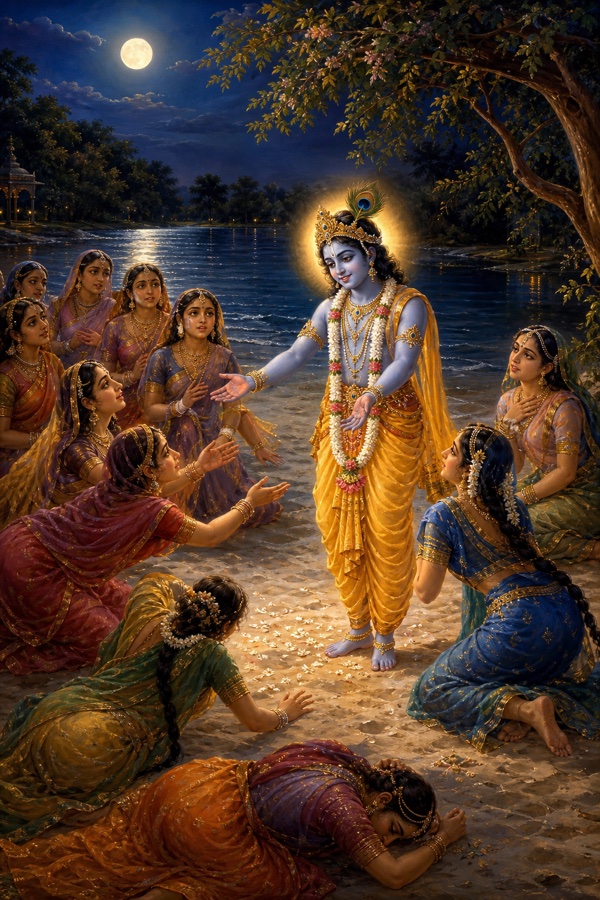
He stood in the middle of them in yellow silk, a garland of wild flowers across his chest, and on his face the smile those nineteen verses had been calling toward all this while, the smile of the one who bewilders the god of desire himself, the god who bewilders all the worlds.
The gopis opened their eyes. For one moment none of them could believe it was truly him. Then they sprang up all at once, the way the limbs of a body spring back to life when the breath returns to it. One clasped his hands in both of hers and would not let go. One drew his arm, cool with sandal paste, across her shoulder. One cupped her palms, and into them he laid the betel he had been chewing, sweet from his own mouth. One took the feet she had always been too frightened to touch and pressed them to the heart that had burned for them all night. One arched her brows, bit her lip, and glared at him through long sidelong eyes, all her love run to anger with nowhere to go. One gazed at his face without blinking and could no more be filled by the looking than a sage is filled who gazes on his feet for a lifetime. And one drew him in through her eyes, closed them over him, and stood holding him inside herself, every hair on her body risen, as still as a yogi deep in his bliss. Then they spread their shawls, still marked with the saffron from their breasts, over the sand for him to sit on, and when he had settled among them, the one whom masters of yoga labor a lifetime to seat in the heart resting easy on a heap of cowherd women’s veils, they took his hands and feet into their laps and asked, with the last of their anger still warm, “Tell us one thing. Some people return the love of those who love them. Some love even those who give them nothing back. And some love no one at all. Which of these is right?”
Krishna answered, very slowly. “Those who love only where they are loved, friends, are trading. Self-interest moves both sides of it; there is no kindness in that bargain, and no dharma either. Those who love even the ones who give nothing back love the way a mother and father love, and that love is compassion without a flaw. And some can love no one: sages folded into their own souls, the fully contented, the dull, and the ungrateful, who turn on their own benefactors. I am none of these. I answer those who love me. And still I went out of your sight, and I did it so that your minds would fasten on me and nowhere else, so that the love itself would deepen. Think of a man with nothing who stumbles on a treasure and then loses it; from that hour he can hold no other thought, and every breath he draws is the treasure. I wanted your hearts turned toward me like that. And I never went far. I stood beside you unseen and heard every verse. What you have done for my sake, cutting the one bond nothing in this world cuts, the bond of home, stepping over the world’s whole law to come to me in the dark, I could not repay it if I labored at the repaying for the full lifetime of a god. So I will not pretend the debt can be cleared. Let your own tenderness stand as its payment, and let it rest there.”
Then the rasa began again. And this time no gopi held anywhere in her the thought that Krishna was hers alone, that she stood apart from the rest. There was only the dance, and inside it the counting of who stood nearest to whom had fallen away.
Literary context
The Gopi Geet is the whole of chapter 31 of the tenth Skandha of the Shrimad Bhagavata. Opening with ‘jayati te’dhikam janmana vrajah’ (“by your birth, Vraja is glorified beyond measure”), these nineteen shlokas are counted among the most lyrical and emotional passages of the Bhagavata. The scene of asking the tree, the doe, and the vine for Krishna’s whereabouts comes just before, in chapter 30, immediately preceding the gopis sitting down to sing. Krishna’s return, with his words that he can never repay this love, fills the chapter that follows, the thirty-second.
The shlokas sit in a fixed meter, which is why they have always lent themselves to recitation; the song is built for the human voice. It has reached newer generations through music as well; M. S. Subbulakshmi’s sung ‘Gopigitam’ remains, for many, their first meeting with it.
On that sand of the Yamuna, where the voice gave out after the nineteenth verse and only breath remained, that same unfinished cry still rises somewhere, even now. And every time, into the middle of that very incompleteness, someone quietly comes and holds out a hand.