On this page
The Prachetas
There was a king named Prachinabarhi, a great-grandson of Prithu, the emperor who had once leveled the wild earth and milked her into fields and grain. He was a man of ceaseless sacrifice; rite followed rite across his reign until the whole face of the land lay strewn with blades of sacred kusha grass, every tip pointing east toward the sunrise, and from that carpet of grass the world took his name. Brahma himself chose his bride: Satadruti, a daughter of the god who presides over the ocean, so lovely as she circled the wedding fire in her ornaments that Agni, the fire-god burning on that very altar, forgot himself watching her, and gods, sages, and Gandharvas in every quarter turned toward the small thunder of her anklets. Through her ten sons were born to the king, and the world knew them by one name, the Prachetas: ten princes of one mind, schooled in one code, moving through their days like a single hand with ten fingers.
One day their father called them near and laid a king’s charge on them. “The line must go forward; children must be born. But before any of that, go and find the Lord through tapasya. Without his grace, no creation ever holds.”
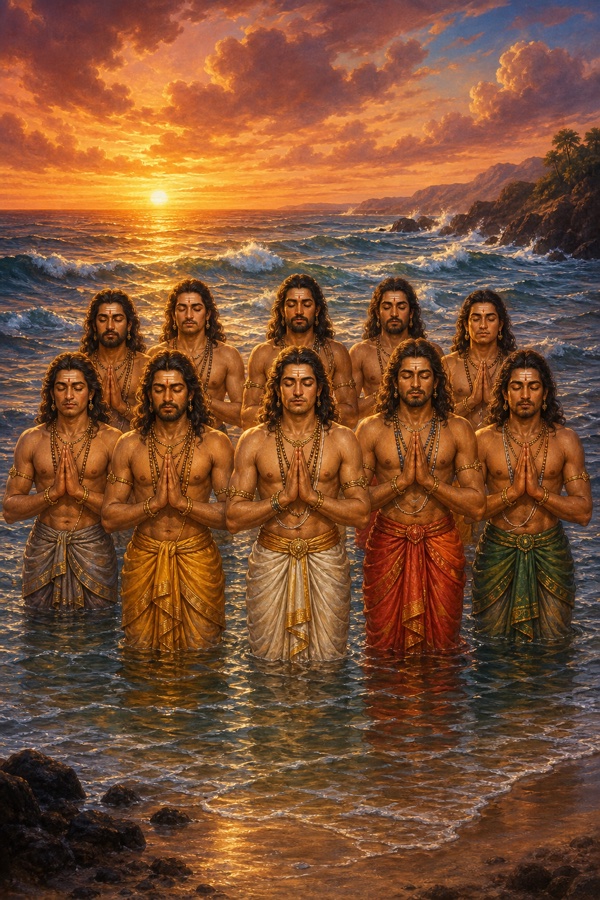
The ten bowed their heads and set out toward the west, their minds already fixed on the austerity ahead. After a long road they came to water that stopped them where they stood: a lake so vast it might have been the sea, and clear to its depths, the way a mind disciplined by spiritual practice is clear. Blue and red lilies opened across it, and lotuses, and the kahlara that blooms at dusk; swans, cranes, ruddy geese, and diving ducks kept up their calling over the surface; and along the banks, trees and flowering creepers leaned above their own reflections, loud with bees, while the breeze dusted the water with lotus pollen. Into that water the ten walked together, and stood, and gave up even food.
And the tapas began.
They slowed the breath, gathered the mind onto a single point, and closed their eyes.
Days passed, then months, then years.
They went hungry. Their bodies dried until the skin lay tight over bone, their matted hair grew down to their shoulders, and still they stood, ten gaunt figures the water rocked without waking. Not one of them so much as opened an eyelid.
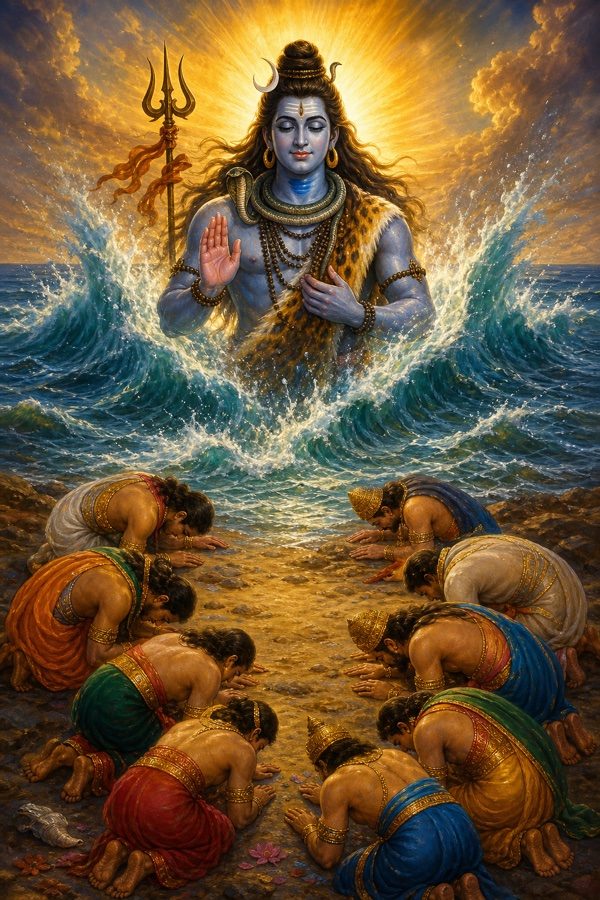
Then a sound crossed the lake: drums of clay and wood, beating under a music so strange it could pull the mind out of its moorings. Behind the music came light, spreading over that lonely water like gold heated to pouring, and out of the lake itself rose Lord Shiva with his retinue about him, Gandharvas and Kinnaras singing his glories as he came. His throat was dark from the poison he had once swallowed to spare the worlds, the young moon lay along his brow, and in his three eyes was the compassion that steadies even the dissolution of worlds. This was the god whom renouncing sages spend whole lifetimes longing merely to picture. He had come of his own accord.
The ten opened their eyes, trembled to find him before them, and bowed until their foreheads touched the ground.
Shiva looked at them with a father’s tenderness. “You are the sons of Vedisad,” he said, calling their father by the name his altars had earned him, “and I know what you have come out here to win. I have no errand of my own. I have come only to pour my grace on you, because no one is dearer to me than a soul who has taken refuge, plainly and wholly, in Lord Vasudeva. A man who keeps his own duty perfectly may climb, after a hundred lives, as high as the seat of Brahma, and with rarer merit he may come even to me. But the Lord’s devotee goes straight, the moment the body falls, to the abode beyond all matter, the abode that I myself, as Rudra, will reach only when my term of office ends and the gods and I shed our last subtle bodies at the great dissolution. You are already his. That is why you are mine, and why, for those who love the Lord, there is no one nearer than me.”
“Now hear this hymn,” he went on. “It is holy, it is supremely auspicious, and it carries whoever keeps it all the way to the far shore.” And there, while the ten stood with joined palms in the water, the Destroyer of the universe sang the praise of Shri Hari, the song that men would afterward call the Rudra Gita.
He sang the Lord under name after name, form after form, and the hymn moved like a procession through everything that is. He bowed to Vasudeva, seat of the watching reason, tranquil, changeless, lit by his own light, from whose navel the lotus of the worlds had opened; to Sankarshana, unmanifest and endless, from whose mouth fire will pour to swallow the universe at the end of things; to Pradyumna, wellspring of all the knowledge in the world; to Aniruddha, who governs the mind and reins in the senses. He hailed the same Lord as the sun that floods the quarters with light, as the door to heaven and to freedom that stands open inside every clean heart, as the fire through whom the offerings of the four priests arrive, as the moon whose nectar feeds the gods and the ancestors, as the water that quenches every creature that breathes, as the earth that lends each body its clay, as the wind that holds the three worlds upright, as the ether that gives sound a home and makes inside and outside possible, as heaven above, as work and as the leaving of work, as the death that unrighteousness earns, as the giver of the fruit of every act, and as Krishna, virtue made person, wisdom without an obstacle, the most ancient Person, lord alike of the path of knowledge and the path of action. Then the hymn turned to asking. Show us, it begged, the form your devotees hold dearest: dark as a rain cloud about to break, gathered out of every elegance there is; the face whose eyes lift at the corners as if always about to smile; the yellow cloth bright as lotus filaments, the crown, the polished ear-rings; conch, discus, mace, and lotus; the Kaustubha gem at the throat, and on the chest a fine streak of gold that is Lakshmi herself, resting where she always rests; the belly with its three soft folds, and the navel deep as a whirlpool, drawing the whole universe back toward the source it came from; the feet like petals of an autumn lotus, whose bright nails drive the darkness out of any heart that looks at them. Whoever reaches those feet, the hymn went on, has nothing left to ask, and Death himself, who wrecks the worlds with one contraction of his brow, does not count among his subjects the soul who shelters there. And on the brothers’ behalf Shiva begged the one gift he called worth begging. Half a moment in the company of those who love the Lord outweighs heaven, he sang; it outweighs the ending of birth and death; the blessings mortals pray for do not enter the scale. Give these princes the company of souls whose sins have dissolved in the stream of your glories and in the Ganga that falls from your feet, souls kind to every creature, free of craving, grudges, and fear of anything alive. And he sang, of himself, that the whole universe lies half dead with the fear of Rudra, and that for those who understand, the Lord alone is the shore where fear ends.
When the song ended, Shiva told them what he had given them. “This hymn is called the Yogadesa. Keep repeating it, every one of you, with a still mind and your work laid at the Lord’s feet, and hold the hermit’s vow while you do. At the first dawn of creation, Brahma, wanting worlds and children to fill them, taught it to Bhrigu and the rest of us, his mind-born sons; it was by this hymn that we shed our ignorance and grew able to bring the species of the living to birth. Whoever rises before daybreak and recites it with joined palms is cut loose from the shackles of karma. Whoever holds it with a steady mind receives from the Lord, who is the one storehouse of blessings, whatever he desires, and of all blessings the highest is the lit understanding that carries a soul through engulfing grief. Practice your tapasya inside this song, and when the time ripens, the very Lord whose praise I have sung will stand before you in person.” Then Shiva vanished where he stood, and for a long while the ten went on gazing at the empty water where he had been.
The Prachetas set the hymn into their hearts and closed their eyes once more. This time their lips kept moving, slow and steady, shaping the names of Shri Hari while the seasons broke and re-formed around them. Ten thousand years passed that way, ten brothers motionless in the water, the world turning on without them.
And then one day, through the wall of that long silence, came a voice like slow thunder.
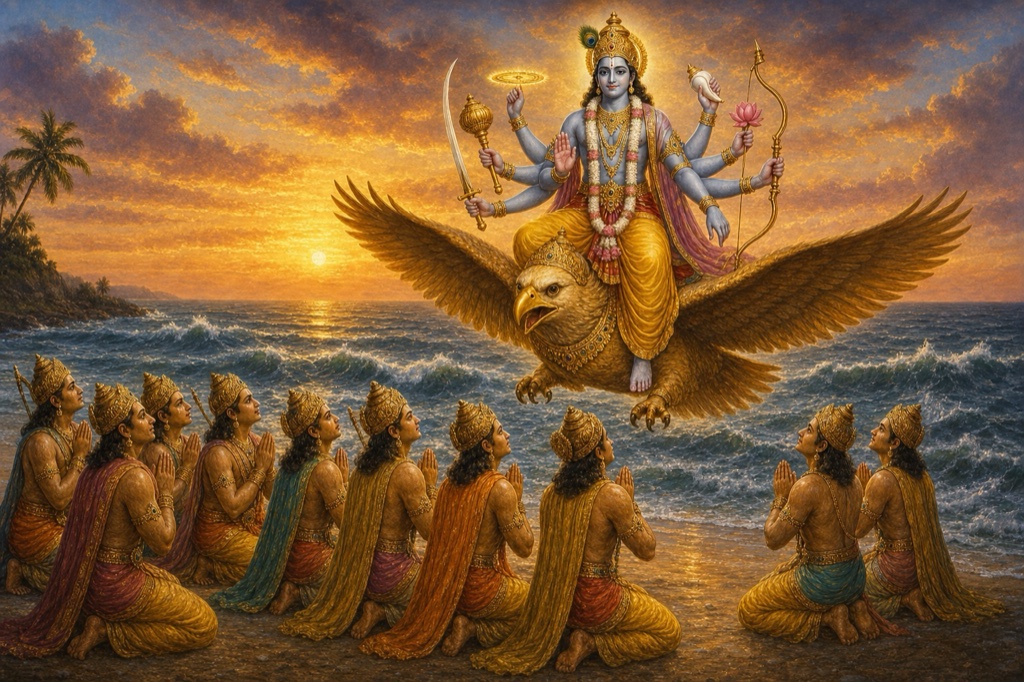
The ten opened their eyes. Before them, mounted on the shoulders of Garuda, was Shri Hari himself, the one whose names they had carried for ten thousand years, and his radiance moved through their starved bodies like rain through burnt ground, easing the whole long ache of the austerity. He looked like a dark cloud come to rest on a golden peak of Meru. His robes were yellow, the Kaustubha gem burned at his throat, and the light going out from him pushed the darkness back from every quarter of the sky. A crown blazed above his brow. Eight long arms circled him, a weapon alive in every hand, conch and discus, bow and arrow, mace, sword, shield, and lotus; sages and gods attended at his sides; and Garuda sang his glory the way the Kinnaras sing it, with the music of his own beating wings. Across the dark chest swung a garland of forest flowers whose splendor rivaled Lakshmi’s own, and on his face was the tender smile that gives the weary their rest.
Their eyes brimmed and ran over. One brother found his voice, and it shook. “Prabhu. You have truly come.”
“Ask,” said Shri Hari, and his merciful gaze went over them all. “Choose any boon you please. You have kept one vow with one heart, and this love you bear one another has won me.” And before they could speak, he began to give. “Whoever remembers you ten at dusk will love his brothers as his own self and will wish every living thing well. Whoever praises me at morning and at evening with the hymn Rudra taught you will receive a clear and shining mind, and with it whatever his heart is set on. Because you took up your father’s charge gladly, your fame will run through every world. And a son will be born to you who will stand in nothing behind Brahma himself, and his children will fill the three worlds.”
The ten looked at one another, and no wish for themselves stirred in any of them. Then they folded their palms, and their voices came thick with feeling. “Prabhu, you have shown us the form that ends every misery. What favor is left for you to grant? A master who remembers his own poor at the right hour has already done everything, and you sit in the heart of the smallest creature that moves, its inmost ruler; you knew what we wanted before the want had formed. Your pleasure is our whole desire; beyond it we ask nothing. And yet hear one boon after all. They call you Ananta, the endless, because no one has ever found the far edge of your glories. When the parijata, the wishing tree of paradise, stands within reach, what bee goes hunting further? So: for as long as your maya keeps us circling through birth and death under the load of our own karma, give us, in every life, the company of those who love you. Half a moment of that company outweighs heaven for us; it outweighs freedom itself; the small blessings mortals pray for do not enter the scale. Where such souls gather, your stories are sung until the thirst for pleasure dies away, and no enmity survives in the heart, and no fear of any creature at all. They walk the roads of the world making the holy places holier with the touch of their feet. One moment in the company of your friend Shiva carried us all the way to you, the one physician for the long disease of birth and death; judge from that what whole lifetimes of such company would do. And whatever we have ever studied, every service we have done our teachers and elders, every bow we have made to the worthy, every year of this standing tapasya in the water, let all of it become one thing only: a means of pleasing you. Manu the first father of men praises you, Brahma praises you, Shiva praises you, and none of them has seen the end of your glory; so we too praise you, by the little light we have.”
Shri Hari smiled. “So be it. The love you hold for one another, and this love you bear me, please me deeply. Now finish what your father began in you. A bride is coming to you whom you will all wed together and hold together in peace, and through her the earth will be peopled again. Taste the pleasures of this world and of heaven; my grace will keep your strength undiminished through a million celestial years of them. And fear nothing from the householder’s life. A house where every act is placed in my hands and every hour turns into talk of me binds no one who lives in it; through that talk I enter the hearts of the talkers, new every time they speak of me, and those in whose hearts I live pass beyond infatuation, beyond grief, beyond joy itself. At the last, when steady love of me has burned every craving out of you, those pleasures will sicken you, and you will set them down of your own accord, and rise to my supreme abode.” The brothers’ eyes had not had their fill of him, and they did not want him to go. He said once more, “Be it so,” and returned to his own realm.
The ten came up out of the water at last, and stopped. They could put no name to the world in front of them.
In ten thousand years of samadhi they had never once felt time move. Outside, it had moved. Their father, his heart turned by the sage Narada’s parable, had laid down his crown and gone into the forest to spend his last years on the Lord; no king had taken his place; and with no ruler and no hand on any plow, the trees had quietly taken back the earth. They had grown so tall and stood so dense that they seemed a green rampart run up against heaven itself, and no ray of sun reached the ground. Forest in every direction, and under the forest, a buried earth.
Forest had buried every place for settlement and every field a plow could cut.
The Prachetas remembered their father’s charge. In forest this deep settlement, children, and a future for the line they had been sent to secure had become impossible. Anger rose in them, anger with the banked heat of thousands of years of tapasya inside it, and they turned it loose the way Kalagnirudra, the fire that ends the three worlds, is turned loose at the dissolution of things.
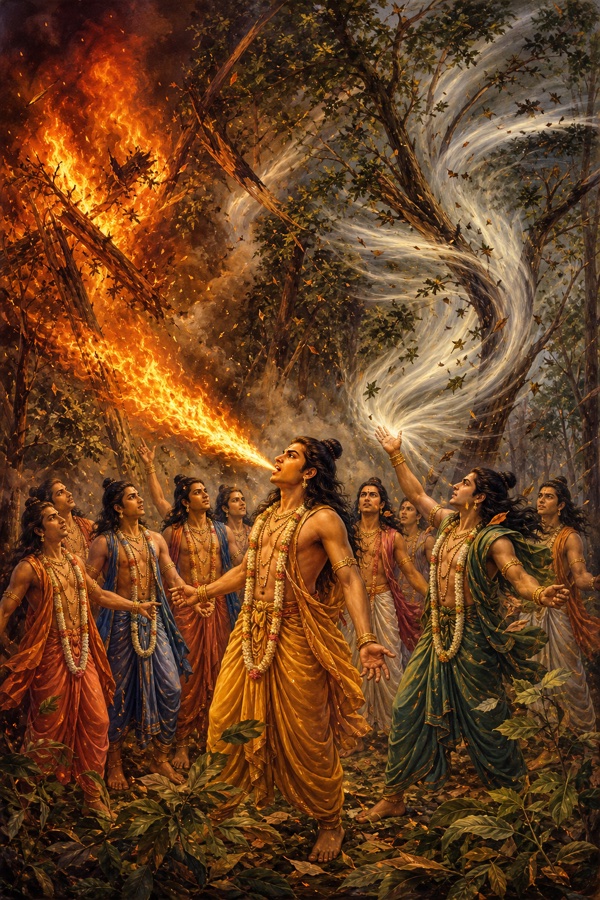
From one mouth came fire. From another came wind, a gale to feed it. Fire and wind fell on the forest together, bent on stripping the earth of every standing tree, and the air filled with the crack of splitting trunks, the smell of scorching leaves, and a curtain of smoke that shut out every horizon.
The forest went up.
Then through the smoke a calm light came down, and Brahma the Grandsire stood before them, the father of their fathers, come to stand between the fire and the forest it was eating.
“Stop, sons of Barhishmat,” he said, and the ten held their fire. “These trees you are burning to ash are living beings, and they too have their place in this creation. To tear them out by the root is no work for rulers of created things.”
One of the brothers answered him. “But the earth has to be made fit to live on. That is our father’s charge, and our children will settle this same ground.”
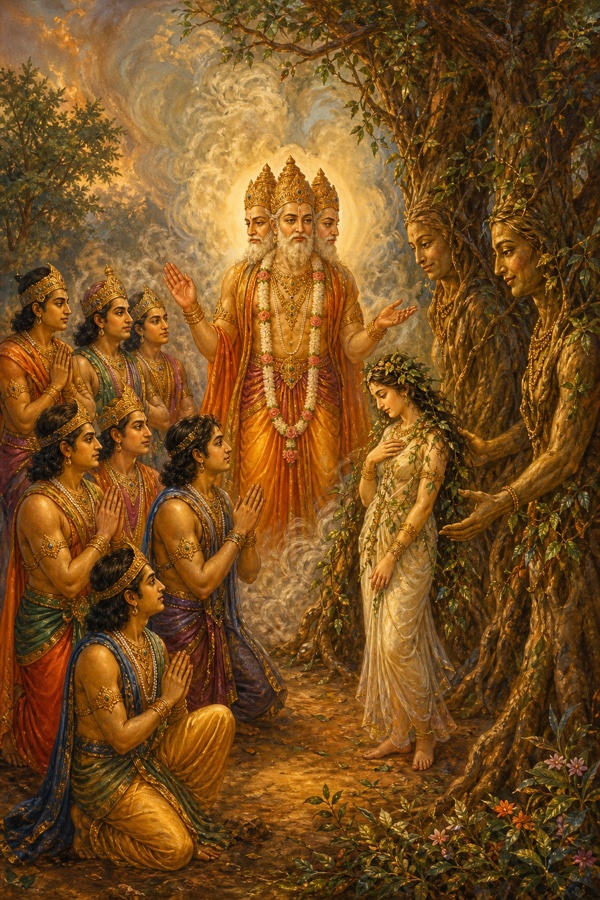
“Then make it fit. The charge is met by making; wrath has never yet settled a country.” And Brahma told them of a girl. Long ago a daughter had been born to the sage Kandu through Pramlocha, an apsara, one of the dancers of the celestial courts, and her eyes even in infancy were lovely as lotus petals. When heaven called the nymph home, she left the infant lying beneath the trees, and the spirits of the trees gathered the crying child up as their own. Soma, king of the moon, moved by that crying, had bent down out of the sky and laid his index finger, wet with nectar, to her small mouth, and fed her: moonlight nursing what the forest had adopted. Now, at Brahma’s word, the trees that had survived the fire came forward timidly through the ash, presenting the girl they had raised, and set her in the brothers’ keeping. Her body was soft as a new shoot, leaves were tangled in her hair, and where she walked the scent of the deep forest followed her.
“This is Marisha, the daughter the trees raised,” said Brahma. “Marry her, all ten of you together. Through her children this earth will fill again.”
The Prachetas stood very still. “One maiden, and ten brothers?”
“Yes,” said Brahma gently. “You have held one vow in common for ten thousand years; hold one wife in common now. Your natures are one, and hers matches them, and no quarrel will ever cross that threshold, between you and her or among yourselves. The Lord himself, when he stood before you in the water, allowed this marriage.” Then, having quieted ten angers and given away one daughter, Brahma returned to his own world.
The ten bowed their heads and accepted.
The marriage took place.
Marisha bore them one son, the son Shri Hari had promised in the water. He was Daksha, Prajapati Daksha come again: the same lord of progeny who, in a body he had worn and lost long before, had slighted the great Lord Shiva and paid for it with everything, and who now took his new birth from a union the Lord himself had sanctioned. Even as he was being born, his splendor drowned every shining thing around him, and for his deftness in the sacred rites they called him Daksha, the able one. In the fullness of the ages, at the dawn of the sixth Manvantara, the long era ruled by the Manu Chakshusha, he would beget the progeny of his choosing; Brahma would set him at the head of all the lords of creation and charge him with extending the race of the living; and he in his turn would portion that work out among the rest.
So the charge laid on the Prachetas was met. For a million celestial years after that, exactly as the Lord had said, they lived the householder’s life with strength that never once diminished, tasting the pleasures of earth and of heaven and keeping Shri Hari in their speech and their work as he had asked. And when the million years had run out and clear sight rose in them at last, they remembered his parting words, and the pleasures dropped from their hands of their own accord. They gave Marisha into the care of their son and went out to the shore of the western sea, to the very spot where the sage Jajali had once broken through to God, and there they took up the final enquiry, the search for the Self that lives as the one life in everything alive.
It was there that Narada found them, the deathless wanderer whose parable had once turned their own father toward the forest: ten men with breath, mind, speech, and sight all stilled, bodies straight and motionless in postures they could hold as long as they chose, their whole attention resting on the changeless. They rose, laid themselves at his feet, seated him with every honor, and said, “Holy one, your coming is our good fortune. You travel as the sun travels, and fear ends wherever your round carries you. What Shiva taught us in the water, what the Lord himself told us face to face, the long comfort of our house has nearly rubbed out of us. Light the lamp of that knowledge in us again, so we may cross the hard sea of birth and death.”
And Narada, whose mind had long since made its home in the Lord, taught them. “Measure a birth by one measure only,” he said. “The only birth worth having, the only deeds, the only span of years, the only mind and the only speech worth anything in this world, are those by which a man reaches Shri Hari, the Self of all. What good is noble parentage, or the second birth of the sacred thread, or the third birth of consecration for the rites; what good are all the duties the three Vedas enjoin, or a lifetime stretched to the length of a god’s? What good is learning, austerity, eloquence, a memory that holds ten things in a single grasp, a penetrating intellect, a strong body, keen senses? What good is yoga, or the analysis that sorts spirit from matter, or renunciation, or the whole recital of the Vedas, if none of it is spent on the Lord who gives his very Self to those who serve him? To find the Self is the end of all finding, and the Self of every living being is Shri Hari. Water the root of a tree, and the trunk drinks, the boughs drink, the last twig on the least branch drinks. Feed the one life in the body, and every sense is fed with it. Worship the one deathless Lord, and everything worthy of worship has been worshiped in him. As rain rises out of the sun’s own heat, falls, and climbs back at last to the sun, as every body rises out of the earth and lies down again into the earth, so this whole moving and unmoving world comes out of Shri Hari and goes home to Shri Hari. And he is easily pleased. Kindness to every living thing pleases him, contentment with whatever comes pleases him, senses held in a steady hand please him; and once his devotees have drawn him into a heart scoured clean of craving, he can no more leave it than the ether can leave the jar it fills; he lets his own servants bind him. He is the wealth of those who own nothing else, and from the proud who slight those poor of his, though they come carrying learning, pedigree, riches, and famous deeds, he will not take worship at all. Think of it this way. Lakshmi herself waits on him, the goddess for one glance of whom kings and gods spend their whole lives scheming, and he, complete in himself, does not turn his head; yet his servants tell him what to do, and he does it. What man with any gratitude in him could put that Lord out of mind for even half a breath?”
He said much more, and all of it circled one center, the glories of the Lord; and when it was done he rose and went his way to Brahma’s world. And the Prachetas, holding in their hearts what they had heard, praise with the power to wash the sins of the world off whoever hears it, fixed their minds on the feet of Shri Hari and went at last where he is, to the realm from which no one returns.
Literary context
The story of the Prachetas spans the fourth Skandha of the Shrimad Bhagavata, Discourses 24 through 31. In Discourse 24 Lord Shiva himself teaches the brothers the hymn men call the Rudra Gita, which he names the Yogadesa (4.24.33 onward). At the end of ten thousand years of austerity in the water, Shri Hari grants them his darshan and his boons (4.30), and in the last discourse the sage Narada rekindles in them the knowledge of the Self, through which they reach the Lord (4.31).
This whole arc, the austerity, the Rudra Gita, the darshan, and the teaching of Narada, is narrated by the rishi Maitreya to Vidura; the allegory of Puranjana that fell between is what Narada had earlier told the brothers’ father, Prachinabarhi. The burning of the forests and the marriage with Marisha are told a second time, with Soma the moon-god pacifying the princes, when Shuka reaches the birth of Daksha in the sixth Skandha (6.4). From these same Prachetas and Marisha comes Daksha, whose earlier body and its quarrel with Shiva stand behind the story of Sati.
The philosophical lens
The Pracetas ask for the company of devotees and receive a commission to serve creation. The Lord directs them toward responsibility and gives them a way to preserve remembrance while carrying it.
One line to keep with you
To the ones who asked him for nothing, the Lord handed his own work. The fruit of bhakti is a new form of seva, and it has never yet looked like rest.