On this page
Daksha and Sati
Daksha was born of Brahma himself, one of the Prajapatis, the lords of created beings, the fathers charged with peopling the worlds. He loved his daughters with a warmth the whole household could feel. The full architecture of the yajna lived in his memory, every mantra pitched to the exact height the shastra prescribed, every gesture timed to the syllable. And under that flawless surface something small was feeding. The honor he craved had learned to measure itself in bowed heads, and that hunger, fed a little every day, would in time set him against his own child.
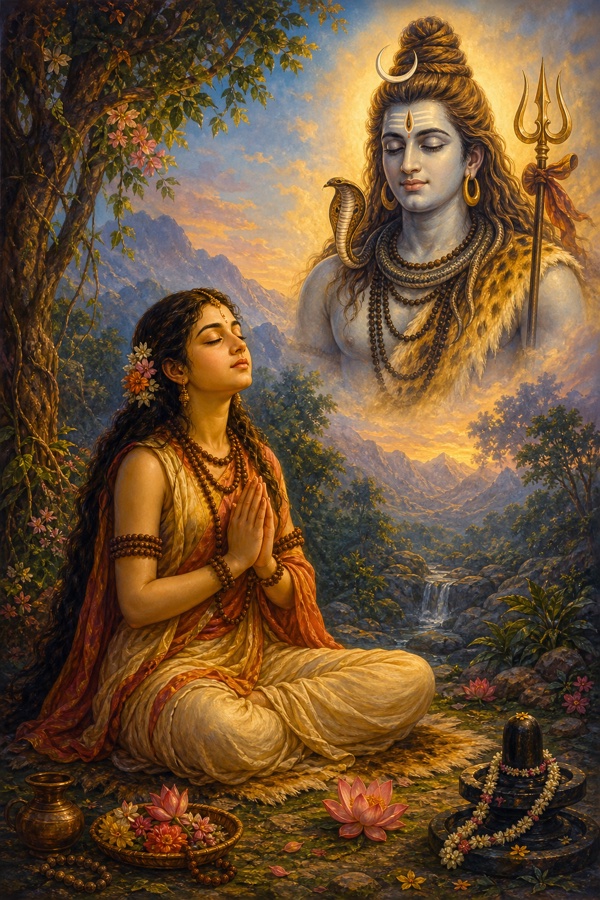
He had a daughter named Sati, the youngest, the darling of the house. From girlhood a single name had settled in her, the name of Shiva, the ascetic god who sits on the ice of Kailasa with matted hair and a crescent moon, revered by the whole world and understood by almost none of it. She gave herself to tapas, the slow austerity that burns a wish down to its essence, and asked for him alone. Shiva accepted her. At Brahma’s own urging Daksha placed her hand in his before fire and Brahmins, and the delicate girl of the Prajapati’s house became the companion of the lord of Kailasa.
The marriage never stopped chafing him. And the strangest part of it was that Daksha knew exactly who his son-in-law was. He knew Shiva to be the teacher of everything that moves and everything that holds still, an enemy to no one, tranquility itself, complete in his own Self, the being the whole universe holds highest. The knowledge only sharpened the sting. A man who feeds on honor cannot stand easy beside someone who needs none, and next to such a son-in-law Daksha’s carefully counted greatness looked small even to himself.
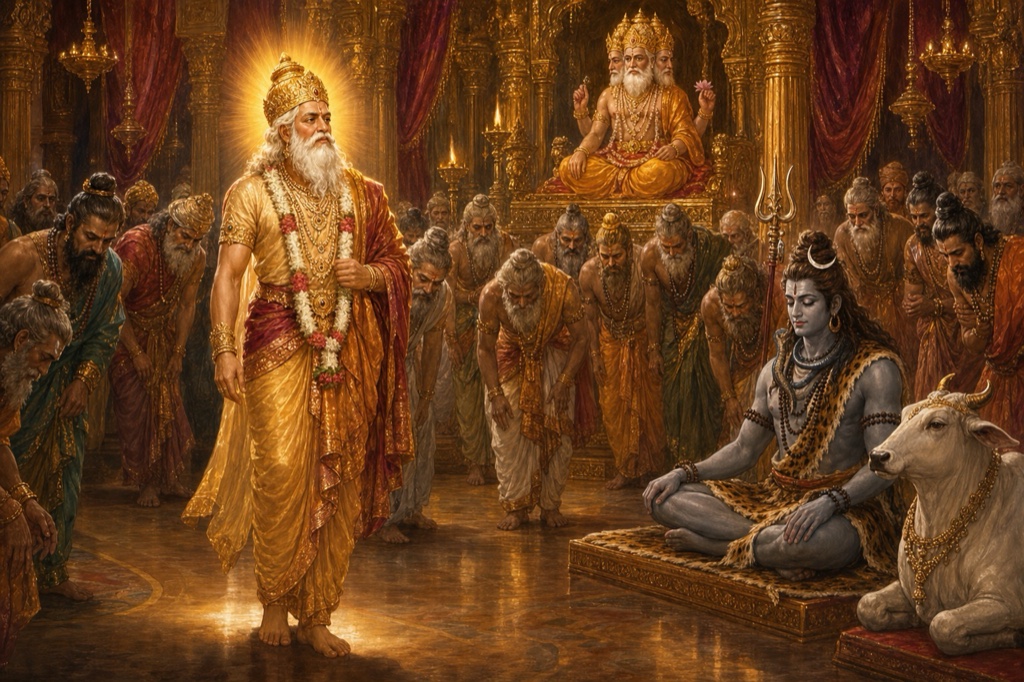
Then came the day that blew the smoldering coal into open flame. The Prajapatis held a great sacrificial session, and everyone came: the foremost brahmarshis, the celestial sages, hosts of gods, even the deities who preside over the sacred fires, each with his following. When Daksha entered, he blazed like the sun walking, and the gloom of that vast hall lifted around him. The whole assembly, dazzled, rose to its feet, heads bowing, seat after seat emptying as he passed. Two did not rise. Brahma, his father, kept his seat, as a father may. And Shiva kept his, eyes half closed, sunk so far into his own Self that hall, splendor, and Daksha himself had ceased to reach him.
Daksha took the honors of the superintending priests, bowed to Brahma, the progenitor of the universe, and sat at his father’s bidding. Then his gaze found Mahadeva, already seated, undisturbed, offering him nothing. He withheld rising, greeting, and every flicker of acknowledgment. The slight went into Daksha’s chest and stayed there. That silence, the same inward stillness before which all creation bends, he read as an insult aimed at himself alone, and he turned on Shiva a look so crooked it seemed meant to set him burning where he sat.
“Hear me, brahmana sages, gods, and you deities of the fires,” he said, and the hall went quiet. “I speak of the conduct of the pious, and I speak free of ignorance and spite. This shameless creature has dragged the good name of the world’s guardians into the dust; the arrogant man has stepped off the road the virtuous walk. He made himself a son to me the day he took my daughter’s hand before fire and Brahmins like a decent soul, my fawn-eyed girl, a second Savitri in her purity, taken by this monkey-eyed vagrant. And after all that he would not rise for me. He would not greet me. He did not spend so much as one word of courtesy on me, when rising was the least of what he owed. To this haughty, unclean being, who has thrown off every pious act and trampled every boundary of decency, I gave my daughter against my own will, the way a fool pours the Veda into the ear of a shudra.”
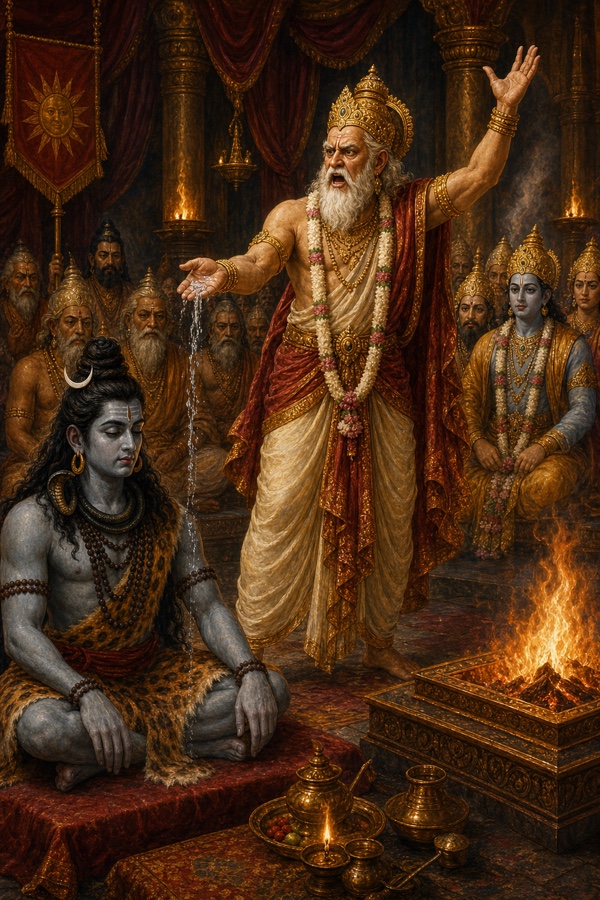
Then he went further, and the hall listened, stone-still. “He haunts the burning-grounds with ghosts and spirits for company, hair flung loose, laughing one moment and howling the next like a madman. He bathes in the ash of funeral pyres. He wears a garland of skulls and ornaments carved of human bone. He carries the name Shiva, the auspicious, and there is no auspiciousness in him anywhere; drunk himself, he loves the drunken, lord of a horde of tamasic ghouls. And to that I gave my virtuous daughter, at Brahma’s own urging.” Even this did not drain him. He sipped water from his palm, the small solemn act that turns a word into a weapon, and pronounced the curse in front of them all: from this day Bhava, vilest of the gods, would take no share of the sacrifice beside Indra, Upendra, and the rest of the immortals. The elders of the assembly pressed him to stop. He heard none of it, and he strode out of the hall in his fury and went home.
Nandishvara, first among Shiva’s attendants, heard the curse, and rage took him whole. A servant’s anguish for a slandered master shook in every word as he turned the cursing back on Daksha and on every Brahmin who had sat there and let it pass. Let this fool who dotes on his perishable body, who hates the one being that hates no one, have his face turned away from the Truth forever. Let him rot in the round of householder ritual, cheated by the flowery promises of the very texts he recites, chasing pleasure with a mind gone brute from contemplating the body as the self. Let him be besotted with women. And let the head that carried all that arrogance become, this instant onward, the head of a goat. As for the Brahmins who had nodded along while a god was reviled: let their learning, their austerity, and their vows dwindle into a trade plied for a living; let them eat whatever comes to hand and wander this world as beggars, delighting in nothing except wealth and their own senses.
At that a whole company of Brahmins burned with anger, and out of them rose Bhrigu the rishi, and he set down a counter-curse as hard to lift as the rod of Brahma. Those who keep the vows of Bhava, and those who trail after such men, shall become heretics and set themselves against the true scriptures; they shall throw purity to the winds, wear matted locks, ashes, and bones, and enter initiations where wine is held holy. You denounce the Veda, he said, the one dam that holds society within its banks, the eternal road walked by the ancients and warranted by Janardana, Vishnu himself; so go, take your heretics’ path, with that lord of ghosts for your god. And while Bhrigu’s words still hung in the air, Shiva rose without answering a syllable of them, gathered his people, and walked out of the assembly, and those who watched him go said afterward that the unshakable one looked almost stricken.
The Prajapatis carried their great session through to its end, a sacrifice that ran a thousand years with Sri Hari, the Supreme Being, as the deity of its worship, and when it was done they bathed at the meeting of the Ganga and the Yamuna and went their separate ways. The enmity outlasted all of it. Years passed over it, and then Brahma raised Daksha over all the lords of created beings as their overlord, and the new title swelled his pride past its old walls. He performed the Vajapeya sacrifice, slighting the deepest knowers of Brahman even as he did it, and then he reached for the summit and began the Brihaspatisava, the greatest rite of them all. Brahmarshis and celestial sages came, the ancestral fathers came, the gods came, and their wives came with them, everyone jeweled from head to foot.
The gods traveled the roads of the sky talking loudly of the festival, and that is how Sati learned of it. From Kailasa she heard, out of passing celestial mouths, that the greatest sacrifice of the age was under way at her own father’s house, and that no word of it had come to her.
Then she saw them. Whole flights of the sky’s women passed near Kailasa, the bright-eyed wives of gandharvas and yakshas, dressed to the last thread, polished earrings swinging, gold at their throats, riding beside their husbands in sky-chariots white as royal swans. The vault of heaven was decked with them, every chariot aimed at one city. And watching that glittering traffic stream toward her childhood home, Sati felt the threshold of her mother’s house tremble somewhere inside her, the worn stone she had run across a thousand times as a girl.
She went to her lord, and for a long moment the words would not come. Then, softly, she laid the matter before him.
“Swami, they say a great festival of sacrifice has begun at your father-in-law’s house. Look, the beings of heaven are streaming toward it; let us go too, if you wish it. My sisters will come with their husbands, eager for the people they were raised among. I long to stand in that crowd, to take the gifts my parents will press on me, to see my sisters honored by their husbands, and my mother’s sisters, and my mother most of all, whose heart has never once let go of me, and to watch the great rite the seers themselves are conducting. All this made of three strands, this whole wonder of a world, is your own maya appearing in you; I know it, and still I am a woman who does not fathom your reality, and I ache to see the place where I was born. Look, lord whose throat went dark the day you drank the ocean’s poison to spare the worlds: women with no claim on that house at all are flying there in their finery. How is a daughter’s heart to sit still when there is festival at her father’s? People go uninvited to the house of a husband, a teacher, a parent, a dear friend, and no one thinks the worse of them. You are called compassionate. You set me in the left half of your own body; grant me this one desire.”
Shiva looked at her a long moment, at the ache standing plainly in her eyes. He was tender toward his own past all reason. And even as he looked, the old wound moved in him, the shaft-like words Daksha had driven into him before the assembled Prajapatis, words of the kind that go in at the ear and never entirely come out. He gave a low laugh with no laughter in it, and answered her.
“What you say is true, Devi. One may go uninvited to one’s own; that is the way of kin. But only where the kinsman’s mind is clean, unclouded by the pride and the anger that grow from taking the body for the self. Learning, austerity, wealth, beauty, youth, high birth: six adornments on the noble, and on the arrogant six blades, for pride seizes each one and turns it, until the eye can no longer see the greatness of the great. Never enter the house of a man whose judgment has turned, who receives his own visitors with a suspicious mind and a frown he does not trouble to hide. An enemy’s arrows leave a wound a man can sleep on; it heals. The crooked words of his own people lodge in the quick of his heart, and they burn there day and night, and no dressing reaches them. You are the most beloved of Daksha’s daughters, the treasure of that whole house. Even so you will get nothing from him, because you are joined to me, and your joining to me is the wound he cannot stop touching. A mind burning with envy of the great cannot climb to where the great stand quiet, so it hates them instead, the way the demons hate Sri Hari. And as for the courtesies you hope to see, the rising, the welcome, the folded hands: the wise pay those inwardly, Devi. They bow to the Supreme Person who lives in every heart, in a mind washed so clean that the wise call the mind itself Vasudeva, the seat where that Person stands unveiled; there, and to him, I bow without ceasing, past the reach of any eye. Bodies I do not salute, and Daksha took me for a body and hated what he saw. He shamed me in open assembly for no wrong of mine. So I tell you plainly: turn your eyes away from his face and from the faces of his followers. Go against me in this, and no good will find you there. For one held in honor, an insult from his own kin kills as surely as a blade, and it kills at once.”
“But he is my father.” It was the oldest argument on earth, and it came from a place no reasoning reaches. “The lap I grew up in does not stop being mine because its door is shut. Whether that house calls me or turns me away, my heart pulls toward it. Let me go.”
Shiva said nothing more. He had already seen how it would end, seen it whole: go or stay, his beloved was now marked for death, and the seeing sealed his mouth. And Sati swung between the two pulls like a pendulum, stepping toward the door on her longing, stepping back under his silent gaze, until the wanting and the warning tore against each other and she wept. Then anger climbed up through the grief. Trembling, she threw one look at her matchless lord as if she, too, could burn what she looked at, and with her heart split down the middle she turned from the one who had given her half of his own body and set out for her father’s house.
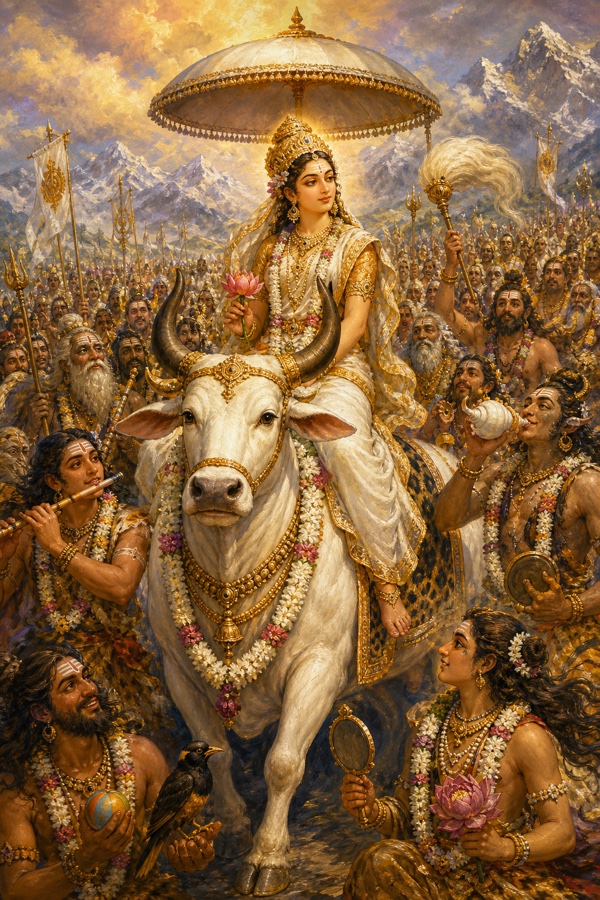
His people could not bear it. To let the lady of Kailasa travel unescorted to a hostile house was past what any of them could watch, and so Maniman, Mada, and the rest of Shiva’s attendants, with thousands of yakshas among them, poured out after her, the bull Nandishvara, king of his kind and the Lord’s own mount, at their head. They seated her on the great white bull. They brought out everything her rank commanded: her pet sarika bird, a ball, a mirror, a lotus to hold, the white parasol, the chamara whisks, garlands, kettledrums, conchs, and flutes, the full insignia of a queen, for her husband stands among the guardians of the quarters of the universe, and his consort travels as royalty travels. In that procession, escorted by thousands, the delicate daughter of Daksha came to her father’s city.
She read the air of the sacrificial grounds the moment she entered them. Vedic chant rolled in from every direction, the Brahmins competing outright over whose recitation would carry farthest. Brahmarshis and gods sat enthroned on all sides. Vessels of clay, of wood, of iron, of gold, of hide stood ranked among the strewn kusha grass, ghee snapped in the fires, the mantras boomed and crossed one another, and through all that sound ran one thing prepared especially for her: a silence.
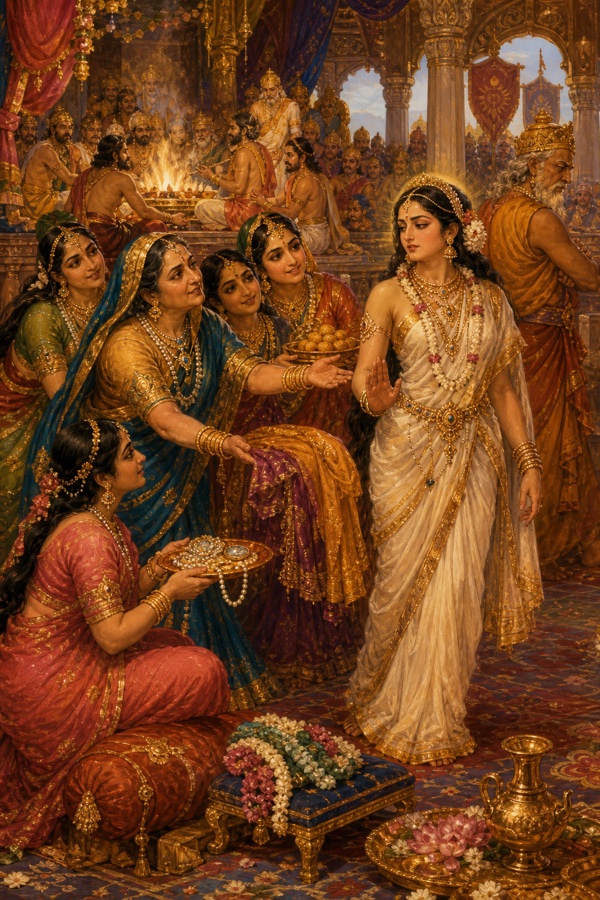
No one greeted her. Daksha’s guests had watched Daksha’s face too long to risk it, and so the whole vast gathering held still, except her mother and her sisters. They came running. They folded her in, throats closing around tears of love, and pressed on her a seat of honor, ornaments, fine cloth, sweet gifts, and the tender questions women save for a daughter come home. Sati touched none of it. Her father had spoken no kind word to her, and until he did, a seat in his courtyard was a stone. She stood inside her mother’s embrace like a traveler at the wrong door, and her eyes went on searching past it.
She found him at last across the crowd, the face whose finger she had gripped while she learned to walk. She came near and called to him. “Father.”
Daksha looked away. He withheld word, name, and glance, and the turning cost him something, because the woman standing before him was the child he had once carried on his arm, and somewhere behind the set face that older father was still alive. He held his face away harder, so that the whole assembly could see his resolve, and so that he could go on believing in it himself.
Sati stood very still. Her eyes moved across the altars, station by station through the enormous rite, and found what she already knew they would find: nowhere, on any vedi in that yajna, a single share set apart for Rudra. Her father had cut her lord out of the worship of the worlds. The insult to Shiva, the contempt in the turned face, her own humiliation before the assembled universe: it rose in her as a fury fit to burn the worlds. Her escort felt it before a word was spoken; the ganas came up off the ground with weapons out, ready to end Daksha where he stood, and she stopped them with a single word of command, a queen’s word. Her eyes had filled. She bound the tears back and let none fall, for a tear would have been a gift to her father, and she had no gifts left for a man who had called her lord inauspicious.
When she finally spoke, her voice did not shake. It came low and level, anger running under it like a river under ice, and it was so quiet that the whole courtyard had to still itself to hear her.
“No one on this earth would set himself against Bhagavan Shankara, father. No one except you. He holds no one dear and holds no one an enemy; he is the beloved Self inside every creature that breathes, the cause of all, past all rivalry. People of your kind can dig a fault out of virtue itself, while the truly great do the opposite work and magnify the smallest good they find in anyone. You have found fault with him. His name is two syllables, Shiva. Let it cross a tongue once, even carelessly, even in passing, and every sin the speaker carries burns off in that instant. That is the being you have chosen for your hatred.”
Her hand had risen, without her knowing it, to rest against her own breast. “You call him inauspicious for the burning-grounds, for the ash, for the skulls. Brahma himself gathers the flowers that have fallen from those feet and sets them on his own head. And understand what is owed when a master is reviled in one’s hearing, father. A man without the power to stop it must close his ears and leave that place. A man with the power must cut out the tongue that spoke, and then lay down his own life. That is the whole of the law; there is no third road. I cannot silence your tongue, so I will pay the other price with the one thing here that is mine. This body came from you, from the blood of a man who reviles Shiva, and I am done carrying it. The wise say that food swallowed in ignorance is cleansed only by being vomited up. Take your body back.”
“And there is more here than you can see, father. The powers native to us are climbed to by no ladder of ritual; they lie past your reach and past the reach of every man fed fat at a sacrifice, for they belong to the knowers of Brahman alone. So keep your yajna. Only hear the last of it. My lord teases me sometimes; he calls me Dakshayani, Daksha’s daughter. From this day that name would kill the laughter in my mouth and hang your deed around my neck. I will not wait for that day. This body sprung from your body is a corpse to me now. I am ashamed of the kinship, and I am setting it down in front of you.”
With that she turned her face from that assembly of her enemies and sat down on the bare earth, facing north. The rivalry of the chanters, the boom of the mantras, the crackle of the fires: all of it drew away from her like weather on the far side of a mountain. She touched water and sipped it, the achamana, the small purification that opens every solemn act. She drew her yellow garment close around her body, closed her eyes, and entered the discipline by which yogis leave the body at an hour of their own choosing.
She stilled everything outside. Then, step by measured step, she walked the inward path. She locked her seat until the body rested like a carved thing. She drew prana and apana, the outgoing breath and the downward breath, level at the navel until the two moved as one. She lifted the udana, the rising air, out of the navel’s wheel and settled it with her intellect in the heart, the heart where her lord’s lotus feet had lived for as long as she had lived, and let it stand there a moment. Then up through the gate of the throat she carried it, to the point between the eyebrows, and held it still.
She was leaving a body that Shiva, whom the most exalted adore, had gathered onto his lap more times than could be counted, and she meant the leaving of it as her answer to her father. By concentration alone she summoned air and fire into her limbs. And then even that intention dissolved, because her attention had gone wholly to one place, the honey of her lord’s lotus feet, the feet of the teacher of the universe, and in that absorption everything else fell away, the assembly, the insult, the father. The last impurity in her, the old thought, I am Daksha’s daughter, melted out of her, and she was utterly clean.
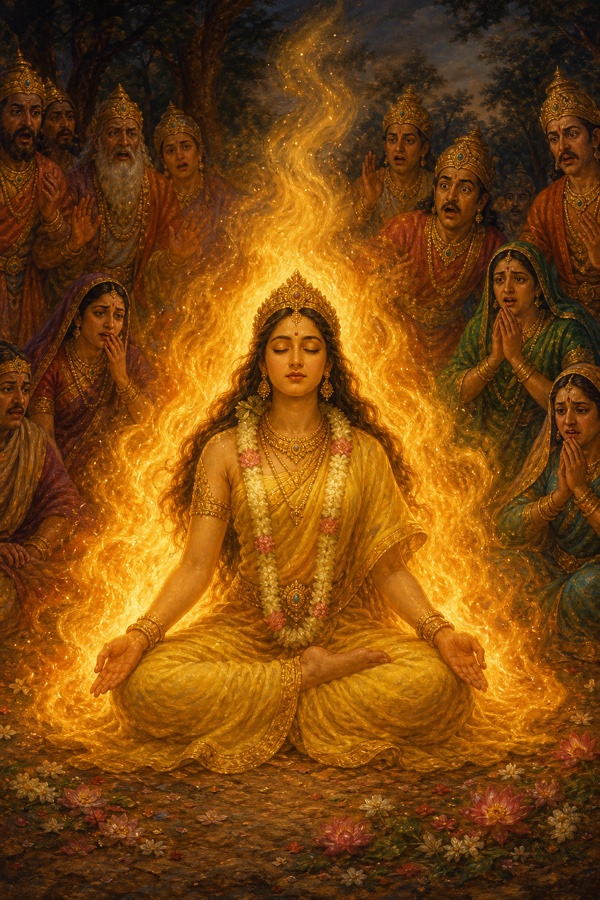
Then it came, out of her own depths, with no spark and no fuel: the fire born of samadhi. A warmth ran through her limbs first. The warmth became flame. For one heartbeat the seated figure went absolutely still, and in the next the fire rising from within her wrapped her around on every side.
Daksha stood and stared. The gods stood and stared. The competing recitations broke off in the middle of their syllables, and the only voice left in the courtyard was the spit of ghee in the fires.
Sati burned, and her face never left its peace, the peace of a mind gone all the way into the name of Shiva. Her lips did not move. Her brow, where the risen breath had stood a moment before, held not one crease. In a little while the flames finished their work, and what remained of the darling of Daksha’s house was a small heap of ash.
The silence that followed was so complete that each man in that courtyard could hear his neighbor breathing. Then it tore open. A clamor rose through earth and heaven together, one cry breaking from every direction at once: Sati is gone. The beloved of the god of gods, provoked by Daksha’s contempt, has given up her life before his eyes. And on the heels of it a harder cry: look at this lord of created beings, this father of everything that moves and stands still. His own daughter, who deserved every honor at his hands, burned in his courtyard, and he watched her make ready to die and never lifted a hand, never said a word to stop her. Let the world remember him by it.
In the same instant the thousands who had escorted her came up off the ground with their weapons, and this time no command held them; they went for Daksha to kill him. Bhrigu was faster. Chanting the Yajurveda formulas whose one power is the destruction of those who wreck a sacrifice, he poured an oblation into the dakshinagni, the southern fire, and out of the fire-pit rose the Ribhus in their thousands, radiant beings who had won the sphere of the moon by sheer austerity. Blazing with the fire of Brahman, firebrands swinging, they broke the assault, and Shiva’s pramathas and the guhyakas with them scattered and fled in every direction.
So the ash lay in the courtyard, and the rite ground on beside it, and Daksha may even have thought the account closed. The news was already climbing toward Kailasa. Narada carried it, the wandering seer who is always first through any door that matters, and before the telling was finished, Shiva’s body shook, the same body whose stillness Daksha had read as an insult.
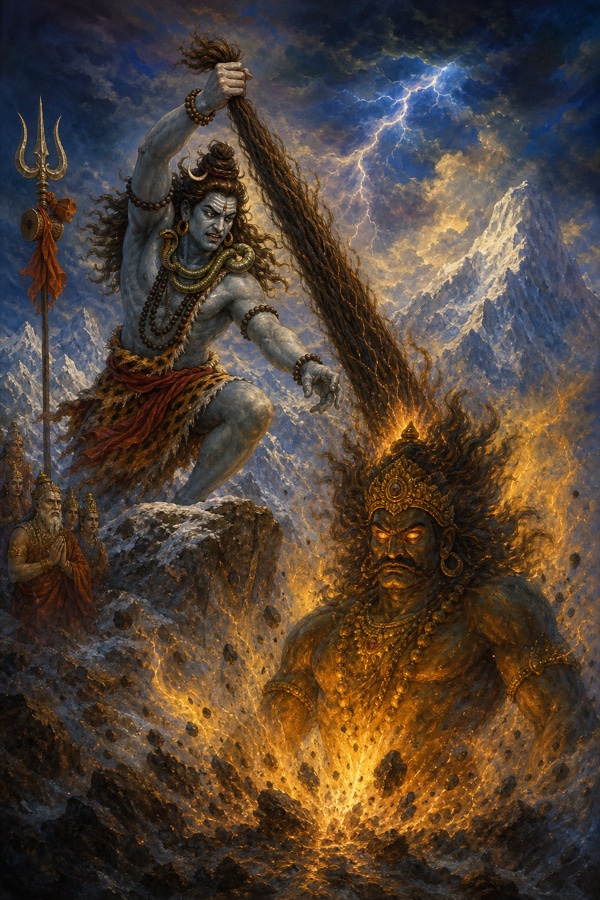
Onto that face came the wrath before which the three worlds go quiet. He bit his lip hard. He reached into the mass of his matted hair and tore a single lock free, and it shone in his fist like a torn strip of lightning, like living flame. He sprang to his feet, laughed once, a laugh with the roll of deep thunder in it, and dashed the lock against the ground with the whole of his strength.
Out of that lock rose a being that made the sky look low. Dark as a rain-heavy cloud, a thousand arms fanned around a body whose head stood among the stars, three eyes bright as suns, teeth made for endings, matted hair burning like flame, a garland of skulls swinging at the neck, and every hand carrying a weapon already lifted. Virabhadra. He joined two of his thousand palms and bent toward his maker. “Command me.” And Shiva said, “You are a part of my own self, warrior Rudra. Lead my hosts against Daksha. End him, and end his sacrifice.”
Virabhadra circled his lord once in reverence, and then he was motion. He raised a trident that could have put an end to Death himself, threw back his head, thundered, and ran, and the armies of Rudra ran roaring behind him, the great anklets at his feet ringing with every stride. Far away at the sacrificial grounds the first sign was a darkness standing in the north, a wall of risen dust, and the priests and guests puzzled over it aloud. No wind was blowing to raise dust. There were no robbers on the roads; old King Prachinabarhi still ruled with his iron rod, and no thief dared move in his kingdom. This was no hour for the herds to come home. So where had it risen from? Was the world beginning its dissolution? Among the women it was Prasuti, Daksha’s own wife, who named it, her voice gone hollow: this is the harvest of my husband’s wrong, the wrong of a man who shamed his innocent daughter to her death in front of her sisters’ eyes. Then the omens fell thick, thousands of them crowding sky and earth, ill signs that frightened even the hardened, and then the host itself arrived. They were squat and misshapen, red-brown and tawny, with the faces and bellies of alligators, and they flooded the grounds like a sea given legs. Beams cracked and came down. The pavilions of the wives, the great assembly hall, the stores of ghee, the sacrificer’s own lodge, the kitchens: down, every one of them. They smashed the vessels, stamped out the sacred fires, snapped the consecrated boundary threads, and fouled the offering pits. The rite that pride had built was pulled apart joint by joint.
Then the punishments began, each fitted to its crime with a judge’s precision. Maniman took the sage Bhrigu and bound him. Chandisha seized Pushan. Nandishvara seized Bhaga. Virabhadra himself took Daksha. Bhrigu had laughed at Shiva in open assembly, stroking his mustache as he laughed, so Virabhadra tore the mustache and beard from his face. Bhaga had sat beside Daksha and encouraged the slander with his eyes, so Virabhadra knocked him to the ground and plucked those eyes out. Pushan had bared his teeth, laughing while a god was reviled, so Virabhadra dashed the teeth out of his mouth.
Stones flew in sheets across the wrecked enclosure. The priests, the officiants, the invited gods, everyone who could still run, ran, scattering into the countryside in whatever direction offered itself.
That left Daksha. Virabhadra set a foot on his chest, laid a sharpened blade against the throat that had reviled Shiva, and cut. The skin did not part. He bore down; the edge might as well have been drawn across stone. The three-eyed giant stood over him a long moment, wondering, while the ruin smoked around them, and then his gaze found the sacrificial post and he understood. These grounds already held a method for taking a head, the sacrificer’s own method, the one used on the bound animal of the rite. Virabhadra took Daksha’s head the way Daksha’s yajna took the heads of its animals, wrenched it free, and flung it into the dakshinagni as an offering. The spirits and ghosts roared their approval; from what remained of Daksha’s party rose a wail. Then Virabhadra put fire to the whole sacrificial city and turned back toward Kailasa.
What was left of the divine assembly went to Brahma. They came broken, limbs crushed by tridents and pattishas, by swords, maces, iron clubs, and mallets, and they laid the whole disaster at his feet. Brahma had not attended Daksha’s sacrifice, and neither had Narayana; both had seen from the beginning where it must end. Now Brahma gave the survivors the truth unsoftened. The offense was yours, he said. You shut Shiva out of a share that was his by right, and a quarrel with a power none of us can measure ends badly for whoever starts it. One road remains. Go to him, with nothing hidden in your hearts, and take hold of his feet. He grieves for a beloved wife your slander took from him, and even so he is quick to forgive. And go soon, for a universe whose mightiest power sits angry and grieving is a universe standing on nothing.
So Brahma led them out of his own realm himself, gods, fathers, and lords of creation together, to Kailasa, best of mountains, the mountain Shiva loves. It is a country of powers: siddhas perfected from birth, sages made perfect by herb and mantra and yoga, kinnaras and gandharvas in the air, apsaras on the slopes, summits of jewel and mineral, forests of every flowering tree the mind can hold. They passed Alaka, Kubera’s shining capital, and the garden called Saugandhika, named for its fragrant lotuses, and the two rivers that run there, the Nanda and the Alakananda, and at the Nanda the gods slowed in spite of themselves, because Sati had bathed in that water, and the water was holy with the memory of her. Then they saw the tree. A banyan a hundred yojanas tall, its boughs reaching seventy-five yojanas out on every side, a permanent shade with no nest anywhere in it, a stillness grown up out of the ground. Beneath it sat Shiva, like Death with all the anger gone out of him, serene as deep water, the quiet perfected ones around him, Sanandana and his brothers, and his friend Kubera in attendance. He wore what renouncers wear, ash and a staff, matted hair and a deerskin, the young moon at his brow, and he sat on a mat of kusha grass, one foot laid over the opposite thigh, a rosary of seeds wound at his wrist, his right hand shaped into the seal of teaching, expounding the eternal Brahman to Narada while the great ones listened. This was the being they had cheated of an offering. The lords of the worlds folded their palms and bowed low. And when Shiva saw Brahma he rose and bent his own head, the way Vishnu, born as the Dwarf, bows to his father Kashyapa. Then Brahma smiled and asked what they had come to ask. I know you for the ruler of all this, he said. Shiva and Shakti, seed of the world and womb of the world, are both of your essence, and you spin the universe out of yourself, sustain it, and draw it back in, as a spider does its thread. It was you who established sacrifice itself through Daksha; yours are the bounds the Brahmins keep. Anger finds no purchase on those surrendered at your feet, so let it not stand against fools whom maya has blinded. Be gracious. Revive the wrecked sacrifice. Let Daksha live again. Give Bhaga back his eyes, Bhrigu his beard, Pushan his teeth. Make whole the gods whose limbs were broken. And take at last, out of what remains of the offerings, the full share that has always been yours.
Shiva heard it all, and then he laughed, an open laugh with no grudge left anywhere in it. “I keep no ledger of the offenses of children whom the Lord’s maya has blinded,” he said. “I do not even remember them. What I dealt out was a teacher’s rod, and it has taught. Now hear the mending.” And the remedies fit the injuries with the same precision the punishments had shown. Daksha, whose own head was ash in the southern fire, would live, and carry the head of a goat. Bhaga, who had winked at slander, would see his share of every offering through the eyes of Mitra. Pushan, who had grinned at it, would eat as the toothless eat, ground meal, and would chew it with the teeth of the sacrificer himself. The priests whose arms were shattered would work with the arms of the Ashvins, the twin physicians of heaven, and those who had lost hands would work with the hands of Pushan. Bhrigu would wear a goat’s beard where his own had shaken with laughter. And the gods, who had now granted Shiva the remains of the sacrifice, would stand whole in every limb again.
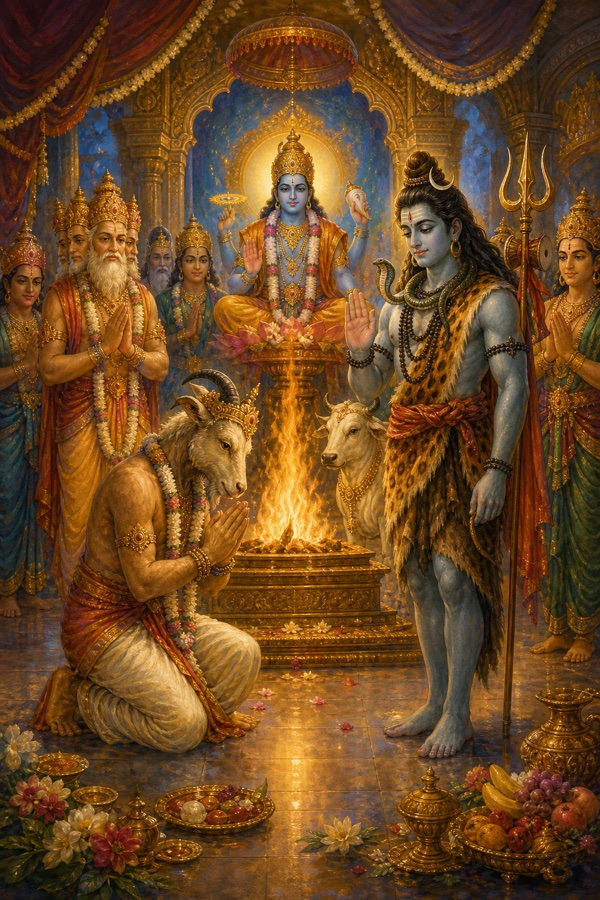
The whole gathering broke into one cry: well said, well said. Then the gods and sages invited the bountiful one to come and grace what had been broken, and they returned with Shiva and Brahma to the burned ground. The mending was done as commanded. To Daksha’s trunk they joined the head of the sacrificial goat, the very head Nandishvara’s curse had promised him in that first crowded hall, and when Rudra turned a kind glance on the body, Daksha woke as a sleeper wakes. He opened his eyes, and the first thing they held was Shiva standing before him. In that instant the malice of years drained out of his heart the way a rain-muddied pool clears in autumn. He tried to speak praise. His throat shut. Memory had arrived ahead of the words, the memory of a daughter who was now a heap of ash in his courtyard, and the man who had counted bowed heads stood weeping under a bowed goat’s head, and it was a long while before he could master himself. When he could, he spoke. You have done me a kindness, lord, he said. You punished me. You and Sri Hari refuse no one; you do not abandon even fallen Brahmins, so how would you abandon men under vows? You guard the keepers of the Veda the way a herdsman guards his cattle, staff in hand. I reviled you before the whole assembly, and you overlooked it, and with one glance you caught me as I fell. I cannot repay this. Let your own mercy be your satisfaction, for I have nothing to add to it.
The rite began again under the guidance of the teachers and priests. To burn away the touch of the pramathas, the Brahmins offered the purodasha, the consecrated cake, set out in three vessels for Vishnu. And as Daksha stood with the adhvaryu priest beside him holding the oblation, his mind gathered on the Lord with nothing held back, Sri Hari came. He came on Garuda, whose two wings are the great Sama chants themselves, the Brihat and the Rathantara, and his brilliance dimmed every light in that assembly the way sunrise dims lamps. His body was dark, girdled in gold. A crown burned like the sun above a face framed by locks black as bees, earrings at his cheeks, and his eight arms carried conch, discus, mace, and lotus, arrow and bow, sword and shield, so that he stood like a karnikara tree in full golden bloom. Lakshmi rested on his breast in the golden curl called the Srivatsa, a garland of forest flowers hung low on him, white fans and chowries moved at his sides like swans, and over his head shone a parasol white as the moon. Brahma rose. Indra rose. Shiva himself rose, and the whole assembly bent low together.
Their own splendor swallowed in his, awed past speech, they came toward him with joined palms lifted over their heads, and then voice after voice reached for what no voice reaches. Daksha spoke first, of the pure Consciousness that only seems to take on stain when maya wears it. The priests confessed that Nandishvara’s curse had chained their minds to ritual, that of the Lord they knew only the yajna-shape of him, the form the three Vedas describe. The priests’ wives begged him to look with his lotus eyes on a sacrifice that had worn the face of a burning-ground and give it back its joy. Rudra said that with his mind at those feet he cared nothing for what the ignorant might call him. Bhrigu asked grace for all who sleep in maya’s long night. Indra praised the eight arms raised for the protection of the worlds. Prasuti, wife of the sacrificer, said aloud what the whole ruin had proved, that without him a sacrifice complete in every limb is a body complete in every limb except the head. Agni said, by your light I blaze, and by it I carry every oblation home to the gods. The Brahmins said, you are the rite itself, the offering, the fire, the mantra, the wood, the kusha grass, the vessels, the priests, the sacrificer and his wife, the deity invoked; you are the Boar who lifted the drowned earth on his tusks as easily as an elephant lifts a lotus. And when the chorus had spent itself, the Lord answered, and what he said was the teaching this whole catastrophe had existed to carry. “I am the one cause of all of this, Daksha. I am Brahma who makes, and I am Shiva who unmakes. I am the Self, the Lord, the witness of every act, self-luminous, beyond every attribute. Wearing my own maya I create the worlds, I sustain them, I withdraw them, and I take the name that fits the work of the hour: Brahma, Vishnu, Rudra. Only the ignorant look at the three of us and count strangers. Does a man look at his own head and hands and see another man’s property? One who is truly mine sees no creature as apart from himself. Whoever sees us three as one essence, the single Self of every living being, that one, Daksha, comes to peace.”
Daksha, enlightened, worshiped Sri Hari with the Trikapaleshti, the rite that is Vishnu’s own, and then honored the gods with the principal and the secondary offerings, each in its due order, and the sacrifice that pride had begun and wrath had broken was carried, at last, all the way to its completion, with the Lord himself as its worshiped deity.
Shiva stood a long while over the small gray heap that had been Sati. Then he turned toward the high snows of the Himalaya, and went.
The story does not end in ash. In time Sati was born again, as the daughter of Mena and of Himavan, sovereign of the snows, and this is what the sages have handed down about that birth: as the divine energy that lies dormant through the night of dissolution embraces the Lord again at creation’s dawn, so she, who had no refuge except him, sought her lord once more, and found him, and stood again at the side of the same Shiva.
Literary context
The wrecking of Daksha’s sacrifice and Sati’s surrender of her body fill the fourth Skandha of the Shrimad Bhagavata, Discourses 2 through 7, and the Gita Press text preserves machinery that shorter retellings smooth away. The curses land in a chain: Daksha bars Shiva from every sacrificial share, Nandishvara answers with the goat’s-head curse on Daksha and a beggar’s fate for the Brahmins who applauded him, and Bhrigu counter-curses Shiva’s devotees into heresy, at which Shiva quietly rises and leaves the hall. When Sati later asks to attend the Brihaspatisava, Shiva warns her and then falls silent, foreseeing her death either way; she rides to the yajna on the bull-king Nandishvara with a queen’s insignia, since her lord ranks among the guardians of the quarters, and leaves her body there by the fire of yoga, with no farewell granted and none asked. Virabhadra’s reprisals are fitted to each offender: Bhrigu loses the beard he stroked while laughing, Bhaga the eyes that signaled approval, Pushan the teeth he bared, and Daksha the head that would not bow, taken at last by the method of the sacrificial post after every blade had failed against his skin.
The Bhagavata gives the mending the same weight as the breaking. Shiva’s remedies mirror the injuries, a goat’s head for Daksha, Mitra’s eyes for Bhaga, the sacrificer’s teeth for Pushan, the Ashvins’ arms for the maimed priests, and once the rite resumes, Vishnu himself appears above it on Garuda and speaks the teaching that closes the wound: Brahma, Vishnu, and Rudra are one essence under three working names, and whoever sees no division among them comes to peace. The later Shakta tradition grew a further cycle out of this katha, the Shakti Pithas, the holy seats marking where Sati’s body is said to have fallen across the land; that geography belongs to the later Puranas, and the Bhagavata text carries none of it.
To carry with you
The fires of that yajna have long gone cold. High in the snows, in the house of the mountain king, a little girl will one day say two syllables no one taught her, and far away, under a banyan tree, someone will hear.
The same katha elsewhere
- The Wedding of Shiva and Sati
Shiva Purana: the wedding of Shiva and Sati - Daksha’s Yajna and the Burning of Sati
Shiva Purana: Daksha’s yajna and the burning of Sati