On this page
Kapila’s Samkhya
Kardama had gone. The sage who had been her husband for long years had risen one morning, taken his leave, and walked into the forest to finish his life in silence, keeping the vow he had made before their marriage. The hut on the bank of the Bindusara, the lake said to have risen where a tear of the Lord’s compassion once fell, felt emptied of him.
Devahuti stayed behind with her son, Kapila.
The boy was growing. He was quiet, and he spent his words carefully. But when he did speak, the air itself seemed to wait, and whatever work Devahuti’s hands had found would stop without her telling them to.
For years she watched him the way any mother watches her child, guarding, measuring, remembering. Then one day she caught him watching her instead, and the gaze that reached her came from some depth no cradle had ever held. She remembered what had been promised over that cradle: that the unborn Lord had entered her house of his own free will, and would one day cut the knot of the world for those who asked him.
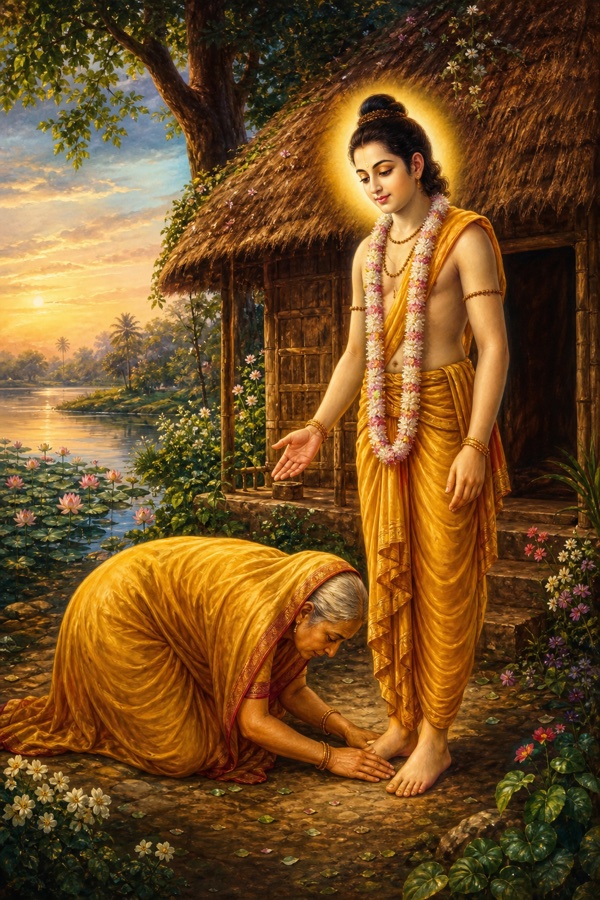
That day Devahuti bent down and touched her son’s feet. In that world the reverence runs the other way, a child’s head at a parent’s feet, every morning of every year. She turned it around in a single motion.
“What are you doing, Mother?”
“Kapila, you are my son. That much stays true. But these years have taught me something more about you, and I have stopped pretending otherwise. You carry the knowledge the rishis spend whole lifetimes seeking. From this day, for me, you are guru.”
Kapila said nothing.
“So teach me. I am sick past telling of these senses and their endless appetite. I have spent a lifetime feeding them, and the feeding has walked me into a darkness so thick I can no longer find my own outline. I have called this body mine, these people mine, and every ‘mine’ has bound me a little tighter. Something tells me this birth is the last of a long, long series, and that you have been given to me as an eye, the one eye that can see through this dark. You are the ax laid to the tree of birth and death for those who take shelter in you. I am taking shelter. What is the road to liberation?”
Kapila looked at his mother for a long moment. In her eyes he saw a thirst, honest and worn: the thirst of a woman in the evening of her life who wanted one road and meant to walk it. And he saw past the courtyard too, for a question asked this purely would open the door for every soul who ever heard it asked. His face warmed into a slow smile.
He sat down on the ashram ground. His mother sat facing him. Around them the hermitage lay still, the water quiet, the trees holding their birds, as if the place itself had decided to listen.
And then the son began to teach the mother. One of the most tender doors in all the Bhagavata opens here: the philosophy called Samkhya, the ancient counting-out of everything that exists, spoken the way a son speaks when the student in front of him is the woman who taught him to walk.
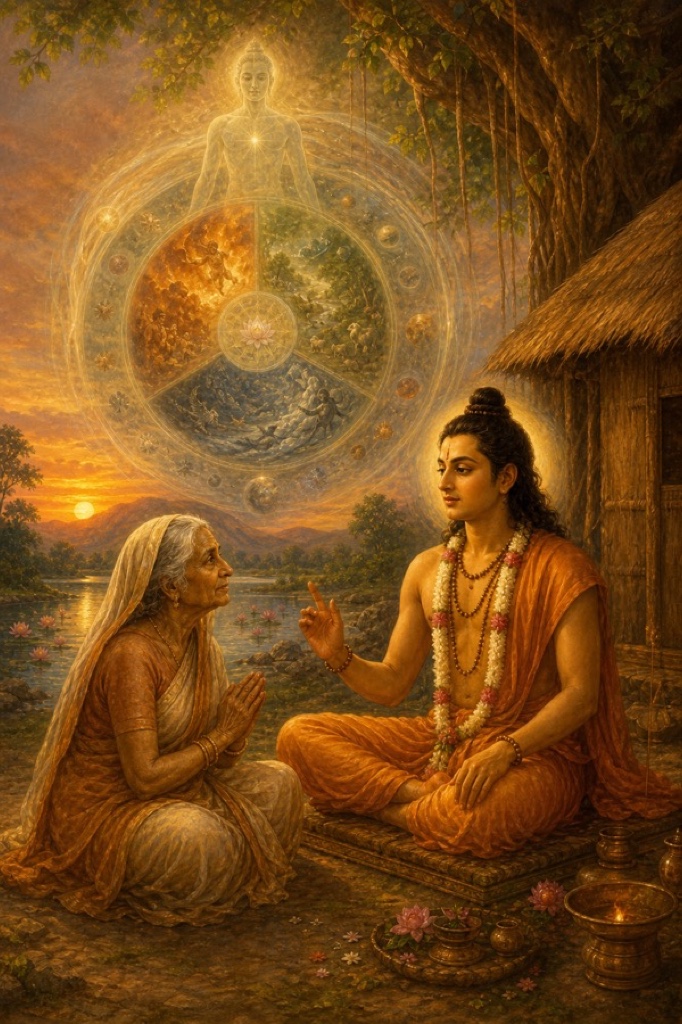
“Mother, hold this first, and hold it firmly. Everything you have ever seen, touched, feared, or loved is woven out of two threads. Purusha and Prakriti.”
“Purusha is the atman, the self. It has no beginning. It does nothing, wants nothing, changes into nothing. It is awareness itself, resting behind everything, and its whole nature is to watch.”
“Prakriti is all the rest: the world that moves. Whatever stirs, grows, decays, acts, or waits to act, that is Prakriti. She is older than every form and outlives every form, the cause hiding inside each effect and the effect flowering out of each cause.”
“When Purusha turns toward Prakriti and watches her, everything begins. She is woven of three strands, three gunas. Sattva, which is light, clarity, balance. Rajas, which is motion, appetite, heat. Tamas, which is weight, darkness, sleep. While the three lie level, nothing happens. The moment they tilt, the world pours out.”
“And it pours out in order, Mother, step after counted step. First rises mahat, a vast field of pure intelligence, the first shimmer in which a universe can even be conceived. Out of mahat comes ahamkara, the sense of I, and the sense of I splits three ways as the gunas take hold of it. From its clear strand comes the mind. From its restless strand come the ten senses, five that gather the world in and five that act upon it. From its dark strand comes sound, and sound thickens into ether; from ether comes touch, and touch thickens into air; from air comes form, and form thickens into fire; from fire comes taste, and taste thickens into water; from water comes smell, and smell thickens into earth, the last and heaviest of the five great elements. The world builds itself downward, from thought toward stone.”
“The old seers counted what Prakriti unfolds and found twenty-four: the five great elements and the five subtle essences, the ten senses, and the inner instrument in its four aspects, mind, understanding, the I-sense, and the deep faculty that reflects. Time is the twenty-fifth, the quiet turning that ages every one of them, and the wise say Time is the Lord’s own power moving inside what he has made. And every item on that list, from the highest intelligence to the dust under your feet, is Prakriti. None of it is you.”
Devahuti listened. Each sentence sounded plain, and each slid from the hand that tried to close around it.
“So look at this body, Mother. It is Prakriti through and through. The eyes you are watching me with, the mind that is weighing my words, the love that is rising in you this moment: all of it woven, all of it borrowed.”
“And the one who watches all of it, silently, from behind the weave: that is Purusha. That one is you.”
“Every one of us hunts for ourselves inside the weave. This is me, we say, this is my son, this is my house. And all the while the real ‘I’ stands apart, close as breath, touching nothing, the silent witness of every scene.”
“Here is the knot, Mother, so look at it closely. The Purusha does nothing. He only watches. But he watches Prakriti at her play, and watching her he forgets himself, like the sun that burns unmoved in the sky yet trembles and breaks in a pail of carried water. He begins to say: I act, I suffer, I own, I lose. That single sentence, I am the doer, is the whole of bondage. Nothing else ties him. A being free by nature, full by nature, at peace by nature, walks into birth after birth and death after death on the strength of one mistaken word.”
“Then what is the road to liberation, my son?” Devahuti asked.
Kapila smiled.
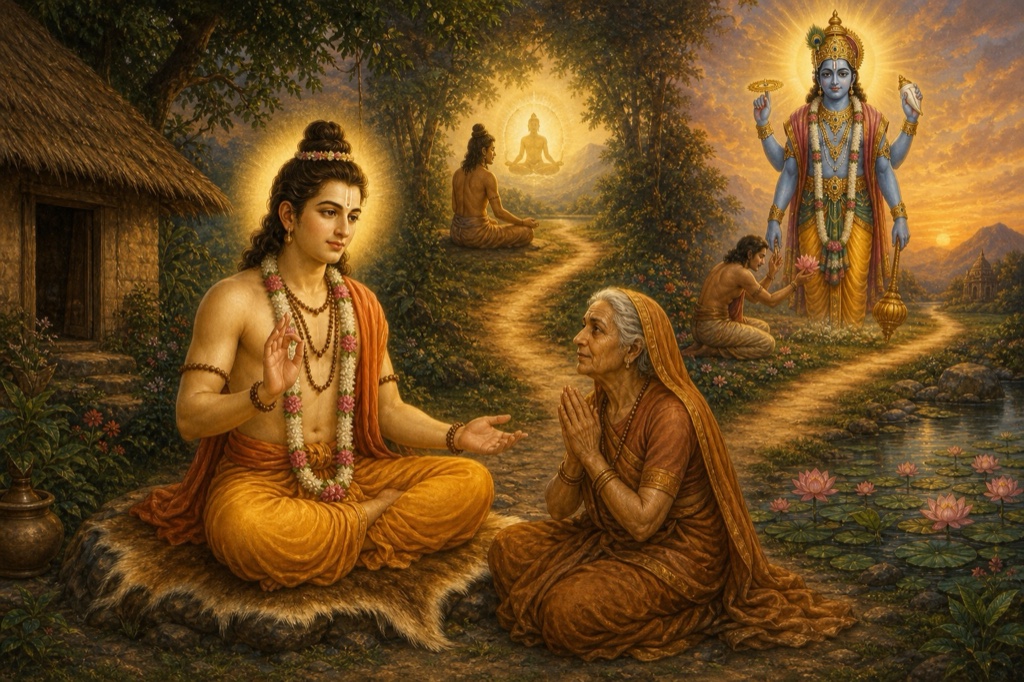
“There are two roads, Mother, and they leave from this very spot. One is the road of knowledge. One is the road of bhakti, of devotion.”
“The road of knowledge is the discipline of watching. Stand inside every experience and ask: is this me? The ache is happening; am I the ache? The thought is passing; am I the thought? Ask, and keep asking, and slowly the body steps away from you like a garment, and the mind steps away like a tool set down, and at the end one thing remains that never stepped away, because it was never a thing: you, the watcher.”
“The road of bhakti is gentler still. For the striving soul there is no path more blessed, and none more sure, than devotion offered to Sri Hari, the Lord who is the Self of the universe.”
Devahuti raised her eyes. “Gentler? How?”
“In bhakti you stop wrestling with the ‘I’ and simply hand it over. You place it in Sri Hari’s hands and leave it there. That is the whole method. Every act done for him, every breath drawn in his name, every feeling laid at his feet as it rises.”
“In knowledge you search for yourself, and the search is long. In bhakti you forget yourself, and the forgetting can begin in a single afternoon. Both roads end at the same rest: the mind flowing toward him without a break, the way the Ganga moves to the sea.”
“And the ones who walk bhakti to its end stop asking even for that rest, Mother. Offer them a home in the Lord’s own realm, offer them his powers, his nearness, a form the very shape of his, absorption into his being: they set each gift aside and go on singing of him to one another. Serving him is the whole of what they want, and in wanting only that they find everything already in their hands.”
“But bhakti carries one sweetness above all the rest, Mother. On this road there is nothing you need ask for. You raised me. In all those years you never once asked me for anything in return; you loved, and the loving was its own reason. That is bhakti, exactly that. You have known this art longer than I have known this body.”
A tear gathered on Devahuti’s lashes, slipped, and stopped halfway down her cheek.
“Is it as small a thing as that, my son?”
“Yes, Mother. As small as that.”
In the days that followed he set the whole map before her, and she questioned him like a disciple, and once like a philosopher. If matter and spirit have always been together, she said, joined the way smell is joined to the earth it rises from, then even a knot untied can tie itself again; what keeps the bondage from coming back? Kapila answered her with fire. The stick that kindles the sacred flame, he said, is eaten by the very flame it gives birth to; so devotion, born in the field of Prakriti, burns away the field, and what is burned does not grow back. A man who wakes from a nightmare cannot be chased by it into the morning. He hid nothing else from her either: the bright road and the dark road that souls travel after death, the slow ruin of the man who lives for his house alone, the soul curled in the womb remembering its hundreds of births and praying, and Time, for fear of whom the wind blows, the sun shines, the rain falls, fire burns, and death itself makes its rounds.
He spoke long of the company of the holy. Look for the ones who are patient, kind, and steady, he told her, friendly to every creature and enemy to none, who keep the shastras and would sooner let go of duty and kin than let go of Sri Hari. Sit near such people. The same attachment that chains a soul to the world becomes an open door the day it fastens on saints. Among them his stories are told and sung, and hearing breeds fondness, and fondness ripens into the love that burns the dark away. And honor every creature while you walk this road, he said, for the Lord lives in each of them as its inmost self; worship offered to the image by a hand that tramples living beings is an offering poured on ashes.
He spoke of the ground the practice stands on: a clean and lonely place, a seat that is firm and easy, the spine held tall, the breath drawn in, held, and released by slow degrees until the mind stands still and bright, the way gold heated in the goldsmith’s fire lets its dross fall away. He taught her to call the senses home from the things they chase and to turn them inward, toward the heart.
And then, because a stilled mind needs somewhere to rest, he gave her the form. Hold the Lord before the inner eye, he said. His body is dark and cool as the petals of the blue lotus, and three of his four hands carry the conch, the discus, and the mace. Silk the color of lotus pollen is wound at his waist; the white curl called Srivatsa rests on his chest; the Kaustubha gem burns at his throat; a garland of forest flowers hangs the length of him with the bees still drunk inside it. Begin at his feet, he said, whose bright nails scatter the gloom of the heart the way the moon scatters night, the feet whose washing gave the Ganga her water, the water Shiva himself receives on his bowed head. Climb without hurry, resting on each limb in turn: the knees, the thighs, the navel like a deep pool out of which the lotus of all the worlds once rose, the chest where Lakshmi lives, the neck so lovely it adorns the very gem that hangs from it, the four arms, and at last the face. There the cheeks are lit by swinging earrings, the brows dance, the glance falls on you heavy with mercy, the smile dries whole oceans of grief, and behind the smile waits a soft laughter that shows small teeth like jasmine buds flushed with the red of his lips. Stay there, he said. Hold that gentle form until the mind sinks into it of itself, until the hair rises along your arms and the tears come without leave, until even the mind you were holding him with goes out, the way a lamp goes out when the oil is spent, and what remains is what was always there.
Devahuti took it all in and stored it where a mother stores things, past forgetting. When he finally fell silent she asked him one thing more, and it came out as pure wonder. You, she said, into whom the universes are drawn when their day is done; you who at the end of a kalpa lie as an infant on a banyan leaf with your own toe at your lips; how did you consent to lie in my womb? And he answered her without evasion: the Lord takes such births to show the road, and the road I have shown you is easy, Mother. Walk it in faith, and the unborn state is yours before long.
When the teaching was complete, Devahuti did what hardly anyone, in any age, actually does.
She began to live it that very hour.
She sat down where she was, on the bank of the Sarasvati, in the hermitage that crowned the river like a chaplet of flowers, closed her eyes, and went in.
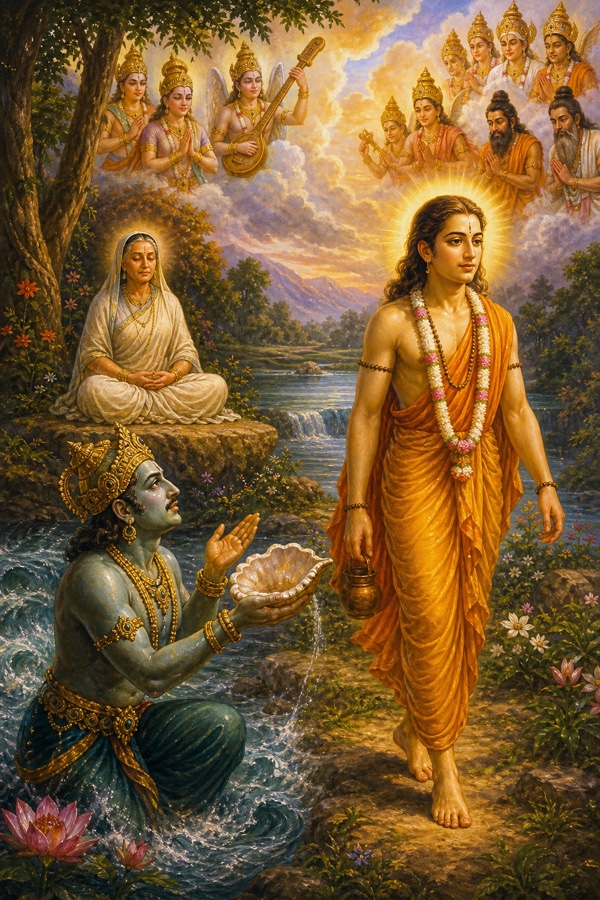
Kapila looked at his mother once. She gave him leave to go in words that showed the teaching had already taken root: all this, she said, is Brahman. Then he rose and walked from his father’s ashram toward the northeast, the quarter called Ishana. The ocean itself came forward to meet him there, worshiped him, and offered him an abode; and there, they say, he remains to this day, sunk in meditation for the good of all three worlds, while siddhas and charanas, gandharvas and apsaras, sages, and the first teachers of the Samkhya he founded sing his praise.
Devahuti stayed seated. Days passed over her, then months, then years.
She bathed at the three junctures of each day until her curling hair matted into jata, and the rags she now wore hung on a body burned thin by austerity. Behind her stood everything she was refusing: the pleasure-house her husband’s tapas had raised, its beds of ivory white as the foam of milk, its seats of gold, its walls of crystal and emerald where lamps of jewels glowed in the hands of sculpted women, its gardens of celestial trees, the pond where gandharvas had sung her praises whenever she entered it at Kardama’s side. The gods themselves had envied that house. She never turned her head toward it again. Grief for her son rose in her at times, a cow’s grief for a calf led away, and she folded even that into the practice. Dust settled on her skin, and she shone through it the way a banked fire shows through its own smoke.
Then came a day with no marker on it when the knowledge her son had given her stopped being words and became her own seeing. Her mind settled into Brahman and let the last thought of being a separate soul dissolve; the world of objects lost its grip the way a dream loses its grip on a man who has opened his eyes; and the body by the river, fed by the attendants her husband had long ago appointed, its hair loosened, went on breathing without her noticing it at all.
The names went first. She no longer answered inwardly to mother, or to queen, or even to Devahuti. What remained was the atman her son had pointed to on that first afternoon: still, conscious, free.
The place where she crossed over is honored through the three worlds as Siddhapada, the ground of attainment. And her body, purged by yoga of everything heavy, became a river: first among streams, gentle and certain, a giver of siddhi, and to this day the perfected ones come to its banks to bathe.
Literary context
Kapila’s teaching to his mother fills chapters 25 through 33 of the Bhagavata’s third skandha; the story of her marriage to Kardama comes just before it, in chapters 23 and 24. Readers have long treasured the passage as a gita in its own right, a complete gospel spoken across a household floor. The Samkhya taught here is theistic through and through: Kapila keeps turning the analysis toward devotion, and that turn is what sets this teaching apart from the classical Samkhya-karika of Ishvarakrishna, which counts the same categories and leaves the Lord out of the count.
A philosophical lens
The tenderest fact in this story is structural: guru and disciple are son and mother. Devahuti carries both roles at once and joins them without strain, mothering the man she bows to, bowing to the child she raised.
In that bow the Bhagavata offers one of its rarest pictures of dasya-bhakti, devotion in the key of service. The mother who spent years serving her son now sits at his feet as his servant, and there is no smallness anywhere in the posture, because the love has simply found another door.
There is no defeat in being taught by the one we raised. Devahuti’s greatness lay in her readiness to bow wherever knowledge truly sat, even when it looked back at her with her own child’s eyes.