On this page
Ila and Sudyumna
Rajan, the full account of Manu’s house could be told for hundreds of years and still leave kings unnamed, so hear its root. When the last great dissolution drowned the worlds, Narayana alone remained, the inner sustainer of every creature, holding all that had ever lived asleep within himself. From his navel rose a golden lotus, and in its calyx appeared the four-faced Brahma. From Brahma’s mind came the sage Marichi; from Marichi, Kashyapa; and Kashyapa fathered on Aditi, daughter of Daksha, a son of pure light, Vivasvan, the sun-god. Vivasvan’s son by his wife Samjna is the Manu of our own age, Shraddhadeva, and he came to that office carrying an older life within him: in the kalpa before ours he had been Satyavrata, royal sage of the Dravida country, whose devotion to Hari carried him through the flood at the end of that age and won him birth as the sun’s own son. This Manu fathered ten sons, Ikshvaku the eldest, then Nriga, Sharyati, Dishta, Dhrishta, Karusha, Narishyanta, Prishadhra, Nabhaga, and Kavi. But there was a season, long before any of those sons, when this same Manu had no child at all, and his own courtyard stood empty.
⁂
So Vasishtha, the all-capable preceptor of the solar race, had a yajna performed for the childless king, a fire-rite to propitiate the gods Mitra and Varuna, the pair the Veda itself prescribes for a man who longs for a son. Manu’s wife was named Shraddha. In those days she kept the payovrata, an austerity that allows milk and nothing more. When the rite began she went to the hota, the priest whose office it is to summon the gods into the fire with verses of the Rig Veda, and fell prostrate before him, and humbly asked him for one thing: to carry the offering so that its fruit would come to her as a daughter, though the whole rite had been set in motion for a son. Only that, one mother’s small longing, laid quietly in the one mind that would ride with the oblation into the flames.
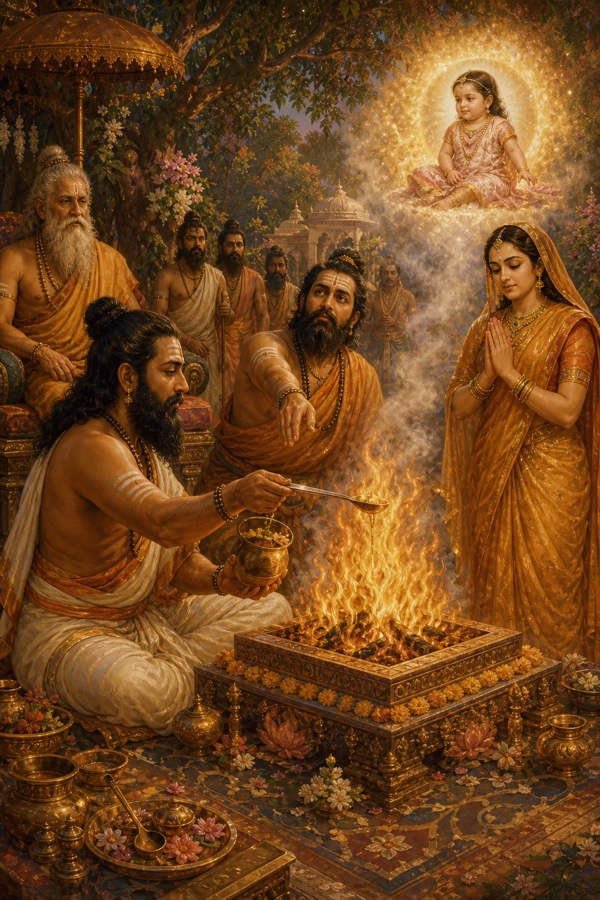
Then the moment of offering came. At the adhvaryu’s direction, the Brahmin serving as hota lifted the ghee in his hand, and as he uttered the vashatkara, the cry that releases an oblation to its god, his fully mastered mind was still resting where Shraddha’s words had left it. He fed the fire with perfect discipline and a turned intention, and the fire honored the intention it was given. The fruit of the yajna came into the world as a daughter where a son had been asked for. They named her Ila.
Manu looked at the child and could not be glad. He turned to his guru Vasishtha and put his grief into a question. You are a knower of Brahman, he said, a master of your senses, a man whose impurities tapas burned away long ago. How has the fruit of your resolve come out so completely reversed? For a Vedic rite to yield its opposite is like falsehood turning up among the gods, a thing that should never be able to happen. It grieves me deeply.
Vasishtha saw at once what had happened; he read the hota’s swayed mind and answered the king plainly. This reversal, he said, came from the hota’s own contrary intention. Yet by the power of my spiritual glory I will still give you the good son you asked for. Holding to that resolve, the famed sage lifted his voice in praise of Purushottama Narayana, the most ancient Person, the same who had held the drowned worlds within himself before Brahma woke, asking that by the force of his tapas the girl be made a fine son. The Lord was pleased. Sri Hari granted the boon exactly as it was asked, and the girl Ila stood up a young prince named Sudyumna.
One day the brave Sudyumna, mounted on a horse of the Saindhava breed, the famed stock of the Sindhu country, rode out toward the forest to hunt, a few of his ministers riding with him.
Clad in armor, a charming bow in his hand and a quiver of truly wondrous arrows at his back, he pressed on after the deer toward the north, farther, and farther still, the way a hunt draws a man past every line he meant to hold.
Chasing the game on and on, he pushed into a forest at the foot of Mount Meru, the golden mountain that stands at the axis of the world. He did not know that in that very wood Bhagavan Shankara himself was at his pleasure with his beloved Parvati, whom the world also calls Uma.
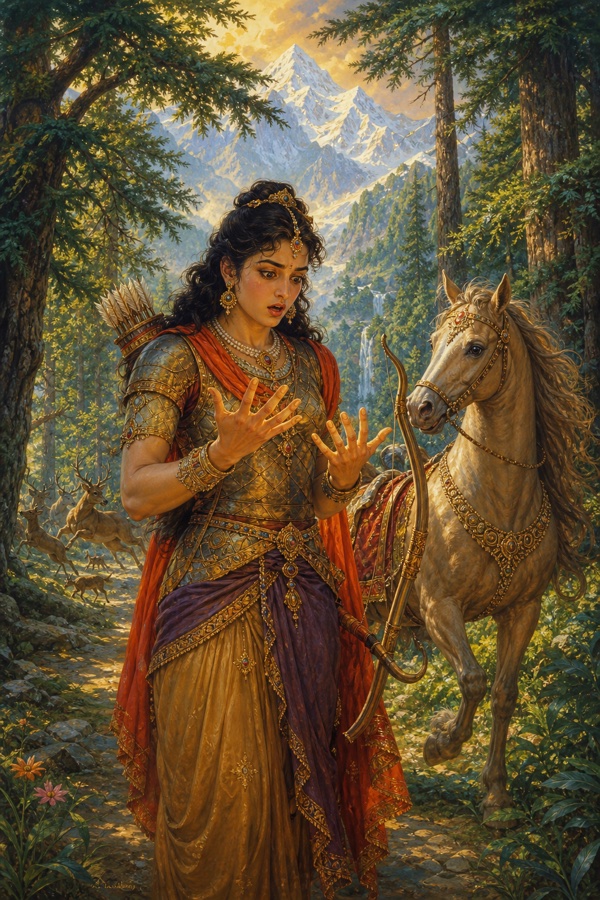
The instant he crossed into that forest, the hero Sudyumna saw that he had become a woman.
He looked down. The hand holding the horse’s rein was slender and strange, a hand he had never seen in his life. And the horse he rode had become a mare.
He went to say something, and the voice that rose from his throat belonged to a stranger. A soft, unfamiliar note trembled in the air and was gone. Hearing his own call, he flinched from it.
“This… is me?” Only that much, and hearing her own changed voice, she went quiet.
The body was no longer the same. Everything the senses could reach had been remade, the hands, the voice, the very shape that had carried his name since birth. And yet the one inside who kept asking whether this was truly himself stood exactly where he had always stood, holding the same fear, the same memory of the king who had ridden out at dawn. All that could be seen had changed. The one watching it happen had not stirred a hair’s breadth.
Trembling, she turned and looked behind her. What she saw pressed the air from her chest.
Every one of her attendants had become a woman too. The ministers, the soldiers, all of them. No one could find a word for anyone else. They stood searching one another’s faces, and a heaviness settled over every heart.
The law of that wood was older than the hunt. Once, great rishis under strict vows had come walking there to take darshan of Bhagavan Shankara, their splendor so fierce that it drove the shadows, and every lesser light with them, out of all the quarters. In that hour Bhagavati Ambika lay uncovered in her lord’s lap. Seeing the sages come upon her so suddenly, she was overcome with modesty, sprang up in haste, slipped from Shankara’s lap, and gathered her clothes about her. The rishis, understanding that Gauri and Shankara were at their pleasure, turned back at once and made their way to the ashram of Nara-Narayana, where austerity keeps a stricter house.
Shiva saw his beloved’s confusion, and to set her at ease for all the ages he spoke a word that would hold like law.
“Whatever man sets foot in this place from now on will become a woman.” That utterance of Shiva’s rang through the forest and settled into its soil.
From that day, no man walked into that grove, and the decree stood waiting through the years for a hunter who could never have known it. So Sudyumna, a woman now among women, took to wandering with her attendants from one forest into the next.
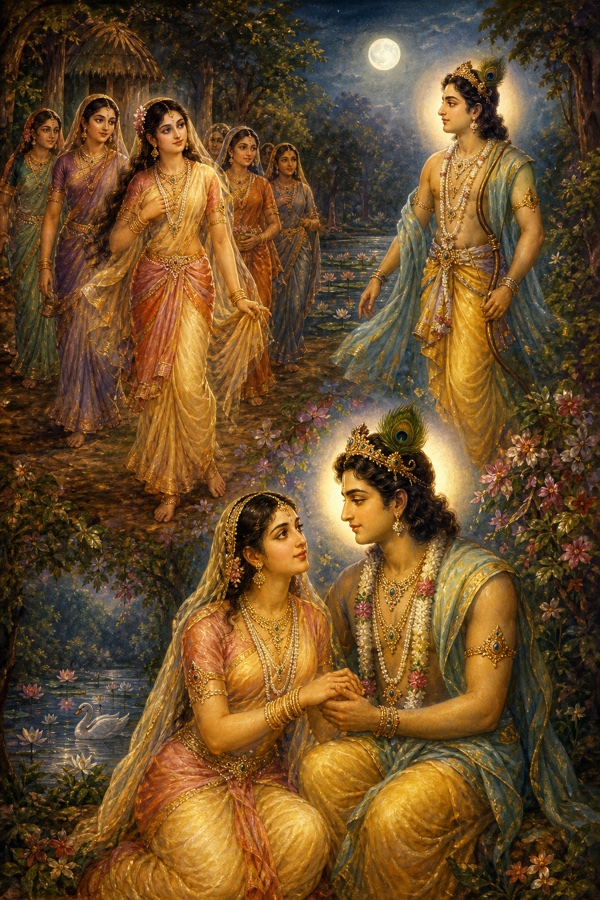
One day, in the precincts of his own hermitage, Budha, son of the Moon and quiet lord of the planet Mercury, came upon a beautiful woman ringed by many women. His gaze fell on her and held there. In his heart he wished this beauty for his own, and she in her turn wished the son of Soma for her husband. From their union a son was born to her, Pururava, who would one day rule the earth in his own right.
So it was that King Sudyumna, Manu’s son now living as a woman, remembered at last the preceptor of his family line, Vasishtha.
The moment she thought of him, the sage was drawn to her by his yoga and stood there in person. Seeing the state his king had come to, his heart filled with pity, and desiring Sudyumna’s manhood restored, he settled into worship of Bhagavan Shankara.
Bhagavan Shankara was pleased with Vasishtha and minded to gratify him. But the word he had given for his beloved’s sake he would not make false, for a god’s utterance, once spoken, does not bend. So, keeping his own speech true, he opened a middle path between the sage’s prayer and his own vow.
“Vasishtha, this yajamana of yours, born in the solar race your line has always served, will be a man for one month and a woman for the month that follows, turn by turn. Under these terms let Sudyumna rule the earth as he pleases.”
So Ila became Sudyumna again, a man. Yet the manhood came back on terms. One month a man, one month a woman, by turns, for the whole of his life.
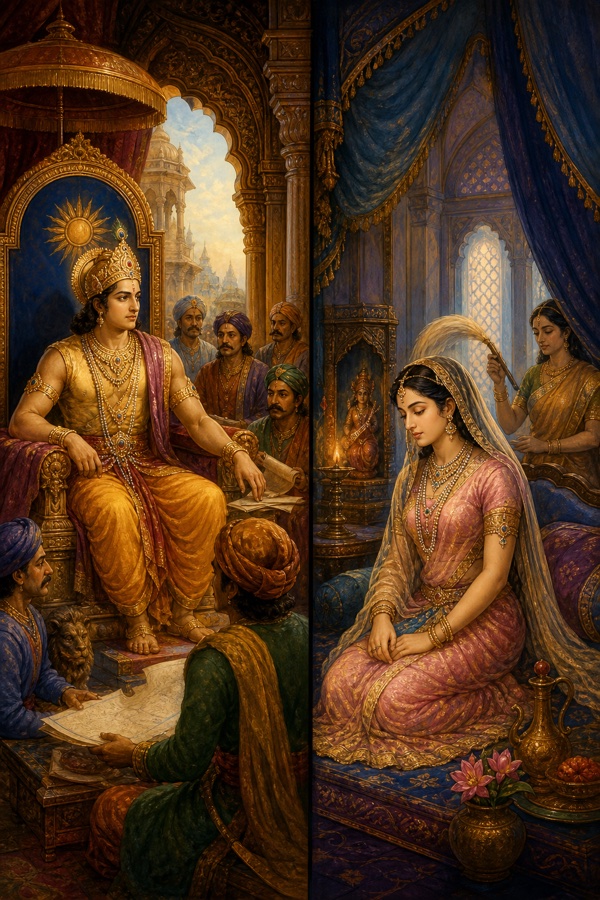
For his month as a man he ruled the earth by his preceptor’s grace and carried the business of the state. Then, when the month turned, he withdrew in shame into the antahpura, the inner palace where no outside eye could follow, and lived a hushed, near-silent life there.
The people never quite took to him. A king who vanished from sight every second month drew none of the easy honor a throne usually commands, even as he went on carrying the full weight of the kingdom.
In his months as a man, three sons were born to him, Utkala, Gaya, and Vimala, all of them devoted to dharma. In time the three became rulers of the Dakshinapatha, the southern reach of the land, and through them his line spread across the south.
Then old age came for him. Sudyumna, lord of Pratishthana, the city standing where the Ganga meets the Yamuna, handed his kingdom to his son Pururava and quietly took the forest road. Behind him he left the throne of the man’s month and the antahpura of the woman’s month. Ahead lay only the road, and walking it went the one whom no month had ever truly made a man, and no month had ever made a woman.
Literary context
This katha of Ila and Sudyumna opens the ninth Skandha of the Shrimad Bhagavata, in its first chapter. Vasishtha performs a fire-rite to Mitra and Varuna to win the childless Vaivasvata Manu a son; but Queen Shraddha, keeping her milk-only payovrata, quietly asks the hota for a daughter instead, and the hota’s turned intent brings the daughter Ila into the world. By Vasishtha’s praise of Purushottama Narayana, Ila is made the man Sudyumna, who turns woman again on riding into the forest at Meru’s foot where Shiva sports with Ambika, and where, by Shiva’s own word, any man who enters becomes a woman. In that form she bears Budha, son of the Moon, a son named Pururava; and by Vasishtha’s worship of Shiva she is granted the strange half-life of one month a man, one month a woman. His three sons, Utkala, Gaya, and Vimala, become kings of the Dakshinapatha, and at the last he hands the kingdom of Pratishthana to Pururava and walks into the forest. Under the genealogy the chapter carries a single steady question, a question the episode leaves with every reader: when the body changes, even to the point of changing its sex, who is the unchanged one who goes on watching?
One king, Ila and Sudyumna
In a forest at the foot of Meru, Prince Sudyumna’s body stopped being his own, his voice stopped being his, even his name gave way. One month a man, one month a woman, by turns for the whole of his life. And every time, inside every changing form, one watcher went on knowing his own palm as if for the first time.