On this page
The Avadhuta’s Twenty-Four Gurus
⁂
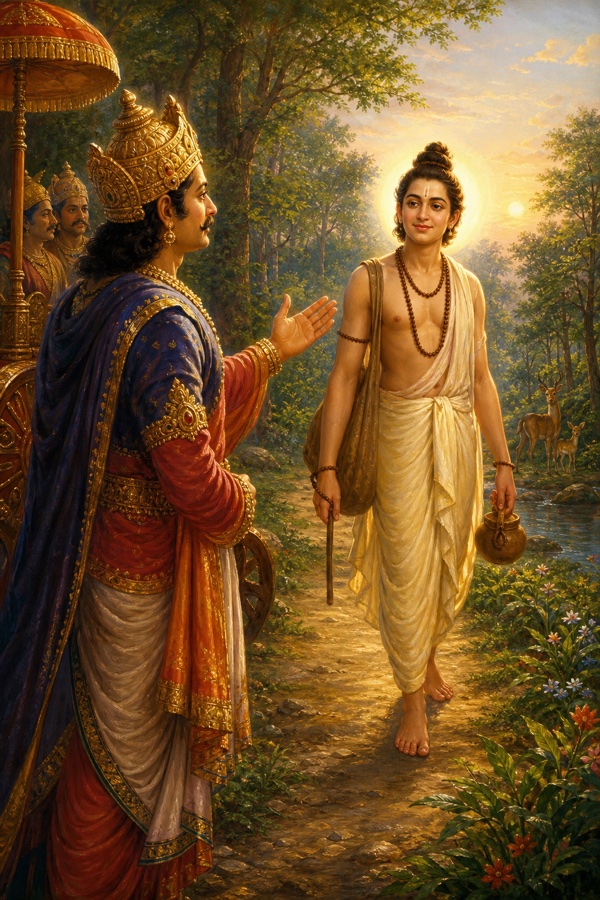
King Yadu, son of Yayati, a ruler of keen mind and deep reverence for Brahmins, came upon a young Brahmin one day, an avadhuta, his body unwashed and streaked with the dust of the roads, and yet full of wisdom, wandering the world without a trace of fear. On his face was a gladness, as though he had attained everything there is to attain, and he moved through the forest the way other men move through their own courtyards.
Yadu stopped. He had spent his life among men who owned things, thrones, armies, treasuries, and on every one of their faces something was always clenched. He had never seen such freedom from care on the face of any emperor. He bowed low, for that was his way with Brahmins, and put his question to this man who knew the heart of dharma.
“Brahmin, you do no work, so where did you come by so deep and penetrating an understanding, that though you are supremely learned you move through the world like an innocent child? Men take up their labors only out of longing for a long life, or fame, or wealth. You are strong, learned, skilled, pleasant to look upon and sweet in speech, and still you do nothing, you want nothing, you carry yourself like a simpleton. All around you people burn in the wildfire of lust and greed, and you stand in the midst of it unscorched, like an elephant standing chest-deep in the cool water of the Ganga while the forest on both banks blazes. Tell me, where does this gladness come from, when you live alone, hold nothing, and taste none of the pleasures of the senses?”
The avadhuta answered gently, the way a man answers who has nowhere else to be.
“I carry a great deal within me, Rajan, though my hands are empty. My mind has taken shelter with many teachers, chosen by my own understanding, and learning from each of them I wander this world free and unbound. I have twenty-four gurus.”
“Twenty-four gurus? Who are they?”
“Listen. I will name each one, and the lesson it gave me.”
“The first guru, the earth.”
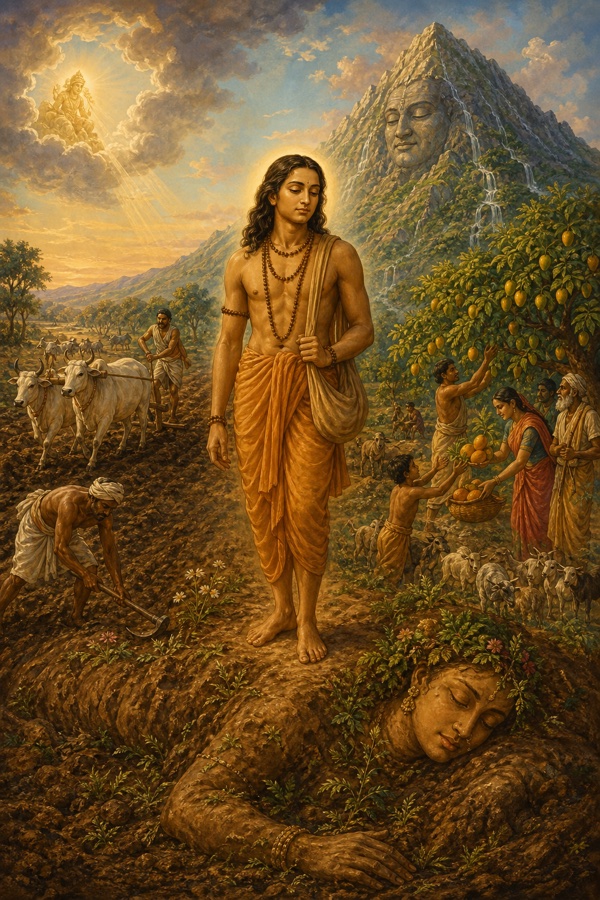
“The earth bears everything. We load it with burdens, we dig it, we tear it open with the plow, we light our fires and bury our dead upon it, and it takes no revenge and raises no cry. Every creature, driven by its own destiny, strikes at it knowingly or in ignorance. From the earth I took a vow: to understand how helpless these creatures are, held as they are in the hand of Providence, and so to keep my patience, never give way to anger, and hold to my own path exactly as I am. The mountain and the tree are the earth’s own children, and each taught me a further thing. From the mountain I learned that a holy person exists for the good of others, spending himself the way a mountain spends itself, holding up forests, feeding rivers, sheltering whatever comes to it, and that his very birth is meant for their service. From the tree I learned complete surrender, for the tree gives its shade to the traveler who will break its branches, its fruit to the boy who throws stones at it, its wood at last to the axe, and bends without complaint to every use they make of it.”
“Second, the wind.”
“The wind moves everywhere and settles nowhere. Fragrance cannot detain it, and stench cannot cling to it. It carries a thousand scents across the world, the smoke of the burning ground and the sandalwood of the temple in the same hour, and not one of them belongs to it. From the wind I learned two things. As the life-breath keeps a body alive on the barest sustenance, a seeker should take only as much food as carries him through, never so little that hunger dulls his wits, never so much that his mind grows heavy and his speech runs loose. And as the outer wind passes through every kind of thing and keeps the nature of none, one who lives inside a body should move among its comforts and its aches without being wound into them, untouched by their merits and their faults.”
“Third, the sky.”
“The sky holds everything inside itself. Clouds gather and scatter, smoke rises, dust blows through, whole storms are born and spend themselves and die, and the sky is stained by none of it. From the sky I learned the nature of the atman, the self within. It pervades all things at once, the moving and the still, and stays whole and unbounded through all of them. The states of the body, its birth and its growth and its wasting away, are like clouds driven across the sky by the wind of time. They darken the light for an hour, and they pass over the self and leave no mark on it.”
“Fourth, water.”
“Water is clear and cool and sweet. It keeps moving, and it makes clean whatever comes near it, the way a river makes clean the pilgrim who wades down into it at dawn. From water I learned what a holy person should be: soft in nature, transparent to the bottom, a wellspring of purity, one whose very sight, whose touch, whose name spoken aloud can wash another clean.”
“Fifth, fire.”
“Fire reduces to ash whatever is placed in it, and it takes on no one’s foulness. It keeps no jar for hoarding; the only vessel it owns is its own belly, and it makes do with whatever it is fed. From fire I learned that a seeker should stay bright with the heat of his tapas, his austerity, and cling to nothing he takes in, however impure. And there is more. Fire eats only what is offered to it, and in the eating it burns away the past and the future sins of the one who made the offering. So a holy person, fed at the doors of others, consumes their wrongs in the flame of his austerity and keeps none of it on himself. Fire hides unseen inside a log and leaps out bright when it is called; just so a seeker may pass unnoticed in one place and blaze forth in another, and the one who saw him hidden would never know him revealed.”
“Sixth, the moon.”
“The moon thins to a sliver and swells to a full circle, waxing and waning night by night, and the villages below set their fasts and their festivals by its changes. Yet the moon is always the one same moon; nothing was ever added to it and nothing taken away; only its phases rise and fall across its face. From the moon I learned that birth and death, childhood and youth and old age, are phases that move across the body while the one who sits within and watches stays exactly as he is, whole and unchanged.”
“Seventh, the sun.”
“One sun stands in the sky, and it glitters back from the water of a hundred pots, a hundred small suns trembling in a hundred courtyards. A simple person, counting the reflections, believes there are many suns. From the sun I learned that a single consciousness shines in countless bodies, and what differs is only the reflection; the one that is reflected stays undivided. The sun taught me one thing more. It draws up water from the earth with its rays through the long summer and pours it back down in the rains, each in its own season, and it hoards nothing of what it gathers. So a yogi may take in the objects of the senses when the time is right and let them go again when the time comes, held fast by none of them.”
“Eighth, the pigeon.”
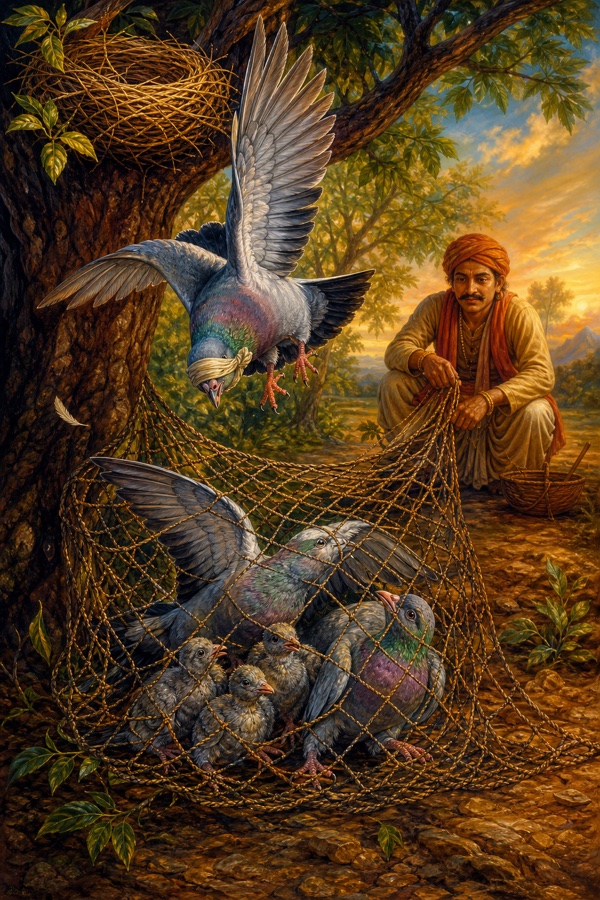
“High in a tree in the forest, a pigeon lived with his mate for many years. Their hearts were bound together, and they did everything as one: they slept and woke, flew and rested, fed and chattered side by side, and neither knew a single hour that did not hold the other in it. When the female laid her eggs and the chicks broke free of the shell, soft and small, their first feathers still like down, the two poured all their love into the brood, and their minds went with the little ones wherever they hopped. One day, while the parents were away searching for food, a fowler came through the forest, a man who fed his own family on the lives of birds, saw the fledglings near the nest, and threw his net over them. The mother returned first, heard her young crying under the mesh, and dropped down to them, blind with love, forgetting that she too could be snared, and the net took her. The father came back to find his mate and his children in the trap, struggling in the jaws of death. He looked at the empty years ahead of him, a nest with no sound left in it, and let himself fall into the same net of his own will. The fowler carried the whole family home, well pleased with his day. From the pigeon I learned how the love of house and family can bind a person and drag him down whole. This human body is a door standing open to freedom, and the one who stays shut inside it, clinging to his nest, has climbed to a great height only to fall from it.”
“Ninth, the python.”
“Pleasure and pain arrive on their own, in heaven and in hell alike, carried to every creature by its own destiny; a wise person does not go chasing them. The python taught me this. It never runs down its prey. It lies where it is, and whatever wanders within reach, it takes and fills its belly; when nothing comes, it lies still and hungry for many days, untroubled, trusting that fate will bring what it brings. It has strength enough to hunt, and it does not spend it. From the python I learned to live on whatever comes to me unasked and unworked for, coarse or delicious, much or little, and to keep an even mind through plenty and through want.”
“Tenth, the ocean.”
“A hundred rivers rush into the sea through the rains, swollen and loud with the whole monsoon on their backs, and it does not swell over its shore; through the drought the rivers shrink to threads and fail, and the sea does not sink. From the ocean I learned to stay grave and deep and hard to fathom, mastered by no one, unmoved by gain and loss. Let joy arrive, and you do not brim over; let sorrow arrive, and you do not go under. No one standing on the beach can tell from the surface what the sea holds, and the measure within stays steady, like the still deep water far below the reach of the tides.”
“Eleventh, the moth.”
“The moth sees the bright shape of the lamp’s flame, and love of that shape carries it straight into the fire, where it burns. It asked the flame for nothing except to be near it. From the moth I learned that a man with no rein on his senses, dazzled by a beautiful form and the shine of fine ornaments, loses his judgment and drops into ruin like the moth into the flame. What the eye drinks in can lead the whole person to his own burning.”
“Twelfth, the honeybee.”
“The honeybee draws a little nectar from each flower, a small sip at a time, and leaves the flower unhurt, still standing in its color and its scent. From the bee I learned that one who lives on alms should beg a little from many houses, rich and poor, so that no single household feels the weight, and that a seeker should gather the essence out of every scripture, the great ones and the small, as the bee gathers from many blossoms. But the bee teaches by its error too. It hoards its honey in the comb, drop by patient drop, and a stronger creature comes and takes the whole store, and the bee is left with nothing. So a mendicant should keep nothing back for the evening or the next day. His two hands are his begging bowl and his belly is his only storehouse; whatever he saves beyond that will be the ruin of him.”
“Thirteenth, the elephant.”
“Hunters trap the wild bull elephant with a decoy, a wooden cow dressed to look like a female of his own kind. Drawn by the hunger to touch her, the great animal that no rope in the forest could hold charges, tumbles into the covered pit, and is bound and led away in chains by tame elephants, while the rival bulls that fought him for her batter him besides. From the elephant I learned how the craving for touch seizes a person and hauls him to his fall. A seeker should never take a woman as something to enjoy; for a man bent on enjoyment, she is death standing before him in a shapely body, and stronger men contending for her may cut him down.”
“Fourteenth, the honey-gatherer.”
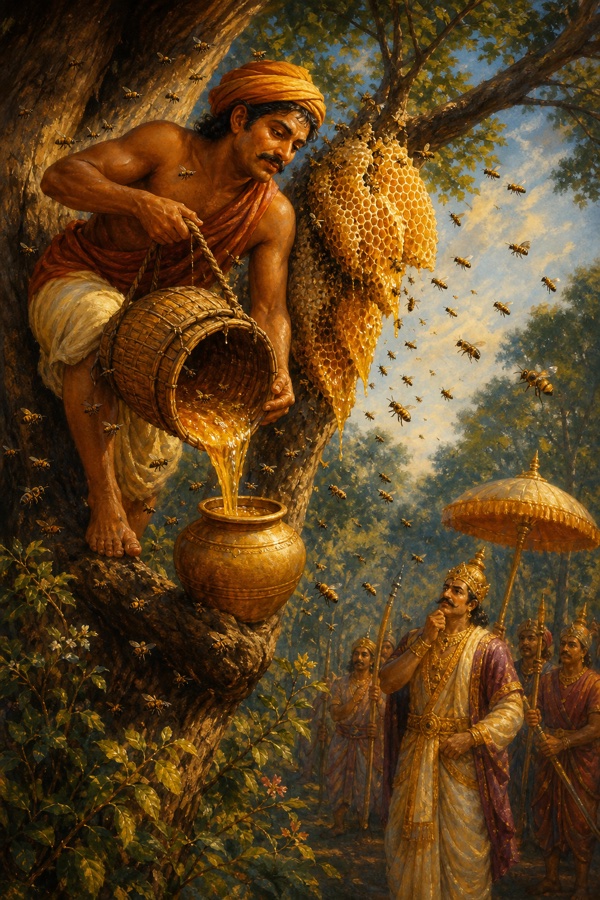
“A man comes to the hive and carries off, with patient effort, all the honey the bees gathered drop by drop across a whole season, and the bees are left with empty combs. From the honey-gatherer I learned about the miser of this world. He piles up wealth through great hardship, grudging himself sleep and food to do it, keeping it from his own use and from every recipient, and in the end some watcher who had been waiting for the chance carries the whole hoard off and enjoys it, while the one who gathered it is left with nothing in his hands. The ascetic, in his own quiet way, is the man at the hive: he lives on what householders have labored to store, and takes only as much as he needs.”
“Fifteenth, the deer.”
“The deer, enchanted by the sweet notes of the hunter’s pipe, forgets the open ground and its own swift legs, drifts close to the sound, and is caught in the net. From the deer I learned how music that flatters the ear can steal away a seeker’s mind. So it was that the sage Rishyashringa, born from the womb of a doe and raised in a forest so lonely that he came to manhood without ever seeing a woman, was lured out by song and dance and fell wholly under the sway of women.”
“Sixteenth, the fish.”
“The fish, greedy for the taste of the bait, swallows the hook and throws away its life for one mouthful. From the fish I learned that of all the senses the tongue is the hardest to hold. When a man gives up food, the other senses quiet down soon enough, the eye stops demanding, the skin stops asking, but the craving of the tongue only grows sharper the longer it is denied. Until the tongue is conquered, no one is truly master of himself; and the one who has conquered the tongue has conquered all the rest at once.”
“Seventeenth, Pingala.”
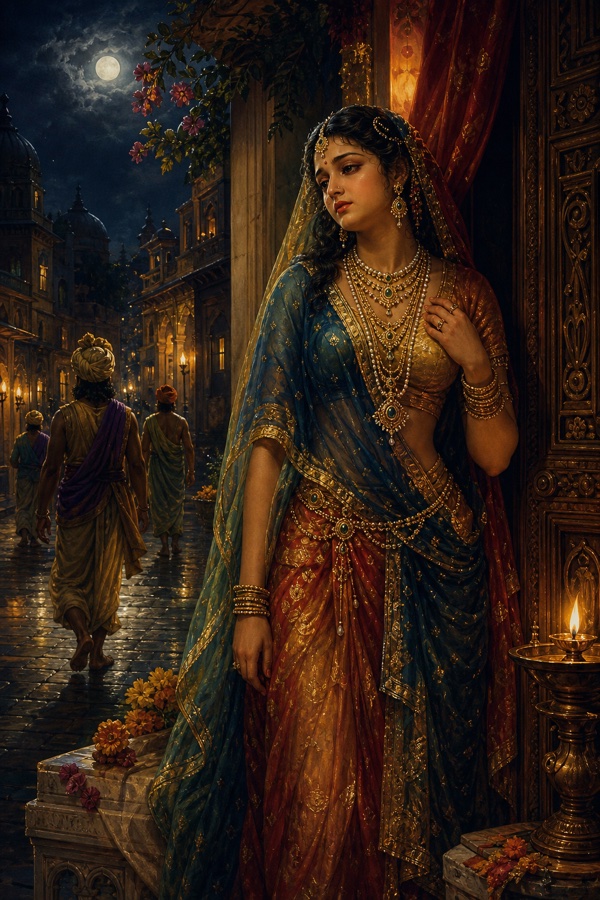
“In Mithila, the chief city of the Videha country, there lived a courtesan named Pingala. One night she dressed and adorned herself, painted her eyes, hung gold at her ears and her throat, and stood at the door of her house, waiting for some wealthy man to come and pay for her company. The night wore on. The lamps in the lane guttered out one by one. Men passed, and to each one her eye ran out in hope, taking him for the rich patron who would fill her hands with money, and each one walked on into the dark. She kept stepping out to the road and back inside, out and back, while her hope broke and mended and broke again. Past midnight her mouth went dry and her hope wore through, and in the wearing through of it a deep dispassion came over her. She saw it plainly at last. The one truly beloved master, seated in her own heart all along, who alone gives lasting wealth and lasting joy, she had turned her back on, to stand year after year in the road watching for these worthless men who bring only fear and grief and worry. Dispassion, she understood, is the sword that cuts the noose of hope. That very night she let every hope fall away, and the moment she let it fall she lay down and slept a sleep freer of care than any she had ever known. From Pingala I learned the plainest of truths: hope is the greatest misery there is, and the end of hope is the greatest peace.”
“Eighteenth, the kurara bird.”
“An osprey was flying with a scrap of meat gripped in its beak. Other birds, larger and stronger, which had caught nothing, swept in around it and struck at it with their beaks from every side. As long as it held on to the scrap, the blows kept falling; the instant it let the meat drop, the whole mob wheeled away after the falling flesh, and the osprey flew off in peace through an empty sky. From the osprey I learned that the very holding of a thing is the root of the pain that comes with it. To reach for and grip what others also want is to invite misery, and the one who wants to grasp nothing rests in a peace that does not end.”
“Nineteenth, the child.”
“A small child does not mourn what is gone or fret over what is to come. Praise does not swell him and insult does not sting him; he has forgotten both before the speaker has finished. From the child I learned to live unburdened, wholly inside the present moment. Only two kinds of people move through the world free of care and full of an untroubled joy: the innocent child who knows nothing yet, and the sage who has passed beyond the three gunas, the strands of nature that bind, and come to rest in the self.”
“Twentieth, the maiden.”
“In one house a young girl was left alone when her family went out, on the very day that suitors had come to look her over as a bride. Having no one to help her, she set about husking rice herself to feed the guests, and the shell bangles crowding her wrists rang out loudly with every stroke of the pestle. Shame went through her: the guests would hear the clatter and know she was doing the servant’s work with no one beside her. She slipped the bangles off one by one until only two remained on each wrist. Even those two struck against each other and rang. So she broke it down further, to a single bangle on each wrist, and then, at last, the ringing stopped, and there was only the quiet sound of the work being done. From the maiden I learned that where many gather there is quarrel and clamor, and even two together will fall to talking. A seeker should therefore move through the world alone, silent as the single bangle on the girl’s wrist.”
“Twenty-first, the arrowsmith.”
“An arrowsmith was so sunk in the filing of a single arrowhead, his eye and his hand and his whole mind narrowed to one point of iron, that the king himself rode past with his whole procession, drums and kettledrums and all, and the man never caught the least hint of it. From him I learned that once the mind is fixed on a single point, held there with a steady breath and a steady seat, the whole clamor of the world drops away, and nothing outside or within can reach the one who is absorbed.”
“Twenty-second, the snake.”
“The snake digs no burrow of its own. It slips quietly into the holes that others have dug, keeps to itself, moves alone, and settles nowhere for long. From the snake I learned that a holy person should build no house, should keep his own company, should stay watchful and spare with his speech, and should avoid attachment to any one place; a perishable body gains only trouble from the walls raised around it, and the world already stands full of shelters that others have made.”
“Twenty-third, the spider.”
“The spider spins the thread out of its own body, weaves the whole web from itself, ranges about inside it, and when it chooses draws the entire web back into itself again, so that nothing of the web is left behind. From the spider I learned how the Lord brings forth the worlds. Out of himself alone he spins creation, first drawing out the single thread from which every form is woven, delights in the play of it, holds it up for its season, and at the close of the age gathers the whole of it back into himself and remains one, alone, undivided.”
“Twenty-fourth, the bhringi wasp.”
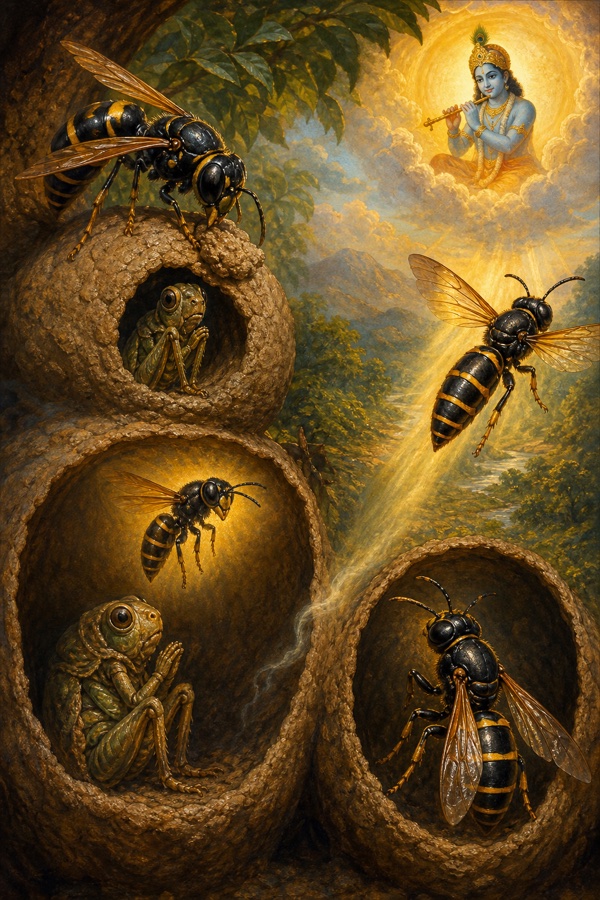
“A wasp seizes a small insect and seals it inside its nest. The captive, at first out of sheer fear and then in an unbroken fixing of its whole attention, meditates on the wasp day and night, until one day, without even shedding its old body, it turns into a wasp itself. The thing it dreaded became the thing it was. From this I learned that whatever a person dwells on without a break, whether in love, or in fear, or even in hatred, is what he becomes in the end. This is the reason a person should hold his mind, always, on God.”
King Yadu bowed his head. The forest path was the same path he had ridden an hour before, and nothing on it looked the same to him now.
“Avadhuta, you truly have twenty-four gurus.”
The avadhuta laughed, and there was no pride in it, only the lightness of a man to whom the count had never mattered.
“I named twenty-four only to make a count of them, Rajan. The teachers are past counting. Even this body of mine has been my teacher, for it is born only to die, and it was never finally mine to keep; it works for me, it ages under me, and every day it tells me quietly where all bodies are going. Watching it, I learned to loosen my hold on everything. For the one whose eye has opened, every creature in the world and every last thing in it is a page to be read. And within them all sits a single guru, taking form after form, teaching without end.”
Literary context
This story of the avadhuta and his twenty-four gurus stands in the eleventh Skandha of the Shrimad Bhagavata, discourses 7 through 9. Bhagavan Shri Krishna tells it to his devotee Uddhava on the eve of his own departure from the world, as the Yadava race stands under a curse and Dwarka waits to be swallowed by the sea. Inside it runs the older dialogue between the avadhuta, understood by the tradition to be Lord Dattatreya, and King Yadu, the son of Yayati and the ancestor from whom Krishna’s own line descended.
The twenty-four teachers, in the order the avadhuta named them, are these: the earth, the wind, the sky, water, fire, the moon, the sun, the pigeon, the python, the ocean, the moth, the honeybee, the elephant, the honey-gatherer, the deer, the fish, Pingala the courtesan, the osprey, the child, the maiden, the arrowsmith, the snake, the spider, and the bhringi wasp.
Like the ninefold path of bhakti, this list too has been repeated again and again in the tradition of vairagya, of dispassion, that followed it, always carrying the one idea that to learn, a person need not wait for any single teacher to appear; the readiness of the student is the whole of the school.
The Way of Dattatreya
King Yadu had asked the avadhuta where such gladness could come from, in a man with no possessions and no refuge to lean on. The answer arrived without a sermon in it. It arrived as a list, twenty-four gurus deep, each guru carrying a single lesson, taken whole and kept for life.
In the ordinary way of thinking, a guru is one particular person. This katha turns that notion over, gently. A guru can be anyone and anything: endurance from the earth, steadiness from the ocean, from the honeybee a living taken without hoarding. A mendicant, a courtesan, a child, a spider, a fish, all of them find a place in the same list, and none of them ever knew they were teaching.
For the seeker, every single thing becomes a text. A jewel is picked up even when it lies in the dust, and no one asks the dust for its credentials; there is no shame in taking a lesson from wherever it happens to fall.
Why this katha matters now
The avadhuta’s twenty-four gurus, the earth, the wind, water, the sun, the moon, the snake, the deer, and all the rest, remind us that a lesson can be found lying anywhere, and that the finding depends on the student, never on the setting. For the one who wakes within and looks, even the din of a crowded street becomes a teacher. All it takes is the eye to see.