On this page
Bhishma’s Final Teaching
The great war of the Mahabharata had ended.
Dharma had won. The hundred Kauravas were gone, and the Pandavas held the throne. Yet out on the emptied field one man still breathed, and every breath was a waiting, for he had fixed an appointment with the sun: the hour of uttarayana.
Bhishma.
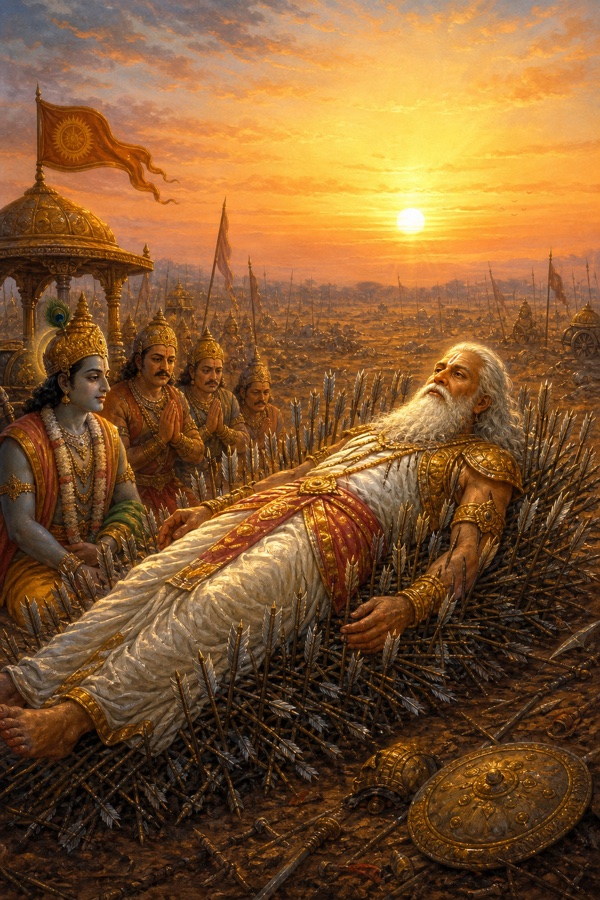
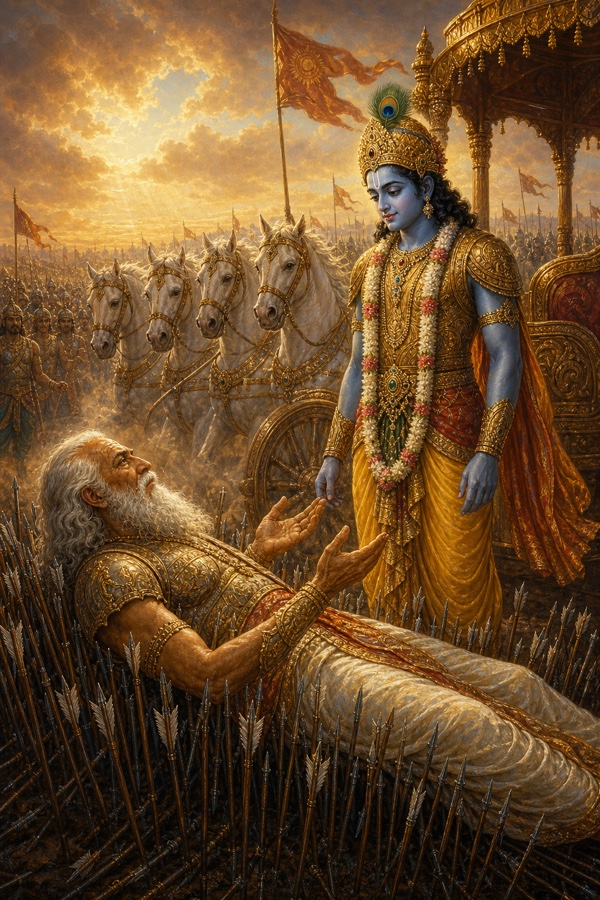
Arjuna’s arrows had brought him down, and so many shafts stood in his flesh that they bore him up off the earth; the old man lay on the points that had pierced him as on a bed. Death could not take him until he consented to go. That power was his father’s gift, granted a lifetime ago in return for the costliest vow a son ever swore, and Bhishma spent it now on waiting, because he had chosen his hour with care: uttarayana, when the sun turns onto its northern road and the way of light opens for the dying.
Then one day, the sun turned. Dakshinayana ended, and uttarayana began.
The hour had come.
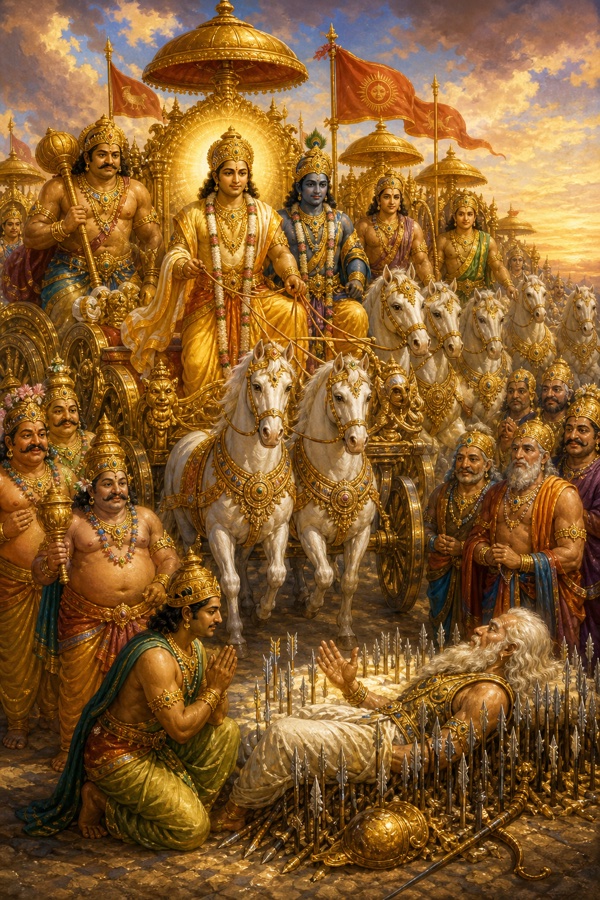
King Yudhishthira rode out to him with his brothers, their chariots worked in gold, the finest horses in the yoke. Bhima, Arjuna, Nakula, Sahadeva.
Krishna came with them in his own chariot. In the midst of them all Yudhishthira shone the way Kubera, the lord of treasure, travels ringed by his yakshas. And when they reached the place and saw Bhishma stretched on the bare ground like a god fallen out of heaven, all of them, Krishna among them, bowed low to the dying man.
Others had been drawn there too. To watch Bhishma go, sages arrived from every quarter: seers of the priestly houses, seers who move among the gods, seers who had once worn crowns. Parvata, Narada, and Dhaumya; the divine Badarayana, who is Vyasa himself; Brihadashva, Bharadvaja, and Parashurama with his disciples; Vasishtha, Indrapramada, Trita, Gritsamada, and Asita; Kakshivan, Gautama, Atri, and Vishvamitra; Sudarshana, Kashyapa, Angirasa, and many others, each trailing his own pupils. A whole caravan of the holy, gathered around one man’s deathbed.
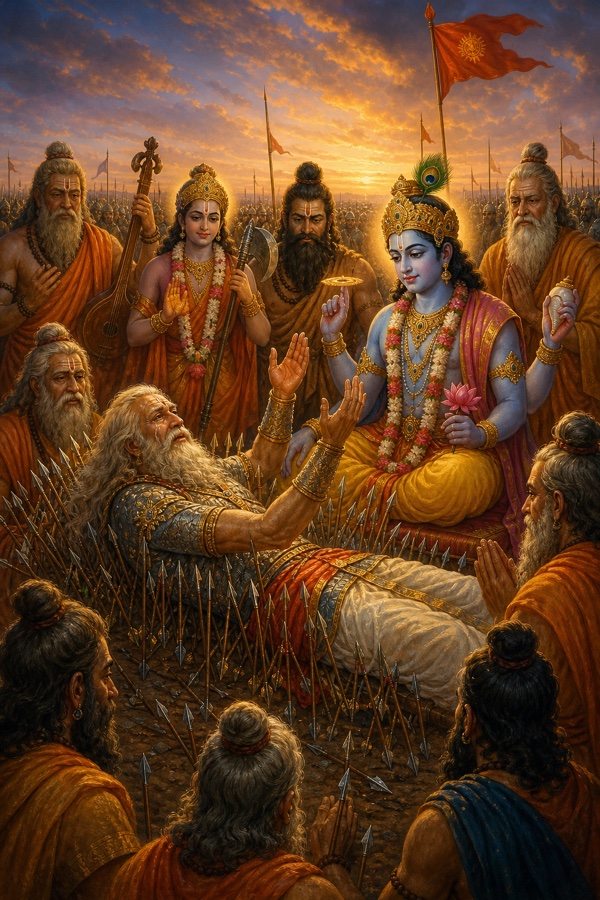
Bhishma opened his eyes and found them all around him, and tears of love rose and blurred his sight. Broken as his body was, he honored each sage exactly as the man, the moment, and the place required; a lifetime of courtesy held to the very end. Then his gaze went to Krishna, and it changed. Bhishma knew what he was looking at. He knew that the Lord of the universe had drawn a human shape around himself by his own maya and seated that shape before him, and he knew that the same Lord sat enthroned inside his own heart, and he worshiped him in both places at once, the Krishna before his eyes and the Krishna within.
Yudhishthira stood by the arrow-bed under a weight that no coronation could lift. He had won the war across the bodies of his own people, and at night sleep refused to come anywhere near him.
The sons of Pandu settled close beside their grandsire, quiet with modesty and love, and Bhishma read the eldest’s face in one look. His eyes still brimming, he set about lifting Yudhishthira’s burden first.
“Son, what a hard and crooked thing it has been, that you, the very children of righteousness, who kept yourselves all your lives in the shelter of dharma and of the Lord, should have had to live on suffering you never earned. When the great Pandu died you were small boys, and my own daughter-in-law Kunti carried hardship after hardship for your sakes, and had barely set one down before the next arrived. But listen to me carefully now. All of it, I believe, came from Time, which is the Lord’s own will at work. The whole world with its guardian gods moves under Time the way clouds move under the wind.”
“Think how impossible your misfortunes should have been. Dharma’s own son sat as king. Bhima stood by with his mace, Arjuna kept watch with Gandiva, the bow the gods themselves had put into his hands, and Shri Krishna was your friend and well-wisher. What calamity could find its way into that house? And still it found the way in. No man, my king, will ever read Shri Krishna’s intention; the deepest seers go searching for the plan and come back bewildered.”
“So know all of this for certain as the working of his will, son, and follow that will. This people has no one else left to hold it. Protect them. You are their sole master now.”
Bhishma paused there, and when he went on, his voice had dropped, because what came next was the one thing he most needed Yudhishthira to carry away.
“You think of Krishna as your cousin, your mother’s brother’s son. As your dearest friend and your surest well-wisher. Out of that affection you made him your counselor, you sent him as your envoy into the Kaurava court, you let him hold the reins of Arjuna’s horses. Hear what he is. He is God himself. He is the Prime Person, Narayana, and he has pulled his own maya over the eyes of the world and lives unrecognized among the Vrishnis, passing for one more prince of the Yadu house. His most hidden glory is known to Shiva. It is known to the celestial sage Narada, and to Lord Kapila. I cannot name a fourth.”
“He is the Soul of the universe, and his gaze rests evenly on all of it. He is one without a second, free of the least trace of I and mine, free of every flaw. So never imagine that the offices he filled for your family out of love, cousin, friend, envoy, charioteer, could divide him, or diminish him, or so much as touch him. They leave him exactly what he is.”
“And now see what his tenderness does for those who belong to him alone. Here I lie at the very hour of quitting this body, and he has walked onto this field and taken his stand in front of me. A yogi who casts off his body with his thought fixed on him in devotion and his name moving on his tongue is stripped of every craving and loosed from the whole long ledger of his deeds. So I ask one grace. Let this Lord whom the gods themselves adore, the four-armed one whose lotus face carries its gracious smile and its reddened eyes, whom other men find only far inside their meditation, stand here in my sight until I have laid this body down.”
Yudhishthira listened, and the stone on his chest began to shift. This was the enlightenment he had come out to the field to ask for, and now, in the hearing of all the assembled rishis, he laid his questions before the grandsire one by one, every duty a man can owe, every burden a crown can carry. Bhishma had only a little daylight left in him, and he chose to spend the whole of it answering.
And Bhishma, lying in his cage of arrows with the truth plain before him, answered everything. He set out the duties native to each man, portioned by varna and by ashrama, the station of his birth and the stage of his life; the two great roads, engagement for those still warm with desire and withdrawal for those grown dispassionate; the dharma of giving, the dharma of kings, the dharma of moksha, the dharma of women, and the dharma of serving the Lord. He unfolded the four ends a human life can pursue, dharma, artha, kama, and moksha, with the means to each, first briefly and then in full, lighting the whole of it with history after history, story after story.
The Pandavas sat by the arrow-bed and listened.
And then comes the turn for which the Bhagavata tells this story at all: the moment after the teaching.
Bhishma was still unfolding dharma when the time arrived, the precise turning that yogis who hold their own death in their hands wait whole lifetimes to catch. The sun entered its northern road.
Bhishma brought his discourse to a close. Then he was quiet, and his attention turned around and moved inward.
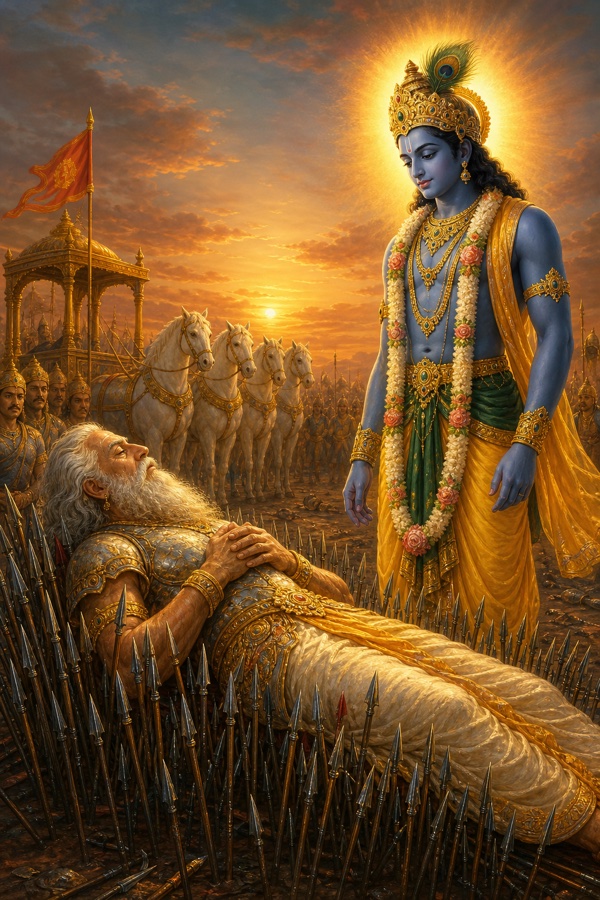
He stilled his voice. He called his mind home from every direction it had ever wandered, a mind with no attachment left in it anywhere, and set it, along with his eyes, which had stopped blinking, on the Prime Person standing before him: Shri Krishna, four-armed, dressed in yellow robes that gathered the winter light. Then, one by one, he closed down the wanderings of his senses.
Hundreds of arrowheads still stood in his flesh, and their pain left him at a single sight of the Lord, burned away by that pure and undivided concentration. Whatever last trace of sin might have clung to a life that long went with it.
He opened his eyes onto the crowded field, and out of all those faces he now saw exactly one.
Krishna.
The yellow pitambara stirred and rippled across Krishna’s beautiful four-armed form. Bhishma’s gaze settled there and stood still, the way a flame stands in a windless room.
Then, palms joined over his pierced chest, with the love of a whole long life gathering in his voice, Bhishma began his hymn.
“O Lord.” The voice was low, and completely clear.
“Here at the edge of death I make my offering. This mind of mine has been scoured by a lifetime of discipline until thirst and appetite for every world have left it; such as it is, I lay it at the feet of Shri Krishna, crown of the Yadus, the infinite Lord who rests forever in his own bliss and yet, for the joy of his play, takes up his own prakriti, and out of that play the whole stream of creation comes pouring.”
“Let my love go to him with no motive folded inside it. To Arjuna’s friend. To the form that is the loveliest thing in the three worlds, dark as the tamala tree, robed in cloth as brilliant as sunrays, the lotus face with its curls drifting loose about it. Let my love rest there and ask for nothing back.”
And then the hymn did an unexpected thing. From the bed of arrows, Bhishma reached back into the war itself, into the days when he had stood against Krishna in arms, because it was there, along the flight of his own arrows, that he had learned to fix his whole aim on him.
“I see him still as I saw him then. The dust beaten up by the horses’ hooves drifting down into his curling hair, sweat standing in beads on his face, and his skin, behind the shine of his armor, cut open by my sharpest arrows. To that Krishna, to the Krishna who wore my wounds, let this body, this inner being, and this soul of mine be given.”
“At one word from Arjuna he drove the chariot forward and set it down in the open ground between the two hosts, and standing there he looked along our ranks, and with that look alone he drew the allotted years out of the men who were marked to die. In that friend of Arjuna let my love find its highest seat.”
“And when Arjuna looked out at us, at the front line of the enemy filled with his own teachers and elders and kin, and his will broke, and he called the killing a sin and turned away from it, it was this Krishna who spoke to him between the armies and gave him the knowledge of the self, the teaching the world keeps now as the Gita, and cut that delusion out of him. At the feet of that supreme person let my love remain.”
“I made him break his word for me. He had sworn to lift no weapon in this war, and I had sworn to force one into his hands, and of our two vows it was mine he kept. Down he came off the chariot with a wheel snatched up in his grip, and he ran at me the way a lion goes for an elephant, the earth trembling under his stride, his upper garment slipping loose and falling behind him, and he did not stop for it.”
“My arrows had already found him. His armor hung broken, his body ran with blood, and still he came on to kill me, the aggressor, deaf to Arjuna, who ran after him and pleaded with him to turn back. Let that Lord, Mukunda, the giver of freedom itself, be my last refuge.”
“And in these final minutes let my love go to him as I watched him each morning of that war, in the servant’s seat, the charioteer’s whip in one hand and the reins gathered in the other, guarding Arjuna’s chariot as he had promised he would. He was so beautiful in that humble office that the warriors who fell on this field with their dying eyes on him rose out of their bodies wearing forms like his own.”
“The gopis of Vraja knew him in another way altogether. Graced by his gliding walk, his playful gestures, his sweet smile, and his glances brimming with love, they were so carried into the madness of that love when he vanished from the middle of the rasa dance that they lost themselves in acting out his lilas, and for that while each of them was him. In that same Shri Krishna let my supreme love rest.”
“I saw the whole earth admit what he is. At Yudhishthira’s rajasuya, the rite that seals an emperor’s sovereignty, in an assembly packed with hosts of sages and the first princes of the world, the worship of the first place was offered to him, to him before all others, and my own eyes watched it done. That same Lord, the Soul of everything that exists, stands before me now at the hour of my death.”
“One sun climbs the sky, and every eye on earth receives a sun of its own. So the unborn Krishna stands in the hearts of all the embodied beings he himself has made, one in himself, appearing as many to the many. That delusion of difference has fallen from me at last. I have reached him.”
So Bhishma gathered every current of his mind, his speech, and his sight into one channel and merged himself into Shri Krishna, the Soul of all.
His breath went out of him and dissolved into the open air, and he was still.
That was the end of him. On a bed of arrows, in the open field. The pride of Bharata’s line, the elephant among warriors, Bhishma the grandsire, left the world as a plain devotee, absorbed into the infinite Brahman.
Everyone around him understood that he had entered the one indivisible Brahman, and every voice on the field stopped at once, the way birdsong dies at the fall of dark.
Then the drums began, struck by gods in their heaven and by men on the earth, and the saintly among the kings praised him aloud, and flowers came down out of the sky in showers.
Yudhishthira had the funeral rites performed over the body, and for a time he let grief take him. The munis, radiant with joy, praised Shri Krishna in his secret names, and then, carrying Krishna enthroned in their hearts, they turned back each to his own hermitage.
Afterward Yudhishthira returned to Hastinapura with Shri Krishna at his side and comforted his uncle Dhritarashtra and the tapasvini Gandhari, who had bound her own eyes with cloth on her wedding day so that she would never see what her blind husband could not, and had never once loosened the knot. Then, with his uncle’s leave and Shri Krishna’s consent, that capable king took up his ancestral empire and ruled it by dharma.
Literary context
Bhishma’s final episode comes in the ninth chapter of the first Skandha of the Shrimad Bhagavata. In the Mahabharata’s Shanti Parva and Anushasana Parva, Bhishma teaches Yudhishthira the principles of dharma at enormous length; the Bhagavata folds all of that instruction into a few verses and lets the full weight of the chapter fall on the closing hymn, the moment when Bhishma turns from Yudhishthira to Krishna.
The eleven verses of that hymn (1.9.32 to 1.9.42) are honored in the tradition as the Bhishma-stava-raja, the royal hymn of Bhishma. It is the first hymn addressed to Krishna in the whole Bhagavata, and its tone, quiet, inward, and unhurried, sets the key for every hymn that follows it.
The same katha elsewhere
- Chapter 34 · Bhishma on the Bed of Arrows: Raja-dharma
Mahabharata (Shanti Parva): Bhishma’s raja-dharma from the bed of arrows - Chapter 35 · Bhishma: Moksha-dharma and Apad-dharma
Mahabharata (Shanti Parva): Bhishma’s moksha-dharma and apad-dharma - Chapter 36 · Bhishma: Dana-dharma and Final Teachings, Bhishma’s Ascent to Heaven
Mahabharata (Anushasana Parva): Bhishma’s dana-dharma and ascent to heaven - Bhishma
Character study: the whole arc of Bhishma