On this page
The Uddhava Gita
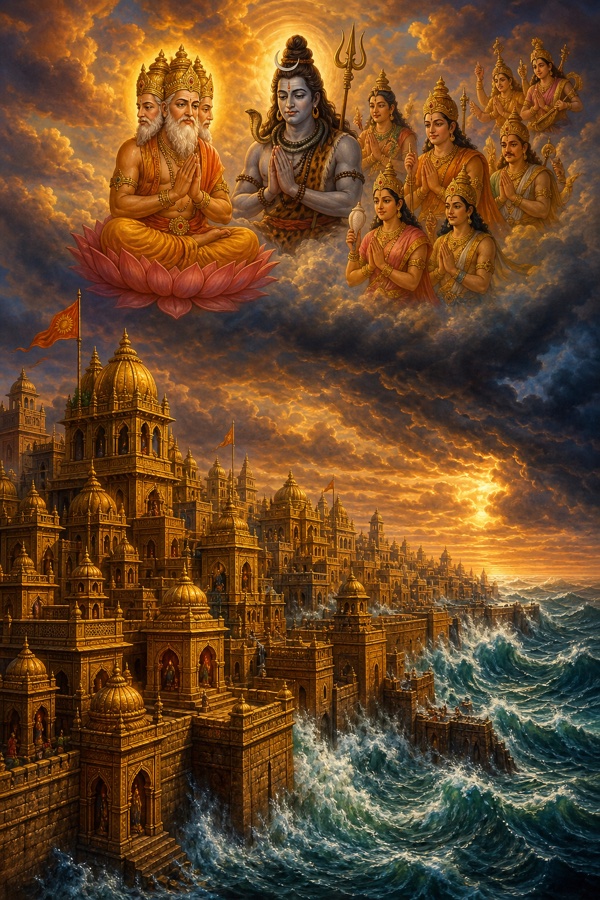
In Dwarka the day had come toward which the whole lila had been moving. A hundred and twenty-five years had passed since the Lord took birth in the line of Yadu, a hundred and twenty-five years, Rajan, from the dust of Gokul to this golden city at the edge of the sea. Now the sky over the city filled. Brahma came with Sanaka and his brothers, the boy sages born of his mind; Shankara came with his troop of goblins; Indra came with the Maruts, and after them the Adityas, the Vasus, the Rudras, gandharvas, siddhas and rishis, every one of them hungry for one more sight of that face. Flowers that grow only in heaven came down over the foremost of the Yadus, and the gods sang. They asked that his feet be a fire to burn the cravings in them, and they said that sixteen thousand wives, with every art of the arched eyebrow and the half-hidden smile, had failed to shake his mind. Then Brahma, standing in the air with Shankara beside him, spoke for all of them. The burden of the earth was lifted, exactly as they had once begged him to lift it. A hundred and twenty-five years had passed since he appeared in the race of Yadu, nothing of the gods’ purpose remained undone, and his own clan was all but gone under the Brahmins’ curse. Would he return now to his own realm? The Lord answered that what Brahma asked was already decided in his own mind. The Yadus, grown insolent on prowess and fortune, he had held in check the way the shore holds the ocean; were he to leave without ending that house, this ocean that had already broken its bounds would drown the whole race of men. The curse of the Brahmins had set the destruction going. When it was complete, he would ascend.
Brahma bowed to the ground and went back to his realm with the host of the gods. Then the omens began. Grave portents showed on every side of Dwarka, and the Lord gathered the elders of the Yadus and told them what the signs meant. A curse from the Brahmins, past any remedy, had taken hold of the clan, and if they wished to live they must leave this very day for Prabhasa, the tirtha where the moon, wasted by the curse of Daksha, had bathed and been made whole and had begun once more to grow. There they would bathe, pour water for the ancestors and the gods, feed Brahmins and give them gifts, and by those gifts cross their sins as men cross an ocean. The Yadavas heard him and set about it. Carts were readied, and a pilgrimage was prepared in a city that was already dying.
Uddhava saw the carts. He had heard the Lord’s words to the elders and he had read the omens for himself. He was the Yadava whose judgment stood apart in every assembly of Dwarka, who carried every debate by the plain force of reason, whom people never tired of calling wise. Yet inside this one man there was a place his whole learning had never reached, and it opened only before a single dark and lovely face. That face he now went looking for, where no one else would be. He found the Lord of the universe alone, laid his head on his feet, and with joined palms began to speak.
“You could have turned the Brahmins’ curse aside, and you have let it run. So you are leaving this world, and you mean to take this house down with you. Krishna, I cannot bear to be away from your feet for half a moment. Take me too, wherever you go.” This was only the first of it. The whole of what Uddhava said in that hour, Rajan, we will come to; hold it for now as the Lord held it, in silence, looking down at the man at his feet.
When the Lord answered, there was something in his voice Uddhava had never heard in a hundred and twenty-five years. The war cry was gone from it, and so was the laughter of the lila. What remained was the quiet of a man who, before setting out on a very long journey, looks once around the house he is leaving.
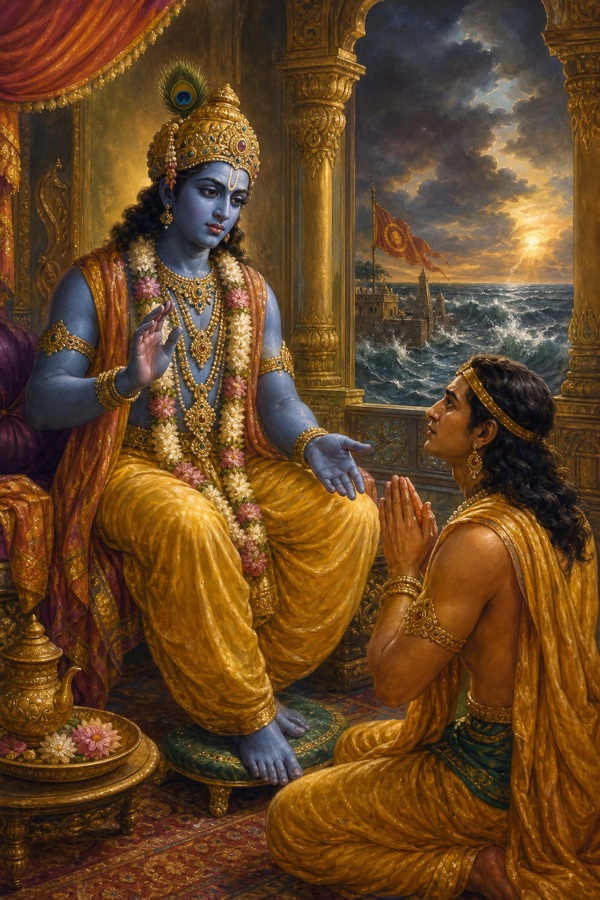
“Uddhava, what you have asked of me is the very thing I intend. Brahma, Shankara and the guardians of the worlds want me back in my own realm; the work of the gods for which I came down with Balarama is wholly done. This house of ours has been eaten through by the curse of the Brahmins. It will perish by its own hands, in a quarrel among kinsmen. And on the seventh day from this one the sea will rise and cover this city.”
Uddhava’s breath caught in his throat. Seven days, and the golden city, every lane and rooftop of it, would be under the sea.
“The moment I leave this earth, every good fortune leaves it with me. Kali will come in fast behind me, and the people of that age will give themselves to adharma. You are to stay here no longer, once I am gone.”
Each word fell on Uddhava’s chest like a stone. He had asked to be taken along. He was being sent out alone into a world with its one meaning gone from it.
The Lord looked at him a long moment, then smiled, and in that smile was the whole of what came next.
“Shake off every attachment to your own people and your kin, Uddhava. Fix your whole mind on me. Then go, and walk this earth looking on all of it with an equal eye.”
What the Lord said next, Rajan, is the very seed of the Uddhava Gita. Whatever the mind takes hold of, whatever the tongue says, whatever the eyes see and the ears hear, all of it, he said, is a making of the mind, and so a passing show. A mind that will not hold still sees the world as many separate things; out of that broken sight come the notions of good and evil, and out of those the whole fretwork of what must be done, what may be left undone, what is forbidden. “So take the reins of your senses and your mind into your own hand. See this whole world spread out within the Self, and see your own self standing in me. A man who has gone past good and evil does not shun a wrong act because he sees sin in it, and he does not do his duty because he thinks well of it; he acts the way a child acts, without the weighing. He is a friend to every being, he is at peace, and he sees this universe as one with me. Sorrow does not reach such a man again.”
Uddhava bowed to the ground. A question had been rising in him while he listened, and now he found the voice for it. This renunciation, with nothing wanted back from it, was for his highest good; he could see that. He could also see that it was close to impossible for a man sunk in the pleasures of the senses, and he, Uddhava, was ignorant, drowned in the sense of “I” and “mine” that clung to this body and to his children, all of it Maya’s making. Would the Lord teach his servant some easier way to the same renunciation? He saw no one, among gods or men, who could teach him the truth; even Brahma was under Maya’s spell. The Lord answered that the Self is its own guide, and that of all the bodies he had made, the human body was dearest to him, because in it the alert could find him, reasoning from the instruments they could see to the one who wields them. And then, to show him how, the Lord told Uddhava an old story.
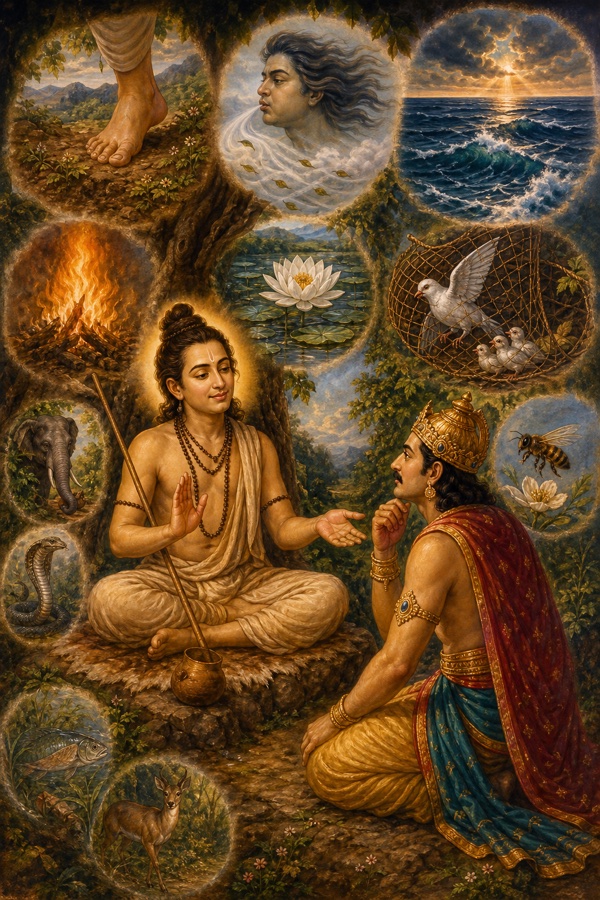
King Yadu, the ancestor of Krishna’s own line, once saw a young Brahmin walking the roads unwashed and unafraid, with the look of a man who knew everything and the manner of a boy. Yadu knew dharma and he knew men, and he could not place this one. How, doing no work at all, had he come by so penetrating an understanding, and why, having come by it, did he wander like a child? He did nothing, wanted nothing, and carried himself like a dunce, a madman or a ghost. In a world on fire with lust and greed he stood unscorched, an elephant cooling in the Ganga. Where did the joy in him come from? The Brahmin answered the king, who stood before him bent with humility, that his teachers were many, chosen by his own discernment: the earth, the wind, the sky, water, fire, the moon and the sun; the dove, the python, the sea, the moth, the honeybee, the elephant, the honey-gatherer, the deer and the fish; Pingala the courtesan, the osprey, the infant, the maiden, the arrow-maker, the serpent, the spider and the wasp. Twenty-four. From the earth he had taken her vow, to hold his course while every creature trampled him, since each of them moved as Providence drove it. From the wind, to live on bare sustenance and to move among every kind of object without taking its color, as air passes through a hundred odors and keeps none. From fire, to eat whatever is set before him and stay clean, to be hidden one day and seen the next, and to burn the sins of the one who feeds him. From a pair of doves who had lived for years in one forest tree and loved their soft-feathered young past all reason, he had learned what the cord of affection does. A fowler’s net closed over the fledglings; the mother flew screaming straight into it; the father, wailing that his house and his whole life were gone with them, followed of his own accord, and the fowler went home with the family complete. A man who reaches the human birth, an open door onto release, and clings like that dove to his nest, has climbed to a height and fallen from it. From the sea, to stay level whether the rivers run or fail; from the fish, that the tongue is the last sense to fall and that all the rest fall with it. From Pingala, a courtesan of Videha who waited at her door all one night for a paying lover, her mouth dry with hoping, until near midnight the hope broke in her and she sang: “Fool that I am, I have sought joy from a man, a thing of skin and bone and filth, and turned from the Lord who sits in my own heart and gives himself. Hope is the greatest misery. Freedom from hope is the greatest joy.” Then she went in and slept as she had not slept in years. From a maiden left alone to pound rice for the men who had come to look her over as a bride, and who broke the conch bangles on her wrists one by one until a single bangle was left on each arm and the clatter stopped: where many live together there is quarrel, and even two will talk, so walk alone. And from his own body, his last teacher, that it breeds grief and teaches discernment, and that it belongs to the creatures that will eat it. “Firm knowledge does not come from one teacher,” he told the king. “The rishis have sung the one Brahman in many voices.” He took his leave and went his way, and Yadu, the Lord said, was never bound by anything again.
Then the Lord gave him the Hamsa Gita, and it came out of a question. Uddhava had asked why men who know perfectly well that the pleasures of the senses breed calamity go on chasing them anyway, like the dog, the donkey and the goat. Because the false sense of “I” lodges in the body, the Lord told him, and rajas floods the mind, until a man sees the sorrow in an act and does it anyway. The remedy was the mind drawn back from everything else and set on him. “This much is the yoga I taught Brahma when Sanaka and his brothers were his pupils.” Uddhava wanted to know when, and in what form, and so the Lord told it. Sanaka and his brothers had gone to their father with a knot they could not untie: the mind clings to the objects of sense, and the objects leave their imprint in the mind, so how is a seeker ever to pry the two apart? Brahma thought hard and could not reach the root of it, his mind being full of his work of creation. So he fixed his mind on the Lord, and the Lord came before them as a swan. The sages, Brahma at their head, bowed at the swan’s feet and asked it who it was. “If the Self is one, what kind of question is that? And if you mean this body, every body is the same five elements, and your question is a drill in words. Whatever the mind grasps, whatever speech utters, whatever the eye and the other senses perceive, is me. There is nothing other than me.” Then the swan untied the knot. Mind and objects are adjuncts laid over the Self; waking, dream and deep sleep belong to the mind, and the Self is the witness of all three. “This is the secret of Samkhya and of yoga.” The sages worshiped him and sang, and the swan flew back to his realm while Brahma watched him go.
The Lord had laid out so many roads. Uddhava asked him the plain question. Those who expound the Veda speak of many disciplines that lead to the highest good; was each as good as the striver’s choice made it, or did one stand above the rest? The Lord himself had said that bhakti stood on its own, that by it the mind let go of everything else and fastened on him. The Lord was quiet a moment. Then he laid one finger on a single road.
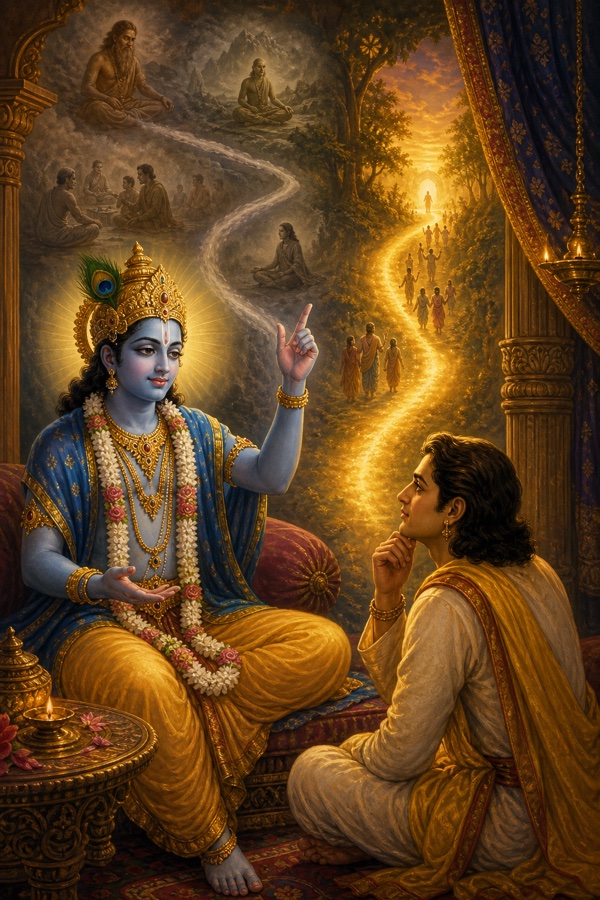
“This word of mine, Uddhava, the knowledge that fixes the mind on me, was lost in the great dissolution. At the dawn of creation I gave it to Brahma, Brahma gave it to Manu, and from Manu it went down through the rishis to gods and Danavas and every kind of being. Each of them was made of sattva, rajas and tamas in a different measure, so each read it differently, and handed down from father to son it bent further. Under my Maya men name the highest good by their own karma and their own taste: dharma, say some; fame, say others; pleasure, self-control, wealth and power, renunciation, sacrifice, austerity, charity, vows. Every one of these fruits has a beginning and an end, sorrow travels with it, and it finishes in ignorance. The man who has set his mind on me and wants nothing from anywhere else knows a happiness those who chase the senses cannot reach. He does not want Brahma’s seat, or Indra’s, or the lordship of the earth, or the siddhis of yoga. He does not want even liberation if it is apart from me. Neither Brahma, who is my son, nor Shiva, who is my own self, nor Balarama, my elder brother, nor Shri, who is half of me, nor my own body, is as dear to me as a devotee like you. And I walk behind such a man, who expects nothing and bears no grudge and sees one thing everywhere, so that the dust of his feet may cleanse me.”
“Devotion burns a man’s sins the way a fire in full flame eats a woodpile. Neither yoga nor Samkhya, neither dharma nor the study of the Veda, neither tapas nor renunciation takes hold of me the way intense bhakti does. By bhakti alone am I captured, and bhakti fixed on me lifts even the man who cooks dogs out of the stain of his birth. How is bhakti known, if the hair does not rise and the heart does not melt and tears of joy do not run? A man whose voice breaks when he speaks of me, who weeps and then laughs, who sings out at the top of his voice and dances without shame, purifies the whole world.”
Uddhava asked how such a man should meditate, and in what form, and the Lord gave him the whole practice: the seat, the gaze held at the tip of the nose, the breath cleansed and joined to Om; the heart seen as an eight-petaled lotus with sun, moon and fire laid on its pericarp; and within the fire the Lord’s own form, four-armed, dark as a rain cloud, in gold cloth, conch and discus and mace and lotus, limb by limb, and then the smiling face alone, and from the face into the Self that fills all space, until nothing else is thought. This far the Lord had spoken. Now, Rajan, we go back to that first hour, before a word of the teaching had been said, to what Uddhava poured out at the Lord’s feet. It was a cry.
Uddhava was sitting with his head laid on the Lord’s feet. He raised it. His chin was shaking, and a knot had tied itself in his throat so that his voice came through it only by force.
“Yogeshwara,” he said, “you are all-powerful. The very hearing of your name makes a man clean. You could have turned aside the Brahmins’ curse with a breath. You did not. And by that I know you mean to end this house, leave this world, and go. I cannot bear to be away from your lotus feet for half a moment, you whom Brahma and Shiva themselves obey. Take me with you to your own realm.”
His voice closed on itself. Then, as though drawing the words up from somewhere very deep, he said, “Those who have once heard the story of your deeds, Krishna, that nectar for the ear, lose their craving for anything else. And we have had more than the hearing. There are sages who wear nothing over their bodies except the wind at their waist, who keep the vow of celibacy their whole lives and draw the seed upward and burn in tapas, who have no passion left and no enjoyment and no stain; they reach your state, the one called Brahman. I am no such sage, Keshava. I cannot make myself into one.”
Drops were falling from his eyes now, and still he did not stop.
“We were with you lying down and sitting up, Krishna. With you walking, with you standing. We bathed beside you, we played beside you, we ate at the one meal with you. How am I to count it? Every breath we drew, we drew beside you. You were our beloved and you were our own self. How are we to do without you? We who turn in the alleys of karma, how are we to cross a darkness so hard to cross on the strength of a tapas we have never done?”
He looked up at the Lord’s face, and in that look was the thirst of a man dying for water.
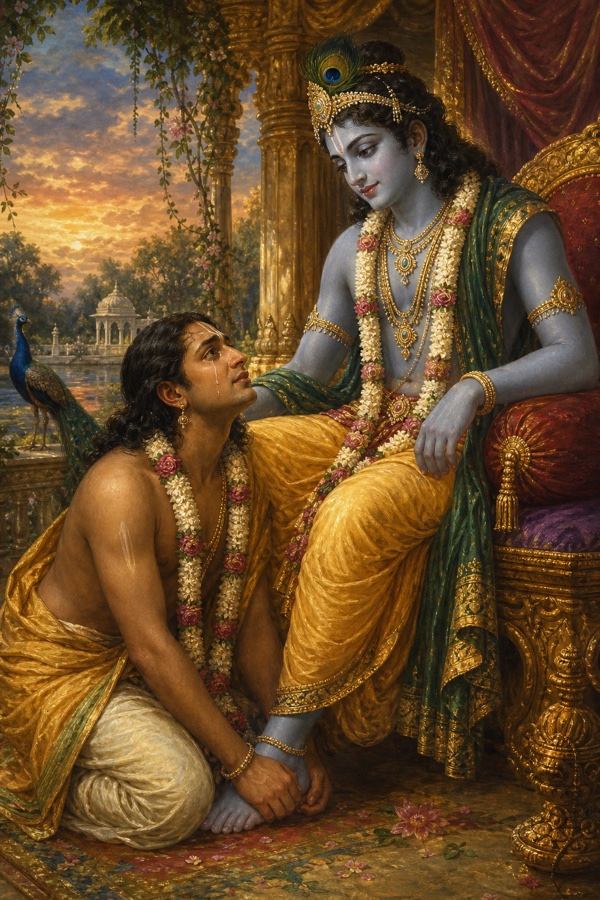
“We will cross it another way. We are your servants, and we have worn the garlands you took off, the sandal paste you set aside, the clothes and the ornaments you were done with, and we have eaten what was left on your plate. By that we will conquer your Maya. We will sit with your devotees and talk of you; we will tell over, again and again, everything you did and everything you said, that walk of yours, those smiles, those sidelong glances, the jokes, every human thing you did in imitation of men. Drowned in the memory of these we will cross what no one crosses.”
For a moment he stopped. Then very low, the way the innermost thing of all comes last, he said, “Your Maya holds no fear for us, Krishna. Our one fear is of being parted from you. Do not leave us. Take me with you too.”
To this the Lord had answered, and gone on answering, through the long teaching that opens the self, Maya, karma, yoga, knowledge and devotion one by one. At the end of it Uddhava said that this yoga was very hard for a man who had no hold on his mind; would the Lord tell him plainly how a man might come through easily? The Lord told him. Do every act for my sake, remembering me. Live among my devotees and follow their conduct. See me alone, within and without, in every creature and in yourself; look with an equal eye on a Brahmin and a low-born man, a thief and a devotee, the sun and a spark. Ignore your own people when they laugh at you, drop the shame of the body, and fall flat as a log before every being down to a dog, an outcaste, a cow and a donkey, until the knowledge that all of them are me has taken root. “This is the whole of Vedanta, Uddhava, which even the gods find hard to grasp. Give it to my devotees, and to shudras and to women if there is bhakti in them, and never to a hypocrite or a scoffer. Is Brahman clear to you now, my friend? Have the grief and the delusion gone out of your mind?” Uddhava stood with his palms joined and his eyes running over, and could not get a word past his throat. Then he steadied himself, laid his head on the Lord’s feet, and said, “The thick darkness I had hugged to myself is scattered by your teaching. Can cold and dark frighten a man who has come near a fire? The hard snare you spread for me, my love for the Dasharhas and Vrishnis and Andhakas and Satvatas, is cut through with the sword of knowledge. Tell me now how an unceasing love for your feet may stay in my heart.”
“Go, Uddhava, to my hermitage, the one called Badarikashrama. Bathe in the Ganga there and drink from her, be cleansed by the very sight of the Alakananda, wear bark, live on wild fruit, want nothing, and bear heat and cold alike. Hold your senses, keep your mind collected, turn over in yourself everything you have learned from me, and give your speech and your mind to me. You will pass beyond the three roads of fate and come to me.” Uddhava walked around the Lord, keeping him on his right. He laid his head on his feet and bathed them in tears, though he had gone past joy and sorrow by now. The thought of parting from Krishna, whose affection no one had ever turned his back on, was an agony in him, and he could not leave; and then he took up the pair of wooden sandals his master had given him, set them on his head, bowed again and again, and went.
With the Lord installed in the innermost place of his heart he came to Vishala, which is Badari, practiced tapas there by the rule, and attained the state of Hari as Krishna had taught him. He had asked to go where the Lord went. He was sent the long way, and he arrived.
Literary context
The Uddhava Gita is in the eleventh Skandha of the Shrimad Bhagavata, chapters six through twenty-nine. It is the final teaching of Bhagavan Shri Krishna, given to his devoted friend and servant Uddhava before he returned to his own abode. The Bhagavad Gita and the Uddhava Gita both came from the mouth of Shri Krishna, one to a warrior on a field of battle, the other to a beloved devotee in a time of peace, at the hour of parting, and for this reason the tradition sets the two side by side.
At the opening of this passage the Bhagavata gives the span of the avatar as a hundred and twenty-five years in the Yadu line (11.6.25), and has Krishna tell Uddhava that the sea will cover Dwarka on the seventh day (11.7.3). The Uddhava Gita lays out Samkhya, yoga, jnana and bhakti; Krishna says that none of them captivates him as intense devotion does (11.14.20), and when Uddhava asks for a way the unruly mind can manage, the answer he is given is bhakti in practice (11.29). For this the Uddhava Gita is often called the gist of the Bhagavata. The katha of the twenty-four gurus, told as a dialogue between King Yadu and an avadhuta the tradition knows as Dattatreya, and the Hamsa Gita, given in the form of a swan to the sages Sanaka and his brothers, both fall within this passage. Shridhara Swami’s Bhavartha-dipika is the basis of the traditional commentary on this section.
The same katha elsewhere
- Bhagavad Gita
The Bhagavad Gita: the teaching to Arjuna at Kurukshetra (Bhishma Parva) - Anugita · Ashvamedha Parva
The Anugita: Arjuna taught again after the war (Ashvamedha Parva)