On this page
The Damodara Lila
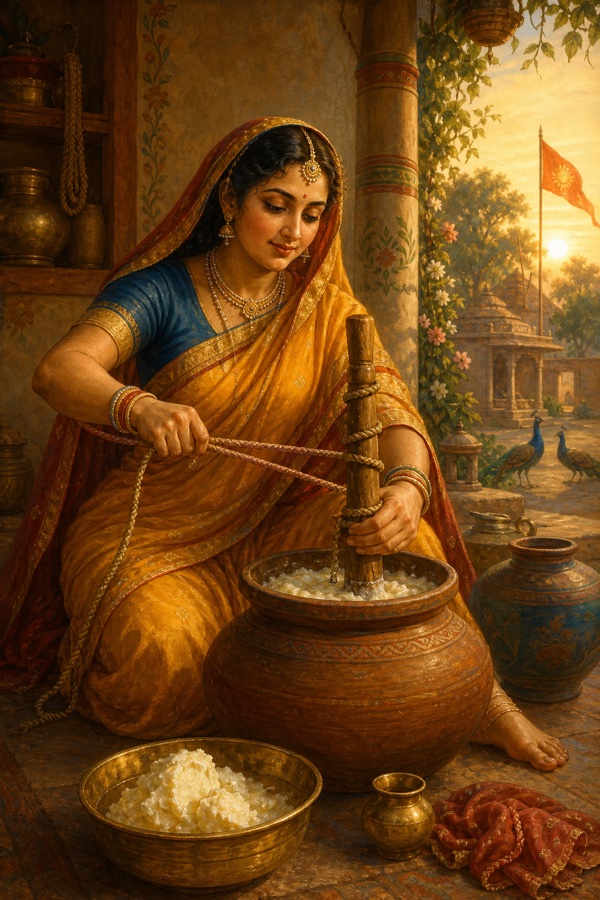
A morning in Vrindavan, deep in the cowherd country of Vraja. The yearly worship of Indra, the lord of rain on whom every herdsman’s pasture depends, was coming due, and its preparations had swallowed every maid-servant in the house of Nanda, the cowherd chieftain, where Krishna was growing up. So the churning came home to the mistress herself. Yashoda set her little son’s milk to boil on the hearth, sat down before the tall pot of curds, and took the churning rope into her own hands, to make his butter herself.
She drew the rope and the churning rod spun, and as it spun she sang. The songs were the ones all of Vraja already sang about her boy, the impossible things he had done in his few small years, and she gave them back under her breath while she worked, a mother singing her own son’s legend without once suspecting it was one. A silk cloth sat knotted at her waist. Milk rose at her breast at the bare thought of him. Sweat filmed her face, her earrings swung with the rhythm of the pulling, her bangles slid along tiring forearms, and one jasmine blossom after another worked loose from her braid and dropped. In the pot, the curd rose and fell, rose and fell, until the first pale gleam of butter gathered on its surface.
Kanhaiya arrived in the middle of it, wanting milk. He caught the churning rod in both small hands and stopped it. Yashoda let the rope fall, gathered him onto her lap, and fed him at her breast, watching the smile that surfaced on his face as he drank, and her whole morning went soft around him.
Then the milk on the hearth surged to the rim and began to spill. Yashoda set him down, still hungry, and ran to save it from the fire.
Being set aside half-fed was more than he was prepared to forgive. His red lower lip trembled and he bit down on it hard. Tears stood up in his eyes, summoned there on purpose. He picked up the flat stone kept for grinding spices, brought it down on the churning pot, and broke it open. Then he slipped away into an inner room of the house and ate the fresh butter stored there, in secret, entirely satisfied with himself.
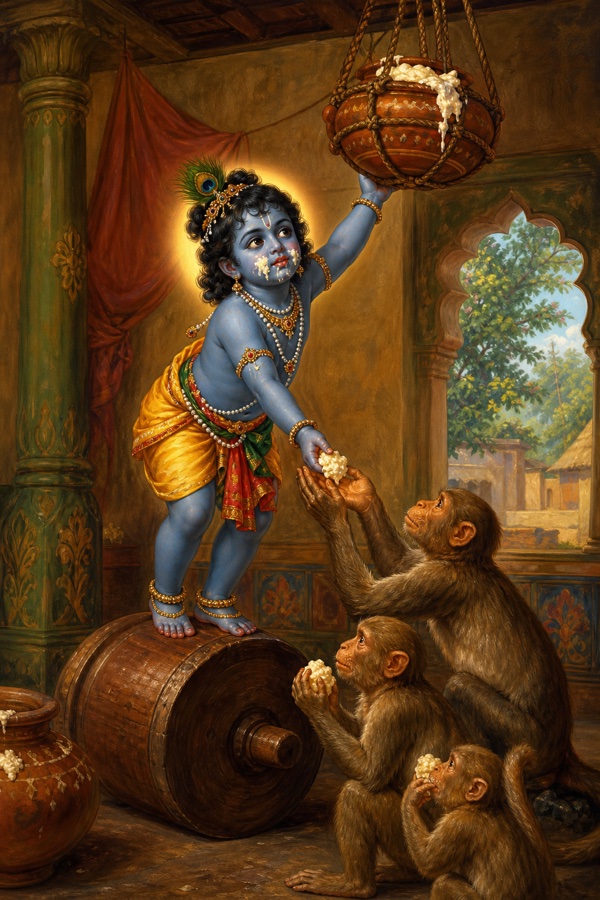
Yashoda took the boiled milk off the fire and came back to a floor of shards and spreading curd. She needed no witnesses; she knew the artist. And because the artist was nowhere in sight, she stood in her ruined kitchen and laughed. Then she stepped out into the yard and found him. He had climbed onto the upturned base of the big wooden mortar, pulled the butter down from the pot that hung high in its rope sling, out of every child’s reach but his, and was handing it out in fistfuls to a monkey.
Butter shone across his mouth and chin. His eyes held a thief’s fear, flicking to every corner of the yard even while his hand kept feeding the monkey. Yashoda came up behind him one soft step at a time.
The laughter went out of her. A mother took its place, and the mother picked up a stick.
“Kanhaiya!”
He spun, saw the stick, and was off the mortar in a single jump, running the way any guilty child runs, low and fast and glancing back over his shoulder. Yashoda ran after him. Understand whom she was chasing. Yogis spend whole lifetimes in tapas to make the mind fine enough, still enough, pure enough to slip inward toward him, and even that mind cannot reach where he is. That morning he ran barefoot through a cowherd’s courtyard with one panting mother behind him, and she would not stop.
He was small, quick, and sure of every turn in the yard. She was a grown woman already tired from the churning, and her own body slowed her, the weight of her hips dragging at every stride. The knot of her braid gave way as she ran. The last jasmine blossoms dropped from it one by one, so that she left a thin white line of fallen flowers behind her, the whole chase written on the ground in petals. And still she closed on him, step by step, until her hand caught his arm.
She held him fast. He was crying loudly now, grinding his small fists into his eyes until the black kajal lining them ran down his cheeks in smears, and he looked up at her with eyes unsteady with fear. She raised the stick, meaning only to frighten him. Then she saw that the fright had already finished its work, and her anger emptied out of her hand. She threw the stick away. She was a mother, though, and the lesson still stood waiting.
“Ma, I will never do it again,” Kanhaiya wept. “Throw the stick away. With your own hand, throw it away.” But Yashoda was already thinking ahead of him. This one needs tying, she told herself, just once, just long enough to learn, or he will bolt the moment my back turns. “Today,” she said, “you go to the mortar. You will sit there tied until you understand what stolen butter costs.”
Krishna looked up at her through his tears and said nothing at all.
The mortar stood close by, a massive waist-high block of hollowed wood, the kind the household used for pounding grain. It would serve. She had no idea, none at all, of what she was about to attempt. The one the shastras call unmanifest, the one who stands past the reach of every sense, had wrapped himself in the disguise of a small boy with butter on his chin, and to Yashoda that disguise was simply her son. So she went for a rope, exactly the way mothers of restless children have always gone for ropes.
She looped the rope around his little belly, led him to the mortar, and bent down to tie the knot.
The rope came up two fingers short.
She fetched a second rope and knotted it to the first.
Still two fingers short.
She added a third length, and then a fourth. However many ropes she joined, knot after knot after knot, the whole line always stopped two fingers from closing. Never one finger, never three. Two fingers, every time.
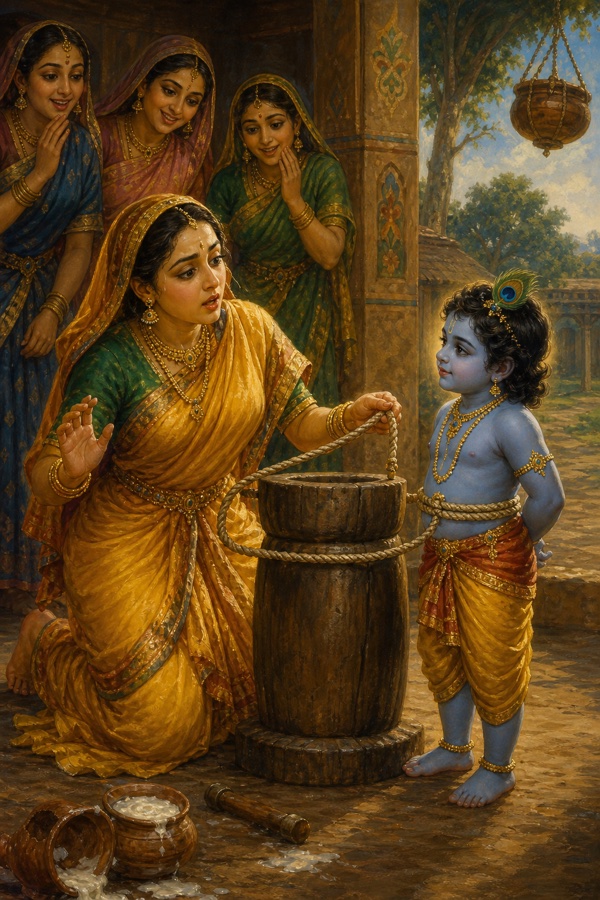
Yashoda went still, her hands frozen on the knot. A line of sweat crept down her brow. Before her stood her son’s belly, small and round, a belly she had oiled and kissed since the day he was born, and no rope she owned would go around it.
She gathered every rope and cord the house possessed and knotted them into one line. The same two fingers waited at the end of it.
Stay with this picture a moment. A mother kneels in her own courtyard, binding one small boy. The boy has stopped crying. He stands quietly in the coil of all that rope and watches her. And the joined ropes of an entire household keep stopping two fingers short of their mark.
The gopis, the cowherd women of the surrounding houses, had gathered by now, and their smiles grew with every failed knot. Yashoda looked up at them, soaked and beaten at her own simplest chore, and began to smile too, and inside her smile stood plain astonishment.
Why would no rope in the world reach around that little waist? Because the child standing in the coil has no inside and no outside. He has no front and no back. He exists before the universe and after it, within it and all around it; he is the universe itself, barefoot in a cowherd’s courtyard. A rope circles a thing by traveling its edge. Yashoda was asking a rope to circle the one who has no edge at all.
And yet one thing in all creation can bind even him.
Yashoda had reached the end of herself. Sweat soaked her whole body. The flower garlands braided into her hair had shaken loose and lay in the dust behind her. Her arms would not lift for another knot. She had nothing left.
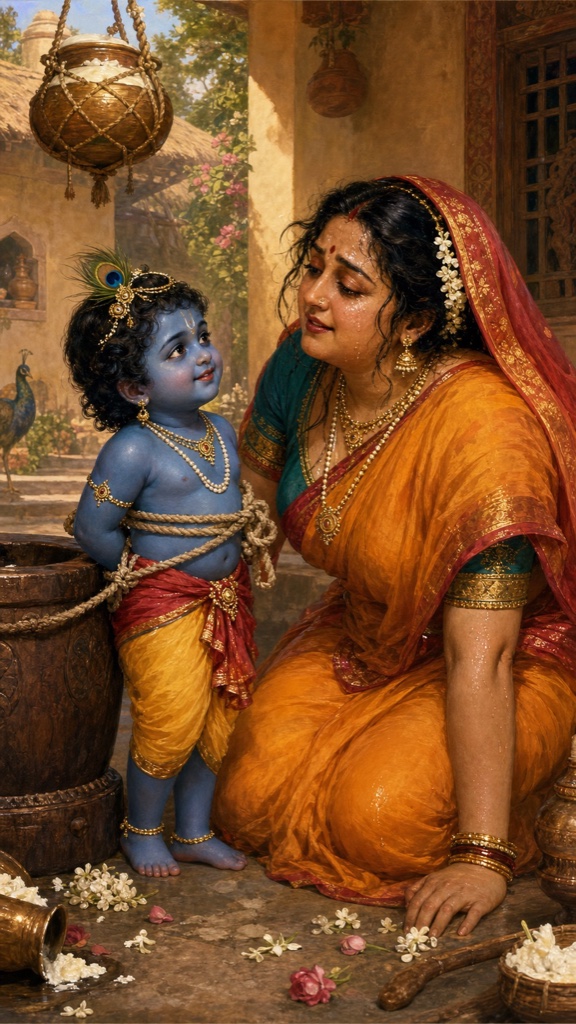
That was the moment Krishna chose. He looked at his mother, at the drenched forehead and the ruined braid and the exhausted eyes that even now refused to leave him, and compassion moved through him. He allowed the binding. No power outside him could ever have managed it; he bound himself with himself, and did it for her.
And he smiled.
The rope reached all the way around.
Yashoda tied her son fast to the mortar.
From that morning Krishna carried a new name, and carries it still: Damodara. Dama, the rope. Udara, the belly. The Lord whose belly a mother’s rope once closed around.
The boy sat where she left him, bound and perfectly content. After a while he shifted his weight and began, unhurried, to drag the great mortar across the yard behind him, as if he had somewhere particular to be.
At the edge of the courtyard stood two enormous arjuna trees, old ones, grown side by side like twins. The mortar caught crosswise between their trunks. The child kept moving. And both trees came out of the ground by their roots, groaning first, then breaking, their crowns thrashing as they went over, and the crash rolled through Vraja while dust climbed into the morning air. Who those two trees had really been, and why they had stood at that spot year after year as if waiting for one small bound boy to pass between them, nobody in Vraja learned that day.
Kanhaiya gave no sign that anything had happened at all. He sat beside the fallen giants with the mortar at his back, teasing the loose end of the rope with one finger.
And his mother, who had just accomplished what Brahma at the summit of creation has never accomplished, who had bound the entire universe with a household rope and knew nothing of it, finished her work indoors and finally sat down, utterly spent.
Literary context
The Damodara lila appears in the tenth Skandha of the Bhagavata, in its ninth chapter. Damodara joins two plain words, dama, rope, and udara, belly, and the name has clung to Krishna ever since a mother knotted the first around the second. In Yashoda’s one act of household discipline, the tradition sees a mother’s tenderness and a child’s divinity pulled into the same knot.
The two trees the dragged mortar brought down were arjuna trees, and they had once been persons: Nalakubara and Manigriva, sons of Kubera, the lord of riches. The sage Narada had found them drunk on their own splendor and cursed them into that rooted, waiting stillness, with the promise that the Lord himself would one day set them free. How a tied child with a mortar kept that promise unfolds in the tenth chapter.