On this page
Yayati’s Old Age
Yayati was a great king, and the crown had reached him through catastrophe. His father Nahusha had been raised to heaven itself, set for a time over the gods in Indra’s own seat, and had fallen from that height in a single hour: for his insolence toward Indra’s queen, the curse of the brahmanas flung him down and poured him into the body of a python, and the ruler of the gods was left dragging his belly through the dust. Of Nahusha’s six sons the eldest, Yati, wanted no throne at all; he had understood what sovereignty does to a man who still hopes to meet his own self. So the earth came to Yayati, and he proved equal to it. He set his four younger brothers over the four quarters, ruled the whole of it as suzerain, kept the treasury full, and carried in his arms the strength that let no enemy stand. But one thing in him nobody could see. Whatever he won pleased him a little while, then went flat, and from under the flatness a new hunger lifted its head. He sat on a throne, and something inside him never sat down at all.
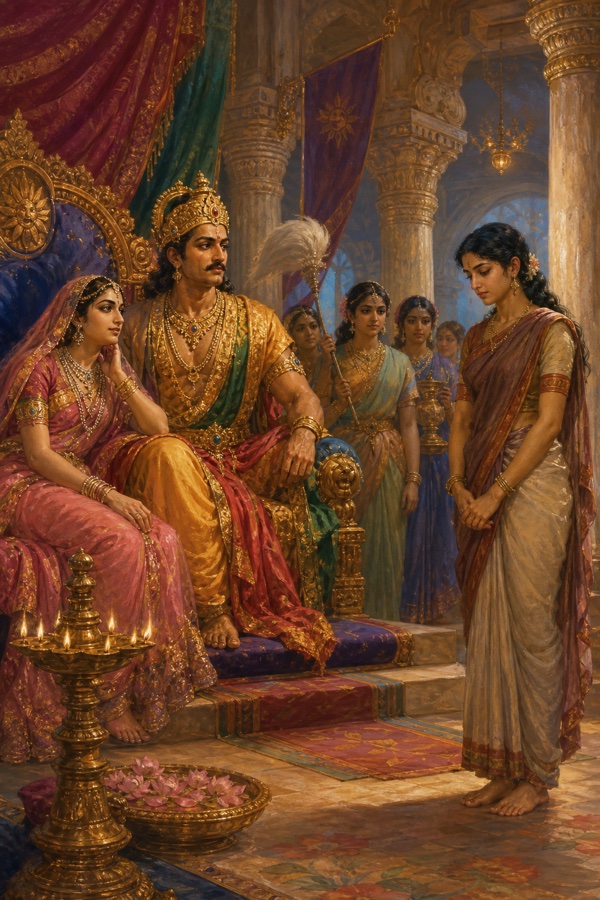
He had two queens, and each had come to him by way of the same well. The first was Devayani, daughter of Shukracharya, guru of the Danavas, the one teacher alive who held the science of calling the dead back to life. One afternoon she had gone out to the garden of the Danava capital with Sharmishtha, daughter of Vrishaparva the Danava king, and a thousand young companions, out among the flowering trees to a lotus pond loud with bees. The girls left their clothes on the sandy bank and played in the water, and when Shiva himself came riding past on his bull with Parvati beside him, they scrambled out abashed and dressed in haste. Sharmishtha, not looking, pulled on Devayani’s garment, and Devayani’s tongue came off its leash: a servant girl daring the clothes of Bhrigu’s line, a dog snatching the offering from a sacrifice. Sharmishtha hissed back like a struck serpent, called her a beggar-maid whose people waited at Danava doors the way crows wait for crumbs, then tore the clothes off her and flung her into a dry well. And it was there, later that day, that a king out hunting leaned thirsty over the well’s mouth looking for water and found a girl looking back up at him. Yayati dropped his own upper cloth down to cover her and drew her out by the hand. Devayani stood on the grass and spoke with love and with perfect clarity: you have taken my hand, and no other man will ever take it; destiny chose a well to arrange this sight of you; and a brahmana can never be my husband in any case, for Kacha, Brihaspati’s son, whom I once cursed, cursed me back with exactly that. Yayati heard fate declaring itself, felt his own mind already leaning toward her, and agreed.
The second queen was the very princess who had thrown her down that well. Devayani carried the story home, and Shukracharya, hearing it, cursed the priest’s trade that keeps a learned man standing at a rich man’s door, praised the pigeon that lives content on gleaned grain, and walked out of the capital with his daughter. Vrishaparva understood at once what that exit meant: if the preceptor crossed over, victory in the long war would tilt to the gods. He ran out and lay flat on the open road at his guru’s feet. Shukracharya, whose anger was famous for lasting half a moment, gave his terms gently: satisfy Devayani, for I cannot ignore her. And Devayani named her price without blinking. Wherever my father gives me, she said, Sharmishtha follows me as my servant, with all her companions. So the princess who had walked those gardens with a thousand attendants of her own came to wait upon Devayani with the same thousand serving beside her, and when Shukracharya gave his daughter to Yayati, Sharmishtha went with her in her train. At the giving, the sage told the king one thing plainly: Sharmishtha must never share your bed. For years she did not. Then Devayani was blessed with a son, and Sharmishtha, chaste and childless, came to Yayati alone in her fertile season and begged him for a child of her own. Yayati remembered the guru’s warning even as he weighed it against the shastra’s word that a woman’s plea for a child accords with dharma, read destiny in the meeting, and inclined toward her. Devayani bore him Yadu and Turvasu. Sharmishtha bore him Druhyu, Anu, and Puru.
Five sons could not stay a secret. When Devayani understood that Sharmishtha too had borne children to her husband, rage carried her past all reason, and she set out weeping for her father’s house. Yayati followed his darling the whole way, coaxing, pleading, pressing her feet with his own hands, and reached nothing in her. Shukracharya came out, looked at his daughter refusing to be comforted, and turned to the king.
This time the famous half moment passed and the anger stayed. “Yayati, you deceived my daughter and broke the one word I asked you to keep. You slave of women. You dull-witted liar. The youth that made all of it possible, on that youth the punishment will fall.”
“What punishment, Munivar?”
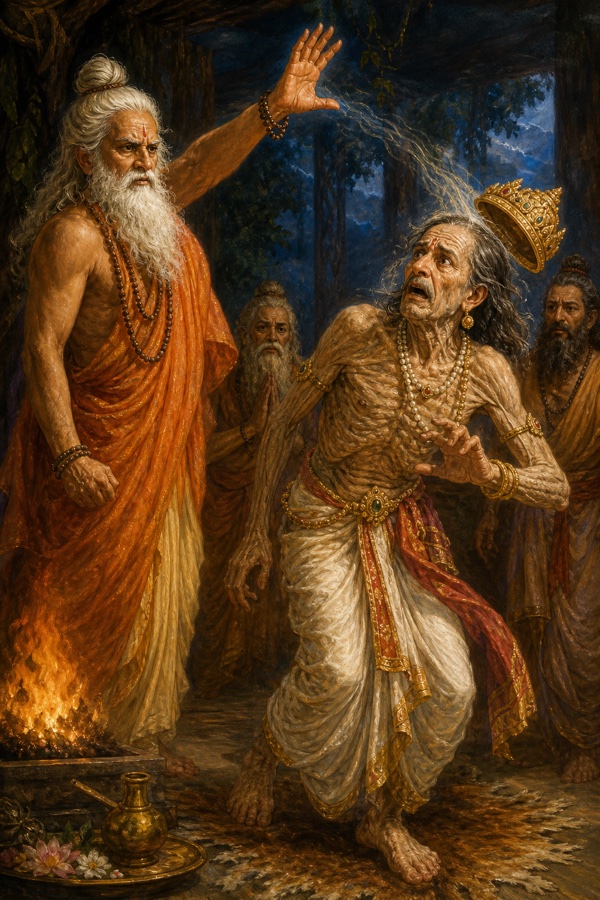
“Go. Let the old age that disfigures a man come into your body now.”
The words had barely finished sounding when Yayati felt the pull, as if a hand behind his breastbone had found a cord and begun drawing it slowly out. His knees answered first. The strength that had stood in them a moment earlier drained down and away, and his thighs began to shake like a traveler’s at the end of a very long road. Then the hands. He lifted his palms in front of his face and watched the skin go thin and slack over the bones, the veins rise, the fingers take up a trembling he could not command to stop. A taste spread through his mouth, sour and metallic, as if fear kept a flavor of its own. His ears filled with a thin whistling, and the muni’s next words sank somewhere inside it.
He ran his tongue over his lips to wet them and found the tongue dry too. His breath caught high in his chest and refused to travel down to his belly. A king whose hand had rested on the whole earth one moment before could not now lay a hand on his own breathing. And beneath all of it a single thought went around and around, foolishly simple: so much is still left. I had only begun.
“Shukracharya,” and the voice that came out was a stranger’s, cracked and shaking, “forgive me. So many of my desires stand unfinished. I cannot get up in the middle like this.”
The muni looked at the trembling king, and his daughter’s tears must have stood before him too. For a breath, the heat of it eased.
“There is one way. Old age can be traded. Take the youth of any one of your sons and give him this decrepitude in exchange, but only if he accepts it of his own free will.”
Yayati went back to his capital on legs he no longer trusted. And there, for the first time, he looked at his sons the way he had never once looked at them: at the straight backs, the full faces, the youth that had just been pulled out of his own body.
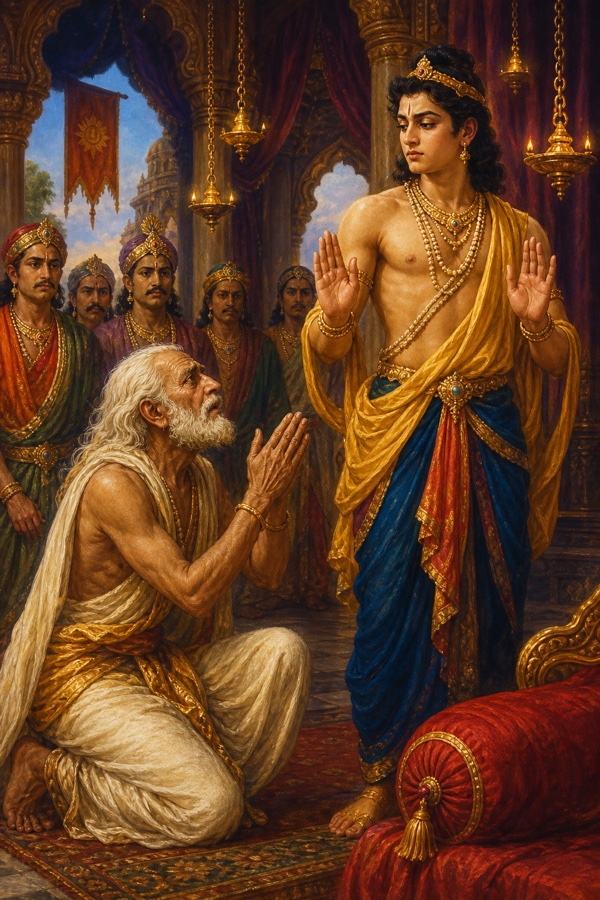
He called the eldest first. Yadu, Devayani’s elder boy. “Son, I am not yet satisfied with the pleasures of sense. Take this old age of mine, your own grandfather’s gift to me, and lend me your youth for some years. I will finish with it, and return it.”
Yadu looked at his father’s white hair, then at his own young hands, and shook his head. “Father, I have no courage for an old age that arrives in the middle of a life. And a man who has never yet tasted pleasure cannot grow tired of it; how would vairagya ever find me? I cannot do this.”
Yayati said nothing. He turned and called Turvasu, Devayani’s younger son. “No, Father.” Then Druhyu, Sharmishtha’s eldest. “No.” Then Anu. Anu joined his palms. “Forgive me.”
Four askings, four refusals. Each of them gripped the borrowed thing, a body lent out for a handful of decades, as though it were a permanent possession, and none of them could see what their father was actually holding out to them. With every refusal Yayati’s head sank a little lower, and part of the weight was recognition. He knew these refusals from the inside. Keeping his own pleasure back from every other hand was the one skill he had practiced for a lifetime.
One son remained, Sharmishtha’s youngest, last of the five in age and first of them in virtue: Puru. Yayati sent for him.
“Son, your four brothers have refused me. Do not turn me away as your elder brothers did.”
Puru looked at the face settled into its wrinkles, and at the restlessness in his father’s eyes, which even a king could no longer hide. For a moment he said nothing. Then he spoke, very quietly, the way a man states a thing too plain to need thinking over.
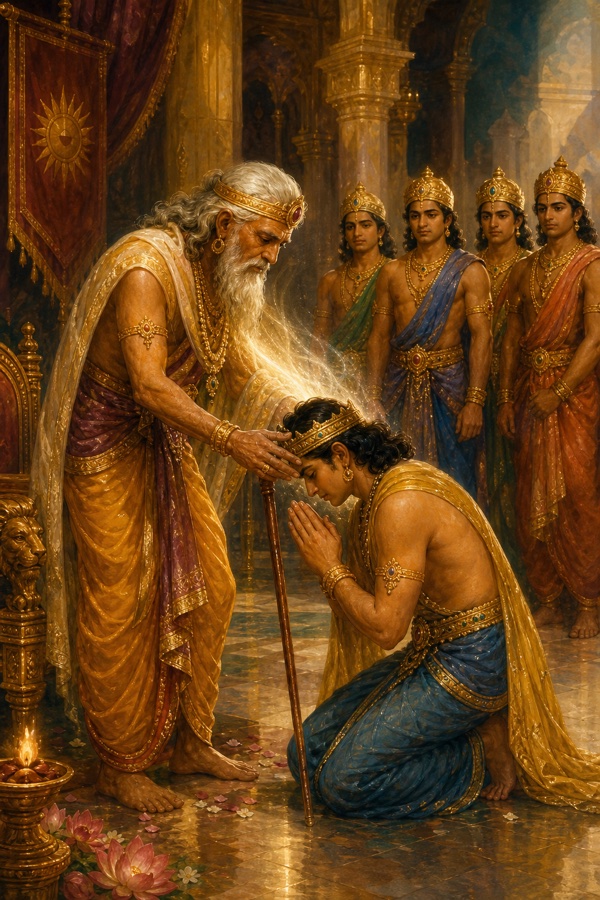
“Father, what man in this world can ever repay the one who gave him his body, the body by whose grace he can reach the highest thing a life can reach? The best son sees what his father wants and does it before the words are spoken. The middling son does what he is told. The lowest one obeys with resentment on his face. And the one who refuses is only the refuse of his father’s body. This body was your gift before it was ever mine. Take it. My old age begins today.”
And it was done, gladly, on the spot. Puru’s straight back curved, his full face fell inward into wrinkles, his hands took up the trembling, and everything they surrendered ran the other way into Yayati: warmth, strength, the old heat. Puru let out no sound at all.
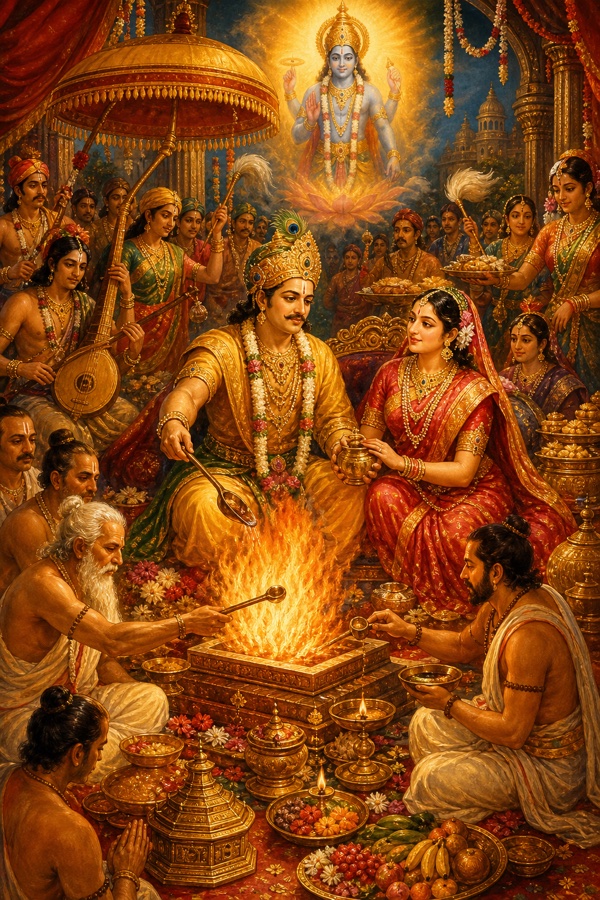
Then for a full thousand years Yayati yoked his mind to his senses and followed them wherever they pointed, and his senses kept their whole power the entire way. He ruled all seven island-continents of the earth and guarded his subjects the way a father guards a household, and he took his pleasures as the scriptures allow a king to take them, all of them, as occasion offered. He worshiped Shri Hari with yajna after yajna and gave away wealth in vast gift-portions, honoring the person of the sacrifice whom all the Vedas describe, in whom all the gods stand gathered. Devayani, day after day, delighted her beloved with mind, speech, body, and every lovely article a palace holds, and he delighted her. He even saw, with the seeing part of him, that this world hangs upon God the way cloud-masses hang on the sky, arriving and dissolving, a dream laid over what is real; he set Vasudeva, the indweller subtler than the subtlest thing, whose seat is in the waters, inside his own heart, and worshiped him there. Whatever rose in his mind, he enjoyed. A thousand years went by like water.
One evening he sat alone in his palace. Outside, the lamps were about to be lit, and from some far courtyard a woman’s song came drifting in, the same raga he had heard past counting, with no drop of new rasa left anywhere in it. For one instant everything held still, the song, even the wind.
And then the thing rose in him that he had been holding off for a thousand years. He looked inward, down into the place where the thirst had always started, to see whether quiet had finally settled there. The thirst stood exactly where it had always stood. It had grown. Every pleasure of a thousand years had been water poured onto its roots.
The words came out of him low, meant for his own ears alone. “A full thousand years I have served my desires, and every time I touch them the craving renews itself; moment upon moment it grows.” He fell silent, then said, lower still, “Feed a fire ghee. It does not lie down. It climbs.”
The saying of it made something in him go light. For a thousand years he had been a fledgling beating one cramped wing inside a nest; the wing had finished growing at last, and the nest was already falling away below him.
He sent for Puru.
Puru came in old, carrying the full weight of a lifetime that had never once belonged to him.
Yayati looked at the bent back and the trembling hands, the same hands that had been young and steady a thousand years before, and his own head went down of itself.
“Son, my satisfaction has not come, even today. But your youth has let me finish the experiment, and I can tell you where it ends: nowhere, at no age. All the rice and barley on this earth, all its gold, its animals, and its women cannot fill the mind of a man whom desire keeps beating. The body wears out and the thirst stays young inside it; a mind grown wrong around it can hardly set it down even at the end. The senses drag away even the learned. A man who trusts his own steadiness should decline to sit close beside even his mother, his sister, or his daughter.”
“Take this youth of yours back now. And give me back my old age.”
Puru pressed his trembling palms together. “No, Father. Let it stay with you.”
“No, son. What I stayed back to learn, I have learned. If I keep it any longer, I will only make the same mistake again.”
And the exchange ran once more, in reverse. Strength and warmth flowed out of Yayati and home into Puru; the young back straightened, the hands went quiet, and Yayati stood once again inside the old age that Shukracharya’s curse had made for him. This time nothing in him flinched from it. The craving had gone out of him for good.
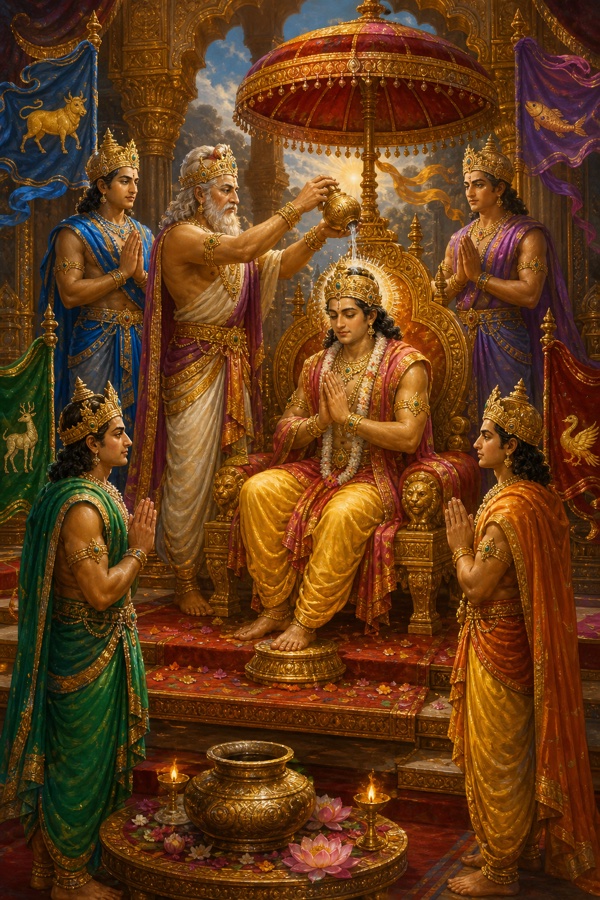
Then he divided the earth. To Druhyu the southeast, to Yadu the south, to Turvasu the west, to Anu the north. And judging Puru, youngest of them all, the worthiest vessel in the whole circle of the world, he consecrated him on his own throne as suzerain of the entire globe and master of its wealth, and set the four elder brothers under his hand. From that Puru descended the line the world would come to call the great Puruvamsha.
Then Yayati turned to the forest. Pleasures he had fed for years past counting he set down in a single moment. He roamed with the deer, free of the paired opposites that pull at every householder, joy and sorrow, gain and loss, with no I left standing in him and no mine. In that forest the self stood plain before him at last, and with that seeing, the subtle body woven of the three gunas dissolved away. He merged into Vasudeva, the supreme Brahman untouched by any stain of maya, and came to the state that opens only to those who love Bhagavan.
Literary context
This katha appears in the ninth Skandha of the Shrimad Bhagavata, in the eighteenth and nineteenth chapters. The Adi Parva of the Mahabharata tells the same episode at full length; the Bhagavata gives it briefly and bends the whole of it toward vairagya. One line carries its heart: ‘na jatu kamah kamanam upabhogena shamyati’ (9.19.14), craving is never stilled by feeding it the very things it craves.
Devayani heard the tale
Devayani heard that tale of the goat and smiled, certain her husband was teasing her, dressing up the sweet torment lovers suffer in separation as a barnyard fable. It did not reach her yet that the man whose thousand years had passed at her side was asking her leave for the last time. Time finished what the tale began: when the parable at last broke open inside her, she saw every gathering of dear ones for what it is, travelers met for an hour at a wayside water stand, assembled by the Lord’s will and scattered by it again, and she let the whole of it go the way a waker lets go of a dream, fixed her mind on Shri Krishna, and followed her husband into the same freedom. But that came afterward. On that evening she only smiled. If it had been you listening, which would you have heard, the laughter or the farewell?