On this page
The Slaying of Kamsa
Akrura’s chariot rolled to a stop on the outskirts of Mathura as the day was going down. All along the road, village people had crowded to the wayside for a look at the two sons of Vasudeva, and had found they could not pull their eyes away. Nanda and his cowherds, who had taken a shorter road, were already waiting in a garden at the edge of the city. There Akrura bowed low and begged for one grace: let the Lord enter his house first. Let the dust of those feet touch a householder’s floor, he pleaded, for the water that washed those feet had made the demon king Bali great among the great, had run through the three worlds as the Ganga and made them clean, had been borne by Shiva himself on his matted head, had carried the sixty thousand sons of King Sagara up to heaven. Krishna took the bent man’s hand in his own and answered, laughing softly. Go into the city ahead of us with the chariot, he said; we will rest here awhile and follow. And then, because Akrura could not bear to enter without them, he gave him the truth without wrapping: I will come to your house when Kamsa is dead. Akrura drove through the gates with the joy gone out of him, delivered word of his errand to the king, and went home.
The next afternoon Krishna and Balarama walked in through the main gate, cowherds around them, two boys from a cattle camp entering the capital that had spent years preparing to kill them, and they entered it without one backward glance. Mathura opened before their eyes: gate-towers of crystal above doors of gold, golden arches over the doorways, granaries of copper and brass, a moat circling the walls, gardens and pleasure groves, meeting halls and gilded rest-houses, pavements and window-lattices inlaid with coral, sapphire, diamond, and pearl. The roads had been sprinkled with water and strewn with flowers, barley sprouts, and parched grain. At the entrance of every house stood pitchers of water dressed with curds and sandal paste, ringed with flowers, crowned with rows of lamps, plantain trunks and areca palms set on either side with the fruit still hanging, and festival banners lifting overhead.
A rumor ran through the lanes ahead of them. People spilled onto rooftops and into the streets to see for themselves. “It is the two from Gokul. The ones Kamsa has feared since the night they were born.”
The women of Mathura had heard the name Krishna for years; now the hurry to see him undid them. One climbed to her terrace with a jewel on one ear and none on the other, another with kohl darkening a single eye. Meals were left half-eaten, oil baths half-finished. Women asleep sprang up at the noise in the street, and a mother put down the baby at her breast and ran. At every step of the road, joyful Brahmins came forward to bless the two brothers with curds and unbroken rice, garlands, perfumes, and vessels of water. And from the rooftops the women said to one another, “What austerities did the cowherd women of Vraja perform, that they may look on these two every day of their lives?”
Down the road came a washerman with a load of freshly washed, freshly dyed clothes, the man who dyed for Kamsa’s own household. Krishna hailed him easily. “Brother, give us two sets from your bundle, whichever will fit us well. The gift will bring you the highest good; of that there is no doubt.”
The washerman looked the two of them up and down and curled his lip. “Royal cloth, for cowherds? Do you dress in clothes like these up on your mountain, out in your forests, that you reach past every limit and ask for the king’s own goods? Get moving, you fools, if you want to keep breathing. When beggars touch the king’s property, the king’s men bind them, strip them, and kill them where they stand.”
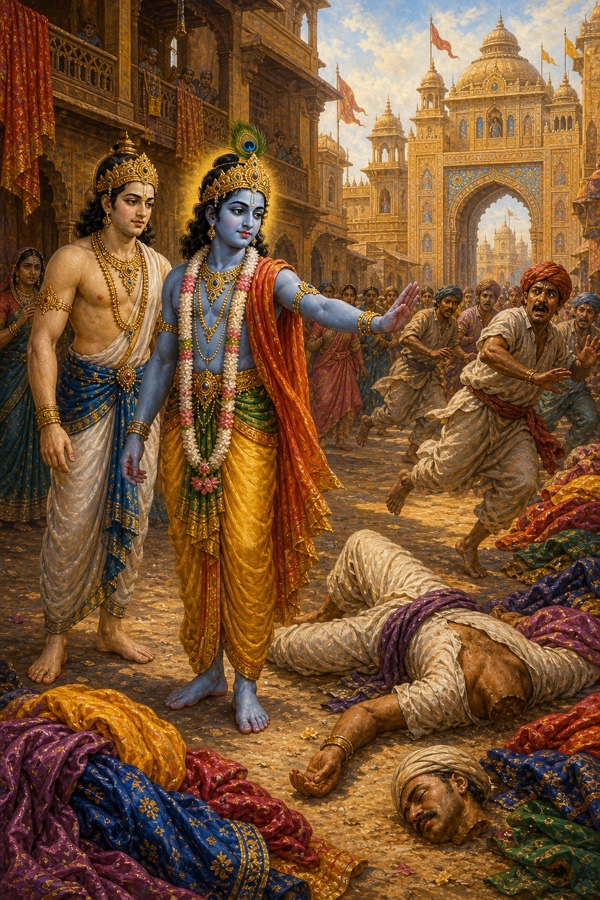
Krishna’s hand moved once. With the tips of his fingers, with no weapon at all, he took the washerman’s head off his body. The dyed clothes spilled into the dust, the bundles dropped, and the dead man’s servants ran in every direction without looking back.
The brothers dressed themselves from the scattered cloth, each choosing the colors he loved, handed most of the rest to their cowherd boys, and tossed what remained on the ground. Mathura stood watching, and something it had never dared to think became visible in a single street: the pride that had strutted over this city for a generation could be laid in the dirt between one breath and the next.
A little farther on, a weaver stepped from his shop, and the sight of Krishna filled him with plain love. He wound and pinned cloth of every color on the two brothers, fitting each fold so exactly that they shone like two young elephants decked for a festival, one dark, one white. Krishna gave the man a wage no king could have matched: wealth and strength in this world, standing among men, senses honed fine, remembrance that would keep the Lord always before his mind, and, at the end of it all, sarupya, a form like Krishna’s own.
Then they came to the house of Sudama, the garland-weaver. Seeing who stood at his door, Sudama rose at once and laid his forehead to the ground. He brought seats, washed their feet, and honored the brothers and their companions with garlands, betel, and sandal paste. “Today our birth bears fruit,” he said. “Our whole line stands hallowed. The ancestors are satisfied with me now, and the gods, and the rishis. You two are the final cause of this whole universe, come down of your own will to guard the world and help it grow. You are friends who want nothing in return, the very self of every creature, and though you give yourselves to those who worship you, your gaze falls level on all beings. So command me. What service can I do? For a man to be put to work by you is itself the great boon.” Then, reading their wish before it was spoken, he strung garlands of his finest flowers, heavy with fragrance, and hung them on the brothers and on every companion with them. Pleased to the heart, Krishna told him to ask for whatever he wanted. And Sudama the garland-weaver asked, himself, for the only wealth he had ever counted: devotion to Krishna that nothing could shake, friendship with those who love him, and compassion toward every living being. Krishna granted it all, and added what had gone unasked: a fortune that would keep growing in the hands of his children, strength, long life, fame, and splendor. Then the brothers walked on.
A little ahead, a young woman came toward them along the lane, a bowl of sandal paste and fine unguents in her hands. Her face was lovely. Her body bent at three places, at the neck, at the chest, at the waist, and so the city had its name for her: Kubja, the crooked one. She saw the dark youth in the road and her breath stopped in her throat.
Krishna spoke first, and he was laughing. “Who are you, sundari? And whom is this sandal paste for? Tell us the truth of it.”
“Give a little of it to the two of us. Good will find you very soon after, for this.”
“I am a servant of the king,” she said. “Trivakra, they call me. Kamsa prizes my sandal paste above any other in Mathura; this bowl was ground for him. And yet who deserves it, if you two do not?” She lifted the thickest and most fragrant of her pastes and spread it on the limbs of both brothers, holding nothing back, bargaining for nothing, and the bright pigment glowed where it met skin dark and fair.
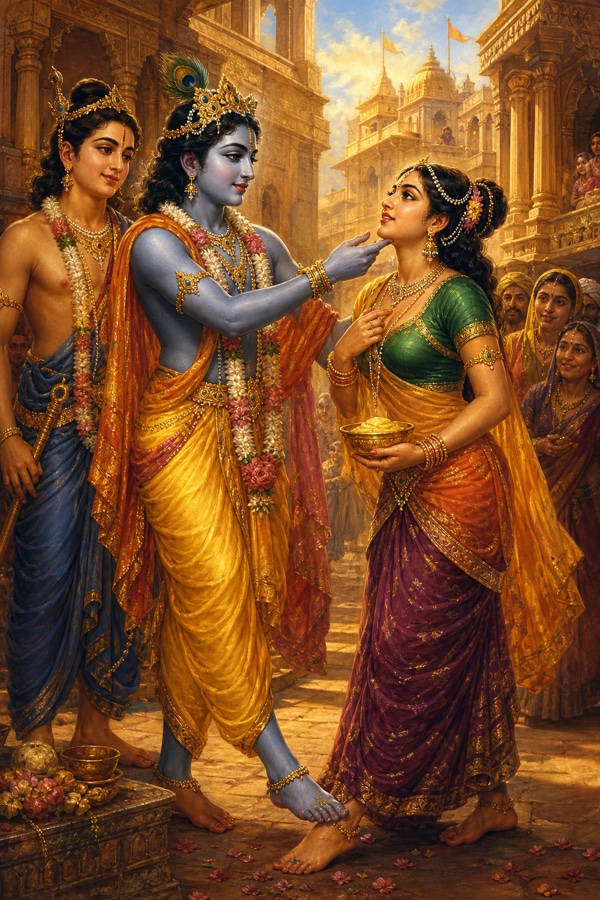
Krishna set his feet gently on the fronts of her feet, pinning them. He raised the index and middle fingers of his open right hand, laid them under her chin, and lifted. A spine bent for as long as she could remember came straight at that one touch. When he stepped back, a tall young woman stood in the lane holding a bowl of sandal paste, straight-bodied, graceful, beautiful, with all her crooked years dropped behind her.
Shyness and love went over her face like heat. She caught the end of his upper cloth and held it. “Come to my house, Prabhu. Once. I cannot make myself let you go.”
Krishna glanced at Balarama, at the cowherds looking on, and laughed. “When my errand in this city is finished, I will come to your house, and it will rest me; wayfarers like us, who carry no roof, have no refuge like yours. One task remains first.” He loosed her hold with kind words, and the brothers moved on up the road, where merchants came out of their shops to honor them with betel, garlands, and sandal paste, and women stood where the sight of him had stopped them, garments slipping, bangles slack on stilled wrists, like painted figures on a wall.
They asked the townsfolk a single question: where is the bow kept? Ahead rose the hall of the dhanur-yajna, the great bow-rite Kamsa had proclaimed with such show of piety, its walls high, its gates thick with soldiers, the whole festival a baited trap wearing the dress of worship.
In the center of the hall, on a raised place, lay a bow with the size and sweep of a rainbow, jewels of every color set along its length, a fortune in gold heaped in attendance on it, priests to venerate it, and a standing company of guards. The word in Mathura was that no man had ever moved it from where it lay; lifting it was past discussing. The guards stepped in front of the boy who walked toward it. He went through them and took it.
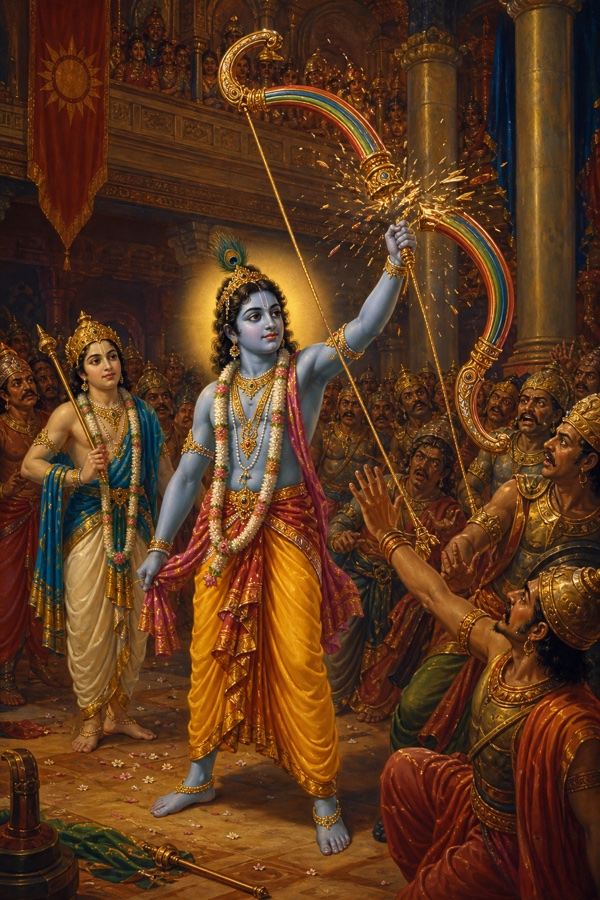
He raised the great bow in his left hand as though it were a toy. He strung it. He drew the string to its full stretch, and in the time an eye takes to blink he broke the bow in half at the middle, the way an elephant in rut snaps a stalk of sugarcane.
The crack of its breaking filled the sky and the earth and every direction between them. In the palace, Kamsa heard it, and the sound entered his chest like a driven nail. The custodians of the bow came on with weapons out, shouting to seize him, bind him, hold him fast, and the two brothers took up the broken halves of the bow itself and beat down first the guards and then the whole detachment Kamsa sent in after them. Then they walked out through the arena gate, wandered the city at their ease while the sun went down on its wealth, and returned to the carts outside the walls. There they washed their feet, ate rice cooked in sweetened milk, and, knowing exactly what Kamsa meant to do with the morning, slept in peace.
Kamsa spent the same night awake. Sleep needs a quiet mind, and his had begun to show him signs. His reflection stood in the mirror without a head. Stars and lamp flames doubled before his eyes, though nothing stood between them and him. His shadow was pierced through with holes. When he stopped his ears with his fingers, the low hum of his own body was gone. Trees turned gold as he looked at them, and where he walked he left no footprints. When exhaustion finally pulled him under, his dead came to him and embraced him; he rode a donkey; he swallowed poison; he wandered naked and alone, smeared with oil, a wreath of red flowers at his throat. Waking and dreaming, portent after portent, and every one of them read the same. Death had marked the house. Kamsa watched the sun rise without having closed his eyes.
Morning came up out of the eastern waters, and the great festival of wrestling began. Kamsa’s men had swept the arena, sprinkled it, and dressed the galleries with garlands, flags, tapestries, and arches, and the stands filled early: people of the city and people of the countryside, Brahmins and Kshatriyas, chiefs and princes on seats set for them. Trumpets sounded, and under the trumpets ran a heavier beat, the champions slapping their own arms as they entered: Chanura first, then Mushtika, Kuta, Shala, and Toshala, dressed to be admired, proud, their limbs hard as the vajra, the thunderbolt in Indra’s hand. Nanda and his cowherds, invited by the king himself, offered their gifts and took a dais of their own. And Kamsa climbed to the royal platform among his ministers and sat down over the whole bright spectacle with an ache pressing on his heart.
One arrangement had been made away from the music. At the gate of the arena Kamsa had stationed Kuvalayapida, a war elephant driven half mad with rut, and the order to its driver was short: before those two set foot inside, crush them at the threshold.
Krishna and Balarama came to the gate and found it filled with elephant. Krishna tightened the cloth at his waist and bound back his curling hair, and when he spoke, his voice rolled out like a monsoon cloud. “Driver. Clear the way. Move him, now, or you and your elephant go together this morning to the house of Death.” The driver’s answer was the goad. Stung into fury, the beast, which might have been Death itself standing in animal shape, charged, and its trunk whipped around Krishna and lifted him.
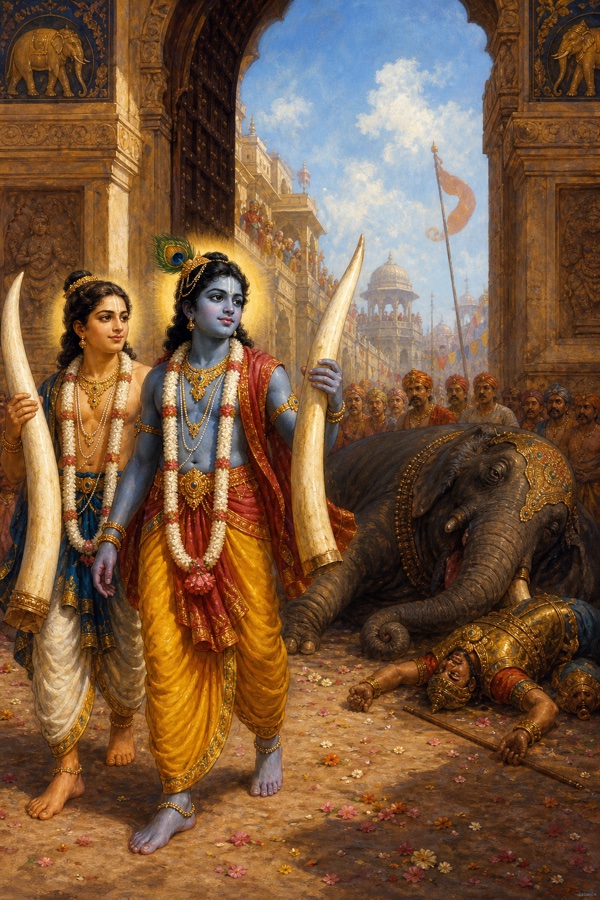
He slid out of the coil, struck the animal one blow it felt through all its bulk, and vanished among its legs. The elephant lost sight of him, hunted him out by smell, and closed the tip of its trunk around him again; he tore free again. Then he took it by the tail. He dragged the animal twenty-five bow-lengths across the ground, dragged it the way Garuda, the great eagle who carries Vishnu, drags a cobra through the sky, and when it wheeled left or right to reach him, he swung with it, circling it as easily as a boy swings a calf by the tail. Then he came around to face it. He struck it, ran ahead of it so close that its tusks brushed him at every stride, then went down in the dust as though he had stumbled, and the elephant, blind with rage, drove both tusks into the earth where he had been. They struck nothing. Its keepers screamed it back into the charge, and Krishna met it coming, caught its trunk in one hand, and threw the whole animal to the ground. He set his foot on it the way a lion stands on its kill, wrenched the tusks from its skull, and with those two arms of ivory finished the elephant and its keepers together.
One tusk went up on Krishna’s shoulder and one on Balarama’s, and they walked into the arena as they were, spattered with blood and ichor, sweat bright on their faces. The whole amphitheater turned, and every pair of eyes saw something different. The wrestlers saw a thunderbolt walking. The men of Mathura saw the jewel of men. The women saw love itself given a body. The cowherds saw their own kin. The corrupt princes saw a punisher arrived. His parents saw only a child. Kamsa saw his own death enter the gate. The dull-eyed saw an undersized village boy; the yogis in that crowd saw the supreme Reality standing in arena dust; and the elders of the Vrishnis, the old blood of Yadu’s line, saw their highest god.
In the ring the five champions stood waiting, Chanura, Mushtika, Kuta, Shala, and Toshala, men built like walking hills. Across the sand from them, two boys not yet come into their beards. The galleries filled with a hum of dread and half-remembered stories. That one, the murmurs ran, is the boy born of Devaki and carried to Gokul the night of his birth, the one who drank the poisoned breast of the child-killer Putana and lived, who broke the whirlwind demon and the horse-demon Keshi, who danced on the hoods of the serpent Kaliya in the Yamuna’s black pool, who held the hill Govardhana up on one hand for a full week of storm to shelter Vraja. And the tall fair one is Balarama, who tore the demon Pralamba apart. The stories climbed the stands, and hearts climbed into throats behind them.
The women of Mathura gathered in knots, and their pity turned to open anger. “This is gross adharma, and the king’s own courtiers are presiding over it. Look at the match they have sanctioned, mountains of vajra set against two soft-limbed boys, and the king sits watching. Whatever merit this assembly ever earned is forfeit today. Where adharma stands up in the open, no one may stay; the wise do not even enter such a gathering, for to sit in it silent, or to mouth false comfort, or to plead ignorance is to share its sin. And still, look at him. Look at Krishna’s face, fresh as a lotus bud under a spray of water; look at Balarama’s, thunder and laughter in it at once. Blessed is the soil of Vraja that those feet walk every day. Blessed are the women there who sing of him while they milk and churn and pound the grain, who rock their cradles to his name, whose whole day turns around the thought of him; blessed the ones who hear the flute on the morning road and drop everything in their hands to watch him pass.” The lament found two listeners it had never been aimed at. Vasudeva and Devaki heard it, and, knowing nothing of their sons’ strength, they burned with helpless remorse for never having begged Akrura to leave the boys in Vraja.
Chanura stepped out and made the challenge formal. “Krishna! Balarama! The king has heard that you are skilled wrestlers, and he wants the pleasure of seeing it. Subjects who please their king in thought, word, and deed come into good fortune; those who cross him find the opposite. Everyone knows how cowherds wrestle for sport while their cattle graze the woods. So come, give the king what the king asks.” Krishna’s answer was calm and exact. “We live in the woods, and we too are subjects of the Bhoja king; we will gladly please him. But we are boys, and we will wrestle boys of our own strength. Let the match be fair, so that no sin of an unequal bout settles on the people watching from these seats.” Chanura laughed at that. “Boys? Neither of you is a boy, and neither of you is weak. This whole city just watched you make sport of Kuvalayapida, and that elephant carried the strength of a thousand elephants. Strong men wrestle the strong; there is no adharma in it. Show your skill against me, Krishna, and let Mushtika have Balarama.”
Chanura came at him with a roar.
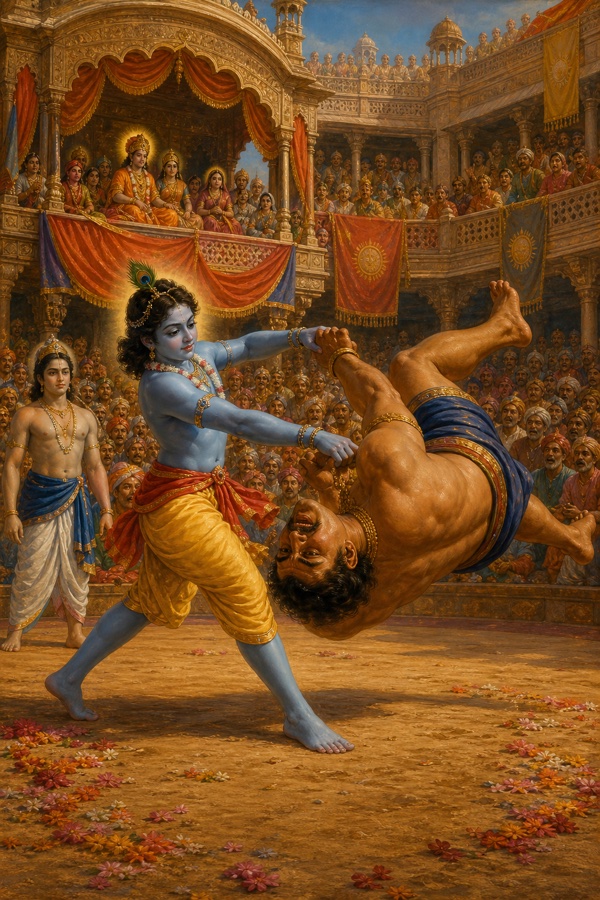
They locked, hand into hand, foot hooked against foot, and the bout turned close and terrible: elbow hammering elbow, knee against knee, head grinding head, chest slamming chest, each man dragging, shoving, crushing the other in his arms, throwing and lifting and pinning, hunting the single grip that ends a match. Blows landed on Chanura like strokes of lightning, and under them his senses went dark once, twice, again; each time he clawed his way back to his feet. At last he sprang high like a stooping hawk and drove both fists together into Krishna’s chest with everything his huge body held. Krishna did not shift the width of a finger. An elephant swatted with a flower garland gives that much ground. Then he caught Chanura by both arms, swung him off his feet, and whirled him through the air, and the whirling itself drew the life out of the man. When Krishna dashed him down, ornaments scattered and hair flying loose, the thing that struck the ground was already dead, and it came down with the crash of one of Indra’s tall festival banners falling.
Mushtika had opened against Balarama with his fist. Balarama replied with a single blow of his open palm, and the champion shook the way a tree shakes when a storm tears at its roots, then dropped, vomiting blood, and lay still. Kuta came next, and Balarama put him down with his left fist, almost carelessly. Krishna’s foot took Shala’s head from his body; Toshala was torn in two like a blade of grass. Five champions lay in the dust of their own arena, and every wrestler still standing ran for his life.
The stands came up shouting. Pious men and the foremost of the Brahmins cried “Well done! Well done!” over the trumpets, while the two brothers pulled their cowherd friends into the ring and danced with them to the music, anklets chiming on the arena floor. Joy ran the full circle of the amphitheater and stopped at one seat.
Kamsa sat on the high dais with his champions dead below him and his festival in ruins around him. His face had gone to ash. Years of stratagems, the murdered infants, the guards on every road, the whole architecture of his fear was falling in on him at once, and he reached for the one instrument left to a king: he gave orders. He cut the trumpets silent and shouted across the arena. Drive these two ill-bred sons of Vasudeva out of the city. Strip the cowherds of everything they own. Chain Nanda. Kill Vasudeva. And kill Ugrasena, my own father, who has taken my enemies’ side. The orders flew out over the sand and found nothing left to obey them; his time had already run out.
Krishna took the dais in a single leap. Kamsa was fast; he came off the throne with sword drawn and shield up, and he moved well, cutting right and left like a hawk riding a gale. It bought him nothing. Shri Hari closed one firm hand on him, the way Garuda takes a serpent however it writhes, and at that grip the royal diadem slipped from Kamsa’s head and rolled away across the boards.
Krishna wound his fingers into the tyrant’s hair and dragged him off the edge of the platform, down into the arena.
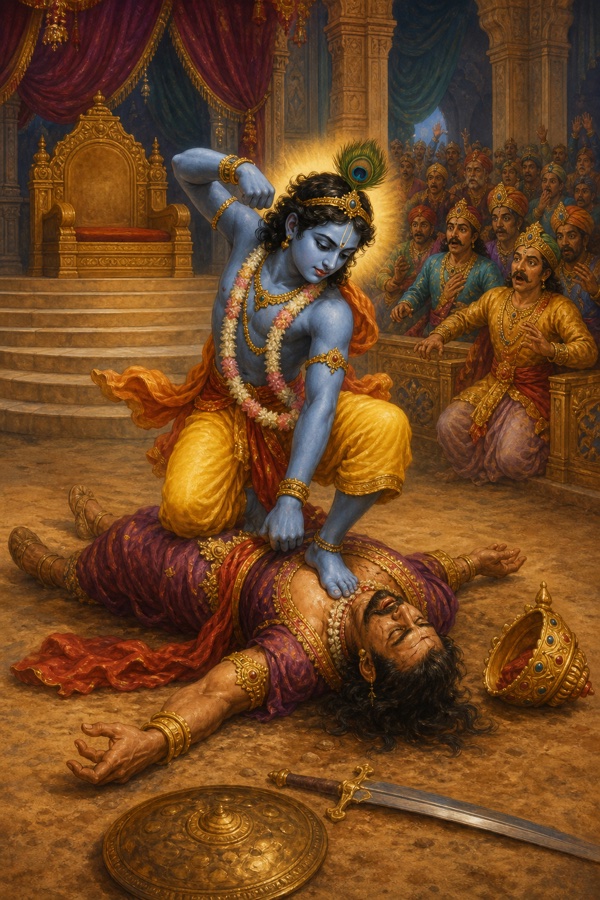
Kamsa struck the ground, and Krishna, the bearer of every world, who leans on nothing, leapt down upon his chest. The life went out of Kamsa in that instant. Then, while all Mathura watched, Krishna dragged the dead king across the arena floor the way a lion drags a killed elephant, and one immense sound rose from the whole assembly at once, grief and awe fused in a single cry.
Under the violence of that ending sat a strange mercy. For years Kamsa had seen Krishna everywhere. Drinking, he had seen the dark face; speaking, he had seen it; walking his ramparts, lying in his bed, drawing plain breath, he had seen the discus-bearing form he dreaded, until dread accomplished what devotion labors toward and fixed the Lord in his mind past all dislodging. Whoever holds God in unbroken remembrance, in whatever key, is bound to him. So when death came, the years of terrified attention paid out their strange wage: Kamsa rose into sarupya, a form like the Lord’s own, a destination that austere yogis reach for across whole lifetimes and rarely touch. Enmity, grown dense enough to crowd out everything else, had turned into a door.
Kamsa had eight younger brothers, Kanka and Nyagrodha at their head, and they came burning to avenge him. Balarama met them with an iron bar and put them down one after another, the way a lion moves through cattle. Then kettledrums sounded above the arena out of a clear sky. Brahma the creator and Shiva the destroyer, with the gods around them, praised the Lord and rained flowers down on the sand, and the apsaras, the dancers of heaven, danced.
A darkness years deep lifted off Mathura, and grief walked into the space it left. The widows of Kamsa and his brothers came down into the arena beating their heads, hair loosed, and folded their dead husbands in their arms on the ground where fallen fighters lie. They keened their loss aloud, and inside the keening, truth found their tongues: you did great harm, they wept, to creatures who had done you none, and this is where such harm arrives; no tormentor of living beings comes to a good rest; this Krishna is the spring and the end and the keeper of every creature, and no one who scorns him has ever prospered. Krishna steadied the grieving women, gave them what comfort words can give, and then had the full funeral rites performed for the dead with every proper observance, for their welfare on the road ahead.
Then Krishna and Balarama went straight to the prison.
There, in the dark that had held them for years, sat Devaki and Vasudeva in chains, the mother and father who had given these two their births, and whose sons had been carried away from them on the very night they were born.
The years were written on them both. Their hair had gone white. The fetters had left their marks on their wrists, and the long nights had left theirs beneath their eyes.
Krishna undid the fetters with his own hands. Then the two brothers bent low and touched their heads to their parents’ feet.
“Ma. Pitaji.”
And their mother and father could not reach for them. They had understood, at last and all at once, that the two bowing before them were the Rulers of the universe, and awe froze the embrace inside their arms. Vasudeva’s hands rose toward his sons’ bowed heads, and stopped, and rose again, and stopped.
Krishna saw at once what had gone wrong. The knowledge had reached them too early, before they had ever tasted the plain human sweetness of holding him as a son, so he drew his own maya across it, the enchantment that is his alone to spread, and let the certainty of his godhead sleep. He came close, called them Mother and Father, and spoke as a son speaks. Through all these years you longed for us, he said, and none of a son’s seasons ever came to you, every season of a son was withheld from you: infancy in your arms, childhood in your courtyard, and boyhood at your table. A man who serves his parents for a hundred years still cannot repay the two who gave him his body, the body in which everything worth winning is won. A son with strength and means who fails to keep his mother and father is made, in the halls of the dead, to eat the flesh of his own body. A man who can support an aging mother and father and does not, that man breathes, and is already dead. Our days went by empty of your service, and the debt stands; fear of Kamsa held us where we were, and we could do nothing. Forgive us, Mother. Father, forgive us those lost years. And beneath the veil of maya, the last knot in the two old hearts let go. They gathered their sons in, took them on their laps, wrapped them in their arms, and bathed them in tears, and their throats closed over every word they tried to say.
Then Krishna brought Kamsa’s old father Ugrasena out of confinement and seated him on the throne of Mathura. The victor of the arena folded his hands before the man he had crowned. Command us, he said; we are your subjects. And he named the reason he would never take this throne himself: long generations back, the patriarch Yayati had laid a sentence on the line of his son Yadu, that no one born of that blood would ever sit a sovereign’s seat. Krishna and Balarama were Yadavas, sons of that very line, and Krishna chose to keep the ancient decree standing. So let Ugrasena reign, he said, with the Lord of the worlds beside him as an attendant; kings would bring tribute to such a throne, and so would powers far above kings. Then Krishna gathered home the Yadavas, the Vrishnis, the whole scattered kin whom fear of Kamsa had driven into foreign lands, worn thin with exile, and settled each family back into its own house, its own goods, its own sleep.
Nanda was still in Mathura, waiting with his cowherds. Krishna and Balarama went to him and held him a long moment, and Krishna spoke softly. Father, you and mother Yashoda raised the two of us with a care past all counting; a parent’s love for a child runs deeper than the love of self. The true father and the true mother are the ones who nourish a child that its own people had to give up. Go back to Vraja now. When we have given our kinsmen here their portion of joy, we will come to see you and everyone who aches for us there. He honored Nanda with garments, ornaments, and fine vessels, loaded the carts with gifts, and Nanda, his eyes brimming, held the two boys once more and turned toward home with his cowherds behind him. And far away in Gokul, no gift could fill what was gone. Yashoda’s courtyard kept its silence, and the lap that had rocked the butter thief stayed empty. The boy whose bare footfall her ear had listened for all day long belonged now to a palace of stone.
The story ran on from there, and a great deal still lay ahead. But one long chapter of dread closed that day, and for the first time in years the air over Mathura moved like air a whole city dared to breathe.
Literary context
This katha spans Chapters 41 to 44 of the tenth Skandha of the Shrimad Bhagavata. The entry into Mathura, the washerman, the weaver and Sudama the garland-weaver, Kubja, the breaking of the bow, Kuvalayapida, the slaying of the wrestlers, and at the last the slaying of Kamsa follow in this order in the Gita Press edition.
Kamsa’s liberation is the Bhagavata’s classic instance of vaira-bhakti, devotion carried by enmity, beside Shishupala and Hiranyakashipu. The text holds unbroken remembrance, whatever feeling drives it, to be a cause of higher passage. Kamsa’s eight brothers and the wrestlers Chanura, Mushtika, Kuta, Shala, and Toshala fall in Chapter 44. The embrace of the parents, veiled in Krishna’s own maya so they could love him simply as a son, the coronation of Ugrasena, at which Krishna honors Yayati’s ancient decree barring Yadu’s line from the throne, and Nanda’s leave-taking follow in Chapter 45.
Why this katha matters now
Kamsa spent a lifetime building walls against a single death, and it walked in through the front gate wearing the face he feared most. Whatever we fear with our whole attention becomes, by that very attention, the deepest remembrance we carry. The Bhagavata’s quiet astonishment is that even a door built of dread can open onto release.
The same katha elsewhere
- Akrura’s Darshan
Shrimad Bhagavata (Skandha 10): Akrura’s darshan - Harivamsha · Akrura and the Road to Mathura
Harivamsha: Akrura and the road to Mathura - Harivamsha · The Slaying of Kamsa
The Harivamsha’s slaying of Kamsa