On this page
Akrura’s Darshan
In Mathura, the news had been reaching Kamsa for years, and every piece of it tightened the fear he lived inside. A voice out of the sky had told him, on the day he drove his sister Devaki home from her wedding, that her eighth child would kill him. He had chained Devaki and her husband Vasudeva in his own prison and murdered her newborn sons one by one, and still the eighth had slipped through his hands on a midnight he could not explain. Now that child had a name and a village. Krishna and Balarama were growing up in Nanda’s house in Gokul, and they were growing fast.
Every killer he had sent against them was dead. Putana, who had come as a wet nurse with poison on her breast. Shakatasura, waiting inside a loaded cart. Trinavarta, the whirlwind that had carried the baby into the sky and fallen out of it broken. Bakasura the crane, Aghasura the serpent whose open mouth the cowherd boys had walked into like a cave. Arishta the bull. Keshi, who had gone out in the shape of a horse and died with Krishna’s arm down his throat. Each mission had failed.
So Kamsa laid out his final move, built from the things he still trusted. He would proclaim a dhanur-yajna, a great rite of the bow, its opening fixed for the fourteenth day of the moon, and under that pretext bring the two brothers to Mathura. His champion wrestlers, Chanura and Mushtika, would meet them on the mats of his own arena, before his own eyes. And in case the boys somehow walked past the wrestlers, the war elephant Kuvalayapida would be standing at the entrance gate, a trained mountain with the temper of death.
For the errand itself he summoned one of the most trusted men in his court: Akrura.
Akrura was of the Yadu line, the son of Swaphalka, kin to Vasudeva himself, and by Kamsa’s own reckoning the most honored man among the Bhojas and the Vrishnis. He served in Kamsa’s court while his mind rested on Shri Hari. Kamsa took his hand and asked him, as a friend, for an act of friendship.
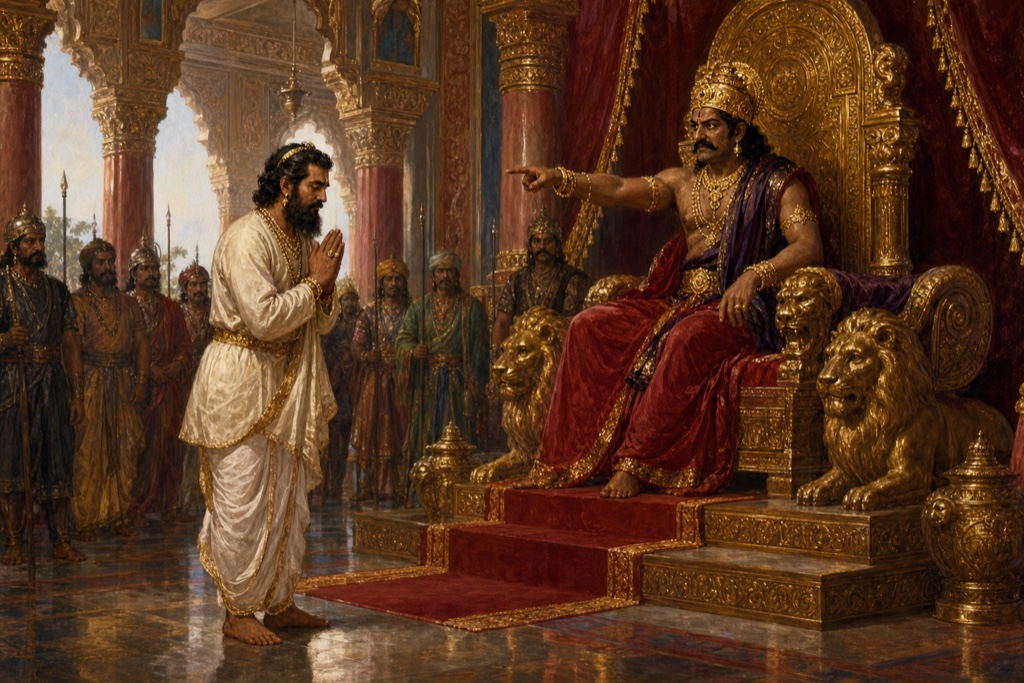
“Akrura, go to Gokul. Take my chariot. Carry the invitation to the dhanur-yajna and bring Krishna and Balarama to Mathura, and Nanda with his cowherds behind them, with the yield of their herds for tribute. Tell them they will see the bow-rite and the splendor of the capital. Say nothing of the rest. The rest we will handle.”
Akrura bowed his head. He answered the king evenly, the way he did everything. A remedy well fitted to the danger, he said. And a man does best to keep his mind level in success and in failure alike, since the fruit of every effort sits in Providence’s hands. He would do the king’s bidding. Inside him, two storms had already risen at once.
On one side lay the king’s command. He knew exactly what intent stood behind it, and refusal lay beyond his reach.
On the other side lay the thought that quickened his breath. The one whose name he had carried for years, he would now see with his own eyes.
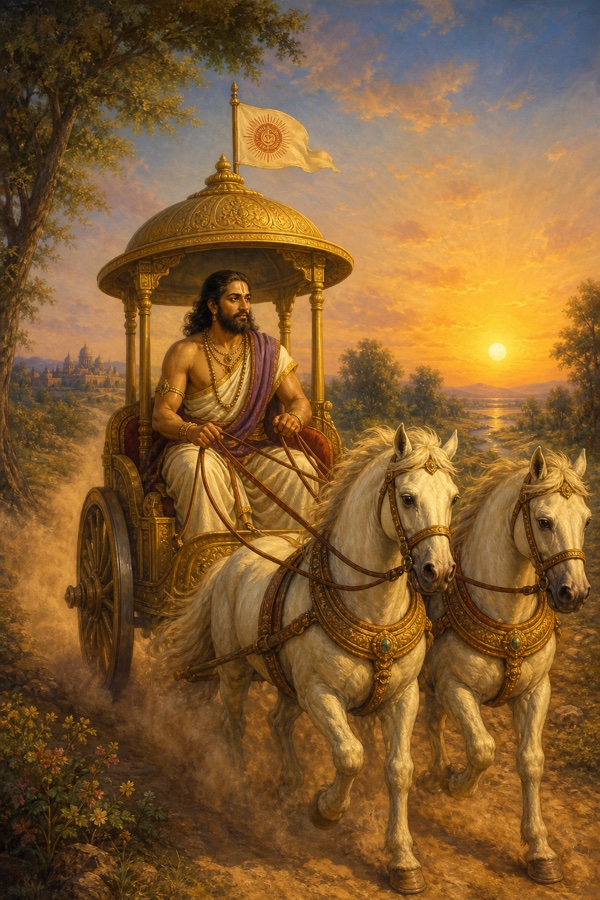
That night he stayed in Mathura. At first light he had the chariot yoked and rolled out through the city gate toward Gokul.
Something kept beating inside him along with the drumming of the wheels. The dust rose off the road, thought after thought rose with it, and before the city was well out of sight the man holding the reins had passed into the deepest devotion of his life.
“What good deed have I ever done,” he thought, “what austerity have I ever burned through, what gift have I ever laid in a worthy hand, that today I should see Bhagavan Shri Krishna with these eyes? My mind lives among the senses and their pleasures. A sight like this belongs to renouncers, and I am a courtier of Kamsa.” Then he would steady himself. “No. I will not think that way. Even a wretch is carried somewhere. A man swept down the river of Time washes up on some shore at the last. My evil is burned off today. My birth bears fruit today, because I am going to bow to the lotus feet that Brahma meditates on, that Shiva meditates on, that Lakshmi herself waits upon, the feet whose bright nails have carried seekers past a darkness of ignorance no strength of their own could cross. Kamsa has done me a kindness without meaning to. His errand is carrying me to the very feet that walk the forest paths behind the cows and take the dust of Vraja on their soles, the feet touched with the saffron the gopis wear on their breasts. Today I will see the face itself, the lovely cheeks, the shapely nose, the reddish lotus eyes with their smiling sidelong glance under the dark curls.”
Then the wheel of his thought would catch. “I am Kamsa’s envoy. I come at the sending of the man who wants him dead. What if they take one look at me and see an enemy?”
And then he would talk his own mind back around. “No. He is without stain. He stands inside and outside every creature that breathes, and no stirring of any mind is hidden from him. He will see straight through the errand to the man carrying it, and he will know my doubt as well. I will stand before him with folded hands. I hope he will set his palm on my head, the palm that has stilled men fleeing the serpent of Time, the palm into which a former Indra once laid his offerings and won the rule of three worlds, into which Bali poured the water of his gift and gained what emperors cannot buy. I hope he will pull me up and press me to his chest with the hands that carry the mark of the chakra, and my bonds of karma will drop away like old rope, and he will call me uncle. Uncle Akrura. If Shri Krishna owns me with that one word, my birth is finally worth something. To him no one is dear and no one is hateful, and still he answers those who love him measure for measure, the way the wishing tree gives to whoever comes and asks. And Balarama will smile, and take my folded hands, and lead me into the house, and ask after everything Kamsa has been doing to our kin.”
Sunk in this current, he ate up the road, and the road answered him. Deer crossed his path on the right side, the side of good omen, mile after mile, and he took heart from the sign. The favorable signs strengthened his hope.
By the time he neared Gokul the sun was standing on the western hill. Close by the cow-pen his gaze dropped to the ground, and stopped there.
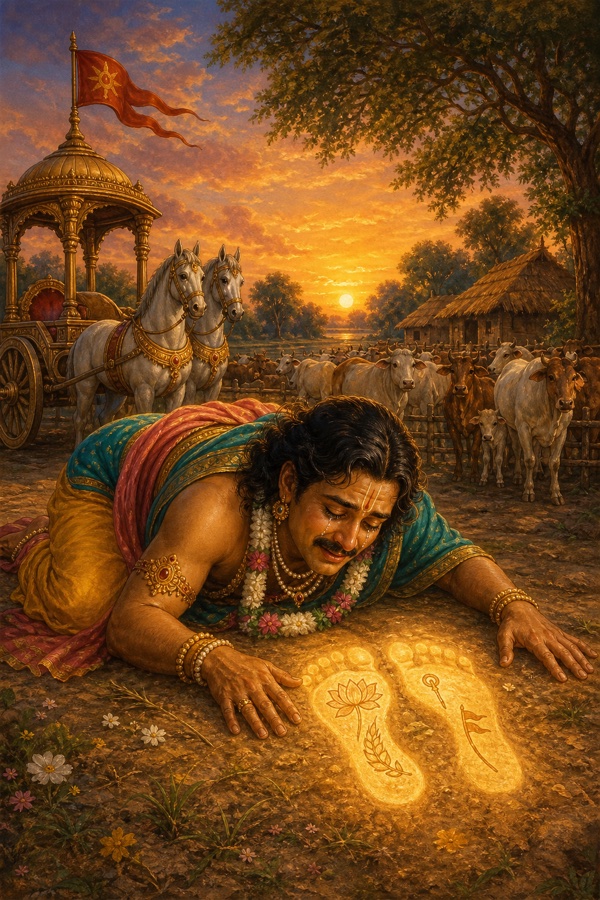
Pressed into the dust were the prints of Shri Hari’s feet, marked with the signs no other feet on earth carry: the lotus, the barleycorn, the goad, the flag. The guardians of the worlds bear that dust on their crowns. Here it lay on a village road, in the open, among the hoofprints of cows, and the soil itself seemed to shine with it.
The longing that rose in him then was past holding. He leapt from the chariot and rolled his body in the dust of those footprints, tears streaming, the hair on his skin standing on end. “Aho! This is the dust of my Lord’s feet.” Rank, caution, the courtier’s lifelong reserve, everything he had carried out of Mathura lay behind him where the chariot had stopped.
Then he went on to the milking ground, and there, among the cows in the last light, stood the two brothers.
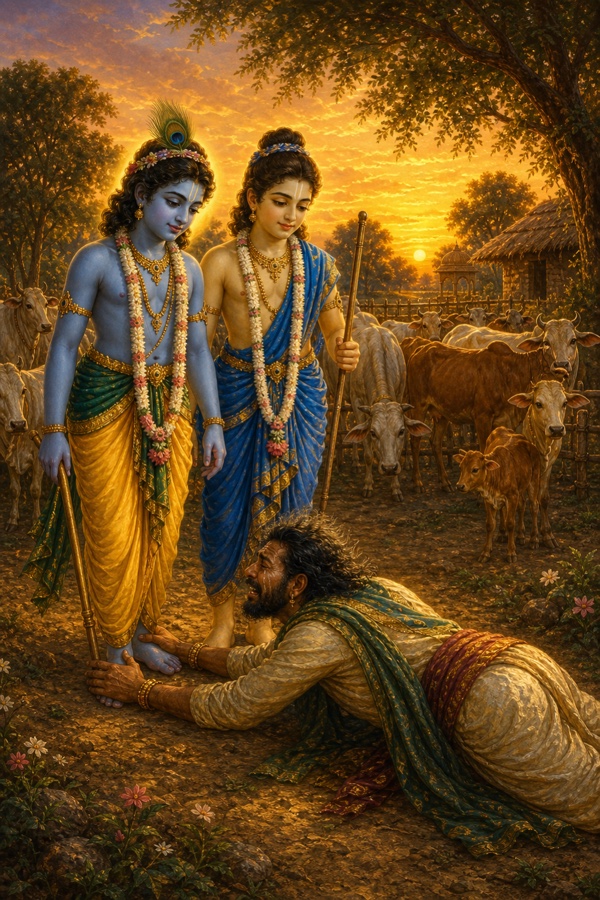
They had bathed and dressed in spotless clothes. Sandal paste cooled their limbs, jeweled necklaces lay at their throats, and garlands of forest flowers hung to their knees. The dark one, Shri Krishna, wore yellow silk; the fair one, Balarama, wore blue. Their eyes were autumn lotuses in full bloom, their arms hung long, to the knees, and they moved with the loose ease of young elephants, boys just stepping into their first youth and already the foremost of everything lovely. Where they set their feet, the soil took the marks of the flag, the thunderbolt, the goad, and the lotus. Krishna stood like a rock cut from emerald, Balarama like a hill of silver washed with gold, and the whole cow-yard brightened between them as if the gloom had been rinsed out of the quarters. Their glances went everywhere, and every glance came with the same small smile of compassion. When they moved, it was as if mercy itself were walking.
At the sight of them Akrura’s throat closed. He came down from the chariot and went down before them full length in the dust, like a dropped staff. Tears of joy blinded him. Every pore of his body blossomed. And so much rose in his throat at once that he could not manage even his own name.
He did not need to. Bhagavan, tender to anyone who takes refuge, already knew him, and knew the whole of what he carried. With hands marked by the chakra he drew Akrura up and pressed him to his chest, and Balarama embraced him in turn, clasping his folded hands in his own. Then the two brothers took a hand each and led him home.
At the house Balarama asked after his journey, seated him on the finest seat, washed his feet with the full rite owed to a guest, and offered him madhuparka, the welcome-cup of honey, curds, and ghee. He gave him a cow, pressed the tiredness out of his legs, and served him with great honor a meal of many excellences, and afterward brought betel, perfumes, and garlands to complete the welcome. Then Nanda Baba came near, the man who had raised Krishna at his own hearth, and asked the question all of Vraja carried for the people of Mathura: “Akrura ji, how do you men live at all with Kamsa over you? You are sheep, and your keeper is a butcher. What safety can there be for the subjects of a king who murdered the newborn sons of his own cousin while she screamed for them?” Under that plain, warm directness, Akrura forgot the whole fatigue of the road.
The night deepened. When the meal was done and the house had gone quiet, Shri Krishna himself came and sat beside Akrura and spoke in an easy voice, a nephew at home with a visiting elder. “Chachaji, was the road kind to you? Is all well with our people, our friends, our kin? Though I hardly know why I ask. What good is asking after the welfare of kinsmen while my mother’s brother thrives, a plague on his own family wearing the name of an uncle? Our noble parents have suffered everything on our account. Their sons were killed because of us. Their chains were accepted because of us. And today, after so long, we finally see one of our own in you. So tell me, uncle. With what purpose has the king made you his envoy and sent you to us?”
Akrura told him everything. The old enmity Kamsa had sworn against the Yadavas, and the day he had snatched up a sword to cut down Vasudeva himself. The invitation, and the arena waiting behind the invitation. And what the sage Narada had carried to the king: that the girl who had slipped from his hands that midnight was Yashoda’s daughter, that Devaki’s eighth child was alive, that the boy in Nanda’s house was that child, and that the king’s death stood decreed at that boy’s hands.
Hearing the whole plot laid out, their own deaths included, Shri Krishna and Balarama laughed. Then they carried Kamsa’s command to Nanda Baba, and Nanda gave his orders to the gopas: gather all the yield of the herds, the milk, the curds, the ghee, load the gift-offerings, and yoke the carts, for at daybreak everyone goes to Mathura. We will give the king his tribute and watch the great festival of the bow, and the whole countryside is going. He had the watchman cry it through every lane of Vraja.
By lamplight, the welcome Akrura had hoped for on the road had come true, down to the seat, the meal, and Krishna’s greeting of “uncle.”
At dawn the three of them mounted the chariot. Krishna, Balarama, and Akrura at the reins.
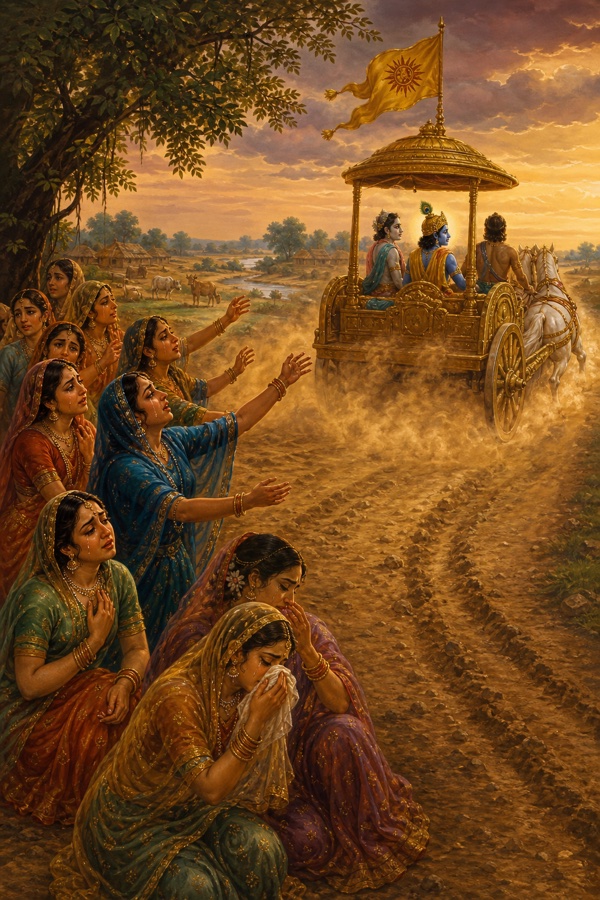
The news had passed through Vraja the evening before, and the gopis had spent the night in grief. Some lost awareness of their own bodies. Others remembered Krishna’s speech, his smiles, the evenings when he returned behind the cows with dust in his hair, and the nights of the great circle dance that had seemed to pass in an instant. At dawn they ran behind the moving chariot, calling, “Govinda! Damodara! Madhava!”
Krishna sent a messenger to console them with a promise that he would return. They remained on the road while the chariot’s banner could still be seen, then while its dust remained in the air. When both disappeared, they stood like figures painted into the landscape. At last they returned to Vraja and passed their days singing his deeds.
By midday the chariot reached the Kalindi, the river the world knows as the Yamuna, whose water carries off sin, her slow current green as emerald. Krishna and Balarama stepped down, washed their hands and feet, and drank the sweet water. Then they climbed back into the chariot where it stood in the shade of a stand of trees.
Akrura settled the two brothers in their seats and took his leave of them.
“Wait for me a little. Let me perform my midday rites.”
He walked off alone to the deep, still pool the people of that country called Brahmahrada, the pool of the Endless One, and waded in. The cold climbed from his calves upward.
He took one dip and began, under his breath, the Gayatri, the mantra that holds the essence of the eternal Veda.
When he lifted his head from the water, his eyes went wide and stayed wide. There in the pool, seated together, were Krishna and Balarama, the same two boys he had just handed up into the chariot.
He stood up out of the pool and reasoned with himself like a sober man. The sons of Vasudeva were sitting in the chariot on the bank; if they were here in the river, they could not also be there. He looked. The brothers sat in the chariot exactly where he had left them, calm under the trees. Then the water had lied, or his eyes had. He filled his chest and went under once more to find out which.
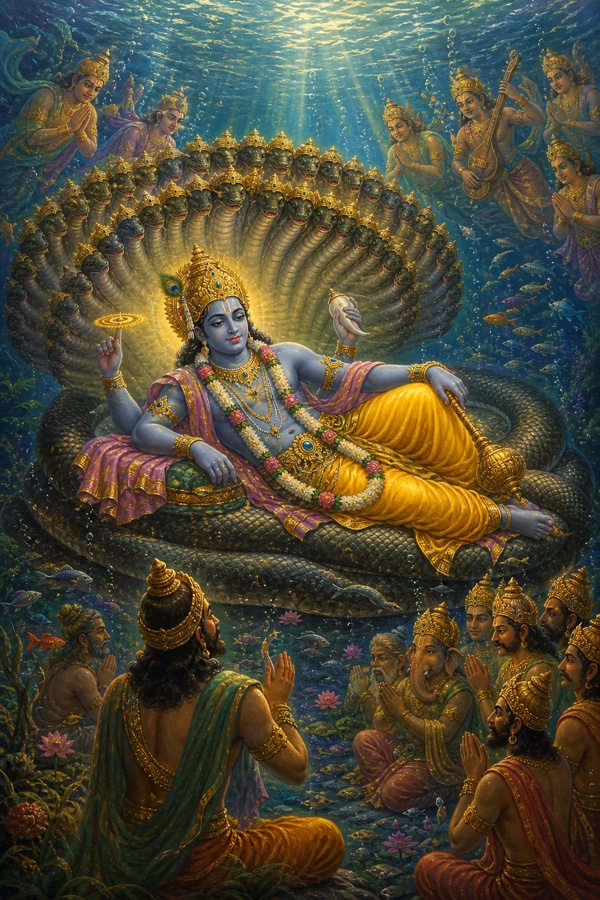
This time the water opened onto another world. Where the two boys had been, there now rose Anantadeva Shesha, the lord of serpents, a thousand hoods spread wide and every hood crowned with a diadem, his body white as the fiber of a lotus stem, vast and rooted as the silver mountain Kailasa, wound about in dark blue silk. Around him, heads bowed low, stood the perfected ones of every world, siddhas and charanas and gandharvas, and even asuras among them, singing his praise.
And on the serpent’s coils, at rest, lay Shri Hari himself, dark as a raincloud, four-armed, utterly serene. Yellow silk. Eyes long and reddish as lotus petals, a face at ease and smiling, the shapely nose and lovely cheeks Akrura had spent two days picturing. In the four hands, the conch, the chakra, the mace, and the lotus. The white curl called Shrivatsa on his chest, the Kaustubha gem burning at his throat, the forest garland falling to his knees, and light streaming from him down to the ruddy nails of his lotus feet. Around that living couch stood the highest court in existence. His attendants, Sunanda and Nanda at their head. Sanaka and his three brothers, the four ageless boy-sages. Brahma and Shiva at his right hand, the nine great seers led by Marichi at his left, and before him the foremost of his devotees, Prahlada, Narada, the Vasu Uparichara. And waiting on him in living form, the goddesses of everything by which the world runs: Sri and Pushti, Sarasvati, Kanti, Kirti, Tushti, Ila the earth, Urja, Vidya and Avidya, Shakti, and Maya herself. Such radiance came off the whole of it that the water itself seemed to stand holding its breath.
Akrura shut his eyes inside the vision. “Could this be a delusion of my own mind?”
Then he lifted his eyelids.
The same vision, under the water, in its full stillness.
His throat closed. His hair stood on end, his mind gathered itself to a single point, and his tears began to flow into the river itself.
“My Lord!”
He bowed his head, joined his palms, and in a voice choked almost past speech, the praise that had been gathering in him for years came pouring out. It came in order, like a man laying his whole understanding at those feet piece by piece.
“I bow to you, Narayana. Most ancient of all, wearing out never, the cause behind every cause. From the lotus that rose out of your navel Brahma was born, and out of Brahma came this whole spread of things, everything that moves and everything that stands still.”
“Earth, water, fire, wind, sky. The mind that thinks, the senses that reach, the things they reach for, and the powers that preside over them. Every one of them came out of your being, and none of them can know you, because they are made things, and you are the one who is aware through them. Even Brahma, working inside the three strands your own nature spins, cannot see past those strands to what you are. So the yogis stop looking outward and worship you where you actually are, seated within the body itself, the inner controller, the ruler under everything.”
“Men come at you by a hundred roads, and each one is sure his road is the only road. The brahmanas of the three Vedas feed the sacred fire and call you by the names of many gods, and it is you who receive their offerings. Men of wisdom renounce every action and worship you as pure awareness, through the sacrifice of knowledge itself. Others, consecrated by their own disciplines, worship you in the four forms of Vasudeva, Sankarshana, Pradyumna, and Aniruddha, or in the single form of Narayana. Others follow the path Shiva taught, through all the branchings of its many teachers, and it is you they find in Shiva. And those who bow to smaller gods, thinking them other than you, even they are bowing to you, whatever name is in their mouths. Rain falls on a mountain, and rivers run down every side of it under a hundred names, and every one of them loses its name in the one sea. So every road, followed to its end, runs home to you.”
“Those who meditate on your form say the fire is your mouth and the earth your feet, the sun your eye, the sky your navel, the directions your ears, heaven the crown of your head, the chiefs of the gods your arms, the oceans your belly, and the wind your breath and your strength. The trees and grasses are the hair of your body, the clouds the hair of your head, the mountains your bones and your nails, and the opening and closing of your eyes are day and night. And whole universes, each with its guardian gods, each swarming with living beings, drift inside you like grains of spawn drifting in water, like the small creatures inside a fig.”
“And you keep entering what drifts inside you. You came as the fish and swam the ocean of the drowned world. As Hayagriva you struck down the demons Madhu and Kaitabha. You came as the tortoise and bore Mount Mandara on your back while the ocean was churned, as the boar who lifted the earth from the flood on his tusk, as the lion who came out of a pillar to end the terror of the righteous, as the dwarf whose three strides took back all three worlds. You came as Parashurama and mowed down the forest of arrogant kings, and as Rama, and Ravana fell. You are Vasudeva and Sankarshana, Pradyumna and Aniruddha, the fourfold protector of the Satvatas. You came as the faultless Buddha and bewildered the enemies of the gods with a doctrine made for them, and at the end of this dark age you will come as Kalki, against kings fallen past all law. Age after age, whatever shape the rescue requires, you take it, and people sing their grief away remembering the shapes.”
“And here is what I am, who saw all this and understood none of it. Your maya spun the dream, and I called the dream my life. This body, mine. This house, this wife, these children, this wealth, these kinsmen, mine, mine, and all of it exactly as solid as the things a sleeper sees. I took the dying for the deathless, sorrow for happiness, what was never myself for my self, and with my face turned toward that shimmer I walked away from you, the real water, the way a fool chases heat-haze across the sand while a lake stands at his back under a cover of weeds. My mind will not hold still long enough even to want you properly. Cravings drag it one way, the turbulent senses drag it another, and I cannot rein it in. So I have come with nothing, and I have taken hold of your feet, the feet no one of crooked life ever finds, and even that grip, I know, comes of your grace alone, for the longing for you rises in a man, through the company of the holy, only when his long turning through birth and death is nearing its end. I bow to you, knowledge itself, body of pure awareness, master of every power that binds every creature. Vasudeva, Sankarshana, Pradyumna, Aniruddha. I am fallen at your feet. Protect me. Keep me.”
He wept on, waist-deep in the river, hands joined.
Above him, on the bank, the world went on. Krishna and Balarama sat in the chariot in the tree-shade, calm, saying nothing. Nothing needed saying. What was passing under the water, they knew, for the one being prayed to had been sitting in the chariot all along.
Then, in the middle of the prayer, the way an actor steps out of a part when the play is done, the Lord drew the vision back into himself. The water was only water. Akrura came up out of the pool, hurried through what remained of his rites with hands that barely obeyed him, and walked back to the chariot wonder-struck, his eyes red, his body still trembling.
He climbed up and looked at Krishna.
“Prabhu!”
Krishna asked, “Uncle, have you seen something wondrous on the earth, in the sky, or in the water? Your appearance tells us that you have.”
Akrura answered, “Every wonder on earth, in the sky, or in the water exists in you, for you are the form of the universe. While I am looking at you, what wonder remains unseen?”
He took up the reins and drove on. By sunset Akrura brought Krishna and Balarama to Mathura, where Nanda and the cowherds were already waiting in a garden outside the city.
Literary context
This katha follows Chapters 38 to 41 of the tenth Skandha of the Shrimad Bhagavata. During his Yamuna bath, Akrura sees Shri Hari upon Shesha together with Sankarshana, or Balarama, and utters the celebrated Akrura-stuti. The gopis’ anguish at the departure for Mathura begins before the vision, while the chariot is still leaving Vraja. The opening verses of Chapter 41 supply the canonical close: Krishna asks what wonder Akrura has seen, and Akrura answers that every wonder already exists within him.
Note that this is a darshan of the Vaikuntha form, as the Gita Press edition describes it; it stands apart from the Vishvarupa that Krishna shows in the Gita.
Why this katha matters now
Akrura lived far away for years, and he arrived carrying Kamsa’s errand, and in the middle of one dip in the Yamuna he saw what yogis search for in samadhi. The glimpse lasted a moment, and that moment held up the rest of his life. This katha teaches you to look past nearness, at the thirst within.
The same katha elsewhere
- Harivamsha · Akrura and the Road to Mathura
Harivamsha: Akrura and the road to Mathura - The Slaying of Kamsa
The slaying of Kamsa in the Shrimad Bhagavata (Skandha 10) - Harivamsha · The Slaying of Kamsa
The Harivamsha’s slaying of Kamsa