On this page
Kunti’s Prayer
The war of the Mahabharata was over. The five Pandava brothers had won it. And the house that victory handed back to them echoed, because so few of the people they had fought for were left alive inside it.
They went down to the Ganga with Shri Krishna, the women of the house walking at the head of the procession, and poured the river’s water from their joined palms for the men who had fallen, the old offering a family owes its dead so the departed do not go thirsty on the road. Then the weeping took them, and they stood in the shallows a long while, telling over what each of those men had been. Abhimanyu, Arjuna’s son, was gone. The five young sons of Draupadi were gone, cut down in their sleep. One after another, every one of them. When the water had been given they bathed in the Ganga once more, as the rite asks, and came up the bank with their grief still on them.
Old Dhritarashtra, the blind king whose ambition for his sons had fed the whole war, now sat broken over their bodies, all hundred of them, and his queen Gandhari was sunk past the reach of any voice. Shri Krishna moved among the mourners with Dhaumya and the other sages, giving what comfort exists to be given, and setting before them the one truth that steadies and stings at once: every creature that breathes lives under the rule of time, and no strength on earth has ever held anyone back from death.
Then Shri Krishna set Yudhishthira, the eldest of the five, back on the throne that gamblers had once lifted from him across a dice board. Men called this king Ajatashatru, the man to whom no enemy was ever born, because his heart kept no room where an enemy could live. The wicked kings who had shortened their own lives the day they laid hands on Draupadi’s hair were ash on the field now, and the seat of Hastinapura stood clear. Krishna had him perform three Ashvamedha sacrifices, the great horse-rites by which a sovereign’s name is carried to the edges of the earth, each with the finest materials and the ablest priests, until Yudhishthira’s renown ran out in every direction the way Indra’s does, and Indra pays for his with a hundred such rites. So the court filled again with splendor. The grief kept its own seat inside the king and did not move.
Now Krishna made ready for Dwarka, his own city far to the west, where his own people waited. He took leave of the Pandavas, honored Vyasa and the other Brahmins, who bowed to him in return, and climbed into his chariot with Satyaki and Uddhava, his kinsman and his dearest companion, beside him.
He had not yet given the horses the word when a young woman came running toward the chariot with terror naked on her face. It was Uttara, King Virata’s daughter, Abhimanyu’s widow, and in her womb she carried the one child the war had left to the entire line of Pandu. “Protect me, great yogi. Save me, Lord of the universe,” she cried. “In a world where every creature is death to the next, I see no shelter anywhere except you. A dart of burning iron is chasing me, my master. Let it burn me if it has to. Only do not let it kill the child I am carrying.”
Krishna understood before she had finished. Ashvatthama, Drona’s son, the same man who had crept through the sleeping camp and cut down Draupadi’s five boys, had loosed a brahmastra to burn out the seed of the Pandavas entirely, a missile that carries the authority of Brahma the creator himself and, once released, cannot fail and cannot be called back. At that same moment the five brothers saw five points of fire streaking toward them and reached for weapons of their own. Krishna raised his discus, the Sudarshana, against the blaze, and then did the quieter and greater thing: he wrapped his own maya around Uttara’s womb and sealed the last thread of the Kuru line inside it. The unfailing weapon met the radiance of the Lord and simply went out.
The danger had passed by the width of a breath.
Kunti, the mother of the five Pandavas, was Vasudeva’s sister, and Vasudeva was Krishna’s father, so the tie between them was blood, and it was as old as her life. But through these years of exile and war and burning, watching him turn back everything the world sent against her sons, she had come to know that the word nephew could not hold what he was.
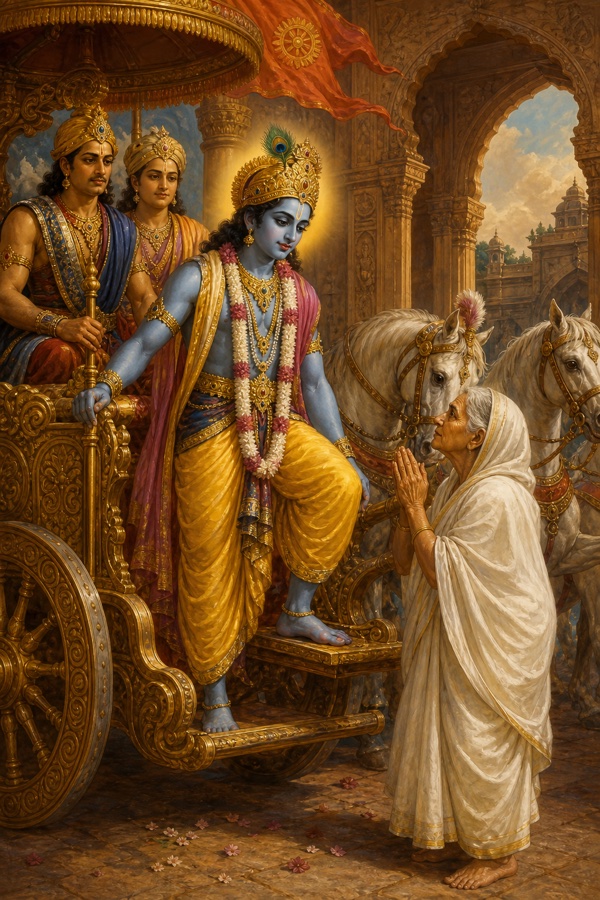
His foot was on the chariot step when she came and stood in his way, her palms joined. Her five sons gathered close behind her, and with them Draupadi, the daughter-in-law whom the years of shared ruin had turned into a daughter outright.
By every measure the world can see, she wanted for nothing now. Her sons had come through with their honor whole, the kingdom was theirs again, and Draupadi was hers. And still she carried one piece of knowledge inside her that no one standing on that road suspected.
Every time ruin had come for her family, Krishna had come with it. Every single time. The poison Duryodhana had fed them. The great fire at Varanavata, in the lacquer house whose very walls had been built of fuel, with her sons asleep inside. The man-eating hunger of the rakshasa Hidimba and the demons who came after him. The gambling hall packed with wicked men, where hands were laid on Draupadi while a court full of kings watched. The long dangers of the forest years. The weapons of Bhishma, of Drona, of Karna, of every great warrior alive, battle after battle after battle. And only moments ago, Brahma’s own missile turned away from Uttara’s womb. Each time, the hand that pulled them clear had been his.
Every disaster had brought him to her door. Now the disasters were finished, and he was leaving.
Kunti pressed her joined palms together and began to praise him.
“I bow to you, the first Person, older than nature itself and standing beyond it, the imperishable Lord. You dwell inside every created being and outside it in the same instant, one presence without a seam, and still no sense can touch you and no thought can close around you, because you keep yourself behind the curtain of your own maya. A man whose sight is bent misses you the way a dull spectator misses the actor: he watches the painted king strut the stage and never once asks who is standing inside the costume. You came down into this world to plant the love of yourself in the hearts of the paramahamsas, the swans among seekers, pure of mind, given wholly to contemplation, free while their bodies still breathe. If they are the ones you came for, what door is left open to an unlearned woman? How am I supposed to see you?”
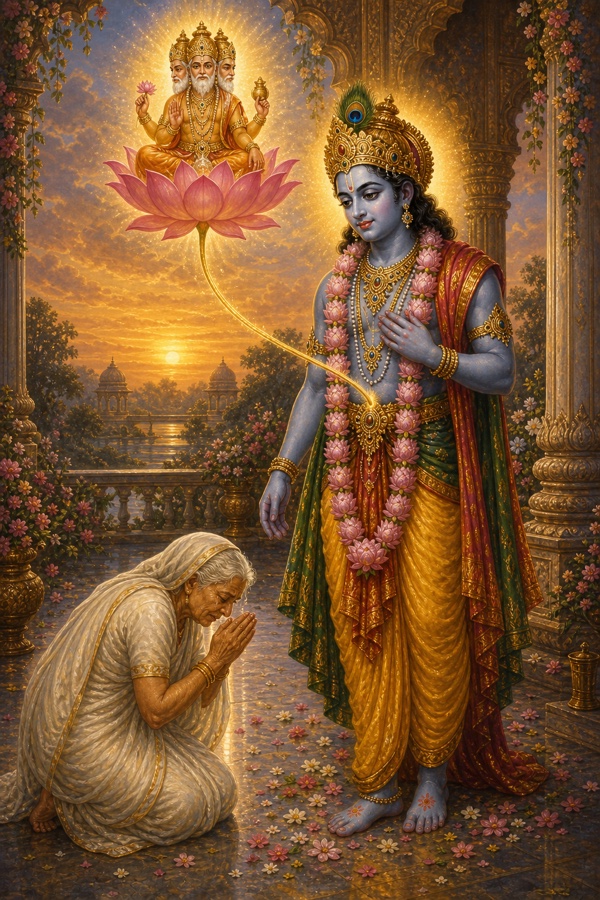
“And yet I know your names, and the names are a door. You are Shri Krishna, Vasudeva’s son. You are the delight of Devaki, who bore you. You are the treasure of Nanda the cowherd, who raised you among his herds. You are Govinda. I bow to you, and bow again. From your navel rose the lotus on which Brahma the creator himself was born, so that the maker of all the worlds has you for his ground. You wear a garland of fresh lotuses. Your eyes are long and wide as lotus petals. The sign of the lotus is pressed into the soles of your feet. To you, again and again and again, I bow.”
“Hrishikesha, lord of every sense that stirs in us, think of Devaki, your own mother. The cruel Kamsa shut her up in his prison for year after year, and she grieved there, and you delivered her. What you did once for that mother you have done for this one over and over. From the poison. From the fire in the lacquer house. From the man-eating demons. From that assembly of the wicked. From every peril of the forest. From the missiles of the great warriors in battle after battle. And just now from the missile of Ashvatthama. Every time, the hand was yours.”
Then Kunti asked him for the one thing nobody asks.
“Teacher of all the worlds, here is my prayer. Let calamities fall on us at every step, and let them keep falling, through this life and through every life to come. Let the sorrow return. Let the trouble return, forever.”
“Because in calamity your darshan is certain. When everything else has been stripped from our hands, you appear, and whoever has once truly seen you never again enters the round of birth and death. That is the whole arithmetic of my prayer. Comfort teaches me to forget you, and I have watched it do so. So give me the hardship gladly, and give it without end, so long as the sight of you rides in with it.”
“And I understand now whom you let find you. The man swollen with high birth, with power, with learning, with wealth, cannot bring even your name across his lips; his fullness leaves no opening for you to enter. You stand in plain view of those who own nothing and claim nothing. To the ones the world calls poor, you are the entire treasury.”
“You are the wealth of everyone who has put away the very sense of mine. You stand past the three strands out of which nature weaves all that it makes. You take your delight in your own self, and you rest in a stillness nothing can enter. You are the lord of kaivalya, of moksha itself, of the final freedom. I bow to you, and bow again.”
What Kunti was asking for has a name in the science of devotion: ahaituki bhakti, love with no motive underneath it, love that files no petition and strikes no bargain. Any other petitioner at that chariot wheel would have begged for the pain to be taken away. Kunti asked to keep the pain, because he came folded inside it. She wanted him, and she had stopped caring what his favor could purchase.
“I know what you are beneath this human face. You are Kala, Time itself, the ruler over every ruler, without a first moment and without a last, keeping one even pace through all creatures alike. And when those creatures fly at one another, as my family and Dhritarashtra’s flew at each other across that field, it is you, moving through them, who set the occasion of their quarrel.”
“No one can read your purpose while you walk among us wearing a man’s body. No one is dear to you and no one is hateful to you. It is we who carve you into portions, this piece a friend, that piece a stranger, and the knife was always ours.”
“You are the soul of the universe, and you are the universe. In yourself you were never born and you perform no act. And still you take birth, and still you act, among the beasts and among men, among the rishis and the creatures of the deep water, descent after descent, and all of it together is your play.”
“And one picture of you defeats me every time I hold it up. You had broken the pot of curds, and Yashoda, the cowherd’s wife who believed to her marrow that you were only her little son, took up a cord to bind you. And you stood there caught, your head hanging, your eyes darting for a way out, the kohl around them running down your cheeks with your tears. Fear itself is afraid of you. The one whom fear fears stood in a courtyard in a cowherd’s village, afraid of a mother with a rope. I have turned that scene over for a lifetime, and the wonder of it has never once worn smooth.”
“Why were you born at all, you who need no birth? The wise give different answers, and I have listened to every one. Some say you rose in the line of your beloved Yadu simply to lift that house into glory, the way a sandal tree, rooting on Mount Malaya, makes the whole mountain famous for its fragrance. Some say Vasudeva and Devaki prayed for you in an earlier life, and that you came as their son to guard this world and finish the enemies of the gods. Some say the earth herself was sinking into the sea under her burden, and that Brahma begged you to come down and take the weight.”
“And some say you came for one reason only. That this world is full of people scorched raw by their own ignorance and their own wanting, and that you performed deeds worth the telling so that they would have something to hear, something to sing, something to repeat to one another and turn over silently in the heart. And that whoever learns to take joy in your stories that way is carried, before very long, clean past births and past deaths.”
“Tree of plenty that grants your devotees whatever they wish, you feel the weight of every soul that leans on you. So tell me if it is true. Do you really mean to leave us this very day? We rest our whole lives on your feet and on nothing else, and we have made enemies of every king left standing on the earth. Where do you imagine we will shelter?”
“Take yourself away, and the Yadavas and we Pandavas together are worth exactly what a body’s senses are worth once the soul that ruled them has walked out. And this land will lose the glory it wears at this hour. Your feet print the earth wherever you walk, and each print carries your own marks, the lotus, the thunderbolt, the goad, the banner, so that the very roads of this kingdom are lettered with you.”
“Look at the country as it stands right now. The fields are heavy with ripe grain, the woods and the hills are full, the rivers run and the oceans keep their wealth, and all of it thrives for one reason, because your glance keeps falling on it kindly.”
“You are the ruler of the universe, you are its soul, and you are its body too. So I ask my last thing, and it is the hardest. This love I bear my own people, my sons the Pandavas and your Yadavas, has grown into a strong cord, and the cord binds me to the world. Take your kindness and cut it through. Leave my mind nowhere to run except toward you. The Ganga carries her whole unbroken stream to the sea and to nothing else. Make my thought that river, Lord of the Madhus, pouring toward you alone, constant, undivided, never once turning aside.”
“Krishna, friend of Arjuna, first among the Vrishnis, you are the fire lit to burn away the whole race of princes who dress themselves in royalty and lie on the earth as dead weight. Your strength has no measure. Govinda, your descent into this world has one purpose only, to draw the suffering out of the cows, the Brahmins, and the gods. Master of all yoga, teacher of everything that moves and everything that stands still, I bow to you.”
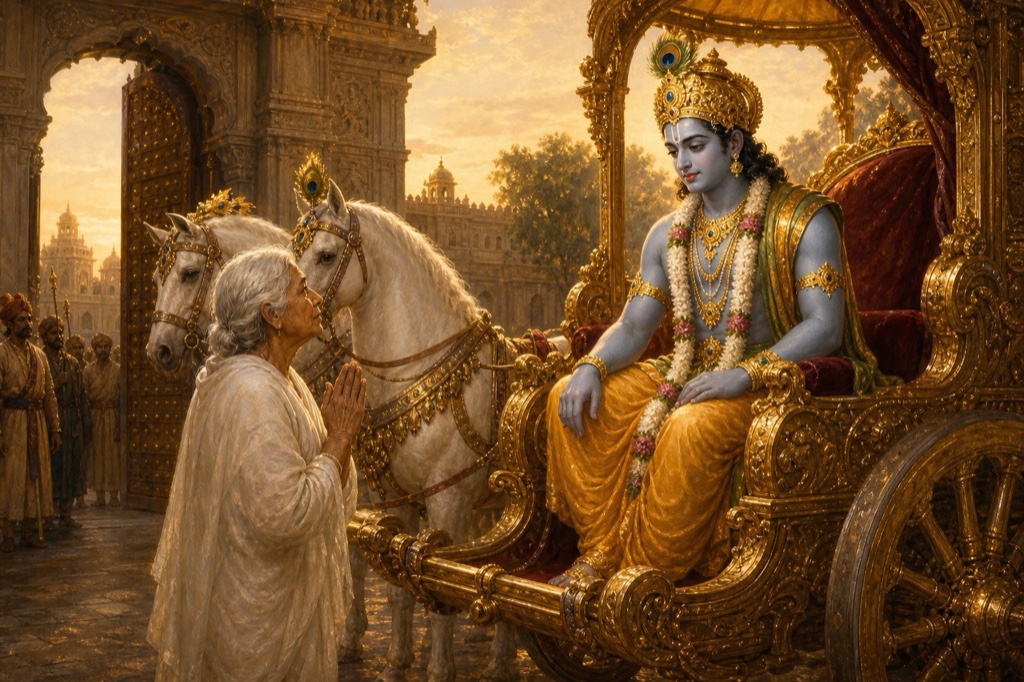
So Kunti gathered the Lord’s glories into the sweetest words she owned and laid them all at his feet. And Krishna, the lord of Vaikuntha, who had stood listening to this catalogue of his own majesty without saying a word, began to smile, a slow and gentle smile, and let the soft enchantment of his maya settle over her.
He answered the vastness of it with two words. “So be it.” Then he took his leave of her, and of the other women of the house. But as he turned toward the road, Yudhishthira could not make himself release him, and held him there out of sheer love, and Krishna turned back once more into Hastinapura.
The horses stood in their harness and were not asked to move. Kunti closed her eyes. Somewhere ahead of her another hardship was surely forming, another sorrow taking aim, and she found the thought held no terror for her at all. She knew now what traveled with it. When the trouble came back, so would he.
Literary context
The Kunti-stuti comes in the first Skandha of the Shrimad Bhagavata, in the eighth chapter (1.8.18-43). The war has just ended, Shri Krishna stands ready to leave for Dwarka, and Kunti speaks these twenty-six verses to him with the five Pandavas and Draupadi at her side, only moments after his discus and his maya have turned Ashvatthama’s brahmastra away from the unborn child in Uttara’s womb.
‘Vipadah santu tah shashvat’ (1.8.25), that is, “let those calamities come to us again and again, so that your darshan keeps coming with them,” is the hymn’s most famous shloka. It holds the rare mood of bhakti in which the devotee hands comfort back to the giver and asks to keep only the remembrance of the Lord.
Kunti’s prayer was, “Govinda, send me calamities, so that you stay remembered.” The temple’s threshold tends to come to mind only when life begins to shake. Kunti caught that same habit in herself, refused to be ashamed of it, and turned it into the very instrument of her bhakti.