The Hanuman Chalisa
Forty-three lines, a recitation of ten minutes, and a courage that outlasts the reciting. The tradition tells that Tulsidas composed it in a prison cell, and from that cell it went out into the temples and kitchens of the north, where it is still said every morning. The thread begins with a mirror being wiped clean.
First, one thing
The tradition tells a story, and no early manuscript stands behind it. It is said that the Mughal emperor Akbar threw Tulsidas into prison over some dispute, and that in that cell he composed the Hanuman Chalisa. Whether or not the cell was real, the legend has shaped the way the forty chaupais are heard: a prayer for release from bonds, said to have been written by a man in chains.
The build is plain: two dohas at the start, then forty chaupais (those forty give the Chalisa its name), and a closing doha at the end. The language is Awadhi, the everyday speech of Awadh, the country around what is now Lucknow. Tulsidas was a deep scholar of Sanskrit, and he chose the speech of the road and the field so that the forty lines could be held by heart by anyone who heard them once or twice.
That choice is its strength. The forty lines ask for nothing to be brought to them beforehand. Each chaupai opens one form of Hanuman, and most of them carry a story folded inside, which unfolds a few chaupais at a time.
PDF · Download
The Hanuman Chalisa in Devanagari, a single PDF for printing. To keep at the place of recitation or to send to someone.
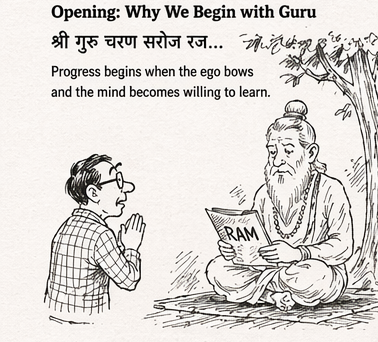
See where Tulsidas begins. He starts by cleaning his own mind, and only then turns to praising Rama. In the first doha he wipes the mirror of his mind with the holy dust from the lotus feet of his guru, and only then sets out to sing that pure glory of Sri Rama which grants the four fruits of life: dharma, artha, kama, and moksha. Clean the mirror first, and then something will show in it. In the second doha, holding himself to be dull-witted and incomplete, he calls the son of the wind to mind, and asks for three things, strength, intelligence, and knowledge, along with the removal of all his suffering and the flaws of his mind. A great poet is calling himself “dull-witted.” This is the openness without which no teaching ever settles inside a person. And the three boons he asks for here, the whole Chalisa in a way turns around these three.
1 · 2 · 3
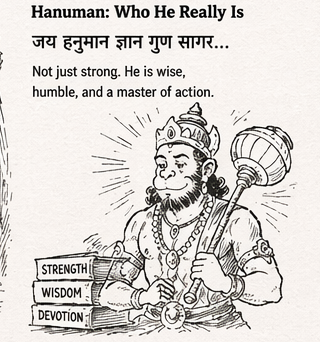
The Chalisa sets its key in the first three chaupais, and it opens with an introduction. The first line holds the word “sagar,” ocean, and the choice is exact: knowledge and virtue in him have no floor that a plumb line could reach. He is the lord of the monkeys, the one whose radiance lights all three worlds. Then Tulsidas names his roots: he is the messenger of Sri Rama and his strength stands beyond all comparison, the son of mother Anjani, and, born from a portion of the wind god, the son of the wind as well. The third chaupai hides a small thing inside it: he is the great hero, valiant, “Bajrangi,” his body firm as the thunderbolt, and he carries far more than strength. He clears away wrong thinking and confusion and becomes the companion of those with clear minds, “the friend of sound judgment.” Strength and understanding, both together, each incomplete without the other.
2
A small story: The old bear Jambavan tells it on the shore of the southern sea, in sarga 66 of Valmiki’s Kishkindha Kanda. Anjana had once been an apsara, Punjikasthala, cursed to be born among the monkeys and free to take whatever form she pleased, and she became the wife of Kesari, a king of the monkeys. One day she stood on a mountaintop in her human form, and the wind lifted the edge of her garment. The god of the wind saw her and was taken. When she cried out that she was another’s wife, he answered that he had touched her in mind alone, and that she would bear a son with his own strength and his own speed. Hanuman was born in a cave of that mountain. This is why he is both “son of the wind” and “Kesari-nandan,” the two names running side by side.
4 · 5 · 6
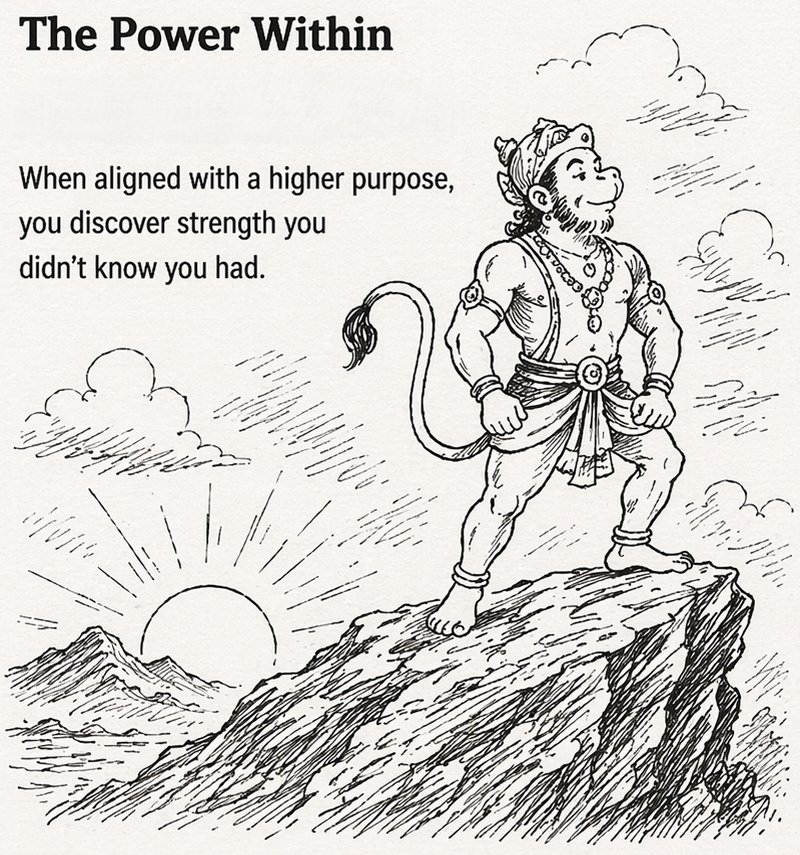
The next three chaupais draw the form of Hanuman, and they draw it to be looked at. The color of his body is golden as gold itself, fine garments and ornaments, earrings swinging at his ears, curling hair that steals the mind. In devotion the image works as an anchor, tying the mind to one place. Then Tulsidas sets strength and restraint together in that same image: in one hand the thunderbolt, that is, the mace, in the other the flag of victory, and across his shoulder the sacred thread of munja grass, a sign of his austerity and his learning. Strength in one hand, restraint on the shoulder, this pairing is the real point. The sixth chaupai opens his two roots: he has sprung from a portion of Lord Shankara, the Shiva Purana tells of him as an avatar of Rudra, and he is also the son of King Kesari. One root divine, one of the earth, joined to both above and below, and his radiance so vast that the whole world bows.
7 · 8
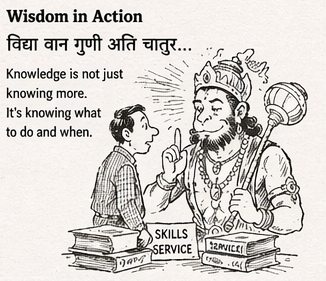
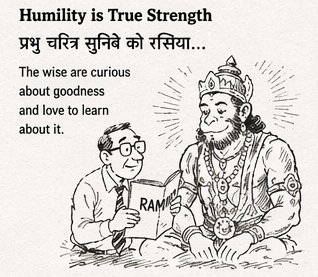
Here the Chalisa makes its finest turn. The seventh chaupai counts out Hanuman’s gifts: he is learned, full of good qualities, exceedingly clever. Valmiki had already set the measure of that learning, in sarga 3 of the Kishkindha Kanda, where Rama hears him speak once, in disguise and without a name, and tells Lakshmana that no one could speak so who had not studied the three Vedas and the whole of grammar. And with all of this, the end of the line arrives, “eager to do Rama’s work,” always eager for the service of Sri Rama. Every gift, and still ready to serve, this is his greatest mark and the true test of great strength as well. The eighth chaupai tells of his dearest habit: he takes delight in hearing Rama’s deeds and stories, and in his heart Rama, Lakshmana, and Sita, all three, always dwell.
8
A small story: Valmiki gives the necklace in sarga 128 of the Yuddha Kanda. At the coronation in Ayodhya, Rama hands Sita a string of pearls and tells her to give it to whomever she pleases, and she looks once at Hanuman and puts it around his neck. What follows belongs to later devotion, told for centuries in temple and home. Hanuman broke each pearl open with his teeth and looked inside, then said, “My Rama is not in these.” Someone asked, laughing, “Then is Rama inside your body?” Hanuman tore open his chest with his nails, and everyone saw Rama, Lakshmana, and Sita seated there. Painters and sculptors have returned to that opened chest ever since.
9 · 10 · 11
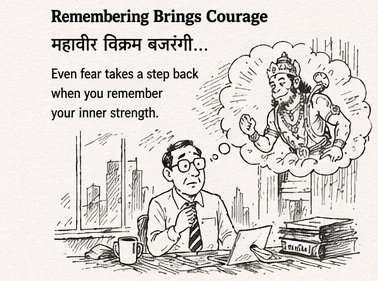
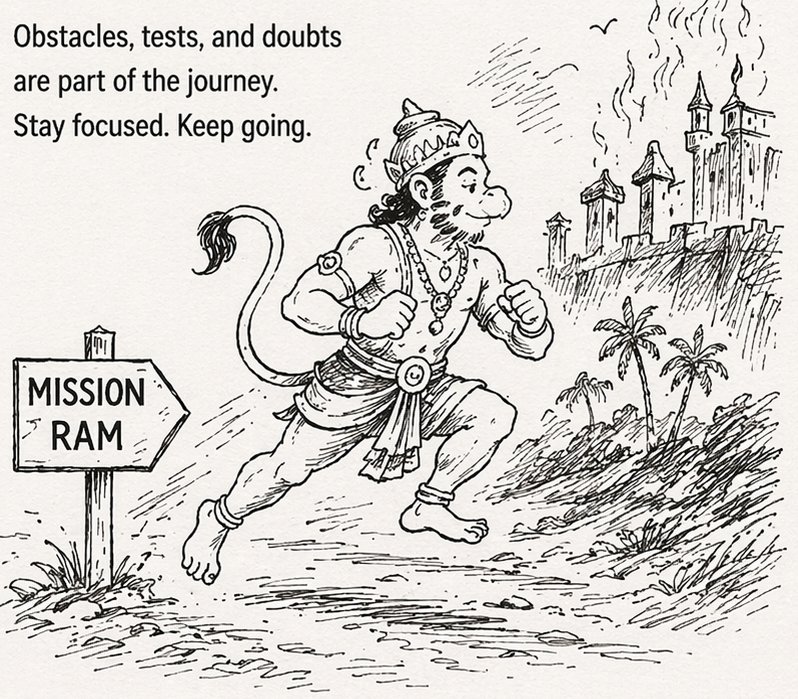
Now the Chalisa descends into the heroism of the Ramayana. The ninth chaupai holds two opposite forms in a single line, the smallest and the most fearsome, and both by his own will. Taking a tiny form, Hanuman showed himself to mother Sita in the Ashoka grove, so small that the demons would not know him, and later, taking a terrible form, he burned all of Lanka with the fire of his tail. The real strength lies exactly here, in being able to decide which form is needed and when. In the tenth chaupai he takes an enormous form, destroys many demons, and sets right every hard task of Sri Ramachandra. The word “sanvare,” set right, is a tender one; it says more than “did.” The task left his hands finished and made beautiful. Then the immortal scene of the eleventh chaupai: for Lakshmana, fallen senseless under a shakti, Hanuman brought the sanjivani herb from the mountain of herbs in the Himalaya and saved his life, and Rama was so glad that he held him to his heart. The Manas has Meghnad throw that shakti; in Valmiki, in sarga 101 of the Yuddha Kanda, the lance is Ravana’s own, and the mountain stands between the peaks of Rishabha and Kailasa.
9
A small story: Valmiki sets the size in sarga 2 of the Sundara Kanda: at nightfall, at the walls of Lanka, Hanuman shrank his body to that of a cat and went in. He did not show himself to the grieving Sita at once. From the branches of a shinshapa tree above her in the Ashoka grove he first sang the story of Rama, softly, so that the name would reach her before the stranger did, and only then came down, small, with his palms joined. He handed her Rama’s ring, gave his message, and took her crest-jewel as a token of recognition. As he left he laid the grove waste, defeated the demon soldiers, then stood fearless in Ravana’s court and delivered his master’s message. Ravana ordered him killed; Vibhishana spoke for the life of an envoy, and the sentence became the burning of the tail. With that burning tail he set the great mansions of Lanka ablaze.
11
A small story: Valmiki tells it twice in the Yuddha Kanda. In sarga 74, when Indrajit’s weapon of Brahma has laid the whole army senseless, Jambavan sends Hanuman to the mountain of herbs between the peaks of Rishabha and Kailasa, for four herbs with the mritasanjivani among them. In sarga 101, when Ravana’s lance has felled Lakshmana, the physician Sushena sends him to the same mountain. Both times the herbs hide themselves from him, and both times he does the one thing left to do: he breaks off the whole peak and carries it on his shoulder across the sea. Kalanemi, the demon Ravana sends to waylay him on the road, belongs to the Adhyatma Ramayana and the Manas. In the temples of north India this scene, Hanuman flying with the mountain lifted high, is one of the images most often made.
12 · 13
The next two chaupais tell how Rama himself sees Hanuman. In the twelfth chaupai Rama praises him greatly and says, “Hanuman, you are as dear to me as my beloved brother Bharata.” In Valmiki’s Ayodhya Kanda, Bharata refuses the throne his mother won for him, carries Rama’s sandals back from the forest, sets them on the seat of Ayodhya, and rules in Rama’s name for fourteen years from a hut at Nandigram, dressed in bark like his brother. To place someone in that same rank is to give him room inside your own heart. In the thirteenth chaupai Rama says that even the thousand-mouthed Sheshnaga forever sings his glory, and saying this, Rama, the lord of Lakshmi, embraces him. The meaning is plain: to sing Hanuman’s glory, one tongue is nothing, even a thousand tongues fall short. Sometimes the truest form of praise is just this, admitting that words are falling short.
14 · 15
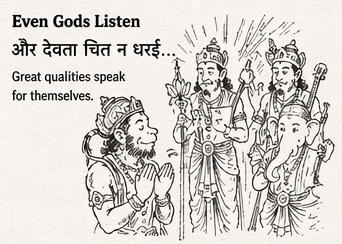
Now the whole of creation gathers to praise him, and that is the force of these two chaupais. In the fourteenth chaupai the four Brahma-sons beginning with Sanaka, gods such as Brahma and the great sages, the divine seer Narada, Sharada the goddess of learning, and Sheshnaga, all of them sing Hanuman’s praises. Those who are themselves so high are bowing too, and this is the mark of real height. The fifteenth chaupai goes further: Yama, Kubera the god of wealth, and the Dikpalas who guard the eight directions cannot fully describe his glory either, so how far can an ordinary poet or scholar hope to sing it? Tulsidas is placing himself in this same line, I too am a poet, my words too will fall short, and this is a poet’s honesty.
14
(Each of these names carries its own story, Narada’s vina, Sharada’s swan, Sheshnaga’s thousand hoods. The deep dive opens them one by one.)
16 · 17
The sixteenth and seventeenth chaupais move as a pair, and in both a single act of Hanuman’s decides everything that follows. In the sixteenth, Hanuman did a great kindness for Sugriva, king of the monkeys, bringing him together with Sri Rama, and the result was that Sugriva won the royal throne of Kishkindha. That one meeting set the rest of Rama’s story in motion. In the seventeenth, Vibhishana took the counsel Hanuman gave, left the side of the unrighteous Ravana, came into Rama’s refuge, and after the war became king of Lanka. In the sixteenth a meeting turned the course of events, in the seventeenth a word of counsel did.
16
A small story: Sugriva’s brother Bali had driven him from the kingdom, and he stayed hidden with a few companions on Mount Rishyamuka. When Rama and Lakshmana, searching for Sita, arrived there, Sugriva saw two armed princes climbing his mountain and sent his minister down to learn what they wanted. In Valmiki, in sargas 3 and 4 of the Kishkindha Kanda, Hanuman comes to them as a wandering mendicant, questions them, names himself, and then carries the two princes up the mountain to Sugriva on his own back; the Manas gives him the form of a Brahmin for that first meeting. He kindled a fire between the two, and with the fire as witness Rama and Sugriva walked around it and were friends. From this friendship the whole further story was built; Sugriva’s army of monkeys became Rama’s strength in the search for Sita and the war at Lanka.
18 · 19
Now two chaupais of childhood and journey, and in both an impossible feat is shown as something easy. In the eighteenth is that famous scene: the sun, thousands of yojanas away from the earth, which Hanuman as a child took for a sweet fruit and swallowed. In the nineteenth, holding Sri Rama’s ring in his mouth, the signet ring Rama had put into his hand at Kishkindha so that Sita would know his messenger, he crossed the vast ocean in a single leap, and the line says this was no wonder at all, it was an easy thing. So great a feat, and it is called “no wonder,” nothing to marvel at.
18
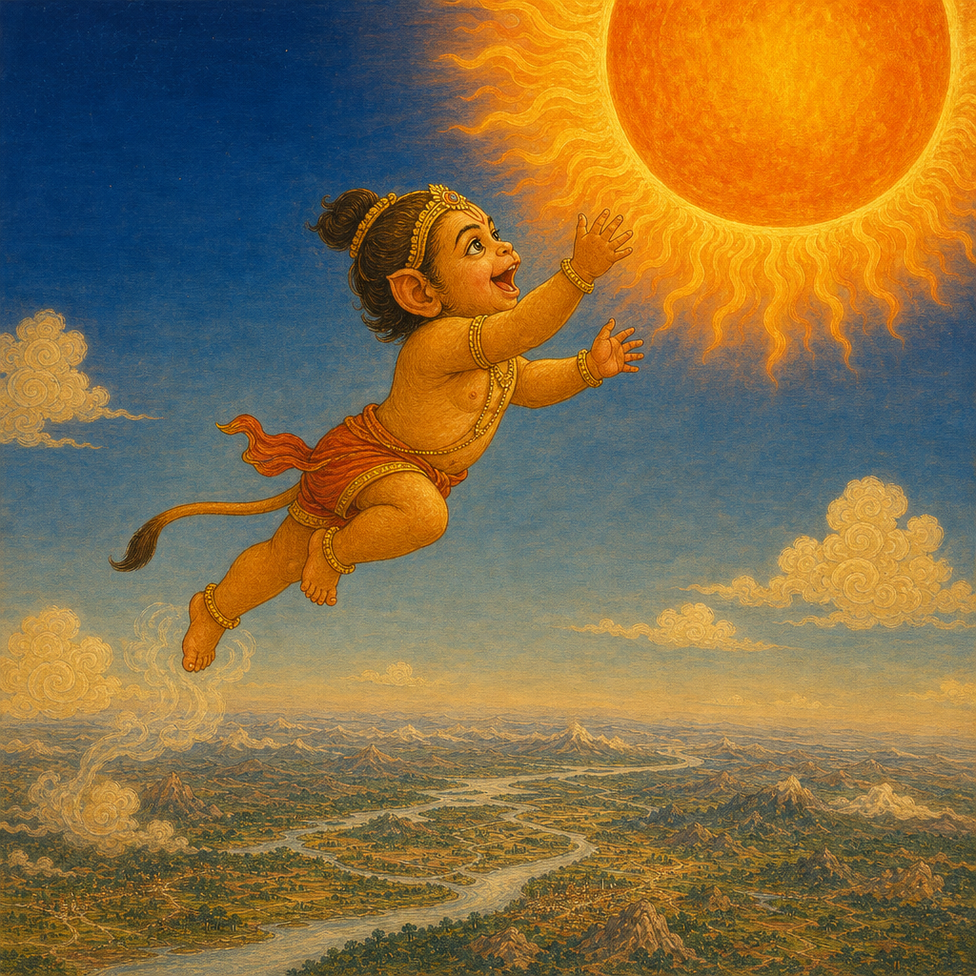
A small story: One day in childhood Hanuman took the rising sun for a ripe red fruit and flew up toward the sky. That same day Rahu was coming to lay an eclipse on the sun; he took Hanuman for another Rahu. Indra came in anger and hurled his thunderbolt. It struck Hanuman on the chin, “hanu” in Sanskrit, and he fell senseless. From this he got his name: “Hanu-man.” Then the wind god in anger stopped the air of the world, every creature began to choke, all the gods came to beg his pardon, and they left Hanuman with a wealth of boons. Valmiki tells it in sarga 66 of the Kishkindha Kanda and at length in sargas 35 and 36 of the Uttara Kanda, and the Uttara Kanda adds a curse laid by the sages on the unruly child, that he would forget his own strength until someone reminded him of it.
There is a puzzle of arithmetic hidden in that “thousand yojanas” as well, and some set the figure against the sun’s real distance; the deep dive works it out.
19
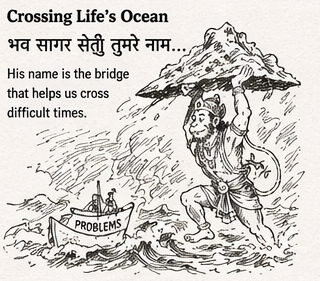
A small story: Valmiki gives the crossing in the first sarga of the Sundara Kanda. To leap the ocean, Hanuman climbed Mount Mahendra, pressed both arms down on the rock until the mountain streamed water, and sprang. On the way the god of the ocean raised up Mount Mainaka, golden, out of the water, so that he might rest; Hanuman touched its peak with his palm and went on, at Rama’s work, without stopping. Then Surasa, mother of the serpents, opened her mouth wider each time he grew, so he shrank to the size of a thumb, passed in and out of it, and took her blessing. Then a demoness named Simhika seized his shadow on the water and dragged him down; he dropped into her and tore his way out. All along the way his speed, his intelligence, and his restraint, all three, were tried.
20 · 21 · 22
Here the key of the Chalisa shifts; now it turns toward the one reciting it. The twentieth chaupai gives a plain assurance: however hard and all but impossible the tasks of the world may seem, once Hanuman’s grace comes they all turn easy, and the distance between “hard to reach” and “easy” is not as fixed as it looks. In the twenty-first he is the guardian of Sri Rama’s door, the chief doorkeeper; without his leave no one may enter there, meaning whoever wishes to reach Rama must first pass through Hanuman, the road of devotion runs through service. In the twenty-second, whoever comes into his refuge finds every kind of comfort with ease, and when the guardian is Hanuman himself no one has anything to fear, “no fear of anyone.” The Chalisa returns again and again to this one feeling, the lessening of fear, and this may be the greatest thing it gives.
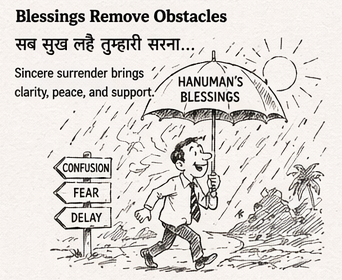
23 · 24 · 25 · 26
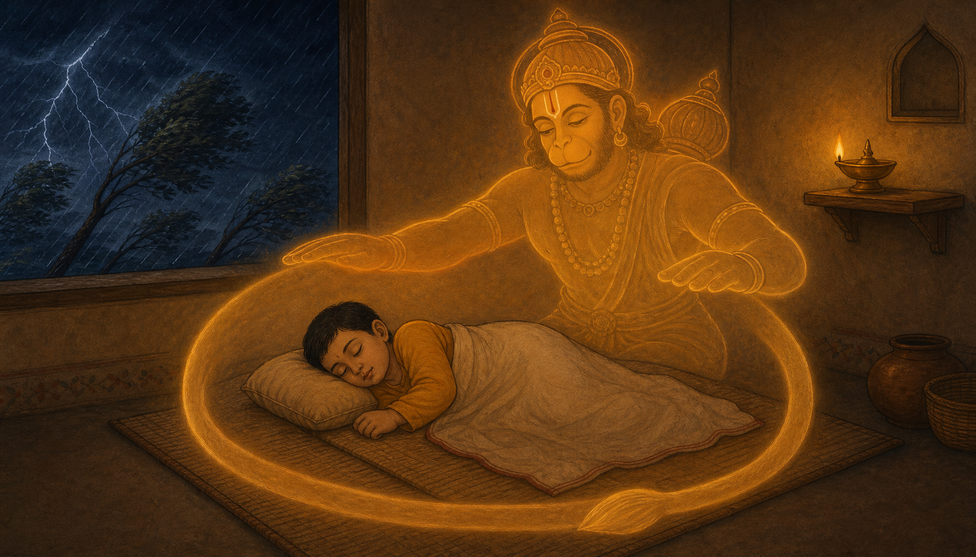
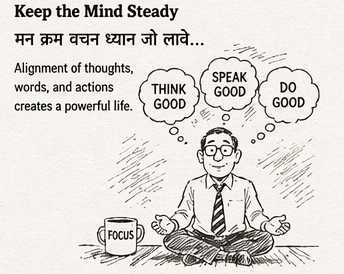
Now come four chaupais on the glory of the name, and they hold some of the most often recited lines. The twenty-third chaupai makes a fine point: Hanuman’s radiance is so great that only he himself can hold it, no one else can bear it, and at a single roar from him all three worlds tremble. Holding power steady is the harder art, and the line gives it to him. In the twenty-fourth, when someone takes the name of “Mahavir Hanuman,” negative forces like ghosts and spirits do not come near, one name, and a dark corner of the mind grows a little bright. In the twenty-fifth, whoever keeps chanting the name of the brave Hanuman has his diseases destroyed and the pains of body and mind lifted away, and here the word “continually” is the key; the chanting has to be unbroken. The twenty-sixth sets a beautiful condition: whoever fixes his attention in all three ways, by mind, by deed, and by word, Hanuman frees him from every distress. What you think, what you do, what you say, let all three be in one key; this oneness is true devotion.
24
These “ghosts and spirits” carry a psychological sense as well, taken up further down.
27 · 28 · 29 · 30
The next four chaupais join the bond between Rama and Hanuman to the matter of reward. In the twenty-seventh, Sri Rama, the ascetic king, stands above all, master of all, and it is his every task that Hanuman set right and carried through. “Ascetic king,” king meaning power and ascetic meaning restraint, Rama is both at once. In the twenty-eighth, whoever comes before him carrying a heart’s wish receives boundless fruit in life; no prayer made with a true heart goes empty. In the twenty-ninth, across Satya, Treta, Dvapara, and Kali, all four yugas, his glory is present; he is famed and a spreader of light through the whole world. Tradition holds him unaging and undying, present in the body even in the age of Kali, and this feeling of standing past time is a comfort in itself. In the thirtieth he is the guardian of holy men and saints, the destroyer of demons, that is, of unrighteous tendencies, and the most “beloved” devotee of Sri Rama. Pause a moment on that word “beloved,” dulare. It is the word a household keeps for its dearest child, one small tender word set in the middle of this whole saga of valor.
31 · 32 · 33 · 34
Now the Chalisa moves toward the deepest feeling of devotion. In the thirty-first he is the giver of the eight siddhis and nine treasures, and this boon, the line says, was given to him by mother Janaki herself. The thirty-second holds the heart of it: the nectar, the elixir, that is devotion to Rama, is his to hold, and still what he chooses is to remain forever the servant of Sri Rama. He has everything at hand, the siddhis, the treasures, the nectar, and his choice is to be a “servant”; the highest feeling of devotion is right here. In the thirty-third, by singing his praise the devotee attains Sri Rama himself and forgets the sorrows of birth after birth, the servant’s door, the master’s house. The thirty-fourth gives a tender assurance: at the final hour the worshiper reaches Rama’s abode, and even if he is born again, it is only as a “devotee of Hari,” the thread of devotion holding into the next life as well.
31
A small story: The Chalisa names the giver and nothing else: Janaki gave the boon. The telling that sets it in the Ashoka grove, in the hour when Hanuman handed Sita the ring and took part in her sorrow with a true heart, and has her bless him in her joy with the power to grant the eight siddhis and nine treasures, is later devotion; Valmiki’s Sita gives him her crest-jewel and her blessing, and no more. What he received, he received to hand onward.
The eight siddhis and the nine treasures each have a name and a history; the full list, with meanings, is in the deep dive.
35 · 36
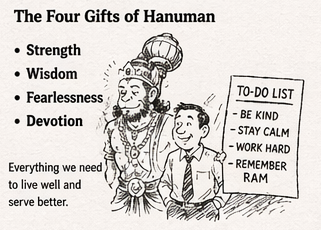
Now comes the feeling of single-mindedness, giving your whole heart to one place. In the thirty-fifth the devotee has no need to seat any other deity in his mind; from the service and devotion of Hanuman alone every kind of comfort arrives, and the line closes no door: Hanuman is himself the supreme devotee of Rama, and in his service the grace of all the gods is already gathered. The thirty-sixth repeats the very thing the Chalisa has said before: whoever remembers the strong and brave Hanuman with a true heart has all his distress cut away and all his pains erased. This repetition is like a trusted friend saying an important thing a second time, so that it settles in the heart.
37 · 38 · 39 · 40
The last four chaupais carry the Chalisa toward its close, and Tulsidas’s own cry comes forward. In the thirty-seventh he says victory to Hanuman three times, with body, with mind, with soul, and prays that grace may pour on him the way a guru shows grace to his disciple. The word “gosain” means the master of the senses; only one who has mastered himself can show another the way. In the thirty-eighth, whoever recites this Chalisa a hundred times is freed from bonds of every kind and finds a deep happiness, and the tradition that sets Tulsidas in Akbar’s prison hears a lived truth in it; if the cell was real, “chhutahi bandi,” the release from bonds, was for him no figure of speech. In the thirty-ninth, whoever reads it faithfully attains success, and the witness to this is Lord Shiva himself, the lord of Gauri, the same Shankara from whose portion the sixth chaupai says Hanuman sprang; this promise was not made lightly. And in the fortieth, the last chaupai, Tulsidas calls himself forever the servant of Sri Hari and asks for one thing only: “Lord, in your grace, make a lasting home in my heart.” Forty chaupais went on singing his glory, and at the end, setting all of it down, just this one wish, stay in my heart.
39
A thread of Advaita Vedanta runs through this one line as well: the one who makes the promise, the one who fulfills it, and the witness, all three are one and the same. It is followed further down.
The Chalisa began with a prayer, to clean the mirror of the mind, and it ends on a prayer, to seat everyone within that cleaned heart. In the closing doha Tulsidas calls the son of the wind the remover of all distress and the very embodiment of blessing, and asks of the lord of the gods only this, that together with Rama, Lakshmana, and Sita he dwell forever in his heart. The beginning and the end, tied by a single thread.
The deeper layers
The forty chaupais stand complete as they are. Under them lie further layers: what the eight siddhis really are, what “wind” carries in “son of the wind,” the arithmetic of the “thousand yojanas,” and the yoga senses of certain words.
Those layers wait at their own pace, and the Chalisa loses nothing if they are left for another day.
→ Hanuman Chalisa · The Deep Dive (esoteric words, the secret of the son of the wind, and much more)
A glimpse of Tulsidas
The tradition sets Goswami Tulsidas’s birth in 1532 at Rajapur, in what is now Uttar Pradesh, and his death in 1623 at the Assi Ghat in Varanasi, a life of nearly ninety-one years by that count.
He was a deep scholar of Sanskrit, and his mark was made by one decision: he wrote his major works in Awadhi and Braj, the spoken languages of the villages and the countryside. Poets before him, Namdev and Kabir among them, had already sung in the people’s tongues. Tulsidas carried the whole of Rama’s story over into Awadhi, in a Kashi whose pandits held Sanskrit to be the only fit vessel for it, and the tradition tells of the opposition he bore from them.
His greatest work is the Ramcharitmanas, seven books and many thousands of lines, held to be the most widely read text in the Hindi world. The Hanuman Chalisa is its reverse in scale: forty-three lines, short enough for a farmer, a trader, a child, a woman, anyone, to carry by heart, and that smallness became the reason for its reach. Its authorship, too, rests on tradition. The fortieth chaupai signs the poem, “Tulsidas, forever the servant of Hari,” and the tradition takes that signature as his.
What comes after the reading
The Hanuman Chalisa deep dive takes up the layers set aside above, the siddhis, the wind, the yojanas.
The Bhagavad Gita returns to the very thing the Chalisa returns to again and again, the lessening of fear, and to work done without a grip on its fruit. Chaupai 7 (“every gift, and still eager to serve”) and Gita 2.47 speak to each other.
One question to carry out of the reading: the Chalisa calls Hanuman “the friend of sound judgment,” the friend of right thinking. Look today for one occasion where a little more courage and a little more clear thinking, both together, could have served.
The Chalisa to recite
Here are all forty-three lines in roman letters, in the order of the Gita Press text: the two opening dohas, the forty chaupais and the closing doha. Long and short vowels are spelled alike, so let the tune you know set the length of each sound.
Shri Guru charana saroja raja, nija manu mukuru sudhari
Baranaun Raghubara bimala jasu, jo dayaku phala chari
Buddhihina tanu janike, sumiraun Pavana-kumara
Bala buddhi bidya dehu mohin, harahu kalesa bikara
Jaya Hanumana gyana guna sagara
Jaya Kapisa tihun loka ujagara
Rama duta atulita bala dhama
Anjani putra Pavanasuta nama
Mahabira bikrama Bajarangi
Kumati nivara sumati ke sangi
Kanchana barana biraja subesa
Kanana kundala kunchita kesa
Hatha bajra au dhvaja birajai
Kandhe munja janeu sajai
Shankara suvana Kesari nandana
Teja pratapa maha jaga bandana
Vidyavana guni ati chatura
Rama kaja karibe ko atura
Prabhu charitra sunibe ko rasiya
Rama Lakhana Sita mana basiya
Sukshma rupa dhari Siyahin dikhava
Bikata rupa dhari Lanka jarava
Bhima rupa dhari asura sanhare
Ramachandra ke kaja sanvare
Laya sajivana Lakhana jiyae
Shri Raghubira harashi ura lae
Raghupati kinhin bahuta barai
Tuma mama priya Bharatahi sama bhai
Sahasa badana tumharo jasa gavain
Asa kahi Shripati kantha lagavain
Sanakadika Brahmadi munisa
Narada Sarada sahita Ahisa
Jama Kubera digapala jahan te
Kabi kobida kahi sakain kahan te
Tuma upakara Sugrivahin kinha
Rama milaya raja pada dinha
Tumharo mantra Vibhishana mana
Lankeshvara bhae saba jaga jana
Juga sahasra jojana para bhanu
Lilyo tahi madhura phala janu
Prabhu mudrika meli mukha mahin
Jaladhi langhi gaye acharaja nahin
Durgama kaja jagata ke jete
Sugama anugraha tumhare tete
Rama duare tuma rakhavare
Hota na agya binu paisare
Saba sukha lahai tumhari sarana
Tuma rakshaka kahu ko dara na
Apana teja samharo apai
Tinon loka hanka te kanpai
Bhuta pisacha nikata nahin avai
Mahabira jaba nama sunavai
Nasai roga harai saba pira
Japata nirantara Hanumata bira
Sankata te Hanumana chhuravai
Mana krama bachana dhyana jo lavai
Saba para Rama tapasvi raja
Tina ke kaja sakala tuma saja
Aura manoratha jo koi lavai
Soi amita jivana phala pavai
Charon juga paratapa tumhara
Hai parasiddha jagata ujiyara
Sadhu santa ke tuma rakhavare
Asura nikandana Rama dulare
Ashta siddhi nau nidhi ke data
Asa bara dina Janaki mata
Rama rasayana tumhare pasa
Sada raho Raghupati ke dasa
Tumhare bhajana Rama ko pavai
Janama janama ke dukha bisaravai
Anta kala Raghubara pura jai
Jahan janma haribhakta kahai
Aura devata chitta na dharai
Hanumata sei sarva sukha karai
Sankata katai mitai saba pira
Jo sumirai Hanumata balabira
Jaya jaya jaya Hanumana gosain
Kripa karahu gurudeva ki nain
Jo sata bara patha kara koi
Chhutahi bandi maha sukha hoi
Jo yaha parhai Hanumana Chalisa
Hoya siddhi sakhi Gaurisa
Tulasidasa sada Hari chera
Kijai natha hridaya mahan dera
Pavanatanaya sankata harana, mangala murati rupa
Rama Lakhana Sita sahita, hridaya basahu sura bhupa
Read alongside · Companion Texts
- Vishnu Sahasranama The formal counterpart to devotional stuti.
- Narada Bhakti Sutra A formal definition of bhakti.
- The Uddhava Gita of the Bhagavatam Krishna’s last teaching before he leaves the earth, a cousin to the Gita.
For further reading
Devdutt Pattanaik’s ‘My Hanuman Chalisa’ reads the Hanuman story in cultural and psychological terms. It is in print and is best bought from its publisher.
The same story, elsewhere
- Hanuman
Character profile: the complete life of Hanuman - Chapter 19 · The Ocean Leap (Mainaka, Surasa, Simhika)
Valmiki Ramayana: the ocean leap - Chapter 22 · The Burning of Lanka and the Return
Valmiki Ramayana: the burning of Lanka - Hanuman: an Avatar of Shiva
Shiva Purana: Hanuman as an avatar of Shiva - Hanuman Chalisa · The Deep Dive
A deeper exposition of the Hanuman Chalisa (Tulsidas)