On this page
The Bewilderment of Brahma
At the far edge of Vrindavan the morning sun was still drying the dew off the grass. Krishna was in his fifth year. As on any other day he called out to his cowherd friends, the calves gathered lowing, and the whole troop set off together, some mornings toward a pasture, some toward the bank of the Yamuna.
That day they had only just walked out of death alive. A demon named Aghasura had laid himself along their path in the shape of a python a league long, jaws propped open like the mouth of a hill cave, and the boys had strolled in with their calves, taking the tongue for a footpath, until Krishna went in after them and swelled inside the throat until the monster’s own life burst from the crown of its head and rose into the boy like light returning home. Now, with the woods still ringing with it, they drove the calves along until they came out on the soft sandy shore of the Yamuna, and Krishna stopped them all. “Look at this bank, friends. The sand is soft and clean, the lotuses are opening, and the bees they have drawn are humming over them; the birds are answering from the trees. The day has climbed high and hunger is on all of us. Let the calves drink and graze the near grass slowly, and let us eat right here.”
The boys answered in one voice, “Done, done.” They watered the calves, loosed them into the green grass, and opened the little bundles their mothers had tied for them at dawn: curd-rice glistening with ghee, pickles and preserves of ginger and lime tucked in at the side. The plain food of cowherds, with the smell of home still living in it.
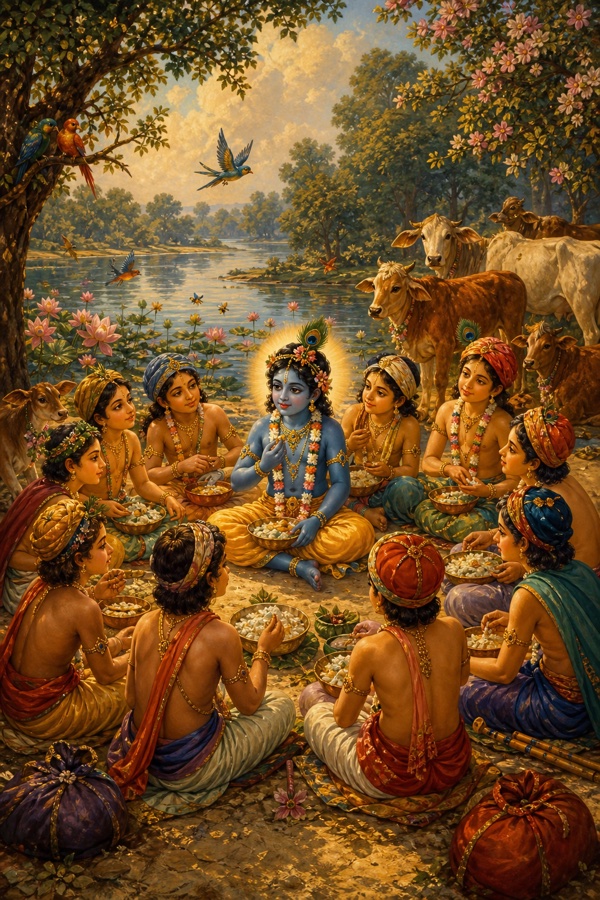
They sat down in a ring with Shyamasundar at the very center, each boy’s meal open in front of him, their eyes wide on him while they chewed. From a little way off the circle looked like the petals of a lotus set around the flower’s heart. He sat in the middle of them all, and yet every boy found Krishna’s face turned full toward his own.
The meal ran on through laughter and boasting, each boy praising the taste of what his own mother had packed and passing morsels around the ring to prove it. One made a cup of a leaf, another of a flower, another of a bud or a strip of bark, and one turned a flat stone into a plate. Kanha kept them all laughing with his jokes, lifted a bite from one boy’s hand into his own mouth, dropped a bite of his own into another’s. The flute was tucked into the fold of his waistcloth, the horn and herding cane pressed under his left arm, a ball of curd-rice sat in his left hand with wedges of pickled fruit gripped between the fingers. There in the middle of his friends sat the being to whom every fire offering on earth finally travels, eating curd-rice off his own palm, playing at being a boy, while the gods leaned out of heaven to watch.
While they ate with their minds full of him, the calves, greedy for deeper grass, wandered off no one knew how far into the woods.
“The calves are gone. They are nowhere in sight.”
Fear moved around the circle. Krishna, at whose name Death itself checks its stride, only laughed. “Keep eating, all of you, and do not worry. I will bring them back this minute.” And with the ball of curd-rice still in his left hand he rose and went after the calves alone, through the hills and the caves and the flowering thickets, wondering how far they could have strayed.
In that same hour, high above the world, Brahma was watching. The four-faced maker, born on a lotus at the beginning of things, from whose hands creature after creature has come, had seen this child undo Aghasura, had watched the demon’s freed light climb into the small body and vanish there, and the wonder of it had not let go of him since. A thought moved in him now. “This Shyamasundar has made himself a human child for the play of it. Let me see one more of his sweet glories.”
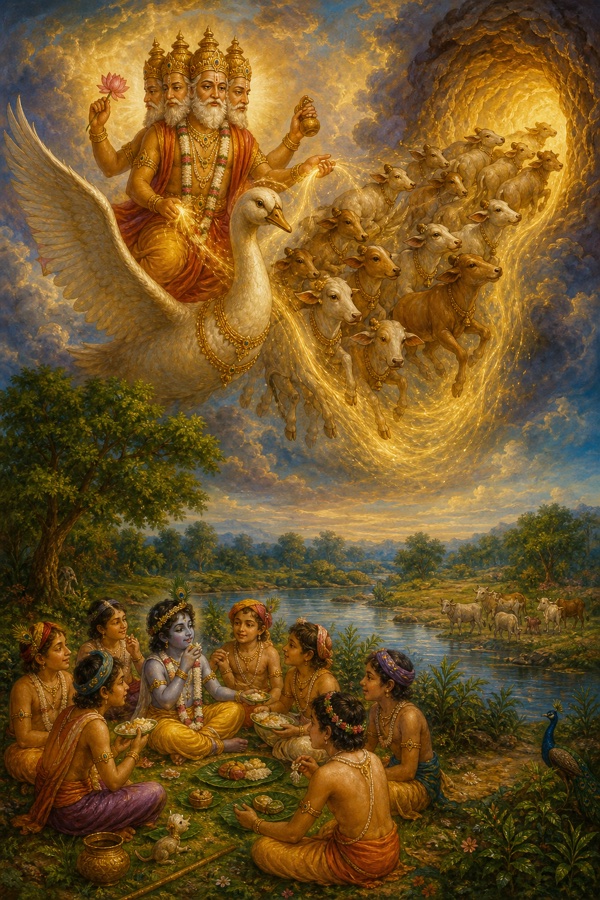
First, by his yoga power, he lifted every calf out of the woods and hid the whole herd where no search would reach.
Kanha combed the hills, the caves, the bowers. Hoofprints, lowing, and every other trace had vanished.
He turned back toward the Yamuna. By then Brahma had gone further. The moment Krishna walked off after the calves, he had carried away all the cowherd boys as well, hidden them beside the calves, and slipped out of sight to see what the child would do.
Now Shyamasundar stood alone on the shore. Calves and friends were gone. Only the opened bundles of food lying in the sand exactly where laughing boys had set them down.
He sent one glance around the empty bank, and within himself he knew the whole of it. Nothing that happens anywhere stands outside his knowing, and he saw at once whose hand had done this. The quick smile came back to his mouth.
“So. Pitamaha has come down to play a game.” Pitamaha, grandfather: the name the whole universe gives its maker. He said it with the patience of the one out of whose own body that maker had once been born.
And then, to fill the mothers of the calves and the mothers of the boys with a joy they had never earned and would never be able to explain, and to give Brahma more game than he had bargained for, the almighty set going a play that would leave the maker of the worlds himself turning in circles.
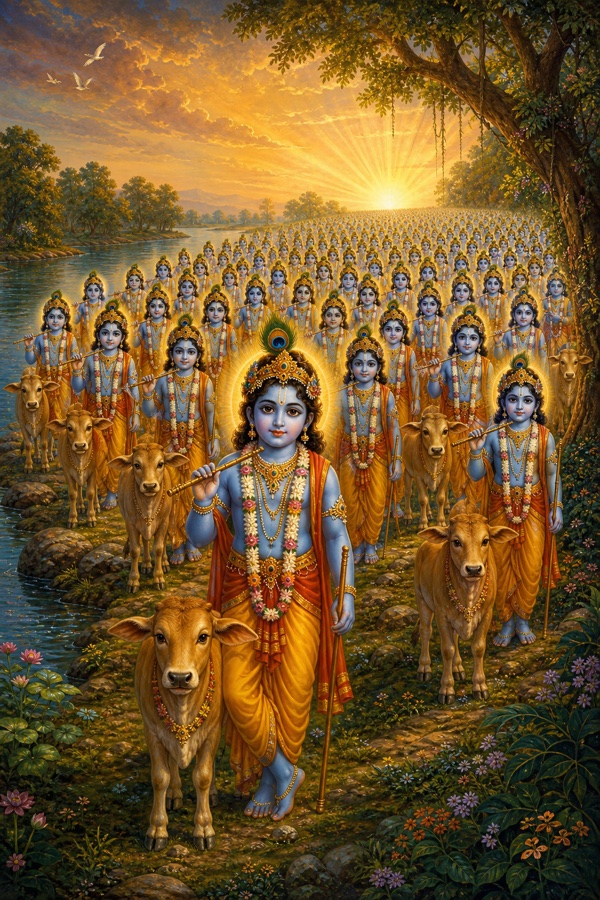
Out of his own self he brought forth new forms, countless and complete. For every stolen cowherd, a Kanha. For every stolen calf, a calf.
Every form was exact to the last hair. The same number as before, the same small bodies, the same hands and feet; each with the very staff, horn, flute, whistle, leaf-cup, and sling that boy had carried; the same clothes worn the same way, the same ornaments, the same tempers and habits and gifts, the same names, the same faces, the same ages, the same games. Each one was just as much as that boy had been, and no more. The old sentence of the Veda says that all this world is made of Vishnu. That morning the sentence put on bodies and walked, where anyone might have seen it.
Then he herded himself home. He was the calves, and he was the boys driving the calves, and he was the guide of them all, and he was every game they played on the road back. Each boy’s calves he shut into that boy’s own stall, and into each house he walked as that house’s own son. Dusk came down, the flutes sounded in the lanes, and every one of them went home. No father caught the faintest breath of it, and no mother. The calves stood in the pens, the children stood in the courtyards, and the mothers were beside themselves. “Home at last, my Lala.”
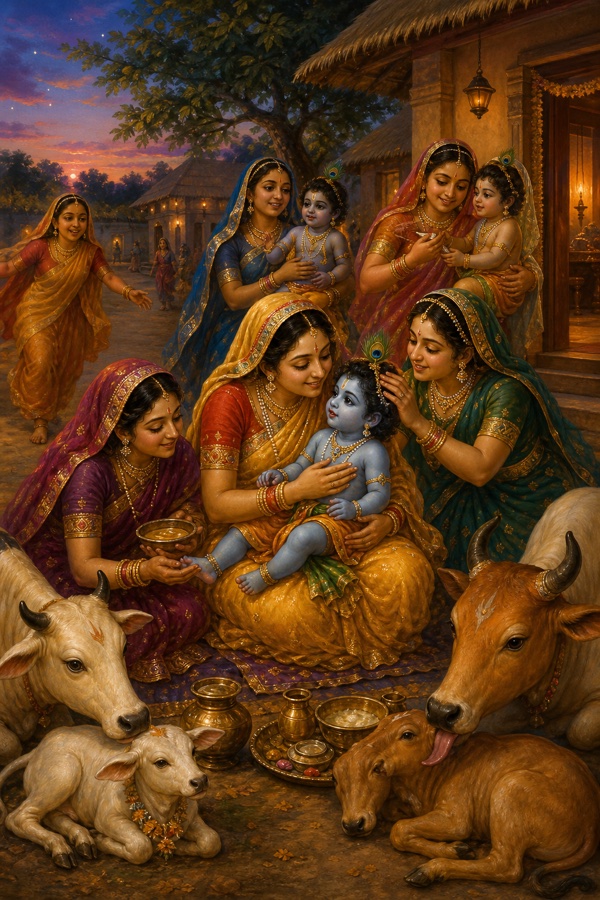
At the first flute note the mothers came running. They caught these Kanha-shaped boys up in their arms, held them against their breasts, and their milk came down of its own accord, driven by sheer love, sweeter than nectar and heady as palm sap, and they fed sons who had been weaned long ago. They rubbed them with fragrant paste, bathed them, drew sandalwood cool across their skin, dressed them in good clothes and ornaments, marked their foreheads, and made the small circling gestures that turn away the evil eye, tending the Self of every living thing as their own small son, evening after evening after evening.
In this way a whole year went by.
In those homes the parents found their children dearer than they had ever been. Day after day, by slow degrees, the creeper of their love climbed higher, as high as their love for Krishna himself had once climbed, and then past anything it had known before. They never guessed that in every courtyard it was Shyamasundar wearing the face of their darling. Everything they gave, he received exactly as their true son would have received it, with one difference too fine for any eye in Vraja to catch: the child who drank in all that love, being the one Self of every one of them, kept not a single thread of it as his own.
It was the same in the cattle pens. The cows had calved again since, and still, at the bare sight of these older calves of theirs, their udders filled and ran of their own accord, and they licked them over and over like creatures out of their senses.
When five or six nights were left to close the year, Shyamasundar went out with Balarama, grazing the calves in the forest. The cows that day were cropping grass high on the crest of Govardhana, the long hill whose slopes feed all of Vraja’s herds, and from that height they caught sight of their calves feeding far below, close to the village. Vatsalya rose in them, the mother-love that asks no permission, and swept everything else out. Forgetting themselves, paying no mind to the herdsmen or to the steep and broken path, they went plunging down with a great bellowing, milk streaming from their udders as they ran, necks drawn in at the hump, heads and tails flung high, until they looked like two-legged creatures galloping. They reached their young and licked them as though they would swallow them back into their own bodies. The herdsmen came down that hard path behind them, angry and ashamed at their failure to turn the herd, worn out by the descent, and then they saw their sons standing there among the calves, and the anger died where it stood. Love sprang up in its place. They gathered the boys into their arms, held them hard, and drew in the smell of their heads, the oldest tenderness a father owns, and it was the highest joy they knew. They could hardly make themselves leave, and afterward the mere thought of the boys set the tears running again.
Balarama, Krishna’s elder brother, watched the people and the cows of Vraja pour out more love, moment upon moment, over children long since weaned, and he could not find the cause of it. He turned it over within himself. “What a strange thing this is. The love that all of Vraja and I myself carry for Krishna, the Self of the universe, is rising in exactly that measure for these boys and these calves, as it never rose before. What enchantment is this, and where has it come from? A god’s work? A man’s? A demon’s? No. It must be the deluding power of my own Lord, for it has fooled even me, and nothing less could do that.”
Then Balarama turned the eye of knowledge on them, and he saw that every calf and every boy was Vishnu, and Vishnu alone. He said to Krishna, “I had taken these boys for gods born down into Vraja to walk beside you, and these calves for great seers who had chosen hide and horn for your sake. Even that guess falls short. You alone shine out of every one of these forms. How? Tell me the whole of it.” So Krishna told him plainly what Brahma had done, and Balarama understood.
Meanwhile Brahma came back. By the measure of his own realm only a moment had passed; a single moment of Brahma’s time swallows a year of ours whole. He came down to see what had become of his test, and he found the scene exactly as he had left it: Krishna playing on the riverbank with his companions around him, the calves grazing in Vrindavan, Nanda and Yashoda pouring themselves out over their darling.
“How can this be? Every boy and every calf of Gokula lies asleep this hour on the bed of my own deluding power, where I laid them with my own hands. Not one of them has stirred. Then who are these, just as many in number, who have been playing a whole year with Krishna in the woods and in Vraja?” He fixed his knowledge on the scene, sorting for the seam between the first ones and the made ones, and he turned the question over a long time, and could not tell, by any means he owned, which were the real ones and which were the others.
He had come to lay a spell on the one who casts the spell over the whole universe and has never once been caught in any. Now he stood snared in his own small power, and even the hold he had kept on that power was gone. The dark of a morning mist goes nowhere against the dark of midnight; the light of a firefly is simply swallowed by noon. Turn a lesser maya against a greater, and it cancels nothing except its own master’s grip.
And what he saw next took away every ground he had ever stood on.
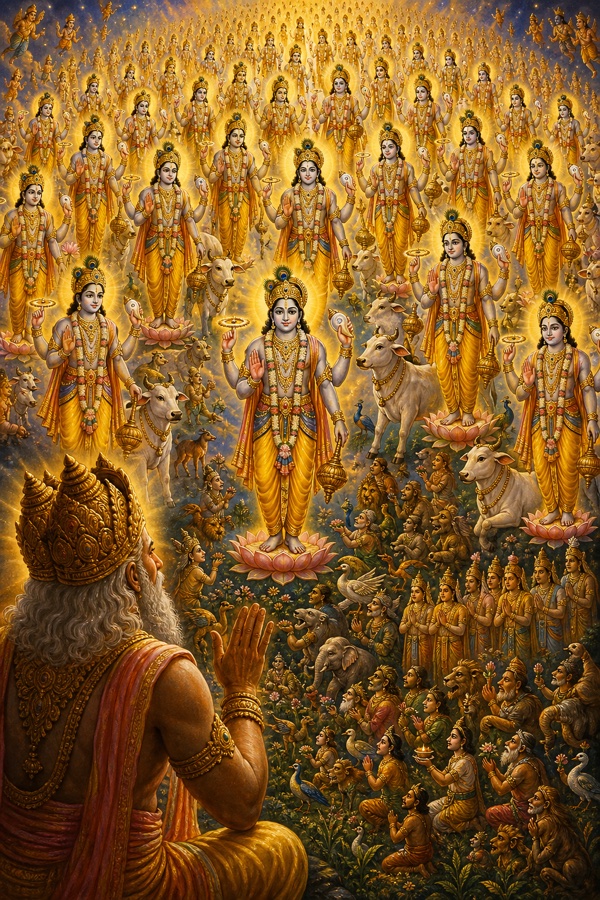
Before his staring eyes every boy and every calf turned dark as a raincloud and stood robed in yellow silk, four-armed, bearing the conch, the discus, the mace, and the lotus. On each head a jeweled diadem; earrings, necklaces of pearl, wreaths of forest flowers; the Srivatsa curl shining on every breast; armlets above, and at each wrist bracelets of precious stone cut with the three lines of a conch; girdles and rings, anklets and bangles; and over every body, head to foot, fresh soft wreaths of tulsi laid there by devotees of great and quiet merit. Their sidelong glances went out from eyes tinged red, under smiles as bright as moonlight, glances that woke longing in the hearts that loved them and in the same instant answered it. At the feet of every single form he saw all that lives and all that does not, from makers like himself down to the last clump of grass, standing embodied, dancing, singing, serving worship upon worship. Around them waited the great powers, the one that folds a body down to an atom and all her sisters; and Maya herself; and the twenty-four principles out of which the fabric of every world is woven, cosmic mind first among them, each standing there in a living form. Time was there in person, and the nature of things, and buried impressions, and desire, and action, and the three strands that twist together into all matter, standing with folded hands, their own famous glory dimmed to nothing in that company. Every form was one seamless essence of truth, consciousness, infinity, and bliss, past the reach even of those whose only eye is knowledge of the Self. And in one glance Brahma saw them all as the single transcendent Absolute, by whose light alone this whole creation, moving and unmoving, stands revealed.
Brahma’s senses gave out. All eleven doors of him, the five that perceive, the five that act, and the mind that drives them, shook once and stopped. He could not stir or blink. The maker of fourteen worlds stood there like a doll set up on the sand beside the presiding lord of Vraja.
“What have I done. I set out to test the one out of whom I myself was born. Who am I even to ask the question?”
Then Krishna, seeing his bewilderment, and without the smallest effort, drew the curtain of his maya aside. He is the one no reasoning can corner, who shines by his own bliss, who stands outside every spell including the one the world is made of, the one the Upanishads approach by subtraction, saying of everything the mind can hold, this is not he, this is not he, until only he is left. Outer sight came back to Brahma the way life comes back to a dead man. He worked his eyes open with great difficulty, and only then did his own body, and this universe, come into view again.
He looked around and saw Vrindavan spread out before him, its trees heavy with what the people lived on, sweetness scattered on every side, and creatures that are born enemies, the man and the hunting beast, moving through it together like friends, all anger and all craving gone out of the place, because the one no power can defeat had made his home in it. And in the middle of it he saw the secondless Infinite, wisdom without a floor, playing the part of a child born among cowherds, standing alone exactly as before, the ball of curd-rice still in his left hand, looking about for his calves and his friends as though he had stepped away from the meal only a moment ago.
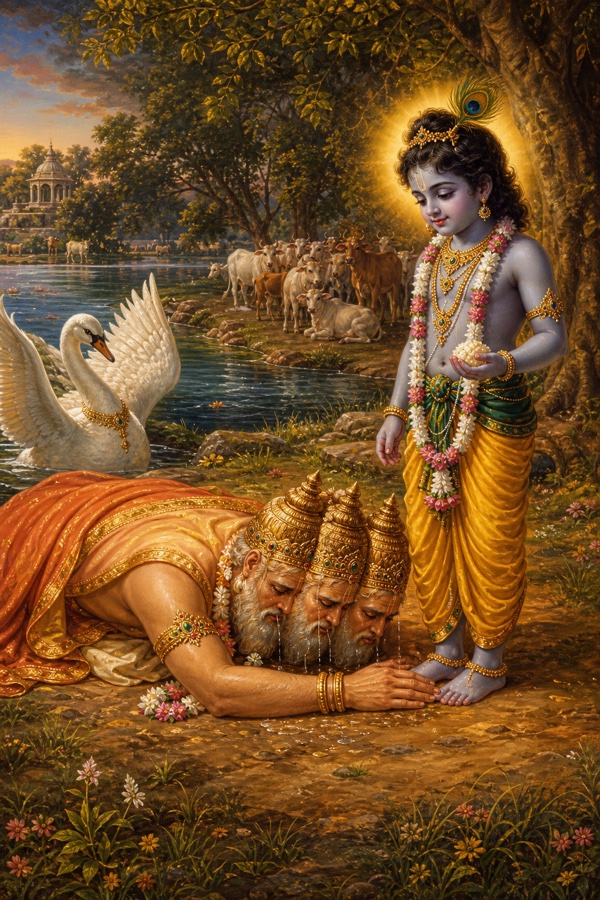
The instant he saw him, Brahma came off his white swan in one motion and let his body, bright as a bar of gold, fall full length on the ground like a dropped staff. He touched Krishna’s feet with the crests of his four crowns, one crown after another, and bathed them in a running stream of the tears of joy. Again and again the glory he had just seen rose back over him, and again and again he rose, and fell, and lay a long while at those small feet. At last he got slowly up, rubbed his eyes, and looked at Krishna. Then, head bent low, palms joined, his voice failing and catching and his whole body trembling, he began, very humbly, to praise him.
“Let me praise you as you stand, child of a cowherd. Your body is a raincloud that walks; your dress burns against it bright as the lightning; your face is lit with earrings of scarlet gunja seed, the peacock feather stands in your hair, and the forest garland swings at your neck. A morsel of curd-rice in your hand, a cane, a horn, a flute: these are your emblems today. Those feet are soft as new leaves. And even this much of you, this one small body, I cannot fathom, though I turn my whole mind inward upon it. No gross element ever went into it; the wishes of the people who love you gave it shape, and it stands here as your kindness to me made visible. If the child is past my sounding, what will I ever measure of you yourself, who are truth, and consciousness, and bliss with no shore?”
“And yet you are easily won, unconquerable one. The whole conquest of you belongs to people who stay in their own houses and let your stories come to them, told by some wandering saint at the door, who give those stories their body and tongue and mind, and quietly let the long grind for liberation drop. Those who set devotion aside and strain after bare knowledge harvest the strain itself, like men pounding husks long after the grain is gone. Strivers past counting have walked this earth, masters of one discipline after another; the ones who arrived laid their every act at your feet, won devotion by that surrender, heard your stories and let the devotion deepen, and were home without another step. Even your unqualified glory, the one with no attributes at all, shows itself to the pure-hearted whose senses have turned inward, and it shows itself the way light does, by its own shining; nothing outside it will ever hold it up for viewing. As for counting your qualities: sooner count the dust grains of the earth, the drops in a fall of dew, the rays pouring from every star. Clever men have managed those. No one has ever finished with you. And the man who claims none of this, who simply lives on watching for your grace, taking in a level spirit whatever his own past acts bring him, bowing to you with heart and speech and body, that man finds his share in the highest freedom already held in his name.”
“Now look at what I did with my little power. I tried to throw a spell over you, you, the cause of everything, the deluder of every deluder, the infinite one, and all of it so that I could watch my own magnificence at work. What am I, held against you? A flame putting on airs in front of the fire it leapt from. I was born of passion’s strand; I mistook the office you gave me for a lordship of my own; my eyes were sealed shut with the ignorance that kept whispering, you are the unborn maker. Forgive it, deathless one, the way a master forgives a man who is his to protect. Measure me. I stand seven spans tall, spans of my own hand, and I preside over one cosmic egg, one, a pot of a world so frail it is wrapped for safekeeping in its eightfold sheath of matter, from earth and water and fire up through the root of nature itself. And universes like it drift through the pores of your body the way dust motes cross the air holes of a lattice. When a child in the womb kicks out its heels, does the mother count it an offense? And is there anything anywhere, anything a word can name or refuse to name, that lies outside your belly?”
“The scriptures say Brahma sprang from a lotus that grew from the navel of Narayana, asleep on the waters into which the three worlds had dissolved. I am the proof of that line, for you are that Narayana and I came out of your body: you, the soul of everything that wears a body, the prompter under every impulse, the witness behind every act. The form that rests on the waters rests there as one form of yours, and the finite look of it is play, no bound of yours at all. Once, new-made on my lotus, I climbed down inside its own stalk hunting for the root it grew from, hunting for you, and found nothing; and long afterward, when I had burned through ages of austerity, you rose in my heart of your own accord. So the sight of you follows no law except your pleasure. In this very descent you opened your mouth for your mother, and inside it she saw this whole universe standing, herself in it, bent over you, looking in. As all of it appears within you, so it appears outside you, and both are your maya. Today you laddered that lesson for me rung by rung. First you alone were, and my theft had changed nothing. Then you stood forth as the boys of Vraja and the calves and every stick and flute and leaf-cup among them. Then you stood in just as many four-armed forms, and everything in creation was worshiping them, and I found myself somewhere in the crowd. Then you widened into as many universes. And now you stand here as you always were, the one Brahman without a second. To eyes that cannot see your nature, you appear as me, so that things can be made; as yourself, standing here before me, so that they can be kept; as the three-eyed one, so that they can be gathered back in. You take birth wherever pride needs breaking and goodness needs shelter, among gods, among seers, among men, among beasts and birds, down among the creatures of the water, and all of it without ever once being born. Who has ever tracked your play through the three worlds, where it will surface next, and when, and how, and in how many places at once? Weighed against you, this whole universe is a dream that thinks itself awake, a show of misery repeating itself and calling itself real, appearing and vanishing inside your endless being, which never appears, never vanishes, and is made of consciousness and bliss alone.”
“For you are the one Self, the first Person, older than old, real, self-luminous, endless, deathless, whole; no attribute sticks to you, and no second thing has ever stood beside you. Those who take from a true teacher the fine-ground eye of wisdom see you as the Self of their own self, and this false ocean of dying and being born lies behind them like a thing already crossed. A man who mistakes a rope for a serpent fears the rope until the day he sees it plainly; the world rises out of self-forgetting and dissolves in self-knowledge exactly so; and bondage and release are two names ignorance uses, the way a man might speak of the sun’s day and the sun’s night, when the sun has neither. And still the ignorant hunt for that Self outside themselves, wearing it the whole time as their own I. Even the sharp-eyed cannot find the rope without first setting aside the serpent that was never there; and no one sets anything aside without a grain of the grace of your feet. A man may sift his own depths alone for a lifetime and finish empty; one mote of that grace, and your glory stands open. So this is my prayer, my whole prayer. Give me any birth you please, in this life of mine or in any life after, a bird in these trees, a beast in this grass, so long as it falls inside this Gokula, where I may carry on my head the dust of the feet of these cowherds, whose entire life, whose wealth and breath and darling, is you. The Vedas have been out searching for that dust since before I was made, and here it lies in the cart tracks of Vraja. Blessed past telling are these cows and these mothers, whose own milk you drank to your heart’s content for a year, wearing their calves and their sons; every yajna ever poured into fire has failed to satisfy you, and their udders and their breasts succeeded. Blessed is Nanda, and blessed is all of Vraja, whose friend and kinsman is the fullness of Brahman itself walking in a boy’s body. And blessed are we, Lord, the eleven bright gods who stand behind the senses of every living creature, for through the eyes and ears and hands of these cowherds, as through eleven raised cups, we drink the honey of your feet day after day. What reward will you find for the people of Vraja, whose houses, wealth, kin, bodies, sons, breath, and minds exist for you alone? There is no reward outside yourself, and here you have already given yourself away. Putana came to this village to kill you at the breast, wearing a mother’s tenderness as a costume, and for that one borrowed gesture of love you raised her and her whole line to your own realm. What waits, then, for these, whose love was never a costume? Greed and its cousins rob a man, the house he keeps holds him like a jail, delusion chains his feet, and all of it only until he turns and is yours, Krishna. You, who owe this world nothing, walk about inside it copying its ways, so that the joy of the people sheltering in you has somewhere to grow. Let those who say they know you, know you. My mind will never reach around your glory, my body will never act it, and my speech, which has praised you now as far as speech goes, falls back here. All-knowing one, give me leave to go. The worlds are in your keeping; they always were. This world, and this body I walked in calling both of them mine, I lay down at your feet. Sun of the lotus of the Vrishni line; moon that lifts the tide of the earth and the gods, of the brahmanas and the cows; scatterer of the darkness that calls itself religion; enemy of the demons who stalk this earth: I bow to you, and I will be bowing still when the universe is called home. My head is at your feet until the ages run out.”
Krishna looked at the old maker and smiled, and released him with that look, the way a boy releases a grandfather from a game gone too far. Given his leave, Brahma rose, walked around him three times with his right side turned always toward that small body, the oldest homage there is, bowed once more at his feet, and went home to his own high realm. Then Krishna gathered up the true calves from the keeping in which not one moment had touched them, and brought them back to the sandy bank where his friends still sat over their opened meals, waiting for him as before. The countless forms he had worn for a year slipped quietly back into the one.
To the boys, the whole year had passed as half a blink. Such is maya: the power under which a whole creation forgets itself daily had folded one year away without their noticing. They looked up and said, “Good, you came back fast. We have not swallowed a single mouthful yet. Come, sit, eat your fill.” Kanha laughed and sat down among them, and the meal went on where it had paused. On the way home that evening he led them past the huge dried skin of Aghasura, coiled along the ground like an emptied canyon, the same skin that would serve the children of Vraja as a play cave for many days; and the boys poured into the village at dusk behind his peacock feather and his flute, shouting the news at every door: today, this very day, the son of Yashoda and Nanda killed a great serpent and saved us all. The deed belonged to his fifth year. The boys told it in his sixth, as news of that afternoon, and none of them ever felt the year that had gone missing in between.
Literary context
This katha comes from the tenth Skandha of the Shrimad Bhagavata, Discourses 13 and 14, and it opens just after Krishna has led his friends alive out of the mouth of Aghasura. Brahma carries off first the calves and then the cowherd boys, and Krishna becomes every one of them himself, so exactly that for one whole year the mothers and the cows of Vraja love these forms even more than before. When Brahma returns after what is to him a single moment, he sees that same one in every shape, and, giving himself up, he sings the hymn known as the Brahma-stuti (Discourse 14).
The line ‘krishnas tu bhagavan svayam’ (1.3.28), Krishna is the Lord himself, set at the very opening of the Bhagavata, finds its living proof in this lila: the Lord himself in person, past all reckoning of portion or ray, standing revealed in numberless forms at once.
The gist of the katha
Brahma, the maker of the universe, chose to test a child, and hid away the calves and the cowherd boys of Vraja. Kanha became every one of them himself, and for a whole year he sat in every lap and stood in every stall of Vraja. When Brahma came back, wherever he turned he saw that same one, and the pride of being the doer scattered at the feet of a five-year-old.