On this page
Parikshit and Kali
Arjuna’s grandson, Abhimanyu’s son, Parikshit had taken up the rule of an earth still scarred by the great war, the last child of the Pandava line and the only heir it had left. He governed by the counsel of the wisest Brahmins, and every noble quality the astrologers had read in him on the day of his birth showed itself in his rule. He took Kripa for his guru, and on the bank of the Ganga he performed three horse-sacrifices of such purity, with fees so open-handed to the priests who served them, that the gods came down and accepted their portions in the plain sight of every man present. He had married Iravati, and she had given him four sons, the eldest of them Janamejaya. He was just, he was generous, and he looked on his people as his own children.
Then hard news reached him: the age of Kali had begun to creep into the very lands his soldiers guarded. He took up his bow, mounted a chariot drawn by black horses under an ensign that carried the figure of a lion, and set out with chariots and elephants, horse and foot, to conquer the four quarters of the world. Bhadrashwa, Ketumala, Bharata, the northern Kurus, Kimpurusha, country upon country yielded to him and paid tribute.
And everywhere he rode he heard his people singing. They sang the deeds of his forbears the Pandavas, and through every one of those songs moved the glory of Krishna, the dark lord of the Yadavas who had steered that terrible war and then withdrawn from the world, and the love that had bound Krishna’s house to the king’s own. They sang, too, of Parikshit’s rescue: how, while he still lay in the womb, the fire of Ashwatthama’s weapon had come hunting the last unborn hope of the line, and the Lord himself had stood guard over him inside his mother’s body. He heard it all, and rode on. And it was on the bank of the Saraswati, where the river turns to the east, that one sight stopped him where he stood.
A dark man stood there in the robes and jeweled insignia of a king, yet the mind shuddered at the mere sight of him, for something base and cruel showed through the royal costume. A thick cudgel swung in his hand. And in front of him, a bull.
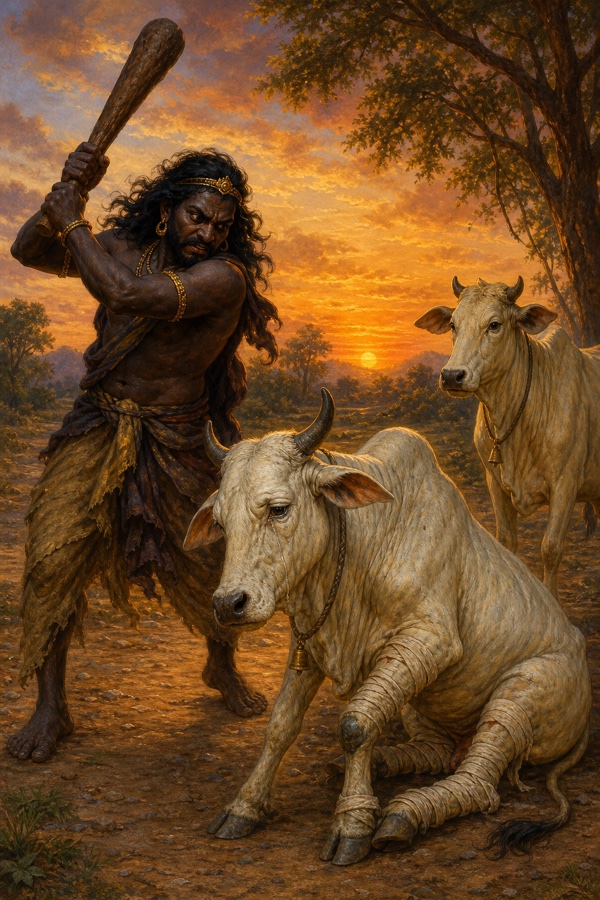
The bull was very old, white as the stalk of a lotus. Only one of his legs still held the ground; the other three were broken, and he kept his footing on that single leg with a labor that hurt to watch. Wounds covered his body. He trembled, and he stood.
And the dark man kept beating him with the cudgel, stroke on stroke, without mercy, as if the bull’s very breathing were a crime and there were no protector left in the world to answer for it.
Nearby stood a cow, of the kind whose milk and butter feed every altar fire in the land, so that a hand raised against her falls on the rites themselves. She had been kicked. Thin, ribs showing, hungry, robbed of her calf, tears running down her face. Those eyes were begging something of someone, and there was no one.
Parikshit halted his gold-plated chariot. His voice carried a king’s authority.
“What is going on here?”
The dark man froze. He turned. He raised his eyes. There was a gleam in those eyes, and the gleam was dirty, as if someone had stirred ink into clean water.
“Who are you?” he asked.
“I am the king of this earth,” said Parikshit, “and in the land I guard no one is strong enough to strike the weak. Who are you? And by what right do you beat this old bull and kick this cow, here in a lonely place, where you thought no eye would find you?”
The man came forward. Something inside him had begun to tremble.
“My name is Kali.”
Something inside Parikshit went still.
He knew. The wise counted four great ages of the world, each dimmer than the one before it, and the last and darkest of them, the age of quarrel and falsehood, carried this very name. It had set its foot upon the earth the very day, the very moment, Krishna left it. Its hour was now arriving, and its footfall could already be heard on every side.
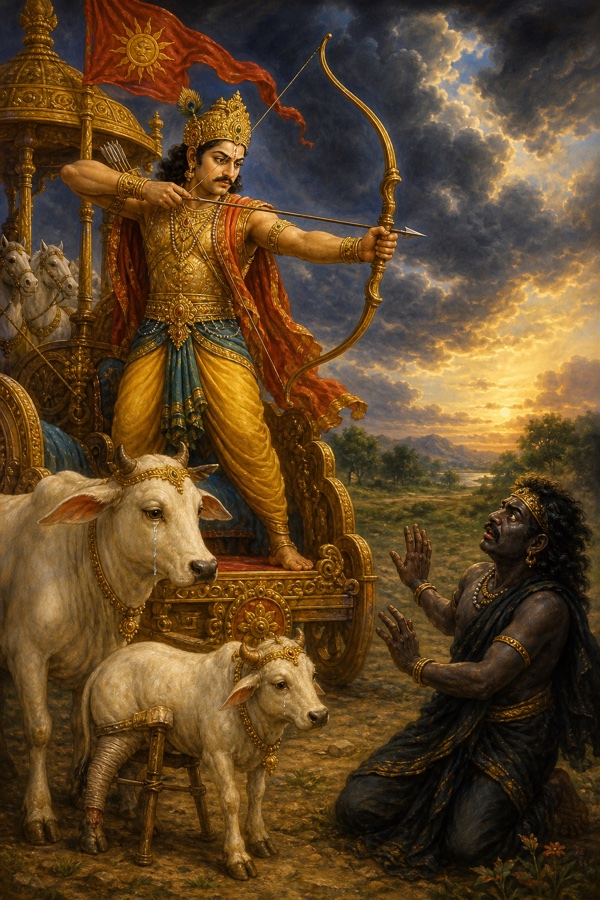
He drew his bow taut and sent out his challenge in a voice deep as thunderheads.
“You wear a king’s robes the way an actor wears them on a stage, and every stroke of that cudgel shows what lives under the costume, the lowest of the low. You chose your hour well. Krishna has left the earth, and Arjuna who carried the bow Gandiva has followed him, and so you dare to raise your hand against harmless creatures where you think no one is left to punish it. That alone earns death. If you truly are Kali, there is no place for you in the land I protect. I will finish you where you stand.”
Kali flung off the royal insignia he had draped himself in and dropped to his knees, laying his head at the king’s feet. Fear had emptied his face; whatever swagger the stolen costume had lent him was gone with it.
“Rajan, spare me. I have laid my head at your feet, and to shelter the one who surrenders has been the vow of your house since Arjuna’s day. Strike me now and you strike a suppliant.”
Parikshit heard him out, to the end.
Slowly, he let the bowstring slacken.
“Very well. A man who joins his palms before the heirs of Arjuna has nothing to fear from them; I will not kill you. But you are the friend of adharma, and you cannot stay. From the day you first crept into the bodies of kings, greed, falsehood, theft, malice, sin, want, deceit, quarrel, and hypocrisy have followed you like a retinue. Go beyond the borders of Brahmavarta, this land of sacrifice and truth, where Brahmins keep the old rites burning and the Lord of sacrifices himself lives inside every offering and blesses the men who make it. And tell me, where do you wish to live?”
Kali joined his palms.
“Then hear me, Rajan. Wherever I think of settling in obedience to your command, I look up and find you already standing there with an arrow on the string. Give me a few dwellings, places that are mine, where I may stay and your bow will not follow.”
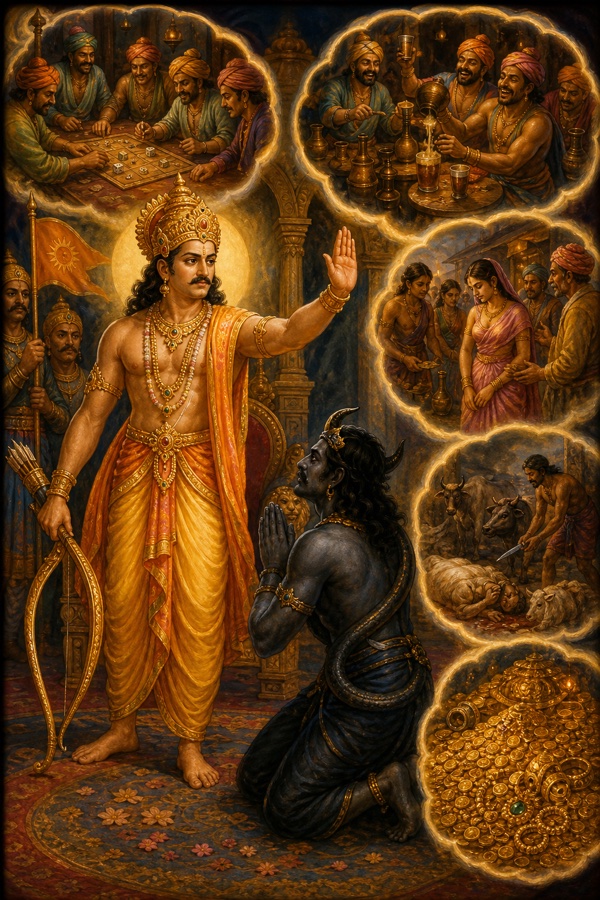
Parikshit thought for a while. When he spoke, he spoke as a judge passing sentence, and he named four dwellings.
“First, the gambling house, where the dice are thrown. Falsehood lives there.”
“Second, the tavern, where liquor flows. Intoxication lives there.”
“Third, the place where a woman’s body is sold. The delusion of lust lives there.”
“Fourth, the slaughter-ground, where helpless creatures are killed. Cruelty lives there.”
Kali asked for more. Parikshit weighed it, and granted him a fifth place as well.
“And fifth, gold, wherever it is heaped by adharma. Enmity takes root there.”
A thin smile crossed Kali’s lips. He bowed his head and said, “As you command, Rajan.” And into those five dwellings the progenitor of adharma settled, the way a seed settles into plowed ground. From that day the counsel has stood for anyone who wants his own good, and doubly for a king, a leader of men, or a teacher: never linger where those five collect.
His business with Kali finished, Parikshit turned to the bull and the cow. His voice was gentle now.
“Who are you?”
The bull slowly raised his head. Looking out of those eyes was some weary old rishi.
“Rajan, I am Dharma.”
Parikshit stood arrested.
“You? Dharma?”
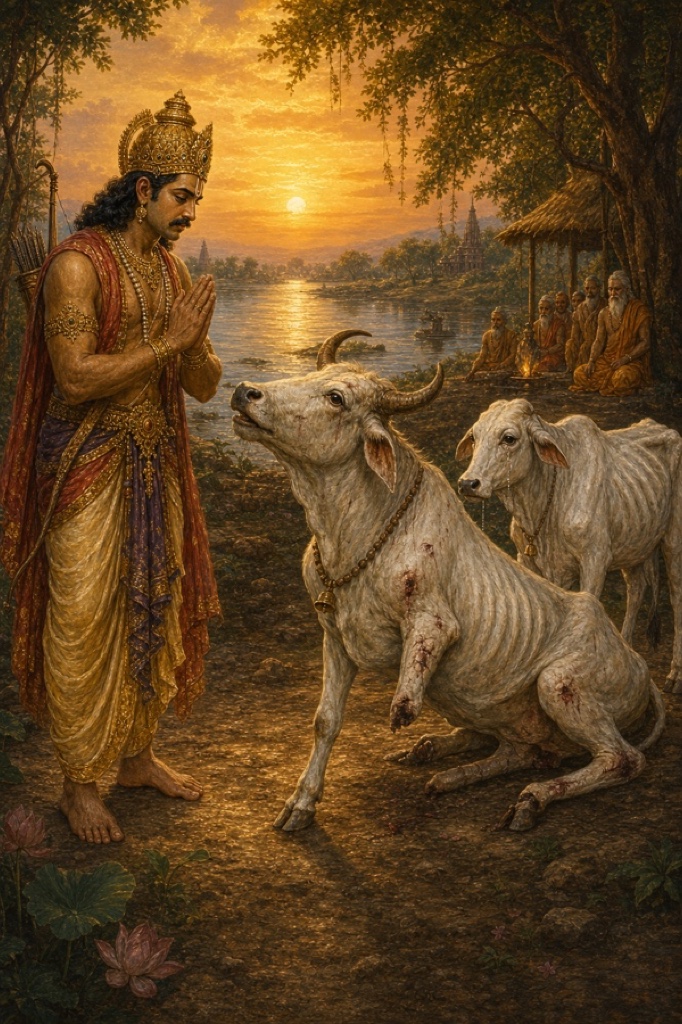
“Yes. I once had four legs, Rajan: tapas, purity, compassion, and truth. In the Satya Yuga, the first and brightest of the world’s ages, all four stood firm upon the earth. Then, age by age, the offspring of adharma broke them, one at a time. Pride broke one. Attachment broke one. Arrogance broke the third. Now only the leg of truth remains, and even that trembles like the old limb you see, for Kali, propped up by falsehood, means to take it too.”
Parikshit asked him who had done this, who had maimed him, and swore that whoever it was, though he were a god, would lose the arm that did it, armlet and all. The bull would not name a single hand. “Rajan, the learned themselves cannot agree on where suffering comes from. Some say a man’s own self brings it upon him, since nothing exists apart from the self. Some say destiny. Some say a man’s past deeds ripen into it, some say nature, some say God, and some hold that its cause lies past all speech and all thought. Weigh them yourself, royal sage, and judge which of them sees true.” Parikshit heard it and pressed no further. “You will keep your silence,” he said, “because you are Dharma himself, and you know that the lot of the wrongdoer falls equally on the one who denounces him. Or the truth is simpler still: the turnings of the Lord’s maya run beyond the mind and the tongue of every creature born.” Only Dharma could stand so broken and still refuse to name the hand that broke him.
“And this cow?”
“She is the Earth. There was a time when the Lord himself walked upon her, and his feet, marked with the lotus, the thunderbolt, the goad, and the flag, printed her body like an ornament, and she outshone the three worlds. Every virtue men climb toward, truth, purity, compassion, forbearance, generosity, contentment, and all the rest past counting, lived in him whole and never waned, and while he stood on her she wanted for nothing. He lifted from her back a burden no one else could lift, a hundred akshauhinis of troops, whole armies of kings who had been demons in their former birth. Now he has withdrawn from her, and she grieves like a woman left desolate, dreading the day base men in the robes of kings will sit upon her. She is my oldest friend. We are growing old together, and together we weep.”
Parikshit consoled Dharma and the Earth. Through his rule he restored austerity, purity, and compassion, and he cherished the Earth.
Parikshit rode on, content. He had protected Dharma, and for that very reason Kali could gain no hold in his kingdom. Yet he bore the beaten wretch no grudge, for he knew the one strange mercy written into the dark age’s law: in the age of Kali a good act bears fruit the moment the heart resolves on it, while a sin bears none until the hand commits it. Like the bee, which takes only nectar wherever it lands, the king had drawn honey even out of this.
Some time later Parikshit rode out to hunt. He chased the game deep into the forest until he was worn out, parched, and faint with hunger, and nowhere in all that wilderness could he find water. So he came to the hermitage of the sage Shamika. The old rishi sat without moving. He had drawn his senses in from the world the way a tortoise draws in its limbs; breath, mind, and intellect stood still in him, and he had passed beyond waking, dream, and dreamless sleep into the changeless state where a man is one with Brahman. His matted hair hung loose and a black deerskin lay across his body. Through a throat cracked with thirst, Parikshit asked him for a little water.
The sage did not stir. The silent hermitage withheld a grass mat, water, and every word of welcome. Hunger, thirst, and exhaustion clouded the king’s judgment, and he read the silence as contempt. Anger rose in him, directed toward a Brahmin for the first time in his life.
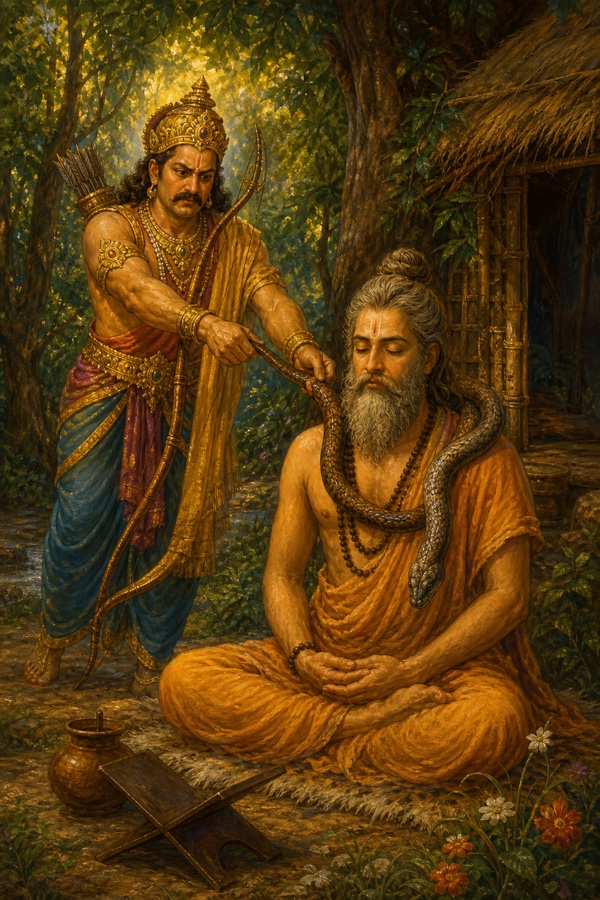
With the tip of his bow he lifted a dead snake lying nearby, laid it silently across the sage’s shoulder, and turned back for his capital.
Shamika had a young son, Shringi, a boy already carrying the banked heat of his line’s penance, at play that day with other Brahmin children. When word reached him that a king had draped a dead snake on his meditating father, the boy’s fury came out in a child’s scalding speech. So the ruling class had grown fat as crows at their masters’ gates. The Kshatriya was the watchdog set at the Brahmin’s door; since when did the dog walk into the house and eat from the master’s own pot? Krishna, who had kept such men within their bounds, was gone from the world, and so, he cried to his playmates, watch me correct them myself; see what power is. He scooped water from the Kausiki, his eyes went red, and he flung it down like a thunderbolt with a curse riding on it: “At my command, on the seventh day from now, Takshaka the serpent king will bite this stain on his own line who insulted my father.”
When Shamika opened his eyes at his son’s weeping and lifted the dead thing from his shoulder, he did not praise the boy. He grieved for him. Foolish child, he said, you have answered a trivial wrong with a terrible punishment, and the sin of it is great. A king carries the name of Vishnu upon the earth, and such a man is never weighed on the scale used for other men; it is his rod that lets the people live unafraid. The moment there is no ruler, thieves rise like a flood, the unguarded world tears itself apart like a flock of sheep with the shepherd gone, property and cattle and women are dragged away, and the guilt of all of it lands on heads like ours. And this king came to us famed as a guardian of righteousness, a devotee of the Lord, a royal sage of horse-sacrifices, worn out, starving, half dead with thirst; such a man did not deserve our curse. The sage prayed to the all-pervading Lord to forgive the wrong his unripe child had done to an innocent servant of His, for a man of God returns no blow for a blow even when he is struck, cheated, or scorned. But the curse could not be called back, and grieving for his son’s rashness, Shamika spared no thought for the insult of the snake.
By the time Parikshit understood what he had done, it was far too late. Yet he took the curse for a blessing, for it cut the last rope that held him to the world. He handed the throne to his son Janamejaya, gave up food and water, and came to sit on the bank of the Ganga, to meet death properly. There Shukadeva arrived, and for seven days the river of the Bhagavata flowed.
Textual note
This episode of Parikshit and Kali runs across the first Skandha of the Shrimad Bhagavata, Chapters 16 through 19. The Gita Press edition is explicit that Kali came disguised in the insignia of a king (1.16.4, 1.17.1), and that Parikshit rebuked him as an actor who had put on a king’s costume while behaving like the basest of men (1.17.5). Dharma stands as a four-legged bull and the Earth as a cow; in the Satya Yuga the bull kept all four feet, austerity, purity, compassion, and truth, until pride, attachment, and arrogance broke three away and left truth alone (1.17.24). The Earth’s grief is given at length in Chapter 16, where her whole body once wore the Lord’s footprints like an ornament and he had lifted from her a burden of a hundred akshauhinis of demon-born kings (1.16.33-34).
Kali is first given four dwellings, gambling, drink, the selling of women’s company, and slaughter, and on his plea a fifth, gold, where enmity takes root (1.17.38-39); the king then restores the bull’s three lost legs, penance, purity, and compassion (1.17.42). The text adds that Kali had set his foot on the earth the very moment Krishna left it (1.18.6), and that in this age a good resolve bears fruit at once while a sin ripens only when committed (1.18.7). The dead snake’s insult and Shringi’s curse follow in the eighteenth chapter, laying the ground for Parikshit’s seven-day river of katha, the frame of the entire text.
Exhaustion, thirst, and perceived insult pushed a righteous king into one rash act. He accepted the consequence without evasion and gave his remaining time to sacred hearing. The episode binds public duty to the private discipline of attention.